INDIAN CULTURE
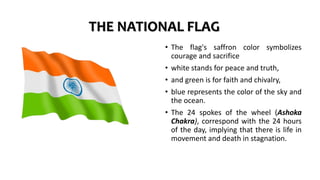
THE NATIONAL FLAG
• The flag's saffron color symbolizes
courage and sacrifice
• white stands for peace and truth,
• and green is for faith and chivalry,
• blue represents the color of the sky and
the ocean.
• The 24 spokes of the wheel (Ashoka
Chakra), correspond with the 24 hours
of the day, implying that there is life in
movement and death in stagnation.
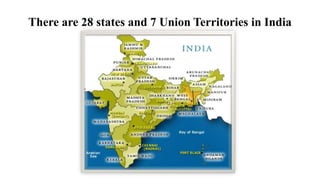
There are 28 states and 7 Union Territories in India
• Total population: 1.06 billion people
• 72% in Rural areas
• 41.6% of the total Indian population in India
are Below Poverty Line.
• 75% of the poor are in rural areas, most of
them are daily wagers, self-employed
householders , and landless labourers.
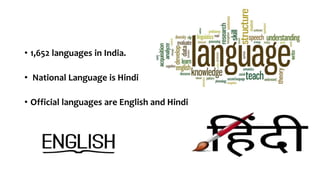
• 1,652 languages in India.
• National Language is Hindi
• Official languages are English and Hindi
• The culture of India is an amalgamation of sub
cultures spread all over the Indian sub-continent
• India’s culture is among the world's oldest.
• civilization in India began about 4,500 years ago.
• Today, India is a very diverse country, with more
than 1.2 billion people.
• Different regions have their own distinct cultures.
INDIAN CULTURE
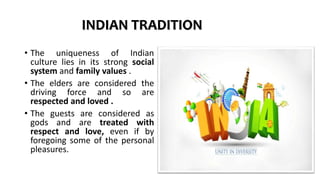
INDIAN TRADITION
• The uniqueness of Indian
culture lies in its strong social
system and family values .
• The elders are considered the
driving force and so are
respected and loved .
• The guests are considered as
gods and are treated with
respect and love, even if by
foregoing some of the personal
pleasures.
Name Protocol
• Younger never uses the proper name of their elders. (eg: Anna,
Akka etc.)
• Only people of the same age will address each other by first name.
• A wife never speaks the name of her husband .
• CAUTION WITH FOOTWEAR: It is very important to apologize
immediately if one touches someone with his or her shoe or sandal
FAMILY SYSTEMS IN INDIA
• Bondage of love and affection
is abundantly found in Indian
family system.
• Parents do not let their child to
live independent life until they
get a marriage match.
• Culture and tradition of India
does not support love-
marriages and the divorce
between a husband and a wife .
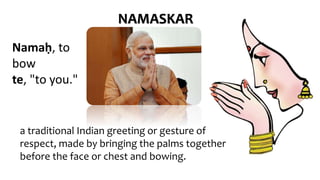
NAMASKAR
a traditional Indian greeting or gesture of
respect, made by bringing the palms together
before the face or chest and bowing.
Namaḥ, to
bow
te, "to you."
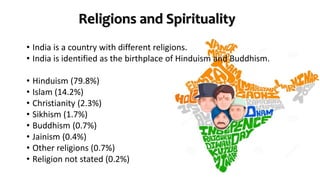
Religions and Spirituality
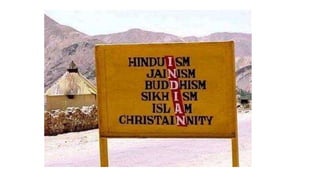
• India is a country with different religions.
• India is identified as the birthplace of Hinduism and Buddhism.
• Hinduism (79.8%)
• Islam (14.2%)
• Christianity (2.3%)
• Sikhism (1.7%)
• Buddhism (0.7%)
• Jainism (0.4%)
• Other religions (0.7%)
• Religion not stated (0.2%)
DINING ETIQUETTE
• Indian cuisine relishes in its flavors
and spices.
• Much Indian food is eaten with the
fingers.
• The guest of honor is served first,
followed by the men, and the
children are served last.
DINING ETIQUETTE
• Women typically serve the men and
eat later.
• You may be asked to wash your
hands before and after sitting down
to a meal.
• Always use your right hand to eat,
whether you are using utensils or
your fingers.
FESTIVALS IN INDIA
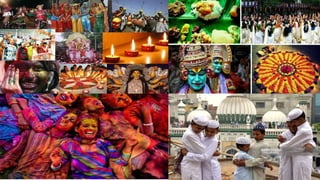
• India is a land of festivals, where people from different religions
coexist harmoniously.
• The wide variety of festivals celebrated in India is a true
manifestation of its rich culture and traditions.
• While the celebrations happen all over the year, October till
January is the time when the country can be seen at its vibrant
best.
• Diwali ,Ganesh Chaturthi, Holi. Navaratri, Dussehra, Durga Puja and
Onam are some of the famous festivals of India.
MARRIAGE
• The average age of marriage for women in India has increased to
21 years, according to 2011 Census of India.
• Arranged marriages have long been the norm in Indian society.
• Even today, the majority of Indians have their marriages planned
by their parents and other respected family-members.
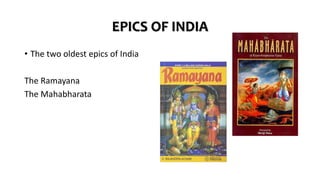
EPICS OF INDIA
• The two oldest epics of India
The Ramayana
The Mahabharata
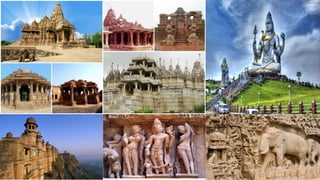
SCULPTURE AND ARCHITECTURE
• The architecture of India is rooted in its history, culture and
religion.
• Indian architecture progressed with time and assimilated the many
influences that came as a result of India's global discourse with
other regions of the world throughout its millennia-old past.
• The architectural methods practiced in India are a result of
examination and implementation of its established building
traditions and outside cultural interactions
AGRICULTURE
• The history of Agriculture in India dates back to Indus Valle
Civilization Era and even before that in some parts of Southern
India.
• Today, India ranks second worldwide in farm output. Agriculture
and allied sectors like forestry and fisheries accounted for 13.7% of
the GDP (gross domestic product) in 2013, about 50% of the
workforce.
• Agriculture is demographically the broadest economic sector and
plays a significant role in the overall socio-economic fabric of India.
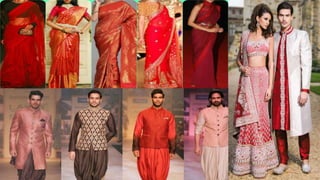
CLOTHING
• Traditional Indian clothing for women in the north and east are saris
worn with choli tops; a long skirt called a lehenga or pavada worn
with choli and a dupatta scarf to create an ensemble called a gagra
choli; or salwar kameez suits, while many south Indian women
traditionally wear sari and children wear pattu langa.
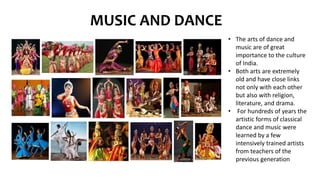
MUSIC AND DANCE
• The arts of dance and
music are of great
importance to the culture
of India.
• Both arts are extremely
old and have close links
not only with each other
but also with religion,
literature, and drama.
• For hundreds of years the
artistic forms of classical
dance and music were
learned by a few
intensively trained artists
from teachers of the
previous generation
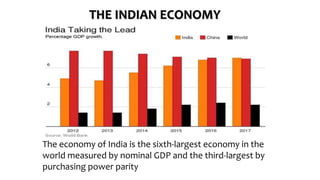
THE INDIAN ECONOMY
The economy of India is the sixth-largest economy in the
world measured by nominal GDP and the third-largest by
purchasing power parity
• INDIA as a developing economy
• India has shown remarkable improvements in many
areas over the decades and now on the road to
development.
Understanding India's culture is key for
business
Not fluent in Hindi? Don't worry.
Business in India is conducted mainly in English,
but a nod to cultural etiquette is vital for
building strong relationships
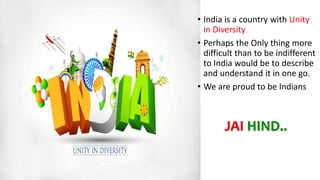
• India is a country with Unity
in Diversity
• Perhaps the Only thing more
difficult than to be indifferent
to India would be to describe
and understand it in one go.
• We are proud to be Indians
JAI HIND..
Indian culture

Indian culture

  • 1.
  • 3.
    THE NATIONAL FLAG •The flag's saffron color symbolizes courage and sacrifice • white stands for peace and truth, • and green is for faith and chivalry, • blue represents the color of the sky and the ocean. • The 24 spokes of the wheel (Ashoka Chakra), correspond with the 24 hours of the day, implying that there is life in movement and death in stagnation.
  • 4.
    There are 28states and 7 Union Territories in India
  • 5.
    • Total population:1.06 billion people • 72% in Rural areas • 41.6% of the total Indian population in India are Below Poverty Line. • 75% of the poor are in rural areas, most of them are daily wagers, self-employed householders , and landless labourers.
  • 6.
    • 1,652 languagesin India. • National Language is Hindi • Official languages are English and Hindi
  • 7.
    • The cultureof India is an amalgamation of sub cultures spread all over the Indian sub-continent • India’s culture is among the world's oldest. • civilization in India began about 4,500 years ago. • Today, India is a very diverse country, with more than 1.2 billion people. • Different regions have their own distinct cultures. INDIAN CULTURE
  • 8.
    INDIAN TRADITION • Theuniqueness of Indian culture lies in its strong social system and family values . • The elders are considered the driving force and so are respected and loved . • The guests are considered as gods and are treated with respect and love, even if by foregoing some of the personal pleasures.
  • 9.
    Name Protocol • Youngernever uses the proper name of their elders. (eg: Anna, Akka etc.) • Only people of the same age will address each other by first name. • A wife never speaks the name of her husband . • CAUTION WITH FOOTWEAR: It is very important to apologize immediately if one touches someone with his or her shoe or sandal
  • 10.
    FAMILY SYSTEMS ININDIA • Bondage of love and affection is abundantly found in Indian family system. • Parents do not let their child to live independent life until they get a marriage match. • Culture and tradition of India does not support love- marriages and the divorce between a husband and a wife .
  • 11.
    NAMASKAR a traditional Indiangreeting or gesture of respect, made by bringing the palms together before the face or chest and bowing. Namaḥ, to bow te, "to you."
  • 12.
    Religions and Spirituality •India is a country with different religions. • India is identified as the birthplace of Hinduism and Buddhism. • Hinduism (79.8%) • Islam (14.2%) • Christianity (2.3%) • Sikhism (1.7%) • Buddhism (0.7%) • Jainism (0.4%) • Other religions (0.7%) • Religion not stated (0.2%)
  • 14.
    DINING ETIQUETTE • Indiancuisine relishes in its flavors and spices. • Much Indian food is eaten with the fingers. • The guest of honor is served first, followed by the men, and the children are served last.
  • 15.
    DINING ETIQUETTE • Womentypically serve the men and eat later. • You may be asked to wash your hands before and after sitting down to a meal. • Always use your right hand to eat, whether you are using utensils or your fingers.
  • 16.
  • 18.
    • India isa land of festivals, where people from different religions coexist harmoniously. • The wide variety of festivals celebrated in India is a true manifestation of its rich culture and traditions. • While the celebrations happen all over the year, October till January is the time when the country can be seen at its vibrant best. • Diwali ,Ganesh Chaturthi, Holi. Navaratri, Dussehra, Durga Puja and Onam are some of the famous festivals of India.
  • 19.
    MARRIAGE • The averageage of marriage for women in India has increased to 21 years, according to 2011 Census of India. • Arranged marriages have long been the norm in Indian society. • Even today, the majority of Indians have their marriages planned by their parents and other respected family-members.
  • 20.
    EPICS OF INDIA •The two oldest epics of India The Ramayana The Mahabharata
  • 21.
    SCULPTURE AND ARCHITECTURE •The architecture of India is rooted in its history, culture and religion. • Indian architecture progressed with time and assimilated the many influences that came as a result of India's global discourse with other regions of the world throughout its millennia-old past. • The architectural methods practiced in India are a result of examination and implementation of its established building traditions and outside cultural interactions
  • 23.
    AGRICULTURE • The historyof Agriculture in India dates back to Indus Valle Civilization Era and even before that in some parts of Southern India. • Today, India ranks second worldwide in farm output. Agriculture and allied sectors like forestry and fisheries accounted for 13.7% of the GDP (gross domestic product) in 2013, about 50% of the workforce. • Agriculture is demographically the broadest economic sector and plays a significant role in the overall socio-economic fabric of India.
  • 25.
    CLOTHING • Traditional Indianclothing for women in the north and east are saris worn with choli tops; a long skirt called a lehenga or pavada worn with choli and a dupatta scarf to create an ensemble called a gagra choli; or salwar kameez suits, while many south Indian women traditionally wear sari and children wear pattu langa.
  • 27.
    MUSIC AND DANCE •The arts of dance and music are of great importance to the culture of India. • Both arts are extremely old and have close links not only with each other but also with religion, literature, and drama. • For hundreds of years the artistic forms of classical dance and music were learned by a few intensively trained artists from teachers of the previous generation
  • 28.
    THE INDIAN ECONOMY Theeconomy of India is the sixth-largest economy in the world measured by nominal GDP and the third-largest by purchasing power parity
  • 29.
    • INDIA asa developing economy • India has shown remarkable improvements in many areas over the decades and now on the road to development.
  • 30.
    Understanding India's cultureis key for business Not fluent in Hindi? Don't worry. Business in India is conducted mainly in English, but a nod to cultural etiquette is vital for building strong relationships
  • 31.
    • India isa country with Unity in Diversity • Perhaps the Only thing more difficult than to be indifferent to India would be to describe and understand it in one go. • We are proud to be Indians JAI HIND..