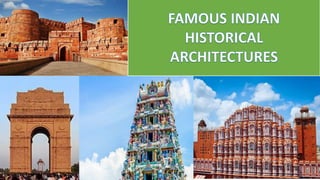
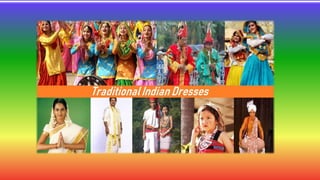
I N D I A
INDIAN
CULTURAL
HERITAGE
PROJECT
NAME:RESHU KUMARI
ROLL NO.: 1913413
ID NO. : BTBTC19205
BRANCH: BTECH CS
SEC : ‘G’
NAME:RATNAPRIYA PATHAK
ROLL NO : 1913412
ID NO. : BTBTC19250
BRANCH:BTECH CS
SEC: ‘G’
NAME: RISHITA SHANKAR
ROLL NO. :1913423
ID NO. :BTBTE19138
BRANCH : BTECH EC
SEC: ‘G’
NAME: RISHITA SHARMA
ROLL NO. : 1913424
ID NO.:BTBTL19044
BRANCH: BTECH EE
SEC :’G’
NAME:RAKHI CHAUDHARY
ROLL NO. : 1913404
ID NO .:BTBTC19026
BRANCH: BTECH CS
SEC: ‘G’
NAME :RITIKA SINGH
ROLL NO. 1913429
ID NO.: BTBTH19038
BRANCH:BTECH CE
SEC : ‘G’
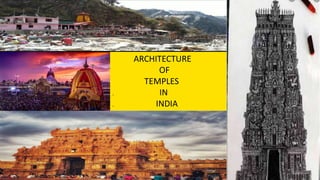
ARCHITECTURE
OF
TEMPLES
. IN
. INDIA
TEMPLES
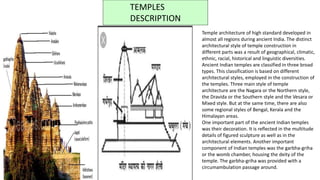
DESCRIPTION
Temple architecture of high standard developed in
almost all regions during ancient India. The distinct
architectural style of temple construction in
different parts was a result of geographical, climatic,
ethnic, racial, historical and linguistic diversities.
Ancient Indian temples are classified in three broad
types. This classification is based on different
architectural styles, employed in the construction of
the temples. Three main style of temple
architecture are the Nagara or the Northern style,
the Dravida or the Southern style and the Vesara or
Mixed style. But at the same time, there are also
some regional styles of Bengal, Kerala and the
Himalayan areas.
One important part of the ancient Indian temples
was their decoration. It is reflected in the multitude
details of figured sculpture as well as in the
architectural elements. Another important
component of Indian temples was the garbha-griha
or the womb chamber, housing the deity of the
temple. The garbha-griha was provided with a
circumambulation passage around.
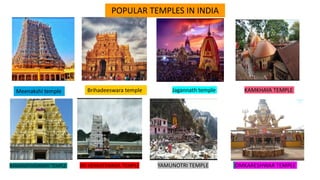
POPULAR TEMPLES IN INDIA
Meenakshi temple Brihadeeswara temple Jagannath temple KAMKHAYA TEMPLE
RAMANATHASWAMY TEMPLE SRI VENKATSWARA TEMPLE YAMUNOTRI TEMPLE OMKARESHWAR TEMPLE
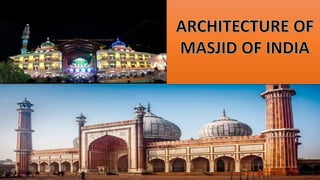
ARCHITECTURE OF MASJID IN INDIA
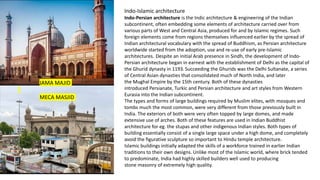
JAMA MAJID
MECA MASJID
Indo-Islamic architecture
Indo-Persian architecture is the Indic architecture & engineering of the Indian
subcontinent, often embedding some elements of architecture carried over from
various parts of West and Central Asia, produced for and by Islamic regimes. Such
foreign elements come from regions themselves influenced earlier by the spread of
Indian architectural vocabulary with the spread of Buddhism, as Persian architecture
worldwide started from the adoption, use and re-use of early pre-Islamic
architectures. Despite an initial Arab presence in Sindh, the development of Indo-
Persian architecture began in earnest with the establishment of Delhi as the capital of
the Ghurid dynasty in 1193. Succeeding the Ghurids was the Delhi Sultanate, a series
of Central Asian dynasties that consolidated much of North India, and later
the Mughal Empire by the 15th century. Both of these dynasties
introduced Persianate, Turkic and Persian architecture and art styles from Western
Eurasia into the Indian subcontinent.
The types and forms of large buildings required by Muslim elites, with mosques and
tombs much the most common, were very different from those previously built in
India. The exteriors of both were very often topped by large domes, and made
extensive use of arches. Both of these features are used in Indian Buddhist
architecture for eg. the stupas and other indigenous Indian styles. Both types of
building essentially consist of a single large space under a high dome, and completely
avoid the figurative sculpture so important to Hindu temple architecture.
Islamic buildings initially adapted the skills of a workforce trained in earlier Indian
traditions to their own designs. Unlike most of the Islamic world, where brick tended
to predominate, India had highly skilled builders well used to producing
stone masonry of extremely high quality.
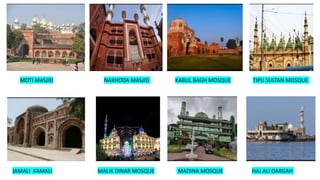
MOTI MASJID NAKHODA MASJID KABUL BAGH MOSQUE TIPU SULTAN MOSQUE
JAMALI KAMALI MALIK DINAR MOSQUE MADINA MOSQUE HAJ ALI DARGAH
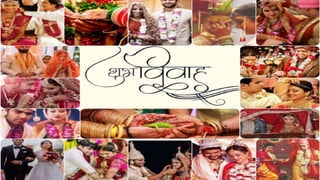
Marriage ,also called matrimony or wedlock, is considered a cultural universal. The definition of marriage varies around
the world , not only between cultures and between religions ,but also through out the history of any given culture and
religion.
Marriages in India are between two families, rather two individuals. Has always existed in one for more another in every
culture , ensuring social sanction to a physical union between man and woman and laying the foundation for building up
of the family–the basic unit of society.
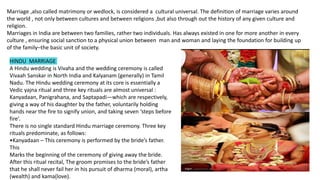
HINDU MARRIAGE
A Hindu wedding is Vivaha and the wedding ceremony is called
Vivaah Sanskar in North India and Kalyanam (generally) in Tamil
Nadu. The Hindu wedding ceremony at its core is essentially a
Vedic yajna ritual and three key rituals are almost universal :
Kanyadaan, Panigrahana, and Saptapadi—which are respectively,
giving a way of his daughter by the father, voluntarily holding
hands near the fire to signify union, and taking seven ‘steps before
fire’.
There is no single standard Hindu marriage ceremony. Three key
rituals predominate, as follows:
•Kanyadaan – This ceremony is performed by the bride’s father.
This
Marks the beginning of the ceremony of giving away the bride.
After this ritual recital, The groom promises to the bride’s father
that he shall never fail her in his pursuit of dharma (moral), artha
(wealth) and kama(love).
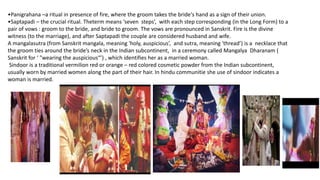
•Panigrahana –a ritual in presence of fire, where the groom takes the bride's hand as a sign of their union.
•Saptapadi – the crucial ritual. Theterm means ‘seven steps’, with each step corresponding (in the Long Form) to a
pair of vows : groom to the bride, and bride to groom. The vows are pronounced in Sanskrit. Fire is the divine
witness (to the marriage), and after Saptapadi the couple are considered husband and wife.
A mangalasutra (from Sanskrit mangala, meaning 'holy, auspicious’, and sutra, meaning 'thread’) is a necklace that
the groom ties around the bride’s neck in the Indian subcontinent, in a ceremony called Mangalya Dharanam (
Sanskrit for ‘ "wearing the auspicious“’) , which identifies her as a married woman.
Sindoor is a traditional vermilion red or orange – red colored cosmetic powder from the Indian subcontinent,
usually worn by married women along the part of their hair. In hindu communitie she use of sindoor indicates a
woman is married.
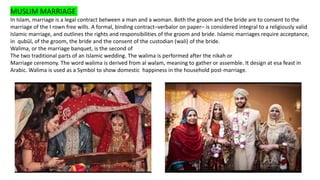
MUSLIM MARRIAGE
In Islam, marriage is a legal contract between a man and a woman. Both the groom and the bride are to consent to the
marriage of the I rown free wills. A formal, binding contract–verbalor on paper– is considered integral to a religiously valid
Islamic marriage, and outlines the rights and responsibilities of the groom and bride. Islamic marriages require acceptance,
in qubūl, of the groom, the bride and the consent of the custodian (wali) of the bride.
Walima, or the marriage banquet, is the second of
The two traditional parts of an Islamic wedding. The walima is performed after the nikah or
Marriage ceremony. The word walima is derived from al walam, meaning to gather or assemble. It design at esa feast in
Arabic. Walima is used as a Symbol to show domestic happiness in the household post-marriage.
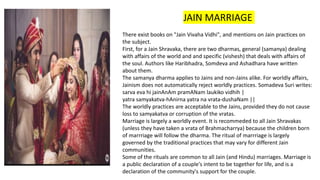
JAIN MARRIAGE
There exist books on "Jain Vivaha Vidhi", and mentions on Jain practices on
the subject.
First, for a Jain Shravaka, there are two dharmas, general (samanya) dealing
with affairs of the world and and specific (vishesh) that deals with affairs of
the soul. Authors like Haribhadra, Somdeva and Ashadhara have written
about them.
The samanya dharma applies to Jains and non-Jains alike. For worldly affairs,
Jainism does not automatically reject worldly practices. Somadeva Suri writes:
sarva eva hi jainAnAm pramANam laukiko vidhih |
yatra samyakatva-hAnirna yatra na vrata-dushaNam ||
The worldly practices are acceptable to the Jains, provided they do not cause
loss to samyakatva or corruption of the vratas.
Marriage is largely a worldly event. It is recommeded to all Jain Shravakas
(unless they have taken a vrata of Brahmacharrya) because the children born
of marrriage will follow the dharma. The ritual of marrriage is largely
governed by the traditional practices that may vary for different Jain
communities.
Some of the rituals are common to all Jain (and Hindu) marriages. Marriage is
a public declaration of a couple's intent to be together for life, and is a
declaration of the community's support for the couple.
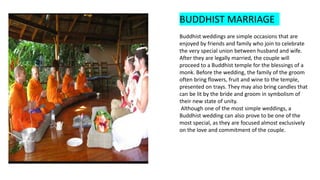
BUDDHIST MARRIAGE
Buddhist weddings are simple occasions that are
enjoyed by friends and family who join to celebrate
the very special union between husband and wife.
After they are legally married, the couple will
proceed to a Buddhist temple for the blessings of a
monk. Before the wedding, the family of the groom
often bring flowers, fruit and wine to the temple,
presented on trays. They may also bring candles that
can be lit by the bride and groom in symbolism of
their new state of unity.
Although one of the most simple weddings, a
Buddhist wedding can also prove to be one of the
most special, as they are focused almost exclusively
on the love and commitment of the couple.
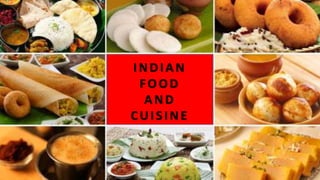
INDIAN
FOOD
AND
CUISINE
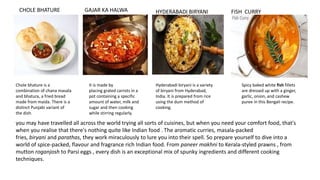
CHOLE BHATURE
Chole bhature is a
combination of chana masala
and bhatura, a fried bread
made from maida. There is a
distinct Punjabi variant of
the dish.
GAJAR KA HALWA
It is made by
placing grated carrots in a
pot containing a specific
amount of water, milk and
sugar and then cooking
while stirring regularly.
HYDERABADI BIRYANI
Hyderabadi biryani is a variety
of biryani from Hyderabad,
India. It is prepared from rice
using the dum method of
cooking.
FISH CURRY
Spicy baked white fish fillets
are dressed up with a ginger,
garlic, onion, and cashew
puree in this Bengali recipe.
you may have travelled all across the world trying all sorts of cuisines, but when you need your comfort food, that's
when you realise that there's nothing quite like Indian food . The aromatic curries, masala-packed
fries, biryani and parathas, they work miraculously to lure you into their spell. So prepare yourself to dive into a
world of spice-packed, flavour and fragrance rich Indian food. From paneer makhni to Kerala-styled prawns , from
mutton roganjosh to Parsi eggs , every dish is an exceptional mix of spunky ingredients and different cooking
techniques.
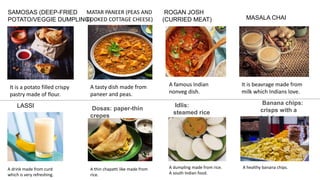
SAMOSAS (DEEP-FRIED
POTATO/VEGGIE DUMPLING)
MATAR PANEER (PEAS AND
COOKED COTTAGE CHEESE)
ROGAN JOSH
(CURRIED MEAT) MASALA CHAI
LASSI Dosas: paper-thin
crepes
Idlis:
steamed rice
cakes
Banana chips:
crisps with a
twist
It is beavrage made from
milk which Indians love.
It is a potato filled crispy
pastry made of flour.
A tasty dish made from
paneer and peas.
A famous Indian
nonveg dish.
A drink made from curd
which is very refreshing.
A thin chapatti like made from
rice.
A dumpling made from rice.
A south Indian food.
A healthy banana chips.
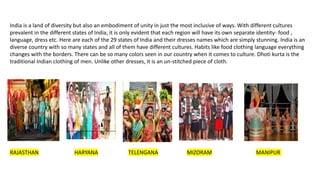
India is a land of diversity but also an embodiment of unity in just the most inclusive of ways. With different cultures
prevalent in the different states of India, it is only evident that each region will have its own separate identity- food ,
language, dress etc. Here are each of the 29 states of India and their dresses names which are simply stunning. India is an
diverse country with so many states and all of them have different cultures. Habits like food clothing language everything
changes with the borders. There can be so many colors seen in our country when it comes to culture. Dhoti kurta is the
traditional Indian clothing of men. Unlike other dresses, it is an un-stitched piece of cloth.
RAJASTHAN HARYANA TELENGANA MIZORAM MANIPUR
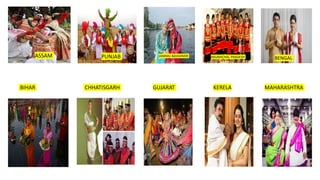
ASSAM PUNJAB JAMMU &KASHMIR ARUNACHAL PRADESH BENGAL
BIHAR CHHATISGARH GUJARAT KERELA MAHARASHTRA
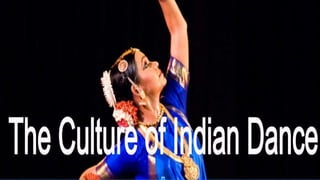
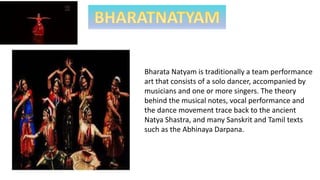
Bharata Natyam is traditionally a team performance
art that consists of a solo dancer, accompanied by
musicians and one or more singers. The theory
behind the musical notes, vocal performance and
the dance movement trace back to the ancient
Natya Shastra, and many Sanskrit and Tamil texts
such as the Abhinaya Darpana.
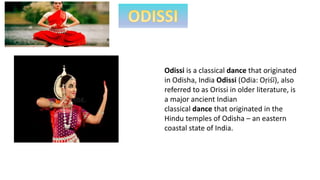
Odissi is a classical dance that originated
in Odisha, India Odissi (Odia: Oṛiśī), also
referred to as Orissi in older literature, is
a major ancient Indian
classical dance that originated in the
Hindu temples of Odisha – an eastern
coastal state of India.
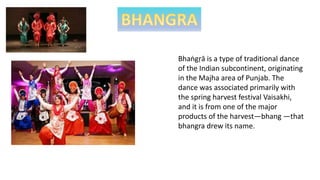
Bhaṅgṛā is a type of traditional dance
of the Indian subcontinent, originating
in the Majha area of Punjab. The
dance was associated primarily with
the spring harvest festival Vaisakhi,
and it is from one of the major
products of the harvest—bhang —that
bhangra drew its name.
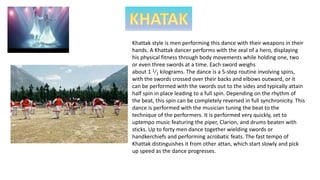
Khattak style is men performing this dance with their weapons in their
hands. A Khattak dancer performs with the zeal of a hero, displaying
his physical fitness through body movements while holding one, two
or even three swords at a time. Each sword weighs
about ​1 1⁄2 kilograms. The dance is a 5-step routine involving spins,
with the swords crossed over their backs and elbows outward, or it
can be performed with the swords out to the sides and typically attain
half spin in place leading to a full spin. Depending on the rhythm of
the beat, this spin can be completely reversed in full synchronicity. This
dance is performed with the musician tuning the beat to the
technique of the performers. It is performed very quickly, set to
uptempo music featuring the piper, Clarion, and drums beaten with
sticks. Up to forty men dance together wielding swords or
handkerchiefs and performing acrobatic feats. The fast tempo of
Khattak distinguishes it from other attan, which start slowly and pick
up speed as the dance progresses.
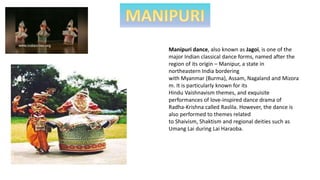
Manipuri dance, also known as Jagoi, is one of the
major Indian classical dance forms, named after the
region of its origin – Manipur, a state in
northeastern India bordering
with Myanmar (Burma), Assam, Nagaland and Mizora
m. It is particularly known for its
Hindu Vaishnavism themes, and exquisite
performances of love-inspired dance drama of
Radha-Krishna called Raslila. However, the dance is
also performed to themes related
to Shaivism, Shaktism and regional deities such as
Umang Lai during Lai Haraoba.
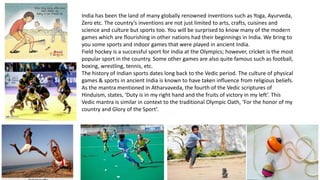
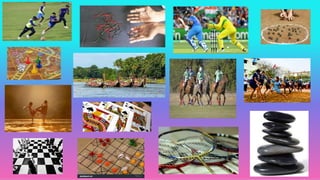
India has been the land of many globally renowned inventions such as Yoga, Ayurveda,
Zero etc. The country’s inventions are not just limited to arts, crafts, cuisines and
science and culture but sports too. You will be surprised to know many of the modern
games which are flourishing in other nations had their beginnings in India. We bring to
you some sports and indoor games that were played in ancient India.
Field hockey is a successful sport for India at the Olympics; however, cricket is the most
popular sport in the country. Some other games are also quite famous such as football,
boxing, wrestling, tennis, etc.
The history of Indian sports dates long back to the Vedic period. The culture of physical
games & sports in ancient India is known to have taken influence from religious beliefs.
As the mantra mentioned in Atharvaveda, the fourth of the Vedic scriptures of
Hinduism, states, ‘Duty is in my right hand and the fruits of victory in my left’. This
Vedic mantra is similar in context to the traditional Olympic Oath, ‘For the honor of my
country and Glory of the Sport’.
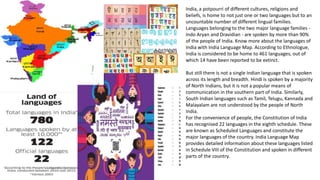
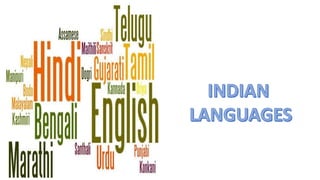
India, a potpourri of different cultures, religions and
beliefs, is home to not just one or two languages but to an
uncountable number of different lingual families.
Languages belonging to the two major language families -
Indo Aryan and Dravidian - are spoken by more than 90%
of the people of India. Know more about the languages of
India with India Language Map. According to Ethnologue,
India is considered to be home to 461 languages, out of
which 14 have been reported to be extinct.
But still there is not a single Indian language that is spoken
across its length and breadth. Hindi is spoken by a majority
of North Indians, but it is not a popular means of
communication in the southern part of India. Similarly,
South Indian languages such as Tamil, Telugu, Kannada and
Malayalam are not understood by the people of North
India.
For the convenience of people, the Constitution of India
has recognised 22 languages in the eighth schedule. These
are known as Scheduled Languages and constitute the
major languages of the country. India Language Map
provides detailed information about these languages listed
in Schedule VIII of the Constitution and spoken in different
parts of the country.
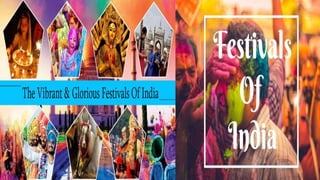
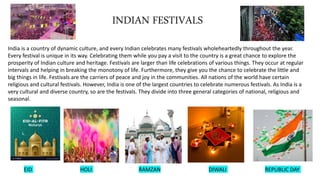
INDIAN FESTIVALS
India is a country of dynamic culture, and every Indian celebrates many festivals wholeheartedly throughout the year.
Every festival is unique in its way. Celebrating them while you pay a visit to the country is a great chance to explore the
prosperity of Indian culture and heritage. Festivals are larger than life celebrations of various things. They occur at regular
intervals and helping in breaking the monotony of life. Furthermore, they give you the chance to celebrate the little and
big things in life. Festivals are the carriers of peace and joy in the communities. All nations of the world have certain
religious and cultural festivals. However, India is one of the largest countries to celebrate numerous festivals. As India is a
very cultural and diverse country, so are the festivals. They divide into three general categories of national, religious and
seasonal.
EID HOLI RAMZAN DIWALI REPUBLIC DAY
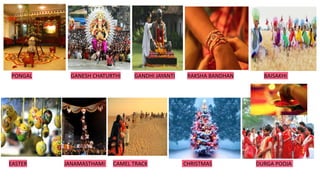
PONGAL GANESH CHATURTHI GANDHI JAYANTI RAKSHA BANDHAN BAISAKHI
EASTER JANAMASTHAMI CAMEL TRACK CHRISTMAS DURGA POOJA
Indian_cultural_heritage

Indian_cultural_heritage

  • 1.
    I N DI A
  • 2.
  • 3.
    NAME:RESHU KUMARI ROLL NO.:1913413 ID NO. : BTBTC19205 BRANCH: BTECH CS SEC : ‘G’ NAME:RATNAPRIYA PATHAK ROLL NO : 1913412 ID NO. : BTBTC19250 BRANCH:BTECH CS SEC: ‘G’ NAME: RISHITA SHANKAR ROLL NO. :1913423 ID NO. :BTBTE19138 BRANCH : BTECH EC SEC: ‘G’ NAME: RISHITA SHARMA ROLL NO. : 1913424 ID NO.:BTBTL19044 BRANCH: BTECH EE SEC :’G’ NAME:RAKHI CHAUDHARY ROLL NO. : 1913404 ID NO .:BTBTC19026 BRANCH: BTECH CS SEC: ‘G’ NAME :RITIKA SINGH ROLL NO. 1913429 ID NO.: BTBTH19038 BRANCH:BTECH CE SEC : ‘G’
  • 4.
  • 5.
    TEMPLES DESCRIPTION Temple architecture ofhigh standard developed in almost all regions during ancient India. The distinct architectural style of temple construction in different parts was a result of geographical, climatic, ethnic, racial, historical and linguistic diversities. Ancient Indian temples are classified in three broad types. This classification is based on different architectural styles, employed in the construction of the temples. Three main style of temple architecture are the Nagara or the Northern style, the Dravida or the Southern style and the Vesara or Mixed style. But at the same time, there are also some regional styles of Bengal, Kerala and the Himalayan areas. One important part of the ancient Indian temples was their decoration. It is reflected in the multitude details of figured sculpture as well as in the architectural elements. Another important component of Indian temples was the garbha-griha or the womb chamber, housing the deity of the temple. The garbha-griha was provided with a circumambulation passage around.
  • 6.
    POPULAR TEMPLES ININDIA Meenakshi temple Brihadeeswara temple Jagannath temple KAMKHAYA TEMPLE RAMANATHASWAMY TEMPLE SRI VENKATSWARA TEMPLE YAMUNOTRI TEMPLE OMKARESHWAR TEMPLE
  • 7.
  • 8.
    JAMA MAJID MECA MASJID Indo-Islamicarchitecture Indo-Persian architecture is the Indic architecture & engineering of the Indian subcontinent, often embedding some elements of architecture carried over from various parts of West and Central Asia, produced for and by Islamic regimes. Such foreign elements come from regions themselves influenced earlier by the spread of Indian architectural vocabulary with the spread of Buddhism, as Persian architecture worldwide started from the adoption, use and re-use of early pre-Islamic architectures. Despite an initial Arab presence in Sindh, the development of Indo- Persian architecture began in earnest with the establishment of Delhi as the capital of the Ghurid dynasty in 1193. Succeeding the Ghurids was the Delhi Sultanate, a series of Central Asian dynasties that consolidated much of North India, and later the Mughal Empire by the 15th century. Both of these dynasties introduced Persianate, Turkic and Persian architecture and art styles from Western Eurasia into the Indian subcontinent. The types and forms of large buildings required by Muslim elites, with mosques and tombs much the most common, were very different from those previously built in India. The exteriors of both were very often topped by large domes, and made extensive use of arches. Both of these features are used in Indian Buddhist architecture for eg. the stupas and other indigenous Indian styles. Both types of building essentially consist of a single large space under a high dome, and completely avoid the figurative sculpture so important to Hindu temple architecture. Islamic buildings initially adapted the skills of a workforce trained in earlier Indian traditions to their own designs. Unlike most of the Islamic world, where brick tended to predominate, India had highly skilled builders well used to producing stone masonry of extremely high quality.
  • 9.
    MOTI MASJID NAKHODAMASJID KABUL BAGH MOSQUE TIPU SULTAN MOSQUE JAMALI KAMALI MALIK DINAR MOSQUE MADINA MOSQUE HAJ ALI DARGAH
  • 13.
    Marriage ,also calledmatrimony or wedlock, is considered a cultural universal. The definition of marriage varies around the world , not only between cultures and between religions ,but also through out the history of any given culture and religion. Marriages in India are between two families, rather two individuals. Has always existed in one for more another in every culture , ensuring social sanction to a physical union between man and woman and laying the foundation for building up of the family–the basic unit of society. HINDU MARRIAGE A Hindu wedding is Vivaha and the wedding ceremony is called Vivaah Sanskar in North India and Kalyanam (generally) in Tamil Nadu. The Hindu wedding ceremony at its core is essentially a Vedic yajna ritual and three key rituals are almost universal : Kanyadaan, Panigrahana, and Saptapadi—which are respectively, giving a way of his daughter by the father, voluntarily holding hands near the fire to signify union, and taking seven ‘steps before fire’. There is no single standard Hindu marriage ceremony. Three key rituals predominate, as follows: •Kanyadaan – This ceremony is performed by the bride’s father. This Marks the beginning of the ceremony of giving away the bride. After this ritual recital, The groom promises to the bride’s father that he shall never fail her in his pursuit of dharma (moral), artha (wealth) and kama(love).
  • 14.
    •Panigrahana –a ritualin presence of fire, where the groom takes the bride's hand as a sign of their union. •Saptapadi – the crucial ritual. Theterm means ‘seven steps’, with each step corresponding (in the Long Form) to a pair of vows : groom to the bride, and bride to groom. The vows are pronounced in Sanskrit. Fire is the divine witness (to the marriage), and after Saptapadi the couple are considered husband and wife. A mangalasutra (from Sanskrit mangala, meaning 'holy, auspicious’, and sutra, meaning 'thread’) is a necklace that the groom ties around the bride’s neck in the Indian subcontinent, in a ceremony called Mangalya Dharanam ( Sanskrit for ‘ "wearing the auspicious“’) , which identifies her as a married woman. Sindoor is a traditional vermilion red or orange – red colored cosmetic powder from the Indian subcontinent, usually worn by married women along the part of their hair. In hindu communitie she use of sindoor indicates a woman is married.
  • 15.
    MUSLIM MARRIAGE In Islam,marriage is a legal contract between a man and a woman. Both the groom and the bride are to consent to the marriage of the I rown free wills. A formal, binding contract–verbalor on paper– is considered integral to a religiously valid Islamic marriage, and outlines the rights and responsibilities of the groom and bride. Islamic marriages require acceptance, in qubūl, of the groom, the bride and the consent of the custodian (wali) of the bride. Walima, or the marriage banquet, is the second of The two traditional parts of an Islamic wedding. The walima is performed after the nikah or Marriage ceremony. The word walima is derived from al walam, meaning to gather or assemble. It design at esa feast in Arabic. Walima is used as a Symbol to show domestic happiness in the household post-marriage.
  • 16.
    JAIN MARRIAGE There existbooks on "Jain Vivaha Vidhi", and mentions on Jain practices on the subject. First, for a Jain Shravaka, there are two dharmas, general (samanya) dealing with affairs of the world and and specific (vishesh) that deals with affairs of the soul. Authors like Haribhadra, Somdeva and Ashadhara have written about them. The samanya dharma applies to Jains and non-Jains alike. For worldly affairs, Jainism does not automatically reject worldly practices. Somadeva Suri writes: sarva eva hi jainAnAm pramANam laukiko vidhih | yatra samyakatva-hAnirna yatra na vrata-dushaNam || The worldly practices are acceptable to the Jains, provided they do not cause loss to samyakatva or corruption of the vratas. Marriage is largely a worldly event. It is recommeded to all Jain Shravakas (unless they have taken a vrata of Brahmacharrya) because the children born of marrriage will follow the dharma. The ritual of marrriage is largely governed by the traditional practices that may vary for different Jain communities. Some of the rituals are common to all Jain (and Hindu) marriages. Marriage is a public declaration of a couple's intent to be together for life, and is a declaration of the community's support for the couple.
  • 17.
    BUDDHIST MARRIAGE Buddhist weddingsare simple occasions that are enjoyed by friends and family who join to celebrate the very special union between husband and wife. After they are legally married, the couple will proceed to a Buddhist temple for the blessings of a monk. Before the wedding, the family of the groom often bring flowers, fruit and wine to the temple, presented on trays. They may also bring candles that can be lit by the bride and groom in symbolism of their new state of unity. Although one of the most simple weddings, a Buddhist wedding can also prove to be one of the most special, as they are focused almost exclusively on the love and commitment of the couple.
  • 18.
  • 19.
    CHOLE BHATURE Chole bhatureis a combination of chana masala and bhatura, a fried bread made from maida. There is a distinct Punjabi variant of the dish. GAJAR KA HALWA It is made by placing grated carrots in a pot containing a specific amount of water, milk and sugar and then cooking while stirring regularly. HYDERABADI BIRYANI Hyderabadi biryani is a variety of biryani from Hyderabad, India. It is prepared from rice using the dum method of cooking. FISH CURRY Spicy baked white fish fillets are dressed up with a ginger, garlic, onion, and cashew puree in this Bengali recipe. you may have travelled all across the world trying all sorts of cuisines, but when you need your comfort food, that's when you realise that there's nothing quite like Indian food . The aromatic curries, masala-packed fries, biryani and parathas, they work miraculously to lure you into their spell. So prepare yourself to dive into a world of spice-packed, flavour and fragrance rich Indian food. From paneer makhni to Kerala-styled prawns , from mutton roganjosh to Parsi eggs , every dish is an exceptional mix of spunky ingredients and different cooking techniques.
  • 20.
    SAMOSAS (DEEP-FRIED POTATO/VEGGIE DUMPLING) MATARPANEER (PEAS AND COOKED COTTAGE CHEESE) ROGAN JOSH (CURRIED MEAT) MASALA CHAI LASSI Dosas: paper-thin crepes Idlis: steamed rice cakes Banana chips: crisps with a twist It is beavrage made from milk which Indians love. It is a potato filled crispy pastry made of flour. A tasty dish made from paneer and peas. A famous Indian nonveg dish. A drink made from curd which is very refreshing. A thin chapatti like made from rice. A dumpling made from rice. A south Indian food. A healthy banana chips.
  • 22.
    India is aland of diversity but also an embodiment of unity in just the most inclusive of ways. With different cultures prevalent in the different states of India, it is only evident that each region will have its own separate identity- food , language, dress etc. Here are each of the 29 states of India and their dresses names which are simply stunning. India is an diverse country with so many states and all of them have different cultures. Habits like food clothing language everything changes with the borders. There can be so many colors seen in our country when it comes to culture. Dhoti kurta is the traditional Indian clothing of men. Unlike other dresses, it is an un-stitched piece of cloth. RAJASTHAN HARYANA TELENGANA MIZORAM MANIPUR
  • 23.
    ASSAM PUNJAB JAMMU&KASHMIR ARUNACHAL PRADESH BENGAL BIHAR CHHATISGARH GUJARAT KERELA MAHARASHTRA
  • 26.
    Bharata Natyam istraditionally a team performance art that consists of a solo dancer, accompanied by musicians and one or more singers. The theory behind the musical notes, vocal performance and the dance movement trace back to the ancient Natya Shastra, and many Sanskrit and Tamil texts such as the Abhinaya Darpana.
  • 28.
    Odissi is aclassical dance that originated in Odisha, India Odissi (Odia: Oṛiśī), also referred to as Orissi in older literature, is a major ancient Indian classical dance that originated in the Hindu temples of Odisha – an eastern coastal state of India.
  • 30.
    Bhaṅgṛā is atype of traditional dance of the Indian subcontinent, originating in the Majha area of Punjab. The dance was associated primarily with the spring harvest festival Vaisakhi, and it is from one of the major products of the harvest—bhang —that bhangra drew its name.
  • 32.
    Khattak style ismen performing this dance with their weapons in their hands. A Khattak dancer performs with the zeal of a hero, displaying his physical fitness through body movements while holding one, two or even three swords at a time. Each sword weighs about ​1 1⁄2 kilograms. The dance is a 5-step routine involving spins, with the swords crossed over their backs and elbows outward, or it can be performed with the swords out to the sides and typically attain half spin in place leading to a full spin. Depending on the rhythm of the beat, this spin can be completely reversed in full synchronicity. This dance is performed with the musician tuning the beat to the technique of the performers. It is performed very quickly, set to uptempo music featuring the piper, Clarion, and drums beaten with sticks. Up to forty men dance together wielding swords or handkerchiefs and performing acrobatic feats. The fast tempo of Khattak distinguishes it from other attan, which start slowly and pick up speed as the dance progresses.
  • 34.
    Manipuri dance, alsoknown as Jagoi, is one of the major Indian classical dance forms, named after the region of its origin – Manipur, a state in northeastern India bordering with Myanmar (Burma), Assam, Nagaland and Mizora m. It is particularly known for its Hindu Vaishnavism themes, and exquisite performances of love-inspired dance drama of Radha-Krishna called Raslila. However, the dance is also performed to themes related to Shaivism, Shaktism and regional deities such as Umang Lai during Lai Haraoba.
  • 36.
    India has beenthe land of many globally renowned inventions such as Yoga, Ayurveda, Zero etc. The country’s inventions are not just limited to arts, crafts, cuisines and science and culture but sports too. You will be surprised to know many of the modern games which are flourishing in other nations had their beginnings in India. We bring to you some sports and indoor games that were played in ancient India. Field hockey is a successful sport for India at the Olympics; however, cricket is the most popular sport in the country. Some other games are also quite famous such as football, boxing, wrestling, tennis, etc. The history of Indian sports dates long back to the Vedic period. The culture of physical games & sports in ancient India is known to have taken influence from religious beliefs. As the mantra mentioned in Atharvaveda, the fourth of the Vedic scriptures of Hinduism, states, ‘Duty is in my right hand and the fruits of victory in my left’. This Vedic mantra is similar in context to the traditional Olympic Oath, ‘For the honor of my country and Glory of the Sport’.
  • 39.
    India, a potpourriof different cultures, religions and beliefs, is home to not just one or two languages but to an uncountable number of different lingual families. Languages belonging to the two major language families - Indo Aryan and Dravidian - are spoken by more than 90% of the people of India. Know more about the languages of India with India Language Map. According to Ethnologue, India is considered to be home to 461 languages, out of which 14 have been reported to be extinct. But still there is not a single Indian language that is spoken across its length and breadth. Hindi is spoken by a majority of North Indians, but it is not a popular means of communication in the southern part of India. Similarly, South Indian languages such as Tamil, Telugu, Kannada and Malayalam are not understood by the people of North India. For the convenience of people, the Constitution of India has recognised 22 languages in the eighth schedule. These are known as Scheduled Languages and constitute the major languages of the country. India Language Map provides detailed information about these languages listed in Schedule VIII of the Constitution and spoken in different parts of the country.
  • 41.
    INDIAN FESTIVALS India isa country of dynamic culture, and every Indian celebrates many festivals wholeheartedly throughout the year. Every festival is unique in its way. Celebrating them while you pay a visit to the country is a great chance to explore the prosperity of Indian culture and heritage. Festivals are larger than life celebrations of various things. They occur at regular intervals and helping in breaking the monotony of life. Furthermore, they give you the chance to celebrate the little and big things in life. Festivals are the carriers of peace and joy in the communities. All nations of the world have certain religious and cultural festivals. However, India is one of the largest countries to celebrate numerous festivals. As India is a very cultural and diverse country, so are the festivals. They divide into three general categories of national, religious and seasonal. EID HOLI RAMZAN DIWALI REPUBLIC DAY
  • 42.
    PONGAL GANESH CHATURTHIGANDHI JAYANTI RAKSHA BANDHAN BAISAKHI EASTER JANAMASTHAMI CAMEL TRACK CHRISTMAS DURGA POOJA