FINANCIAL AID & FAFSA
101
PAYING FOR COLLEGE
• College is an investment in your future.
• There are many forms of financial aid available to help pay for:
• Tuition
• Fees
• Books
• Room and board
• Transportation
• Personal Expenses
BIGGEST IS
FAFSA!!!!!!
HOW TO APPLY
• Applying for FAFSA is free!!
• Just follow these 6 easy steps.
STEP 1: ASK FOR HELP
• Get free information to help from:
• School Counselor
• College and Career Office
• US Department of education www.federalstudentaid.ed.gov
• GEAR UP!
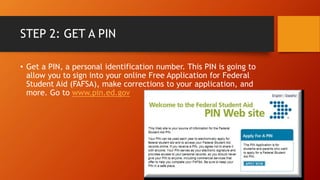
STEP 2: GET A PIN
• Get a PIN, a personal identification number. This PIN is going to
allow you to sign into your online Free Application for Federal
Student Aid (FAFSA), make corrections to your application, and
more. Go to www.pin.ed.gov
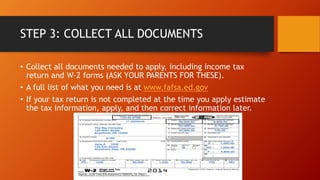
STEP 3: COLLECT ALL DOCUMENTS
• Collect all documents needed to apply, including income tax
return and W-2 forms (ASK YOUR PARENTS FOR THESE).
• A full list of what you need is at www.fafsa.ed.gov
• If your tax return is not completed at the time you apply estimate
the tax information, apply, and then correct information later.
STEP 4: COMPLETE THE FAFSA
• Complete the FAFSA between January 1st and June 30th There is no
exception to either date!!!
• Apply early, it is first come first serve!!!!
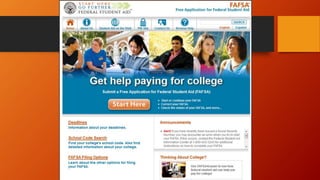
• Note: Make sure you go to www.fafsa.ed.gov not .com because the
.com will charge you money
STEP 5: REVIEW YOUR SAR
• They will send you your Student Aid Report (SAR) which are the
results of your FAFSA.
• Review your SAR, and if necessary, make changes or corrections
and submit your SAR for reprocessing.
• Your complete, correct SAR will contain your Expected Family
Contribution EFC (IMPORTANT!!!)
• EFC is the number used to determine your federal student aid
eligibility, based on the financial contributions that your family is
expected to make.
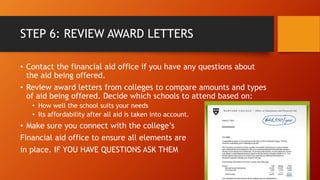
STEP 6: REVIEW AWARD LETTERS
• Contact the financial aid office if you have any questions about
the aid being offered.
• Review award letters from colleges to compare amounts and types
of aid being offered. Decide which schools to attend based on:
• How well the school suits your needs
• Its affordability after all aid is taken into account.
• Make sure you connect with the college’s
Financial aid office to ensure all elements are
in place. IF YOU HAVE QUESTIONS ASK THEM
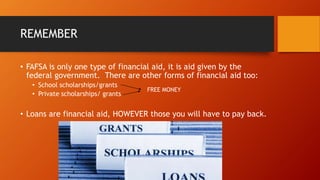
REMEMBER
• FAFSA is only one type of financial aid, it is aid given by the
federal government. There are other forms of financial aid too:
• School scholarships/grants
• Private scholarships/ grants
• Loans are financial aid, HOWEVER those you will have to pay back.
FREE MONEY
WHAT IF YOU DON’T QUALIFY
• FAFSA does require for the applicant to be a
U.S. permanent resident or citizen.
• If you do not qualify there are other forms of aid:
• Private Universities can grant financial aid to any students regardless of
their immigration status.
• Private Scholarships
• Community colleges are a great starting place.
IT IS POSSIBLE!!!
Important Information
• Talk to GEAR Up we can HELP!!!! 
• High score on ACT means free money
• High grades and GPA means free money
• For most loans payments have to start 6 months after graduation
date.
• Loans should be your third option after FAFSA & scholarships , but they are
still a good option to get you what you need.
Scholarships
Require above
average GPA and
ACT scores
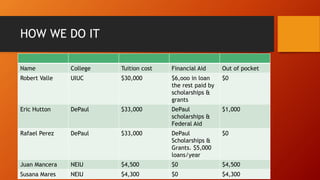
HOW WE DO IT
Name College Tuition cost Financial Aid Out of pocket
Robert Valle UIUC $30,000 $6,ooo in loan
the rest paid by
scholarships &
grants
$0
Eric Hutton DePaul $33,000 DePaul
scholarships &
Federal Aid
$1,000
Rafael Perez DePaul $33,000 DePaul
Scholarships &
Grants. $5,000
loans/year
$0
Juan Mancera NEIU $4,500 $0 $4,500
Susana Mares NEIU $4,300 $0 $4,300

Fafsa

  • 1.
    FINANCIAL AID &FAFSA 101
  • 2.
    PAYING FOR COLLEGE •College is an investment in your future. • There are many forms of financial aid available to help pay for: • Tuition • Fees • Books • Room and board • Transportation • Personal Expenses BIGGEST IS FAFSA!!!!!!
  • 3.
    HOW TO APPLY •Applying for FAFSA is free!! • Just follow these 6 easy steps.
  • 4.
    STEP 1: ASKFOR HELP • Get free information to help from: • School Counselor • College and Career Office • US Department of education www.federalstudentaid.ed.gov • GEAR UP!
  • 5.
    STEP 2: GETA PIN • Get a PIN, a personal identification number. This PIN is going to allow you to sign into your online Free Application for Federal Student Aid (FAFSA), make corrections to your application, and more. Go to www.pin.ed.gov
  • 6.
    STEP 3: COLLECTALL DOCUMENTS • Collect all documents needed to apply, including income tax return and W-2 forms (ASK YOUR PARENTS FOR THESE). • A full list of what you need is at www.fafsa.ed.gov • If your tax return is not completed at the time you apply estimate the tax information, apply, and then correct information later.
  • 7.
    STEP 4: COMPLETETHE FAFSA • Complete the FAFSA between January 1st and June 30th There is no exception to either date!!! • Apply early, it is first come first serve!!!! • Note: Make sure you go to www.fafsa.ed.gov not .com because the .com will charge you money
  • 9.
    STEP 5: REVIEWYOUR SAR • They will send you your Student Aid Report (SAR) which are the results of your FAFSA. • Review your SAR, and if necessary, make changes or corrections and submit your SAR for reprocessing. • Your complete, correct SAR will contain your Expected Family Contribution EFC (IMPORTANT!!!) • EFC is the number used to determine your federal student aid eligibility, based on the financial contributions that your family is expected to make.
  • 10.
    STEP 6: REVIEWAWARD LETTERS • Contact the financial aid office if you have any questions about the aid being offered. • Review award letters from colleges to compare amounts and types of aid being offered. Decide which schools to attend based on: • How well the school suits your needs • Its affordability after all aid is taken into account. • Make sure you connect with the college’s Financial aid office to ensure all elements are in place. IF YOU HAVE QUESTIONS ASK THEM
  • 11.
    REMEMBER • FAFSA isonly one type of financial aid, it is aid given by the federal government. There are other forms of financial aid too: • School scholarships/grants • Private scholarships/ grants • Loans are financial aid, HOWEVER those you will have to pay back. FREE MONEY
  • 12.
    WHAT IF YOUDON’T QUALIFY • FAFSA does require for the applicant to be a U.S. permanent resident or citizen. • If you do not qualify there are other forms of aid: • Private Universities can grant financial aid to any students regardless of their immigration status. • Private Scholarships • Community colleges are a great starting place. IT IS POSSIBLE!!!
  • 13.
    Important Information • Talkto GEAR Up we can HELP!!!!  • High score on ACT means free money • High grades and GPA means free money • For most loans payments have to start 6 months after graduation date. • Loans should be your third option after FAFSA & scholarships , but they are still a good option to get you what you need. Scholarships Require above average GPA and ACT scores
  • 14.
    HOW WE DOIT Name College Tuition cost Financial Aid Out of pocket Robert Valle UIUC $30,000 $6,ooo in loan the rest paid by scholarships & grants $0 Eric Hutton DePaul $33,000 DePaul scholarships & Federal Aid $1,000 Rafael Perez DePaul $33,000 DePaul Scholarships & Grants. $5,000 loans/year $0 Juan Mancera NEIU $4,500 $0 $4,500 Susana Mares NEIU $4,300 $0 $4,300