The Road Map To Higher
       Learning
Topics We Will Discuss

   What is financial aid
   Cost of attendance (COA)
   Expected Family Contribution (EFC)
   What is financial need
   Categories, types, and sources of financial
    aid
What is Financial Aid
Financial aid is funds provided to
students and families to help pay for
postsecondary educational expenses.
What is Cost of Attendance (COA)

• Direct costs
  – (Tuition, Fees, Room & Board)


• Indirect costs
  – (Books, Transportation, Supplies)


• Varies widely from college to college
What is the Expected Family Contribution
 (EFC)
   Is the number that is used to determine your
    eligibility for federal student financial aid.
    (Amount family can reasonably be expected to contribute>)
   Calculated using data from the Free
    Application for Federal Student Aid (FAFSA)
    and a federal formula
   Two components
    –   Parent contribution
    –   Student contribution
   Stays the same regardless of college
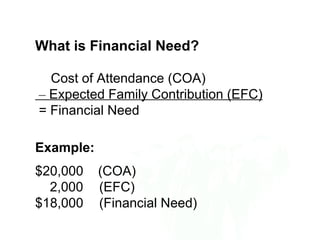
What is Financial Need?

  Cost of Attendance (COA)
– Expected Family Contribution (EFC)
= Financial Need

Example:
$20,000    (COA)
  2,000    (EFC)
$18,000    (Financial Need)
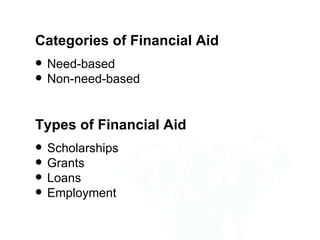
Categories of Financial Aid
   Need-based
   Non-need-based


Types of Financial Aid
   Scholarships
   Grants
   Loans
   Employment
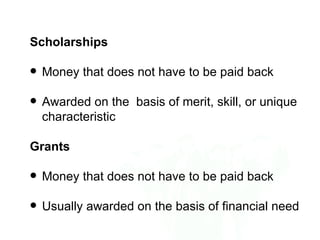
Scholarships

   Money that does not have to be paid back

   Awarded on the basis of merit, skill, or unique
    characteristic

Grants

   Money that does not have to be paid back

   Usually awarded on the basis of financial need
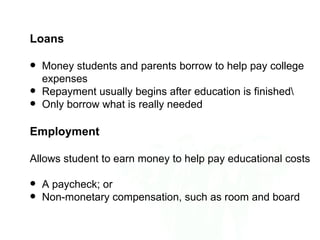
Loans

   Money students and parents borrow to help pay college
    expenses
   Repayment usually begins after education is finished
   Only borrow what is really needed

Employment

Allows student to earn money to help pay educational costs

   A paycheck; or
   Non-monetary compensation, such as room and board
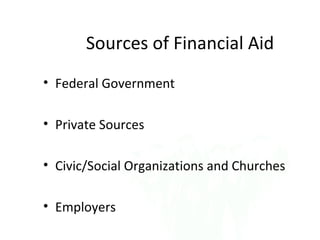
Sources of Financial Aid
• Federal Government

• Private Sources

• Civic/Social Organizations and Churches

• Employers
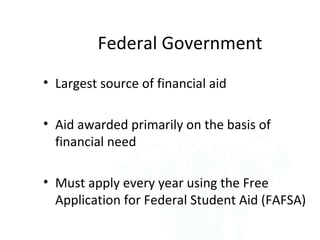
Federal Government
• Largest source of financial aid

• Aid awarded primarily on the basis of
  financial need

• Must apply every year using the Free
  Application for Federal Student Aid (FAFSA)
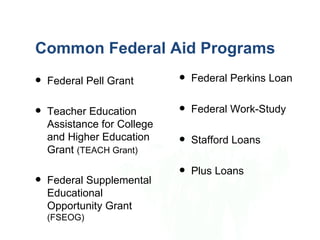
Common Federal Aid Programs
   Federal Pell Grant          Federal Perkins Loan

   Teacher Education           Federal Work-Study
    Assistance for College
    and Higher Education        Stafford Loans
    Grant (TEACH Grant)
                                Plus Loans
   Federal Supplemental
    Educational
    Opportunity Grant
    (FSEOG)
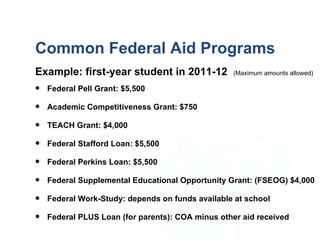
Common Federal Aid Programs
Example: first-year student in 2011-12            (Maximum amounts allowed)

   Federal Pell Grant: $5,500

   Academic Competitiveness Grant: $750

   TEACH Grant: $4,000

   Federal Stafford Loan: $5,500

   Federal Perkins Loan: $5,500

   Federal Supplemental Educational Opportunity Grant: (FSEOG) $4,000

   Federal Work-Study: depends on funds available at school

   Federal PLUS Loan (for parents): COA minus other aid received
Pennsylvania Higher Education
Assistance Agency (PHEAA)
   Requires Pennsylvania Residency
   Award aid on the basis of both financial need and
    merit
   Use information from the FAFSA
   Deadline for PA State Grant Application is May 1st for
    State Grant recipients and all non 2011-12 grant
    recipients in degree programs. All other applicants
    August 1st.
Private Sources
   Foundations, businesses, charitable organizations
   Civic/Social Organizations and Churches
   Employers

    o   Deadlines and application procedures will vary
    o   Begin researching private aid sources early
    o   Research what is available in the community
    o   Companies may have scholarships available to the
        children of employees
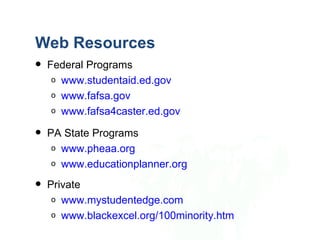
Web Resources
   Federal Programs
     o www.studentaid.ed.gov
     o www.fafsa.gov
     o www.fafsa4caster.ed.gov

   PA State Programs
     o www.pheaa.org
     o www.educationplanner.org

   Private
     o www.mystudentedge.com
     o www.blackexcel.org/100minority.htm
Thank you !

Anthony R. Johnson, M.S.

The Road Map To Higher Learning 11

  • 1.
    The Road MapTo Higher Learning
  • 2.
    Topics We WillDiscuss  What is financial aid  Cost of attendance (COA)  Expected Family Contribution (EFC)  What is financial need  Categories, types, and sources of financial aid
  • 3.
    What is FinancialAid Financial aid is funds provided to students and families to help pay for postsecondary educational expenses.
  • 4.
    What is Costof Attendance (COA) • Direct costs – (Tuition, Fees, Room & Board) • Indirect costs – (Books, Transportation, Supplies) • Varies widely from college to college
  • 5.
    What is theExpected Family Contribution (EFC)  Is the number that is used to determine your eligibility for federal student financial aid. (Amount family can reasonably be expected to contribute>)  Calculated using data from the Free Application for Federal Student Aid (FAFSA) and a federal formula  Two components – Parent contribution – Student contribution  Stays the same regardless of college
  • 6.
    What is FinancialNeed? Cost of Attendance (COA) – Expected Family Contribution (EFC) = Financial Need Example: $20,000 (COA) 2,000 (EFC) $18,000 (Financial Need)
  • 7.
    Categories of FinancialAid  Need-based  Non-need-based Types of Financial Aid  Scholarships  Grants  Loans  Employment
  • 8.
    Scholarships  Money that does not have to be paid back  Awarded on the basis of merit, skill, or unique characteristic Grants  Money that does not have to be paid back  Usually awarded on the basis of financial need
  • 9.
    Loans  Money students and parents borrow to help pay college expenses  Repayment usually begins after education is finished  Only borrow what is really needed Employment Allows student to earn money to help pay educational costs  A paycheck; or  Non-monetary compensation, such as room and board
  • 10.
    Sources of FinancialAid • Federal Government • Private Sources • Civic/Social Organizations and Churches • Employers
  • 11.
    Federal Government • Largestsource of financial aid • Aid awarded primarily on the basis of financial need • Must apply every year using the Free Application for Federal Student Aid (FAFSA)
  • 12.
    Common Federal AidPrograms  Federal Pell Grant  Federal Perkins Loan  Teacher Education  Federal Work-Study Assistance for College and Higher Education  Stafford Loans Grant (TEACH Grant)  Plus Loans  Federal Supplemental Educational Opportunity Grant (FSEOG)
  • 13.
    Common Federal AidPrograms Example: first-year student in 2011-12 (Maximum amounts allowed)  Federal Pell Grant: $5,500  Academic Competitiveness Grant: $750  TEACH Grant: $4,000  Federal Stafford Loan: $5,500  Federal Perkins Loan: $5,500  Federal Supplemental Educational Opportunity Grant: (FSEOG) $4,000  Federal Work-Study: depends on funds available at school  Federal PLUS Loan (for parents): COA minus other aid received
  • 14.
    Pennsylvania Higher Education AssistanceAgency (PHEAA)  Requires Pennsylvania Residency  Award aid on the basis of both financial need and merit  Use information from the FAFSA  Deadline for PA State Grant Application is May 1st for State Grant recipients and all non 2011-12 grant recipients in degree programs. All other applicants August 1st.
  • 15.
    Private Sources  Foundations, businesses, charitable organizations  Civic/Social Organizations and Churches  Employers o Deadlines and application procedures will vary o Begin researching private aid sources early o Research what is available in the community o Companies may have scholarships available to the children of employees
  • 16.
    Web Resources  Federal Programs o www.studentaid.ed.gov o www.fafsa.gov o www.fafsa4caster.ed.gov  PA State Programs o www.pheaa.org o www.educationplanner.org  Private o www.mystudentedge.com o www.blackexcel.org/100minority.htm
  • 17.
    Thank you ! AnthonyR. Johnson, M.S.

Editor's Notes

  • #5 After completing a scholarship search, students are presented with the results, where they can view scholarship profiles and add scholarships of interest to a saved list. Students may also further refine their results based on a variety of factors: Keyword Requirements Deadline Minimum number awarded Minimum award amount
  • #11 A page in the career assessment, which matches students with career types based on their interests
  • #12 A page in the career assessment, which matches students with career types based on their interests