What You Need to Know About Financial AidRuth PusichElmhurst College
Topics We Will Discuss TonightWhat is Financial AidHow to Apply for Financial AidWhat is FAFSA, EFC, COA, NeedCategories, Types and Sources of Financial AidSpecial CircumstancesStudent/Family Responsibilities
What is Financial Aid?Financial aid is funds provided to students and families to help pay for postsecondary educational expenses
How to ApplyApply for admission to a collegeComplete the FAFSA (Free Application for Federal Student Aid)Complete any other forms required by the institutionInternal Financial Aid/Scholarship ApplicationCSS Profile
FAFSA - www.fafsa.govA web-based standard form that collects demographic and financial information about the student and familyAvailable in English and SpanishMay be filed at any time during the school year, beginning January 1stApply for a PIN number at www.pin.ed.gov – real time!Student and one parent must signColleges may set FAFSA filing deadlinesColleges use the calculation results to award financial aid
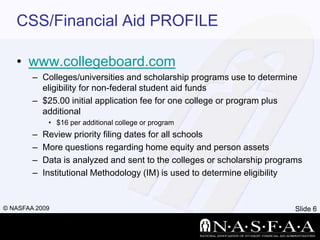
CSS/Financial Aid PROFILEwww.collegeboard.comColleges/universities and scholarship programs use to determine eligibility for non-federal student aid funds$25.00 initial application fee for one college or program plus additional $16 per additional college or program Review priority filing dates for all schoolsMore questions regarding home equity and person assetsData is analyzed and sent to the colleges or scholarship programsInstitutional Methodology (IM) is used to determine eligibility
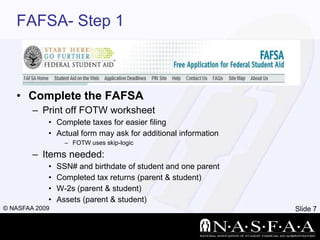
FAFSA- Step 1Complete the FAFSAPrint off FOTW worksheetComplete taxes for easier filingActual form may ask for additional informationFOTW uses skip-logicItems needed:SSN# and birthdate of student and one parentCompleted tax returns (parent & student)W-2s (parent & student)Assets (parent & student)
FAFSAFrequently Asked QuestionsWho is a dependent student?Who is a parent?Who lives in the house?Who counts as a college student?What if my taxes are not completed?What is additional financial data?What is untaxed income?What assets must be included?
FAFSA – Step 2Watch for your Student Aid Report (SAR)Review for errorsSocial Security NumbersDivorced/remarried parental informationIncome earned by parents/stepparentsUntaxed incomeU.S. income taxes paid Household sizeNumber of household members in collegeReal estate and investment net worthBusiness and farm net worthMake corrections and/or update estimated informationDo nothing if correct
FAFSA – Step 3Institutions receive FAFSA resultsCan be sent to up to 10 different collegesCollege reviews dataVerification (35% random selection)May request additional documentation
FAFSA – Step 4Wait to hear from your collegesOnce accepted to the college and the FAFSA has been received, the financial aid department gets busySchools determine a student’s eligibility for all types of financial aid – including loansFAFASA and/or PROFILE are data analysis tools onlySchools have different processing methodsWatch for your financial aid packageSent either through mail to the home or via the student’s email
Expected Family Contribution (EFC)Amount family can reasonably be expected to contribute towards education for one yearCalculated using FAFSA data and a federal formulaStays the same regardless of collegeTwo componentsParent contributionStudent contribution
What is Cost of Attendance (COA)Direct and indirect costs combined into cost of attendanceDirect costs – tuition, fees, room & boardIndirect costs – books, travel expenses, etcVaries widely from college to collegeCOA – EFC = Need
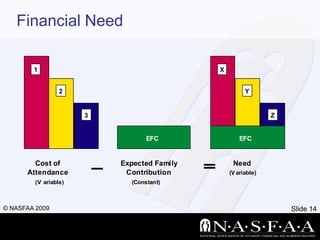
Financial Need
Categories of Financial AidNeed-basedGrants – usually awarded on the basis of financial needFederal Work StudyLoans – (Perkins, Subsidized)Non Need-basedScholarships – awarded on the basis of merit, skill, or unique characteristicsStudent employmentLoans - (Unsubsidized, PLUS, Private Alternative)
Types of Financial AidGiftMoney that generally is not paid backScholarshipsGrantsStudent Employment – Self-HelpAllows student to earn money to help pay educational costsA paycheck, direct deposit or student account deductionNon-monetary compensation, such as room and board
Types of Financial AidLoans – Self-HelpMoney students and parents borrow to help pay college expenses Look at loans as an investment in the futureRepayment usually begins after education is finishedOnly borrow what is really needed
Loans - TypesStudentPerkins (5% fixed)StaffordSubsidized (4.5% fixed)Unsubsidized (6.8%)Parent – PLUS (7.9%)Student/Parent – private alternative
Sources of Financial AidFederal governmentStatesInstitutionsPrivate sources
Federal GovernmentLargest source of financial aidAid awarded primarily on the basis of financial needMust apply every year using the FAFSA
Common Federal Aid ProgramsFederal Pell GrantFSEOG - Federal Supplemental Educational Opportunity GrantACG - Academic Competitiveness GrantSMART - National Science and Mathematics Access to Retain Talent GrantTEACH- Teacher Education Assistance for College and Higher Education GrantFederal Work-StudyFederal Perkins LoanStafford LoansPLUS Loans
StatesResidency requirementsAward aid on the basis of both merit and needUse information from the FAFSADeadlines vary by state - check FAFSAIllinois recommends early filing
InstitutionsColleges and UniversitiesAthletic scholarships	Academic scholarshipsPrivate InstitutionsNeed-based grantsEndowed scholarships
Private SourcesFoundations, businesses, charitable organizations, employersDeadlines and application procedures vary widelyBegin researching private aid sources early - usually spring of senior year
Suggested Websiteswww.collegezone.comState of Illinois Student Financial Assistancewww.finaid.orgFinAid on the webwww.collegeboard.comCollegeboardwww.gocollege.comThe Collegiate WebsourceSmall scholarships do add up!
Special CircumstancesCannot report on FAFSASend explanation to financial aid office at each collegeChange in employment statusMedical expenses not covered by insuranceChange in parent marital statusUnusual dependent care expensesPrivate school expensesStudent cannot obtain parent information
Financial Aid ScamsBe skeptical if:A fee is chargedYou are told to attend an information sessionYou are promised or guaranteed an amount of money…www.fastweb.com
Annual RenewalEach school will have guidelines for renewing institutional aidFAFSA must be filed each year of enrollment for need-based aid and loan considerationStudent loan eligibility is determined by FAFSA results and student’s year in school
Take ChargeFollow deadline recommendationsApply early to maximize eligibilityCompare award packagesAsk questions when in doubt
ConclusionKeep up good gradesResearch and visit schools of interestCheck out local scholarship opportunitiesREAD EVERYTHING – ASK QUESTIONS

Zion Benton Financial Aid

  • 1.
    What You Needto Know About Financial AidRuth PusichElmhurst College
  • 2.
    Topics We WillDiscuss TonightWhat is Financial AidHow to Apply for Financial AidWhat is FAFSA, EFC, COA, NeedCategories, Types and Sources of Financial AidSpecial CircumstancesStudent/Family Responsibilities
  • 3.
    What is FinancialAid?Financial aid is funds provided to students and families to help pay for postsecondary educational expenses
  • 4.
    How to ApplyApplyfor admission to a collegeComplete the FAFSA (Free Application for Federal Student Aid)Complete any other forms required by the institutionInternal Financial Aid/Scholarship ApplicationCSS Profile
  • 5.
    FAFSA - www.fafsa.govAweb-based standard form that collects demographic and financial information about the student and familyAvailable in English and SpanishMay be filed at any time during the school year, beginning January 1stApply for a PIN number at www.pin.ed.gov – real time!Student and one parent must signColleges may set FAFSA filing deadlinesColleges use the calculation results to award financial aid
  • 6.
    CSS/Financial Aid PROFILEwww.collegeboard.comColleges/universitiesand scholarship programs use to determine eligibility for non-federal student aid funds$25.00 initial application fee for one college or program plus additional $16 per additional college or program Review priority filing dates for all schoolsMore questions regarding home equity and person assetsData is analyzed and sent to the colleges or scholarship programsInstitutional Methodology (IM) is used to determine eligibility
  • 7.
    FAFSA- Step 1Completethe FAFSAPrint off FOTW worksheetComplete taxes for easier filingActual form may ask for additional informationFOTW uses skip-logicItems needed:SSN# and birthdate of student and one parentCompleted tax returns (parent & student)W-2s (parent & student)Assets (parent & student)
  • 8.
    FAFSAFrequently Asked QuestionsWhois a dependent student?Who is a parent?Who lives in the house?Who counts as a college student?What if my taxes are not completed?What is additional financial data?What is untaxed income?What assets must be included?
  • 9.
    FAFSA – Step2Watch for your Student Aid Report (SAR)Review for errorsSocial Security NumbersDivorced/remarried parental informationIncome earned by parents/stepparentsUntaxed incomeU.S. income taxes paid Household sizeNumber of household members in collegeReal estate and investment net worthBusiness and farm net worthMake corrections and/or update estimated informationDo nothing if correct
  • 10.
    FAFSA – Step3Institutions receive FAFSA resultsCan be sent to up to 10 different collegesCollege reviews dataVerification (35% random selection)May request additional documentation
  • 11.
    FAFSA – Step4Wait to hear from your collegesOnce accepted to the college and the FAFSA has been received, the financial aid department gets busySchools determine a student’s eligibility for all types of financial aid – including loansFAFASA and/or PROFILE are data analysis tools onlySchools have different processing methodsWatch for your financial aid packageSent either through mail to the home or via the student’s email
  • 12.
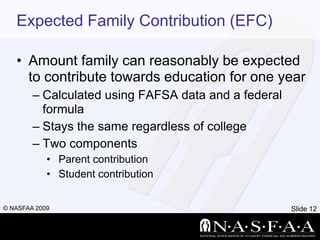
    Expected Family Contribution(EFC)Amount family can reasonably be expected to contribute towards education for one yearCalculated using FAFSA data and a federal formulaStays the same regardless of collegeTwo componentsParent contributionStudent contribution
  • 13.
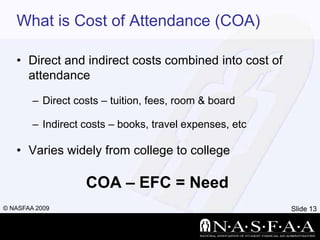
    What is Costof Attendance (COA)Direct and indirect costs combined into cost of attendanceDirect costs – tuition, fees, room & boardIndirect costs – books, travel expenses, etcVaries widely from college to collegeCOA – EFC = Need
  • 14.
  • 15.
    Categories of FinancialAidNeed-basedGrants – usually awarded on the basis of financial needFederal Work StudyLoans – (Perkins, Subsidized)Non Need-basedScholarships – awarded on the basis of merit, skill, or unique characteristicsStudent employmentLoans - (Unsubsidized, PLUS, Private Alternative)
  • 16.
    Types of FinancialAidGiftMoney that generally is not paid backScholarshipsGrantsStudent Employment – Self-HelpAllows student to earn money to help pay educational costsA paycheck, direct deposit or student account deductionNon-monetary compensation, such as room and board
  • 17.
    Types of FinancialAidLoans – Self-HelpMoney students and parents borrow to help pay college expenses Look at loans as an investment in the futureRepayment usually begins after education is finishedOnly borrow what is really needed
  • 18.
    Loans - TypesStudentPerkins(5% fixed)StaffordSubsidized (4.5% fixed)Unsubsidized (6.8%)Parent – PLUS (7.9%)Student/Parent – private alternative
  • 19.
    Sources of FinancialAidFederal governmentStatesInstitutionsPrivate sources
  • 20.
    Federal GovernmentLargest sourceof financial aidAid awarded primarily on the basis of financial needMust apply every year using the FAFSA
  • 21.
    Common Federal AidProgramsFederal Pell GrantFSEOG - Federal Supplemental Educational Opportunity GrantACG - Academic Competitiveness GrantSMART - National Science and Mathematics Access to Retain Talent GrantTEACH- Teacher Education Assistance for College and Higher Education GrantFederal Work-StudyFederal Perkins LoanStafford LoansPLUS Loans
  • 22.
    StatesResidency requirementsAward aidon the basis of both merit and needUse information from the FAFSADeadlines vary by state - check FAFSAIllinois recommends early filing
  • 23.
    InstitutionsColleges and UniversitiesAthleticscholarships Academic scholarshipsPrivate InstitutionsNeed-based grantsEndowed scholarships
  • 24.
    Private SourcesFoundations, businesses,charitable organizations, employersDeadlines and application procedures vary widelyBegin researching private aid sources early - usually spring of senior year
  • 25.
    Suggested Websiteswww.collegezone.comState ofIllinois Student Financial Assistancewww.finaid.orgFinAid on the webwww.collegeboard.comCollegeboardwww.gocollege.comThe Collegiate WebsourceSmall scholarships do add up!
  • 26.
    Special CircumstancesCannot reporton FAFSASend explanation to financial aid office at each collegeChange in employment statusMedical expenses not covered by insuranceChange in parent marital statusUnusual dependent care expensesPrivate school expensesStudent cannot obtain parent information
  • 27.
    Financial Aid ScamsBeskeptical if:A fee is chargedYou are told to attend an information sessionYou are promised or guaranteed an amount of money…www.fastweb.com
  • 28.
    Annual RenewalEach schoolwill have guidelines for renewing institutional aidFAFSA must be filed each year of enrollment for need-based aid and loan considerationStudent loan eligibility is determined by FAFSA results and student’s year in school
  • 29.
    Take ChargeFollow deadlinerecommendationsApply early to maximize eligibilityCompare award packagesAsk questions when in doubt
  • 30.
    ConclusionKeep up goodgradesResearch and visit schools of interestCheck out local scholarship opportunitiesREAD EVERYTHING – ASK QUESTIONS