Example of an Occupational Health Risk Assessment
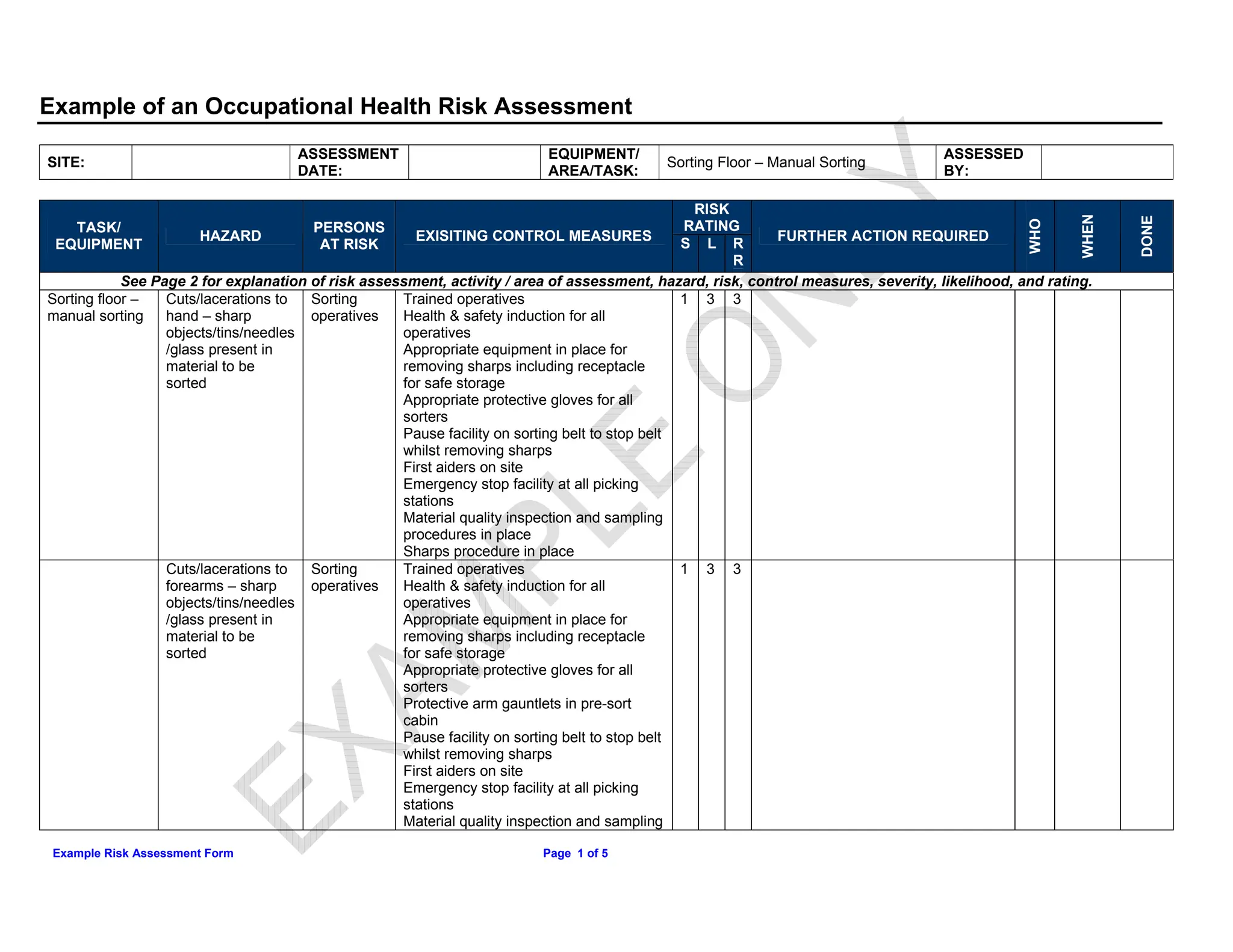
Example Risk Assessment Form Page 1 of 5
SITE:
ASSESSMENT
DATE:
EQUIPMENT/
AREA/TASK:
Sorting Floor – Manual Sorting
ASSESSED
BY:
RISK
RATING
TASK/
EQUIPMENT
HAZARD
PERSONS
AT RISK
EXISITING CONTROL MEASURES
S L R
R
FURTHER ACTION REQUIRED
WHO
WHEN
DONE
See Page 2 for explanation of risk assessment, activity / area of assessment, hazard, risk, control measures, severity, likelihood, and rating.
Sorting floor –
manual sorting
Cuts/lacerations to
hand – sharp
objects/tins/needles
/glass present in
material to be
sorted
Sorting
operatives
Trained operatives
Health & safety induction for all
operatives
Appropriate equipment in place for
removing sharps including receptacle
for safe storage
Appropriate protective gloves for all
sorters
Pause facility on sorting belt to stop belt
whilst removing sharps
First aiders on site
Emergency stop facility at all picking
stations
Material quality inspection and sampling
procedures in place
Sharps procedure in place
1 3 3
Cuts/lacerations to
forearms – sharp
objects/tins/needles
/glass present in
material to be
sorted
Sorting
operatives
Trained operatives
Health & safety induction for all
operatives
Appropriate equipment in place for
removing sharps including receptacle
for safe storage
Appropriate protective gloves for all
sorters
Protective arm gauntlets in pre-sort
cabin
Pause facility on sorting belt to stop belt
whilst removing sharps
First aiders on site
Emergency stop facility at all picking
stations
Material quality inspection and sampling
1 3 3
Example of an Occupational Health Risk Assessment
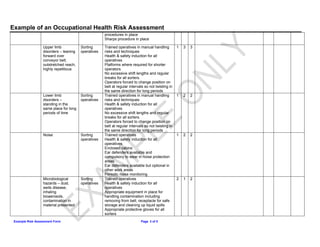
Example Risk Assessment Form Page 2 of 5
procedures in place
Sharps procedure in place
Upper limb
disorders – leaning
forward over
conveyor belt,
outstretched reach,
highly repetitious
Sorting
operatives
Trained operatives in manual handling
risks and techniques
Health & safety induction for all
operatives
Platforms where required for shorter
operators
No excessive shift lengths and regular
breaks for all sorters.
Operators forced to change position on
belt at regular intervals so not twisting in
the same direction for long periods
1 3 3
Lower limb
disorders –
standing in the
same place for long
periods of time
Sorting
operatives
Trained operatives in manual handling
risks and techniques
Health & safety induction for all
operatives
No excessive shift lengths and regular
breaks for all sorters.
Operators forced to change position on
belt at regular intervals so not twisting in
the same direction for long periods
1 2 2
Noise Sorting
operatives
Trained operatives
Health & safety induction for all
operatives
Enclosed cabins
Ear defenders available and
compulsory to wear in noise protection
areas.
Ear defenders available but optional in
other work areas
Periodic noise monitoring
1 2 2
Microbiological
hazards – dust,
weils disease,
inhaling
bioaerosols,
contamination in
material presented
Sorting
operatives
Trained operatives
Health & safety induction for all
operatives
Appropriate equipment in place for
handling contamination including
removing from belt, receptacle for safe
storage and cleaning up liquid spills
Appropriate protective gloves for all
sorters
2 1 2
Example of an Occupational Health Risk Assessment
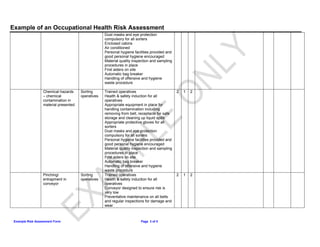
Example Risk Assessment Form Page 3 of 5
Dust masks and eye protection
compulsory for all sorters
Enclosed cabins
Air conditioned
Personal hygiene facilities provided and
good personal hygiene encouraged
Material quality inspection and sampling
procedures in place
First aiders on site
Automatic bag breaker
Handling of offensive and hygiene
waste procedure
Chemical hazards
– chemical
contamination in
material presented
Sorting
operatives
Trained operatives
Health & safety induction for all
operatives
Appropriate equipment in place for
handling contamination including
removing from belt, receptacle for safe
storage and cleaning up liquid spills
Appropriate protective gloves for all
sorters
Dust masks and eye protection
compulsory for all sorters
Personal hygiene facilities provided and
good personal hygiene encouraged
Material quality inspection and sampling
procedures in place
First aiders on site
Automatic bag breaker
Handling of offensive and hygiene
waste procedure
2 1 2
Pinching/
entrapment in
conveyor
Sorting
operatives
Trained operatives
Health & safety induction for all
operatives
Conveyor designed to ensure risk is
very low
Preventative maintenance on all belts
and regular inspections for damage and
wear
2 1 2
Example of an Occupational Health Risk Assessment
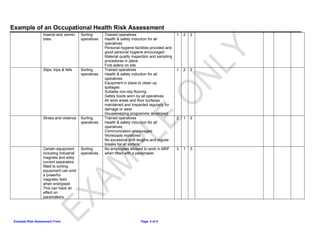
Example Risk Assessment Form Page 4 of 5
Insects and vermin
bites
Sorting
operatives
Trained operatives
Health & safety induction for all
operatives
Personal hygiene facilities provided and
good personal hygiene encouraged
Material quality inspection and sampling
procedures in place
First aiders on site
1 2 2
Slips, trips & falls Sorting
operatives
Trained operatives
Health & safety induction for all
operatives
Equipment in place to clean up
spillages
Suitable non-slip flooring
Safety boots worn by all operatives
All work areas and floor surfaces
maintained and inspected regularly for
damage or wear
Housekeeping programme developed
1 2 2
Stress and violence Sorting
operatives
Trained operatives
Health & safety induction for all
operatives
Communication encouraged
Workloads monitored
No excessive shift lengths and regular
breaks for all sorters.
2 1 2
Certain equipment
including industrial
magnets and eddy
current separators
fitted to sorting
equipment can emit
a powerful
magnetic field
when energised.
This can have an
effect on
pacemakers.
Sorting
operatives
No employees allowed to work in MRF
when fitted with a pacemaker
3 1 3
Example of an Occupational Health Risk Assessment
Example Risk Assessment Form Page 5 of 5
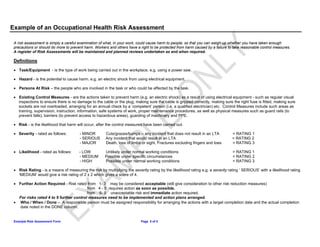
A risk assessment is simply a careful examination of what, in your work, could cause harm to people, so that you can weigh up whether you have taken enough
precautions or should do more to prevent harm. Workers and others have a right to be protected from harm caused by a failure to take reasonable control measures.
A register of Risk Assessments will be maintained and planned reviews undertaken as and when required.
Definitions
• Task/Equipment - is the type of work being carried out in the workplace. e.g. using a power saw.
• Hazard - is the potential to cause harm. e.g. an electric shock from using electrical equipment.
• Persons At Risk – the people who are involved in the task or who could be affected by the task.
• Existing Control Measures - are the actions taken to prevent harm (e.g. an electric shock) as a result of using electrical equipment - such as regular visual
inspections to ensure there is no damage to the cable or the plug, making sure the cable is gripped correctly, making sure the right fuse is fitted, making sure
sockets are not overloaded, arranging for an annual check by a ‘competent’ person (i.e. a qualified electrician) etc. Control Measures include such areas as
training, supervision, instruction, information, safe systems of work, proper maintenance procedures, as well as physical measures such as guard rails (to
prevent falls), barriers (to prevent access to hazardous areas), guarding of machinery and PPE.
• Risk - is the likelihood that harm will occur, after the control measures have been carried out.
• Severity - rated as follows: - MINOR Cuts/grazes/bumps – any incident that does not result in an LTA = RATING 1
- SERIOUS Any incident that would result in an LTA = RATING 2
- MAJOR Death, loss of limbs or sight. Fractures excluding fingers and toes = RATING 3
• Likelihood - rated as follows: - LOW Unlikely under normal working conditions = RATING 1
- MEDIUM Possible under specific circumstances = RATING 2
- HIGH Possible under normal working conditions = RATING 3
• Risk Rating - is a means of measuring the risk by multiplying the severity rating by the likelihood rating e.g. a severity rating ‘ SERIOUS’ with a likelihood rating
‘MEDIUM’ would give a risk rating of 2 x 2 which gives a score of 4.
• Further Action Required - Risk rated from 1- 3 may be considered acceptable (still give consideration to other risk reduction measures)
from 4 - 5 requires action as soon as possible.
from 6- 9 unacceptable risk and immediate action required.
For risks rated 4 to 9 further control measures need to be implemented and action plans arranged.
• Who / When / Done – A responsible person must be assigned responsibility for arranging the actions with a target completion date and the actual completion
date noted in the DONE column.

07 Manual Handling Assessment - RPS Floor Sorting.pdf

  • 1.
    Example of anOccupational Health Risk Assessment Example Risk Assessment Form Page 1 of 5 SITE: ASSESSMENT DATE: EQUIPMENT/ AREA/TASK: Sorting Floor – Manual Sorting ASSESSED BY: RISK RATING TASK/ EQUIPMENT HAZARD PERSONS AT RISK EXISITING CONTROL MEASURES S L R R FURTHER ACTION REQUIRED WHO WHEN DONE See Page 2 for explanation of risk assessment, activity / area of assessment, hazard, risk, control measures, severity, likelihood, and rating. Sorting floor – manual sorting Cuts/lacerations to hand – sharp objects/tins/needles /glass present in material to be sorted Sorting operatives Trained operatives Health & safety induction for all operatives Appropriate equipment in place for removing sharps including receptacle for safe storage Appropriate protective gloves for all sorters Pause facility on sorting belt to stop belt whilst removing sharps First aiders on site Emergency stop facility at all picking stations Material quality inspection and sampling procedures in place Sharps procedure in place 1 3 3 Cuts/lacerations to forearms – sharp objects/tins/needles /glass present in material to be sorted Sorting operatives Trained operatives Health & safety induction for all operatives Appropriate equipment in place for removing sharps including receptacle for safe storage Appropriate protective gloves for all sorters Protective arm gauntlets in pre-sort cabin Pause facility on sorting belt to stop belt whilst removing sharps First aiders on site Emergency stop facility at all picking stations Material quality inspection and sampling 1 3 3
  • 2.
    Example of anOccupational Health Risk Assessment Example Risk Assessment Form Page 2 of 5 procedures in place Sharps procedure in place Upper limb disorders – leaning forward over conveyor belt, outstretched reach, highly repetitious Sorting operatives Trained operatives in manual handling risks and techniques Health & safety induction for all operatives Platforms where required for shorter operators No excessive shift lengths and regular breaks for all sorters. Operators forced to change position on belt at regular intervals so not twisting in the same direction for long periods 1 3 3 Lower limb disorders – standing in the same place for long periods of time Sorting operatives Trained operatives in manual handling risks and techniques Health & safety induction for all operatives No excessive shift lengths and regular breaks for all sorters. Operators forced to change position on belt at regular intervals so not twisting in the same direction for long periods 1 2 2 Noise Sorting operatives Trained operatives Health & safety induction for all operatives Enclosed cabins Ear defenders available and compulsory to wear in noise protection areas. Ear defenders available but optional in other work areas Periodic noise monitoring 1 2 2 Microbiological hazards – dust, weils disease, inhaling bioaerosols, contamination in material presented Sorting operatives Trained operatives Health & safety induction for all operatives Appropriate equipment in place for handling contamination including removing from belt, receptacle for safe storage and cleaning up liquid spills Appropriate protective gloves for all sorters 2 1 2
  • 3.
    Example of anOccupational Health Risk Assessment Example Risk Assessment Form Page 3 of 5 Dust masks and eye protection compulsory for all sorters Enclosed cabins Air conditioned Personal hygiene facilities provided and good personal hygiene encouraged Material quality inspection and sampling procedures in place First aiders on site Automatic bag breaker Handling of offensive and hygiene waste procedure Chemical hazards – chemical contamination in material presented Sorting operatives Trained operatives Health & safety induction for all operatives Appropriate equipment in place for handling contamination including removing from belt, receptacle for safe storage and cleaning up liquid spills Appropriate protective gloves for all sorters Dust masks and eye protection compulsory for all sorters Personal hygiene facilities provided and good personal hygiene encouraged Material quality inspection and sampling procedures in place First aiders on site Automatic bag breaker Handling of offensive and hygiene waste procedure 2 1 2 Pinching/ entrapment in conveyor Sorting operatives Trained operatives Health & safety induction for all operatives Conveyor designed to ensure risk is very low Preventative maintenance on all belts and regular inspections for damage and wear 2 1 2
  • 4.
    Example of anOccupational Health Risk Assessment Example Risk Assessment Form Page 4 of 5 Insects and vermin bites Sorting operatives Trained operatives Health & safety induction for all operatives Personal hygiene facilities provided and good personal hygiene encouraged Material quality inspection and sampling procedures in place First aiders on site 1 2 2 Slips, trips & falls Sorting operatives Trained operatives Health & safety induction for all operatives Equipment in place to clean up spillages Suitable non-slip flooring Safety boots worn by all operatives All work areas and floor surfaces maintained and inspected regularly for damage or wear Housekeeping programme developed 1 2 2 Stress and violence Sorting operatives Trained operatives Health & safety induction for all operatives Communication encouraged Workloads monitored No excessive shift lengths and regular breaks for all sorters. 2 1 2 Certain equipment including industrial magnets and eddy current separators fitted to sorting equipment can emit a powerful magnetic field when energised. This can have an effect on pacemakers. Sorting operatives No employees allowed to work in MRF when fitted with a pacemaker 3 1 3
  • 5.
    Example of anOccupational Health Risk Assessment Example Risk Assessment Form Page 5 of 5 A risk assessment is simply a careful examination of what, in your work, could cause harm to people, so that you can weigh up whether you have taken enough precautions or should do more to prevent harm. Workers and others have a right to be protected from harm caused by a failure to take reasonable control measures. A register of Risk Assessments will be maintained and planned reviews undertaken as and when required. Definitions • Task/Equipment - is the type of work being carried out in the workplace. e.g. using a power saw. • Hazard - is the potential to cause harm. e.g. an electric shock from using electrical equipment. • Persons At Risk – the people who are involved in the task or who could be affected by the task. • Existing Control Measures - are the actions taken to prevent harm (e.g. an electric shock) as a result of using electrical equipment - such as regular visual inspections to ensure there is no damage to the cable or the plug, making sure the cable is gripped correctly, making sure the right fuse is fitted, making sure sockets are not overloaded, arranging for an annual check by a ‘competent’ person (i.e. a qualified electrician) etc. Control Measures include such areas as training, supervision, instruction, information, safe systems of work, proper maintenance procedures, as well as physical measures such as guard rails (to prevent falls), barriers (to prevent access to hazardous areas), guarding of machinery and PPE. • Risk - is the likelihood that harm will occur, after the control measures have been carried out. • Severity - rated as follows: - MINOR Cuts/grazes/bumps – any incident that does not result in an LTA = RATING 1 - SERIOUS Any incident that would result in an LTA = RATING 2 - MAJOR Death, loss of limbs or sight. Fractures excluding fingers and toes = RATING 3 • Likelihood - rated as follows: - LOW Unlikely under normal working conditions = RATING 1 - MEDIUM Possible under specific circumstances = RATING 2 - HIGH Possible under normal working conditions = RATING 3 • Risk Rating - is a means of measuring the risk by multiplying the severity rating by the likelihood rating e.g. a severity rating ‘ SERIOUS’ with a likelihood rating ‘MEDIUM’ would give a risk rating of 2 x 2 which gives a score of 4. • Further Action Required - Risk rated from 1- 3 may be considered acceptable (still give consideration to other risk reduction measures) from 4 - 5 requires action as soon as possible. from 6- 9 unacceptable risk and immediate action required. For risks rated 4 to 9 further control measures need to be implemented and action plans arranged. • Who / When / Done – A responsible person must be assigned responsibility for arranging the actions with a target completion date and the actual completion date noted in the DONE column.