The Factories Act of 1948 outlines regulations for occupational safety, health and welfare of workers in factories. Some key points include:
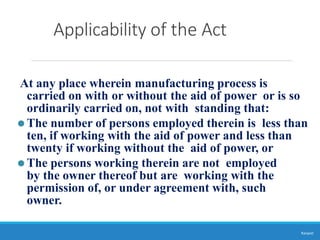
- A factory is defined as any premises with 10 or more power-driven workers or 20 or more non-power driven workers engaged in manufacturing.
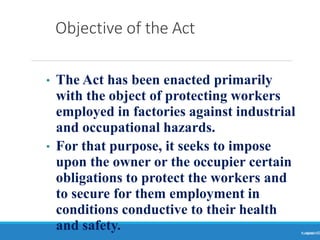
- The Act aims to protect workers from industrial hazards by imposing obligations on factory owners regarding worker safety and health conditions.
- It provides guidelines for facilities like cleanliness, ventilation, lighting, drinking water, latrines, and welfare provisions such as canteens and rest areas.
- Machinery and equipment safety is an important aspect, requiring guards on moving parts and restrictions on young workers operating dangerous machines.

![What is a factory?
2
⚫A premises whereon 10 or more
persons are engaged if power is used, or
20 or more persons are engaged if
power is not used, in a manufacturing
process. [section 2(m)].](https://image.slidesharecdn.com/thefactoriesact1948-110311015406-phpapp02-230615074934-75a96365/85/thefactoriesact1948-110311015406-phpapp02-pptx-2-320.jpg)
![What is a manufacturing
process?
Ranjeet
KUMAR5
Manufacturing process means any process for-
•
•
•
•
•
•
• (i) making, altering, repairing, ornamenting, finishing, packing,
oiling, washing, cleaning, breaking up, demolishing, or
otherwise treating or adapting any article or substance with a
view to its use, sale, transport, delivery or disposal; or
(ii) pumping oil, water, sewage or any other substance; or
(iii) generating, transforming or transmitting power; or
(iv)composing types for printing, printing by letter press,
lithography, photogravure or other similar process or book
binding
(v)constructing, reconstructing, repairing, refitting, finishing
or breaking up ships or vessels;
(vi)preserving or storing any article in cold storage.
[section 2(k)].](https://image.slidesharecdn.com/thefactoriesact1948-110311015406-phpapp02-230615074934-75a96365/85/thefactoriesact1948-110311015406-phpapp02-pptx-5-320.jpg)
![Who is a worker?
Ranjeet
KUMAR6
⚫A person employed in any
manufacturing process or cleaning or
any work incidental to manufacturing
process.
⚫A person employed, directly or by or
through any agency with or without
knowledge of the principal employer.
⚫Whether for remuneration or not.
⚫Relationship of master & servant
⚫[section 2(l)].](https://image.slidesharecdn.com/thefactoriesact1948-110311015406-phpapp02-230615074934-75a96365/85/thefactoriesact1948-110311015406-phpapp02-pptx-6-320.jpg)
![Definitions[Sec.2]
Ranjeet
KUMAR7
• “Adult” means a person who has
completed his eighteenth year of age
• “Adolescent” means a person who has
completed his fifteenth year of age but
has not completed his eighteenth year
• “Child” means a person who has not
completed his fifteenth year of age
• “Young person” means a person who is
either a child or an adolescent](https://image.slidesharecdn.com/thefactoriesact1948-110311015406-phpapp02-230615074934-75a96365/85/thefactoriesact1948-110311015406-phpapp02-pptx-7-320.jpg)
![Definitions[Sec.2]
Ranjeet
KUMAR8
•
•
•
•
“Day” means a period of twenty-four hours
beginning at midnight;
"week" means a period of seven days beginning at
midnight on Saturday night
“Calendar year” means the period of twelve
months beginning with the first day of January in
any year
“Power” means electrical energy, or any other
form of energy which is mechanically transmitted
and is not generated by human or animal agency;
“Prime mover” means any engine, motor or other
appliance which generates or otherwise provides
power](https://image.slidesharecdn.com/thefactoriesact1948-110311015406-phpapp02-230615074934-75a96365/85/thefactoriesact1948-110311015406-phpapp02-pptx-8-320.jpg)
![Who is the occupier?
Ranjeet
KUMAR9
⚫The person who has ultimate control
over the affairs of factory.
⚫It includes a partner in case of firm and
director in case of a company.
⚫In case of Government company,
'occupier' need not be a director. In
that case, person appointed to manage
affairs of the factory shall be occupier.
[section 2(n)].](https://image.slidesharecdn.com/thefactoriesact1948-110311015406-phpapp02-230615074934-75a96365/85/thefactoriesact1948-110311015406-phpapp02-pptx-9-320.jpg)
![Approval, Licensing &
Registration Of Factories[sec.6]
Ranjeet
KUMAR
10
•
•
•
• Making an application to the Government or Chief
Inspector , along with the duly certified plans and
specifications required by the rules,
Sent to the State Government or Chief Inspectors by
registered post,
And no order is communicated to the applicant
within 3 months from the date on which it is so sent,
the permission deemed to be granted.
If the application is rejected appeal can be made to
the government within 30 days of the date of such
rejection.](https://image.slidesharecdn.com/thefactoriesact1948-110311015406-phpapp02-230615074934-75a96365/85/thefactoriesact1948-110311015406-phpapp02-pptx-10-320.jpg)
![Notice by Occupier[sec.7]
Ranjeet
KUMAR
11
The occupier shall, at least 15 days before he begins to occupy or
use any premises as a factory, send a notice to the Chief
Inspector containing-
•
•
•
•
•
•
•
•
•
(a) The name and situation of the factory;
(b) The name and address of the occupier;
(c) The name and address of the owner of the premises
(d)The address to which communications relating to the
factory may be sent;
(e) The nature of the manufacturing process;
(f)The total rated horse power installed or to be installed in the
factory;
(g)The name of the manager of the factory for the purposes of
this Act;
(h) The number of workers likely to be employed in the factory;
(i) Such other particulars as may be prescribed](https://image.slidesharecdn.com/thefactoriesact1948-110311015406-phpapp02-230615074934-75a96365/85/thefactoriesact1948-110311015406-phpapp02-pptx-11-320.jpg)
![The Inspecting Staff[Sec.8]
Ranjeet
KUMAR
13
• State government may appoint Chief Inspector,
Additional Chief Inspectors, Joint Chief Inspectors,
Deputy Chief Inspectors,and Inspectors.
• Prescribe their duties and
qualifications
• Every District Magistrate shall be an Inspector
for his district
• Every inspector is deemed to be a public servant
within the meaning of the Indian Penal Code](https://image.slidesharecdn.com/thefactoriesact1948-110311015406-phpapp02-230615074934-75a96365/85/thefactoriesact1948-110311015406-phpapp02-pptx-13-320.jpg)
![Powers of Inspectors[sec.9]
Ranjeet
KUMAR
14
•
•
•
•
•
•
•
•
Enter factory premises for
investigation Examine the premises
Inquire into any accident or dangerous occurrence
Require the production of any prescribed register
or document
Seize, or take copies of, any register, record or
other document
Take measurements and photographs and make
such recordings
Exercise such other powers as may be prescribed
No person shall be compelled under this section to
answer any question or give any evidence tending
to incriminate himself .](https://image.slidesharecdn.com/thefactoriesact1948-110311015406-phpapp02-230615074934-75a96365/85/thefactoriesact1948-110311015406-phpapp02-pptx-14-320.jpg)
![Certifying Surgeon[Sec.10]
Ranjeet
KUMAR
15
•
•
•
•
•
•
•
• State Government may appoint qualified medical practitioners
to be certifying surgeons
Duties of surgeons
(a)the examination and certification of young persons under
this Act;
(b)the examination of persons engaged in factories in such
dangerous occupations or processes
(c) supervising the factories where
(i)cases of illness have occurred which are due to the nature of
the manufacturing process or
(ii)due to manufacturing process there is a likelihood of injury
to the health of workers or
(iii)young persons are employed in any work which is likely to
cause injury to their health.](https://image.slidesharecdn.com/thefactoriesact1948-110311015406-phpapp02-230615074934-75a96365/85/thefactoriesact1948-110311015406-phpapp02-pptx-15-320.jpg)
![Health Provisions[Sec.11-20]
Ranjeet
KUMAR
16
⚫Chapter III of Factories Act contain
details regarding health of workers. Let
us discuss these provisions…](https://image.slidesharecdn.com/thefactoriesact1948-110311015406-phpapp02-230615074934-75a96365/85/thefactoriesact1948-110311015406-phpapp02-pptx-16-320.jpg)
![Cleanliness[sec.11]
Ranjeet
KUMAR
17
⚫The working conditions should be clean
and safe.
⚫Clean the floor at least once a week by
washing, or by some effective method.
⚫Effective means of drainage shall be
provided.
⚫White wash every 14 weeks
⚫Paint / varnish every 5 years](https://image.slidesharecdn.com/thefactoriesact1948-110311015406-phpapp02-230615074934-75a96365/85/thefactoriesact1948-110311015406-phpapp02-pptx-17-320.jpg)
![Disposal of wastes and
effluents [sec.12]
Ranjeet
KUMAR
18
⚫There should be proper arrangements
or disposal of wastes and effluents.
⚫Follow state govt. rules…](https://image.slidesharecdn.com/thefactoriesact1948-110311015406-phpapp02-230615074934-75a96365/85/thefactoriesact1948-110311015406-phpapp02-pptx-18-320.jpg)
![Ventilation & Temperature
[sec.13]
Ranjeet
KUMAR
19
⚫Proper level of ventilation temperature
and humidity must be maintained.
⚫Make provisions for reducing excess
heat.](https://image.slidesharecdn.com/thefactoriesact1948-110311015406-phpapp02-230615074934-75a96365/85/thefactoriesact1948-110311015406-phpapp02-pptx-19-320.jpg)
![Dust and fume[sec.14]
Ranjeet
KUMAR
20
• Effective measures should be taken to
prevent inhalation or accumulation of
dust & fume.
• If any exhaust appliance is necessary
for, it shall be applied as near as
possible to the point of origin of the
dust, fume or other impurity.](https://image.slidesharecdn.com/thefactoriesact1948-110311015406-phpapp02-230615074934-75a96365/85/thefactoriesact1948-110311015406-phpapp02-pptx-20-320.jpg)
![Ranjeet
KUMAR
21
• Factories in which the humidity of the
air is artificially increased(like in textile
units), keep it in limits.
• The water used for artificial
humidification to be clean.
Artificial Humidification[sec.15]](https://image.slidesharecdn.com/thefactoriesact1948-110311015406-phpapp02-230615074934-75a96365/85/thefactoriesact1948-110311015406-phpapp02-pptx-21-320.jpg)
![Overcrowding[Sec.16]
Ranjeet
KUMAR
22
⚫14.2 cubic metres space per worker.
While calculating this space, space
above the worker beyond 4.2 meters
will not be taken into account.
⚫Notice specifying the maximum
number of workers, which can be
employed in any work room shall be
displayed in the premises.](https://image.slidesharecdn.com/thefactoriesact1948-110311015406-phpapp02-230615074934-75a96365/85/thefactoriesact1948-110311015406-phpapp02-pptx-22-320.jpg)
![Lighting[Sec17]
Ranjeet
KUMAR
23
⚫Sufficient & suitable lighting in every
part of factory. There should natural
lighting as far as possible.
⚫All glazed windows and skylights used
for the lighting of the workroom shall
be kept clean.
⚫Formation of shadows to such an extent
as to cause eye-strain or the risk of
accident to any worker shall be
prevented.](https://image.slidesharecdn.com/thefactoriesact1948-110311015406-phpapp02-230615074934-75a96365/85/thefactoriesact1948-110311015406-phpapp02-pptx-23-320.jpg)
![Drinking water[Sec.18]
Ranjeet
KUMAR
24
⚫There should be drinking water
(wholesome water)
⚫Drinking points to be marked as
drinking water. They should be at least
6 meters away from wash room/urinal/
latrine/spittoons.
⚫If >250 workers are working, then have
cool water facility also.](https://image.slidesharecdn.com/thefactoriesact1948-110311015406-phpapp02-230615074934-75a96365/85/thefactoriesact1948-110311015406-phpapp02-pptx-24-320.jpg)
![Latrines and Urinals[Sec.19]
Ranjeet
KUMAR
25
⚫There should be separate – for male
and female.
⚫Proper cleaning should be there.](https://image.slidesharecdn.com/thefactoriesact1948-110311015406-phpapp02-230615074934-75a96365/85/thefactoriesact1948-110311015406-phpapp02-pptx-25-320.jpg)
![Spittoons[Sec.20]
Ranjeet
KUMAR
26
⚫There should be sufficient number of
spittoons.
⚫No person shall spit within the premises
of a factory except in the Spittoons
provided for the purpose
⚫Whoever spits in contravention shall be
punishable with fine not exceeding five
rupees](https://image.slidesharecdn.com/thefactoriesact1948-110311015406-phpapp02-230615074934-75a96365/85/thefactoriesact1948-110311015406-phpapp02-pptx-26-320.jpg)
![Safety of Worker[Sec.21-41]
Ranjeet
KUMAR
27
⚫CHAPTER IV DEALS WITH
SAFETY OF WORKERS…](https://image.slidesharecdn.com/thefactoriesact1948-110311015406-phpapp02-230615074934-75a96365/85/thefactoriesact1948-110311015406-phpapp02-pptx-27-320.jpg)
![Fencing of Machinery[Sec.21]
Ranjeet
KUMAR
28
⚫Every dangerous parts must be
securely fenced.
⚫The State Government may by rules
prescribe such further precautions.](https://image.slidesharecdn.com/thefactoriesact1948-110311015406-phpapp02-230615074934-75a96365/85/thefactoriesact1948-110311015406-phpapp02-pptx-28-320.jpg)
![Machines in motions[Sec.22]
Ranjeet
KUMAR
29
⚫Examination of machinery in motion
only by a specially trained adult male
worker wearing tight fitting clothing.
⚫No women or child should be allowed to
work.](https://image.slidesharecdn.com/thefactoriesact1948-110311015406-phpapp02-230615074934-75a96365/85/thefactoriesact1948-110311015406-phpapp02-pptx-29-320.jpg)
![Employment of young
persons on dangerous
machines[Sec.23]
Ranjeet
KUMAR
30
⚫No young person should be allowed to
work on dangerous machines (unless he
has been trained, and is under
supervision).
⚫Young person = 14 to 18.](https://image.slidesharecdn.com/thefactoriesact1948-110311015406-phpapp02-230615074934-75a96365/85/thefactoriesact1948-110311015406-phpapp02-pptx-30-320.jpg)
![Striking gears[Sec.24]
Ranjeet 31
⚫There should be suitable striking gears
etc. to switch off the power, so that if
there is any emergency, problem can be
solved.](https://image.slidesharecdn.com/thefactoriesact1948-110311015406-phpapp02-230615074934-75a96365/85/thefactoriesact1948-110311015406-phpapp02-pptx-31-320.jpg)
![Self acting machines[Sec.25]
Ranjeet
KUMAR
32
⚫Make sure that no person should walk
in a space within 45 cm from any fixed
structure which is not a part of
machine.](https://image.slidesharecdn.com/thefactoriesact1948-110311015406-phpapp02-230615074934-75a96365/85/thefactoriesact1948-110311015406-phpapp02-pptx-32-320.jpg)
![Casing of new
machines[Sec.26]
Ranjeet
KUMAR
33
⚫All machinery driven by power &
installed should be so sunk, encased or
otherwise effectively guarded as to
prevent danger.](https://image.slidesharecdn.com/thefactoriesact1948-110311015406-phpapp02-230615074934-75a96365/85/thefactoriesact1948-110311015406-phpapp02-pptx-33-320.jpg)
![Cotton openers[Sec.27]
Ranjeet
KUMAR
34
⚫No women and children are allowed to
work on cotton openers.](https://image.slidesharecdn.com/thefactoriesact1948-110311015406-phpapp02-230615074934-75a96365/85/thefactoriesact1948-110311015406-phpapp02-pptx-34-320.jpg)
![Hoists and lifts[Sec.28]
Ranjeet
KUMAR
35
⚫Every hoist and lift should be in good
condition, and properly checked.
⚫The maximum load it can carry – must be
clearly mentioned.
⚫The gates should be locked by
interlocking / safe method (it should not
open in between).
⚫To be properly examined in every 6
months.](https://image.slidesharecdn.com/thefactoriesact1948-110311015406-phpapp02-230615074934-75a96365/85/thefactoriesact1948-110311015406-phpapp02-pptx-35-320.jpg)
![Lifting machines, chains,
ropes & lifting tackles[Sec.29]
Ranjeet
KUMAR
36
⚫Cranes & lifting machines, etc. to be of
good construction & to be examined
once in every 12 month.
⚫Cranes and lifting machines not to be
loaded beyond safe working load.
⚫Cranes not to be approach within 6
metres of a place where any person is
employed or working.](https://image.slidesharecdn.com/thefactoriesact1948-110311015406-phpapp02-230615074934-75a96365/85/thefactoriesact1948-110311015406-phpapp02-pptx-36-320.jpg)
![Revolving machines[Sec.30]
Ranjeet
KUMAR
37
⚫Maximum safe speed must be
mentioned for each machine.
⚫Speed indicated in notices should not to
be exceeded.](https://image.slidesharecdn.com/thefactoriesact1948-110311015406-phpapp02-230615074934-75a96365/85/thefactoriesact1948-110311015406-phpapp02-pptx-37-320.jpg)
![Pressure plant[Sec.31]
Ranjeet
KUMAR
38
⚫There should be safe working pressure
on pressure plants.
⚫Effective measures should be taken to
ensure that the safe working pressure is
not exceeded.](https://image.slidesharecdn.com/thefactoriesact1948-110311015406-phpapp02-230615074934-75a96365/85/thefactoriesact1948-110311015406-phpapp02-pptx-38-320.jpg)
![Floors, Stairs etc.[Sec.32]
Ranjeet
KUMAR
39
⚫All floors, steps, stairs, passages &
gangways should be of sound
construction & properly mentioned.](https://image.slidesharecdn.com/thefactoriesact1948-110311015406-phpapp02-230615074934-75a96365/85/thefactoriesact1948-110311015406-phpapp02-pptx-39-320.jpg)
![Pits, sumps, openings in
floors etc.[Sec.33]
Ranjeet
KUMAR
40
• Pits, sumps etc. should be securely
covered or fenced.](https://image.slidesharecdn.com/thefactoriesact1948-110311015406-phpapp02-230615074934-75a96365/85/thefactoriesact1948-110311015406-phpapp02-pptx-40-320.jpg)
![Excessive weights[Sec.34]
Ranjeet
KUMAR
41
⚫No person should be employed to hold
more weight than the person can hold.](https://image.slidesharecdn.com/thefactoriesact1948-110311015406-phpapp02-230615074934-75a96365/85/thefactoriesact1948-110311015406-phpapp02-pptx-41-320.jpg)
![Protection of eyes[Sec.35]
Ranjeet
KUMAR
42
⚫Provide goggles if workers have to
work on something stretching to the
eyes.](https://image.slidesharecdn.com/thefactoriesact1948-110311015406-phpapp02-230615074934-75a96365/85/thefactoriesact1948-110311015406-phpapp02-pptx-42-320.jpg)
![Dangerous fumes etc[Sec.36]
Ranjeet
KUMAR
43
⚫Prohibited to employ workers in places
where dangerous gas / fume is present.
⚫Practicable measures should be taken
for removal of gas, fume, etc.](https://image.slidesharecdn.com/thefactoriesact1948-110311015406-phpapp02-230615074934-75a96365/85/thefactoriesact1948-110311015406-phpapp02-pptx-43-320.jpg)
![Portable electric
light[Sec.36A]
Ranjeet
KUMAR
44
• It should not be above 24 volts](https://image.slidesharecdn.com/thefactoriesact1948-110311015406-phpapp02-230615074934-75a96365/85/thefactoriesact1948-110311015406-phpapp02-pptx-44-320.jpg)
![Explosive or inflammable
dust, gas, etc.[Sec.37]
Ranjeet
KUMAR
45
• Take all measures for safety and to
prevent explosion on ignition of gas,
fume etc.](https://image.slidesharecdn.com/thefactoriesact1948-110311015406-phpapp02-230615074934-75a96365/85/thefactoriesact1948-110311015406-phpapp02-pptx-45-320.jpg)
![Precautions in case of
fire[Sec.38]
Ranjeet
KUMAR
46
⚫There should be separate exit for cases
of fire.
⚫There should be facilities for
extinguishing fire.](https://image.slidesharecdn.com/thefactoriesact1948-110311015406-phpapp02-230615074934-75a96365/85/thefactoriesact1948-110311015406-phpapp02-pptx-46-320.jpg)
![Role of inspector[Sec.39,40]
Ranjeet
KUMAR
47
⚫Section 39, 40 and 40A talk about various
roles that have been assigned to the
inspector.
⚫He may call for details regarding building,
machines etc.](https://image.slidesharecdn.com/thefactoriesact1948-110311015406-phpapp02-230615074934-75a96365/85/thefactoriesact1948-110311015406-phpapp02-pptx-47-320.jpg)
![Safety officer[Sec.40B]
Ranjeet
KUMAR
48
⚫If 1000 or more workers are employed,
appoint a separate safety officer.](https://image.slidesharecdn.com/thefactoriesact1948-110311015406-phpapp02-230615074934-75a96365/85/thefactoriesact1948-110311015406-phpapp02-pptx-48-320.jpg)
![to supplement the
above
provisions[Sec.41]
Ranjeet
KUMAR
49
⚫The State Government may make rules
requiring the provision in any factory
of such further devices & measures for
securing the safety of persons employed
therein as it may deem necessary.](https://image.slidesharecdn.com/thefactoriesact1948-110311015406-phpapp02-230615074934-75a96365/85/thefactoriesact1948-110311015406-phpapp02-pptx-49-320.jpg)
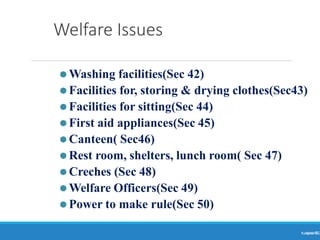
![Welfare Provision[Sec.42-50]
Ranjeet
KUMAR
50
⚫Chapter V
⚫There are a number of provisions in the
factories act regarding welfare facilities
for the workers.](https://image.slidesharecdn.com/thefactoriesact1948-110311015406-phpapp02-230615074934-75a96365/85/thefactoriesact1948-110311015406-phpapp02-pptx-50-320.jpg)
![Washing facilities[Sec.42]
Ranjeet
KUMAR
52
⚫There should be washing facilities in
every factory for the workers–separate for
male and female workers-properly
screened.
⚫conveniently accessible and shall be kept
clean.](https://image.slidesharecdn.com/thefactoriesact1948-110311015406-phpapp02-230615074934-75a96365/85/thefactoriesact1948-110311015406-phpapp02-pptx-52-320.jpg)
![Facility for storing and
drying of clothing[Sec.43]
Ranjeet
KUMAR
53
⚫There should be facility so that worker
can place their cloth not worn during the
manufacturing process.
⚫There should be facility so that worker
can dry their wet cloth.](https://image.slidesharecdn.com/thefactoriesact1948-110311015406-phpapp02-230615074934-75a96365/85/thefactoriesact1948-110311015406-phpapp02-pptx-53-320.jpg)
![Facilities for sitting[Sec.44]
Ranjeet
KUMAR
54
⚫Suitable arrangements for sitting shall
be provided and maintained for all
workers obliged to work in a standing
position
⚫If the worker can do the work by
sitting, - there should be sitting
arrangement for the worker.](https://image.slidesharecdn.com/thefactoriesact1948-110311015406-phpapp02-230615074934-75a96365/85/thefactoriesact1948-110311015406-phpapp02-pptx-54-320.jpg)
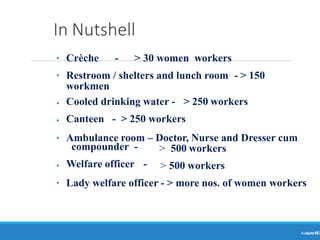
![First-aid appliances[Sec.45]
Ranjeet
KUMAR
55
⚫There should be at least 1 first aid box
for every 150 workers.
⚫It should have the prescribed contents.
⚫A responsible person should hold a
certificate on first aid treatment.
⚫An ambulance room should be there if
the number of workers is more than
500.](https://image.slidesharecdn.com/thefactoriesact1948-110311015406-phpapp02-230615074934-75a96365/85/thefactoriesact1948-110311015406-phpapp02-pptx-55-320.jpg)
![Canteen[sec.46]
Ranjeet
KUMAR
56
⚫If the number of workers is more than
250, the govt. may make rules for
canteen.
⚫The govt. may make rules regarding
foodstuff, construction, furniture,
equipment of the canteen.](https://image.slidesharecdn.com/thefactoriesact1948-110311015406-phpapp02-230615074934-75a96365/85/thefactoriesact1948-110311015406-phpapp02-pptx-56-320.jpg)
![Shelter, rest room, lunch
room[Sec.47]
Ranjeet
KUMAR
57
⚫When 150 workers are working, there
should be rest rooms, lunch room, etc.
⚫Such places should be having drinking
water facilities etc.](https://image.slidesharecdn.com/thefactoriesact1948-110311015406-phpapp02-230615074934-75a96365/85/thefactoriesact1948-110311015406-phpapp02-pptx-57-320.jpg)
![Creches[Sec.48]
Ranjeet
KUMAR
58
⚫If the number of women workers is
more than 30, there should be the
creches.
⚫It should be sufficiently lighted,
ventilated & to be under the charge of
trained women](https://image.slidesharecdn.com/thefactoriesact1948-110311015406-phpapp02-230615074934-75a96365/85/thefactoriesact1948-110311015406-phpapp02-pptx-58-320.jpg)
![Welfare Officer[Sec.49]
Ranjeet
KUMAR
59
⚫If the number of workers is 500 or
more, there should be a welfare officer
to look after the welfare of the workers.](https://image.slidesharecdn.com/thefactoriesact1948-110311015406-phpapp02-230615074934-75a96365/85/thefactoriesact1948-110311015406-phpapp02-pptx-59-320.jpg)
![Spread over[sec.56]
Ranjeet
KUMAR
64
• Inclusive of rest intervals they shall not
spread over more than 10-1/2 hours in
any day
• Inspector may increase the spread over
up to 12 hours.](https://image.slidesharecdn.com/thefactoriesact1948-110311015406-phpapp02-230615074934-75a96365/85/thefactoriesact1948-110311015406-phpapp02-pptx-64-320.jpg)
![Night Shifts[Sec.57]
⚫If shift extends beyond midnight , a
holiday for him will mean a period
of 24 hours beginning when his
shift ends.
Ranjeet
KUMAR
65](https://image.slidesharecdn.com/thefactoriesact1948-110311015406-phpapp02-230615074934-75a96365/85/thefactoriesact1948-110311015406-phpapp02-pptx-65-320.jpg)
![Prohibition Overlapping
Shifts[Sec.58]
Ranjeet
KUMAR
66
⚫Work shall not be carried in any
factory by means of system of shifts so
arranged that more than one relay of
workers is engaged in the work of same
kind at the same time.](https://image.slidesharecdn.com/thefactoriesact1948-110311015406-phpapp02-230615074934-75a96365/85/thefactoriesact1948-110311015406-phpapp02-pptx-66-320.jpg)
![Extra Wages for
Overtime[Sec.5
9]
Ranjeet
KUMAR
67
⚫If workers work for more than 9 hours
a day or more than 48 hour a week,
extra wages should be given.
⚫Wages at twice the ordinary Rate.](https://image.slidesharecdn.com/thefactoriesact1948-110311015406-phpapp02-230615074934-75a96365/85/thefactoriesact1948-110311015406-phpapp02-pptx-67-320.jpg)
![Restriction on Double
Employment[Sec.60]
Ranjeet
KUMAR
68
⚫No worker is allowed to work in any
factory on any day on which he has
already been working in any other
factory](https://image.slidesharecdn.com/thefactoriesact1948-110311015406-phpapp02-230615074934-75a96365/85/thefactoriesact1948-110311015406-phpapp02-pptx-68-320.jpg)
![Notice of periods of work
for Adult Workers[Sec.61]
Ranjeet
KUMAR
69
⚫Periods to be fixed beforehand
⚫Notice to be displayed at some
Conspicuous place.
⚫Classification of workers-Groups.
⚫Copy of Notice in Duplicate & any
change to be sent to Inspector.](https://image.slidesharecdn.com/thefactoriesact1948-110311015406-phpapp02-230615074934-75a96365/85/thefactoriesact1948-110311015406-phpapp02-pptx-69-320.jpg)
![Register of Adult
Workers[Sec.62,63]
Ranjeet
KUMAR
70
⚫The manager should maintain Register
of Adult workers showing-
- Name
- Nature of work
- The Group etc.
Of each & every Adult Worker in the
factory.
⚫The Register shall be available to the
Inspector at all time during working](https://image.slidesharecdn.com/thefactoriesact1948-110311015406-phpapp02-230615074934-75a96365/85/thefactoriesact1948-110311015406-phpapp02-pptx-70-320.jpg)
![Prohibition of
employment of young
Children[Sec.67]
Ranjeet
KUMAR
72
⚫No child who has not completed his 14th
year allowed to work in Factory.](https://image.slidesharecdn.com/thefactoriesact1948-110311015406-phpapp02-230615074934-75a96365/85/thefactoriesact1948-110311015406-phpapp02-pptx-72-320.jpg)
![Non-Adult workers to
Carry Tokens [Sec.68]
Ranjeet
KUMAR
73
A child who has completed his 14th year
may be allowed to work in factory if:-
• a) a certificate of fitness for such work
is in custody of manager of factory.
• b) Such child or adolescent carries , a
token giving a reference to such
Certificate.](https://image.slidesharecdn.com/thefactoriesact1948-110311015406-phpapp02-230615074934-75a96365/85/thefactoriesact1948-110311015406-phpapp02-pptx-73-320.jpg)
![Working Hours for Young
persons[Sec.71,72]
Ranjeet
KUMAR
75
⚫Working Hours limited to 4-1/2
⚫Not during Nights.
⚫Period of work limited to 2 shifts.
⚫Entitled to weekly Holidays.
⚫Female to work only between 6am to 7
pm.
⚫Fixation of periods of work beforehand.](https://image.slidesharecdn.com/thefactoriesact1948-110311015406-phpapp02-230615074934-75a96365/85/thefactoriesact1948-110311015406-phpapp02-pptx-75-320.jpg)
![Power to require Medical
Examination[Sec.73]
Ranjeet
KUMAR
77
Inspector has the power to direct
manager to have medical examination
of young persons working in case-
• Young Persons working without
License.
• They no longer seem to be Fit.](https://image.slidesharecdn.com/thefactoriesact1948-110311015406-phpapp02-230615074934-75a96365/85/thefactoriesact1948-110311015406-phpapp02-pptx-77-320.jpg)
![Annual Leave with
Wages[Sec.78-84(Chapter-
VIII)]
Ranjeet
KUMAR
79
• Rules:
1) Leave Entitlement-
One day for every 20/15 days of work performed in
case of adult/Child who has worked for period of 240
days.
2) Computation of Period of 240 days-
The days of lay-off, maternity leave not exceeding 12
weeks,& earned leave in previous year should be
included.
3)Discharge, Dismissal , Superannuation ,death ,
quitting of employment-
He , his heir , nominee as the case may be entitled to
wages.](https://image.slidesharecdn.com/thefactoriesact1948-110311015406-phpapp02-230615074934-75a96365/85/thefactoriesact1948-110311015406-phpapp02-pptx-79-320.jpg)
![Wages during leave
period[sec.80]
Ranjeet
KUMAR
81
⚫Worker is entitled to wages at a rate
equal to the daily average of his total
full time earnings for the days on which
he actually worked during the month
immediately proceeding his leave.](https://image.slidesharecdn.com/thefactoriesact1948-110311015406-phpapp02-230615074934-75a96365/85/thefactoriesact1948-110311015406-phpapp02-pptx-81-320.jpg)
![106]
Ranjeet
KUMAR
82](https://image.slidesharecdn.com/thefactoriesact1948-110311015406-phpapp02-230615074934-75a96365/85/thefactoriesact1948-110311015406-phpapp02-pptx-82-320.jpg)
![General Penalty for
Offences [Sec.92]
Ranjeet
KUMAR
83
⚫If there is any contravention of any of
the provisions of the act, the Occupier
& Manager each shall be Guilty &
punishable with
⚫Imprisonment for a term upto 2 years.
⚫ with a fine upto Rs.100000
⚫or with Both.](https://image.slidesharecdn.com/thefactoriesact1948-110311015406-phpapp02-230615074934-75a96365/85/thefactoriesact1948-110311015406-phpapp02-pptx-83-320.jpg)
![⚫[Sec.93] further extends, if the
contravention under section 92 continued
after conviction ,they(Manager& Occupier)
shall be punishable with further fine which
may extend to Rs. 1000 for each day on
which contravention is so continued.
Ranjeet
KUMAR
84](https://image.slidesharecdn.com/thefactoriesact1948-110311015406-phpapp02-230615074934-75a96365/85/thefactoriesact1948-110311015406-phpapp02-pptx-84-320.jpg)
![Enhanced Penalty after
Conviction[Sec.94]
Ranjeet
KUMAR
85
⚫ If a person convicted of any offence punishable
under Sec 92, is again guilty involving contravention
of same provision ,he shall be punishable with
⚫ Imprisonment for a term which may extend to 3
years.
⚫ Or fine which shall not be less than 10000
⚫ Or both.
⚫ If any contravention of provision relating to safety,
has resulted in an accident causing death /serious
bodily injury,Fine shall not be less than
Rs.35000/Rs.10000](https://image.slidesharecdn.com/thefactoriesact1948-110311015406-phpapp02-230615074934-75a96365/85/thefactoriesact1948-110311015406-phpapp02-pptx-85-320.jpg)
![Cognizance of
Offences[sec.105]
Ranjeet
KUMAR
86
⚫No court shall take cognizance of any offence
under this act except on a complaint by or
with the previous section in writing of an
Inspector.
⚫The complaint shall be filed within 3 months
of the date on which offence comes to the
knowledge of an Inspector. But it can be six
months , if offence consists of disobeying a
written order made by an Inspector.](https://image.slidesharecdn.com/thefactoriesact1948-110311015406-phpapp02-230615074934-75a96365/85/thefactoriesact1948-110311015406-phpapp02-pptx-86-320.jpg)
![Appeal[Sec.107]
⚫The manager of the Factory or the
Occupier on whom an order in
writing by an inspector has been
served, within 30 days of the notice,
can appeal against it to the
prescribed Authority.
Ranjeet
KUMAR
87](https://image.slidesharecdn.com/thefactoriesact1948-110311015406-phpapp02-230615074934-75a96365/85/thefactoriesact1948-110311015406-phpapp02-pptx-87-320.jpg)
![Display of Notices[Sec.108]
Ranjeet
KUMAR
88
⚫A notice containing Abstracts of this
Act & the rules made thereunder and
also the name & address of the
Inspector and the certifying surgeon.
⚫Shall be in English& Language
Understood by the majority of the
workers.
⚫Convenient Places or near main
Enterance.](https://image.slidesharecdn.com/thefactoriesact1948-110311015406-phpapp02-230615074934-75a96365/85/thefactoriesact1948-110311015406-phpapp02-pptx-88-320.jpg)
![Returns[Sec.110]
Ranjeet
KUMAR
89
⚫The State Govt. may make rules
requiring Owner , Occupier, Manager
of factories to submit Returns as may
be required.](https://image.slidesharecdn.com/thefactoriesact1948-110311015406-phpapp02-230615074934-75a96365/85/thefactoriesact1948-110311015406-phpapp02-pptx-89-320.jpg)
![give
directions[Sec.112,113,11
5]
Ranjeet
KUMAR
90
⚫(Sec 112) The State Govt. may make rules
providing for any matter which may be
discovered expedient In order to give effect to
the purposes of the act.
⚫(Sec 113) The central Govt. may also give
directions to the State Govt. as to carrying to
the execution of the provisions of the act.
⚫(Sec 115) provides for the publication of the
rules made under the act in the official
Gazette.](https://image.slidesharecdn.com/thefactoriesact1948-110311015406-phpapp02-230615074934-75a96365/85/thefactoriesact1948-110311015406-phpapp02-pptx-90-320.jpg)
![Restriction on Disclosure
of Information[Sec.118-
A]
Ranjeet
KUMAR
91
⚫ Every Inspector shall treat as
confidential the source of any
complaint brought to his notice on the
breach of any provision of this act.
Further he shall not disclose to
manager or occupier that the inspection
is made in pursuance of the receipt of
complaint.](https://image.slidesharecdn.com/thefactoriesact1948-110311015406-phpapp02-230615074934-75a96365/85/thefactoriesact1948-110311015406-phpapp02-pptx-91-320.jpg)