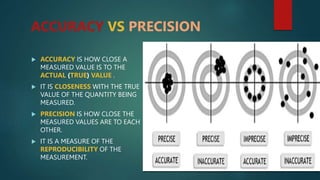
ACCURACY VS PRECISION
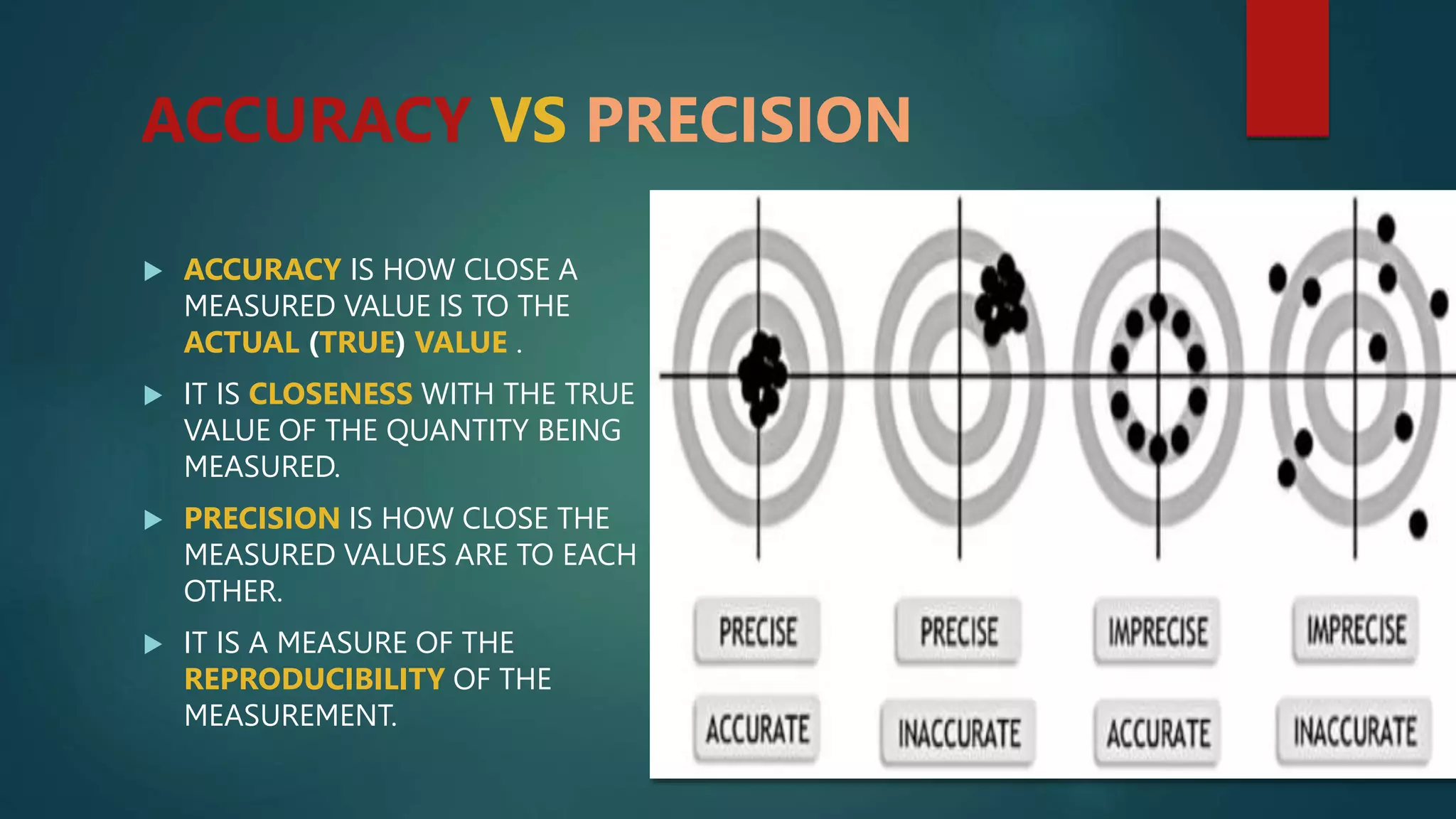
 ACCURACY IS HOW CLOSE A
MEASURED VALUE IS TO THE
ACTUAL (TRUE) VALUE .
 IT IS CLOSENESS WITH THE TRUE
VALUE OF THE QUANTITY BEING
MEASURED.
 PRECISION IS HOW CLOSE THE
MEASURED VALUES ARE TO EACH
OTHER.
 IT IS A MEASURE OF THE
REPRODUCIBILITY OF THE
MEASUREMENT.
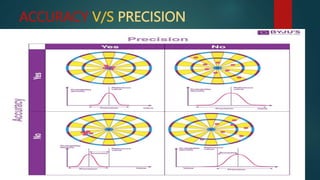
ACCURACY V/S PRECISION
ACCURACY VS PRECISION
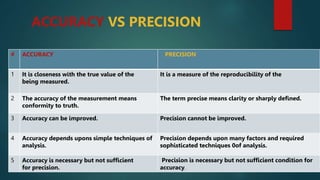
# ACCURACY PRECISION
1 It is closeness with the true value of the
being measured.
It is a measure of the reproducibility of the
2 The accuracy of the measurement means
conformity to truth.
The term precise means clarity or sharply defined.
3 Accuracy can be improved. Precision cannot be improved.
4 Accuracy depends upons simple techniques of
analysis.
Precision depends upon many factors and required
sophisticated techniques 0of analysis.
5 Accuracy is necessary but not sufficient
for precision.
Precision is necessary but not sufficient condition for
accuracy.
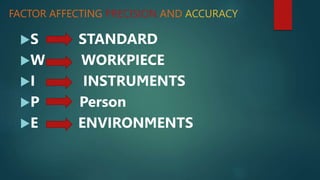
FACTOR AFFECTING PRECISION AND ACCURACY
S STANDARD
W WORKPIECE
I INSTRUMENTS
P Person
E ENVIRONMENTS
1. STANDARD
Normally the measuring instruments is calibrated
with a standard are at regular intervals. The standard
may be affected by
 Coefficient of thermal expansion
 Stability with time
 Elastic properties'
 Geometric compatibility
 Positions etc.
2. WORKPIECE
The following factors affects the accuracy
 Cleanliness surface finish etc.
 Surface Defects
 Hidden geometry
 Thermal equalization etc.
3. Instruments
The inherent characteristics of the instruments which affect the accuracy and
precision are
 Inadequate amplification
 Scale error
 Effect of friction backlash hysteresis etc.
 Deformation while handling heavy workpiece
 Calibration error
 Repeatability & readability
4. PERSON
The factors responsible for accuracy are
 Training skill
 Sense of precision appreciation
 Ability to select measuring instruments & standards
 Attitude towards personal accuracy achievement
 Planning for measurement techniques to have minimum just with
consistent in precision.
5. ENVIRONMENTS
The environments factors are
 Temperature , Pressure , Humidity
 Clean Surroundings and minimum vibrations
 Adequate illumination
 Temperature equalization between standards workpiece and instruments.
Thanks
you.

FACTORS AFFECTING PRECISION AND ACCURACY.pptx

  • 1.
    ACCURACY VS PRECISION ACCURACY IS HOW CLOSE A MEASURED VALUE IS TO THE ACTUAL (TRUE) VALUE .  IT IS CLOSENESS WITH THE TRUE VALUE OF THE QUANTITY BEING MEASURED.  PRECISION IS HOW CLOSE THE MEASURED VALUES ARE TO EACH OTHER.  IT IS A MEASURE OF THE REPRODUCIBILITY OF THE MEASUREMENT.
  • 2.
  • 3.
    ACCURACY VS PRECISION #ACCURACY PRECISION 1 It is closeness with the true value of the being measured. It is a measure of the reproducibility of the 2 The accuracy of the measurement means conformity to truth. The term precise means clarity or sharply defined. 3 Accuracy can be improved. Precision cannot be improved. 4 Accuracy depends upons simple techniques of analysis. Precision depends upon many factors and required sophisticated techniques 0of analysis. 5 Accuracy is necessary but not sufficient for precision. Precision is necessary but not sufficient condition for accuracy.
  • 4.
    FACTOR AFFECTING PRECISIONAND ACCURACY S STANDARD W WORKPIECE I INSTRUMENTS P Person E ENVIRONMENTS
  • 5.
    1. STANDARD Normally themeasuring instruments is calibrated with a standard are at regular intervals. The standard may be affected by  Coefficient of thermal expansion  Stability with time  Elastic properties'  Geometric compatibility  Positions etc.
  • 6.
    2. WORKPIECE The followingfactors affects the accuracy  Cleanliness surface finish etc.  Surface Defects  Hidden geometry  Thermal equalization etc.
  • 7.
    3. Instruments The inherentcharacteristics of the instruments which affect the accuracy and precision are  Inadequate amplification  Scale error  Effect of friction backlash hysteresis etc.  Deformation while handling heavy workpiece  Calibration error  Repeatability & readability
  • 8.
    4. PERSON The factorsresponsible for accuracy are  Training skill  Sense of precision appreciation  Ability to select measuring instruments & standards  Attitude towards personal accuracy achievement  Planning for measurement techniques to have minimum just with consistent in precision.
  • 9.
    5. ENVIRONMENTS The environmentsfactors are  Temperature , Pressure , Humidity  Clean Surroundings and minimum vibrations  Adequate illumination  Temperature equalization between standards workpiece and instruments.
  • 10.