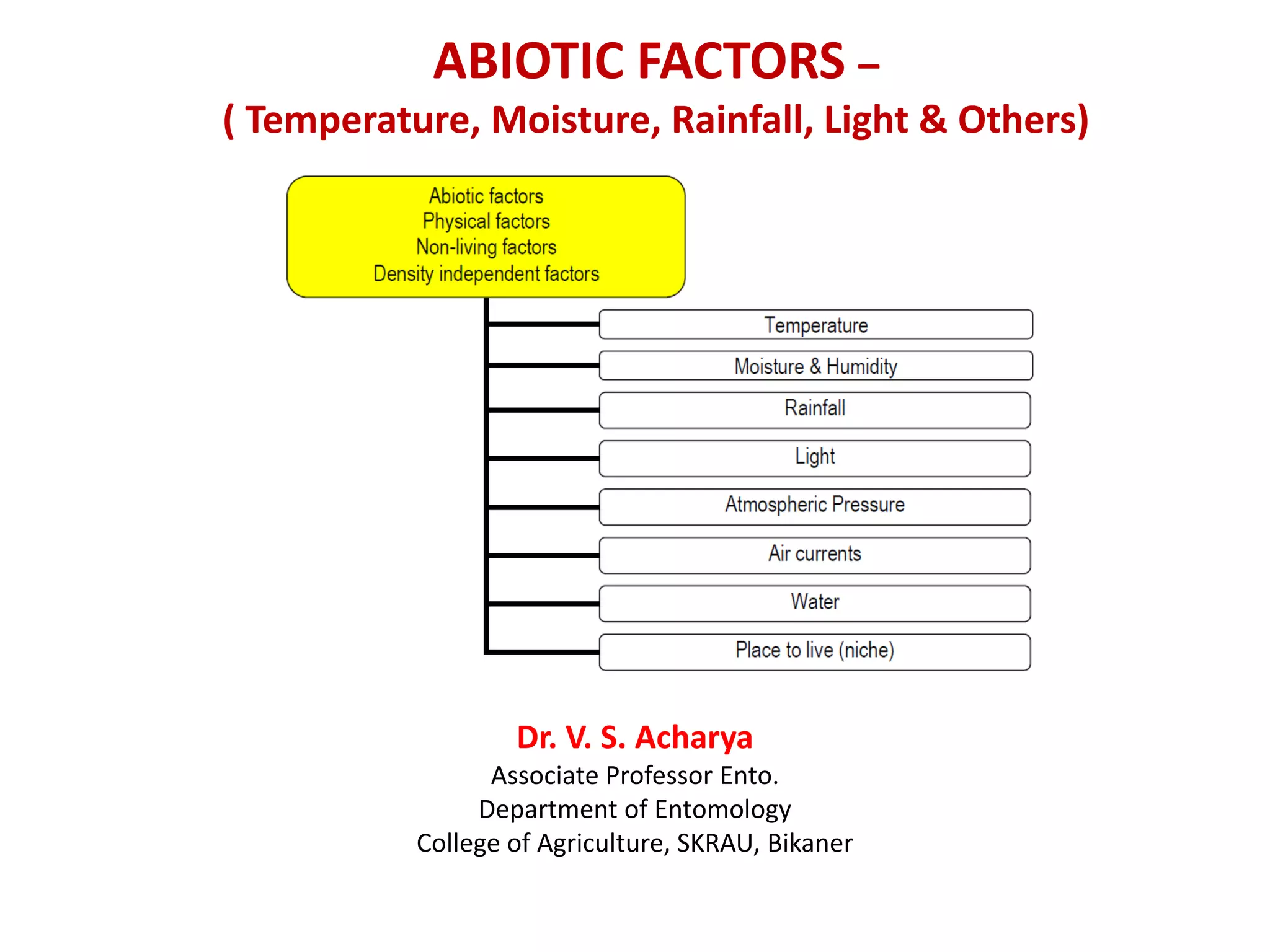
ABIOTIC FACTORS –
( Temperature, Moisture, Rainfall, Light & Others)
Dr. V. S. Acharya
Associate Professor Ento.
Department of Entomology
College of Agriculture, SKRAU, Bikaner
TEMPERATURE
• Temperature directly influences the distribution of insects in nature,
because certain amount of warmth is essential for growth and
reproduction. This is the most important physical factor of the
environment.
• It affects directly on the dispersal, distribution, movement, development,
metabolism, fecundity and reproduction which determine the abundance
of the insect and also indirectly through influence on food availability
(crops) and other environmental factors such as moisture, air movement
etc.
• With few exceptions, all the developmental activities ceases at about
0oC, similarly beyond certain high temperatures, animals cannot live. The
range of favorable temperatures for any particular species depends on the
prevailing conditions under which the insect usually lives. Generally
speaking, terrestrial animals have a wider range of favorable temperatures
than the aquatic animals.
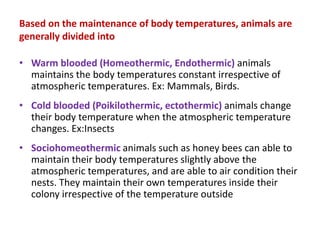
Based on the maintenance of body temperatures, animals are
generally divided into
• Warm blooded (Homeothermic, Endothermic) animals
maintains the body temperatures constant irrespective of
atmospheric temperatures. Ex: Mammals, Birds.
• Cold blooded (Poikilothermic, ectothermic) animals change
their body temperature when the atmospheric temperature
changes. Ex:Insects
• Sociohomeothermic animals such as honey bees can able to
maintain their body temperatures slightly above the
atmospheric temperatures, and are able to air condition their
nests. They maintain their own temperatures inside their
colony irrespective of the temperature outside
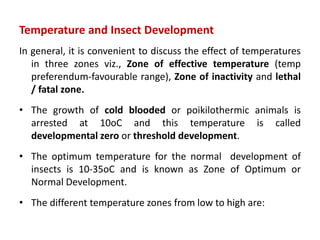
Temperature and Insect Development
In general, it is convenient to discuss the effect of temperatures
in three zones viz., Zone of effective temperature (temp
preferendum-favourable range), Zone of inactivity and lethal
/ fatal zone.
• The growth of cold blooded or poikilothermic animals is
arrested at 10oC and this temperature is called
developmental zero or threshold development.
• The optimum temperature for the normal development of
insects is 10-35oC and is known as Zone of Optimum or
Normal Development.
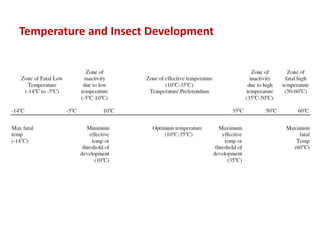
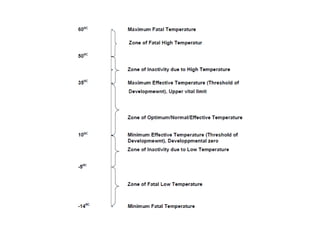
• The different temperature zones from low to high are:
Temperature and Insect Development
Zone of effective temperature (10-35oC):
• Active development takes place in this zone (temperature
preferendum);
• At minimum effective temp or threshold of development, the
development ceases and on ascending scale the development
starts, while
• At maximum effective temperature or upper vital limit or
threshold of development, the development ceases and on
descending scale the development starts.
Zone of inactivity (-5oC to 10oC, and 35oC to 50oC):
• The are the zones immediately below and above the
threshold of development, and in these zones the insect will
live but without development, and they can recover if
removed to favorable temperatures.
Zone of fatal temperatures (-5oC to -14oC, and 50oC to 60oC):
• The zone is fatal for insects, and cannot survive and die.
• If the insect is given a choice to move along a temperature
gradient, it prefers a narrow limit of temperature known as
temperature Preferendum or preferred temperature.
• Certain insects do not get freezes even the surrounding
temperatures go below the freezing point (cold
hardiness/super cooling).
• These insects have cryoprotective compounds like glycerol,
sorbitol and erythritol which help insects not forming ice
crystals in haemolymph by depressing the freezing point.
• The freezing point of most insects is between -100C to -2oC. It
is observed that when a cold-hardy insect is chilled the body
tissue do not freeze immediately.
• Dehydration also enhances the cold hardiness. The tropical
stored-grain pests lack these capabilities.
Under unfavorable temperatures, insects suspend their
activities, and these are two types.
• Hybernation is the period of suspended activity in individuals
occurring during seasonal low temperatures,
• While Aestivation is a period of suspended activity in
individuals occurring during seasonal high temperatures or in
dry season.
• This reversible inactivity can last for number of weeks during
winter and summer, respectively. As soon as the temperature
becomes moderate, these insects resume activity.
• It is claimed that a logistic curve completely expresses the
relation between the temperature and the speed of the
development.
• It has the form of a flattened letter “S” and therefore, is
called a “Sigmoid Curve”.
Temperature and Fecundity:
• In insects, fecundity (egg laying ability) is maximum at
moderately high temperatures and decline at both upper and
lower limits of favorable temperature.
• Aphids remain parthenogenetic under high temperatures and
many hours of sunshine while the opposite condition gives
rise to oviparous forms.
• If the number of days required to hatch eggs of an insect
species are plotted against the temperature at which are kept,
the points would fall along a symmetrical curve that
resembles a hyperbola.
Temperature and Insect Distribution:
• Tropical and sub-tropical conditions like in India are
favourable for distribution and establishment of insects.
• Mediterranean fruit fly Ceratitis capitata (Tephritidae-Diptera)
could not establish in England and North Europe, because it
cannot withstand temperature below 10oC.
• Mosquitoes (Culicidae-Diptera) are abundant at 70-80oF
(=10oC) but are rare at 100- 113oF (30oC).
• Cotton Pink Bollworn Pectinophora gossypiella (Gelechidae-
Lepidoptera) is serious pest and abundant in the Punjab state
where temperature is 95.5oF during August- September, and
is non-abundant in adjoining Western Pakistan due to high
temperatures, 99oC (23oC) during August-September.
Temperature and Dispersal:
• Insects tend to move away from unfavorable temperatures.
• The rice weevil Sitophilus oryzae (curculionidae:coleoptera)
found in the upper layers of storage bins, because the inner
layers are warm and it cannot tolerate beyond 32oC and
hence adults migrate to upper layers of the bins.
• Desert Locust Schistocerga gregaria (acrididae- orthoptera)
start gathering in basking groups to gain warmth and they
take flight only when the temperature near the ground is
between 17-22oC and stop migrate when the temperature
goes down to 14-16oC.
Adaptations to Temperatures (Acclimatization):
• The effect of temperature on growth can be quite
complicated or subtle.
• In other words, the reaction to a certain changed temperature
depends on whether that change has been brought gradually
or suddenly. By a gradual change, the insects become
conditioned and that conditioning is called acclimatization or
acclimation Based on the experiments conducted by various
scientists suggests that the rate of acclimatization is
dependent on the duration for which they are conditioned,
and also depends upon whether the change in temperature is
brought about suddenly or gradually.
• At high temperatures, locusts expose minimum body surface
to sun rays by lying parallel to them (changes body angle)
while they expose maximum body surface to sun rays at low
temperatures laying at right angles to them.
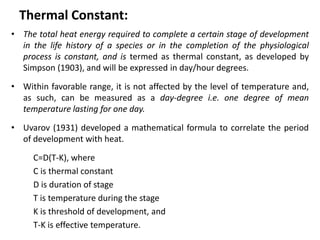
Thermal Constant:
• The total heat energy required to complete a certain stage of development
in the life history of a species or in the completion of the physiological
process is constant, and is termed as thermal constant, as developed by
Simpson (1903), and will be expressed in day/hour degrees.
• Within favorable range, it is not affected by the level of temperature and,
as such, can be measured as a day-degree i.e. one degree of mean
temperature lasting for one day.
• Uvarov (1931) developed a mathematical formula to correlate the period
of development with heat.
C=D(T-K), where
C is thermal constant
D is duration of stage
T is temperature during the stage
K is threshold of development, and
T-K is effective temperature.

Lec 2.pptx

  • 1.
    ABIOTIC FACTORS – (Temperature, Moisture, Rainfall, Light & Others) Dr. V. S. Acharya Associate Professor Ento. Department of Entomology College of Agriculture, SKRAU, Bikaner
  • 2.
    TEMPERATURE • Temperature directlyinfluences the distribution of insects in nature, because certain amount of warmth is essential for growth and reproduction. This is the most important physical factor of the environment. • It affects directly on the dispersal, distribution, movement, development, metabolism, fecundity and reproduction which determine the abundance of the insect and also indirectly through influence on food availability (crops) and other environmental factors such as moisture, air movement etc. • With few exceptions, all the developmental activities ceases at about 0oC, similarly beyond certain high temperatures, animals cannot live. The range of favorable temperatures for any particular species depends on the prevailing conditions under which the insect usually lives. Generally speaking, terrestrial animals have a wider range of favorable temperatures than the aquatic animals.
  • 3.
    Based on themaintenance of body temperatures, animals are generally divided into • Warm blooded (Homeothermic, Endothermic) animals maintains the body temperatures constant irrespective of atmospheric temperatures. Ex: Mammals, Birds. • Cold blooded (Poikilothermic, ectothermic) animals change their body temperature when the atmospheric temperature changes. Ex:Insects • Sociohomeothermic animals such as honey bees can able to maintain their body temperatures slightly above the atmospheric temperatures, and are able to air condition their nests. They maintain their own temperatures inside their colony irrespective of the temperature outside
  • 4.
    Temperature and InsectDevelopment In general, it is convenient to discuss the effect of temperatures in three zones viz., Zone of effective temperature (temp preferendum-favourable range), Zone of inactivity and lethal / fatal zone. • The growth of cold blooded or poikilothermic animals is arrested at 10oC and this temperature is called developmental zero or threshold development. • The optimum temperature for the normal development of insects is 10-35oC and is known as Zone of Optimum or Normal Development. • The different temperature zones from low to high are:
  • 5.
  • 7.
    Zone of effectivetemperature (10-35oC): • Active development takes place in this zone (temperature preferendum); • At minimum effective temp or threshold of development, the development ceases and on ascending scale the development starts, while • At maximum effective temperature or upper vital limit or threshold of development, the development ceases and on descending scale the development starts.
  • 8.
    Zone of inactivity(-5oC to 10oC, and 35oC to 50oC): • The are the zones immediately below and above the threshold of development, and in these zones the insect will live but without development, and they can recover if removed to favorable temperatures. Zone of fatal temperatures (-5oC to -14oC, and 50oC to 60oC): • The zone is fatal for insects, and cannot survive and die. • If the insect is given a choice to move along a temperature gradient, it prefers a narrow limit of temperature known as temperature Preferendum or preferred temperature.
  • 9.
    • Certain insectsdo not get freezes even the surrounding temperatures go below the freezing point (cold hardiness/super cooling). • These insects have cryoprotective compounds like glycerol, sorbitol and erythritol which help insects not forming ice crystals in haemolymph by depressing the freezing point. • The freezing point of most insects is between -100C to -2oC. It is observed that when a cold-hardy insect is chilled the body tissue do not freeze immediately. • Dehydration also enhances the cold hardiness. The tropical stored-grain pests lack these capabilities.
  • 10.
    Under unfavorable temperatures,insects suspend their activities, and these are two types. • Hybernation is the period of suspended activity in individuals occurring during seasonal low temperatures, • While Aestivation is a period of suspended activity in individuals occurring during seasonal high temperatures or in dry season. • This reversible inactivity can last for number of weeks during winter and summer, respectively. As soon as the temperature becomes moderate, these insects resume activity. • It is claimed that a logistic curve completely expresses the relation between the temperature and the speed of the development. • It has the form of a flattened letter “S” and therefore, is called a “Sigmoid Curve”.
  • 11.
    Temperature and Fecundity: •In insects, fecundity (egg laying ability) is maximum at moderately high temperatures and decline at both upper and lower limits of favorable temperature. • Aphids remain parthenogenetic under high temperatures and many hours of sunshine while the opposite condition gives rise to oviparous forms. • If the number of days required to hatch eggs of an insect species are plotted against the temperature at which are kept, the points would fall along a symmetrical curve that resembles a hyperbola.
  • 12.
    Temperature and InsectDistribution: • Tropical and sub-tropical conditions like in India are favourable for distribution and establishment of insects. • Mediterranean fruit fly Ceratitis capitata (Tephritidae-Diptera) could not establish in England and North Europe, because it cannot withstand temperature below 10oC. • Mosquitoes (Culicidae-Diptera) are abundant at 70-80oF (=10oC) but are rare at 100- 113oF (30oC). • Cotton Pink Bollworn Pectinophora gossypiella (Gelechidae- Lepidoptera) is serious pest and abundant in the Punjab state where temperature is 95.5oF during August- September, and is non-abundant in adjoining Western Pakistan due to high temperatures, 99oC (23oC) during August-September.
  • 13.
    Temperature and Dispersal: •Insects tend to move away from unfavorable temperatures. • The rice weevil Sitophilus oryzae (curculionidae:coleoptera) found in the upper layers of storage bins, because the inner layers are warm and it cannot tolerate beyond 32oC and hence adults migrate to upper layers of the bins. • Desert Locust Schistocerga gregaria (acrididae- orthoptera) start gathering in basking groups to gain warmth and they take flight only when the temperature near the ground is between 17-22oC and stop migrate when the temperature goes down to 14-16oC.
  • 14.
    Adaptations to Temperatures(Acclimatization): • The effect of temperature on growth can be quite complicated or subtle. • In other words, the reaction to a certain changed temperature depends on whether that change has been brought gradually or suddenly. By a gradual change, the insects become conditioned and that conditioning is called acclimatization or acclimation Based on the experiments conducted by various scientists suggests that the rate of acclimatization is dependent on the duration for which they are conditioned, and also depends upon whether the change in temperature is brought about suddenly or gradually. • At high temperatures, locusts expose minimum body surface to sun rays by lying parallel to them (changes body angle) while they expose maximum body surface to sun rays at low temperatures laying at right angles to them.
  • 15.
    Thermal Constant: • Thetotal heat energy required to complete a certain stage of development in the life history of a species or in the completion of the physiological process is constant, and is termed as thermal constant, as developed by Simpson (1903), and will be expressed in day/hour degrees. • Within favorable range, it is not affected by the level of temperature and, as such, can be measured as a day-degree i.e. one degree of mean temperature lasting for one day. • Uvarov (1931) developed a mathematical formula to correlate the period of development with heat. C=D(T-K), where C is thermal constant D is duration of stage T is temperature during the stage K is threshold of development, and T-K is effective temperature.