INFORMATION TECHNOLOGY
     0801291260          NISHANT KUMAR SINHA
Road Map
 Introduction to Facial Recognition Technology


                                                  INFORMATION TECHNOLOGY
 History and Development

 Identification Procedure

 Motivation

 Implementation & Performance

 Algorithm Used
INTRODUCTION
INTRODUCTION
Facial recognition is a form of computer vision


                                                  INFORMATION TECHNOLOGY
that uses faces to attempt to identify a person
or verify a person’s claimed identity.
Regardless of specific method used, the facial
recognition is accomplished in a five step
process.
HISTORY AND DEVELOPMENT
HISTORY & DEVELOPMENT
•Late 1980s: Research


                                 INFORMATION TECHNOLOGY
• Mid 1990s: Commercialization

• Current

       - Authentication
       - ID
       - Law Enforcement
HISTORY & DEVELOPMENT
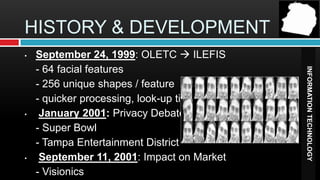
•   September 24, 1999: OLETC  ILEFIS
    - 64 facial features


                                            INFORMATION TECHNOLOGY
    - 256 unique shapes / feature
    - quicker processing, look-up time
•    January 2001: Privacy Debate
    - Super Bowl
    - Tampa Entertainment District
•    September 11, 2001: Impact on Market
    - Visionics
HISTORY & DEVELOPMENT
•September 21, 2001: Looking Ahead


                                                      INFORMATION TECHNOLOGY
      - Colorado DMV: July 2001
      - Neighborhoods (ie, Tampa Police Department)
IDENTIFICATION PROCEDURE
FACE RECOGNITION
Two types of comparison in face recognition


                                                                  INFORMATION TECHNOLOGY
1. Verification- The system compare the given individual
   with who that individual says they are.
2. Identification-The system compares a given individual to
   all the other individuals in the database and gives a ranked
   list of matches.
FOUR STAGES OF IDENTIFICATION
   Capture-Capture the behavioral sample


                                                                INFORMATION TECHNOLOGY
   Extraction-unique data is extracted from the sample and a
template is created.

   Comparison-the template is compared with a new sample.

   Match/non match-the system decides whether the new
samples are matched or not.
MOTIVATION
MOTIVATION - SECURITY
   Recognize criminals


                                                       INFORMATION TECHNOLOGY
    1. In public spaces (airports, shopping centers)
    2. In stores
   Verify identity to grant access in restricted
    areas: non-invasive Biometrics
    1.Airports
    2.Office
    3.Risk: privacy rights
MOTIVATION–HUMAN MACHINE INTERFACE
   Government Use
    1. Law enforcement


                                          INFORMATION TECHNOLOGY
    2.Security/counterterrorism
    3.Immigration
   Commercial Use
    1. Cell phones (Omron, Iphone, etc)
    2. Residential security
    3. Voter verification
    4. Banking using ATM
    5. Computers
    6. Intelligent buildings
IMPLEMENTATION & PERFORMANCE
  IMPLEMENTATION        IMPLEMENTATION
                    • False Acceptance Rate
•Data acquisition   [FAR]
•Input processing   • False Rejection Rates
                    [FRR]
•Face image
                    • Response time
classification      • Decision Threshold
•Decision making    • Enrollment time
ALGORITHM
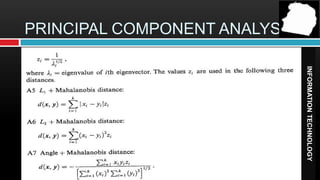
PRINCIPAL COMPONENT ANALYSIS


                               INFORMATION TECHNOLOGY
PRINCIPAL COMPONENT ANALYSIS


                               INFORMATION TECHNOLOGY
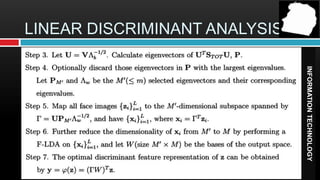
LINEAR DISCRIMINANT ANALYSIS


                               INFORMATION TECHNOLOGY
LINEAR DISCRIMINANT ANALYSIS


                               INFORMATION TECHNOLOGY
CONCLUSION
CONCLUSION
       Face recognition technologies have been associated
generally with very costly top secure applications. Today


                                                             INFORMATION TECHNOLOGY
the core technologies have evolved and the cost of
equipments is going down dramatically due to the
integration and the increasing processing power. Certain
applications of face recognition technology are now cost
effective ,reliable and highly accurate. As a result there
are no technological or financial barriers for stepping
from the pilot project to widespread deployment.

Facial Recognition Technology

  • 1.
    INFORMATION TECHNOLOGY 0801291260 NISHANT KUMAR SINHA
  • 2.
    Road Map  Introductionto Facial Recognition Technology INFORMATION TECHNOLOGY  History and Development  Identification Procedure  Motivation  Implementation & Performance  Algorithm Used
  • 3.
  • 4.
    INTRODUCTION Facial recognition isa form of computer vision INFORMATION TECHNOLOGY that uses faces to attempt to identify a person or verify a person’s claimed identity. Regardless of specific method used, the facial recognition is accomplished in a five step process.
  • 5.
  • 6.
    HISTORY & DEVELOPMENT •Late1980s: Research INFORMATION TECHNOLOGY • Mid 1990s: Commercialization • Current - Authentication - ID - Law Enforcement
  • 7.
    HISTORY & DEVELOPMENT • September 24, 1999: OLETC  ILEFIS - 64 facial features INFORMATION TECHNOLOGY - 256 unique shapes / feature - quicker processing, look-up time • January 2001: Privacy Debate - Super Bowl - Tampa Entertainment District • September 11, 2001: Impact on Market - Visionics
  • 8.
    HISTORY & DEVELOPMENT •September21, 2001: Looking Ahead INFORMATION TECHNOLOGY - Colorado DMV: July 2001 - Neighborhoods (ie, Tampa Police Department)
  • 9.
  • 10.
    FACE RECOGNITION Two typesof comparison in face recognition INFORMATION TECHNOLOGY 1. Verification- The system compare the given individual with who that individual says they are. 2. Identification-The system compares a given individual to all the other individuals in the database and gives a ranked list of matches.
  • 11.
    FOUR STAGES OFIDENTIFICATION  Capture-Capture the behavioral sample INFORMATION TECHNOLOGY  Extraction-unique data is extracted from the sample and a template is created.  Comparison-the template is compared with a new sample.  Match/non match-the system decides whether the new samples are matched or not.
  • 12.
  • 13.
    MOTIVATION - SECURITY  Recognize criminals INFORMATION TECHNOLOGY 1. In public spaces (airports, shopping centers) 2. In stores  Verify identity to grant access in restricted areas: non-invasive Biometrics 1.Airports 2.Office 3.Risk: privacy rights
  • 14.
    MOTIVATION–HUMAN MACHINE INTERFACE  Government Use 1. Law enforcement INFORMATION TECHNOLOGY 2.Security/counterterrorism 3.Immigration  Commercial Use 1. Cell phones (Omron, Iphone, etc) 2. Residential security 3. Voter verification 4. Banking using ATM 5. Computers 6. Intelligent buildings
  • 15.
  • 16.
    IMPLEMENTATION & PERFORMANCE IMPLEMENTATION IMPLEMENTATION • False Acceptance Rate •Data acquisition [FAR] •Input processing • False Rejection Rates [FRR] •Face image • Response time classification • Decision Threshold •Decision making • Enrollment time
  • 17.
  • 18.
    PRINCIPAL COMPONENT ANALYSIS INFORMATION TECHNOLOGY
  • 19.
    PRINCIPAL COMPONENT ANALYSIS INFORMATION TECHNOLOGY
  • 20.
    LINEAR DISCRIMINANT ANALYSIS INFORMATION TECHNOLOGY
  • 21.
    LINEAR DISCRIMINANT ANALYSIS INFORMATION TECHNOLOGY
  • 22.
  • 23.
    CONCLUSION Face recognition technologies have been associated generally with very costly top secure applications. Today INFORMATION TECHNOLOGY the core technologies have evolved and the cost of equipments is going down dramatically due to the integration and the increasing processing power. Certain applications of face recognition technology are now cost effective ,reliable and highly accurate. As a result there are no technological or financial barriers for stepping from the pilot project to widespread deployment.