Management of
Truamatic Facial
Nerve Paralysis
Dr. Erami M.D.
ENT Resident
Department Of ENT
Shahid Sadoghi Hospital
Yazd Iran
 Seven percent of temporal bone fractures
result in facial paralysis, and 25% of such
cases involve complete paralysis
 The latency of delay in onset of facial palsy
ranges from 1 to 16 days
 Differentiation of delayed onset from
delayed diagnosis
 delayed diagnosis :
paralytic agent and is intubated before the
examination of facial function
attention is given to other life-threatening
complications
should be treated in a manner similar to
the immediate-onset patients
choice of which patients should undergo
exploration:
 based on prognostic factors for poor outcome
predict the recovery of facial nerve
 the timing of onset (delayed vs. immediate
onset)
most important of the predictive factors
 the severity of the injury (penetrating vs.
nonpenetrating)
 the presence of associated infection
 Turner reviewed a large series of traumatic facial
paralysis patients who were treated
conservatively.
36 immediate-onset ……. 75%
34 delayed-onset …… 94%
Complete recovery occurred in 94% of the
delayed-onset cases and 75%
of immediate-onset cases
 Nash and colleagues
similarly examined conservative management
25 patients with immediate-onset…..<40%
20 patients with delayed-onset…..80%
Review of the literature argues
strongly against surgical
exploration and decompression of
delayed posttraumatic facial
paralysis
if facial function is present in the emergency
department and subsequently deteriorates, our
experience is that the patient will recover without
surgical treatment.
 degree of facial nerve injury:
also a critical factor that guides the management
algorithm
Incomplete paresis rarely fails to resolve
spontaneously
 electrodiagnostic test:
 evoked electromyography
(EEMG)
 standard electromyography (EMG)
Hilger facial nerve stimulator
 nerve excitability test (NET)
the current is increased until the threshold is reached,
which is manifested with facial twitching
 Maximal stimulation test (MST)
the intensity of the stimulus is increased until the amount
of facial contraction plateaus or is limited by patient
intolerance
In the NET
A threshold difference of 3.5 mA or greater
between the affected and nonaffected sides of the
face suggests signifiant neural degeneration
The test is most useful between 3 days and 14 after
injury in patients with dense facial paralysis to
differentiate between neurapraxic and degenerative
injuries
electrodiagnostic testing cannot reliably
differentiate a neurapraxic injury from a laceration
of the nerve for up to 3 to 5 days.
The testing is unnecessary in incomplete paralysis,
in which recovery is almost always 100%.
 EEMG has been popularized by Fisch in a
version called electroneuronography, which
differs from EEMG only in the use
of bipolar stimulating and recording electrodes.
 provide similar information to the MST, but
in an objective fashion.
 The key factor in the decision to surgically
explore a facial nerve is whether the nerve is
suspected of being severed, crushed, or impaled
with bone fragments
 Because it is not possible to differentiate a
Sunderland fith-degree injury (severed nerve)
from a third- or fourthdegree injury on the basis
of electrodiagnostic testing, exploration is
warranted only in patients with complete
immediate-onset paralysis in whom electrical
stimulability is lost
 these are the patients at risk for crushed,
partially severed, and transected nerves
 The site of injury of the facial nerve in temporal
bone fractures is in the perigeniculate region in
80% to 93% of patients
 a second lesion in the mastoid segment
 Fisch
advocates a translabyrinthine approach for
transverse fractures
and a combined transmastoid/middle cranial
fossa approach for longitudinal fractures.
 May
described a transmastoid/
supralabyrinthine approach to the region of the
geniculate ganglion for facial nerve
decompression.
 The translabyrinthine approach is :
 advocated for facial nerve exploration in patients
with profound hearing loss
 The approach provides excellentexposure for
decompression,
nerve rerouting with direct reanastomosis,
cable grafting
 otic capsule–sparing fractures with ossicular
discontinuity:
transmastoid/supralabyrinthine approach
 This approach generally requires dislocation of
the incus and ossicular reconstruction at the
completion of the operation
 If the patient has any:
1.contralateral hearing loss or
2.if the anatomy is not conducive for
supralabyrinthine exposure,
a middle cranial fossa approach is used.
 Timing of facial nerve repair:
advocates exploration when electroneuronography
indicates that 90% degeneration has occurred
within 6 days,
and he argues that decompression should be
performed early to minimize further degeneration
 May also advocates :
Early exploration; his series demonstrated a
correlation of best results with a shorter interval
between injury and repair
The range in latency to recovery of facial function
varies
from 1 day to 1 year.
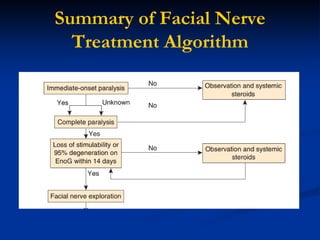
Summary of Facial Nerve
Treatment Algorithm
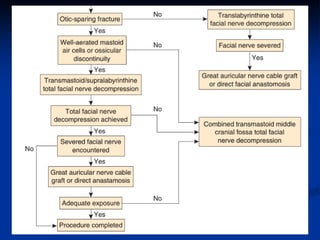
Summary of Facial Nerve
Treatment Algorithm
 patients with delayed-onset:
Unless medically contraindicated
are placed on a 2-week course of systemic
corticosteroids and are observed.
Patients with complete paralysis of immediate
onset are tested with the Hilger nerve stimulator
between days 3 and 7 after injury
Facial nerve injuries that occur in an
otic capsule–disrupting
fracture are explored via a translabyrinthine
approach
Otic capsule–sparing fractures
two surgical approaches
1.transmastoid/supralabyrinthine
2. transmastoid/middle cranial fossa
 transmastoid/supralabyrinthine:
In patients with well-aerated mastoid air-cell sys
tems or with ossicular discontinuity
 transmastoid/middle cranial fossa :
poorly aerated mastoid aircell system or if total
facial nerve decompression cannot be
achieved via the transmastoid/supralabyrinthine
 The transmastoid facial nerve decompression
begins with:
complete mastoidectomy
skeletonization of the
tegmen mastoideum superiorly,
the sigmoid sinus posteriorly
The posterior EAC wall anteriorly.
 The antrum is opened, which
exposes the short process of the incus and the
lateral semicircular canal.
The semicircular canals are then skeletonized.
The facial recess is opened, and the facial nerve is
skeletonized from the second genu to the
stylomastoid foramen
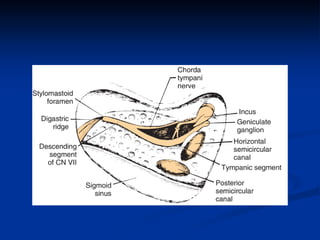
 The lateral semicircular canal and
digastric ridge are important landmarks for
identifiation of the facial nerve.
 The tympanic segment of the nerve is
immediately inferior to the lateral canal
 the anterior margin of the digastric ridge marks
the location of the stylomastoid foramen.
 The short process of the incus is identifid but
should not be disturbed by an instrument or a
rotating bur.
 The facial recess is opened with a small diamond
bur to allow visualization of the tympanic
segment of CN VII in the middle ear
 Advantages and Uses
excellent exposure of the mastoid and tympanic
segments
 Exposure of the geniculate ganglion requires
removal of the incus, which can be replaced at
the end of the operation
 The labyrinthine segment cannot be reached
unless the ampulla of the superior semicircular
canal is sacrified.
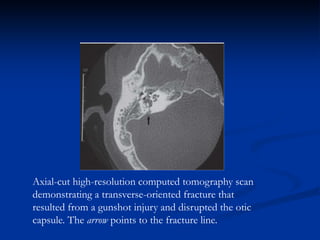
Axial-cut high-resolution computed tomography scan
demonstrating a transverse-oriented fracture that
resulted from a gunshot injury and disrupted the otic
capsule. The arrow points to the fracture line.
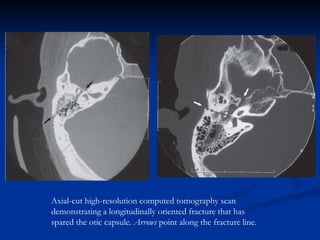
Axial-cut high-resolution computed tomography scan
demonstrating a longitudinally oriented fracture that has
spared the otic capsule. Arrows point along the fracture line.
 Majority of the patients in our series had
longitudinal fracture which was associated with
the involvement of the fallopian canal in the
perigeniculate region.
 Hematoma, multiple bone chips compression, and edema
were the main findings in our patients
 The rate of recovery within HBG I-II after total
facial nerve exploration in our short series is
70%
 Stretch, com-pression injuries with disruption of
the endoneurial tubules undetectable at the time
of surgery may be associated with suboptimal
results in our series
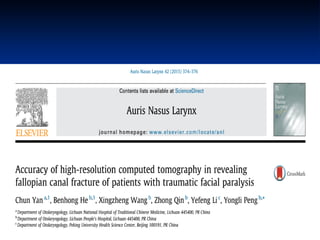
 Conclusion:
HRCT of temporal bone was able to accurately
reveal fracture of fallopian canal at geniculate
ganglion and labyrinthine segment in the vast
majority cases, but severely underestimated
fracture at pyramid segment and mastoid segment
of fallopian canal
Facial nerve paralysis Dr. M. Erami

Facial nerve paralysis Dr. M. Erami

  • 1.
    Management of Truamatic Facial NerveParalysis Dr. Erami M.D. ENT Resident Department Of ENT Shahid Sadoghi Hospital Yazd Iran
  • 2.
     Seven percentof temporal bone fractures result in facial paralysis, and 25% of such cases involve complete paralysis  The latency of delay in onset of facial palsy ranges from 1 to 16 days
  • 3.
     Differentiation ofdelayed onset from delayed diagnosis  delayed diagnosis : paralytic agent and is intubated before the examination of facial function attention is given to other life-threatening complications should be treated in a manner similar to the immediate-onset patients
  • 4.
    choice of whichpatients should undergo exploration:  based on prognostic factors for poor outcome
  • 5.
    predict the recoveryof facial nerve  the timing of onset (delayed vs. immediate onset) most important of the predictive factors  the severity of the injury (penetrating vs. nonpenetrating)  the presence of associated infection
  • 6.
     Turner revieweda large series of traumatic facial paralysis patients who were treated conservatively. 36 immediate-onset ……. 75% 34 delayed-onset …… 94% Complete recovery occurred in 94% of the delayed-onset cases and 75% of immediate-onset cases
  • 7.
     Nash andcolleagues similarly examined conservative management 25 patients with immediate-onset…..<40% 20 patients with delayed-onset…..80%
  • 8.
    Review of theliterature argues strongly against surgical exploration and decompression of delayed posttraumatic facial paralysis
  • 9.
    if facial functionis present in the emergency department and subsequently deteriorates, our experience is that the patient will recover without surgical treatment.
  • 10.
     degree offacial nerve injury: also a critical factor that guides the management algorithm Incomplete paresis rarely fails to resolve spontaneously
  • 11.
     electrodiagnostic test: evoked electromyography (EEMG)  standard electromyography (EMG) Hilger facial nerve stimulator
  • 12.
     nerve excitabilitytest (NET) the current is increased until the threshold is reached, which is manifested with facial twitching  Maximal stimulation test (MST) the intensity of the stimulus is increased until the amount of facial contraction plateaus or is limited by patient intolerance
  • 13.
    In the NET Athreshold difference of 3.5 mA or greater between the affected and nonaffected sides of the face suggests signifiant neural degeneration The test is most useful between 3 days and 14 after injury in patients with dense facial paralysis to differentiate between neurapraxic and degenerative injuries
  • 14.
    electrodiagnostic testing cannotreliably differentiate a neurapraxic injury from a laceration of the nerve for up to 3 to 5 days. The testing is unnecessary in incomplete paralysis, in which recovery is almost always 100%.
  • 15.
     EEMG hasbeen popularized by Fisch in a version called electroneuronography, which differs from EEMG only in the use of bipolar stimulating and recording electrodes.  provide similar information to the MST, but in an objective fashion.
  • 16.
     The keyfactor in the decision to surgically explore a facial nerve is whether the nerve is suspected of being severed, crushed, or impaled with bone fragments
  • 17.
     Because itis not possible to differentiate a Sunderland fith-degree injury (severed nerve) from a third- or fourthdegree injury on the basis of electrodiagnostic testing, exploration is warranted only in patients with complete immediate-onset paralysis in whom electrical stimulability is lost  these are the patients at risk for crushed, partially severed, and transected nerves
  • 18.
     The siteof injury of the facial nerve in temporal bone fractures is in the perigeniculate region in 80% to 93% of patients  a second lesion in the mastoid segment
  • 19.
     Fisch advocates atranslabyrinthine approach for transverse fractures and a combined transmastoid/middle cranial fossa approach for longitudinal fractures.
  • 20.
     May described atransmastoid/ supralabyrinthine approach to the region of the geniculate ganglion for facial nerve decompression.
  • 21.
     The translabyrinthineapproach is :  advocated for facial nerve exploration in patients with profound hearing loss  The approach provides excellentexposure for decompression, nerve rerouting with direct reanastomosis, cable grafting
  • 22.
     otic capsule–sparingfractures with ossicular discontinuity: transmastoid/supralabyrinthine approach
  • 23.
     This approachgenerally requires dislocation of the incus and ossicular reconstruction at the completion of the operation  If the patient has any: 1.contralateral hearing loss or 2.if the anatomy is not conducive for supralabyrinthine exposure, a middle cranial fossa approach is used.
  • 24.
     Timing offacial nerve repair: advocates exploration when electroneuronography indicates that 90% degeneration has occurred within 6 days, and he argues that decompression should be performed early to minimize further degeneration
  • 25.
     May alsoadvocates : Early exploration; his series demonstrated a correlation of best results with a shorter interval between injury and repair The range in latency to recovery of facial function varies from 1 day to 1 year.
  • 26.
    Summary of FacialNerve Treatment Algorithm
  • 28.
    Summary of FacialNerve Treatment Algorithm  patients with delayed-onset: Unless medically contraindicated are placed on a 2-week course of systemic corticosteroids and are observed. Patients with complete paralysis of immediate onset are tested with the Hilger nerve stimulator between days 3 and 7 after injury
  • 29.
    Facial nerve injuriesthat occur in an otic capsule–disrupting fracture are explored via a translabyrinthine approach Otic capsule–sparing fractures two surgical approaches 1.transmastoid/supralabyrinthine 2. transmastoid/middle cranial fossa
  • 30.
     transmastoid/supralabyrinthine: In patientswith well-aerated mastoid air-cell sys tems or with ossicular discontinuity  transmastoid/middle cranial fossa : poorly aerated mastoid aircell system or if total facial nerve decompression cannot be achieved via the transmastoid/supralabyrinthine
  • 31.
     The transmastoidfacial nerve decompression begins with: complete mastoidectomy skeletonization of the tegmen mastoideum superiorly, the sigmoid sinus posteriorly The posterior EAC wall anteriorly.
  • 32.
     The antrumis opened, which exposes the short process of the incus and the lateral semicircular canal. The semicircular canals are then skeletonized. The facial recess is opened, and the facial nerve is skeletonized from the second genu to the stylomastoid foramen
  • 33.
     The lateralsemicircular canal and digastric ridge are important landmarks for identifiation of the facial nerve.  The tympanic segment of the nerve is immediately inferior to the lateral canal  the anterior margin of the digastric ridge marks the location of the stylomastoid foramen.
  • 34.
     The shortprocess of the incus is identifid but should not be disturbed by an instrument or a rotating bur.  The facial recess is opened with a small diamond bur to allow visualization of the tympanic segment of CN VII in the middle ear
  • 36.
     Advantages andUses excellent exposure of the mastoid and tympanic segments  Exposure of the geniculate ganglion requires removal of the incus, which can be replaced at the end of the operation  The labyrinthine segment cannot be reached unless the ampulla of the superior semicircular canal is sacrified.
  • 37.
    Axial-cut high-resolution computedtomography scan demonstrating a transverse-oriented fracture that resulted from a gunshot injury and disrupted the otic capsule. The arrow points to the fracture line.
  • 38.
    Axial-cut high-resolution computedtomography scan demonstrating a longitudinally oriented fracture that has spared the otic capsule. Arrows point along the fracture line.
  • 40.
     Majority ofthe patients in our series had longitudinal fracture which was associated with the involvement of the fallopian canal in the perigeniculate region.  Hematoma, multiple bone chips compression, and edema were the main findings in our patients
  • 41.
     The rateof recovery within HBG I-II after total facial nerve exploration in our short series is 70%  Stretch, com-pression injuries with disruption of the endoneurial tubules undetectable at the time of surgery may be associated with suboptimal results in our series
  • 43.
     Conclusion: HRCT oftemporal bone was able to accurately reveal fracture of fallopian canal at geniculate ganglion and labyrinthine segment in the vast majority cases, but severely underestimated fracture at pyramid segment and mastoid segment of fallopian canal