Group Members
 Nitish Vishvakarma(12/PGDM/046)
 Piyush Dubey(12/PGDM/ 047)
Pragati Maity (12/PGDM/048)
Praveen Kr.Rawat (12/PGDM/049)
Priyanka Rai (12/PGDM/051)
Rachit Johri (12/PGDM/052)
Ashutosh Srivastava (12/PGDM/112)
Tripti Rai (12/PGDM/115)
INTRODUCTION
•FABINDIA was founded by John Bissell as a home furnishing
exporter in 1960 to market the traditional arts and crafts of India.
•1974 saw FABINDIA’S first retail store in Greater Kailash .
•Now it has over 170 stores across India and abroad and is managed
by his son, William Bissell.
•FABINDIA links over 80,000 craft based rural producers to modern
urban markets.
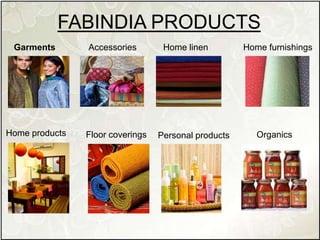
FABINDIA PRODUCTS
Garments Home furnishingsHome linenAccessories
Home products Floor coverings Personal products Organics
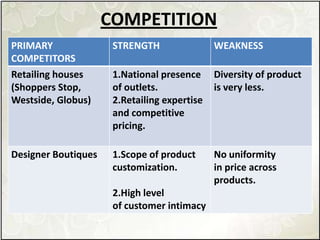
COMPETITION
PRIMARY
COMPETITORS
STRENGTH WEAKNESS
Retailing houses
(Shoppers Stop,
Westside, Globus)
1.National presence
of outlets.
2.Retailing expertise
and competitive
pricing.
Diversity of product
is very less.
Designer Boutiques 1.Scope of product
customization.
2.High level
of customer intimacy
No uniformity
in price across
products.
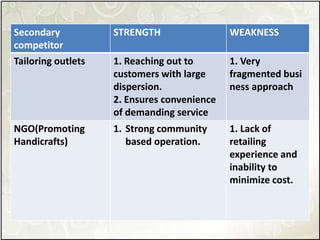
Secondary
competitor
STRENGTH WEAKNESS
Tailoring outlets 1. Reaching out to
customers with large
dispersion.
2. Ensures convenience
of demanding service
1. Very
fragmented busi
ness approach
NGO(Promoting
Handicrafts)
1. Strong community
based operation.
1. Lack of
retailing
experience and
inability to
minimize cost.
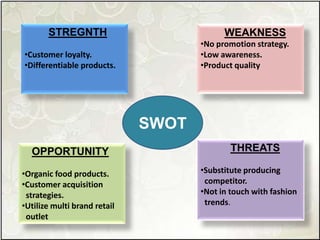
STREGNTH
•Customer loyalty.
•Differentiable products.
THREATS
•Substitute producing
competitor.
•Not in touch with fashion
trends.
OPPORTUNITY
•Organic food products.
•Customer acquisition
strategies.
•Utilize multi brand retail
outlet
WEAKNESS
•No promotion strategy.
•Low awareness.
•Product quality
SWOT
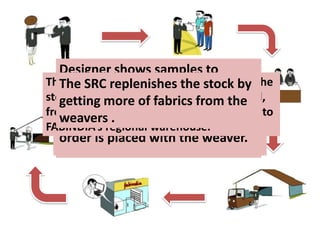
CURRENT
MARKETING STRATEGY
The weaver weaves some
yardage and show it to
the regional SRC.
The SRC calls the designers
,They approve the fabric, work
with the weavers to develop
the same samples.
Designer shows samples to
FABINDIA’S product selection
committee.
The price is then finalized and an
order is placed with the weaver.
The weaver brings
complete order to the
SRC warehouse.
Though an online order booking system, the
store manager books the quantity needed,
from the SRC warehouse the stock moves to
FABINDIA’s regional warehouse.
The SRC replenishes the stock by
getting more of fabrics from the
weavers .
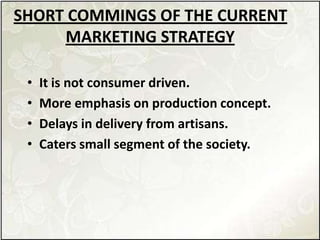
SHORT COMMINGS OF THE CURRENT
MARKETING STRATEGY
• It is not consumer driven.
• More emphasis on production concept.
• Delays in delivery from artisans.
• Caters small segment of the society.
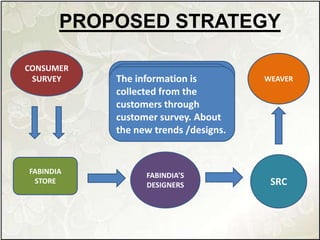
PROPOSED STRATEGY
CONSUMER
SURVEY
SRC
WEAVER
Information gained is
then absorbed by
FABINDIA Store.
FABINDIA
STORE
FABINDIA’S
DESIGNERS
Information is then
analyzed by designers
and trendy patterns
are created.
Proposed design is
then passed on to SRC.
The weaver then
produces only
proposed designs
The information is
collected from the
customers through
customer survey. About
the new trends /designs.
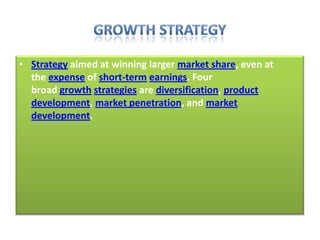
• Strategy aimed at winning larger market share, even at
the expense of short-term earnings. Four
broad growth strategies are diversification, product
development, market penetration, and market
development.
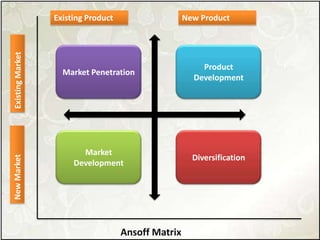
Existing Product New ProductExistingMarketNewMarket
Market Penetration
Diversification
Market
Development
Product
Development
Ansoff Matrix
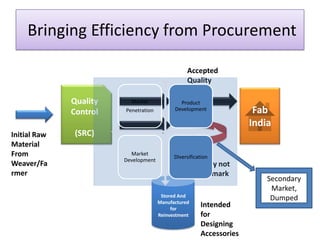
Bringing Efficiency from Procurement
Quality
Control
(SRC)
Fab
India
Initial Raw
Material
From
Weaver/Fa
rmer
Accepted
Quality
Quality not
up to mark
Stored And
Manufactured
for
Reinvestment
Intended
for
Designing
Accessories
Secondary
Market,
Dumped
Market
Penetration
Product
Development
Market
Development
Diversification
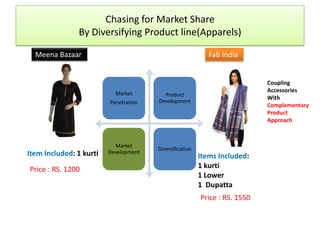
Chasing for Market Share
By Diversifying Product line(Apparels)
Meena Bazaar Fab India
Item Included: 1 kurti Items Included:
1 kurti
1 Lower
1 Dupatta
Market
Penetration
Product
Development
Market
Development
Diversification
Price : RS. 1550
Price : RS. 1200
Market
Penetration
Product
Development
Market
Development
Diversification
Coupling
Accessories
With
Complementary
Product
Approach
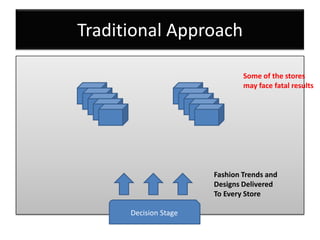
Traditional Approach
Decision Stage
Fashion Trends and
Designs Delivered
To Every Store
Some of the stores
may face fatal results
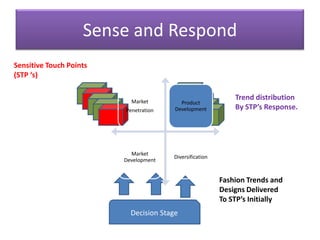
Sense and Respond
Sensitive Touch Points
(STP ‘s)
Decision Stage
Trend distribution
By STP’s Response.
Fashion Trends and
Designs Delivered
To STP’s Initially
Market
Penetration
Product
Development
Market
Development
Diversification
THANK
YOU

fab india

  • 2.
    Group Members  NitishVishvakarma(12/PGDM/046)  Piyush Dubey(12/PGDM/ 047) Pragati Maity (12/PGDM/048) Praveen Kr.Rawat (12/PGDM/049) Priyanka Rai (12/PGDM/051) Rachit Johri (12/PGDM/052) Ashutosh Srivastava (12/PGDM/112) Tripti Rai (12/PGDM/115)
  • 3.
    INTRODUCTION •FABINDIA was foundedby John Bissell as a home furnishing exporter in 1960 to market the traditional arts and crafts of India. •1974 saw FABINDIA’S first retail store in Greater Kailash . •Now it has over 170 stores across India and abroad and is managed by his son, William Bissell. •FABINDIA links over 80,000 craft based rural producers to modern urban markets.
  • 4.
    FABINDIA PRODUCTS Garments HomefurnishingsHome linenAccessories Home products Floor coverings Personal products Organics
  • 5.
    COMPETITION PRIMARY COMPETITORS STRENGTH WEAKNESS Retailing houses (ShoppersStop, Westside, Globus) 1.National presence of outlets. 2.Retailing expertise and competitive pricing. Diversity of product is very less. Designer Boutiques 1.Scope of product customization. 2.High level of customer intimacy No uniformity in price across products.
  • 6.
    Secondary competitor STRENGTH WEAKNESS Tailoring outlets1. Reaching out to customers with large dispersion. 2. Ensures convenience of demanding service 1. Very fragmented busi ness approach NGO(Promoting Handicrafts) 1. Strong community based operation. 1. Lack of retailing experience and inability to minimize cost.
  • 7.
    STREGNTH •Customer loyalty. •Differentiable products. THREATS •Substituteproducing competitor. •Not in touch with fashion trends. OPPORTUNITY •Organic food products. •Customer acquisition strategies. •Utilize multi brand retail outlet WEAKNESS •No promotion strategy. •Low awareness. •Product quality SWOT
  • 8.
  • 9.
    The weaver weavessome yardage and show it to the regional SRC. The SRC calls the designers ,They approve the fabric, work with the weavers to develop the same samples. Designer shows samples to FABINDIA’S product selection committee. The price is then finalized and an order is placed with the weaver. The weaver brings complete order to the SRC warehouse. Though an online order booking system, the store manager books the quantity needed, from the SRC warehouse the stock moves to FABINDIA’s regional warehouse. The SRC replenishes the stock by getting more of fabrics from the weavers .
  • 10.
    SHORT COMMINGS OFTHE CURRENT MARKETING STRATEGY • It is not consumer driven. • More emphasis on production concept. • Delays in delivery from artisans. • Caters small segment of the society.
  • 11.
    PROPOSED STRATEGY CONSUMER SURVEY SRC WEAVER Information gainedis then absorbed by FABINDIA Store. FABINDIA STORE FABINDIA’S DESIGNERS Information is then analyzed by designers and trendy patterns are created. Proposed design is then passed on to SRC. The weaver then produces only proposed designs The information is collected from the customers through customer survey. About the new trends /designs.
  • 12.
    • Strategy aimedat winning larger market share, even at the expense of short-term earnings. Four broad growth strategies are diversification, product development, market penetration, and market development.
  • 13.
    Existing Product NewProductExistingMarketNewMarket Market Penetration Diversification Market Development Product Development Ansoff Matrix
  • 14.
    Bringing Efficiency fromProcurement Quality Control (SRC) Fab India Initial Raw Material From Weaver/Fa rmer Accepted Quality Quality not up to mark Stored And Manufactured for Reinvestment Intended for Designing Accessories Secondary Market, Dumped Market Penetration Product Development Market Development Diversification
  • 15.
    Chasing for MarketShare By Diversifying Product line(Apparels) Meena Bazaar Fab India Item Included: 1 kurti Items Included: 1 kurti 1 Lower 1 Dupatta Market Penetration Product Development Market Development Diversification Price : RS. 1550 Price : RS. 1200 Market Penetration Product Development Market Development Diversification Coupling Accessories With Complementary Product Approach
  • 16.
    Traditional Approach Decision Stage FashionTrends and Designs Delivered To Every Store Some of the stores may face fatal results
  • 17.
    Sense and Respond SensitiveTouch Points (STP ‘s) Decision Stage Trend distribution By STP’s Response. Fashion Trends and Designs Delivered To STP’s Initially Market Penetration Product Development Market Development Diversification
  • 18.