BY:
KRISHIKARAMASWAMY (D18012)
RAMYA RAMPRAKASH (D18031)
RUHIGHOSH (D18034)
Overview
Financial Performance
Key Questions and Focus Area
Hypothesis and Assumptions
Approach
Strategies
Recommendation
Overview
Financial Data
Key Questions and Focus Area
Hypothesis and Assumptions
Overview
Financial Performance
Key Questions and Focus AreaKey Questions and Focus Area
Hypothesis and Assumptions
Approach
Strategies
Recommendation
Approach
Strategies
Recommendation
Overview
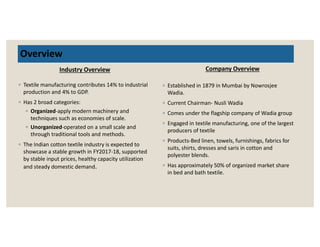
Industry Overview
◦ Textile manufacturing contributes 14% to industrial
production and 4% to GDP.
◦ Has 2 broad categories:
◦ Organized-apply modern machinery and
techniques such as economies of scale.
Unorganized-operated on a small scale and
Company Overview
◦ Established in 1879 in Mumbai by Nowrosjee
Wadia.
◦ Current Chairman- Nusli Wadia
◦ Comes under the flagship company of Wadia group
◦ Engaged in textile manufacturing, one of the largest
◦ Unorganized-operated on a small scale and
through traditional tools and methods.
◦ The Indian cotton textile industry is expected to
showcase a stable growth in FY2017-18, supported
by stable input prices, healthy capacity utilization
and steady domestic demand.
◦ Engaged in textile manufacturing, one of the largest
producers of textile
◦ Products-Bed linen, towels, furnishings, fabrics for
suits, shirts, dresses and saris in cotton and
polyester blends.
◦ Has approximately 50% of organized market share
in bed and bath textile.
Overview
Financial Data
Key Questions and Focus Area
Hypothesis and Assumptions
Overview
Financial Performance
Key Questions and Focus AreaKey Questions and Focus Area
Hypothesis and Assumptions
Approach
Strategies
Recommendation
Approach
Strategies
Recommendation
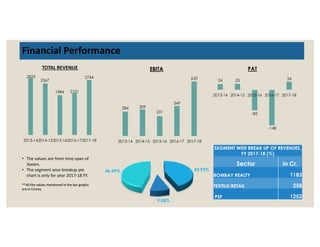
2823
2567
1984 2101
2744
TOTAL REVENUE
284 309
231
349
633
EBITA
24 25
-85
34
2013-14 2014-15 2015-16 2016-17 2017-18
PAT
Financial Performance
2013-142014-152015-162016-172017-18 2013-14 2014-15 2015-16 2016-17 2017-18
-148
43.93%
9.58%
46.49%
SEGMENT WISE BREAK UP OF REVENUES,
FY 2017-18 (%)
Sector in Cr.
BOMBAY REALTY 1183
TEXTILE/RETAIL 258
PSF 1252
• The values are from time span of
3years.
• The segment wise breakup pie
chart is only for year 2017-18 FY.
**All the values mentioned in the bar graphs**All the values mentioned in the bar graphs
are in Crores.are in Crores..
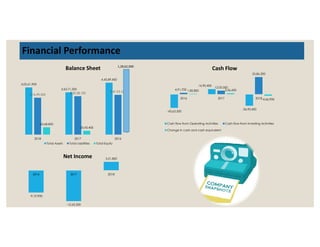
4,05,61,900
3,63,71,500
4,45,89,400
3,16,99,500
3,30,28,100 3,41,93,100
63,68,800
Balance Sheet 1,28,62,000
Financial Performance
-43,63,500
16,90,400
-36,90,400
4,91,700
12,05,000
55,86,300
1,82,800 3,56,600
-4,66,9002016 2017 2018
Cash Flow
Cash flow from Operating Activities Cash flow from Investing Activities63,68,800
33,43,400
0
2018 2017 2016
Total Assets Total Liabilities Total Equity
Cash flow from Operating Activities Cash flow from Investing Activities
Change in cash and cash equivalent
-9,10,900
-12,65,200
3,51,800
2016 2017 2018
Net Income
Overview
Financial Data
Key Questions and Focus Area
Hypothesis and Assumptions
Overview
Financial Performance
Key Questions and Focus AreaKey Questions and Focus Area
Hypothesis and Assumptions
Approach
Strategies
Recommendation
Approach
Strategies
Recommendation
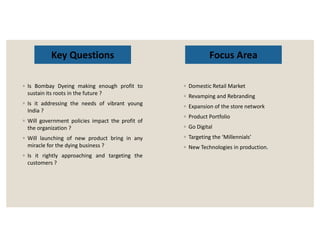
Key Questions
◦ Is Bombay Dyeing making enough profit to
sustain its roots in the future ?
◦ Is it addressing the needs of vibrant young
India ?
◦ Will government policies impact the profit of
◦ Domestic Retail Market
◦ Revamping and Rebranding
◦ Expansion of the store network
◦ Product Portfolio
◦ Go Digital
Focus Area
◦ Will government policies impact the profit of
the organization ?
◦ Will launching of new product bring in any
miracle for the dying business ?
◦ Is it rightly approaching and targeting the
customers ?
◦ Go Digital
◦ Targeting the ‘Millennials’
◦ New Technologies in production.
Overview
Financial Data
Key Questions and Focus Area
Hypothesis and Assumptions
Overview
Financial Performance
Key Questions and Focus AreaKey Questions and Focus Area
Hypothesis and Assumptions
Approach
Strategies
Recommendation
Approach
Strategies
Recommendation
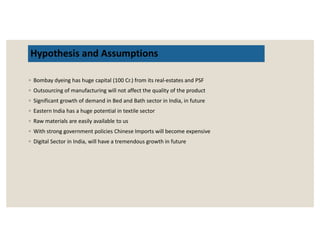
Hypothesis and Assumptions
◦ Bombay dyeing has huge capital (100 Cr.) from its real-estates and PSF
◦ Outsourcing of manufacturing will not affect the quality of the product
◦ Significant growth of demand in Bed and Bath sector in India, in future
◦ Eastern India has a huge potential in textile sector
◦ Raw materials are easily available to us◦ Raw materials are easily available to us
◦ With strong government policies Chinese Imports will become expensive
◦ Digital Sector in India, will have a tremendous growth in future
Overview
Financial Data
Key Questions and Focus Area
Hypothesis and Assumptions
Overview
Financial Performance
Key Questions and Focus AreaKey Questions and Focus Area
Hypothesis and Assumptions
Approach
Strategies
Recommendation
Approach
Strategies
Recommendation
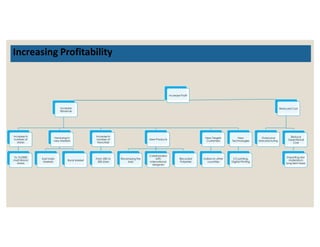
Increase Profit
Increase
Revenue
Reduced Cost
Increasing Profitability
Increase in
number of
stores
To 10,0000
mulit-Brand
stores
Venturing in
new Markets
East India
Markets
Rural Market
Increase in
number of
franchise
From 200 to
500 store
New Products
Revamping the
look
Collaboration
with
international
designers
Recycled
Polyester
New Targets
Customers
Indians in other
countries
New
Technologies
3 D printing,
Digital Printing
Outsource
Manufacturing
Reduce
Operational
Cost
Importing raw
materials in
long term basis
Overview
Financial Data
Key Questions and Focus Area
Hypothesis and Assumptions
Overview
Financial Data
Key Questions and Focus AreaKey Questions and Focus Area
Hypothesis and Assumptions
Approach
Strategies
Recommendation
Approach
Strategies
Recommendation
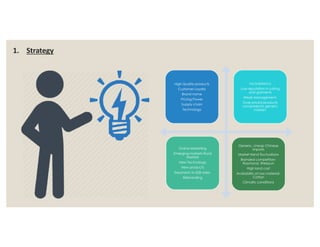
High Quality products
Customer Loyalty
Brand name
Pricing Power
Supply chain
Technology
Inconsistency
Low reputation in suiting
and garments
Weak Management.
Over priced products
compared to generic
market.
1. Strategy
Online Marketing
Emerging markets-Rural
Markets
New Technology
New products
Expansion to B2B sales.
Rebranding
Generic, cheap Chinese
imports
Market trend fluctuations
Branded competitors-
Raymond, Welspun
High land cost
Availability of raw material-
Cotton
Climatic conditions
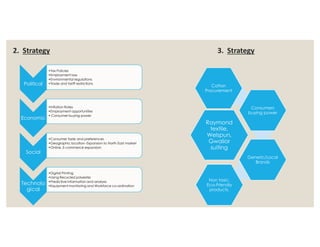
Political
•Tax Policies
•Employment law
•Environmental regulations
•Trade and tariff restrictions
Economic
•Inflation Rates
•Employment opportunities
• Consumer buying power
Raymond
Cotton
Procurement
Consumers
buying power
2. Strategy 3. Strategy
Social
•Consumer taste and preferences
•Geographic location- Expansion to North East market
•Online, E-commerce expansion
Technolo
gical
•Digital Printing
•Using Recycled polyester
•Predictive information and analysis
•Equipment monitoring and Workforce co-ordination
Raymond
textile,
Welspun,
Gwalior
suiting
Generic/Local
Brands
Non toxic,
Eco-Friendly
products.
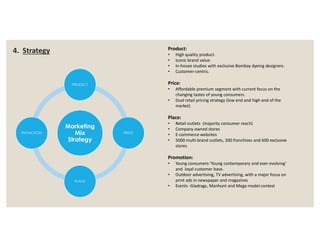
Marketing
PRODUCT
Product:
• High quality product.
• Iconic brand value.
• In-house studios with exclusive Bombay dyeing designers.
• Customer-centric.
Price:
• Affordable premium segment with current focus on the
changing tastes of young consumers.
• Dual retail pricing strategy (low end and high end of the
market)
Place:
• Retail outlets (majority consumer reach)
4. Strategy
Marketing
Mix
Strategy
PRICE
PLACE
PROMOTION
• Retail outlets (majority consumer reach)
• Company owned stores
• E-commerce websites
• 5000 multi-brand outlets, 200 franchises and 600 exclusive
stores
Promotion:
• Young consumers-'Young contemporary and ever-evolving‘
and loyal customer base.
• Outdoor advertising, TV advertising, with a major focus on
print ads in newspaper and magazines
• Events -Gladrags, Manhunt and Mega model contest
Overview
Financial Data
Key Questions and Focus Area
Hypothesis and Assumptions
Overview
Financial Performance
Key Questions and Focus AreaKey Questions and Focus Area
Hypothesis and Assumptions
Approach
Strategies
Recommendation
Approach
Strategies
Recommendation
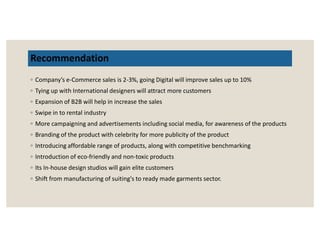
Recommendation
◦ Company’s e-Commerce sales is 2-3%, going Digital will improve sales up to 10%
◦ Tying up with International designers will attract more customers
◦ Expansion of B2B will help in increase the sales
◦ Swipe in to rental industry
◦ More campaigning and advertisements including social media, for awareness of the products◦ More campaigning and advertisements including social media, for awareness of the products
◦ Branding of the product with celebrity for more publicity of the product
◦ Introducing affordable range of products, along with competitive benchmarking
◦ Introduction of eco-friendly and non-toxic products
◦ Its In-house design studios will gain elite customers
◦ Shift from manufacturing of suiting's to ready made garments sector.
Bombay dyeing

Bombay dyeing

  • 1.
  • 2.
    Overview Financial Performance Key Questionsand Focus Area Hypothesis and Assumptions Approach Strategies Recommendation
  • 3.
    Overview Financial Data Key Questionsand Focus Area Hypothesis and Assumptions Overview Financial Performance Key Questions and Focus AreaKey Questions and Focus Area Hypothesis and Assumptions Approach Strategies Recommendation Approach Strategies Recommendation
  • 4.
    Overview Industry Overview ◦ Textilemanufacturing contributes 14% to industrial production and 4% to GDP. ◦ Has 2 broad categories: ◦ Organized-apply modern machinery and techniques such as economies of scale. Unorganized-operated on a small scale and Company Overview ◦ Established in 1879 in Mumbai by Nowrosjee Wadia. ◦ Current Chairman- Nusli Wadia ◦ Comes under the flagship company of Wadia group ◦ Engaged in textile manufacturing, one of the largest ◦ Unorganized-operated on a small scale and through traditional tools and methods. ◦ The Indian cotton textile industry is expected to showcase a stable growth in FY2017-18, supported by stable input prices, healthy capacity utilization and steady domestic demand. ◦ Engaged in textile manufacturing, one of the largest producers of textile ◦ Products-Bed linen, towels, furnishings, fabrics for suits, shirts, dresses and saris in cotton and polyester blends. ◦ Has approximately 50% of organized market share in bed and bath textile.
  • 5.
    Overview Financial Data Key Questionsand Focus Area Hypothesis and Assumptions Overview Financial Performance Key Questions and Focus AreaKey Questions and Focus Area Hypothesis and Assumptions Approach Strategies Recommendation Approach Strategies Recommendation
  • 6.
    2823 2567 1984 2101 2744 TOTAL REVENUE 284309 231 349 633 EBITA 24 25 -85 34 2013-14 2014-15 2015-16 2016-17 2017-18 PAT Financial Performance 2013-142014-152015-162016-172017-18 2013-14 2014-15 2015-16 2016-17 2017-18 -148 43.93% 9.58% 46.49% SEGMENT WISE BREAK UP OF REVENUES, FY 2017-18 (%) Sector in Cr. BOMBAY REALTY 1183 TEXTILE/RETAIL 258 PSF 1252 • The values are from time span of 3years. • The segment wise breakup pie chart is only for year 2017-18 FY. **All the values mentioned in the bar graphs**All the values mentioned in the bar graphs are in Crores.are in Crores..
  • 7.
    4,05,61,900 3,63,71,500 4,45,89,400 3,16,99,500 3,30,28,100 3,41,93,100 63,68,800 Balance Sheet1,28,62,000 Financial Performance -43,63,500 16,90,400 -36,90,400 4,91,700 12,05,000 55,86,300 1,82,800 3,56,600 -4,66,9002016 2017 2018 Cash Flow Cash flow from Operating Activities Cash flow from Investing Activities63,68,800 33,43,400 0 2018 2017 2016 Total Assets Total Liabilities Total Equity Cash flow from Operating Activities Cash flow from Investing Activities Change in cash and cash equivalent -9,10,900 -12,65,200 3,51,800 2016 2017 2018 Net Income
  • 8.
    Overview Financial Data Key Questionsand Focus Area Hypothesis and Assumptions Overview Financial Performance Key Questions and Focus AreaKey Questions and Focus Area Hypothesis and Assumptions Approach Strategies Recommendation Approach Strategies Recommendation
  • 9.
    Key Questions ◦ IsBombay Dyeing making enough profit to sustain its roots in the future ? ◦ Is it addressing the needs of vibrant young India ? ◦ Will government policies impact the profit of ◦ Domestic Retail Market ◦ Revamping and Rebranding ◦ Expansion of the store network ◦ Product Portfolio ◦ Go Digital Focus Area ◦ Will government policies impact the profit of the organization ? ◦ Will launching of new product bring in any miracle for the dying business ? ◦ Is it rightly approaching and targeting the customers ? ◦ Go Digital ◦ Targeting the ‘Millennials’ ◦ New Technologies in production.
  • 10.
    Overview Financial Data Key Questionsand Focus Area Hypothesis and Assumptions Overview Financial Performance Key Questions and Focus AreaKey Questions and Focus Area Hypothesis and Assumptions Approach Strategies Recommendation Approach Strategies Recommendation
  • 11.
    Hypothesis and Assumptions ◦Bombay dyeing has huge capital (100 Cr.) from its real-estates and PSF ◦ Outsourcing of manufacturing will not affect the quality of the product ◦ Significant growth of demand in Bed and Bath sector in India, in future ◦ Eastern India has a huge potential in textile sector ◦ Raw materials are easily available to us◦ Raw materials are easily available to us ◦ With strong government policies Chinese Imports will become expensive ◦ Digital Sector in India, will have a tremendous growth in future
  • 12.
    Overview Financial Data Key Questionsand Focus Area Hypothesis and Assumptions Overview Financial Performance Key Questions and Focus AreaKey Questions and Focus Area Hypothesis and Assumptions Approach Strategies Recommendation Approach Strategies Recommendation
  • 13.
    Increase Profit Increase Revenue Reduced Cost IncreasingProfitability Increase in number of stores To 10,0000 mulit-Brand stores Venturing in new Markets East India Markets Rural Market Increase in number of franchise From 200 to 500 store New Products Revamping the look Collaboration with international designers Recycled Polyester New Targets Customers Indians in other countries New Technologies 3 D printing, Digital Printing Outsource Manufacturing Reduce Operational Cost Importing raw materials in long term basis
  • 14.
    Overview Financial Data Key Questionsand Focus Area Hypothesis and Assumptions Overview Financial Data Key Questions and Focus AreaKey Questions and Focus Area Hypothesis and Assumptions Approach Strategies Recommendation Approach Strategies Recommendation
  • 15.
    High Quality products CustomerLoyalty Brand name Pricing Power Supply chain Technology Inconsistency Low reputation in suiting and garments Weak Management. Over priced products compared to generic market. 1. Strategy Online Marketing Emerging markets-Rural Markets New Technology New products Expansion to B2B sales. Rebranding Generic, cheap Chinese imports Market trend fluctuations Branded competitors- Raymond, Welspun High land cost Availability of raw material- Cotton Climatic conditions
  • 16.
    Political •Tax Policies •Employment law •Environmentalregulations •Trade and tariff restrictions Economic •Inflation Rates •Employment opportunities • Consumer buying power Raymond Cotton Procurement Consumers buying power 2. Strategy 3. Strategy Social •Consumer taste and preferences •Geographic location- Expansion to North East market •Online, E-commerce expansion Technolo gical •Digital Printing •Using Recycled polyester •Predictive information and analysis •Equipment monitoring and Workforce co-ordination Raymond textile, Welspun, Gwalior suiting Generic/Local Brands Non toxic, Eco-Friendly products.
  • 17.
    Marketing PRODUCT Product: • High qualityproduct. • Iconic brand value. • In-house studios with exclusive Bombay dyeing designers. • Customer-centric. Price: • Affordable premium segment with current focus on the changing tastes of young consumers. • Dual retail pricing strategy (low end and high end of the market) Place: • Retail outlets (majority consumer reach) 4. Strategy Marketing Mix Strategy PRICE PLACE PROMOTION • Retail outlets (majority consumer reach) • Company owned stores • E-commerce websites • 5000 multi-brand outlets, 200 franchises and 600 exclusive stores Promotion: • Young consumers-'Young contemporary and ever-evolving‘ and loyal customer base. • Outdoor advertising, TV advertising, with a major focus on print ads in newspaper and magazines • Events -Gladrags, Manhunt and Mega model contest
  • 18.
    Overview Financial Data Key Questionsand Focus Area Hypothesis and Assumptions Overview Financial Performance Key Questions and Focus AreaKey Questions and Focus Area Hypothesis and Assumptions Approach Strategies Recommendation Approach Strategies Recommendation
  • 19.
    Recommendation ◦ Company’s e-Commercesales is 2-3%, going Digital will improve sales up to 10% ◦ Tying up with International designers will attract more customers ◦ Expansion of B2B will help in increase the sales ◦ Swipe in to rental industry ◦ More campaigning and advertisements including social media, for awareness of the products◦ More campaigning and advertisements including social media, for awareness of the products ◦ Branding of the product with celebrity for more publicity of the product ◦ Introducing affordable range of products, along with competitive benchmarking ◦ Introduction of eco-friendly and non-toxic products ◦ Its In-house design studios will gain elite customers ◦ Shift from manufacturing of suiting's to ready made garments sector.