Eye Tracking for TV Commercial
Methodology overview & case study
4/30/2015 1EyeSee
March 2015
Case TV Commercial
4/30/2015 EyeSee 2
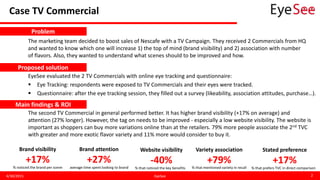
The marketing team decided to boost sales of Nescafe with a TV Campaign. They received 2 Commercials from HQ
and wanted to know which one will increase 1) the top of mind (brand visibility) and 2) association with number
of flavors. Also, they wanted to understand what scenes should to be improved and how.
Problem
EyeSee evaluated the 2 TV Commercials with online eye tracking and questionnaire:
 Eye Tracking: respondents were exposed to TV Commercials and their eyes were tracked.
 Questionnaire: after the eye tracking session, they filled out a survey (likeability, association attitudes, purchase…).
Proposed solution
Main findings & ROI
The second TV Commercial in general performed better. It has higher brand visibility (+17% on average) and
attention (27% longer). However, the tag on needs to be improved - especially a low website visibility. The website is
important as shoppers can buy more variations online than at the retailers. 79% more people associate the 2nd TVC
with greater and more exotic flavor variety and 11% more would consider to buy it.
Brand visibility
+17%
Website visibility
-40%
Brand attention
+27%
% noticed the brand per scene % that noticed the key benefitsaverage time spent looking to brand
Variety association
+79%
% that mentioned variety in recall
Stated preference
+17%
% that prefers TVC in direct comparison
Table of contents
1. About EyeSee
1. EyeSee: Explicit + Implicit insights
2. Unique proposition (online): Fast, cost effective and end2end solution
3. How it works: Remotely at home
4. Our behavioral metrics: From seen to purchase intent
5. Why EyeSee
2. Case study – Nescafe
1. Main findings and recommendations
2. Brand and product visibility over time
3. Overview of the video 1
4. Overview of the video 2
5. Questionnaire consumers evaluation
4/30/2015 EyeSee 3
Most of traditional researches use explicit methods
4/30/2015 EyeSee 4
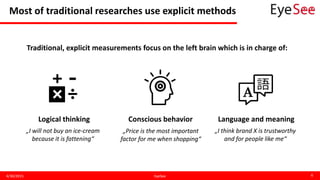
Traditional, explicit measurements focus on the left brain which is in charge of:
„Price is the most important
factor for me when shopping“
„I will not buy an ice-cream
because it is fattening“
Logical thinking Conscious behavior Language and meaning
„I think brand X is trustworthy
and for people like me“
However, the buying process is more than the left brain
4/30/2015 EyeSee 5
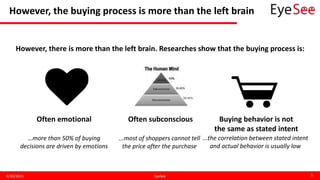
However, there is more than the left brain. Researches show that the buying process is:
...most of shoppers cannot tell
the price after the purchase
…more than 50% of buying
decisions are driven by emotions
Often emotional Often subconscious Buying behavior is not
the same as stated intent
...the correlation between stated intent
and actual behavior is usually low
EyeSee complements left brain with right brain insights
4/30/2015 EyeSee 6
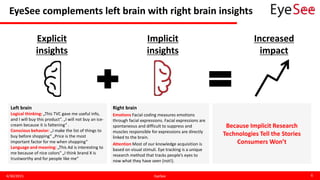
Implicit
insights
Explicit
insights
Increased
impact
Right brain
Emotions Facial coding measures emotions
through facial expressions. Facial expressions are
spontaneous and difficult to suppress and
muscles responsible for expressions are directly
linked to the brain.
Attention Most of our knowledge acquisition is
based on visual stimuli. Eye tracking is a unique
research method that tracks people’s eyes to
now what they have seen (not!).
Left brain
Logical thinking: „This TVC gave me useful info,
and I will buy this product“. „I will not buy an ice-
cream because it is fattening“ .
Conscious behavior: „I make the list of things to
buy before shopping“ „Price is the most
important factor for me when shopping“
Language and meaning: „This Ad is interesting to
me because of nice colors“ „I think brand X is
trustworthy and for people like me“
Because Implicit Research
Technologies Tell the Stories
Consumers Won’t
Unique proposition of our remote testing platform:
fast, cost effective and end2end solution
4/30/2015 EyeSee 7
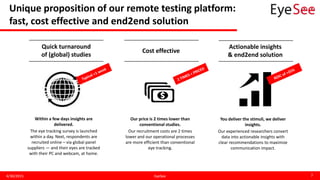
Within a few days insights are
delivered.
The eye tracking survey is launched
within a day. Next, respondents are
recruited online – via global panel
suppliers — and their eyes are tracked
with their PC and webcam, at home.
Quick turnaround
of (global) studies
Actionable insights
& end2end solution
Cost effective
You deliver the stimuli, we deliver
insights.
Our experienced researchers convert
data into actionable insights with
clear recommendations to maximize
communication impact.
Our price is 2 times lower than
conventional studies.
Our recruitment costs are 2 times
lower and our operational processes
are more efficient than conventional
eye tracking.
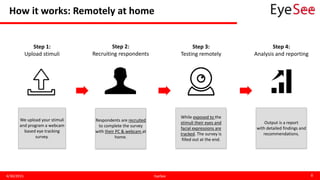
How it works: Remotely at home
4/30/2015 EyeSee 8
Step 1:
Upload stimuli
Step 2:
Recruiting respondents
Step 3:
Testing remotely
Step 4:
Analysis and reporting
We upload your stimuli
and program a webcam
based eye tracking
survey.
Respondents are recruited
to complete the survey
with their PC & webcam at
home.
While exposed to the
stimuli their eyes and
facial expressions are
tracked. The survey is
filled out at the end.
Output is a report
with detailed findings and
recommendations.
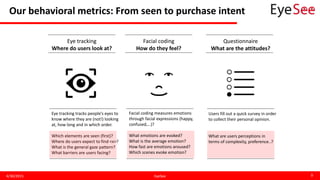
Our behavioral metrics: From seen to purchase intent
4/30/2015 EyeSee 9
Eye tracking
Where do users look at?
Eye tracking tracks people’s eyes to
know where they are (not!) looking
at, how long and in which order.
Which elements are seen (first)?
Where do users expect to find <x>?
What is the general gaze pattern?
What barriers are users facing?
Questionnaire
What are the attitudes?
Users fill out a quick survey in order
to collect their personal opinion.
What are users perceptions in
terms of complexity, preference..?
Facial coding
How do they feel?
Facial coding measures emotions
through facial expressions (happy,
confused,…)?
What emotions are evoked?
What is the average emotion?
How fast are emotions aroused?
Which scenes evoke emotion?
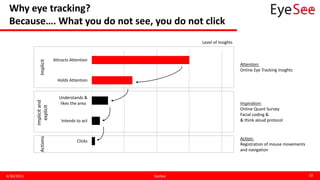
Why eye tracking?
Because…. What you do not see, you do not click
4/30/2015 EyeSee 10
Clicks
Intends to act
Understands &
likes the area
Holds Attention
Attracts Attention
Attention:
Online Eye Tracking Insights
Inspiration:
Online Quant Survey
Facial coding &
& think aloud protocol
Action:
Registration of mouse movements
and navigation
Actions
Implicitand
explicit
Implicit Level of insights
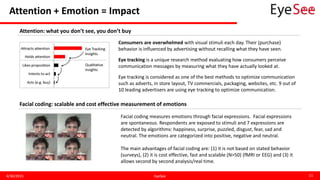
Attention + Emotion = Impact
4/30/2015 EyeSee 11
Attention: what you don’t see, you don’t buy
Consumers are overwhelmed with visual stimuli each day. Their (purchase)
behavior is influenced by advertising without recalling what they have seen.
Eye tracking is a unique research method evaluating how consumers perceive
communication messages by measuring what they have actually looked at.
Eye tracking is considered as one of the best methods to optimize communication
such as adverts, in store layout, TV commercials, packaging, websites, etc. 9 out of
10 leading advertisers are using eye tracking to optimize communication.
Facial coding: scalable and cost effective measurement of emotions
Facial coding measures emotions through facial expressions. Facial expressions
are spontaneous. Respondents are exposed to stimuli and 7 expressions are
detected by algorithms: happiness, surprise, puzzled, disgust, fear, sad and
neutral. The emotions are categorized into positive, negative and neutral.
The main advantages of facial coding are: (1) it is not based on stated behavior
(surveys), (2) it is cost effective, fast and scalable (N>50) (fMRI or EEG) and (3) it
allows second by second analysis/real time.
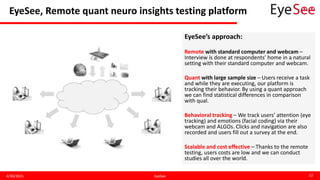
EyeSee, Remote quant neuro insights testing platform
4/30/2015 EyeSee 12
EyeSee’s approach:
Remote with standard computer and webcam –
Interview is done at respondents’ home in a natural
setting with their standard computer and webcam.
Quant with large sample size – Users receive a task
and while they are executing, our platform is
tracking their behavior. By using a quant approach
we can find statistical differences in comparison
with qual.
Behavioral tracking – We track users’ attention (eye
tracking) and emotions (facial coding) via their
webcam and ALGOs. Clicks and navigation are also
recorded and users fill out a survey at the end.
Scalable and cost effective – Thanks to the remote
testing, users costs are low and we can conduct
studies all over the world.
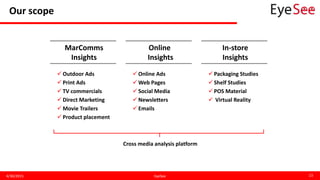
Our scope
4/30/2015 EyeSee 13
 Packaging Studies
 Shelf Studies
 POS Material
 Virtual Reality
 Online Ads
 Web Pages
 Social Media
 Newsletters
 Emails
 Outdoor Ads
 Print Ads
 TV commercials
 Direct Marketing
 Movie Trailers
 Product placement
MarComms
Insights
Cross media analysis platform
Online
Insights
In-store
Insights
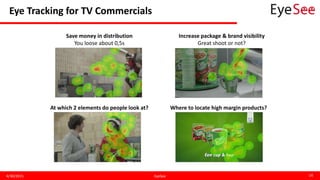
Eye Tracking for TV Commercials
4/30/2015 EyeSee 14
Save money in distribution
You loose about 0,5s
Increase package & brand visibility
Great shoot or not?
At which 2 elements do people look at? Where to locate high margin products?
Why EyeSee
4/30/2015 EyeSee 15
EyeSee: experience + unique technology = actionable insights
Experience
Unique
technology
Actionable
insights
EyeSee is working for UX, marketing and market research VPs of leading brands and
our team consists of former consultants of big MR companies. We have eye tracked
more than 10.000 respondents.
EyeSee is revolutionizing the market research industry. We have a unique platform to
track people’s eyes and facial expressions with their laptop and webcam at home,
resulting in fast and cost effective insights.
Our team consists of former market researchers of big market research companies. We
focus on actionable insights and improve marketing communication impact.
Some of our clients:
Eye Tracking for TV Commercial testing
4/30/2015 EyeSee 16
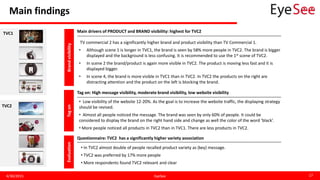
Main findings
4/30/2015 EyeSee 17
BrandvisibilityTagon
Main drivers of PRODUCT and BRAND visibility: highest for TVC2
TV commercial 2 has a significantly higher brand and product visibility than TV Commercial 1.
• Although scene 1 is longer in TVC1, the brand is seen by 58% more people in TVC2. The brand is bigger
displayed and the background is less confusing. It is recommended to use the 1st scene of TVC2.
• In scene 2 the brand/product is again more visible in TVC2. The product is moving less fast and it is
displayed bigger.
• In scene 4, the brand is more visible in TVC1 than in TVC2. In TVC2 the products on the right are
distracting attention and the product on the left is blocking the brand.
Tag on: High message visibility, moderate brand visibility, low website visibility
• Low visibility of the website 12-20%. As the goal is to increase the website traffic, the displaying strategy
should be revised.
• Almost all people noticed the message. The brand was seen by only 60% of people. It could be
considered to display the brand on the right hand side and change as well the color of the word ‘black’.
• More people noticed all products in TVC2 than in TVC1. There are less products in TVC2.
Evaluation
Questionnaire: TVC2 has a significantly higher variety association
• In TVC2 almost double of people recalled product variety as (key) message.
• TVC2 was preferred by 17% more people
• More respondents found TVC2 relevant and clear
TVC1
TVC2
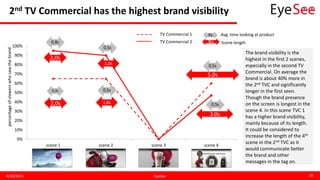
2nd TV Commercial has the highest brand visibility
4/30/2015 EyeSee 18
0%
10%
20%
30%
40%
50%
60%
70%
80%
90%
100%
scene 1 scene 2 scene 3 scene 4
2,0s
5.0s
0,8s
0,5s
Xs
Xs
Scene length
Avg. time looking at product
percentageofviewerswhosawthebrand
2,0s 1,0s
0,3s 0,5s
TV Commercial 2
TV Commercial 1
1,0s
3.0s
0,5s
0,5s
The brand visibility is the
highest in the first 2 scenes,
especially in the second TV
Commercial. On average the
brand is about 40% more in
the 2nd TVC and significantly
longer in the first seen.
Though the brand presence
on the screen is longest in the
scene 4. In this scene TVC 1
has a higher brand visibility,
mainly because of its length.
It could be considered to
increase the length of the 4th
scene in the 2nd TVC as it
would communicate better
the brand and other
messages in the tag on.
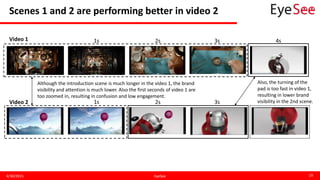
Scenes 1 and 2 are performing better in video 2
4/30/2015 EyeSee 19
Video 1
Video 2
1s
1s
2s
2s
3s
3s
4s
Although the introduction scene is much longer in the video 1, the brand
visibility and attention is much lower. Also the first seconds of video 1 are
too zoomed in, resulting in confusion and low engagement.
Also, the turning of the
pad is too fast in video 1,
resulting in lower brand
visibility in the 2nd scene.
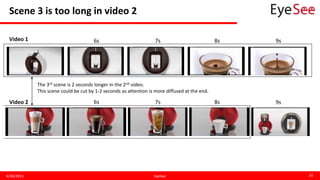
Scene 3 is too long in video 2
4/30/2015 EyeSee 20
Video 1
Video 2
6s
6s
7s
7s
8s
8s
9s
9s
The 3rd scene is 2 seconds longer in the 2nd video.
This scene could be cut by 1-2 seconds as attention is more diffused at the end.
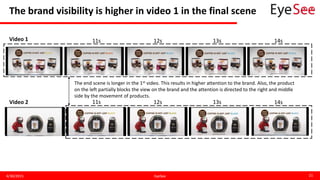
The brand visibility is higher in video 1 in the final scene
4/30/2015 EyeSee 21
Video 1
Video 2
11s
11s
12s
12s
13s
13s
14s
14s
The end scene is longer in the 1st video. This results in higher attention to the brand. Also, the product
on the left partially blocks the view on the brand and the attention is directed to the right and middle
side by the movement of products.
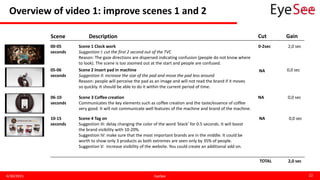
Overview of video 1: improve scenes 1 and 2
4/30/2015 EyeSee 22
Scene Description Cut Gain
00-05
seconds
Scene 1 Clock work
Suggestion I: cut the first 2 second out of the TVC
Reason: The gaze directions are dispersed indicating confusion (people do not know where
to look). The scene is too zoomed out at the start and people are confused.
0-2sec 2,0 sec
TOTAL 2,0 sec
05-06
seconds
Scene 2 Insert pad in machine
Suggestion II: increase the size of the pad and move the pad less around
Reason: people will perceive the pad as an image and will not read the brand if it moves
so quickly. It should be able to do it within the current period of time.
NA 0,0 sec
10-15
seconds
Scene 4 Tag on
Suggestion III: delay changing the color of the word ‘black’ for 0.5 seconds. It will boost
the brand visibility with 10-20%.
Suggestion IV: make sure that the most important brands are in the middle. It could be
worth to show only 3 products as both extremes are seen only by 35% of people.
Suggestion V: increase visibility of the website. You could create an additional add on.
NA 0,0 sec
06-10
seconds
Scene 3 Coffee creation
Communicates the key elements such as coffee creation and the taste/essence of coffee
very good. It will not communicate well features of the machine and brand of the machine.
NA 0,0 sec
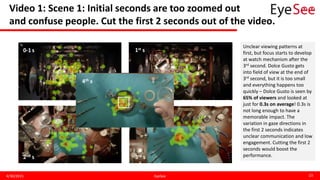
Video 1: Scene 1: Initial seconds are too zoomed out
and confuse people. Cut the first 2 seconds out of the video.
4/30/2015 EyeSee 23
Unclear viewing patterns at
first, but focus starts to develop
at watch mechanism after the
3rd second. Dolce Gusto gets
into field of view at the end of
3rd second, but it is too small
and everything happens too
quickly – Dolce Gusto is seen by
65% of viewers and looked at
just for 0.3s on average! 0.3s is
not long enough to have a
memorable impact. The
variation in gaze directions in
the first 2 seconds indicates
unclear communication and low
engagement. Cutting the first 2
seconds would boost the
performance.
0-1 s 1st s
2nd s 3rd s
4th s
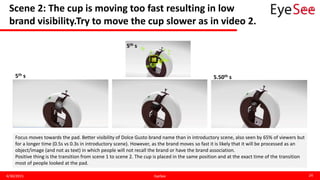
Scene 2: The cup is moving too fast resulting in low
brand visibility.Try to move the cup slower as in video 2.
4/30/2015 EyeSee 24
Focus moves towards the pad. Better visibility of Dolce Gusto brand name than in introductory scene, also seen by 65% of viewers but
for a longer time (0.5s vs 0.3s in introductory scene). However, as the brand moves so fast it is likely that it will be processed as an
object/image (and not as text) in which people will not recall the brand or have the brand association.
Positive thing is the transition from scene 1 to scene 2. The cup is placed in the same position and at the exact time of the transition
most of people looked at the pad.
5th s
5th s 5.50th s
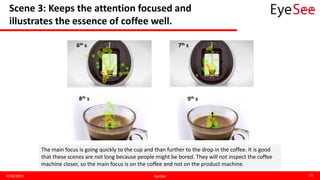
Scene 3: Keeps the attention focused and
illustrates the essence of coffee well.
4/30/2015 EyeSee 25
6th s 7th s
8th s 9th s
The main focus is going quickly to the cup and than further to the drop in the coffee. It is good
that these scenes are not long because people might be bored. They will not inspect the coffee
machine closer, so the main focus is on the coffee and not on the product machine.
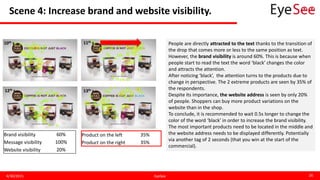
Scene 4: Increase brand and website visibility.
4/30/2015 EyeSee 26
10th s 11th s
12th s 13th s
Product on the left 35%
Product on the right 35%
Brand visibility 60%
Message visibility 100%
Website visibility 20%
People are directly attracted to the text thanks to the transition of
the drop that comes more or less to the same position as text.
However, the brand visibility is around 60%. This is because when
people start to read the text the word ‘black’ changes the color
and attracts the attention.
After noticing ‘black’, the attention turns to the products due to
change in perspective. The 2 extreme products are seen by 35% of
the respondents.
Despite its importance, the website address is seen by only 20%
of people. Shoppers can buy more product variations on the
website than in the shop.
To conclude, it is recommended to wait 0.5s longer to change the
color of the word ‘black’ in order to increase the brand visibility.
The most important products need to be located in the middle and
the website address needs to be displayed differently. Potentially
via another tag of 2 seconds (that you win at the start of the
commercial).
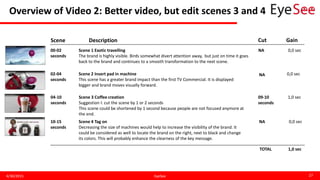
Overview of Video 2: Better video, but edit scenes 3 and 4
4/30/2015 EyeSee 27
Scene Description Cut Gain
00-02
seconds
Scene 1 Exotic travelling
The brand is highly visible. Birds somewhat divert attention away, but just on time it goes
back to the brand and continues to a smooth transformation to the next scene.
NA 0,0 sec
TOTAL 1,0 sec
02-04
seconds
Scene 2 Insert pad in machine
This scene has a greater brand impact than the first TV Commercial. It is displayed
bigger and brand moves visually forward.
NA 0,0 sec
10-15
seconds
Scene 4 Tag on
Decreasing the size of machines would help to increase the visibility of the brand. It
could be considered as well to locate the brand on the right, next to black and change
its colors. This will probably enhance the clearness of the key message.
NA 0,0 sec
04-10
seconds
Scene 3 Coffee creation
Suggestion I: cut the scene by 1 or 2 seconds
This scene could be shortened by 1 second because people are not focused anymore at
the end.
09-10
seconds
1,0 sec
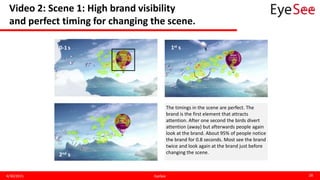
Video 2: Scene 1: High brand visibility
and perfect timing for changing the scene.
4/30/2015 EyeSee 28
0-1 s 1st s
2nd s
The timings in the scene are perfect. The
brand is the first element that attracts
attention. After one second the birds divert
attention (away) but afterwards people again
look at the brand. About 95% of people notice
the brand for 0.8 seconds. Most see the brand
twice and look again at the brand just before
changing the scene.
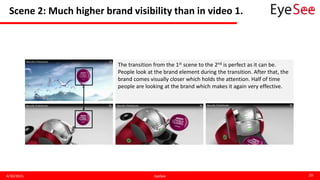
Scene 2: Much higher brand visibility than in video 1.
4/30/2015 EyeSee 29
The transition from the 1st scene to the 2nd is perfect as it can be.
People look at the brand element during the transition. After that, the
brand comes visually closer which holds the attention. Half of time
people are looking at the brand which makes it again very effective.
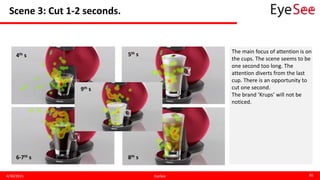
Scene 3: Cut 1-2 seconds.
4/30/2015 EyeSee 30
4th s 5th s
6-7th s 8th s
9th s
The main focus of attention is on
the cups. The scene seems to be
one second too long. The
attention diverts from the last
cup. There is an opportunity to
cut one second.
The brand ‘Krups’ will not be
noticed.
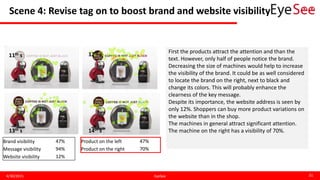
Scene 4: Revise tag on to boost brand and website visibility
4/30/2015 EyeSee 31
11th s 12th s
13th s 14th s
First the products attract the attention and than the
text. However, only half of people notice the brand.
Decreasing the size of machines would help to increase
the visibility of the brand. It could be as well considered
to locate the brand on the right, next to black and
change its colors. This will probably enhance the
clearness of the key message.
Despite its importance, the website address is seen by
only 12%. Shoppers can buy more product variations on
the website than in the shop.
The machines in general attract significant attention.
The machine on the right has a visibility of 70%.
Product on the left 47%
Product on the right 70%
Brand visibility 47%
Message visibility 94%
Website visibility 12%
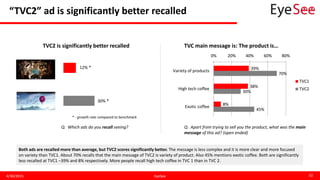
“TVC2” ad is significantly better recalled
4/30/2015 EyeSee 32
Q: Which ads do you recall seeing?
* - growth rate compared to benchmark
Q: Apart from trying to sell you the product, what was the main
message of this ad? (open ended)
TVC main message is: The product is…
Both ads are recalled more than average, but TVC2 scores significantly better. The message is less complex and it is more clear and more focused
on variety than TVC1. About 70% recalls that the main message of TVC2 is variety of product. Also 45% mentions exotic coffee. Both are significantly
less recalled at TVC1 –39% and 8% respectively. More people recall high tech coffee in TVC 1 than in TVC 2.
30% *
12% *
TVC2 is significantly better recalled
39%
38%
8%
70%
30%
45%
0% 20% 40% 60% 80%
Variety of products
High tech coffee
Exotic coffee
TVC1
TVC2
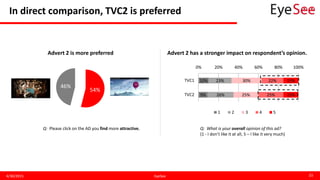
In direct comparison, TVC2 is preferred
4/30/2015 EyeSee 33
54%
46%
Q: What is your overall opinion of this ad?
(1 - I don’t like it at all, 5 – I like it very much)
Advert 2 has a stronger impact on respondent’s opinion.Advert 2 is more preferred
10%
9%
23%
26%
30%
25%
22%
25%
15%
15%
0% 20% 40% 60% 80% 100%
TVC1
TVC2
1 2 3 4 5
Q: Please click on the AD you find more attractive.
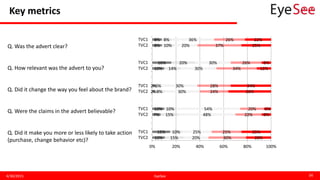
Key metrics
4/30/2015 EyeSee 34
Q. Was the advert clear?
Q. How relevant was the advert to you?
Q. Did it change the way you feel about the brand?
Q. Were the claims in the advert believable?
Q. Did it make you more or less likely to take action
(purchase, change behavior etc)? 10%
15%
7%
10%
2%
2%
10%
16%
8%
8%
15%
10%
15%
10%
8%
6%
14%
20%
10%
8%
20%
25%
48%
54%
30%
30%
30%
30%
20%
36%
30%
25%
22%
20%
24%
28%
34%
26%
37%
26%
20%
25%
8%
6%
36%
34%
12%
8%
25%
22%
0% 20% 40% 60% 80% 100%
TVC2
TVC1
TVC2
TVC1
TVC2
TVC1
TVC2
TVC1
TVC2
TVC1
Maximize marketing impact with EyeSee
It’s fast, affordable and easy!
30/04/2015 35EyeSee
Olivier Tilleuil
+1 917 960 6255
olivier.tilleuil@eyesee-research.com

TVC Eye Tracking - Example Report

  • 1.
    Eye Tracking forTV Commercial Methodology overview & case study 4/30/2015 1EyeSee March 2015
  • 2.
    Case TV Commercial 4/30/2015EyeSee 2 The marketing team decided to boost sales of Nescafe with a TV Campaign. They received 2 Commercials from HQ and wanted to know which one will increase 1) the top of mind (brand visibility) and 2) association with number of flavors. Also, they wanted to understand what scenes should to be improved and how. Problem EyeSee evaluated the 2 TV Commercials with online eye tracking and questionnaire:  Eye Tracking: respondents were exposed to TV Commercials and their eyes were tracked.  Questionnaire: after the eye tracking session, they filled out a survey (likeability, association attitudes, purchase…). Proposed solution Main findings & ROI The second TV Commercial in general performed better. It has higher brand visibility (+17% on average) and attention (27% longer). However, the tag on needs to be improved - especially a low website visibility. The website is important as shoppers can buy more variations online than at the retailers. 79% more people associate the 2nd TVC with greater and more exotic flavor variety and 11% more would consider to buy it. Brand visibility +17% Website visibility -40% Brand attention +27% % noticed the brand per scene % that noticed the key benefitsaverage time spent looking to brand Variety association +79% % that mentioned variety in recall Stated preference +17% % that prefers TVC in direct comparison
  • 3.
    Table of contents 1.About EyeSee 1. EyeSee: Explicit + Implicit insights 2. Unique proposition (online): Fast, cost effective and end2end solution 3. How it works: Remotely at home 4. Our behavioral metrics: From seen to purchase intent 5. Why EyeSee 2. Case study – Nescafe 1. Main findings and recommendations 2. Brand and product visibility over time 3. Overview of the video 1 4. Overview of the video 2 5. Questionnaire consumers evaluation 4/30/2015 EyeSee 3
  • 4.
    Most of traditionalresearches use explicit methods 4/30/2015 EyeSee 4 Traditional, explicit measurements focus on the left brain which is in charge of: „Price is the most important factor for me when shopping“ „I will not buy an ice-cream because it is fattening“ Logical thinking Conscious behavior Language and meaning „I think brand X is trustworthy and for people like me“
  • 5.
    However, the buyingprocess is more than the left brain 4/30/2015 EyeSee 5 However, there is more than the left brain. Researches show that the buying process is: ...most of shoppers cannot tell the price after the purchase …more than 50% of buying decisions are driven by emotions Often emotional Often subconscious Buying behavior is not the same as stated intent ...the correlation between stated intent and actual behavior is usually low
  • 6.
    EyeSee complements leftbrain with right brain insights 4/30/2015 EyeSee 6 Implicit insights Explicit insights Increased impact Right brain Emotions Facial coding measures emotions through facial expressions. Facial expressions are spontaneous and difficult to suppress and muscles responsible for expressions are directly linked to the brain. Attention Most of our knowledge acquisition is based on visual stimuli. Eye tracking is a unique research method that tracks people’s eyes to now what they have seen (not!). Left brain Logical thinking: „This TVC gave me useful info, and I will buy this product“. „I will not buy an ice- cream because it is fattening“ . Conscious behavior: „I make the list of things to buy before shopping“ „Price is the most important factor for me when shopping“ Language and meaning: „This Ad is interesting to me because of nice colors“ „I think brand X is trustworthy and for people like me“ Because Implicit Research Technologies Tell the Stories Consumers Won’t
  • 7.
    Unique proposition ofour remote testing platform: fast, cost effective and end2end solution 4/30/2015 EyeSee 7 Within a few days insights are delivered. The eye tracking survey is launched within a day. Next, respondents are recruited online – via global panel suppliers — and their eyes are tracked with their PC and webcam, at home. Quick turnaround of (global) studies Actionable insights & end2end solution Cost effective You deliver the stimuli, we deliver insights. Our experienced researchers convert data into actionable insights with clear recommendations to maximize communication impact. Our price is 2 times lower than conventional studies. Our recruitment costs are 2 times lower and our operational processes are more efficient than conventional eye tracking.
  • 8.
    How it works:Remotely at home 4/30/2015 EyeSee 8 Step 1: Upload stimuli Step 2: Recruiting respondents Step 3: Testing remotely Step 4: Analysis and reporting We upload your stimuli and program a webcam based eye tracking survey. Respondents are recruited to complete the survey with their PC & webcam at home. While exposed to the stimuli their eyes and facial expressions are tracked. The survey is filled out at the end. Output is a report with detailed findings and recommendations.
  • 9.
    Our behavioral metrics:From seen to purchase intent 4/30/2015 EyeSee 9 Eye tracking Where do users look at? Eye tracking tracks people’s eyes to know where they are (not!) looking at, how long and in which order. Which elements are seen (first)? Where do users expect to find <x>? What is the general gaze pattern? What barriers are users facing? Questionnaire What are the attitudes? Users fill out a quick survey in order to collect their personal opinion. What are users perceptions in terms of complexity, preference..? Facial coding How do they feel? Facial coding measures emotions through facial expressions (happy, confused,…)? What emotions are evoked? What is the average emotion? How fast are emotions aroused? Which scenes evoke emotion?
  • 10.
    Why eye tracking? Because….What you do not see, you do not click 4/30/2015 EyeSee 10 Clicks Intends to act Understands & likes the area Holds Attention Attracts Attention Attention: Online Eye Tracking Insights Inspiration: Online Quant Survey Facial coding & & think aloud protocol Action: Registration of mouse movements and navigation Actions Implicitand explicit Implicit Level of insights
  • 11.
    Attention + Emotion= Impact 4/30/2015 EyeSee 11 Attention: what you don’t see, you don’t buy Consumers are overwhelmed with visual stimuli each day. Their (purchase) behavior is influenced by advertising without recalling what they have seen. Eye tracking is a unique research method evaluating how consumers perceive communication messages by measuring what they have actually looked at. Eye tracking is considered as one of the best methods to optimize communication such as adverts, in store layout, TV commercials, packaging, websites, etc. 9 out of 10 leading advertisers are using eye tracking to optimize communication. Facial coding: scalable and cost effective measurement of emotions Facial coding measures emotions through facial expressions. Facial expressions are spontaneous. Respondents are exposed to stimuli and 7 expressions are detected by algorithms: happiness, surprise, puzzled, disgust, fear, sad and neutral. The emotions are categorized into positive, negative and neutral. The main advantages of facial coding are: (1) it is not based on stated behavior (surveys), (2) it is cost effective, fast and scalable (N>50) (fMRI or EEG) and (3) it allows second by second analysis/real time.
  • 12.
    EyeSee, Remote quantneuro insights testing platform 4/30/2015 EyeSee 12 EyeSee’s approach: Remote with standard computer and webcam – Interview is done at respondents’ home in a natural setting with their standard computer and webcam. Quant with large sample size – Users receive a task and while they are executing, our platform is tracking their behavior. By using a quant approach we can find statistical differences in comparison with qual. Behavioral tracking – We track users’ attention (eye tracking) and emotions (facial coding) via their webcam and ALGOs. Clicks and navigation are also recorded and users fill out a survey at the end. Scalable and cost effective – Thanks to the remote testing, users costs are low and we can conduct studies all over the world.
  • 13.
    Our scope 4/30/2015 EyeSee13  Packaging Studies  Shelf Studies  POS Material  Virtual Reality  Online Ads  Web Pages  Social Media  Newsletters  Emails  Outdoor Ads  Print Ads  TV commercials  Direct Marketing  Movie Trailers  Product placement MarComms Insights Cross media analysis platform Online Insights In-store Insights
  • 14.
    Eye Tracking forTV Commercials 4/30/2015 EyeSee 14 Save money in distribution You loose about 0,5s Increase package & brand visibility Great shoot or not? At which 2 elements do people look at? Where to locate high margin products?
  • 15.
    Why EyeSee 4/30/2015 EyeSee15 EyeSee: experience + unique technology = actionable insights Experience Unique technology Actionable insights EyeSee is working for UX, marketing and market research VPs of leading brands and our team consists of former consultants of big MR companies. We have eye tracked more than 10.000 respondents. EyeSee is revolutionizing the market research industry. We have a unique platform to track people’s eyes and facial expressions with their laptop and webcam at home, resulting in fast and cost effective insights. Our team consists of former market researchers of big market research companies. We focus on actionable insights and improve marketing communication impact. Some of our clients:
  • 16.
    Eye Tracking forTV Commercial testing 4/30/2015 EyeSee 16
  • 17.
    Main findings 4/30/2015 EyeSee17 BrandvisibilityTagon Main drivers of PRODUCT and BRAND visibility: highest for TVC2 TV commercial 2 has a significantly higher brand and product visibility than TV Commercial 1. • Although scene 1 is longer in TVC1, the brand is seen by 58% more people in TVC2. The brand is bigger displayed and the background is less confusing. It is recommended to use the 1st scene of TVC2. • In scene 2 the brand/product is again more visible in TVC2. The product is moving less fast and it is displayed bigger. • In scene 4, the brand is more visible in TVC1 than in TVC2. In TVC2 the products on the right are distracting attention and the product on the left is blocking the brand. Tag on: High message visibility, moderate brand visibility, low website visibility • Low visibility of the website 12-20%. As the goal is to increase the website traffic, the displaying strategy should be revised. • Almost all people noticed the message. The brand was seen by only 60% of people. It could be considered to display the brand on the right hand side and change as well the color of the word ‘black’. • More people noticed all products in TVC2 than in TVC1. There are less products in TVC2. Evaluation Questionnaire: TVC2 has a significantly higher variety association • In TVC2 almost double of people recalled product variety as (key) message. • TVC2 was preferred by 17% more people • More respondents found TVC2 relevant and clear TVC1 TVC2
  • 18.
    2nd TV Commercialhas the highest brand visibility 4/30/2015 EyeSee 18 0% 10% 20% 30% 40% 50% 60% 70% 80% 90% 100% scene 1 scene 2 scene 3 scene 4 2,0s 5.0s 0,8s 0,5s Xs Xs Scene length Avg. time looking at product percentageofviewerswhosawthebrand 2,0s 1,0s 0,3s 0,5s TV Commercial 2 TV Commercial 1 1,0s 3.0s 0,5s 0,5s The brand visibility is the highest in the first 2 scenes, especially in the second TV Commercial. On average the brand is about 40% more in the 2nd TVC and significantly longer in the first seen. Though the brand presence on the screen is longest in the scene 4. In this scene TVC 1 has a higher brand visibility, mainly because of its length. It could be considered to increase the length of the 4th scene in the 2nd TVC as it would communicate better the brand and other messages in the tag on.
  • 19.
    Scenes 1 and2 are performing better in video 2 4/30/2015 EyeSee 19 Video 1 Video 2 1s 1s 2s 2s 3s 3s 4s Although the introduction scene is much longer in the video 1, the brand visibility and attention is much lower. Also the first seconds of video 1 are too zoomed in, resulting in confusion and low engagement. Also, the turning of the pad is too fast in video 1, resulting in lower brand visibility in the 2nd scene.
  • 20.
    Scene 3 istoo long in video 2 4/30/2015 EyeSee 20 Video 1 Video 2 6s 6s 7s 7s 8s 8s 9s 9s The 3rd scene is 2 seconds longer in the 2nd video. This scene could be cut by 1-2 seconds as attention is more diffused at the end.
  • 21.
    The brand visibilityis higher in video 1 in the final scene 4/30/2015 EyeSee 21 Video 1 Video 2 11s 11s 12s 12s 13s 13s 14s 14s The end scene is longer in the 1st video. This results in higher attention to the brand. Also, the product on the left partially blocks the view on the brand and the attention is directed to the right and middle side by the movement of products.
  • 22.
    Overview of video1: improve scenes 1 and 2 4/30/2015 EyeSee 22 Scene Description Cut Gain 00-05 seconds Scene 1 Clock work Suggestion I: cut the first 2 second out of the TVC Reason: The gaze directions are dispersed indicating confusion (people do not know where to look). The scene is too zoomed out at the start and people are confused. 0-2sec 2,0 sec TOTAL 2,0 sec 05-06 seconds Scene 2 Insert pad in machine Suggestion II: increase the size of the pad and move the pad less around Reason: people will perceive the pad as an image and will not read the brand if it moves so quickly. It should be able to do it within the current period of time. NA 0,0 sec 10-15 seconds Scene 4 Tag on Suggestion III: delay changing the color of the word ‘black’ for 0.5 seconds. It will boost the brand visibility with 10-20%. Suggestion IV: make sure that the most important brands are in the middle. It could be worth to show only 3 products as both extremes are seen only by 35% of people. Suggestion V: increase visibility of the website. You could create an additional add on. NA 0,0 sec 06-10 seconds Scene 3 Coffee creation Communicates the key elements such as coffee creation and the taste/essence of coffee very good. It will not communicate well features of the machine and brand of the machine. NA 0,0 sec
  • 23.
    Video 1: Scene1: Initial seconds are too zoomed out and confuse people. Cut the first 2 seconds out of the video. 4/30/2015 EyeSee 23 Unclear viewing patterns at first, but focus starts to develop at watch mechanism after the 3rd second. Dolce Gusto gets into field of view at the end of 3rd second, but it is too small and everything happens too quickly – Dolce Gusto is seen by 65% of viewers and looked at just for 0.3s on average! 0.3s is not long enough to have a memorable impact. The variation in gaze directions in the first 2 seconds indicates unclear communication and low engagement. Cutting the first 2 seconds would boost the performance. 0-1 s 1st s 2nd s 3rd s 4th s
  • 24.
    Scene 2: Thecup is moving too fast resulting in low brand visibility.Try to move the cup slower as in video 2. 4/30/2015 EyeSee 24 Focus moves towards the pad. Better visibility of Dolce Gusto brand name than in introductory scene, also seen by 65% of viewers but for a longer time (0.5s vs 0.3s in introductory scene). However, as the brand moves so fast it is likely that it will be processed as an object/image (and not as text) in which people will not recall the brand or have the brand association. Positive thing is the transition from scene 1 to scene 2. The cup is placed in the same position and at the exact time of the transition most of people looked at the pad. 5th s 5th s 5.50th s
  • 25.
    Scene 3: Keepsthe attention focused and illustrates the essence of coffee well. 4/30/2015 EyeSee 25 6th s 7th s 8th s 9th s The main focus is going quickly to the cup and than further to the drop in the coffee. It is good that these scenes are not long because people might be bored. They will not inspect the coffee machine closer, so the main focus is on the coffee and not on the product machine.
  • 26.
    Scene 4: Increasebrand and website visibility. 4/30/2015 EyeSee 26 10th s 11th s 12th s 13th s Product on the left 35% Product on the right 35% Brand visibility 60% Message visibility 100% Website visibility 20% People are directly attracted to the text thanks to the transition of the drop that comes more or less to the same position as text. However, the brand visibility is around 60%. This is because when people start to read the text the word ‘black’ changes the color and attracts the attention. After noticing ‘black’, the attention turns to the products due to change in perspective. The 2 extreme products are seen by 35% of the respondents. Despite its importance, the website address is seen by only 20% of people. Shoppers can buy more product variations on the website than in the shop. To conclude, it is recommended to wait 0.5s longer to change the color of the word ‘black’ in order to increase the brand visibility. The most important products need to be located in the middle and the website address needs to be displayed differently. Potentially via another tag of 2 seconds (that you win at the start of the commercial).
  • 27.
    Overview of Video2: Better video, but edit scenes 3 and 4 4/30/2015 EyeSee 27 Scene Description Cut Gain 00-02 seconds Scene 1 Exotic travelling The brand is highly visible. Birds somewhat divert attention away, but just on time it goes back to the brand and continues to a smooth transformation to the next scene. NA 0,0 sec TOTAL 1,0 sec 02-04 seconds Scene 2 Insert pad in machine This scene has a greater brand impact than the first TV Commercial. It is displayed bigger and brand moves visually forward. NA 0,0 sec 10-15 seconds Scene 4 Tag on Decreasing the size of machines would help to increase the visibility of the brand. It could be considered as well to locate the brand on the right, next to black and change its colors. This will probably enhance the clearness of the key message. NA 0,0 sec 04-10 seconds Scene 3 Coffee creation Suggestion I: cut the scene by 1 or 2 seconds This scene could be shortened by 1 second because people are not focused anymore at the end. 09-10 seconds 1,0 sec
  • 28.
    Video 2: Scene1: High brand visibility and perfect timing for changing the scene. 4/30/2015 EyeSee 28 0-1 s 1st s 2nd s The timings in the scene are perfect. The brand is the first element that attracts attention. After one second the birds divert attention (away) but afterwards people again look at the brand. About 95% of people notice the brand for 0.8 seconds. Most see the brand twice and look again at the brand just before changing the scene.
  • 29.
    Scene 2: Muchhigher brand visibility than in video 1. 4/30/2015 EyeSee 29 The transition from the 1st scene to the 2nd is perfect as it can be. People look at the brand element during the transition. After that, the brand comes visually closer which holds the attention. Half of time people are looking at the brand which makes it again very effective.
  • 30.
    Scene 3: Cut1-2 seconds. 4/30/2015 EyeSee 30 4th s 5th s 6-7th s 8th s 9th s The main focus of attention is on the cups. The scene seems to be one second too long. The attention diverts from the last cup. There is an opportunity to cut one second. The brand ‘Krups’ will not be noticed.
  • 31.
    Scene 4: Revisetag on to boost brand and website visibility 4/30/2015 EyeSee 31 11th s 12th s 13th s 14th s First the products attract the attention and than the text. However, only half of people notice the brand. Decreasing the size of machines would help to increase the visibility of the brand. It could be as well considered to locate the brand on the right, next to black and change its colors. This will probably enhance the clearness of the key message. Despite its importance, the website address is seen by only 12%. Shoppers can buy more product variations on the website than in the shop. The machines in general attract significant attention. The machine on the right has a visibility of 70%. Product on the left 47% Product on the right 70% Brand visibility 47% Message visibility 94% Website visibility 12%
  • 32.
    “TVC2” ad issignificantly better recalled 4/30/2015 EyeSee 32 Q: Which ads do you recall seeing? * - growth rate compared to benchmark Q: Apart from trying to sell you the product, what was the main message of this ad? (open ended) TVC main message is: The product is… Both ads are recalled more than average, but TVC2 scores significantly better. The message is less complex and it is more clear and more focused on variety than TVC1. About 70% recalls that the main message of TVC2 is variety of product. Also 45% mentions exotic coffee. Both are significantly less recalled at TVC1 –39% and 8% respectively. More people recall high tech coffee in TVC 1 than in TVC 2. 30% * 12% * TVC2 is significantly better recalled 39% 38% 8% 70% 30% 45% 0% 20% 40% 60% 80% Variety of products High tech coffee Exotic coffee TVC1 TVC2
  • 33.
    In direct comparison,TVC2 is preferred 4/30/2015 EyeSee 33 54% 46% Q: What is your overall opinion of this ad? (1 - I don’t like it at all, 5 – I like it very much) Advert 2 has a stronger impact on respondent’s opinion.Advert 2 is more preferred 10% 9% 23% 26% 30% 25% 22% 25% 15% 15% 0% 20% 40% 60% 80% 100% TVC1 TVC2 1 2 3 4 5 Q: Please click on the AD you find more attractive.
  • 34.
    Key metrics 4/30/2015 EyeSee34 Q. Was the advert clear? Q. How relevant was the advert to you? Q. Did it change the way you feel about the brand? Q. Were the claims in the advert believable? Q. Did it make you more or less likely to take action (purchase, change behavior etc)? 10% 15% 7% 10% 2% 2% 10% 16% 8% 8% 15% 10% 15% 10% 8% 6% 14% 20% 10% 8% 20% 25% 48% 54% 30% 30% 30% 30% 20% 36% 30% 25% 22% 20% 24% 28% 34% 26% 37% 26% 20% 25% 8% 6% 36% 34% 12% 8% 25% 22% 0% 20% 40% 60% 80% 100% TVC2 TVC1 TVC2 TVC1 TVC2 TVC1 TVC2 TVC1 TVC2 TVC1
  • 35.
    Maximize marketing impactwith EyeSee It’s fast, affordable and easy! 30/04/2015 35EyeSee Olivier Tilleuil +1 917 960 6255 olivier.tilleuil@eyesee-research.com