Eye Health from A – Z
Did You Know?
75% of all blindness and vision impairment is either
preventable or treatable
Vision problems affect nearly million children in the U.S.
13.5
Students, especiallyyoung ones, may not know
that what they are experiencing is a vision problem
Leads to frustration and worsening academic performance
Start Young!
• Discovering vision problems
early on in a child’s life is an
important part of helping him
or her do well in school.
• Avoid frustration
• Make reading easier
• Make learning more
enjoyable
• In the case of some vision
conditions, early detection
and treatment is the only way
to prevent loss of sight in the
afflictedeye
Common Eye Disorders in Children
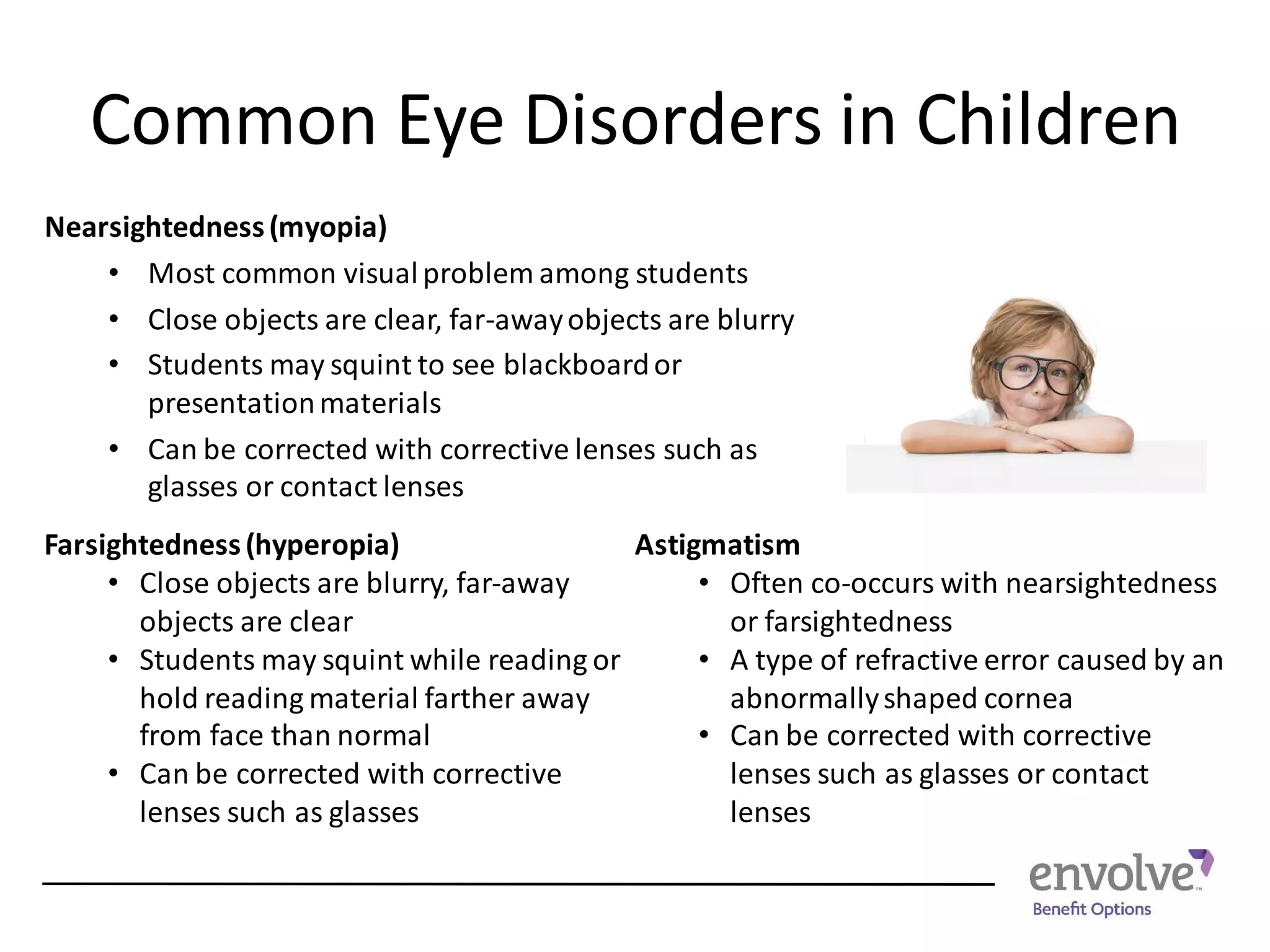
Nearsightedness(myopia)
• Most common visualproblem among students
• Close objects are clear, far-awayobjects are blurry
• Students may squint to see blackboardor
presentationmaterials
• Can be corrected with corrective lenses such as
glasses or contact lenses
Farsightedness(hyperopia)
• Close objects are blurry, far-away
objects are clear
• Students may squint while reading or
hold reading material farther away
from face than normal
• Can be corrected with corrective
lenses such as glasses
Astigmatism
• Often co-occurs with nearsightedness
or farsightedness
• A type of refractive error caused by an
abnormallyshaped cornea
• Can be corrected with corrective
lenses such as glasses or contact
lenses
Common Eye Disorders in Children
Strabismus
• Issue with eye muscles
• Student’seyes appearto be
focusing on two different points
• Often co-occurs with amblyopia
• Glasses or eye muscle exercises
can treat strabismus. Sometimes
surgery is needed.
Lazy Eye (Amblyopia)
• One eye is stronger than the other
• Student may show signs of
strabismus, but the two do not
alwaysco-occur
• Over time, the brainmay begin to
disregard signals from the weaker
eye
• If it is not detected early,
amblyopiacan lead to a
permanent loss of sight in the
weaker eye
• This disorder is only detectable
through an eye exam from an
optometrist or ophthalmologist
Common Eye Disorders In Seniors
• By age 65, one in three Americans have some vision-impairing eye
disease
• Most don’t know it—often there are no early warning signs
• Poor sight is not a natural part of aging
• You can take measures to
preserve your sight
• Have eye disease detected and
treated early
• Visit an eye doctor at least every
1-2 years
Common Eye Conditions in Seniors
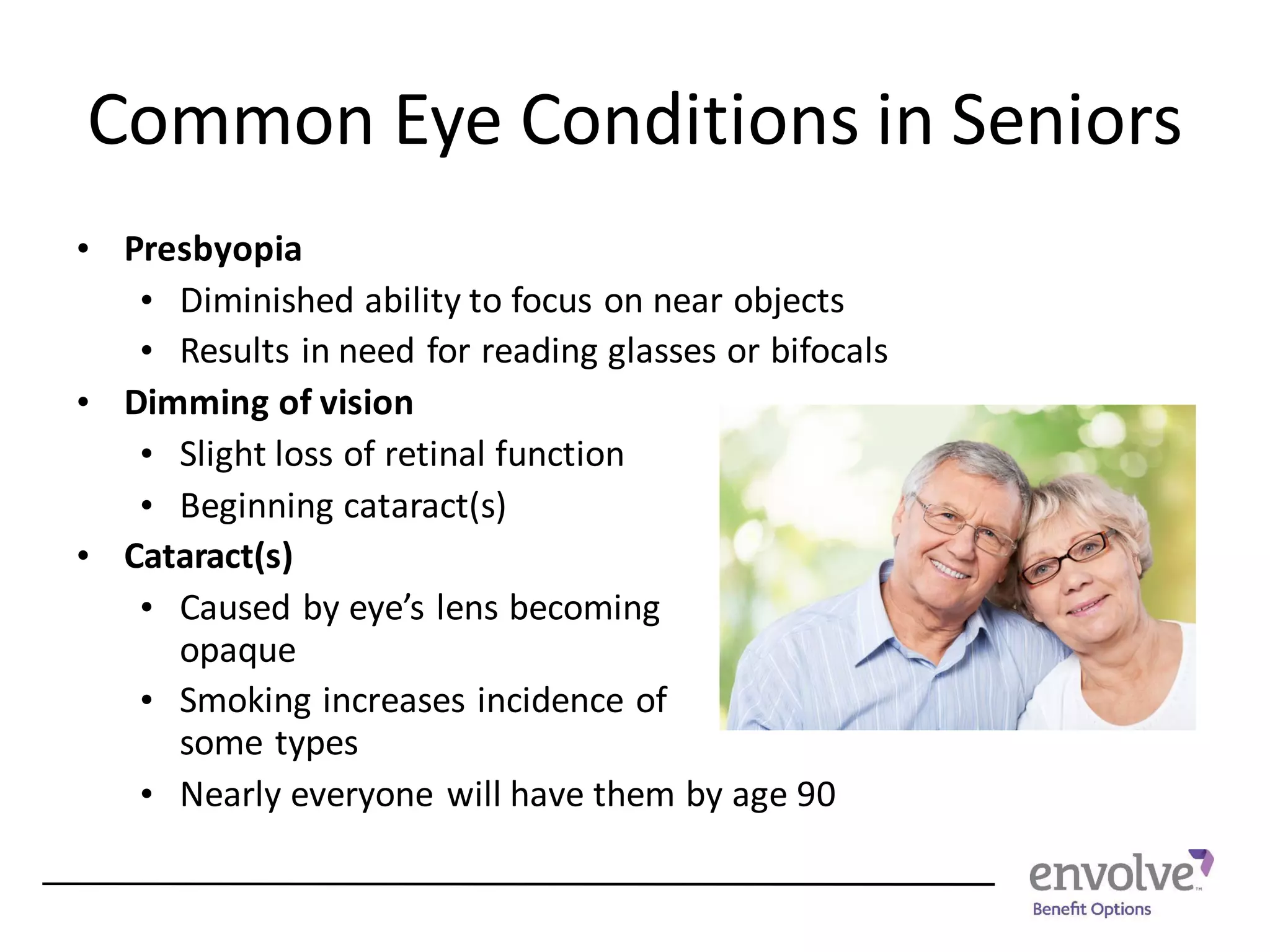
• Presbyopia
• Diminished ability to focus on near objects
• Results in need for reading glasses or bifocals
• Dimming of vision
• Slight loss of retinal function
• Beginning cataract(s)
• Cataract(s)
• Caused by eye’s lens becoming
opaque
• Smoking increases incidence of
some types
• Nearly everyone will have them by age 90
Common Eye Conditions in Seniors
• Dry eye
• Caused by insufficient tears or by eyelid inflammation
• Persistently painful, stinging or itchy eyes
• Glaucoma
• Gradually destroys optic nerve
• Peripheral (side) vision lost first
• Essential for seniorsto have comprehensive
eye exam at least every1-2 years
• AMD (age-relatedmacular degeneration)
• Leading cause of blindness and
irreversible vision loss in seniors
• Gradually destroys central retina (macula)
needed for sharp vision
• Three times more common in smokers
Facts about Eye
Health – Worldwide
• Somewhere in the world, someone goes
blind every 5 seconds.
• A child goes blind every minute.
• 80% of all blindness is preventable or curable.
• It is estimated that at least 7 million people
go blind every year.
http://www.eyecareamerica.org/
• Worldwide some 180 million people are blind or visually disabled—the
equivalent of two-thirds of the entire U.S. population.
• Rates of blindness will double by the year 2020 unless prevention efforts are
intensified.
• People in developing countries represent 90 percent of the world’s blind
population and are 10 times more likely to go blind than those in developed
countries.
• Africa averages just one ophthalmologist for every 1.25 million people
Facts about Eye Health
in America
• By age 65, one in three Americans has some form of vision impairing eye
disease.
• Of the 119 million people in the United States who are age 40 or over, 3.4
million are visually impaired or blind. This level of blindness and visual
impairment costs more than $4 billion annually in benefits and lost
income.
• In California, over 13,000,000people are age 40 or over, and 356,000 are
visually impaired or blind. This represents approximately 10% of all visual
impairment and blindness in the United States.
• People with diabetes are 25 times more likely to become blind than
people without diabetes.
• Glaucoma is one of the leading causes of blindness in the United States,
and the most commoncause of blindness among African Americans.
• Nearly three million people have glaucoma, but half do not realize it
because there are often no warning symptoms
http://www.eyecareamerica.org/

eye health

  • 1.
  • 2.
    Did You Know? 75%of all blindness and vision impairment is either preventable or treatable Vision problems affect nearly million children in the U.S. 13.5 Students, especiallyyoung ones, may not know that what they are experiencing is a vision problem Leads to frustration and worsening academic performance
  • 3.
    Start Young! • Discoveringvision problems early on in a child’s life is an important part of helping him or her do well in school. • Avoid frustration • Make reading easier • Make learning more enjoyable • In the case of some vision conditions, early detection and treatment is the only way to prevent loss of sight in the afflictedeye
  • 4.
    Common Eye Disordersin Children Nearsightedness(myopia) • Most common visualproblem among students • Close objects are clear, far-awayobjects are blurry • Students may squint to see blackboardor presentationmaterials • Can be corrected with corrective lenses such as glasses or contact lenses Farsightedness(hyperopia) • Close objects are blurry, far-away objects are clear • Students may squint while reading or hold reading material farther away from face than normal • Can be corrected with corrective lenses such as glasses Astigmatism • Often co-occurs with nearsightedness or farsightedness • A type of refractive error caused by an abnormallyshaped cornea • Can be corrected with corrective lenses such as glasses or contact lenses
  • 5.
    Common Eye Disordersin Children Strabismus • Issue with eye muscles • Student’seyes appearto be focusing on two different points • Often co-occurs with amblyopia • Glasses or eye muscle exercises can treat strabismus. Sometimes surgery is needed. Lazy Eye (Amblyopia) • One eye is stronger than the other • Student may show signs of strabismus, but the two do not alwaysco-occur • Over time, the brainmay begin to disregard signals from the weaker eye • If it is not detected early, amblyopiacan lead to a permanent loss of sight in the weaker eye • This disorder is only detectable through an eye exam from an optometrist or ophthalmologist
  • 6.
    Common Eye DisordersIn Seniors • By age 65, one in three Americans have some vision-impairing eye disease • Most don’t know it—often there are no early warning signs • Poor sight is not a natural part of aging • You can take measures to preserve your sight • Have eye disease detected and treated early • Visit an eye doctor at least every 1-2 years
  • 7.
    Common Eye Conditionsin Seniors • Presbyopia • Diminished ability to focus on near objects • Results in need for reading glasses or bifocals • Dimming of vision • Slight loss of retinal function • Beginning cataract(s) • Cataract(s) • Caused by eye’s lens becoming opaque • Smoking increases incidence of some types • Nearly everyone will have them by age 90
  • 8.
    Common Eye Conditionsin Seniors • Dry eye • Caused by insufficient tears or by eyelid inflammation • Persistently painful, stinging or itchy eyes • Glaucoma • Gradually destroys optic nerve • Peripheral (side) vision lost first • Essential for seniorsto have comprehensive eye exam at least every1-2 years • AMD (age-relatedmacular degeneration) • Leading cause of blindness and irreversible vision loss in seniors • Gradually destroys central retina (macula) needed for sharp vision • Three times more common in smokers
  • 9.
    Facts about Eye Health– Worldwide • Somewhere in the world, someone goes blind every 5 seconds. • A child goes blind every minute. • 80% of all blindness is preventable or curable. • It is estimated that at least 7 million people go blind every year. http://www.eyecareamerica.org/ • Worldwide some 180 million people are blind or visually disabled—the equivalent of two-thirds of the entire U.S. population. • Rates of blindness will double by the year 2020 unless prevention efforts are intensified. • People in developing countries represent 90 percent of the world’s blind population and are 10 times more likely to go blind than those in developed countries. • Africa averages just one ophthalmologist for every 1.25 million people
  • 10.
    Facts about EyeHealth in America • By age 65, one in three Americans has some form of vision impairing eye disease. • Of the 119 million people in the United States who are age 40 or over, 3.4 million are visually impaired or blind. This level of blindness and visual impairment costs more than $4 billion annually in benefits and lost income. • In California, over 13,000,000people are age 40 or over, and 356,000 are visually impaired or blind. This represents approximately 10% of all visual impairment and blindness in the United States. • People with diabetes are 25 times more likely to become blind than people without diabetes. • Glaucoma is one of the leading causes of blindness in the United States, and the most commoncause of blindness among African Americans. • Nearly three million people have glaucoma, but half do not realize it because there are often no warning symptoms http://www.eyecareamerica.org/