Introduction to
Shakespeare’s Othello
Then must you speak
Of one that loved not wisely, but too well…
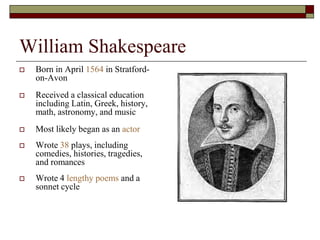
William Shakespeare
 Born in April 1564 in Stratford-
on-Avon
 Received a classical education
including Latin, Greek, history,
math, astronomy, and music
 Most likely began as an actor
 Wrote 38 plays, including
comedies, histories, tragedies,
and romances
 Wrote 4 lengthy poems and a
sonnet cycle
Shakespeare Vocabulary
 Verse vs. Prose
 Meter
 Foot
 Iambic Pentameter
 Blank Verse vs. Free
Verse
 Sonnet
 Quatrain
 Couplet
 Aside
 Monologue
 Soliloquy
 Allusion
 Foil
 Tragedy
 Tragic Hero
 Tragic Flaw
Verse vs. Prose
Verse: Poetic language that includes
meter and sometimes rhyme;
organized in lines with a
consistent number of syllables
Prose: Ordinary written language with no
meter or rhyme; organized in
sentences
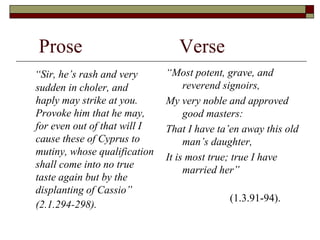
Prose Verse
“Sir, he’s rash and very
sudden in choler, and
haply may strike at you.
Provoke him that he may,
for even out of that will I
cause these of Cyprus to
mutiny, whose qualification
shall come into no true
taste again but by the
displanting of Cassio”
(2.1.294-298).
“Most potent, grave, and
reverend signoirs,
My very noble and approved
good masters:
That I have ta’en away this old
man’s daughter,
It is most true; true I have
married her”
(1.3.91-94).
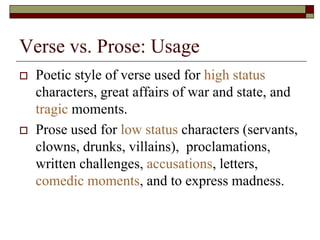
Verse vs. Prose: Usage
 Poetic style of verse used for high status
characters, great affairs of war and state, and
tragic moments.
 Prose used for low status characters (servants,
clowns, drunks, villains), proclamations,
written challenges, accusations, letters,
comedic moments, and to express madness.
Verse vs. Prose
 In Othello, pay careful attention to the
situations in which Iago switches between
speaking in verse and speaking in prose.
 What importance does his choice of verse or
prose seem to have?
Meter
 Meter: the pattern of stressed and unstressed
syllables.
 Meter is responsible for creating the rhythm
of a line.
Meter and Foot
 Foot: a group of syllables that forms one complete
unit of a metrical pattern.
 Meter is described in terms of the pattern of stressed
and unstressed syllables AND the total number of
metrical feet in a line of verse.
 Iambic pentameter is the most common metrical
pattern in Shakespeare.
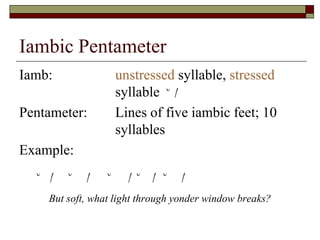
Iambic Pentameter
Iamb: unstressed syllable, stressed
syllable ˘ /
Pentameter: Lines of five iambic feet; 10
syllables
Example:
˘ / ˘ / ˘ / ˘ / ˘ /
But soft, what light through yonder window breaks?
Blank Verse vs. Free Verse
Blank Verse: Unrhymed iambic pentameter
One equal temper of heroic hearts,
Made weak by time and fate, but strong in will
To strive, to seek, to find, and not to yield.
Free Verse: No regular meter
One’s-Self I sing, a simple separate person,
Yet utter the word Democratic, the word En-Masse.
Sonnet
 14 line poem, usually written in iambic pentameter
 organized in three quatrains and a couplet
 typical rhyme scheme abab cdcd efef gg
 four-part organization has greater flexibility about where
thematic breaks occur
 most pronounced break or turn comes with concluding
couplet
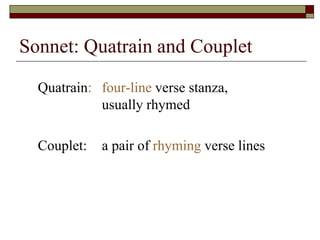
Sonnet: Quatrain and Couplet
Quatrain: four-line verse stanza,
usually rhymed
Couplet: a pair of rhyming verse lines
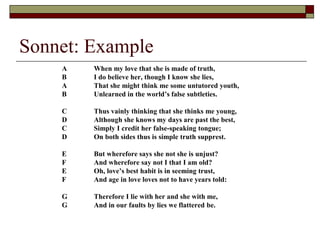
Sonnet: Example
A When my love that she is made of truth,
B I do believe her, though I know she lies,
A That she might think me some untutored youth,
B Unlearned in the world’s false subtleties.
C Thus vainly thinking that she thinks me young,
D Although she knows my days are past the best,
C Simply I credit her false-speaking tongue;
D On both sides thus is simple truth supprest.
E But wherefore says she not she is unjust?
F And wherefore say not I that I am old?
E Oh, love’s best habit is in seeming trust,
F And age in love loves not to have years told:
G Therefore I lie with her and she with me,
G And in our faults by lies we flattered be.
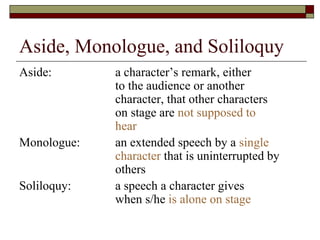
Aside, Monologue, and Soliloquy
Aside: a character’s remark, either
to the audience or another
character, that other characters
on stage are not supposed to
hear
Monologue: an extended speech by a single
character that is uninterrupted by
others
Soliloquy: a speech a character gives
when s/he is alone on stage
Foil
A character whose personality or
attitudes are in sharp contrast to
those of another character in the
same work
Allusion
 Allusion: reference to an event, person,
place, or another work of literature
 Shakespeare’s work contains numerous
allusions to Greek and Roman mythology.
Allusion: Janus
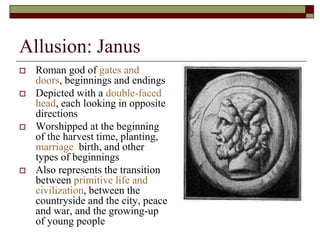
 Roman god of gates and
doors, beginnings and endings
 Depicted with a double-faced
head, each looking in opposite
directions
 Worshipped at the beginning
of the harvest time, planting,
marriage, birth, and other
types of beginnings
 Also represents the transition
between primitive life and
civilization, between the
countryside and the city, peace
and war, and the growing-up
of young people
Tragedy
 A serious play representing the disastrous downfall
of the hero
 Achieves a catharsis by arousing pity and terror in
the audience
 Hero is led into fatal calamity by hamartia (tragic
flaw or error) which often takes the form of hubris
(excessive pride leading to divine retribution
 Tragic effect depends upon audience’s awareness of
the admirable qualities of the hero which are wasted
in the disaster
Classical Tragic Hero
 The tragic hero is a good man, important to society
 The hero suffers a fall brought about by something
in his nature
 The fall provokes the emotions of pity and fear in
the reader
 The tragic character comes to some kind of
understanding or new recognition of what has
happened
Tragic Flaw
Defect of character that leads to
the hero’s disastrous downfall
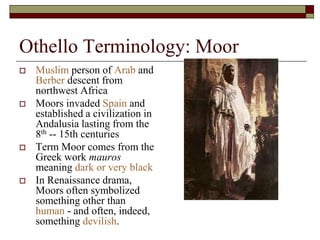
Othello Terminology: Moor
 Muslim person of Arab and
Berber descent from
northwest Africa
 Moors invaded Spain and
established a civilization in
Andalusia lasting from the
8th -- 15th centuries
 Term Moor comes from the
Greek work mauros
meaning dark or very black
 In Renaissance drama,
Moors often symbolized
something other than
human - and often, indeed,
something devilish.
Othello Terminology: Cuckold
 a man whose wife is unfaithful to him
 Represented with horns growing out of his
forehead
“That cuckold lives in bliss
Who, certain of his fate, loves not his wronger;
But O, what damned minutes tells he o’er
Who dotes, yet doubts; suspects, yet strongly loves!”
(3.3.197-200)
“I have a pain upon my forehead, here” (326).
Othello: A Tragedy
 Written in 1604
 One of the major tragedies -- after Hamlet and
before King Lear and Macbeth
 Fascination with evil
 Study the devastating effects of the deadly
sins of the spirit: ambitious pride, ingratitude,
wrath, jealousy and vengeful hate
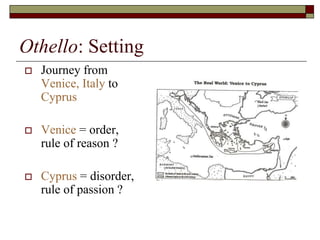
Othello: Setting
 Journey from
Venice, Italy to
Cyprus
 Venice = order,
rule of reason ?
 Cyprus = disorder,
rule of passion ?
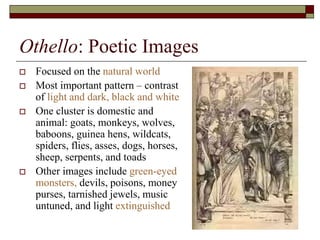
Othello: Poetic Images
 Focused on the natural world
 Most important pattern – contrast
of light and dark, black and white
 One cluster is domestic and
animal: goats, monkeys, wolves,
baboons, guinea hens, wildcats,
spiders, flies, asses, dogs, horses,
sheep, serpents, and toads
 Other images include green-eyed
monsters, devils, poisons, money
purses, tarnished jewels, music
untuned, and light extinguished
Othello: the Villain
 Delights in evil for its own sake
 Conscienceless, sinister, and amused by his own
cunning
 Related to Vice, the figure of personified evil, from
the medieval morality play whose role is to win
Humankind away from virtue and corrupt him with
worldly enticements
 Takes audience into his confidence, boasts in
soliloquy of his cleverness, exults in the triumph of
evil, and improvises plans with daring and
resourcefulness
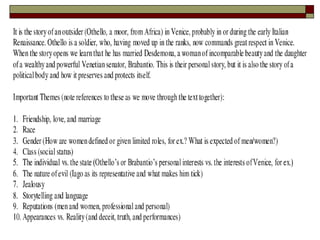
Othello: Thematic Ideas
 Nature of love and marriage
 Nature of jealousy
 Nature and use of language
 Male mistrust of women
 Deception / Honesty
 Importance of reputation
The Plot
 The plot is simple. A man, disappointed of promotion which
he thought he had a right to expect, determines on revenge
and in part secures it. By a series of careful moves he
persuaded the General (Othello) of the adultery of the
General's wife (Desdemona) with the lieutenant (Cassio) who
has been promoted ahead of him. As a result, the general first
kills his wife then himself, but the ensign (Iago) fails in the
second part of his design, since the plot is disclosed. Cassio
receives yet a further promotion and Iago is left facing trial
and torture. The plot "scheme" is concerned with one of the
strangest and most distressing of human emotions - jealousy -
and this is what makes the plot powerful.
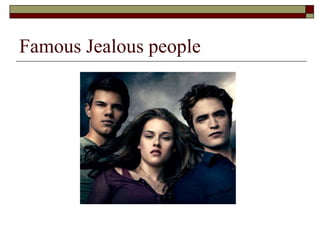
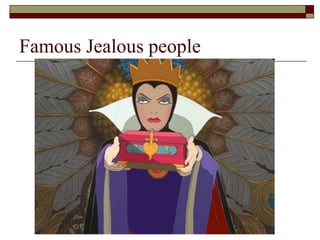
Famous Jealous people
Quotes about Jealousy
 Jealousy is indeed a poor medium to secure love,
but it is a secure medium to destroy one's self-
respect. For jealous people, like dope-fiends,
stoop to the lowest level and in the end inspire
only disgust and loathing.
Emma Goldman
Quotes about Jealousy
 Love may be blind but jealousy has 20-20 vision.
Anonymous
Quotes about Jealousy
 Jealousy is the jaundice of the soul.
John Dryden
Themes
 The play’s central theme is love
 destruction of love = hate
 love and hate together arouse jealousy.
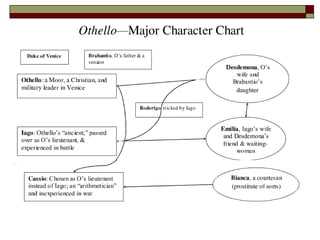
 The central conflict is between men and women and
this is presented through a series of parallel and
contrasting couples.
 Desdemona/Othello, Emilia/Iago, Bianca/Cassio and
a number of fantasy couples:
 Roderigo/Desdemona, Cassio/Desdemona,
Othello/Emilia.

introduction_to_othello.ppt

  • 1.
    Introduction to Shakespeare’s Othello Thenmust you speak Of one that loved not wisely, but too well…
  • 2.
    William Shakespeare  Bornin April 1564 in Stratford- on-Avon  Received a classical education including Latin, Greek, history, math, astronomy, and music  Most likely began as an actor  Wrote 38 plays, including comedies, histories, tragedies, and romances  Wrote 4 lengthy poems and a sonnet cycle
  • 3.
    Shakespeare Vocabulary  Versevs. Prose  Meter  Foot  Iambic Pentameter  Blank Verse vs. Free Verse  Sonnet  Quatrain  Couplet  Aside  Monologue  Soliloquy  Allusion  Foil  Tragedy  Tragic Hero  Tragic Flaw
  • 4.
    Verse vs. Prose Verse:Poetic language that includes meter and sometimes rhyme; organized in lines with a consistent number of syllables Prose: Ordinary written language with no meter or rhyme; organized in sentences
  • 5.
    Prose Verse “Sir, he’srash and very sudden in choler, and haply may strike at you. Provoke him that he may, for even out of that will I cause these of Cyprus to mutiny, whose qualification shall come into no true taste again but by the displanting of Cassio” (2.1.294-298). “Most potent, grave, and reverend signoirs, My very noble and approved good masters: That I have ta’en away this old man’s daughter, It is most true; true I have married her” (1.3.91-94).
  • 6.
    Verse vs. Prose:Usage  Poetic style of verse used for high status characters, great affairs of war and state, and tragic moments.  Prose used for low status characters (servants, clowns, drunks, villains), proclamations, written challenges, accusations, letters, comedic moments, and to express madness.
  • 7.
    Verse vs. Prose In Othello, pay careful attention to the situations in which Iago switches between speaking in verse and speaking in prose.  What importance does his choice of verse or prose seem to have?
  • 8.
    Meter  Meter: thepattern of stressed and unstressed syllables.  Meter is responsible for creating the rhythm of a line.
  • 9.
    Meter and Foot Foot: a group of syllables that forms one complete unit of a metrical pattern.  Meter is described in terms of the pattern of stressed and unstressed syllables AND the total number of metrical feet in a line of verse.  Iambic pentameter is the most common metrical pattern in Shakespeare.
  • 10.
    Iambic Pentameter Iamb: unstressedsyllable, stressed syllable ˘ / Pentameter: Lines of five iambic feet; 10 syllables Example: ˘ / ˘ / ˘ / ˘ / ˘ / But soft, what light through yonder window breaks?
  • 11.
    Blank Verse vs.Free Verse Blank Verse: Unrhymed iambic pentameter One equal temper of heroic hearts, Made weak by time and fate, but strong in will To strive, to seek, to find, and not to yield. Free Verse: No regular meter One’s-Self I sing, a simple separate person, Yet utter the word Democratic, the word En-Masse.
  • 12.
    Sonnet  14 linepoem, usually written in iambic pentameter  organized in three quatrains and a couplet  typical rhyme scheme abab cdcd efef gg  four-part organization has greater flexibility about where thematic breaks occur  most pronounced break or turn comes with concluding couplet
  • 13.
    Sonnet: Quatrain andCouplet Quatrain: four-line verse stanza, usually rhymed Couplet: a pair of rhyming verse lines
  • 14.
    Sonnet: Example A Whenmy love that she is made of truth, B I do believe her, though I know she lies, A That she might think me some untutored youth, B Unlearned in the world’s false subtleties. C Thus vainly thinking that she thinks me young, D Although she knows my days are past the best, C Simply I credit her false-speaking tongue; D On both sides thus is simple truth supprest. E But wherefore says she not she is unjust? F And wherefore say not I that I am old? E Oh, love’s best habit is in seeming trust, F And age in love loves not to have years told: G Therefore I lie with her and she with me, G And in our faults by lies we flattered be.
  • 15.
    Aside, Monologue, andSoliloquy Aside: a character’s remark, either to the audience or another character, that other characters on stage are not supposed to hear Monologue: an extended speech by a single character that is uninterrupted by others Soliloquy: a speech a character gives when s/he is alone on stage
  • 16.
    Foil A character whosepersonality or attitudes are in sharp contrast to those of another character in the same work
  • 17.
    Allusion  Allusion: referenceto an event, person, place, or another work of literature  Shakespeare’s work contains numerous allusions to Greek and Roman mythology.
  • 18.
    Allusion: Janus  Romangod of gates and doors, beginnings and endings  Depicted with a double-faced head, each looking in opposite directions  Worshipped at the beginning of the harvest time, planting, marriage, birth, and other types of beginnings  Also represents the transition between primitive life and civilization, between the countryside and the city, peace and war, and the growing-up of young people
  • 19.
    Tragedy  A seriousplay representing the disastrous downfall of the hero  Achieves a catharsis by arousing pity and terror in the audience  Hero is led into fatal calamity by hamartia (tragic flaw or error) which often takes the form of hubris (excessive pride leading to divine retribution  Tragic effect depends upon audience’s awareness of the admirable qualities of the hero which are wasted in the disaster
  • 20.
    Classical Tragic Hero The tragic hero is a good man, important to society  The hero suffers a fall brought about by something in his nature  The fall provokes the emotions of pity and fear in the reader  The tragic character comes to some kind of understanding or new recognition of what has happened
  • 21.
    Tragic Flaw Defect ofcharacter that leads to the hero’s disastrous downfall
  • 22.
    Othello Terminology: Moor Muslim person of Arab and Berber descent from northwest Africa  Moors invaded Spain and established a civilization in Andalusia lasting from the 8th -- 15th centuries  Term Moor comes from the Greek work mauros meaning dark or very black  In Renaissance drama, Moors often symbolized something other than human - and often, indeed, something devilish.
  • 23.
    Othello Terminology: Cuckold a man whose wife is unfaithful to him  Represented with horns growing out of his forehead “That cuckold lives in bliss Who, certain of his fate, loves not his wronger; But O, what damned minutes tells he o’er Who dotes, yet doubts; suspects, yet strongly loves!” (3.3.197-200) “I have a pain upon my forehead, here” (326).
  • 24.
    Othello: A Tragedy Written in 1604  One of the major tragedies -- after Hamlet and before King Lear and Macbeth  Fascination with evil  Study the devastating effects of the deadly sins of the spirit: ambitious pride, ingratitude, wrath, jealousy and vengeful hate
  • 25.
    Othello: Setting  Journeyfrom Venice, Italy to Cyprus  Venice = order, rule of reason ?  Cyprus = disorder, rule of passion ?
  • 28.
    Othello: Poetic Images Focused on the natural world  Most important pattern – contrast of light and dark, black and white  One cluster is domestic and animal: goats, monkeys, wolves, baboons, guinea hens, wildcats, spiders, flies, asses, dogs, horses, sheep, serpents, and toads  Other images include green-eyed monsters, devils, poisons, money purses, tarnished jewels, music untuned, and light extinguished
  • 29.
    Othello: the Villain Delights in evil for its own sake  Conscienceless, sinister, and amused by his own cunning  Related to Vice, the figure of personified evil, from the medieval morality play whose role is to win Humankind away from virtue and corrupt him with worldly enticements  Takes audience into his confidence, boasts in soliloquy of his cleverness, exults in the triumph of evil, and improvises plans with daring and resourcefulness
  • 30.
    Othello: Thematic Ideas Nature of love and marriage  Nature of jealousy  Nature and use of language  Male mistrust of women  Deception / Honesty  Importance of reputation
  • 31.
    The Plot  Theplot is simple. A man, disappointed of promotion which he thought he had a right to expect, determines on revenge and in part secures it. By a series of careful moves he persuaded the General (Othello) of the adultery of the General's wife (Desdemona) with the lieutenant (Cassio) who has been promoted ahead of him. As a result, the general first kills his wife then himself, but the ensign (Iago) fails in the second part of his design, since the plot is disclosed. Cassio receives yet a further promotion and Iago is left facing trial and torture. The plot "scheme" is concerned with one of the strangest and most distressing of human emotions - jealousy - and this is what makes the plot powerful.
  • 32.
  • 33.
  • 34.
    Quotes about Jealousy Jealousy is indeed a poor medium to secure love, but it is a secure medium to destroy one's self- respect. For jealous people, like dope-fiends, stoop to the lowest level and in the end inspire only disgust and loathing. Emma Goldman
  • 35.
    Quotes about Jealousy Love may be blind but jealousy has 20-20 vision. Anonymous
  • 36.
    Quotes about Jealousy Jealousy is the jaundice of the soul. John Dryden
  • 37.
    Themes  The play’scentral theme is love  destruction of love = hate  love and hate together arouse jealousy.  The central conflict is between men and women and this is presented through a series of parallel and contrasting couples.  Desdemona/Othello, Emilia/Iago, Bianca/Cassio and a number of fantasy couples:  Roderigo/Desdemona, Cassio/Desdemona, Othello/Emilia.