EXTRA CELLULAR MATRIX
Adarsh P P
TISSUES
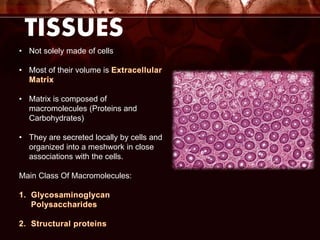
• Not solely made of cells
• Most of their volume is
• Matrix is composed of
macromolecules (Proteins and
Carbohydrates)
• They are secreted locally by cells and
organized into a meshwork in close
associations with the cells.
Main Class Of Macromolecules:
MATRIX STRUCTUAL PROTEINS
• Extracellular matrix is composed of tough fibrous proteins
embedded in a gel like polysaccharide substance.
• It also contain adhesion proteins, that helps in linkage.
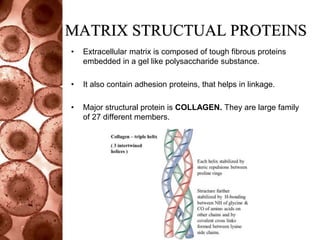
• Major structural protein is COLLAGEN. They are large family
of 27 different members.
• The triple helix domains of the collagen consist of repeats of
the amino acid sequence Gly-X-Y
• X - Proline
Y - Hydroxyproline
Ring structure stabilizes the triple helix
• Most abundant type – Type I Collagen, fibril forming
collagen.
• Type I Collagen has around 1000 amino acid residues or
about 330 Gly-X-Y repeats.
• In addition to fibrin forming collagen, there are also fibril
associated collagens, which bind to the fibrils and link them to
one another and to matrix.
• Type IV Collagen (network forming) form the basal laminae
(a layer of extracellular matrix secreted by the epithelial cells,
on which the epithelium sits)
In this, the Gly-X-Y repeats are frequently interrupted by short
non-helical sequences.
• Yet another collagen forms anchoring fibrils, which link basal
laminae to underlying connective tissues.
• Other types of collagen are transmembrane proteins that
participate in cell matrix interactions.
MATRIX POLYSACCHARIDES
• The fibrous proteins are embedded in gels formed from
polysaccharides called Glycosaminoglycans (GAGs)
• They contain repeating units of disaccharides.
• One sugar is either N-acetylglucosamine or N-
acetylgalactosamine and the second sugar is acidic, either
glucuronic acid or iduronic acid.
• These sugars are modified by sulfate groups, except
hyaluronan.
• Because of the negative charge, GAGs bind to positively
charged ions and trap water molecules, giving mechanical
support.
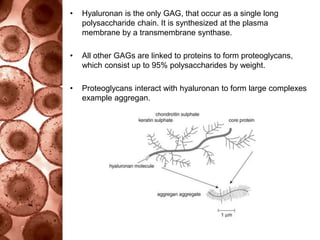
• Hyaluronan is the only GAG, that occur as a single long
polysaccharide chain. It is synthesized at the plasma
membrane by a transmembrane synthase.
• All other GAGs are linked to proteins to form proteoglycans,
which consist up to 95% polysaccharides by weight.
• Proteoglycans interact with hyaluronan to form large complexes
example aggregan.
MATRIX ADHESION PROTEINS
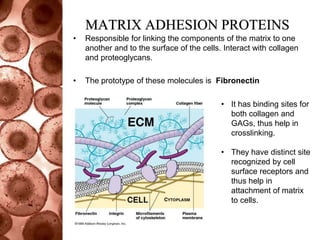
• Responsible for linking the components of the matrix to one
another and to the surface of the cells. Interact with collagen
and proteoglycans.
• The prototype of these molecules is Fibronectin
• It has binding sites for
both collagen and
GAGs, thus help in
crosslinking.
• They have distinct site
recognized by cell
surface receptors and
thus help in
attachment of matrix
to cells.
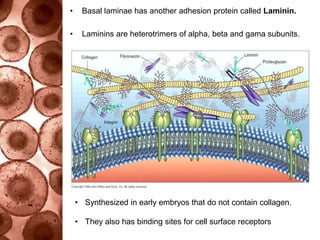
• Basal laminae has another adhesion protein called Laminin.
• Laminins are heterotrimers of alpha, beta and gama subunits.
• Synthesized in early embryos that do not contain collagen.
• They also has binding sites for cell surface receptors
• They are also tightly associated with another protein called
entactin, which also bind to type IV collagen.
• This multiple interactions will form cross linked networks in the
basal laminae.
Extra cellular matrix

Extra cellular matrix

  • 1.
  • 2.
    TISSUES • Not solelymade of cells • Most of their volume is • Matrix is composed of macromolecules (Proteins and Carbohydrates) • They are secreted locally by cells and organized into a meshwork in close associations with the cells. Main Class Of Macromolecules:
  • 3.
    MATRIX STRUCTUAL PROTEINS •Extracellular matrix is composed of tough fibrous proteins embedded in a gel like polysaccharide substance. • It also contain adhesion proteins, that helps in linkage. • Major structural protein is COLLAGEN. They are large family of 27 different members.
  • 4.
    • The triplehelix domains of the collagen consist of repeats of the amino acid sequence Gly-X-Y • X - Proline Y - Hydroxyproline Ring structure stabilizes the triple helix • Most abundant type – Type I Collagen, fibril forming collagen. • Type I Collagen has around 1000 amino acid residues or about 330 Gly-X-Y repeats.
  • 5.
    • In additionto fibrin forming collagen, there are also fibril associated collagens, which bind to the fibrils and link them to one another and to matrix. • Type IV Collagen (network forming) form the basal laminae (a layer of extracellular matrix secreted by the epithelial cells, on which the epithelium sits) In this, the Gly-X-Y repeats are frequently interrupted by short non-helical sequences. • Yet another collagen forms anchoring fibrils, which link basal laminae to underlying connective tissues. • Other types of collagen are transmembrane proteins that participate in cell matrix interactions.
  • 7.
    MATRIX POLYSACCHARIDES • Thefibrous proteins are embedded in gels formed from polysaccharides called Glycosaminoglycans (GAGs) • They contain repeating units of disaccharides. • One sugar is either N-acetylglucosamine or N- acetylgalactosamine and the second sugar is acidic, either glucuronic acid or iduronic acid. • These sugars are modified by sulfate groups, except hyaluronan. • Because of the negative charge, GAGs bind to positively charged ions and trap water molecules, giving mechanical support.
  • 10.
    • Hyaluronan isthe only GAG, that occur as a single long polysaccharide chain. It is synthesized at the plasma membrane by a transmembrane synthase. • All other GAGs are linked to proteins to form proteoglycans, which consist up to 95% polysaccharides by weight. • Proteoglycans interact with hyaluronan to form large complexes example aggregan.
  • 11.
    MATRIX ADHESION PROTEINS •Responsible for linking the components of the matrix to one another and to the surface of the cells. Interact with collagen and proteoglycans. • The prototype of these molecules is Fibronectin • It has binding sites for both collagen and GAGs, thus help in crosslinking. • They have distinct site recognized by cell surface receptors and thus help in attachment of matrix to cells.
  • 12.
    • Basal laminaehas another adhesion protein called Laminin. • Laminins are heterotrimers of alpha, beta and gama subunits. • Synthesized in early embryos that do not contain collagen. • They also has binding sites for cell surface receptors
  • 13.
    • They arealso tightly associated with another protein called entactin, which also bind to type IV collagen. • This multiple interactions will form cross linked networks in the basal laminae.