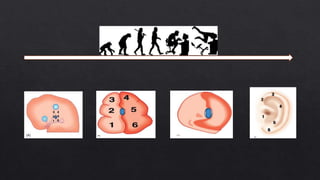
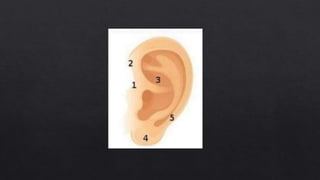
1,2,3 hillocks of His Lower part of First
Branchial Arch
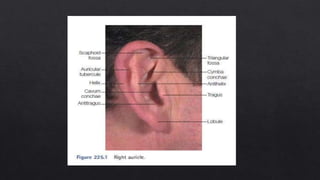
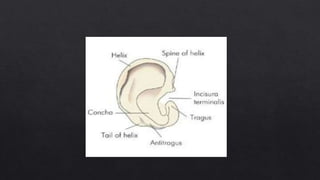
Tragus, Helical root, Helical
crus
4,5,6 hillocks of His Upper part of Second
Branchial Arch
Antihelix, Antitragus, Lower
Helix and Lobule.
Pinna Development
Develops from Paired mesenchymal condensation around the First pharyngeal cleft,
referred to as the 6 hillocks of His (auricular hillocks)
By 5 to 6 years pinna will become of adult size.
The cartilage of the auricle is connected to the temporal bone
by two extrinsic ligaments.
The anterior ligament runs from the tragus and from a
cartilaginous spine on the anterior rim of the crus of the helix to
the root of the zygomatic arch.
A separate posterior ligament runs from the medial surface of
the concha to the lateral surface of the mastoid prominence.
Intrinsic ligaments connect various parts of the cartilaginous
auricle; that between helix and tragus and another runs from the
antihelix to the posteroinferior portion of the helix.
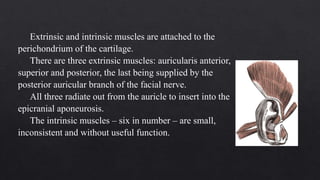
Extrinsic and intrinsic muscles are attached to the
perichondrium of the cartilage.
There are three extrinsic muscles: auricularis anterior,
superior and posterior, the last being supplied by the
posterior auricular branch of the facial nerve.
All three radiate out from the auricle to insert into the
epicranial aponeurosis.
The intrinsic muscles – six in number – are small,
inconsistent and without useful function.
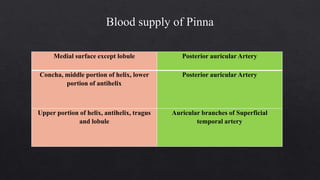
Medial surface except lobule Posterior auricular Artery
Concha, middle portion of helix, lower
portion of antihelix
Posterior auricular Artery
Upper portion of helix, antihelix, tragus
and lobule
Auricular branches of Superficial
temporal artery
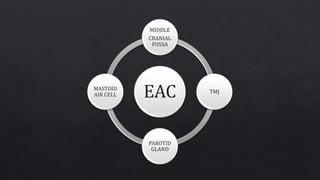
EAC
MIDDLE
CRANIAL
FOSSA
TMJ
PAROTID
GLAND
MASTOID
AIR CELL
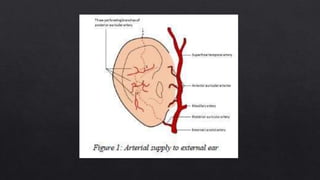
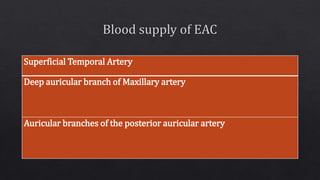
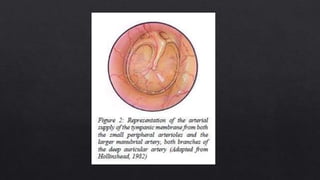
Superficial Temporal Artery
Deep auricular branch of Maxillary artery
Auricular branches of the posterior auricular artery
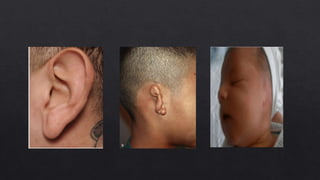
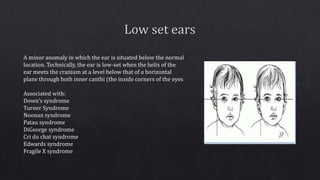
A minor anomaly in which the ear is situated below the normal
location. Technically, the ear is low-set when the helix of the
ear meets the cranium at a level below that of a horizontal
plane through both inner canthi (the inside corners of the eyes
Associated with:
Down's syndrome
Turner Syndrome
Noonan syndrome
Patau syndrome
DiGeorge syndrome
Cri du chat syndrome
Edwards syndrome
Fragile X syndrome
External ear anatomy

External ear anatomy

  • 3.
    1,2,3 hillocks ofHis Lower part of First Branchial Arch Tragus, Helical root, Helical crus 4,5,6 hillocks of His Upper part of Second Branchial Arch Antihelix, Antitragus, Lower Helix and Lobule. Pinna Development Develops from Paired mesenchymal condensation around the First pharyngeal cleft, referred to as the 6 hillocks of His (auricular hillocks) By 5 to 6 years pinna will become of adult size.
  • 16.
    The cartilage ofthe auricle is connected to the temporal bone by two extrinsic ligaments. The anterior ligament runs from the tragus and from a cartilaginous spine on the anterior rim of the crus of the helix to the root of the zygomatic arch. A separate posterior ligament runs from the medial surface of the concha to the lateral surface of the mastoid prominence. Intrinsic ligaments connect various parts of the cartilaginous auricle; that between helix and tragus and another runs from the antihelix to the posteroinferior portion of the helix.
  • 17.
    Extrinsic and intrinsicmuscles are attached to the perichondrium of the cartilage. There are three extrinsic muscles: auricularis anterior, superior and posterior, the last being supplied by the posterior auricular branch of the facial nerve. All three radiate out from the auricle to insert into the epicranial aponeurosis. The intrinsic muscles – six in number – are small, inconsistent and without useful function.
  • 18.
    Medial surface exceptlobule Posterior auricular Artery Concha, middle portion of helix, lower portion of antihelix Posterior auricular Artery Upper portion of helix, antihelix, tragus and lobule Auricular branches of Superficial temporal artery
  • 25.
  • 30.
    Superficial Temporal Artery Deepauricular branch of Maxillary artery Auricular branches of the posterior auricular artery
  • 43.
    A minor anomalyin which the ear is situated below the normal location. Technically, the ear is low-set when the helix of the ear meets the cranium at a level below that of a horizontal plane through both inner canthi (the inside corners of the eyes Associated with: Down's syndrome Turner Syndrome Noonan syndrome Patau syndrome DiGeorge syndrome Cri du chat syndrome Edwards syndrome Fragile X syndrome