External Data Representation
and Marshalling
Unit - II
External Data Representation
• The individual primitive data items transmitted in messages can be data values of many
different types, and not all computers store primitive values such as integers in the
same order.
• The representation of floating-point numbers also differs between architectures.
• There are two variants for the ordering of integers:
• big-endian order - the most significant byte comes first
• little-endian order - the most significant byte comes last.
• Methods used to exchange binary values
• The values are converted to an agreed external format before transmission and converted to the
local form on receipt
• if the two computers are known to be the same type, the conversion to external format can be omitted.
• The values are transmitted in the sender’s format, together with an indication of the format used,
and the recipient converts the values if necessary.
Marshalling
• Marshalling is the process of taking a collection of data items and
assembling them into a form suitable for transmission in a message.
• Marshalling consists of the translation of structured data items and
primitive values into an external data representation.
• Unmarshalling is the process of disassembling them on arrival to
produce an equivalent collection of data items at the destination.
• Unmarshalling consists of the generation of primitive values from their
external data representation and the rebuilding of the data structures.
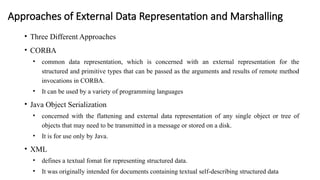
Approaches of External Data Representation and Marshalling
• Three Different Approaches
• CORBA
• common data representation, which is concerned with an external representation for the
structured and primitive types that can be passed as the arguments and results of remote method
invocations in CORBA.
• It can be used by a variety of programming languages
• Java Object Serialization
• concerned with the flattening and external data representation of any single object or tree of
objects that may need to be transmitted in a message or stored on a disk.
• It is for use only by Java.
• XML
• defines a textual fomat for representing structured data.
• It was originally intended for documents containing textual self-describing structured data
CORBA
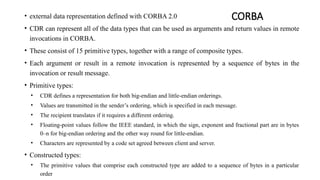
• external data representation defined with CORBA 2.0
• CDR can represent all of the data types that can be used as arguments and return values in remote
invocations in CORBA.
• These consist of 15 primitive types, together with a range of composite types.
• Each argument or result in a remote invocation is represented by a sequence of bytes in the
invocation or result message.
• Primitive types:
• CDR defines a representation for both big-endian and little-endian orderings.
• Values are transmitted in the sender’s ordering, which is specified in each message.
• The recipient translates if it requires a different ordering.
• Floating-point values follow the IEEE standard, in which the sign, exponent and fractional part are in bytes
0–n for big-endian ordering and the other way round for little-endian.
• Characters are represented by a code set agreed between client and server.
• Constructed types:
• The primitive values that comprise each constructed type are added to a sequence of bytes in a particular
order
CORBA
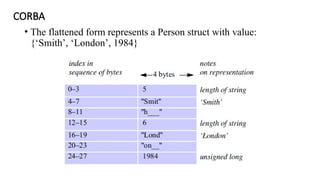
• The flattened form represents a Person struct with value:
{‘Smith’, ‘London’, 1984}
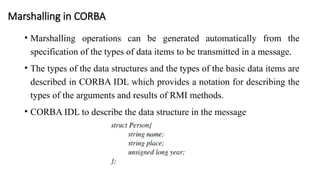
Marshalling in CORBA
• Marshalling operations can be generated automatically from the
specification of the types of data items to be transmitted in a message.
• The types of the data structures and the types of the basic data items are
described in CORBA IDL which provides a notation for describing the
types of the arguments and results of RMI methods.
• CORBA IDL to describe the data structure in the message
Java Object Serialization
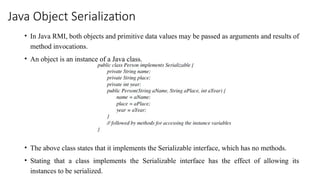
• In Java RMI, both objects and primitive data values may be passed as arguments and results of
method invocations.
• An object is an instance of a Java class.
• The above class states that it implements the Serializable interface, which has no methods.
• Stating that a class implements the Serializable interface has the effect of allowing its
instances to be serialized.
Java Object Serialization
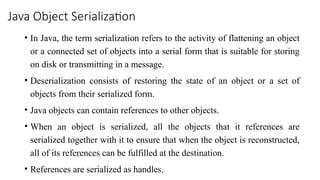
• In Java, the term serialization refers to the activity of flattening an object
or a connected set of objects into a serial form that is suitable for storing
on disk or transmitting in a message.
• Deserialization consists of restoring the state of an object or a set of
objects from their serialized form.
• Java objects can contain references to other objects.
• When an object is serialized, all the objects that it references are
serialized together with it to ensure that when the object is reconstructed,
all of its references can be fulfilled at the destination.
• References are serialized as handles.
Java Object Serialization
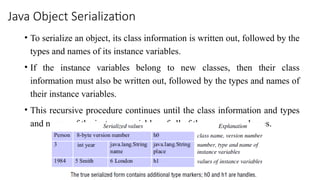
• To serialize an object, its class information is written out, followed by the
types and names of its instance variables.
• If the instance variables belong to new classes, then their class
information must also be written out, followed by the types and names of
their instance variables.
• This recursive procedure continues until the class information and types
and names of the instance variables of all of the necessary classes.
Java Object Serialization
• Serialization and deserialization of the arguments and results of remote
invocations are generally carried out automatically by the middleware,
without any participation by the application programmer.
• The Java language supports reflection – the ability to enquire about the
properties of a class, such as the names and types of its instance variables and
methods.
• It also enables classes to be created from their names, and a constructor with
given argument types to be created for a given class.
• Reflection makes it possible to do serialization and deserialization in a
completely generic manner.
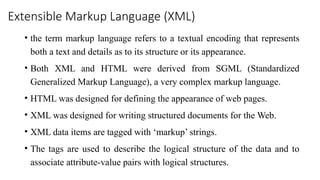
Extensible Markup Language (XML)
• the term markup language refers to a textual encoding that represents
both a text and details as to its structure or its appearance.
• Both XML and HTML were derived from SGML (Standardized
Generalized Markup Language), a very complex markup language.
• HTML was designed for defining the appearance of web pages.
• XML was designed for writing structured documents for the Web.
• XML data items are tagged with ‘markup’ strings.
• The tags are used to describe the logical structure of the data and to
associate attribute-value pairs with logical structures.
Extensible Markup Language (XML)
• XML is used to enable clients to communicate with web services and
for defining the interfaces and other properties of web services.
• XML is extensible in the sense that users can define their own tags, in
contrast to HTML, which uses a fixed set of tags.
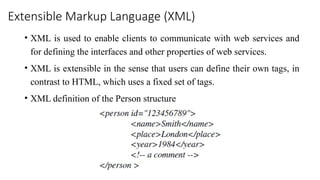
• XML definition of the Person structure
XML Elements and Attributes
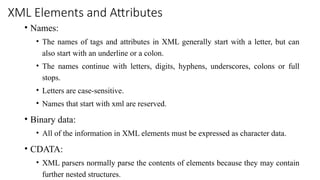
• Names:
• The names of tags and attributes in XML generally start with a letter, but can
also start with an underline or a colon.
• The names continue with letters, digits, hyphens, underscores, colons or full
stops.
• Letters are case-sensitive.
• Names that start with xml are reserved.
• Binary data:
• All of the information in XML elements must be expressed as character data.
• CDATA:
• XML parsers normally parse the contents of elements because they may contain
further nested structures.
XML Elements and Attributes
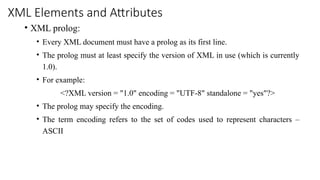
• XML prolog:
• Every XML document must have a prolog as its first line.
• The prolog must at least specify the version of XML in use (which is currently
1.0).
• For example:
<?XML version = "1.0" encoding = "UTF-8" standalone = "yes"?>
• The prolog may specify the encoding.
• The term encoding refers to the set of codes used to represent characters –
ASCII
XML Elements and Attributes
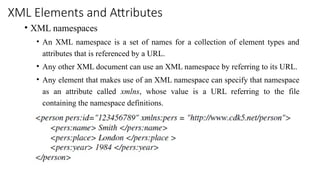
• XML namespaces
• An XML namespace is a set of names for a collection of element types and
attributes that is referenced by a URL.
• Any other XML document can use an XML namespace by referring to its URL.
• Any element that makes use of an XML namespace can specify that namespace
as an attribute called xmlns, whose value is a URL referring to the file
containing the namespace definitions.
Remote Object References
• A remote object reference is an identifier for a remote object that is valid throughout a
distributed system.
• A remote object reference is passed in the invocation message to specify which object is to
be invoked.
• Remote object references must be generated in a manner that ensures uniqueness over
space and time.
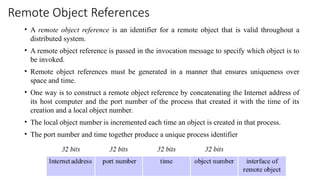
• One way is to construct a remote object reference by concatenating the Internet address of
its host computer and the port number of the process that created it with the time of its
creation and a local object number.
• The local object number is incremented each time an object is created in that process.
• The port number and time together produce a unique process identifier

External Data Representation and Marshalling

  • 1.
    External Data Representation andMarshalling Unit - II
  • 2.
    External Data Representation •The individual primitive data items transmitted in messages can be data values of many different types, and not all computers store primitive values such as integers in the same order. • The representation of floating-point numbers also differs between architectures. • There are two variants for the ordering of integers: • big-endian order - the most significant byte comes first • little-endian order - the most significant byte comes last. • Methods used to exchange binary values • The values are converted to an agreed external format before transmission and converted to the local form on receipt • if the two computers are known to be the same type, the conversion to external format can be omitted. • The values are transmitted in the sender’s format, together with an indication of the format used, and the recipient converts the values if necessary.
  • 3.
    Marshalling • Marshalling isthe process of taking a collection of data items and assembling them into a form suitable for transmission in a message. • Marshalling consists of the translation of structured data items and primitive values into an external data representation. • Unmarshalling is the process of disassembling them on arrival to produce an equivalent collection of data items at the destination. • Unmarshalling consists of the generation of primitive values from their external data representation and the rebuilding of the data structures.
  • 4.
    Approaches of ExternalData Representation and Marshalling • Three Different Approaches • CORBA • common data representation, which is concerned with an external representation for the structured and primitive types that can be passed as the arguments and results of remote method invocations in CORBA. • It can be used by a variety of programming languages • Java Object Serialization • concerned with the flattening and external data representation of any single object or tree of objects that may need to be transmitted in a message or stored on a disk. • It is for use only by Java. • XML • defines a textual fomat for representing structured data. • It was originally intended for documents containing textual self-describing structured data
  • 5.
    CORBA • external datarepresentation defined with CORBA 2.0 • CDR can represent all of the data types that can be used as arguments and return values in remote invocations in CORBA. • These consist of 15 primitive types, together with a range of composite types. • Each argument or result in a remote invocation is represented by a sequence of bytes in the invocation or result message. • Primitive types: • CDR defines a representation for both big-endian and little-endian orderings. • Values are transmitted in the sender’s ordering, which is specified in each message. • The recipient translates if it requires a different ordering. • Floating-point values follow the IEEE standard, in which the sign, exponent and fractional part are in bytes 0–n for big-endian ordering and the other way round for little-endian. • Characters are represented by a code set agreed between client and server. • Constructed types: • The primitive values that comprise each constructed type are added to a sequence of bytes in a particular order
  • 6.
    CORBA • The flattenedform represents a Person struct with value: {‘Smith’, ‘London’, 1984}
  • 7.
    Marshalling in CORBA •Marshalling operations can be generated automatically from the specification of the types of data items to be transmitted in a message. • The types of the data structures and the types of the basic data items are described in CORBA IDL which provides a notation for describing the types of the arguments and results of RMI methods. • CORBA IDL to describe the data structure in the message
  • 8.
    Java Object Serialization •In Java RMI, both objects and primitive data values may be passed as arguments and results of method invocations. • An object is an instance of a Java class. • The above class states that it implements the Serializable interface, which has no methods. • Stating that a class implements the Serializable interface has the effect of allowing its instances to be serialized.
  • 9.
    Java Object Serialization •In Java, the term serialization refers to the activity of flattening an object or a connected set of objects into a serial form that is suitable for storing on disk or transmitting in a message. • Deserialization consists of restoring the state of an object or a set of objects from their serialized form. • Java objects can contain references to other objects. • When an object is serialized, all the objects that it references are serialized together with it to ensure that when the object is reconstructed, all of its references can be fulfilled at the destination. • References are serialized as handles.
  • 10.
    Java Object Serialization •To serialize an object, its class information is written out, followed by the types and names of its instance variables. • If the instance variables belong to new classes, then their class information must also be written out, followed by the types and names of their instance variables. • This recursive procedure continues until the class information and types and names of the instance variables of all of the necessary classes.
  • 11.
    Java Object Serialization •Serialization and deserialization of the arguments and results of remote invocations are generally carried out automatically by the middleware, without any participation by the application programmer. • The Java language supports reflection – the ability to enquire about the properties of a class, such as the names and types of its instance variables and methods. • It also enables classes to be created from their names, and a constructor with given argument types to be created for a given class. • Reflection makes it possible to do serialization and deserialization in a completely generic manner.
  • 12.
    Extensible Markup Language(XML) • the term markup language refers to a textual encoding that represents both a text and details as to its structure or its appearance. • Both XML and HTML were derived from SGML (Standardized Generalized Markup Language), a very complex markup language. • HTML was designed for defining the appearance of web pages. • XML was designed for writing structured documents for the Web. • XML data items are tagged with ‘markup’ strings. • The tags are used to describe the logical structure of the data and to associate attribute-value pairs with logical structures.
  • 13.
    Extensible Markup Language(XML) • XML is used to enable clients to communicate with web services and for defining the interfaces and other properties of web services. • XML is extensible in the sense that users can define their own tags, in contrast to HTML, which uses a fixed set of tags. • XML definition of the Person structure
  • 14.
    XML Elements andAttributes • Names: • The names of tags and attributes in XML generally start with a letter, but can also start with an underline or a colon. • The names continue with letters, digits, hyphens, underscores, colons or full stops. • Letters are case-sensitive. • Names that start with xml are reserved. • Binary data: • All of the information in XML elements must be expressed as character data. • CDATA: • XML parsers normally parse the contents of elements because they may contain further nested structures.
  • 15.
    XML Elements andAttributes • XML prolog: • Every XML document must have a prolog as its first line. • The prolog must at least specify the version of XML in use (which is currently 1.0). • For example: <?XML version = "1.0" encoding = "UTF-8" standalone = "yes"?> • The prolog may specify the encoding. • The term encoding refers to the set of codes used to represent characters – ASCII
  • 16.
    XML Elements andAttributes • XML namespaces • An XML namespace is a set of names for a collection of element types and attributes that is referenced by a URL. • Any other XML document can use an XML namespace by referring to its URL. • Any element that makes use of an XML namespace can specify that namespace as an attribute called xmlns, whose value is a URL referring to the file containing the namespace definitions.
  • 17.
    Remote Object References •A remote object reference is an identifier for a remote object that is valid throughout a distributed system. • A remote object reference is passed in the invocation message to specify which object is to be invoked. • Remote object references must be generated in a manner that ensures uniqueness over space and time. • One way is to construct a remote object reference by concatenating the Internet address of its host computer and the port number of the process that created it with the time of its creation and a local object number. • The local object number is incremented each time an object is created in that process. • The port number and time together produce a unique process identifier