WESTWOOD LANGUAGE COLLEGE FOR GIRLS
DEPARTMENT LESSON PLAN KS4
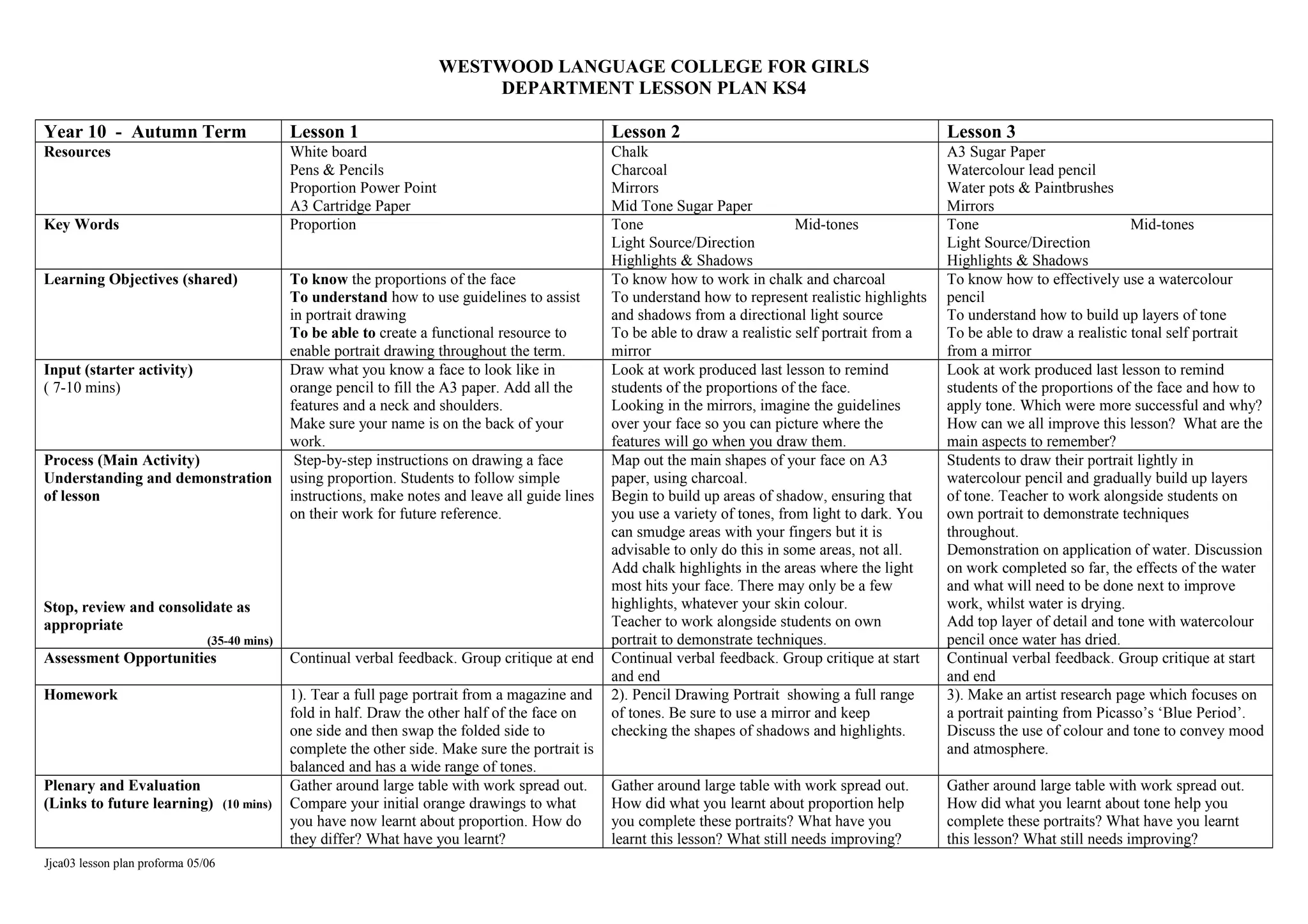
Year 10 - Autumn Term Lesson 1 Lesson 2 Lesson 3
Resources White board
Pens & Pencils
Proportion Power Point
A3 Cartridge Paper
Chalk
Charcoal
Mirrors
Mid Tone Sugar Paper
A3 Sugar Paper
Watercolour lead pencil
Water pots & Paintbrushes
Mirrors
Key Words Proportion Tone Mid-tones
Light Source/Direction
Highlights & Shadows
Tone Mid-tones
Light Source/Direction
Highlights & Shadows
Learning Objectives (shared) To know the proportions of the face
To understand how to use guidelines to assist
in portrait drawing
To be able to create a functional resource to
enable portrait drawing throughout the term.
To know how to work in chalk and charcoal
To understand how to represent realistic highlights
and shadows from a directional light source
To be able to draw a realistic self portrait from a
mirror
To know how to effectively use a watercolour
pencil
To understand how to build up layers of tone
To be able to draw a realistic tonal self portrait
from a mirror
Input (starter activity)
( 7-10 mins)
Draw what you know a face to look like in
orange pencil to fill the A3 paper. Add all the
features and a neck and shoulders.
Make sure your name is on the back of your
work.
Look at work produced last lesson to remind
students of the proportions of the face.
Looking in the mirrors, imagine the guidelines
over your face so you can picture where the
features will go when you draw them.
Look at work produced last lesson to remind
students of the proportions of the face and how to
apply tone. Which were more successful and why?
How can we all improve this lesson? What are the
main aspects to remember?
Process (Main Activity)
Understanding and demonstration
of lesson
Stop, review and consolidate as
appropriate
(35-40 mins)
Step-by-step instructions on drawing a face
using proportion. Students to follow simple
instructions, make notes and leave all guide lines
on their work for future reference.
Map out the main shapes of your face on A3
paper, using charcoal.
Begin to build up areas of shadow, ensuring that
you use a variety of tones, from light to dark. You
can smudge areas with your fingers but it is
advisable to only do this in some areas, not all.
Add chalk highlights in the areas where the light
most hits your face. There may only be a few
highlights, whatever your skin colour.
Teacher to work alongside students on own
portrait to demonstrate techniques.
Students to draw their portrait lightly in
watercolour pencil and gradually build up layers
of tone. Teacher to work alongside students on
own portrait to demonstrate techniques
throughout.
Demonstration on application of water. Discussion
on work completed so far, the effects of the water
and what will need to be done next to improve
work, whilst water is drying.
Add top layer of detail and tone with watercolour
pencil once water has dried.
Assessment Opportunities Continual verbal feedback. Group critique at end Continual verbal feedback. Group critique at start
and end
Continual verbal feedback. Group critique at start
and end
Homework 1). Tear a full page portrait from a magazine and
fold in half. Draw the other half of the face on
one side and then swap the folded side to
complete the other side. Make sure the portrait is
balanced and has a wide range of tones.
2). Pencil Drawing Portrait showing a full range
of tones. Be sure to use a mirror and keep
checking the shapes of shadows and highlights.
3). Make an artist research page which focuses on
a portrait painting from Picasso’s ‘Blue Period’.
Discuss the use of colour and tone to convey mood
and atmosphere.
Plenary and Evaluation
(Links to future learning) (10 mins)
Gather around large table with work spread out.
Compare your initial orange drawings to what
you have now learnt about proportion. How do
they differ? What have you learnt?
Gather around large table with work spread out.
How did what you learnt about proportion help
you complete these portraits? What have you
learnt this lesson? What still needs improving?
Gather around large table with work spread out.
How did what you learnt about tone help you
complete these portraits? What have you learnt
this lesson? What still needs improving?
Jjca03 lesson plan proforma 05/06
WESTWOOD LANGUAGE COLLEGE FOR GIRLS
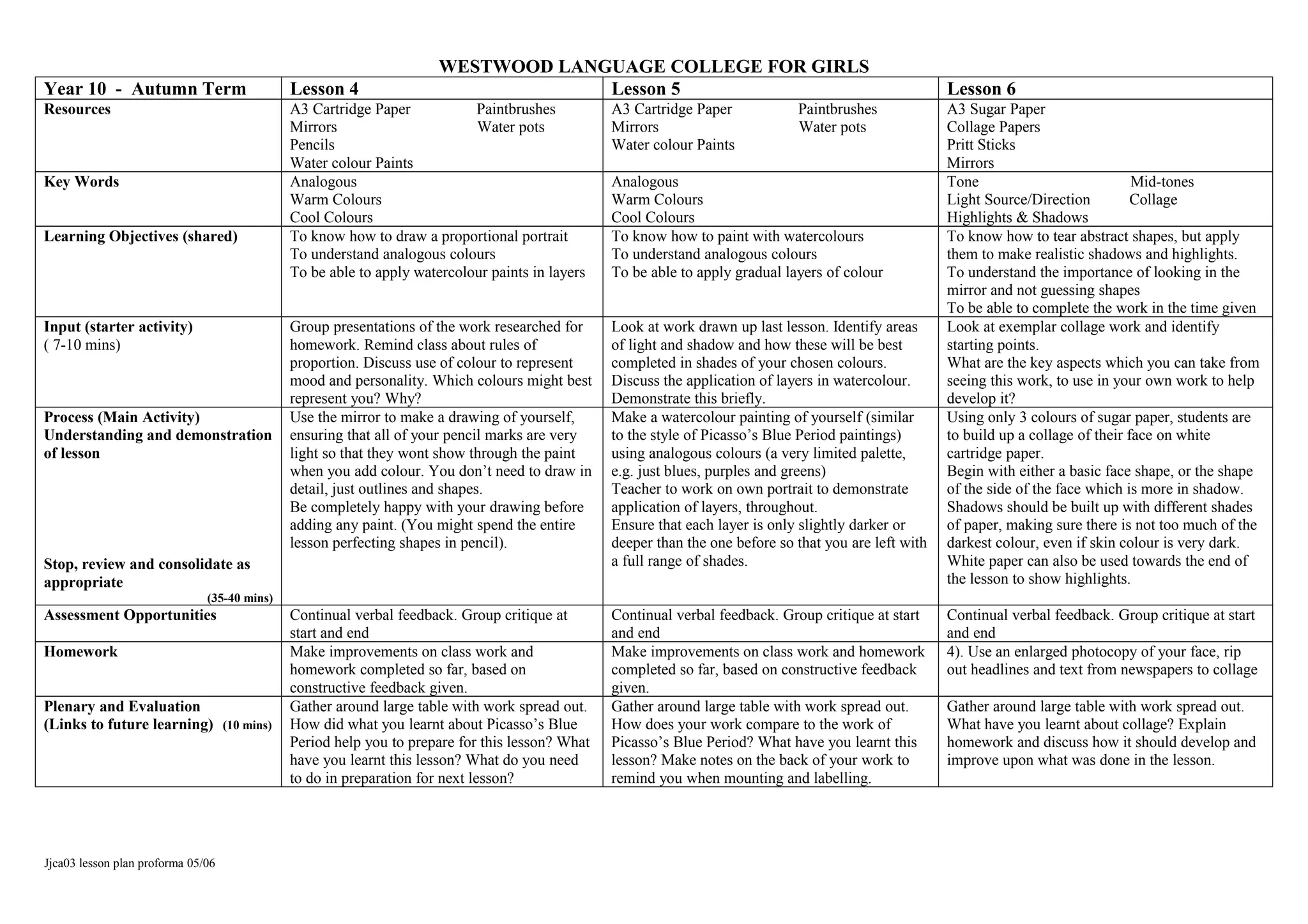
Year 10 - Autumn Term Lesson 4 Lesson 5 Lesson 6
Resources A3 Cartridge Paper Paintbrushes
Mirrors Water pots
Pencils
Water colour Paints
A3 Cartridge Paper Paintbrushes
Mirrors Water pots
Water colour Paints
A3 Sugar Paper
Collage Papers
Pritt Sticks
Mirrors
Key Words Analogous
Warm Colours
Cool Colours
Analogous
Warm Colours
Cool Colours
Tone Mid-tones
Light Source/Direction Collage
Highlights & Shadows
Learning Objectives (shared) To know how to draw a proportional portrait
To understand analogous colours
To be able to apply watercolour paints in layers
To know how to paint with watercolours
To understand analogous colours
To be able to apply gradual layers of colour
To know how to tear abstract shapes, but apply
them to make realistic shadows and highlights.
To understand the importance of looking in the
mirror and not guessing shapes
To be able to complete the work in the time given
Input (starter activity)
( 7-10 mins)
Group presentations of the work researched for
homework. Remind class about rules of
proportion. Discuss use of colour to represent
mood and personality. Which colours might best
represent you? Why?
Look at work drawn up last lesson. Identify areas
of light and shadow and how these will be best
completed in shades of your chosen colours.
Discuss the application of layers in watercolour.
Demonstrate this briefly.
Look at exemplar collage work and identify
starting points.
What are the key aspects which you can take from
seeing this work, to use in your own work to help
develop it?
Process (Main Activity)
Understanding and demonstration
of lesson
Stop, review and consolidate as
appropriate
(35-40 mins)
Use the mirror to make a drawing of yourself,
ensuring that all of your pencil marks are very
light so that they wont show through the paint
when you add colour. You don’t need to draw in
detail, just outlines and shapes.
Be completely happy with your drawing before
adding any paint. (You might spend the entire
lesson perfecting shapes in pencil).
Make a watercolour painting of yourself (similar
to the style of Picasso’s Blue Period paintings)
using analogous colours (a very limited palette,
e.g. just blues, purples and greens)
Teacher to work on own portrait to demonstrate
application of layers, throughout.
Ensure that each layer is only slightly darker or
deeper than the one before so that you are left with
a full range of shades.
Using only 3 colours of sugar paper, students are
to build up a collage of their face on white
cartridge paper.
Begin with either a basic face shape, or the shape
of the side of the face which is more in shadow.
Shadows should be built up with different shades
of paper, making sure there is not too much of the
darkest colour, even if skin colour is very dark.
White paper can also be used towards the end of
the lesson to show highlights.
Assessment Opportunities Continual verbal feedback. Group critique at
start and end
Continual verbal feedback. Group critique at start
and end
Continual verbal feedback. Group critique at start
and end
Homework Make improvements on class work and
homework completed so far, based on
constructive feedback given.
Make improvements on class work and homework
completed so far, based on constructive feedback
given.
4). Use an enlarged photocopy of your face, rip
out headlines and text from newspapers to collage
Plenary and Evaluation
(Links to future learning) (10 mins)
Gather around large table with work spread out.
How did what you learnt about Picasso’s Blue
Period help you to prepare for this lesson? What
have you learnt this lesson? What do you need
to do in preparation for next lesson?
Gather around large table with work spread out.
How does your work compare to the work of
Picasso’s Blue Period? What have you learnt this
lesson? Make notes on the back of your work to
remind you when mounting and labelling.
Gather around large table with work spread out.
What have you learnt about collage? Explain
homework and discuss how it should develop and
improve upon what was done in the lesson.
Jjca03 lesson plan proforma 05/06
WESTWOOD LANGUAGE COLLEGE FOR GIRLS
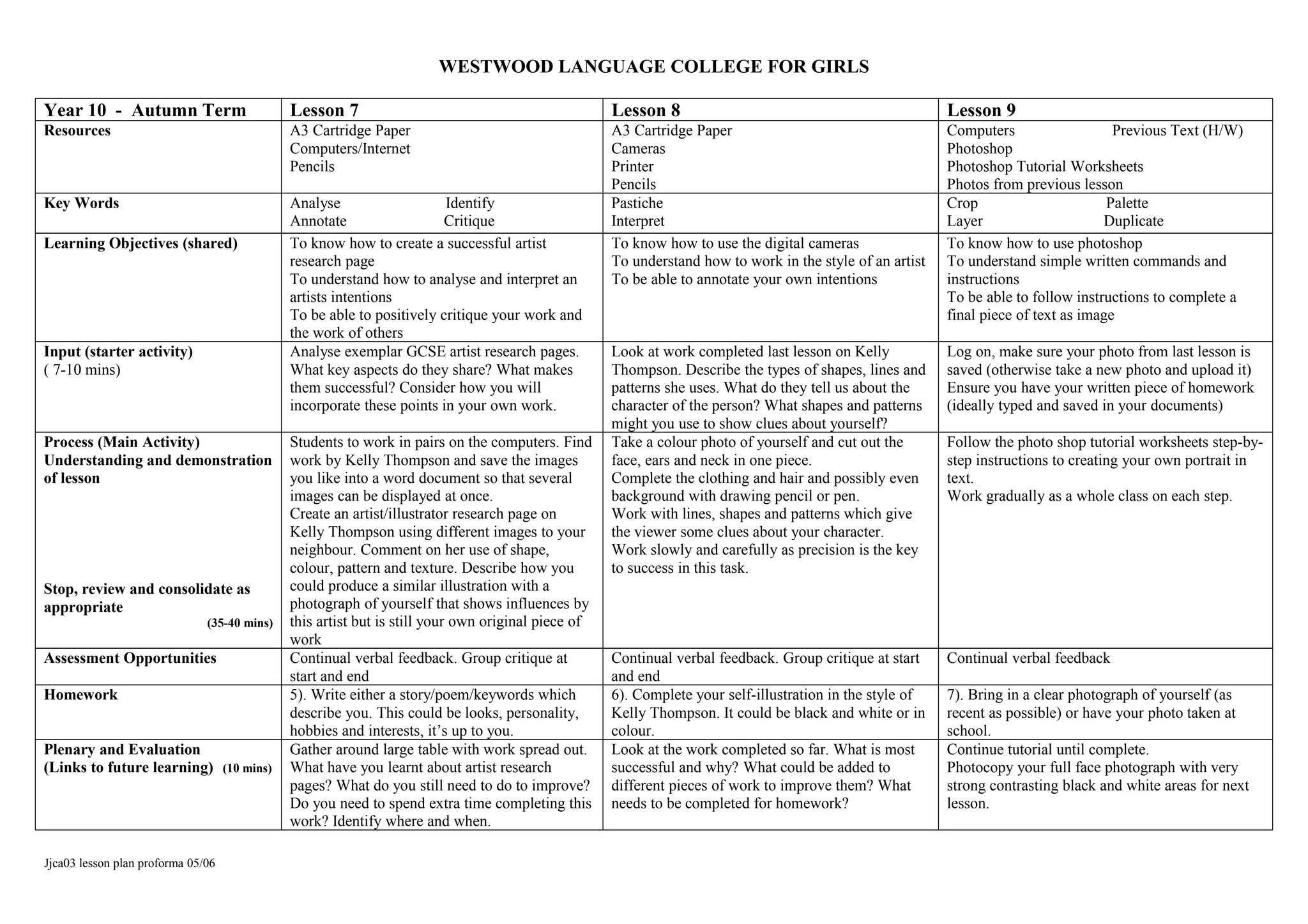
Year 10 - Autumn Term Lesson 7 Lesson 8 Lesson 9
Resources A3 Cartridge Paper
Computers/Internet
Pencils
A3 Cartridge Paper
Cameras
Printer
Pencils
Computers Previous Text (H/W)
Photoshop
Photoshop Tutorial Worksheets
Photos from previous lesson
Key Words Analyse Identify
Annotate Critique
Pastiche
Interpret
Crop Palette
Layer Duplicate
Learning Objectives (shared) To know how to create a successful artist
research page
To understand how to analyse and interpret an
artists intentions
To be able to positively critique your work and
the work of others
To know how to use the digital cameras
To understand how to work in the style of an artist
To be able to annotate your own intentions
To know how to use photoshop
To understand simple written commands and
instructions
To be able to follow instructions to complete a
final piece of text as image
Input (starter activity)
( 7-10 mins)
Analyse exemplar GCSE artist research pages.
What key aspects do they share? What makes
them successful? Consider how you will
incorporate these points in your own work.
Look at work completed last lesson on Kelly
Thompson. Describe the types of shapes, lines and
patterns she uses. What do they tell us about the
character of the person? What shapes and patterns
might you use to show clues about yourself?
Log on, make sure your photo from last lesson is
saved (otherwise take a new photo and upload it)
Ensure you have your written piece of homework
(ideally typed and saved in your documents)
Process (Main Activity)
Understanding and demonstration
of lesson
Stop, review and consolidate as
appropriate
(35-40 mins)
Students to work in pairs on the computers. Find
work by Kelly Thompson and save the images
you like into a word document so that several
images can be displayed at once.
Create an artist/illustrator research page on
Kelly Thompson using different images to your
neighbour. Comment on her use of shape,
colour, pattern and texture. Describe how you
could produce a similar illustration with a
photograph of yourself that shows influences by
this artist but is still your own original piece of
work
Take a colour photo of yourself and cut out the
face, ears and neck in one piece.
Complete the clothing and hair and possibly even
background with drawing pencil or pen.
Work with lines, shapes and patterns which give
the viewer some clues about your character.
Work slowly and carefully as precision is the key
to success in this task.
Follow the photo shop tutorial worksheets step-by-
step instructions to creating your own portrait in
text.
Work gradually as a whole class on each step.
Assessment Opportunities Continual verbal feedback. Group critique at
start and end
Continual verbal feedback. Group critique at start
and end
Continual verbal feedback
Homework 5). Write either a story/poem/keywords which
describe you. This could be looks, personality,
hobbies and interests, it’s up to you.
6). Complete your self-illustration in the style of
Kelly Thompson. It could be black and white or in
colour.
7). Bring in a clear photograph of yourself (as
recent as possible) or have your photo taken at
school.
Plenary and Evaluation
(Links to future learning) (10 mins)
Gather around large table with work spread out.
What have you learnt about artist research
pages? What do you still need to do to improve?
Do you need to spend extra time completing this
work? Identify where and when.
Look at the work completed so far. What is most
successful and why? What could be added to
different pieces of work to improve them? What
needs to be completed for homework?
Continue tutorial until complete.
Photocopy your full face photograph with very
strong contrasting black and white areas for next
lesson.
Jjca03 lesson plan proforma 05/06
WESTWOOD LANGUAGE COLLEGE FOR GIRLS
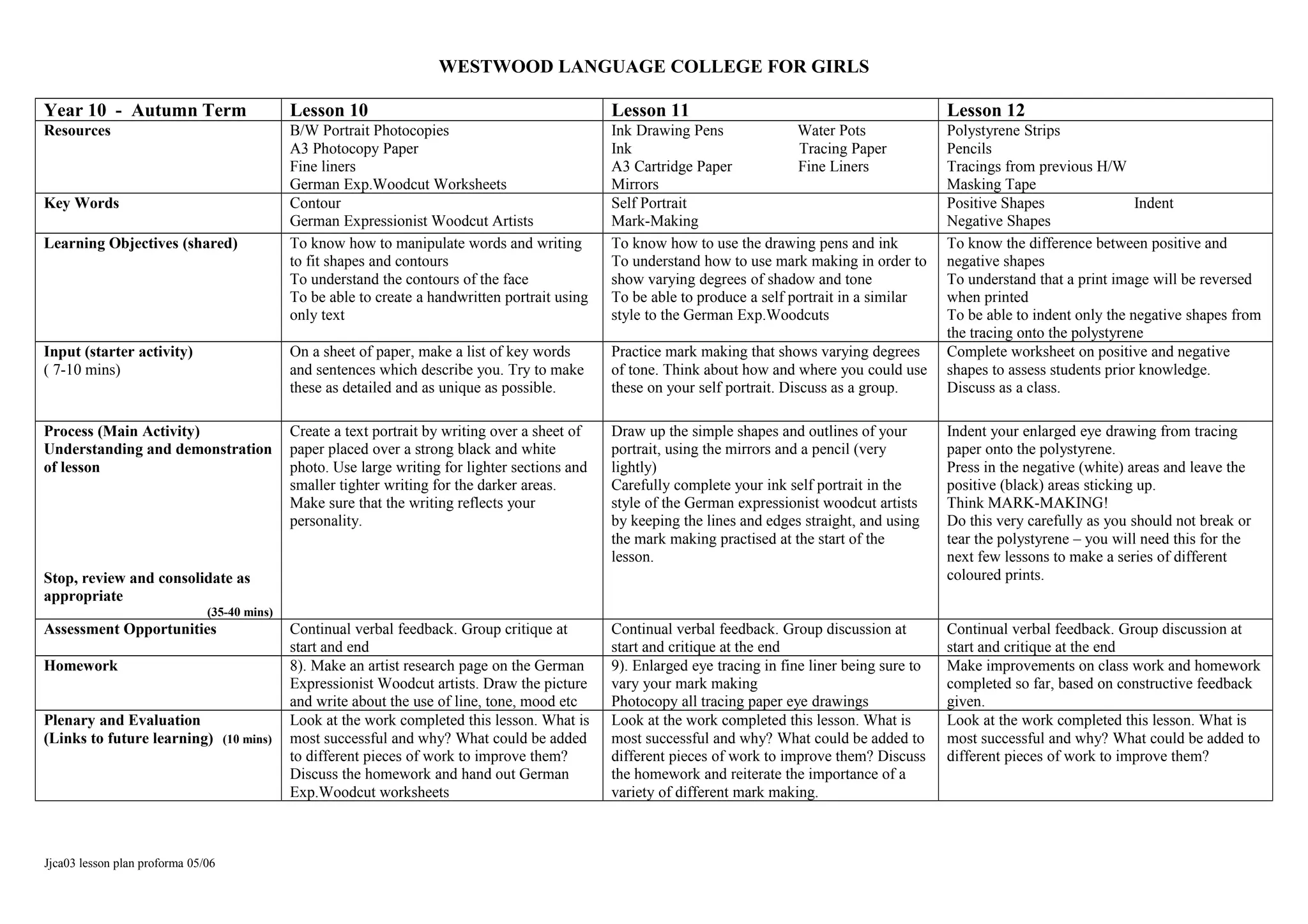
Year 10 - Autumn Term Lesson 10 Lesson 11 Lesson 12
Resources B/W Portrait Photocopies
A3 Photocopy Paper
Fine liners
German Exp.Woodcut Worksheets
Ink Drawing Pens Water Pots
Ink Tracing Paper
A3 Cartridge Paper Fine Liners
Mirrors
Polystyrene Strips
Pencils
Tracings from previous H/W
Masking Tape
Key Words Contour
German Expressionist Woodcut Artists
Self Portrait
Mark-Making
Positive Shapes Indent
Negative Shapes
Learning Objectives (shared) To know how to manipulate words and writing
to fit shapes and contours
To understand the contours of the face
To be able to create a handwritten portrait using
only text
To know how to use the drawing pens and ink
To understand how to use mark making in order to
show varying degrees of shadow and tone
To be able to produce a self portrait in a similar
style to the German Exp.Woodcuts
To know the difference between positive and
negative shapes
To understand that a print image will be reversed
when printed
To be able to indent only the negative shapes from
the tracing onto the polystyrene
Input (starter activity)
( 7-10 mins)
On a sheet of paper, make a list of key words
and sentences which describe you. Try to make
these as detailed and as unique as possible.
Practice mark making that shows varying degrees
of tone. Think about how and where you could use
these on your self portrait. Discuss as a group.
Complete worksheet on positive and negative
shapes to assess students prior knowledge.
Discuss as a class.
Process (Main Activity)
Understanding and demonstration
of lesson
Stop, review and consolidate as
appropriate
(35-40 mins)
Create a text portrait by writing over a sheet of
paper placed over a strong black and white
photo. Use large writing for lighter sections and
smaller tighter writing for the darker areas.
Make sure that the writing reflects your
personality.
Draw up the simple shapes and outlines of your
portrait, using the mirrors and a pencil (very
lightly)
Carefully complete your ink self portrait in the
style of the German expressionist woodcut artists
by keeping the lines and edges straight, and using
the mark making practised at the start of the
lesson.
Indent your enlarged eye drawing from tracing
paper onto the polystyrene.
Press in the negative (white) areas and leave the
positive (black) areas sticking up.
Think MARK-MAKING!
Do this very carefully as you should not break or
tear the polystyrene – you will need this for the
next few lessons to make a series of different
coloured prints.
Assessment Opportunities Continual verbal feedback. Group critique at
start and end
Continual verbal feedback. Group discussion at
start and critique at the end
Continual verbal feedback. Group discussion at
start and critique at the end
Homework 8). Make an artist research page on the German
Expressionist Woodcut artists. Draw the picture
and write about the use of line, tone, mood etc
9). Enlarged eye tracing in fine liner being sure to
vary your mark making
Photocopy all tracing paper eye drawings
Make improvements on class work and homework
completed so far, based on constructive feedback
given.
Plenary and Evaluation
(Links to future learning) (10 mins)
Look at the work completed this lesson. What is
most successful and why? What could be added
to different pieces of work to improve them?
Discuss the homework and hand out German
Exp.Woodcut worksheets
Look at the work completed this lesson. What is
most successful and why? What could be added to
different pieces of work to improve them? Discuss
the homework and reiterate the importance of a
variety of different mark making.
Look at the work completed this lesson. What is
most successful and why? What could be added to
different pieces of work to improve them?
Jjca03 lesson plan proforma 05/06
WESTWOOD LANGUAGE COLLEGE FOR GIRLS
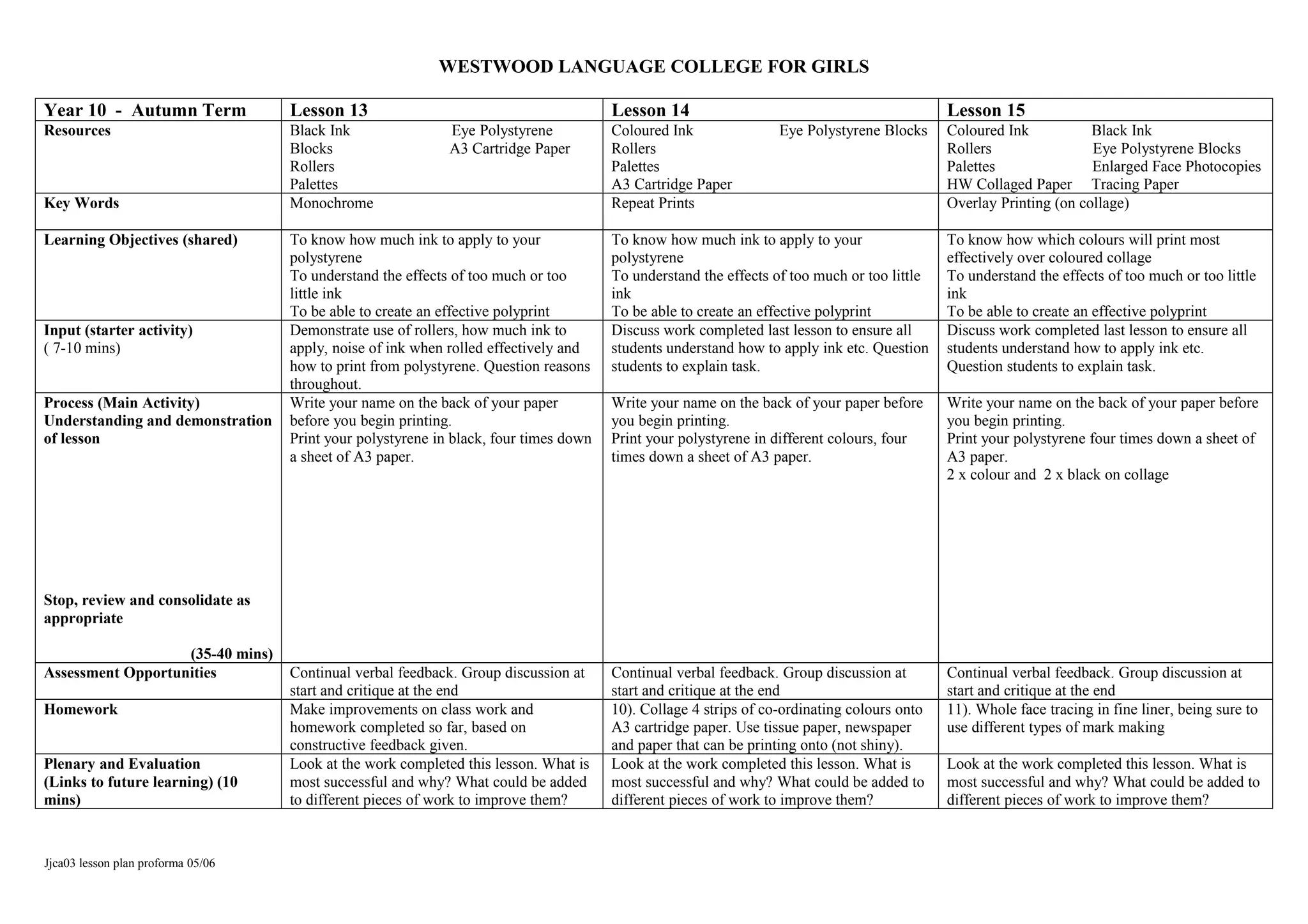
Year 10 - Autumn Term Lesson 13 Lesson 14 Lesson 15
Resources Black Ink Eye Polystyrene
Blocks A3 Cartridge Paper
Rollers
Palettes
Coloured Ink Eye Polystyrene Blocks
Rollers
Palettes
A3 Cartridge Paper
Coloured Ink Black Ink
Rollers Eye Polystyrene Blocks
Palettes Enlarged Face Photocopies
HW Collaged Paper Tracing Paper
Key Words Monochrome Repeat Prints Overlay Printing (on collage)
Learning Objectives (shared) To know how much ink to apply to your
polystyrene
To understand the effects of too much or too
little ink
To be able to create an effective polyprint
To know how much ink to apply to your
polystyrene
To understand the effects of too much or too little
ink
To be able to create an effective polyprint
To know how which colours will print most
effectively over coloured collage
To understand the effects of too much or too little
ink
To be able to create an effective polyprint
Input (starter activity)
( 7-10 mins)
Demonstrate use of rollers, how much ink to
apply, noise of ink when rolled effectively and
how to print from polystyrene. Question reasons
throughout.
Discuss work completed last lesson to ensure all
students understand how to apply ink etc. Question
students to explain task.
Discuss work completed last lesson to ensure all
students understand how to apply ink etc.
Question students to explain task.
Process (Main Activity)
Understanding and demonstration
of lesson
Stop, review and consolidate as
appropriate
(35-40 mins)
Write your name on the back of your paper
before you begin printing.
Print your polystyrene in black, four times down
a sheet of A3 paper.
Write your name on the back of your paper before
you begin printing.
Print your polystyrene in different colours, four
times down a sheet of A3 paper.
Write your name on the back of your paper before
you begin printing.
Print your polystyrene four times down a sheet of
A3 paper.
2 x colour and 2 x black on collage
Assessment Opportunities Continual verbal feedback. Group discussion at
start and critique at the end
Continual verbal feedback. Group discussion at
start and critique at the end
Continual verbal feedback. Group discussion at
start and critique at the end
Homework Make improvements on class work and
homework completed so far, based on
constructive feedback given.
10). Collage 4 strips of co-ordinating colours onto
A3 cartridge paper. Use tissue paper, newspaper
and paper that can be printing onto (not shiny).
11). Whole face tracing in fine liner, being sure to
use different types of mark making
Plenary and Evaluation
(Links to future learning) (10
mins)
Look at the work completed this lesson. What is
most successful and why? What could be added
to different pieces of work to improve them?
Look at the work completed this lesson. What is
most successful and why? What could be added to
different pieces of work to improve them?
Look at the work completed this lesson. What is
most successful and why? What could be added to
different pieces of work to improve them?
Jjca03 lesson plan proforma 05/06
WESTWOOD LANGUAGE COLLEGE FOR GIRLS
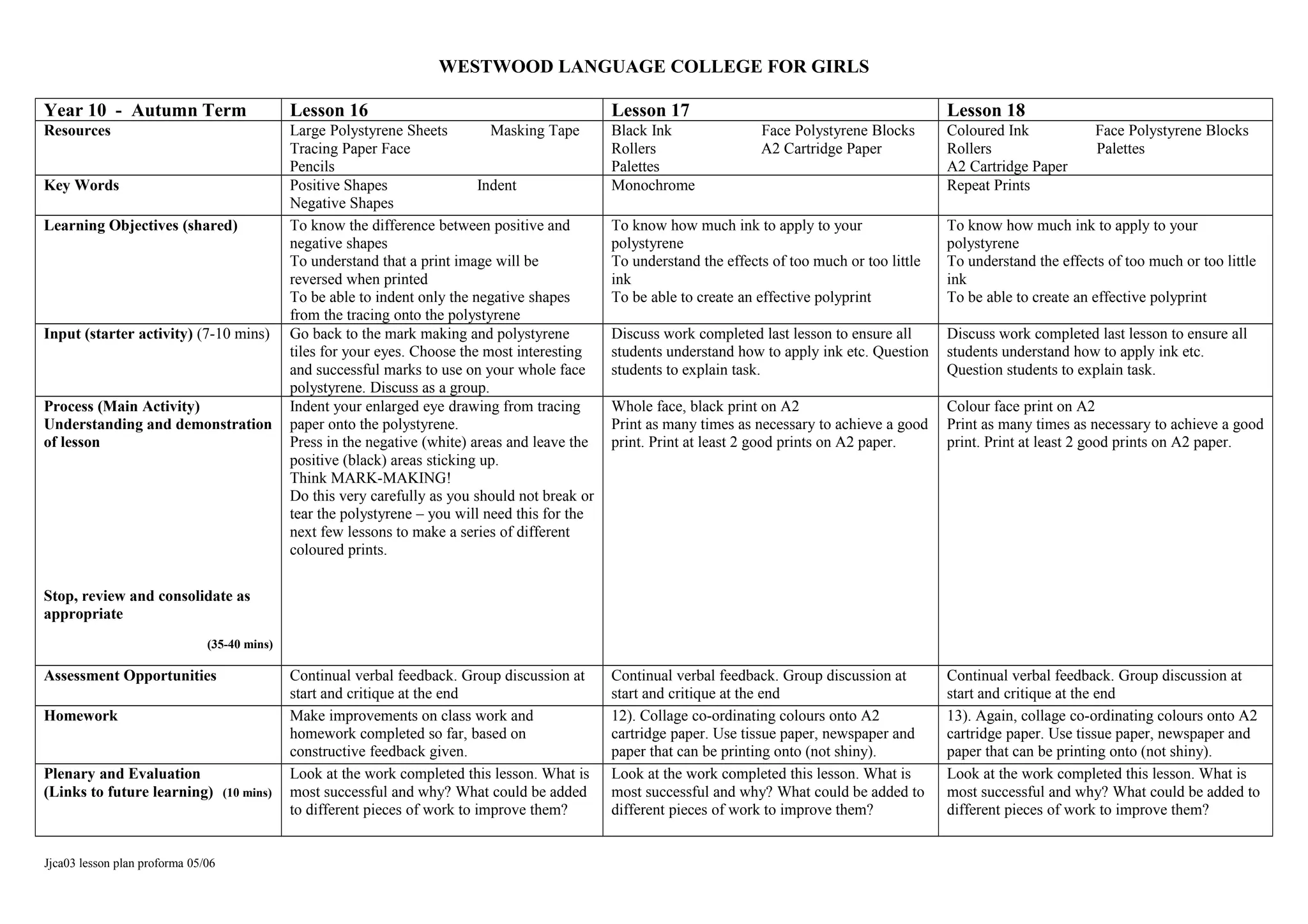
Year 10 - Autumn Term Lesson 16 Lesson 17 Lesson 18
Resources Large Polystyrene Sheets Masking Tape
Tracing Paper Face
Pencils
Black Ink Face Polystyrene Blocks
Rollers A2 Cartridge Paper
Palettes
Coloured Ink Face Polystyrene Blocks
Rollers Palettes
A2 Cartridge Paper
Key Words Positive Shapes Indent
Negative Shapes
Monochrome Repeat Prints
Learning Objectives (shared) To know the difference between positive and
negative shapes
To understand that a print image will be
reversed when printed
To be able to indent only the negative shapes
from the tracing onto the polystyrene
To know how much ink to apply to your
polystyrene
To understand the effects of too much or too little
ink
To be able to create an effective polyprint
To know how much ink to apply to your
polystyrene
To understand the effects of too much or too little
ink
To be able to create an effective polyprint
Input (starter activity) (7-10 mins) Go back to the mark making and polystyrene
tiles for your eyes. Choose the most interesting
and successful marks to use on your whole face
polystyrene. Discuss as a group.
Discuss work completed last lesson to ensure all
students understand how to apply ink etc. Question
students to explain task.
Discuss work completed last lesson to ensure all
students understand how to apply ink etc.
Question students to explain task.
Process (Main Activity)
Understanding and demonstration
of lesson
Stop, review and consolidate as
appropriate
(35-40 mins)
Indent your enlarged eye drawing from tracing
paper onto the polystyrene.
Press in the negative (white) areas and leave the
positive (black) areas sticking up.
Think MARK-MAKING!
Do this very carefully as you should not break or
tear the polystyrene – you will need this for the
next few lessons to make a series of different
coloured prints.
Whole face, black print on A2
Print as many times as necessary to achieve a good
print. Print at least 2 good prints on A2 paper.
Colour face print on A2
Print as many times as necessary to achieve a good
print. Print at least 2 good prints on A2 paper.
Assessment Opportunities Continual verbal feedback. Group discussion at
start and critique at the end
Continual verbal feedback. Group discussion at
start and critique at the end
Continual verbal feedback. Group discussion at
start and critique at the end
Homework Make improvements on class work and
homework completed so far, based on
constructive feedback given.
12). Collage co-ordinating colours onto A2
cartridge paper. Use tissue paper, newspaper and
paper that can be printing onto (not shiny).
13). Again, collage co-ordinating colours onto A2
cartridge paper. Use tissue paper, newspaper and
paper that can be printing onto (not shiny).
Plenary and Evaluation
(Links to future learning) (10 mins)
Look at the work completed this lesson. What is
most successful and why? What could be added
to different pieces of work to improve them?
Look at the work completed this lesson. What is
most successful and why? What could be added to
different pieces of work to improve them?
Look at the work completed this lesson. What is
most successful and why? What could be added to
different pieces of work to improve them?
Jjca03 lesson plan proforma 05/06
WESTWOOD LANGUAGE COLLEGE FOR GIRLS
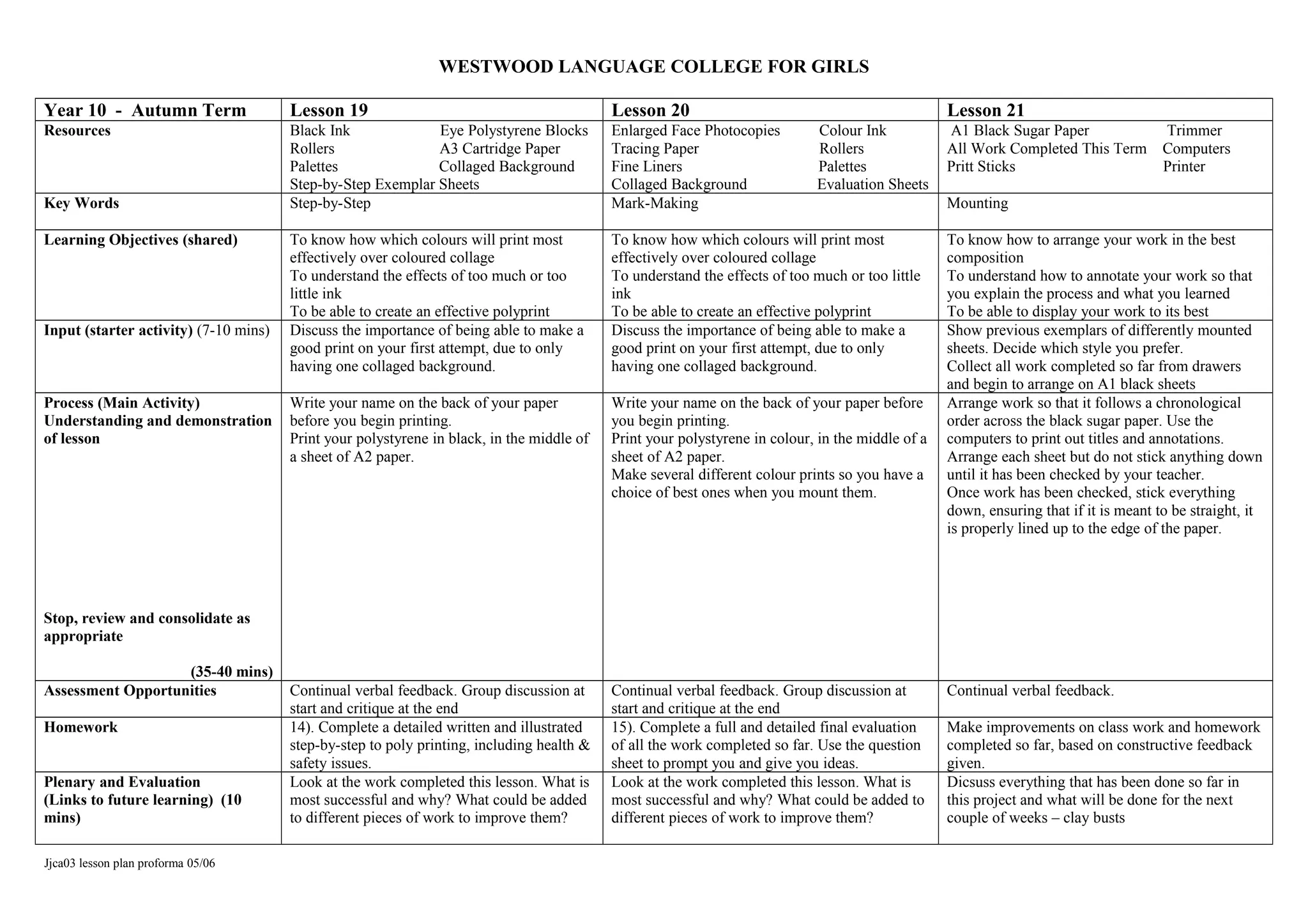
Year 10 - Autumn Term Lesson 19 Lesson 20 Lesson 21
Resources Black Ink Eye Polystyrene Blocks
Rollers A3 Cartridge Paper
Palettes Collaged Background
Step-by-Step Exemplar Sheets
Enlarged Face Photocopies Colour Ink
Tracing Paper Rollers
Fine Liners Palettes
Collaged Background Evaluation Sheets
A1 Black Sugar Paper Trimmer
All Work Completed This Term Computers
Pritt Sticks Printer
Key Words Step-by-Step Mark-Making Mounting
Learning Objectives (shared) To know how which colours will print most
effectively over coloured collage
To understand the effects of too much or too
little ink
To be able to create an effective polyprint
To know how which colours will print most
effectively over coloured collage
To understand the effects of too much or too little
ink
To be able to create an effective polyprint
To know how to arrange your work in the best
composition
To understand how to annotate your work so that
you explain the process and what you learned
To be able to display your work to its best
Input (starter activity) (7-10 mins) Discuss the importance of being able to make a
good print on your first attempt, due to only
having one collaged background.
Discuss the importance of being able to make a
good print on your first attempt, due to only
having one collaged background.
Show previous exemplars of differently mounted
sheets. Decide which style you prefer.
Collect all work completed so far from drawers
and begin to arrange on A1 black sheets
Process (Main Activity)
Understanding and demonstration
of lesson
Stop, review and consolidate as
appropriate
(35-40 mins)
Write your name on the back of your paper
before you begin printing.
Print your polystyrene in black, in the middle of
a sheet of A2 paper.
Write your name on the back of your paper before
you begin printing.
Print your polystyrene in colour, in the middle of a
sheet of A2 paper.
Make several different colour prints so you have a
choice of best ones when you mount them.
Arrange work so that it follows a chronological
order across the black sugar paper. Use the
computers to print out titles and annotations.
Arrange each sheet but do not stick anything down
until it has been checked by your teacher.
Once work has been checked, stick everything
down, ensuring that if it is meant to be straight, it
is properly lined up to the edge of the paper.
Assessment Opportunities Continual verbal feedback. Group discussion at
start and critique at the end
Continual verbal feedback. Group discussion at
start and critique at the end
Continual verbal feedback.
Homework 14). Complete a detailed written and illustrated
step-by-step to poly printing, including health &
safety issues.
15). Complete a full and detailed final evaluation
of all the work completed so far. Use the question
sheet to prompt you and give you ideas.
Make improvements on class work and homework
completed so far, based on constructive feedback
given.
Plenary and Evaluation
(Links to future learning) (10
mins)
Look at the work completed this lesson. What is
most successful and why? What could be added
to different pieces of work to improve them?
Look at the work completed this lesson. What is
most successful and why? What could be added to
different pieces of work to improve them?
Dicsuss everything that has been done so far in
this project and what will be done for the next
couple of weeks – clay busts
Jjca03 lesson plan proforma 05/06
WESTWOOD LANGUAGE COLLEGE FOR GIRLS
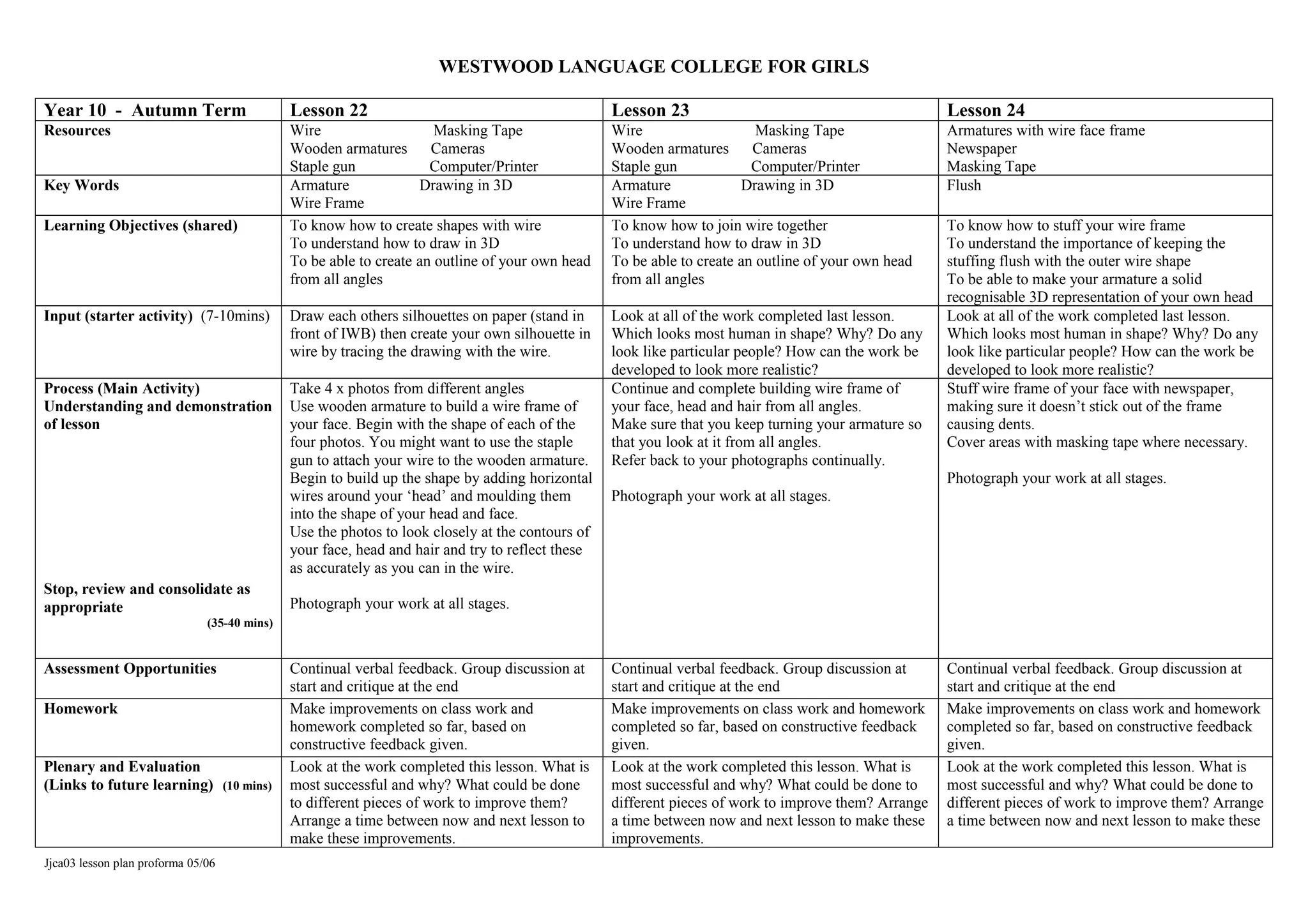
Year 10 - Autumn Term Lesson 22 Lesson 23 Lesson 24
Resources Wire Masking Tape
Wooden armatures Cameras
Staple gun Computer/Printer
Wire Masking Tape
Wooden armatures Cameras
Staple gun Computer/Printer
Armatures with wire face frame
Newspaper
Masking Tape
Key Words Armature Drawing in 3D
Wire Frame
Armature Drawing in 3D
Wire Frame
Flush
Learning Objectives (shared) To know how to create shapes with wire
To understand how to draw in 3D
To be able to create an outline of your own head
from all angles
To know how to join wire together
To understand how to draw in 3D
To be able to create an outline of your own head
from all angles
To know how to stuff your wire frame
To understand the importance of keeping the
stuffing flush with the outer wire shape
To be able to make your armature a solid
recognisable 3D representation of your own head
Input (starter activity) (7-10mins) Draw each others silhouettes on paper (stand in
front of IWB) then create your own silhouette in
wire by tracing the drawing with the wire.
Look at all of the work completed last lesson.
Which looks most human in shape? Why? Do any
look like particular people? How can the work be
developed to look more realistic?
Look at all of the work completed last lesson.
Which looks most human in shape? Why? Do any
look like particular people? How can the work be
developed to look more realistic?
Process (Main Activity)
Understanding and demonstration
of lesson
Stop, review and consolidate as
appropriate
(35-40 mins)
Take 4 x photos from different angles
Use wooden armature to build a wire frame of
your face. Begin with the shape of each of the
four photos. You might want to use the staple
gun to attach your wire to the wooden armature.
Begin to build up the shape by adding horizontal
wires around your ‘head’ and moulding them
into the shape of your head and face.
Use the photos to look closely at the contours of
your face, head and hair and try to reflect these
as accurately as you can in the wire.
Photograph your work at all stages.
Continue and complete building wire frame of
your face, head and hair from all angles.
Make sure that you keep turning your armature so
that you look at it from all angles.
Refer back to your photographs continually.
Photograph your work at all stages.
Stuff wire frame of your face with newspaper,
making sure it doesn’t stick out of the frame
causing dents.
Cover areas with masking tape where necessary.
Photograph your work at all stages.
Assessment Opportunities Continual verbal feedback. Group discussion at
start and critique at the end
Continual verbal feedback. Group discussion at
start and critique at the end
Continual verbal feedback. Group discussion at
start and critique at the end
Homework Make improvements on class work and
homework completed so far, based on
constructive feedback given.
Make improvements on class work and homework
completed so far, based on constructive feedback
given.
Make improvements on class work and homework
completed so far, based on constructive feedback
given.
Plenary and Evaluation
(Links to future learning) (10 mins)
Look at the work completed this lesson. What is
most successful and why? What could be done
to different pieces of work to improve them?
Arrange a time between now and next lesson to
make these improvements.
Look at the work completed this lesson. What is
most successful and why? What could be done to
different pieces of work to improve them? Arrange
a time between now and next lesson to make these
improvements.
Look at the work completed this lesson. What is
most successful and why? What could be done to
different pieces of work to improve them? Arrange
a time between now and next lesson to make these
Jjca03 lesson plan proforma 05/06
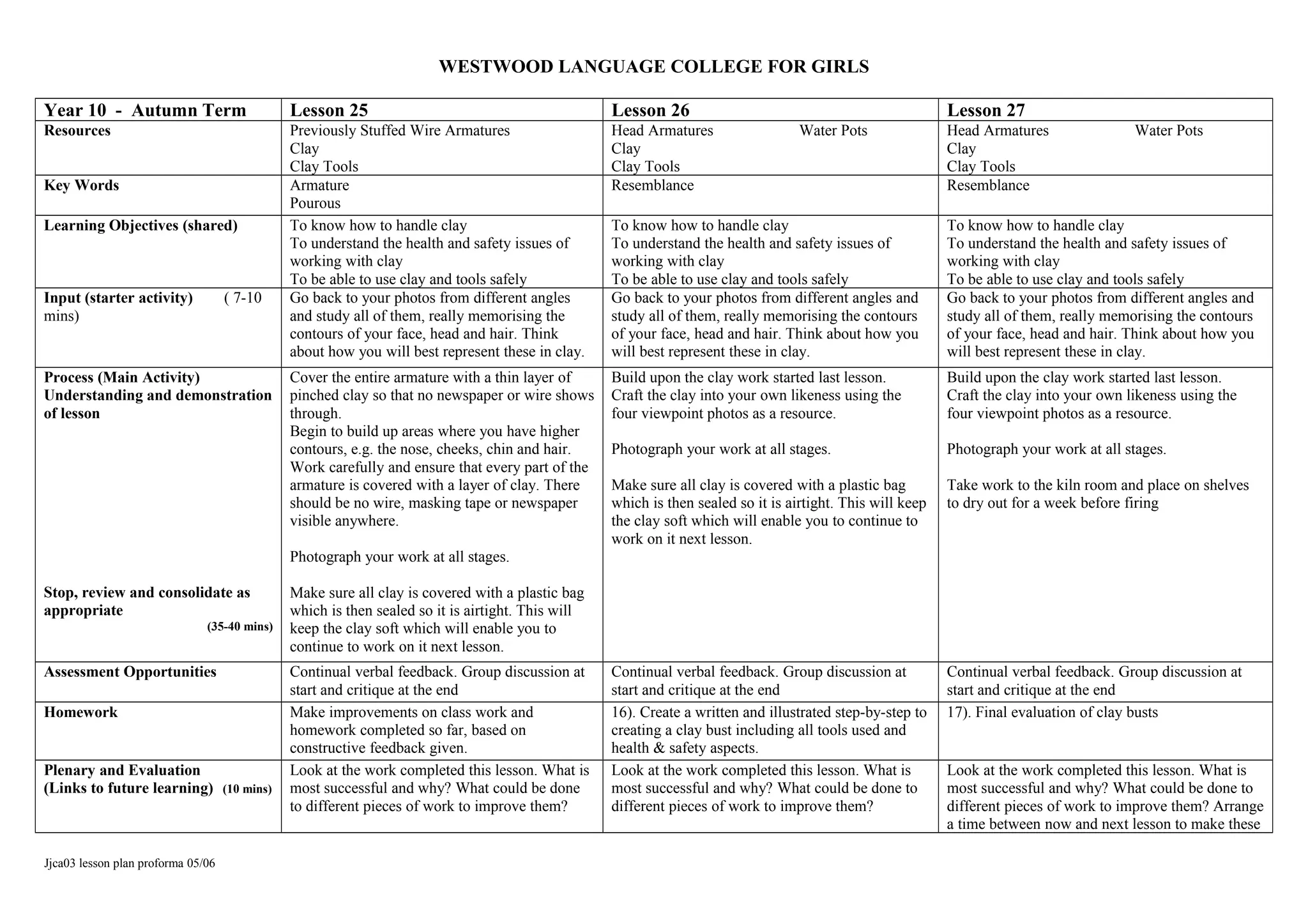
WESTWOOD LANGUAGE COLLEGE FOR GIRLS
Year 10 - Autumn Term Lesson 25 Lesson 26 Lesson 27
Resources Previously Stuffed Wire Armatures
Clay
Clay Tools
Head Armatures Water Pots
Clay
Clay Tools
Head Armatures Water Pots
Clay
Clay Tools
Key Words Armature
Pourous
Resemblance Resemblance
Learning Objectives (shared) To know how to handle clay
To understand the health and safety issues of
working with clay
To be able to use clay and tools safely
To know how to handle clay
To understand the health and safety issues of
working with clay
To be able to use clay and tools safely
To know how to handle clay
To understand the health and safety issues of
working with clay
To be able to use clay and tools safely
Input (starter activity) ( 7-10
mins)
Go back to your photos from different angles
and study all of them, really memorising the
contours of your face, head and hair. Think
about how you will best represent these in clay.
Go back to your photos from different angles and
study all of them, really memorising the contours
of your face, head and hair. Think about how you
will best represent these in clay.
Go back to your photos from different angles and
study all of them, really memorising the contours
of your face, head and hair. Think about how you
will best represent these in clay.
Process (Main Activity)
Understanding and demonstration
of lesson
Stop, review and consolidate as
appropriate
(35-40 mins)
Cover the entire armature with a thin layer of
pinched clay so that no newspaper or wire shows
through.
Begin to build up areas where you have higher
contours, e.g. the nose, cheeks, chin and hair.
Work carefully and ensure that every part of the
armature is covered with a layer of clay. There
should be no wire, masking tape or newspaper
visible anywhere.
Photograph your work at all stages.
Make sure all clay is covered with a plastic bag
which is then sealed so it is airtight. This will
keep the clay soft which will enable you to
continue to work on it next lesson.
Build upon the clay work started last lesson.
Craft the clay into your own likeness using the
four viewpoint photos as a resource.
Photograph your work at all stages.
Make sure all clay is covered with a plastic bag
which is then sealed so it is airtight. This will keep
the clay soft which will enable you to continue to
work on it next lesson.
Build upon the clay work started last lesson.
Craft the clay into your own likeness using the
four viewpoint photos as a resource.
Photograph your work at all stages.
Take work to the kiln room and place on shelves
to dry out for a week before firing
Assessment Opportunities Continual verbal feedback. Group discussion at
start and critique at the end
Continual verbal feedback. Group discussion at
start and critique at the end
Continual verbal feedback. Group discussion at
start and critique at the end
Homework Make improvements on class work and
homework completed so far, based on
constructive feedback given.
16). Create a written and illustrated step-by-step to
creating a clay bust including all tools used and
health & safety aspects.
17). Final evaluation of clay busts
Plenary and Evaluation
(Links to future learning) (10 mins)
Look at the work completed this lesson. What is
most successful and why? What could be done
to different pieces of work to improve them?
Look at the work completed this lesson. What is
most successful and why? What could be done to
different pieces of work to improve them?
Look at the work completed this lesson. What is
most successful and why? What could be done to
different pieces of work to improve them? Arrange
a time between now and next lesson to make these
Jjca03 lesson plan proforma 05/06
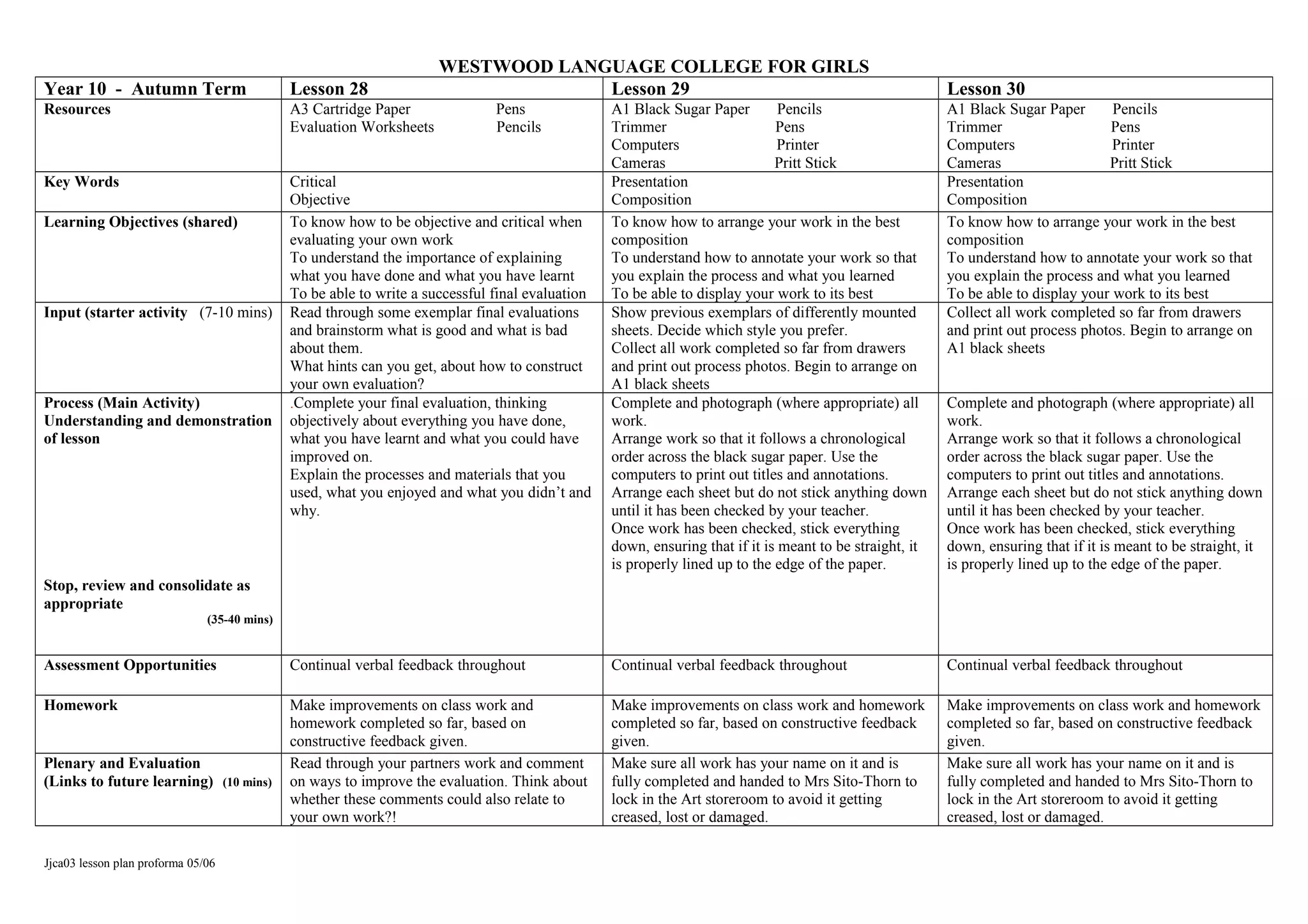
WESTWOOD LANGUAGE COLLEGE FOR GIRLS
Year 10 - Autumn Term Lesson 28 Lesson 29 Lesson 30
Resources A3 Cartridge Paper Pens
Evaluation Worksheets Pencils
A1 Black Sugar Paper Pencils
Trimmer Pens
Computers Printer
Cameras Pritt Stick
A1 Black Sugar Paper Pencils
Trimmer Pens
Computers Printer
Cameras Pritt Stick
Key Words Critical
Objective
Presentation
Composition
Presentation
Composition
Learning Objectives (shared) To know how to be objective and critical when
evaluating your own work
To understand the importance of explaining
what you have done and what you have learnt
To be able to write a successful final evaluation
To know how to arrange your work in the best
composition
To understand how to annotate your work so that
you explain the process and what you learned
To be able to display your work to its best
To know how to arrange your work in the best
composition
To understand how to annotate your work so that
you explain the process and what you learned
To be able to display your work to its best
Input (starter activity (7-10 mins) Read through some exemplar final evaluations
and brainstorm what is good and what is bad
about them.
What hints can you get, about how to construct
your own evaluation?
Show previous exemplars of differently mounted
sheets. Decide which style you prefer.
Collect all work completed so far from drawers
and print out process photos. Begin to arrange on
A1 black sheets
Collect all work completed so far from drawers
and print out process photos. Begin to arrange on
A1 black sheets
Process (Main Activity)
Understanding and demonstration
of lesson
Stop, review and consolidate as
appropriate
(35-40 mins)
.Complete your final evaluation, thinking
objectively about everything you have done,
what you have learnt and what you could have
improved on.
Explain the processes and materials that you
used, what you enjoyed and what you didn’t and
why.
Complete and photograph (where appropriate) all
work.
Arrange work so that it follows a chronological
order across the black sugar paper. Use the
computers to print out titles and annotations.
Arrange each sheet but do not stick anything down
until it has been checked by your teacher.
Once work has been checked, stick everything
down, ensuring that if it is meant to be straight, it
is properly lined up to the edge of the paper.
Complete and photograph (where appropriate) all
work.
Arrange work so that it follows a chronological
order across the black sugar paper. Use the
computers to print out titles and annotations.
Arrange each sheet but do not stick anything down
until it has been checked by your teacher.
Once work has been checked, stick everything
down, ensuring that if it is meant to be straight, it
is properly lined up to the edge of the paper.
Assessment Opportunities Continual verbal feedback throughout Continual verbal feedback throughout Continual verbal feedback throughout
Homework Make improvements on class work and
homework completed so far, based on
constructive feedback given.
Make improvements on class work and homework
completed so far, based on constructive feedback
given.
Make improvements on class work and homework
completed so far, based on constructive feedback
given.
Plenary and Evaluation
(Links to future learning) (10 mins)
Read through your partners work and comment
on ways to improve the evaluation. Think about
whether these comments could also relate to
your own work?!
Make sure all work has your name on it and is
fully completed and handed to Mrs Sito-Thorn to
lock in the Art storeroom to avoid it getting
creased, lost or damaged.
Make sure all work has your name on it and is
fully completed and handed to Mrs Sito-Thorn to
lock in the Art storeroom to avoid it getting
creased, lost or damaged.
Jjca03 lesson plan proforma 05/06

Yr 10 Portraits and Poly Printing Scheme Of Work

  • 1.
    WESTWOOD LANGUAGE COLLEGEFOR GIRLS DEPARTMENT LESSON PLAN KS4 Year 10 - Autumn Term Lesson 1 Lesson 2 Lesson 3 Resources White board Pens & Pencils Proportion Power Point A3 Cartridge Paper Chalk Charcoal Mirrors Mid Tone Sugar Paper A3 Sugar Paper Watercolour lead pencil Water pots & Paintbrushes Mirrors Key Words Proportion Tone Mid-tones Light Source/Direction Highlights & Shadows Tone Mid-tones Light Source/Direction Highlights & Shadows Learning Objectives (shared) To know the proportions of the face To understand how to use guidelines to assist in portrait drawing To be able to create a functional resource to enable portrait drawing throughout the term. To know how to work in chalk and charcoal To understand how to represent realistic highlights and shadows from a directional light source To be able to draw a realistic self portrait from a mirror To know how to effectively use a watercolour pencil To understand how to build up layers of tone To be able to draw a realistic tonal self portrait from a mirror Input (starter activity) ( 7-10 mins) Draw what you know a face to look like in orange pencil to fill the A3 paper. Add all the features and a neck and shoulders. Make sure your name is on the back of your work. Look at work produced last lesson to remind students of the proportions of the face. Looking in the mirrors, imagine the guidelines over your face so you can picture where the features will go when you draw them. Look at work produced last lesson to remind students of the proportions of the face and how to apply tone. Which were more successful and why? How can we all improve this lesson? What are the main aspects to remember? Process (Main Activity) Understanding and demonstration of lesson Stop, review and consolidate as appropriate (35-40 mins) Step-by-step instructions on drawing a face using proportion. Students to follow simple instructions, make notes and leave all guide lines on their work for future reference. Map out the main shapes of your face on A3 paper, using charcoal. Begin to build up areas of shadow, ensuring that you use a variety of tones, from light to dark. You can smudge areas with your fingers but it is advisable to only do this in some areas, not all. Add chalk highlights in the areas where the light most hits your face. There may only be a few highlights, whatever your skin colour. Teacher to work alongside students on own portrait to demonstrate techniques. Students to draw their portrait lightly in watercolour pencil and gradually build up layers of tone. Teacher to work alongside students on own portrait to demonstrate techniques throughout. Demonstration on application of water. Discussion on work completed so far, the effects of the water and what will need to be done next to improve work, whilst water is drying. Add top layer of detail and tone with watercolour pencil once water has dried. Assessment Opportunities Continual verbal feedback. Group critique at end Continual verbal feedback. Group critique at start and end Continual verbal feedback. Group critique at start and end Homework 1). Tear a full page portrait from a magazine and fold in half. Draw the other half of the face on one side and then swap the folded side to complete the other side. Make sure the portrait is balanced and has a wide range of tones. 2). Pencil Drawing Portrait showing a full range of tones. Be sure to use a mirror and keep checking the shapes of shadows and highlights. 3). Make an artist research page which focuses on a portrait painting from Picasso’s ‘Blue Period’. Discuss the use of colour and tone to convey mood and atmosphere. Plenary and Evaluation (Links to future learning) (10 mins) Gather around large table with work spread out. Compare your initial orange drawings to what you have now learnt about proportion. How do they differ? What have you learnt? Gather around large table with work spread out. How did what you learnt about proportion help you complete these portraits? What have you learnt this lesson? What still needs improving? Gather around large table with work spread out. How did what you learnt about tone help you complete these portraits? What have you learnt this lesson? What still needs improving? Jjca03 lesson plan proforma 05/06
  • 2.
    WESTWOOD LANGUAGE COLLEGEFOR GIRLS Year 10 - Autumn Term Lesson 4 Lesson 5 Lesson 6 Resources A3 Cartridge Paper Paintbrushes Mirrors Water pots Pencils Water colour Paints A3 Cartridge Paper Paintbrushes Mirrors Water pots Water colour Paints A3 Sugar Paper Collage Papers Pritt Sticks Mirrors Key Words Analogous Warm Colours Cool Colours Analogous Warm Colours Cool Colours Tone Mid-tones Light Source/Direction Collage Highlights & Shadows Learning Objectives (shared) To know how to draw a proportional portrait To understand analogous colours To be able to apply watercolour paints in layers To know how to paint with watercolours To understand analogous colours To be able to apply gradual layers of colour To know how to tear abstract shapes, but apply them to make realistic shadows and highlights. To understand the importance of looking in the mirror and not guessing shapes To be able to complete the work in the time given Input (starter activity) ( 7-10 mins) Group presentations of the work researched for homework. Remind class about rules of proportion. Discuss use of colour to represent mood and personality. Which colours might best represent you? Why? Look at work drawn up last lesson. Identify areas of light and shadow and how these will be best completed in shades of your chosen colours. Discuss the application of layers in watercolour. Demonstrate this briefly. Look at exemplar collage work and identify starting points. What are the key aspects which you can take from seeing this work, to use in your own work to help develop it? Process (Main Activity) Understanding and demonstration of lesson Stop, review and consolidate as appropriate (35-40 mins) Use the mirror to make a drawing of yourself, ensuring that all of your pencil marks are very light so that they wont show through the paint when you add colour. You don’t need to draw in detail, just outlines and shapes. Be completely happy with your drawing before adding any paint. (You might spend the entire lesson perfecting shapes in pencil). Make a watercolour painting of yourself (similar to the style of Picasso’s Blue Period paintings) using analogous colours (a very limited palette, e.g. just blues, purples and greens) Teacher to work on own portrait to demonstrate application of layers, throughout. Ensure that each layer is only slightly darker or deeper than the one before so that you are left with a full range of shades. Using only 3 colours of sugar paper, students are to build up a collage of their face on white cartridge paper. Begin with either a basic face shape, or the shape of the side of the face which is more in shadow. Shadows should be built up with different shades of paper, making sure there is not too much of the darkest colour, even if skin colour is very dark. White paper can also be used towards the end of the lesson to show highlights. Assessment Opportunities Continual verbal feedback. Group critique at start and end Continual verbal feedback. Group critique at start and end Continual verbal feedback. Group critique at start and end Homework Make improvements on class work and homework completed so far, based on constructive feedback given. Make improvements on class work and homework completed so far, based on constructive feedback given. 4). Use an enlarged photocopy of your face, rip out headlines and text from newspapers to collage Plenary and Evaluation (Links to future learning) (10 mins) Gather around large table with work spread out. How did what you learnt about Picasso’s Blue Period help you to prepare for this lesson? What have you learnt this lesson? What do you need to do in preparation for next lesson? Gather around large table with work spread out. How does your work compare to the work of Picasso’s Blue Period? What have you learnt this lesson? Make notes on the back of your work to remind you when mounting and labelling. Gather around large table with work spread out. What have you learnt about collage? Explain homework and discuss how it should develop and improve upon what was done in the lesson. Jjca03 lesson plan proforma 05/06
  • 3.
    WESTWOOD LANGUAGE COLLEGEFOR GIRLS Year 10 - Autumn Term Lesson 7 Lesson 8 Lesson 9 Resources A3 Cartridge Paper Computers/Internet Pencils A3 Cartridge Paper Cameras Printer Pencils Computers Previous Text (H/W) Photoshop Photoshop Tutorial Worksheets Photos from previous lesson Key Words Analyse Identify Annotate Critique Pastiche Interpret Crop Palette Layer Duplicate Learning Objectives (shared) To know how to create a successful artist research page To understand how to analyse and interpret an artists intentions To be able to positively critique your work and the work of others To know how to use the digital cameras To understand how to work in the style of an artist To be able to annotate your own intentions To know how to use photoshop To understand simple written commands and instructions To be able to follow instructions to complete a final piece of text as image Input (starter activity) ( 7-10 mins) Analyse exemplar GCSE artist research pages. What key aspects do they share? What makes them successful? Consider how you will incorporate these points in your own work. Look at work completed last lesson on Kelly Thompson. Describe the types of shapes, lines and patterns she uses. What do they tell us about the character of the person? What shapes and patterns might you use to show clues about yourself? Log on, make sure your photo from last lesson is saved (otherwise take a new photo and upload it) Ensure you have your written piece of homework (ideally typed and saved in your documents) Process (Main Activity) Understanding and demonstration of lesson Stop, review and consolidate as appropriate (35-40 mins) Students to work in pairs on the computers. Find work by Kelly Thompson and save the images you like into a word document so that several images can be displayed at once. Create an artist/illustrator research page on Kelly Thompson using different images to your neighbour. Comment on her use of shape, colour, pattern and texture. Describe how you could produce a similar illustration with a photograph of yourself that shows influences by this artist but is still your own original piece of work Take a colour photo of yourself and cut out the face, ears and neck in one piece. Complete the clothing and hair and possibly even background with drawing pencil or pen. Work with lines, shapes and patterns which give the viewer some clues about your character. Work slowly and carefully as precision is the key to success in this task. Follow the photo shop tutorial worksheets step-by- step instructions to creating your own portrait in text. Work gradually as a whole class on each step. Assessment Opportunities Continual verbal feedback. Group critique at start and end Continual verbal feedback. Group critique at start and end Continual verbal feedback Homework 5). Write either a story/poem/keywords which describe you. This could be looks, personality, hobbies and interests, it’s up to you. 6). Complete your self-illustration in the style of Kelly Thompson. It could be black and white or in colour. 7). Bring in a clear photograph of yourself (as recent as possible) or have your photo taken at school. Plenary and Evaluation (Links to future learning) (10 mins) Gather around large table with work spread out. What have you learnt about artist research pages? What do you still need to do to improve? Do you need to spend extra time completing this work? Identify where and when. Look at the work completed so far. What is most successful and why? What could be added to different pieces of work to improve them? What needs to be completed for homework? Continue tutorial until complete. Photocopy your full face photograph with very strong contrasting black and white areas for next lesson. Jjca03 lesson plan proforma 05/06
  • 4.
    WESTWOOD LANGUAGE COLLEGEFOR GIRLS Year 10 - Autumn Term Lesson 10 Lesson 11 Lesson 12 Resources B/W Portrait Photocopies A3 Photocopy Paper Fine liners German Exp.Woodcut Worksheets Ink Drawing Pens Water Pots Ink Tracing Paper A3 Cartridge Paper Fine Liners Mirrors Polystyrene Strips Pencils Tracings from previous H/W Masking Tape Key Words Contour German Expressionist Woodcut Artists Self Portrait Mark-Making Positive Shapes Indent Negative Shapes Learning Objectives (shared) To know how to manipulate words and writing to fit shapes and contours To understand the contours of the face To be able to create a handwritten portrait using only text To know how to use the drawing pens and ink To understand how to use mark making in order to show varying degrees of shadow and tone To be able to produce a self portrait in a similar style to the German Exp.Woodcuts To know the difference between positive and negative shapes To understand that a print image will be reversed when printed To be able to indent only the negative shapes from the tracing onto the polystyrene Input (starter activity) ( 7-10 mins) On a sheet of paper, make a list of key words and sentences which describe you. Try to make these as detailed and as unique as possible. Practice mark making that shows varying degrees of tone. Think about how and where you could use these on your self portrait. Discuss as a group. Complete worksheet on positive and negative shapes to assess students prior knowledge. Discuss as a class. Process (Main Activity) Understanding and demonstration of lesson Stop, review and consolidate as appropriate (35-40 mins) Create a text portrait by writing over a sheet of paper placed over a strong black and white photo. Use large writing for lighter sections and smaller tighter writing for the darker areas. Make sure that the writing reflects your personality. Draw up the simple shapes and outlines of your portrait, using the mirrors and a pencil (very lightly) Carefully complete your ink self portrait in the style of the German expressionist woodcut artists by keeping the lines and edges straight, and using the mark making practised at the start of the lesson. Indent your enlarged eye drawing from tracing paper onto the polystyrene. Press in the negative (white) areas and leave the positive (black) areas sticking up. Think MARK-MAKING! Do this very carefully as you should not break or tear the polystyrene – you will need this for the next few lessons to make a series of different coloured prints. Assessment Opportunities Continual verbal feedback. Group critique at start and end Continual verbal feedback. Group discussion at start and critique at the end Continual verbal feedback. Group discussion at start and critique at the end Homework 8). Make an artist research page on the German Expressionist Woodcut artists. Draw the picture and write about the use of line, tone, mood etc 9). Enlarged eye tracing in fine liner being sure to vary your mark making Photocopy all tracing paper eye drawings Make improvements on class work and homework completed so far, based on constructive feedback given. Plenary and Evaluation (Links to future learning) (10 mins) Look at the work completed this lesson. What is most successful and why? What could be added to different pieces of work to improve them? Discuss the homework and hand out German Exp.Woodcut worksheets Look at the work completed this lesson. What is most successful and why? What could be added to different pieces of work to improve them? Discuss the homework and reiterate the importance of a variety of different mark making. Look at the work completed this lesson. What is most successful and why? What could be added to different pieces of work to improve them? Jjca03 lesson plan proforma 05/06
  • 5.
    WESTWOOD LANGUAGE COLLEGEFOR GIRLS Year 10 - Autumn Term Lesson 13 Lesson 14 Lesson 15 Resources Black Ink Eye Polystyrene Blocks A3 Cartridge Paper Rollers Palettes Coloured Ink Eye Polystyrene Blocks Rollers Palettes A3 Cartridge Paper Coloured Ink Black Ink Rollers Eye Polystyrene Blocks Palettes Enlarged Face Photocopies HW Collaged Paper Tracing Paper Key Words Monochrome Repeat Prints Overlay Printing (on collage) Learning Objectives (shared) To know how much ink to apply to your polystyrene To understand the effects of too much or too little ink To be able to create an effective polyprint To know how much ink to apply to your polystyrene To understand the effects of too much or too little ink To be able to create an effective polyprint To know how which colours will print most effectively over coloured collage To understand the effects of too much or too little ink To be able to create an effective polyprint Input (starter activity) ( 7-10 mins) Demonstrate use of rollers, how much ink to apply, noise of ink when rolled effectively and how to print from polystyrene. Question reasons throughout. Discuss work completed last lesson to ensure all students understand how to apply ink etc. Question students to explain task. Discuss work completed last lesson to ensure all students understand how to apply ink etc. Question students to explain task. Process (Main Activity) Understanding and demonstration of lesson Stop, review and consolidate as appropriate (35-40 mins) Write your name on the back of your paper before you begin printing. Print your polystyrene in black, four times down a sheet of A3 paper. Write your name on the back of your paper before you begin printing. Print your polystyrene in different colours, four times down a sheet of A3 paper. Write your name on the back of your paper before you begin printing. Print your polystyrene four times down a sheet of A3 paper. 2 x colour and 2 x black on collage Assessment Opportunities Continual verbal feedback. Group discussion at start and critique at the end Continual verbal feedback. Group discussion at start and critique at the end Continual verbal feedback. Group discussion at start and critique at the end Homework Make improvements on class work and homework completed so far, based on constructive feedback given. 10). Collage 4 strips of co-ordinating colours onto A3 cartridge paper. Use tissue paper, newspaper and paper that can be printing onto (not shiny). 11). Whole face tracing in fine liner, being sure to use different types of mark making Plenary and Evaluation (Links to future learning) (10 mins) Look at the work completed this lesson. What is most successful and why? What could be added to different pieces of work to improve them? Look at the work completed this lesson. What is most successful and why? What could be added to different pieces of work to improve them? Look at the work completed this lesson. What is most successful and why? What could be added to different pieces of work to improve them? Jjca03 lesson plan proforma 05/06
  • 6.
    WESTWOOD LANGUAGE COLLEGEFOR GIRLS Year 10 - Autumn Term Lesson 16 Lesson 17 Lesson 18 Resources Large Polystyrene Sheets Masking Tape Tracing Paper Face Pencils Black Ink Face Polystyrene Blocks Rollers A2 Cartridge Paper Palettes Coloured Ink Face Polystyrene Blocks Rollers Palettes A2 Cartridge Paper Key Words Positive Shapes Indent Negative Shapes Monochrome Repeat Prints Learning Objectives (shared) To know the difference between positive and negative shapes To understand that a print image will be reversed when printed To be able to indent only the negative shapes from the tracing onto the polystyrene To know how much ink to apply to your polystyrene To understand the effects of too much or too little ink To be able to create an effective polyprint To know how much ink to apply to your polystyrene To understand the effects of too much or too little ink To be able to create an effective polyprint Input (starter activity) (7-10 mins) Go back to the mark making and polystyrene tiles for your eyes. Choose the most interesting and successful marks to use on your whole face polystyrene. Discuss as a group. Discuss work completed last lesson to ensure all students understand how to apply ink etc. Question students to explain task. Discuss work completed last lesson to ensure all students understand how to apply ink etc. Question students to explain task. Process (Main Activity) Understanding and demonstration of lesson Stop, review and consolidate as appropriate (35-40 mins) Indent your enlarged eye drawing from tracing paper onto the polystyrene. Press in the negative (white) areas and leave the positive (black) areas sticking up. Think MARK-MAKING! Do this very carefully as you should not break or tear the polystyrene – you will need this for the next few lessons to make a series of different coloured prints. Whole face, black print on A2 Print as many times as necessary to achieve a good print. Print at least 2 good prints on A2 paper. Colour face print on A2 Print as many times as necessary to achieve a good print. Print at least 2 good prints on A2 paper. Assessment Opportunities Continual verbal feedback. Group discussion at start and critique at the end Continual verbal feedback. Group discussion at start and critique at the end Continual verbal feedback. Group discussion at start and critique at the end Homework Make improvements on class work and homework completed so far, based on constructive feedback given. 12). Collage co-ordinating colours onto A2 cartridge paper. Use tissue paper, newspaper and paper that can be printing onto (not shiny). 13). Again, collage co-ordinating colours onto A2 cartridge paper. Use tissue paper, newspaper and paper that can be printing onto (not shiny). Plenary and Evaluation (Links to future learning) (10 mins) Look at the work completed this lesson. What is most successful and why? What could be added to different pieces of work to improve them? Look at the work completed this lesson. What is most successful and why? What could be added to different pieces of work to improve them? Look at the work completed this lesson. What is most successful and why? What could be added to different pieces of work to improve them? Jjca03 lesson plan proforma 05/06
  • 7.
    WESTWOOD LANGUAGE COLLEGEFOR GIRLS Year 10 - Autumn Term Lesson 19 Lesson 20 Lesson 21 Resources Black Ink Eye Polystyrene Blocks Rollers A3 Cartridge Paper Palettes Collaged Background Step-by-Step Exemplar Sheets Enlarged Face Photocopies Colour Ink Tracing Paper Rollers Fine Liners Palettes Collaged Background Evaluation Sheets A1 Black Sugar Paper Trimmer All Work Completed This Term Computers Pritt Sticks Printer Key Words Step-by-Step Mark-Making Mounting Learning Objectives (shared) To know how which colours will print most effectively over coloured collage To understand the effects of too much or too little ink To be able to create an effective polyprint To know how which colours will print most effectively over coloured collage To understand the effects of too much or too little ink To be able to create an effective polyprint To know how to arrange your work in the best composition To understand how to annotate your work so that you explain the process and what you learned To be able to display your work to its best Input (starter activity) (7-10 mins) Discuss the importance of being able to make a good print on your first attempt, due to only having one collaged background. Discuss the importance of being able to make a good print on your first attempt, due to only having one collaged background. Show previous exemplars of differently mounted sheets. Decide which style you prefer. Collect all work completed so far from drawers and begin to arrange on A1 black sheets Process (Main Activity) Understanding and demonstration of lesson Stop, review and consolidate as appropriate (35-40 mins) Write your name on the back of your paper before you begin printing. Print your polystyrene in black, in the middle of a sheet of A2 paper. Write your name on the back of your paper before you begin printing. Print your polystyrene in colour, in the middle of a sheet of A2 paper. Make several different colour prints so you have a choice of best ones when you mount them. Arrange work so that it follows a chronological order across the black sugar paper. Use the computers to print out titles and annotations. Arrange each sheet but do not stick anything down until it has been checked by your teacher. Once work has been checked, stick everything down, ensuring that if it is meant to be straight, it is properly lined up to the edge of the paper. Assessment Opportunities Continual verbal feedback. Group discussion at start and critique at the end Continual verbal feedback. Group discussion at start and critique at the end Continual verbal feedback. Homework 14). Complete a detailed written and illustrated step-by-step to poly printing, including health & safety issues. 15). Complete a full and detailed final evaluation of all the work completed so far. Use the question sheet to prompt you and give you ideas. Make improvements on class work and homework completed so far, based on constructive feedback given. Plenary and Evaluation (Links to future learning) (10 mins) Look at the work completed this lesson. What is most successful and why? What could be added to different pieces of work to improve them? Look at the work completed this lesson. What is most successful and why? What could be added to different pieces of work to improve them? Dicsuss everything that has been done so far in this project and what will be done for the next couple of weeks – clay busts Jjca03 lesson plan proforma 05/06
  • 8.
    WESTWOOD LANGUAGE COLLEGEFOR GIRLS Year 10 - Autumn Term Lesson 22 Lesson 23 Lesson 24 Resources Wire Masking Tape Wooden armatures Cameras Staple gun Computer/Printer Wire Masking Tape Wooden armatures Cameras Staple gun Computer/Printer Armatures with wire face frame Newspaper Masking Tape Key Words Armature Drawing in 3D Wire Frame Armature Drawing in 3D Wire Frame Flush Learning Objectives (shared) To know how to create shapes with wire To understand how to draw in 3D To be able to create an outline of your own head from all angles To know how to join wire together To understand how to draw in 3D To be able to create an outline of your own head from all angles To know how to stuff your wire frame To understand the importance of keeping the stuffing flush with the outer wire shape To be able to make your armature a solid recognisable 3D representation of your own head Input (starter activity) (7-10mins) Draw each others silhouettes on paper (stand in front of IWB) then create your own silhouette in wire by tracing the drawing with the wire. Look at all of the work completed last lesson. Which looks most human in shape? Why? Do any look like particular people? How can the work be developed to look more realistic? Look at all of the work completed last lesson. Which looks most human in shape? Why? Do any look like particular people? How can the work be developed to look more realistic? Process (Main Activity) Understanding and demonstration of lesson Stop, review and consolidate as appropriate (35-40 mins) Take 4 x photos from different angles Use wooden armature to build a wire frame of your face. Begin with the shape of each of the four photos. You might want to use the staple gun to attach your wire to the wooden armature. Begin to build up the shape by adding horizontal wires around your ‘head’ and moulding them into the shape of your head and face. Use the photos to look closely at the contours of your face, head and hair and try to reflect these as accurately as you can in the wire. Photograph your work at all stages. Continue and complete building wire frame of your face, head and hair from all angles. Make sure that you keep turning your armature so that you look at it from all angles. Refer back to your photographs continually. Photograph your work at all stages. Stuff wire frame of your face with newspaper, making sure it doesn’t stick out of the frame causing dents. Cover areas with masking tape where necessary. Photograph your work at all stages. Assessment Opportunities Continual verbal feedback. Group discussion at start and critique at the end Continual verbal feedback. Group discussion at start and critique at the end Continual verbal feedback. Group discussion at start and critique at the end Homework Make improvements on class work and homework completed so far, based on constructive feedback given. Make improvements on class work and homework completed so far, based on constructive feedback given. Make improvements on class work and homework completed so far, based on constructive feedback given. Plenary and Evaluation (Links to future learning) (10 mins) Look at the work completed this lesson. What is most successful and why? What could be done to different pieces of work to improve them? Arrange a time between now and next lesson to make these improvements. Look at the work completed this lesson. What is most successful and why? What could be done to different pieces of work to improve them? Arrange a time between now and next lesson to make these improvements. Look at the work completed this lesson. What is most successful and why? What could be done to different pieces of work to improve them? Arrange a time between now and next lesson to make these Jjca03 lesson plan proforma 05/06
  • 9.
    WESTWOOD LANGUAGE COLLEGEFOR GIRLS Year 10 - Autumn Term Lesson 25 Lesson 26 Lesson 27 Resources Previously Stuffed Wire Armatures Clay Clay Tools Head Armatures Water Pots Clay Clay Tools Head Armatures Water Pots Clay Clay Tools Key Words Armature Pourous Resemblance Resemblance Learning Objectives (shared) To know how to handle clay To understand the health and safety issues of working with clay To be able to use clay and tools safely To know how to handle clay To understand the health and safety issues of working with clay To be able to use clay and tools safely To know how to handle clay To understand the health and safety issues of working with clay To be able to use clay and tools safely Input (starter activity) ( 7-10 mins) Go back to your photos from different angles and study all of them, really memorising the contours of your face, head and hair. Think about how you will best represent these in clay. Go back to your photos from different angles and study all of them, really memorising the contours of your face, head and hair. Think about how you will best represent these in clay. Go back to your photos from different angles and study all of them, really memorising the contours of your face, head and hair. Think about how you will best represent these in clay. Process (Main Activity) Understanding and demonstration of lesson Stop, review and consolidate as appropriate (35-40 mins) Cover the entire armature with a thin layer of pinched clay so that no newspaper or wire shows through. Begin to build up areas where you have higher contours, e.g. the nose, cheeks, chin and hair. Work carefully and ensure that every part of the armature is covered with a layer of clay. There should be no wire, masking tape or newspaper visible anywhere. Photograph your work at all stages. Make sure all clay is covered with a plastic bag which is then sealed so it is airtight. This will keep the clay soft which will enable you to continue to work on it next lesson. Build upon the clay work started last lesson. Craft the clay into your own likeness using the four viewpoint photos as a resource. Photograph your work at all stages. Make sure all clay is covered with a plastic bag which is then sealed so it is airtight. This will keep the clay soft which will enable you to continue to work on it next lesson. Build upon the clay work started last lesson. Craft the clay into your own likeness using the four viewpoint photos as a resource. Photograph your work at all stages. Take work to the kiln room and place on shelves to dry out for a week before firing Assessment Opportunities Continual verbal feedback. Group discussion at start and critique at the end Continual verbal feedback. Group discussion at start and critique at the end Continual verbal feedback. Group discussion at start and critique at the end Homework Make improvements on class work and homework completed so far, based on constructive feedback given. 16). Create a written and illustrated step-by-step to creating a clay bust including all tools used and health & safety aspects. 17). Final evaluation of clay busts Plenary and Evaluation (Links to future learning) (10 mins) Look at the work completed this lesson. What is most successful and why? What could be done to different pieces of work to improve them? Look at the work completed this lesson. What is most successful and why? What could be done to different pieces of work to improve them? Look at the work completed this lesson. What is most successful and why? What could be done to different pieces of work to improve them? Arrange a time between now and next lesson to make these Jjca03 lesson plan proforma 05/06
  • 10.
    WESTWOOD LANGUAGE COLLEGEFOR GIRLS Year 10 - Autumn Term Lesson 28 Lesson 29 Lesson 30 Resources A3 Cartridge Paper Pens Evaluation Worksheets Pencils A1 Black Sugar Paper Pencils Trimmer Pens Computers Printer Cameras Pritt Stick A1 Black Sugar Paper Pencils Trimmer Pens Computers Printer Cameras Pritt Stick Key Words Critical Objective Presentation Composition Presentation Composition Learning Objectives (shared) To know how to be objective and critical when evaluating your own work To understand the importance of explaining what you have done and what you have learnt To be able to write a successful final evaluation To know how to arrange your work in the best composition To understand how to annotate your work so that you explain the process and what you learned To be able to display your work to its best To know how to arrange your work in the best composition To understand how to annotate your work so that you explain the process and what you learned To be able to display your work to its best Input (starter activity (7-10 mins) Read through some exemplar final evaluations and brainstorm what is good and what is bad about them. What hints can you get, about how to construct your own evaluation? Show previous exemplars of differently mounted sheets. Decide which style you prefer. Collect all work completed so far from drawers and print out process photos. Begin to arrange on A1 black sheets Collect all work completed so far from drawers and print out process photos. Begin to arrange on A1 black sheets Process (Main Activity) Understanding and demonstration of lesson Stop, review and consolidate as appropriate (35-40 mins) .Complete your final evaluation, thinking objectively about everything you have done, what you have learnt and what you could have improved on. Explain the processes and materials that you used, what you enjoyed and what you didn’t and why. Complete and photograph (where appropriate) all work. Arrange work so that it follows a chronological order across the black sugar paper. Use the computers to print out titles and annotations. Arrange each sheet but do not stick anything down until it has been checked by your teacher. Once work has been checked, stick everything down, ensuring that if it is meant to be straight, it is properly lined up to the edge of the paper. Complete and photograph (where appropriate) all work. Arrange work so that it follows a chronological order across the black sugar paper. Use the computers to print out titles and annotations. Arrange each sheet but do not stick anything down until it has been checked by your teacher. Once work has been checked, stick everything down, ensuring that if it is meant to be straight, it is properly lined up to the edge of the paper. Assessment Opportunities Continual verbal feedback throughout Continual verbal feedback throughout Continual verbal feedback throughout Homework Make improvements on class work and homework completed so far, based on constructive feedback given. Make improvements on class work and homework completed so far, based on constructive feedback given. Make improvements on class work and homework completed so far, based on constructive feedback given. Plenary and Evaluation (Links to future learning) (10 mins) Read through your partners work and comment on ways to improve the evaluation. Think about whether these comments could also relate to your own work?! Make sure all work has your name on it and is fully completed and handed to Mrs Sito-Thorn to lock in the Art storeroom to avoid it getting creased, lost or damaged. Make sure all work has your name on it and is fully completed and handed to Mrs Sito-Thorn to lock in the Art storeroom to avoid it getting creased, lost or damaged. Jjca03 lesson plan proforma 05/06