Welcome to the Presentation on
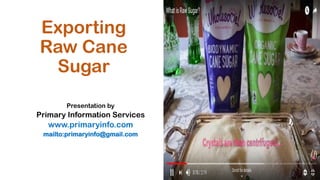
"Exporting
Raw Cane
Sugar"
Exporting
Raw Cane
Sugar
Presentation by
Primary Information Services
www.primaryinfo.com
mailto:primaryinfo@gmail.com
Raw Cane
Sugar
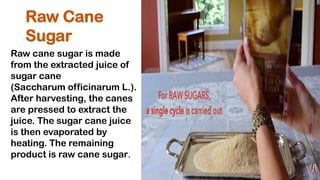
Raw cane sugar is made
from the extracted juice of
sugar cane
(Saccharum officinarum L.).
After harvesting, the canes
are pressed to extract the
juice. The sugar cane juice
is then evaporated by
heating. The remaining
product is raw cane sugar.
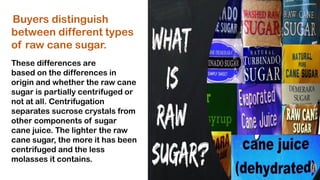
Buyers distinguish
between different types
of raw cane sugar.
These differences are
based on the differences in
origin and whether the raw cane
sugar is partially centrifuged or
not at all. Centrifugation
separates sucrose crystals from
other components of sugar
cane juice. The lighter the raw
cane sugar, the more it has been
centrifuged and the less
molasses it contains.
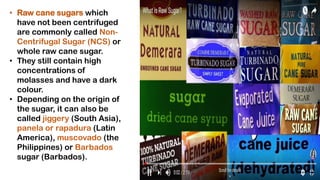
• Raw cane sugars which
have not been centrifuged
are commonly called Non-
Centrifugal Sugar (NCS) or
whole raw cane sugar.
• They still contain high
concentrations of
molasses and have a dark
colour.
• Depending on the origin of
the sugar, it can also be
called jiggery (South Asia),
panela or rapadura (Latin
America), muscovado (the
Philippines) or Barbados
sugar (Barbados).
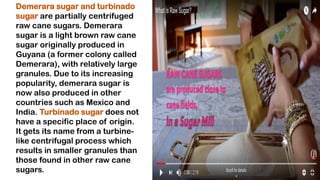
Demerara sugar and turbinado
sugar are partially centrifuged
raw cane sugars. Demerara
sugar is a light brown raw cane
sugar originally produced in
Guyana (a former colony called
Demerara), with relatively large
granules. Due to its increasing
popularity, demerara sugar is
now also produced in other
countries such as Mexico and
India. Turbinado sugar does not
have a specific place of origin.
It gets its name from a turbine-
like centrifugal process which
results in smaller granules than
those found in other raw cane
sugars.
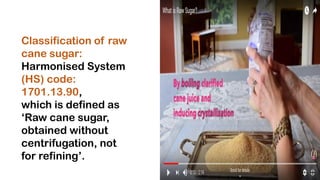
Classification of raw
cane sugar:
Harmonised System
(HS) code:
1701.13.90,
which is defined as
‘Raw cane sugar,
obtained without
centrifugation, not
for refining’.
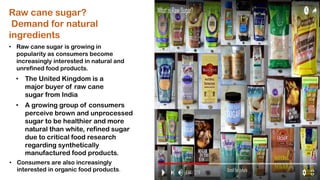
• Raw cane sugar is growing in
popularity as consumers become
increasingly interested in natural and
unrefined food products.
• The United Kingdom is a
major buyer of raw cane
sugar from India
• A growing group of consumers
perceive brown and unprocessed
sugar to be healthier and more
natural than white, refined sugar
due to critical food research
regarding synthetically
manufactured food products.
Raw cane sugar?
Demand for natural
ingredients
• Consumers are also increasingly
interested in organic food products.
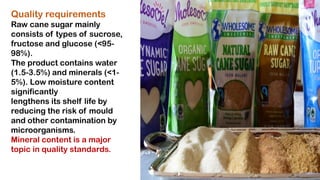
Quality requirements
Raw cane sugar mainly
consists of types of sucrose,
fructose and glucose (<95-
98%).
The product contains water
(1.5-3.5%) and minerals (<1-
5%). Low moisture content
significantly
lengthens its shelf life by
reducing the risk of mould
and other contamination by
microorganisms.
Mineral content is a major
topic in quality standards.
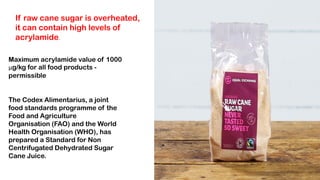
If raw cane sugar is overheated,
it can contain high levels of
acrylamide.
Maximum acrylamide value of 1000
μg/kg for all food products -
permissible
The Codex Alimentarius, a joint
food standards programme of the
Food and Agriculture
Organisation (FAO) and the World
Health Organisation (WHO), has
prepared a Standard for Non
Centrifugated Dehydrated Sugar
Cane Juice.
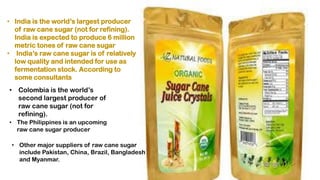
• India is the world’s largest producer
of raw cane sugar (not for refining).
India is expected to produce 6 million
metric tones of raw cane sugar
• India’s raw cane sugar is of relatively
low quality and intended for use as
fermentation stock. According to
some consultants
• Colombia is the world’s
second largest producer of
raw cane sugar (not for
refining).
• The Philippines is an upcoming
raw cane sugar producer
• Other major suppliers of raw cane sugar
include Pakistan, China, Brazil, Bangladesh
and Myanmar.
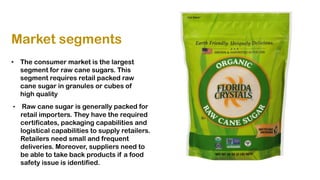
Market segments
• The consumer market is the largest
segment for raw cane sugars. This
segment requires retail packed raw
cane sugar in granules or cubes of
high quality
• Raw cane sugar is generally packed for
retail importers. They have the required
certificates, packaging capabilities and
logistical capabilities to supply retailers.
Retailers need small and frequent
deliveries. Moreover, suppliers need to
be able to take back products if a food
safety issue is identified.
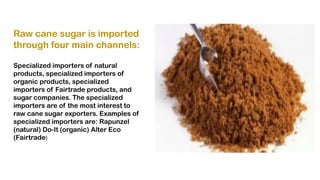
Raw cane sugar is imported
through four main channels:
Specialized importers of natural
products, specialized importers of
organic products, specialized
importers of Fairtrade products, and
sugar companies. The specialized
importers are of the most interest to
raw cane sugar exporters. Examples of
specialized importers are: Rapunzel
(natural) Do-It (organic) Alter Eco
(Fairtrade)
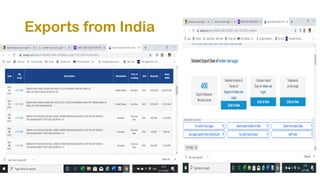
Exports from India
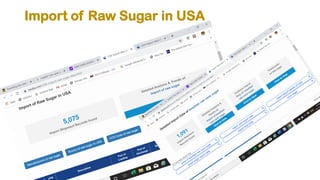
Import of Raw Sugar in USA
QUESTIONS?

Exporting Raw cane-sugar

  • 1.
    Welcome to thePresentation on "Exporting Raw Cane Sugar"
  • 2.
    Exporting Raw Cane Sugar Presentation by PrimaryInformation Services www.primaryinfo.com mailto:primaryinfo@gmail.com
  • 3.
    Raw Cane Sugar Raw canesugar is made from the extracted juice of sugar cane (Saccharum officinarum L.). After harvesting, the canes are pressed to extract the juice. The sugar cane juice is then evaporated by heating. The remaining product is raw cane sugar.
  • 4.
    Buyers distinguish between differenttypes of raw cane sugar. These differences are based on the differences in origin and whether the raw cane sugar is partially centrifuged or not at all. Centrifugation separates sucrose crystals from other components of sugar cane juice. The lighter the raw cane sugar, the more it has been centrifuged and the less molasses it contains.
  • 5.
    • Raw canesugars which have not been centrifuged are commonly called Non- Centrifugal Sugar (NCS) or whole raw cane sugar. • They still contain high concentrations of molasses and have a dark colour. • Depending on the origin of the sugar, it can also be called jiggery (South Asia), panela or rapadura (Latin America), muscovado (the Philippines) or Barbados sugar (Barbados).
  • 6.
    Demerara sugar andturbinado sugar are partially centrifuged raw cane sugars. Demerara sugar is a light brown raw cane sugar originally produced in Guyana (a former colony called Demerara), with relatively large granules. Due to its increasing popularity, demerara sugar is now also produced in other countries such as Mexico and India. Turbinado sugar does not have a specific place of origin. It gets its name from a turbine- like centrifugal process which results in smaller granules than those found in other raw cane sugars.
  • 7.
    Classification of raw canesugar: Harmonised System (HS) code: 1701.13.90, which is defined as ‘Raw cane sugar, obtained without centrifugation, not for refining’.
  • 8.
    • Raw canesugar is growing in popularity as consumers become increasingly interested in natural and unrefined food products. • The United Kingdom is a major buyer of raw cane sugar from India • A growing group of consumers perceive brown and unprocessed sugar to be healthier and more natural than white, refined sugar due to critical food research regarding synthetically manufactured food products. Raw cane sugar? Demand for natural ingredients • Consumers are also increasingly interested in organic food products.
  • 9.
    Quality requirements Raw canesugar mainly consists of types of sucrose, fructose and glucose (<95- 98%). The product contains water (1.5-3.5%) and minerals (<1- 5%). Low moisture content significantly lengthens its shelf life by reducing the risk of mould and other contamination by microorganisms. Mineral content is a major topic in quality standards.
  • 10.
    If raw canesugar is overheated, it can contain high levels of acrylamide. Maximum acrylamide value of 1000 μg/kg for all food products - permissible The Codex Alimentarius, a joint food standards programme of the Food and Agriculture Organisation (FAO) and the World Health Organisation (WHO), has prepared a Standard for Non Centrifugated Dehydrated Sugar Cane Juice.
  • 11.
    • India isthe world’s largest producer of raw cane sugar (not for refining). India is expected to produce 6 million metric tones of raw cane sugar • India’s raw cane sugar is of relatively low quality and intended for use as fermentation stock. According to some consultants • Colombia is the world’s second largest producer of raw cane sugar (not for refining). • The Philippines is an upcoming raw cane sugar producer • Other major suppliers of raw cane sugar include Pakistan, China, Brazil, Bangladesh and Myanmar.
  • 12.
    Market segments • Theconsumer market is the largest segment for raw cane sugars. This segment requires retail packed raw cane sugar in granules or cubes of high quality • Raw cane sugar is generally packed for retail importers. They have the required certificates, packaging capabilities and logistical capabilities to supply retailers. Retailers need small and frequent deliveries. Moreover, suppliers need to be able to take back products if a food safety issue is identified.
  • 13.
    Raw cane sugaris imported through four main channels: Specialized importers of natural products, specialized importers of organic products, specialized importers of Fairtrade products, and sugar companies. The specialized importers are of the most interest to raw cane sugar exporters. Examples of specialized importers are: Rapunzel (natural) Do-It (organic) Alter Eco (Fairtrade)
  • 14.
  • 15.
    Import of RawSugar in USA
  • 16.