NIK MERIAM NIK SULAIMAN
DEAN, SUSTAINABILITY SCIENCE RESEARCH CLUSTER, UNIVERSITY OF
MALAYA
Exploring ‘Sustainability’:
Concept and Definition from
Practitioner’s Perspective
INTERNATIONAL SEMINAR ON SCIENCE FOR SUSTAINABLE
DEVELOPMENT:
ISLAMIC PERSPECTIVES
18 November 2014, Grand Hall, IKIM
Theme: Concept and Definition
“It suddenly struck me that that tiny
pea, pretty and blue, was the Earth. I
put up my thumb and shut one eye,
and my thumb blotted out the planet
Earth. I didn't feel like a giant. I felt
very, very small”.
[Neil Armstrong on Apollo 11, July
20, 1969]
Image taken from: http://www.wikinewforum.com
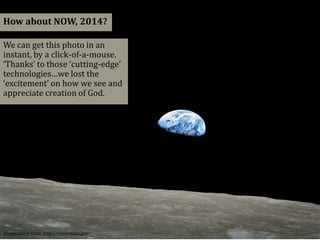
How about NOW, 2014?
We can get this photo in an
instant, by a click-of-a-mouse.
‘Thanks’ to those ‘cutting-edge’
technologies…we lost the
‘excitement’ on how we see and
appreciate creation of God.
Image taken from: http://www.nasa.gov
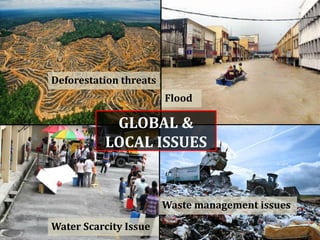
Deforestation threats
Water Scarcity Issue
Flood
Waste management issues
GLOBAL &
LOCAL ISSUES
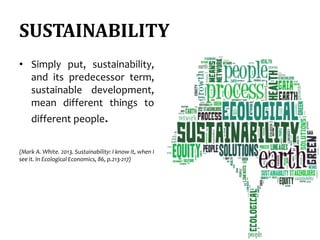
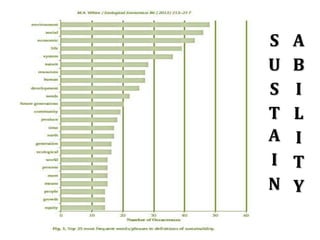
SUSTAINABILITY
• Simply put, sustainability,
and its predecessor term,
sustainable development,
mean different things to
different people.
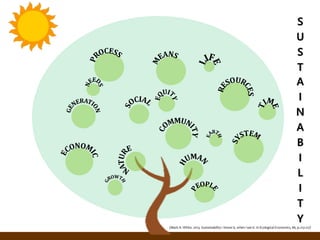
(Mark A. White. 2013. Sustainability: I know it, when I
see it. In Ecological Economics, 86, p.213-217)
S
U
S
T
A
I
N
A
B
I
L
I
T
Y
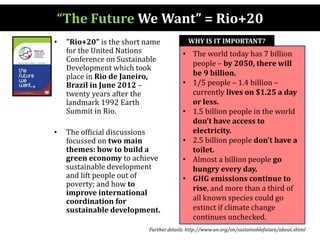
“The Future We Want” = Rio+20
• "Rio+20" is the short name
for the United Nations
Conference on Sustainable
Development which took
place in Rio de Janeiro,
Brazil in June 2012 –
twenty years after the
landmark 1992 Earth
Summit in Rio.
• The official discussions
focussed on two main
themes: how to build a
green economy to achieve
sustainable development
and lift people out of
poverty; and how to
improve international
coordination for
sustainable development.
• The world today has 7 billion
people – by 2050, there will
be 9 billion.
• 1/5 people – 1.4 billion –
currently lives on $1.25 a day
or less.
• 1.5 billion people in the world
don’t have access to
electricity.
• 2.5 billion people don’t have a
toilet.
• Almost a billion people go
hungry every day.
• GHG emissions continue to
rise, and more than a third of
all known species could go
extinct if climate change
continues unchecked.
WHY IS IT IMPORTANT?
Further details: http://www.un.org/en/sustainablefuture/about.shtml
SUSTAINABILITY
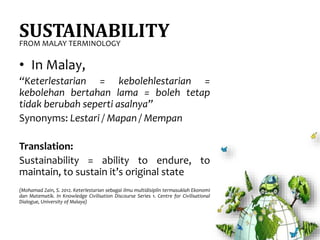
• In Malay,
“Keterlestarian = kebolehlestarian =
kebolehan bertahan lama = boleh tetap
tidak berubah seperti asalnya”
Synonyms: Lestari / Mapan / Mempan
Translation:
Sustainability = ability to endure, to
maintain, to sustain it’s original state
(Mohamad Zain, S. 2012. Keterlestarian sebagai ilmu multidisiplin termasuklah Ekonomi
dan Matematik. In Knowledge Civilisation Discourse Series 1. Centre for Civilisational
Dialogue, University of Malaya)
FROM MALAY TERMINOLOGY
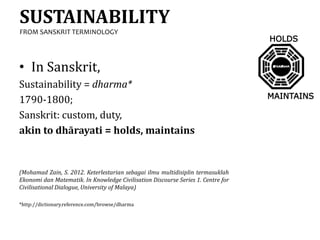
• In Sanskrit,
Sustainability = dharma*
1790-1800;
Sanskrit: custom, duty,
akin to dhārayati = holds, maintains
(Mohamad Zain, S. 2012. Keterlestarian sebagai ilmu multidisiplin termasuklah
Ekonomi dan Matematik. In Knowledge Civilisation Discourse Series 1. Centre for
Civilisational Dialogue, University of Malaya)
*http://dictionary.reference.com/browse/dharma
HOLDS
MAINTAINS
SUSTAINABILITY
FROM SANSKRIT TERMINOLOGY
SUSTAINABILITY
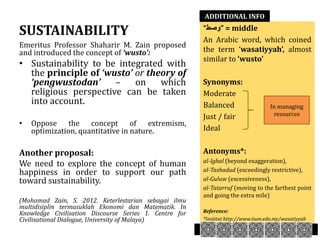
Emeritus Professor Shaharir M. Zain proposed
and introduced the concept of ‘wusto’:
• Sustainability to be integrated with
the principle of ‘wusto’ or theory of
‘pengwustodan’ – on which
religious perspective can be taken
into account.
• Oppose the concept of extremism,
optimization, quantitative in nature.
Another proposal:
We need to explore the concept of human
happiness in order to support our path
toward sustainability.
(Mohamad Zain, S. 2012. Keterlestarian sebagai ilmu
multidisiplin termasuklah Ekonomi dan Matematik. In
Knowledge Civilisation Discourse Series 1. Centre for
Civilisational Dialogue, University of Malaya)
“‫”وصط‬ = middle
An Arabic word, which coined
the term ‘wasatiyyah’, almost
similar to ‘wusto’
Synonyms:
Moderate
Balanced
Just / fair
Ideal
Antonyms*:
al-Ighal (beyond exaggeration),
al-Tashadud (exceedingly restrictive),
al-Guluw (excessiveness),
al-Tatarruf (moving to the farthest point
and going the extra mile)
Reference:
*Institut http://www.iium.edu.my/wasatiyyah
ADDITIONAL INFO
In managing
resources
Integration of Islamic Perspective
on Sustainability
Translation:
“Indeed, the wasteful are brothers of the devils, and
ever has Satan been to his Lord ungrateful”
[Surah al-Isra’: 27]
• Badzara = root word for tabdzir / mubazirun which means the act of wasteful
• ‘wasteful’ in this context is mentioned thrice (3) in Quran: Surah al-Isra’: 26-27
info
Integration of Islamic Perspective
on Sustainability
Prophet Muhammad S.A.W said:
“Do not waste water, even if you perform your
ablution on the banks of an abundantly-flowing river”
[HR Imam Ahmad]
Integration of Islamic Perspective
on Sustainability
Translation:
O Children of Adam! wear your beautiful apparel at
every time and place of prayer: eat and drink: But
waste not by excess, for Allah loveth not the wasters.
[Surah al-A’araf: 31]
• Sarafa = root word for Israf / Musrifin which means the act of wasteful in excess,
transgression beyond limit, excessive
• ‘excessive’ in this context is mentioned twenty three (23) time in 21 verses in
Quran: with different or similar connotation
info
Newspaper clipping
Source:
http://www.umlib.um.edu.my/umnews/wasatiyah-lahir_n2-280414.jpg
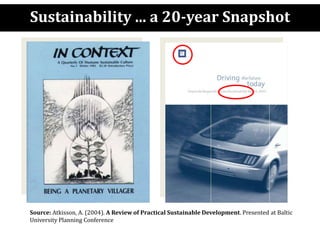
Sustainability ... a 20-year Snapshot
1983 2003Source: Atkisson, A. (2004). A Review of Practical Sustainable Development. Presented at Baltic
University Planning Conference
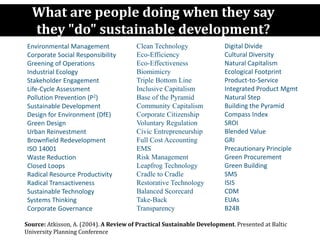
What are people doing when they say
they "do" sustainable development?
Environmental Management
Corporate Social Responsibility
Greening of Operations
Industrial Ecology
Stakeholder Engagement
Life-Cycle Assessment
Pollution Prevention (P2)
Sustainable Development
Design for Environment (DfE)
Green Design
Urban Reinvestment
Brownfield Redevelopment
ISO 14001
Waste Reduction
Closed Loops
Radical Resource Productivity
Radical Transactiveness
Sustainable Technology
Systems Thinking
Corporate Governance
Clean Technology
Eco-Efficiency
Eco-Effectiveness
Biomimicry
Triple Bottom Line
Inclusive Capitalism
Base of the Pyramid
Community Capitalism
Corporate Citizenship
Voluntary Regulation
Civic Entrepreneurship
Full Cost Accounting
EMS
Risk Management
Leapfrog Technology
Cradle to Cradle
Restorative Technology
Balanced Scorecard
Take-Back
Transparency
Source: Stuart Hart,
with thanks to Marty LaGod,
with additions by AtKisson
Digital Divide
Cultural Diversity
Natural Capitalism
Ecological Footprint
Product-to-Service
Integrated Product Mgmt
Natural Step
Building the Pyramid
Compass Index
SROI
Blended Value
GRI
Precautionary Principle
Green Procurement
Green Building
SMS
ISIS
CDM
EUAs
B24B
Source: Atkisson, A. (2004). A Review of Practical Sustainable Development. Presented at Baltic
University Planning Conference
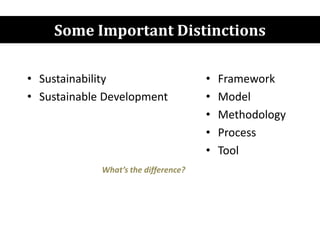
Some Important Distinctions
• Sustainability
• Sustainable Development
• Framework
• Model
• Methodology
• Process
• Tool
What’s the difference?
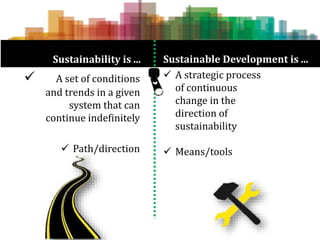
Sustainability is ...
 A set of conditions
and trends in a given
system that can
continue indefinitely
 Path/direction
 A strategic process
of continuous
change in the
direction of
sustainability
 Means/tools
Sustainable Development is ...
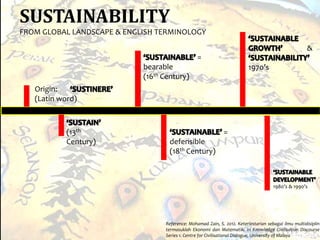
SUSTAINABILITY
FROM GLOBAL LANDSCAPE & ENGLISH TERMINOLOGY
Origin:
(Latin word)
(13th
Century)
=
bearable
(16th Century)
=
defensible
(18th Century)
&
1970’s
Reference: Mohamad Zain, S. 2012. Keterlestarian sebagai ilmu multidisiplin
termasuklah Ekonomi dan Matematik. In Knowledge Civilisation Discourse
Series 1. Centre for Civilisational Dialogue, University of Malaya
1980’s & 1990’s
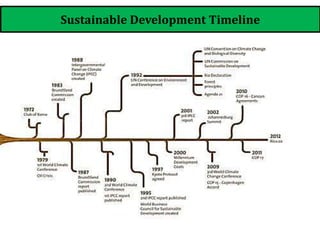
Sustainable Development Timeline
Sustainability Concepts
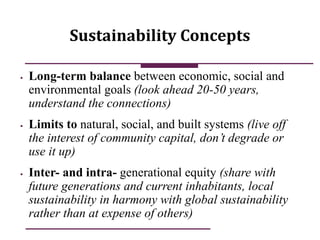
 Long-term balance between economic, social and
environmental goals (look ahead 20-50 years,
understand the connections)
 Limits to natural, social, and built systems (live off
the interest of community capital, don’t degrade or
use it up)
 Inter- and intra- generational equity (share with
future generations and current inhabitants, local
sustainability in harmony with global sustainability
rather than at expense of others)
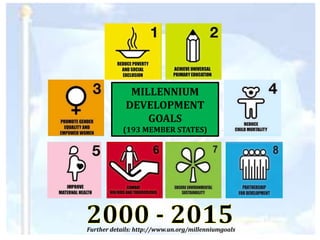
MILLENNIUM
DEVELOPMENT
GOALS
(193 MEMBER STATES)
Further details: http://www.un.org/millenniumgoals
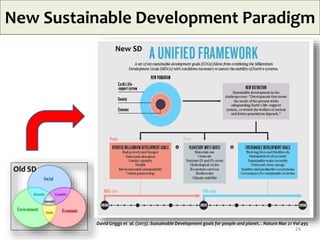
New Sustainable Development Paradigm
David Griggs et al. (2013). Sustainable Development goals for people and planet. . Nature Mar 21 Vol 495
Old SD
New SD
24
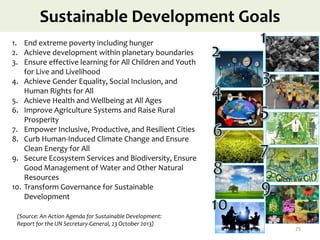
Sustainable Development Goals
1. End extreme poverty including hunger
2. Achieve development within planetary boundaries
3. Ensure effective learning for All Children and Youth
for Live and Livelihood
4. Achieve Gender Equality, Social Inclusion, and
Human Rights for All
5. Achieve Health and Wellbeing at All Ages
6. Improve Agriculture Systems and Raise Rural
Prosperity
7. Empower Inclusive, Productive, and Resilient Cities
8. Curb Human-Induced Climate Change and Ensure
Clean Energy for All
9. Secure Ecosystem Services and Biodiversity, Ensure
Good Management of Water and Other Natural
Resources
10. Transform Governance for Sustainable
Development
(Source: An Action Agenda for Sustainable Development:
Report for the UN Secretary-General, 23 October 2013)
25
Trees of Sustainability
What word will best
describe ‘sustainability’?
(Mark A. White. 2013. Sustainability: I know it, when I see it. In Ecological Economics, 86, p.213-217)
SUSTAINABILITY…
HAS DIFFERENT MEANING TO
DIFFERENT PEOPLE
SUSTAINABILITY…
HAS DIFFERENT MEANING TO
DIFFERENT PEOPLE
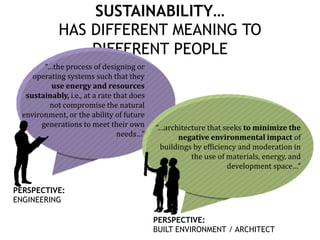
PERSPECTIVE:
ENGINEERING
“…the process of designing or
operating systems such that they
use energy and resources
sustainably, i.e., at a rate that does
not compromise the natural
environment, or the ability of future
generations to meet their own
needs…”
PERSPECTIVE:
BUILT ENVIRONMENT / ARCHITECT
“…architecture that seeks to minimize the
negative environmental impact of
buildings by efficiency and moderation in
the use of materials, energy, and
development space…”
SUSTAINABILITY…
HAS DIFFERENT MEANING TO
DIFFERENT PEOPLE
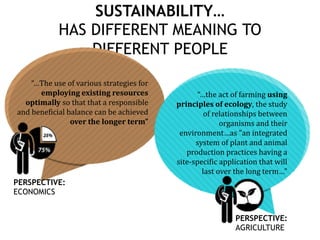
“…The use of various strategies for
employing existing resources
optimally so that that a responsible
and beneficial balance can be achieved
over the longer term”
PERSPECTIVE:
ECONOMICS
PERSPECTIVE:
AGRICULTURE
“…the act of farming using
principles of ecology, the study
of relationships between
organisms and their
environment…as "an integrated
system of plant and animal
production practices having a
site-specific application that will
last over the long term…"
SUSTAINABILITY…
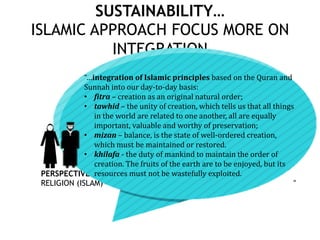
ISLAMIC APPROACH FOCUS MORE ON
INTEGRATION
PERSPECTIVE:
RELIGION (ISLAM)
“…integration of Islamic principles based on the Quran and
Sunnah into our day-to-day basis:
• fitra – creation as an original natural order;
• tawhid – the unity of creation, which tells us that all things
in the world are related to one another, all are equally
important, valuable and worthy of preservation;
• mizan – balance, is the state of well-ordered creation,
which must be maintained or restored.
• khilafa - the duty of mankind to maintain the order of
creation. The fruits of the earth are to be enjoyed, but its
resources must not be wastefully exploited.
”
2 Mode of Science: Practitioner’s Perspective
Mode-1
Science
Academic
Mono-
disciplinary
Technocratic
Certain
Predictive
Mode-2
Science
Academic &
Social
Multi-Inter-
Trans-
disciplinary
Participative
Uncertain
Exploratory
Reference: [AKEPT Material] - Martens, P. (2006) Sustainability:
science or fiction? Sustainability: Science, Practice and Policy, 2(1), 1-
5. (also published as: Solidarity & Sustainability, Reflections on
Solidarity, Sustainability and Religious Violence, 2 (9), September
2006.)
The role of Sustainability + Science in Policy Process
Reference: [AKEPT Material] - Martens, P. (2006) Sustainability:
science or fiction? Sustainability: Science, Practice and Policy, 2(1), 1-
5. (also published as: Solidarity & Sustainability, Reflections on
Solidarity, Sustainability and Religious Violence, 2 (9), September
2006.)
Definitions of Sustainable Development
Reference: [AKEPT Material] - Kemp R. & Martens P. 2007. Sustainable development:
how to manage something that is subjective and never can be achieved?.
Sustainability: Science, Practice, & Policy 3(2):5-14. Published online Aug 30, 2007.
http://www.google.com.my/archives/vol3iss2/0703-007.kemp.html
What is to be
sustained?
Nature: Earth, Biodiversity, Ecosystems
Life Support: Ecosystem Services,
Resources, Environment
Community: Cultures, Groups, Places
What is to be
developed?
People: child survival, Life expectancy,
education, Equity, Equal opportunity
Economy: wealth, productive sectors,
consumption
Society: institutions, social capital
states, regions
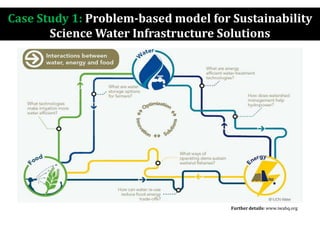
Case Study 1: Problem-based model for Sustainability
Science Water Infrastructure Solutions
Further details: www.iwahq.org
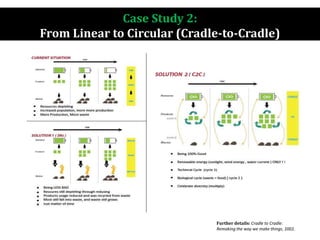
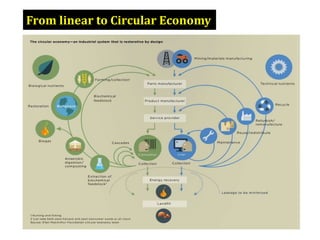
Case Study 2:
From Linear to Circular (Cradle-to-Cradle)
Further details: Cradle to Cradle:
Remaking the way we make things, 2002.
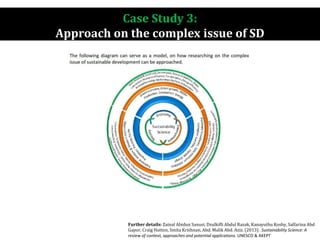
Case Study 3:
Approach on the complex issue of SD
Further details: Zainal Abidun Sanusi, Dzulkifli Abdul Razak, Kanayuthu Koshy, Salfarina Abd
Gapor, Craig Hutton, Smita Krishnan, Abd. Malik Abd. Aziz. (2013) . Sustainability Science: A
review of context, approaches and potential applications. UNESCO & AKEPT
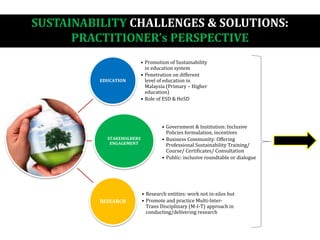
SUSTAINABILITY CHALLENGES & SOLUTIONS:
PRACTITIONER’s PERSPECTIVE
EDUCATION
• Promotion of Sustainability
in education system
• Penetration on different
level of education in
Malaysia (Primary – Higher
education)
• Role of ESD & HeSD
STAKEHOLDERS
ENGAGEMENT
• Government & Institution: Inclusive
Policies formulation, incentives
• Business Community: Offering
Professional Sustainability Training/
Course/ Certificates/ Consultation
• Public: inclusive roundtable or dialogue
RESEARCH
• Research entities: work not in-silos but
• Promote and practice Multi-Inter-
Trans Disciplinary (M-I-T) approach in
conducting/delivering research
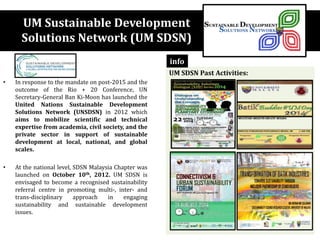
UM Sustainable Development
Solutions Network (UM SDSN)
• In response to the mandate on post-2015 and the
outcome of the Rio + 20 Conference, UN
Secretary-General Ban Ki-Moon has launched the
United Nations Sustainable Development
Solutions Network (UNSDSN) in 2012 which
aims to mobilize scientific and technical
expertise from academia, civil society, and the
private sector in support of sustainable
development at local, national, and global
scales.
• At the national level, SDSN Malaysia Chapter was
launched on October 10th, 2012. UM SDSN is
envisaged to become a recognised sustainability
referral centre in promoting multi-, inter- and
trans-disciplinary approach in engaging
sustainability and sustainable development
issues.
UM SDSN Past Activities:
info
UM Sustainable Development
Solutions Network (UM SDSN)
UM SDSN Upcoming & Future Activities
(Tentative):
• (SD)₂ Series II: Sustainable Agenda for
SMEs in Malaysia – December 2014
• (SD)₂ Series III: Sustainability
Discourse from faith and values-based
perspective – 2015
• UM Sustainability Curriculum
Mapping – 2014 – 2015
• UM Living Lab Projects - 2015
• UM Sustainability Summit –
November / December 2015
info
For further enquiries/ networking/
collaboration opportunities:
UM Sustainable Development Solutions
Network (UM SDSN)
Level 6,
Research Management & Innovation
Complex (RMIC), University of Malaya,
50603 Kuala Lumpur,
MALAYSIA
Tel: +603-7967 7022 (+2325/2362)
Fax: +603-7967 7813
Email: umsdsn@gmail.com
Contact details
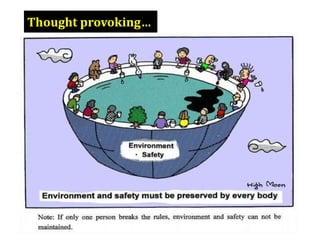
Thought provoking…
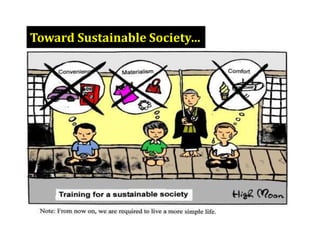
Toward Sustainable Society…
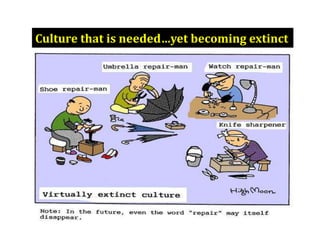
Culture that is needed…yet becoming extinct
Sustainability Science Research Cluster UM:
http://susci.um.edu.my/
UM Sustainable Development Solutions Network (UM
SDSN):
https://www.facebook.com/umsdsn
Newspaper clipping
Source:
http://www.townplan.gov.my/media_gallery.php?cat=newsclip&year_month=2012_03&ID=408
http://hornbillunleashed.wordpress.com
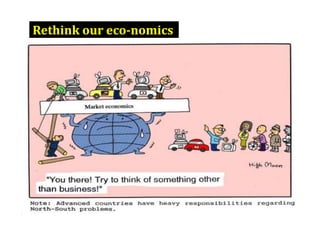
Rethink our eco-nomics
From linear to Circular Economy

Exploring Sustainability: Concept and Definition from Practitioner's Perspective

  • 1.
    NIK MERIAM NIKSULAIMAN DEAN, SUSTAINABILITY SCIENCE RESEARCH CLUSTER, UNIVERSITY OF MALAYA Exploring ‘Sustainability’: Concept and Definition from Practitioner’s Perspective INTERNATIONAL SEMINAR ON SCIENCE FOR SUSTAINABLE DEVELOPMENT: ISLAMIC PERSPECTIVES 18 November 2014, Grand Hall, IKIM Theme: Concept and Definition
  • 2.
    “It suddenly struckme that that tiny pea, pretty and blue, was the Earth. I put up my thumb and shut one eye, and my thumb blotted out the planet Earth. I didn't feel like a giant. I felt very, very small”. [Neil Armstrong on Apollo 11, July 20, 1969] Image taken from: http://www.wikinewforum.com
  • 3.
    How about NOW,2014? We can get this photo in an instant, by a click-of-a-mouse. ‘Thanks’ to those ‘cutting-edge’ technologies…we lost the ‘excitement’ on how we see and appreciate creation of God. Image taken from: http://www.nasa.gov
  • 4.
    Deforestation threats Water ScarcityIssue Flood Waste management issues GLOBAL & LOCAL ISSUES
  • 6.
    SUSTAINABILITY • Simply put,sustainability, and its predecessor term, sustainable development, mean different things to different people. (Mark A. White. 2013. Sustainability: I know it, when I see it. In Ecological Economics, 86, p.213-217)
  • 7.
  • 8.
    “The Future WeWant” = Rio+20 • "Rio+20" is the short name for the United Nations Conference on Sustainable Development which took place in Rio de Janeiro, Brazil in June 2012 – twenty years after the landmark 1992 Earth Summit in Rio. • The official discussions focussed on two main themes: how to build a green economy to achieve sustainable development and lift people out of poverty; and how to improve international coordination for sustainable development. • The world today has 7 billion people – by 2050, there will be 9 billion. • 1/5 people – 1.4 billion – currently lives on $1.25 a day or less. • 1.5 billion people in the world don’t have access to electricity. • 2.5 billion people don’t have a toilet. • Almost a billion people go hungry every day. • GHG emissions continue to rise, and more than a third of all known species could go extinct if climate change continues unchecked. WHY IS IT IMPORTANT? Further details: http://www.un.org/en/sustainablefuture/about.shtml
  • 9.
    SUSTAINABILITY • In Malay, “Keterlestarian= kebolehlestarian = kebolehan bertahan lama = boleh tetap tidak berubah seperti asalnya” Synonyms: Lestari / Mapan / Mempan Translation: Sustainability = ability to endure, to maintain, to sustain it’s original state (Mohamad Zain, S. 2012. Keterlestarian sebagai ilmu multidisiplin termasuklah Ekonomi dan Matematik. In Knowledge Civilisation Discourse Series 1. Centre for Civilisational Dialogue, University of Malaya) FROM MALAY TERMINOLOGY
  • 10.
    • In Sanskrit, Sustainability= dharma* 1790-1800; Sanskrit: custom, duty, akin to dhārayati = holds, maintains (Mohamad Zain, S. 2012. Keterlestarian sebagai ilmu multidisiplin termasuklah Ekonomi dan Matematik. In Knowledge Civilisation Discourse Series 1. Centre for Civilisational Dialogue, University of Malaya) *http://dictionary.reference.com/browse/dharma HOLDS MAINTAINS SUSTAINABILITY FROM SANSKRIT TERMINOLOGY
  • 11.
    SUSTAINABILITY Emeritus Professor ShaharirM. Zain proposed and introduced the concept of ‘wusto’: • Sustainability to be integrated with the principle of ‘wusto’ or theory of ‘pengwustodan’ – on which religious perspective can be taken into account. • Oppose the concept of extremism, optimization, quantitative in nature. Another proposal: We need to explore the concept of human happiness in order to support our path toward sustainability. (Mohamad Zain, S. 2012. Keterlestarian sebagai ilmu multidisiplin termasuklah Ekonomi dan Matematik. In Knowledge Civilisation Discourse Series 1. Centre for Civilisational Dialogue, University of Malaya) “‫”وصط‬ = middle An Arabic word, which coined the term ‘wasatiyyah’, almost similar to ‘wusto’ Synonyms: Moderate Balanced Just / fair Ideal Antonyms*: al-Ighal (beyond exaggeration), al-Tashadud (exceedingly restrictive), al-Guluw (excessiveness), al-Tatarruf (moving to the farthest point and going the extra mile) Reference: *Institut http://www.iium.edu.my/wasatiyyah ADDITIONAL INFO In managing resources
  • 12.
    Integration of IslamicPerspective on Sustainability Translation: “Indeed, the wasteful are brothers of the devils, and ever has Satan been to his Lord ungrateful” [Surah al-Isra’: 27] • Badzara = root word for tabdzir / mubazirun which means the act of wasteful • ‘wasteful’ in this context is mentioned thrice (3) in Quran: Surah al-Isra’: 26-27 info
  • 13.
    Integration of IslamicPerspective on Sustainability Prophet Muhammad S.A.W said: “Do not waste water, even if you perform your ablution on the banks of an abundantly-flowing river” [HR Imam Ahmad]
  • 14.
    Integration of IslamicPerspective on Sustainability Translation: O Children of Adam! wear your beautiful apparel at every time and place of prayer: eat and drink: But waste not by excess, for Allah loveth not the wasters. [Surah al-A’araf: 31] • Sarafa = root word for Israf / Musrifin which means the act of wasteful in excess, transgression beyond limit, excessive • ‘excessive’ in this context is mentioned twenty three (23) time in 21 verses in Quran: with different or similar connotation info
  • 15.
  • 16.
    Sustainability ... a20-year Snapshot 1983 2003Source: Atkisson, A. (2004). A Review of Practical Sustainable Development. Presented at Baltic University Planning Conference
  • 17.
    What are peopledoing when they say they "do" sustainable development? Environmental Management Corporate Social Responsibility Greening of Operations Industrial Ecology Stakeholder Engagement Life-Cycle Assessment Pollution Prevention (P2) Sustainable Development Design for Environment (DfE) Green Design Urban Reinvestment Brownfield Redevelopment ISO 14001 Waste Reduction Closed Loops Radical Resource Productivity Radical Transactiveness Sustainable Technology Systems Thinking Corporate Governance Clean Technology Eco-Efficiency Eco-Effectiveness Biomimicry Triple Bottom Line Inclusive Capitalism Base of the Pyramid Community Capitalism Corporate Citizenship Voluntary Regulation Civic Entrepreneurship Full Cost Accounting EMS Risk Management Leapfrog Technology Cradle to Cradle Restorative Technology Balanced Scorecard Take-Back Transparency Source: Stuart Hart, with thanks to Marty LaGod, with additions by AtKisson Digital Divide Cultural Diversity Natural Capitalism Ecological Footprint Product-to-Service Integrated Product Mgmt Natural Step Building the Pyramid Compass Index SROI Blended Value GRI Precautionary Principle Green Procurement Green Building SMS ISIS CDM EUAs B24B Source: Atkisson, A. (2004). A Review of Practical Sustainable Development. Presented at Baltic University Planning Conference
  • 18.
    Some Important Distinctions •Sustainability • Sustainable Development • Framework • Model • Methodology • Process • Tool What’s the difference?
  • 19.
    Sustainability is ... A set of conditions and trends in a given system that can continue indefinitely  Path/direction  A strategic process of continuous change in the direction of sustainability  Means/tools Sustainable Development is ...
  • 20.
    SUSTAINABILITY FROM GLOBAL LANDSCAPE& ENGLISH TERMINOLOGY Origin: (Latin word) (13th Century) = bearable (16th Century) = defensible (18th Century) & 1970’s Reference: Mohamad Zain, S. 2012. Keterlestarian sebagai ilmu multidisiplin termasuklah Ekonomi dan Matematik. In Knowledge Civilisation Discourse Series 1. Centre for Civilisational Dialogue, University of Malaya 1980’s & 1990’s
  • 21.
  • 22.
    Sustainability Concepts  Long-termbalance between economic, social and environmental goals (look ahead 20-50 years, understand the connections)  Limits to natural, social, and built systems (live off the interest of community capital, don’t degrade or use it up)  Inter- and intra- generational equity (share with future generations and current inhabitants, local sustainability in harmony with global sustainability rather than at expense of others)
  • 23.
    MILLENNIUM DEVELOPMENT GOALS (193 MEMBER STATES) Furtherdetails: http://www.un.org/millenniumgoals
  • 24.
    New Sustainable DevelopmentParadigm David Griggs et al. (2013). Sustainable Development goals for people and planet. . Nature Mar 21 Vol 495 Old SD New SD 24
  • 25.
    Sustainable Development Goals 1.End extreme poverty including hunger 2. Achieve development within planetary boundaries 3. Ensure effective learning for All Children and Youth for Live and Livelihood 4. Achieve Gender Equality, Social Inclusion, and Human Rights for All 5. Achieve Health and Wellbeing at All Ages 6. Improve Agriculture Systems and Raise Rural Prosperity 7. Empower Inclusive, Productive, and Resilient Cities 8. Curb Human-Induced Climate Change and Ensure Clean Energy for All 9. Secure Ecosystem Services and Biodiversity, Ensure Good Management of Water and Other Natural Resources 10. Transform Governance for Sustainable Development (Source: An Action Agenda for Sustainable Development: Report for the UN Secretary-General, 23 October 2013) 25
  • 26.
    Trees of Sustainability Whatword will best describe ‘sustainability’?
  • 27.
    (Mark A. White.2013. Sustainability: I know it, when I see it. In Ecological Economics, 86, p.213-217)
  • 28.
  • 29.
    SUSTAINABILITY… HAS DIFFERENT MEANINGTO DIFFERENT PEOPLE PERSPECTIVE: ENGINEERING “…the process of designing or operating systems such that they use energy and resources sustainably, i.e., at a rate that does not compromise the natural environment, or the ability of future generations to meet their own needs…” PERSPECTIVE: BUILT ENVIRONMENT / ARCHITECT “…architecture that seeks to minimize the negative environmental impact of buildings by efficiency and moderation in the use of materials, energy, and development space…”
  • 30.
    SUSTAINABILITY… HAS DIFFERENT MEANINGTO DIFFERENT PEOPLE “…The use of various strategies for employing existing resources optimally so that that a responsible and beneficial balance can be achieved over the longer term” PERSPECTIVE: ECONOMICS PERSPECTIVE: AGRICULTURE “…the act of farming using principles of ecology, the study of relationships between organisms and their environment…as "an integrated system of plant and animal production practices having a site-specific application that will last over the long term…"
  • 31.
    SUSTAINABILITY… ISLAMIC APPROACH FOCUSMORE ON INTEGRATION PERSPECTIVE: RELIGION (ISLAM) “…integration of Islamic principles based on the Quran and Sunnah into our day-to-day basis: • fitra – creation as an original natural order; • tawhid – the unity of creation, which tells us that all things in the world are related to one another, all are equally important, valuable and worthy of preservation; • mizan – balance, is the state of well-ordered creation, which must be maintained or restored. • khilafa - the duty of mankind to maintain the order of creation. The fruits of the earth are to be enjoyed, but its resources must not be wastefully exploited. ”
  • 32.
    2 Mode ofScience: Practitioner’s Perspective Mode-1 Science Academic Mono- disciplinary Technocratic Certain Predictive Mode-2 Science Academic & Social Multi-Inter- Trans- disciplinary Participative Uncertain Exploratory Reference: [AKEPT Material] - Martens, P. (2006) Sustainability: science or fiction? Sustainability: Science, Practice and Policy, 2(1), 1- 5. (also published as: Solidarity & Sustainability, Reflections on Solidarity, Sustainability and Religious Violence, 2 (9), September 2006.)
  • 33.
    The role ofSustainability + Science in Policy Process Reference: [AKEPT Material] - Martens, P. (2006) Sustainability: science or fiction? Sustainability: Science, Practice and Policy, 2(1), 1- 5. (also published as: Solidarity & Sustainability, Reflections on Solidarity, Sustainability and Religious Violence, 2 (9), September 2006.)
  • 34.
    Definitions of SustainableDevelopment Reference: [AKEPT Material] - Kemp R. & Martens P. 2007. Sustainable development: how to manage something that is subjective and never can be achieved?. Sustainability: Science, Practice, & Policy 3(2):5-14. Published online Aug 30, 2007. http://www.google.com.my/archives/vol3iss2/0703-007.kemp.html What is to be sustained? Nature: Earth, Biodiversity, Ecosystems Life Support: Ecosystem Services, Resources, Environment Community: Cultures, Groups, Places What is to be developed? People: child survival, Life expectancy, education, Equity, Equal opportunity Economy: wealth, productive sectors, consumption Society: institutions, social capital states, regions
  • 35.
    Case Study 1:Problem-based model for Sustainability Science Water Infrastructure Solutions Further details: www.iwahq.org
  • 36.
    Case Study 2: FromLinear to Circular (Cradle-to-Cradle) Further details: Cradle to Cradle: Remaking the way we make things, 2002.
  • 37.
    Case Study 3: Approachon the complex issue of SD Further details: Zainal Abidun Sanusi, Dzulkifli Abdul Razak, Kanayuthu Koshy, Salfarina Abd Gapor, Craig Hutton, Smita Krishnan, Abd. Malik Abd. Aziz. (2013) . Sustainability Science: A review of context, approaches and potential applications. UNESCO & AKEPT
  • 38.
    SUSTAINABILITY CHALLENGES &SOLUTIONS: PRACTITIONER’s PERSPECTIVE EDUCATION • Promotion of Sustainability in education system • Penetration on different level of education in Malaysia (Primary – Higher education) • Role of ESD & HeSD STAKEHOLDERS ENGAGEMENT • Government & Institution: Inclusive Policies formulation, incentives • Business Community: Offering Professional Sustainability Training/ Course/ Certificates/ Consultation • Public: inclusive roundtable or dialogue RESEARCH • Research entities: work not in-silos but • Promote and practice Multi-Inter- Trans Disciplinary (M-I-T) approach in conducting/delivering research
  • 39.
    UM Sustainable Development SolutionsNetwork (UM SDSN) • In response to the mandate on post-2015 and the outcome of the Rio + 20 Conference, UN Secretary-General Ban Ki-Moon has launched the United Nations Sustainable Development Solutions Network (UNSDSN) in 2012 which aims to mobilize scientific and technical expertise from academia, civil society, and the private sector in support of sustainable development at local, national, and global scales. • At the national level, SDSN Malaysia Chapter was launched on October 10th, 2012. UM SDSN is envisaged to become a recognised sustainability referral centre in promoting multi-, inter- and trans-disciplinary approach in engaging sustainability and sustainable development issues. UM SDSN Past Activities: info
  • 40.
    UM Sustainable Development SolutionsNetwork (UM SDSN) UM SDSN Upcoming & Future Activities (Tentative): • (SD)₂ Series II: Sustainable Agenda for SMEs in Malaysia – December 2014 • (SD)₂ Series III: Sustainability Discourse from faith and values-based perspective – 2015 • UM Sustainability Curriculum Mapping – 2014 – 2015 • UM Living Lab Projects - 2015 • UM Sustainability Summit – November / December 2015 info For further enquiries/ networking/ collaboration opportunities: UM Sustainable Development Solutions Network (UM SDSN) Level 6, Research Management & Innovation Complex (RMIC), University of Malaya, 50603 Kuala Lumpur, MALAYSIA Tel: +603-7967 7022 (+2325/2362) Fax: +603-7967 7813 Email: umsdsn@gmail.com Contact details
  • 41.
  • 42.
  • 43.
    Culture that isneeded…yet becoming extinct
  • 44.
    Sustainability Science ResearchCluster UM: http://susci.um.edu.my/ UM Sustainable Development Solutions Network (UM SDSN): https://www.facebook.com/umsdsn
  • 45.
  • 46.
  • 47.
    From linear toCircular Economy