
E xperimental/ R esearch  R eports
E xperimental/ R esearch  R eports T hese reports are common in subjects like engineering, psychology, and life science. Y ou will be expected to indentify a scientific problem and solve it by carrying out research.
E xperimental/ R esearch  R eports T o be able to write the report you need to identify a problem and critically analyse it by using your knowledge and reading. Y ou need to carry out some kind of experiment or investigation to see which solution is best in your particular context.
E xperimental/ R esearch  R eports Y ou need to explain your method of investigation and describe your results. Y ou have to evaluate your findings. Y ou have to justify any conclusions you come to.
E xperimental/ R esearch  R eports T he main section of most scientific reports are organized according to the IMRAD system. I ntroduction M ethods R esults and D iscussion
E xperimental/ R esearch  R eports T he IMRAD sections are usually signalled with headings and subheadings. D iagrams and charts are used as necessary.
E xperimental/ R esearch  R eports Introduction:  this section justifies the research by explaining why the study was undertaken. Methods:  this section reports on how the study was done. It normally includes procedures and materials. The two parts are sometimes given separate sections.
E xperimental/ R esearch  R eports Results:  this reports what the study found. Discussion:  this section discusses  what the findings might mean, and why they matter, especially in relation to what other researchers have found. It clearly connects the results with your conclusion.
E xperimental/ R esearch  R eports Conclusion:  this section, which may be part of the discussion, summarizes the findings and points the research forward to the next stage. Tip:  Some subjects, especially in life science, do not need much in the methods section as all the methods are well known. Check what is required.
E xperimental/ R esearch  R eports Note:  Of course the report will have a title page, an abstract, perhaps a content page, references and possibly appendices.
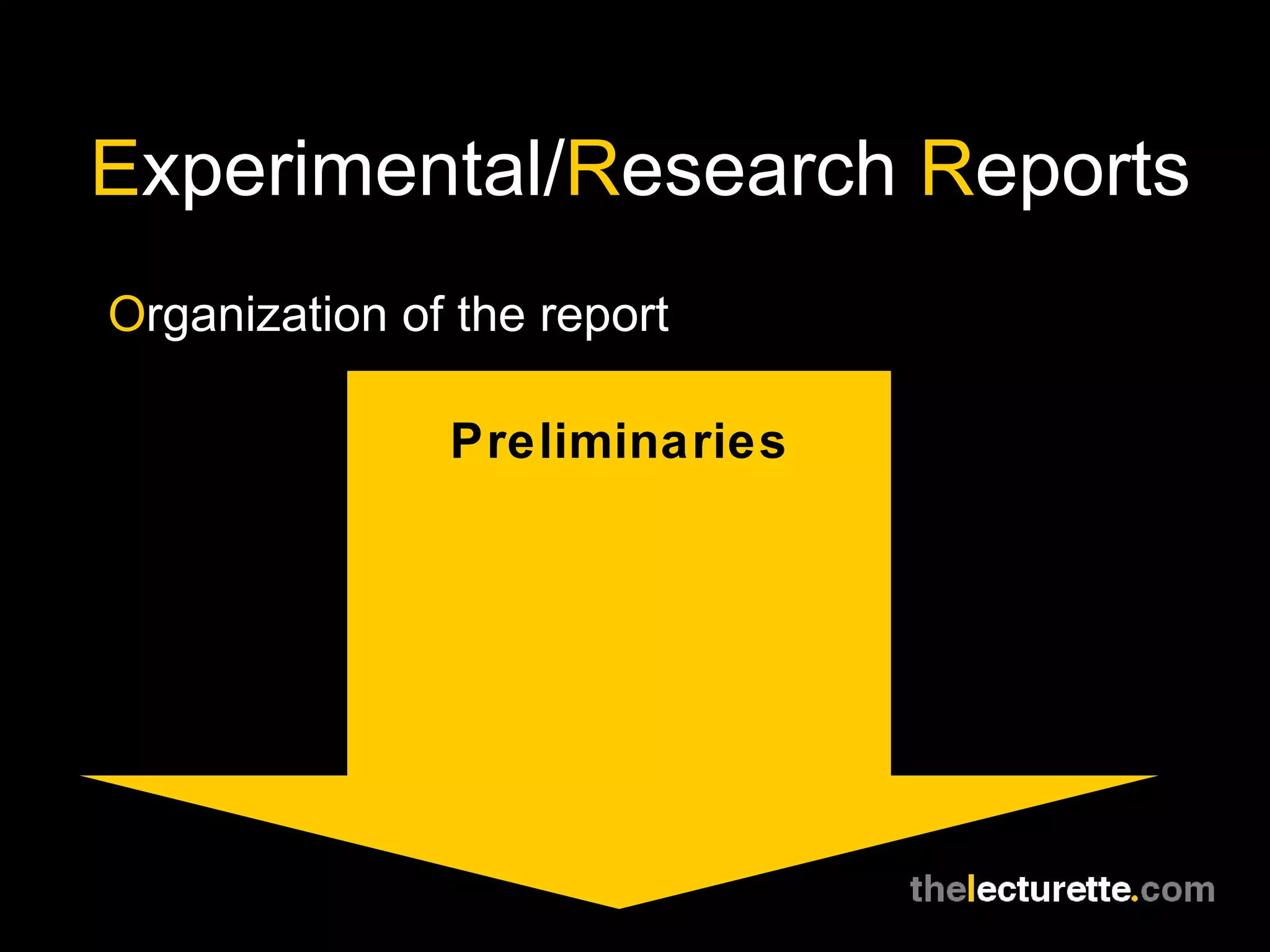
E xperimental/ R esearch  R eports O rganization of the report Preliminaries
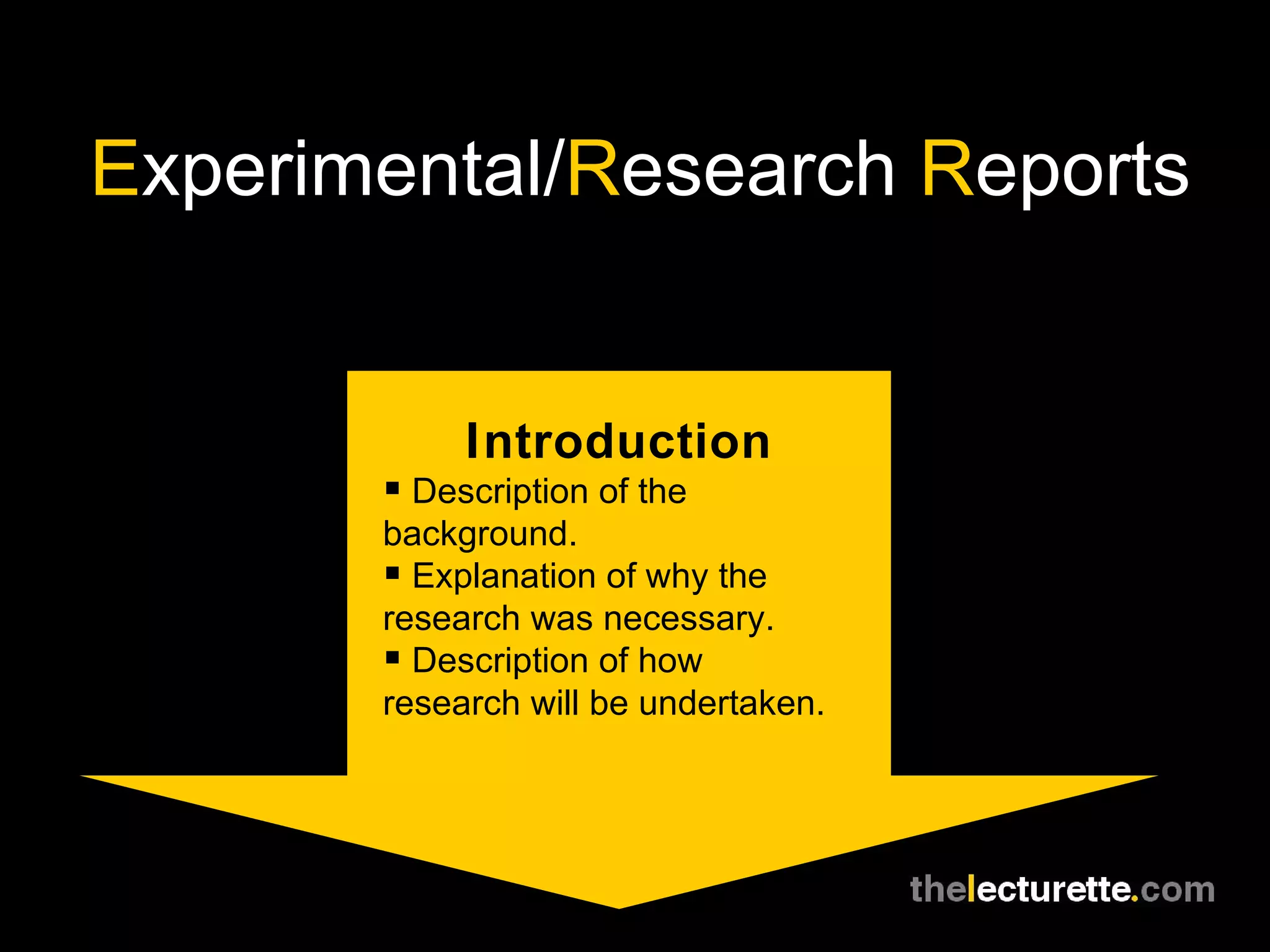
E xperimental/ R esearch  R eports Introduction Description of the  background. Explanation of why the research was necessary. Description of how  research will be undertaken.
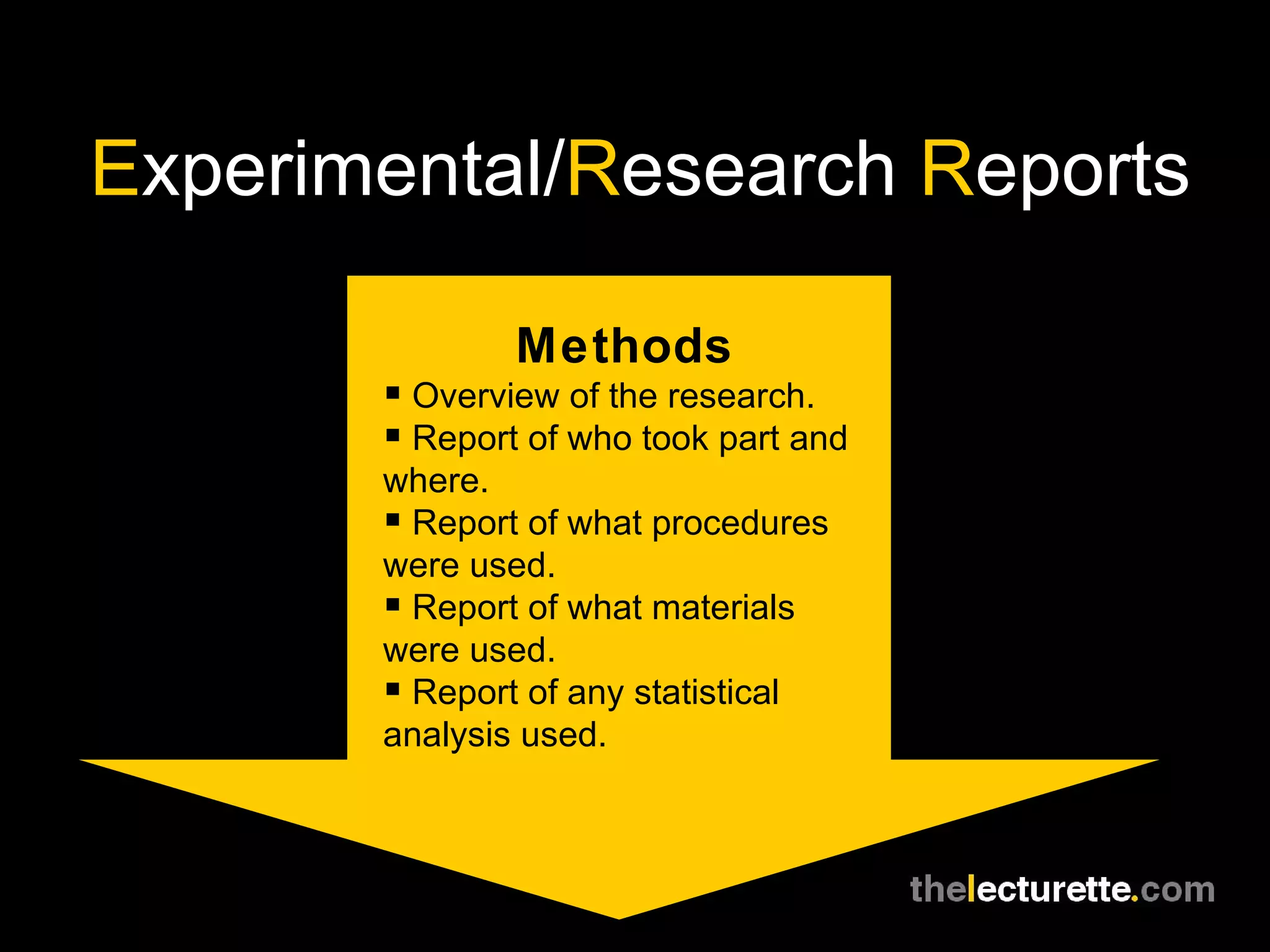
E xperimental/ R esearch  R eports Methods Overview of the research. Report of who took part and where. Report of what procedures were used. Report of what materials were used. Report of any statistical analysis used.
E xperimental/ R esearch  R eports Results Report of findings. Reference to any diagrams used.
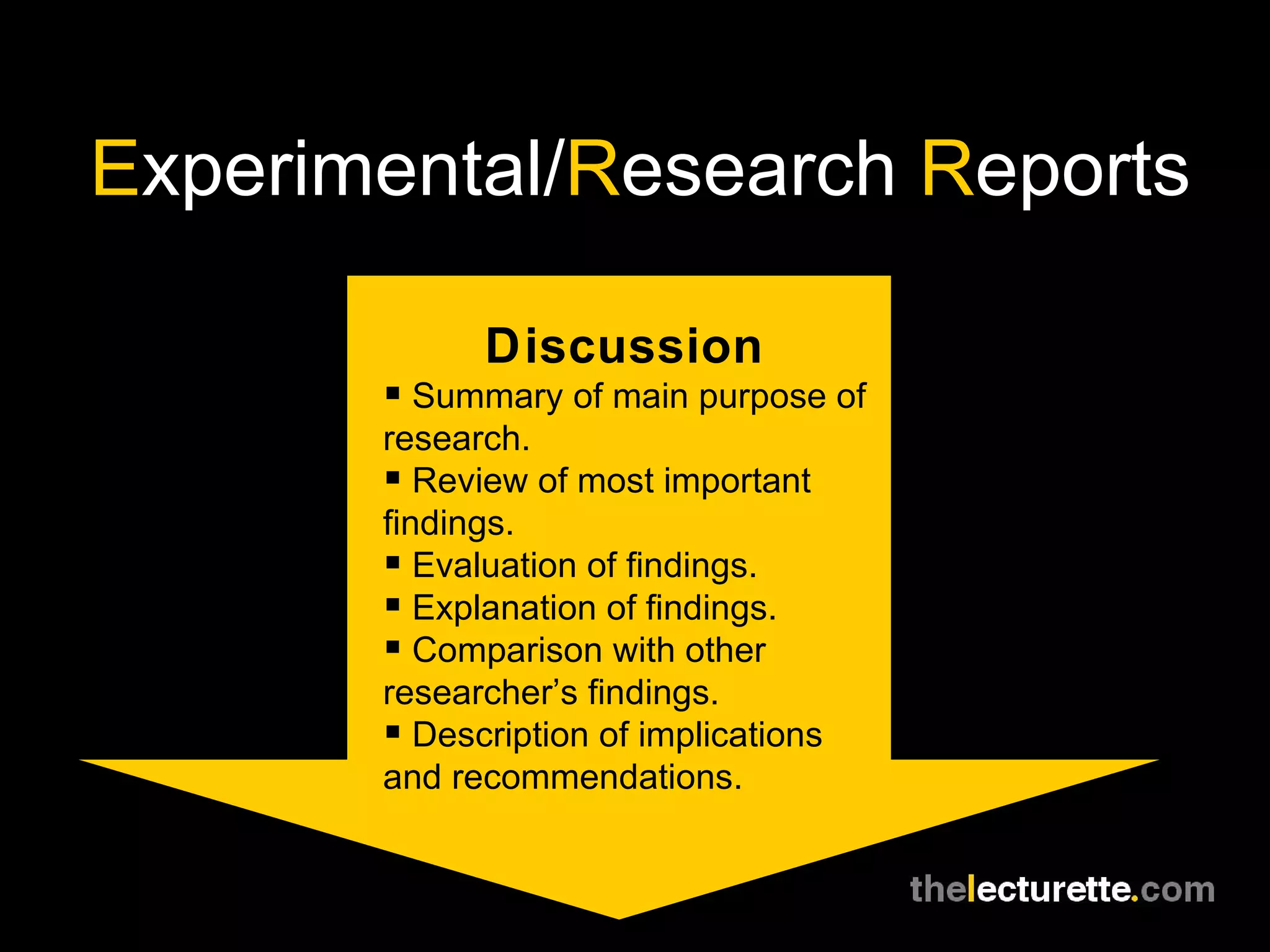
E xperimental/ R esearch  R eports Discussion Summary of main purpose of research. Review of most important findings. Evaluation of findings. Explanation of findings. Comparison with other researcher’s findings. Description of implications and recommendations.
E xperimental/ R esearch  R eports End Matter
Q uestions? For more slide presentations visit:

Experimental/Research Reports

  • 1.
    E xperimental/ Research R eports
  • 2.
    E xperimental/ Research R eports T hese reports are common in subjects like engineering, psychology, and life science. Y ou will be expected to indentify a scientific problem and solve it by carrying out research.
  • 3.
    E xperimental/ Research R eports T o be able to write the report you need to identify a problem and critically analyse it by using your knowledge and reading. Y ou need to carry out some kind of experiment or investigation to see which solution is best in your particular context.
  • 4.
    E xperimental/ Research R eports Y ou need to explain your method of investigation and describe your results. Y ou have to evaluate your findings. Y ou have to justify any conclusions you come to.
  • 5.
    E xperimental/ Research R eports T he main section of most scientific reports are organized according to the IMRAD system. I ntroduction M ethods R esults and D iscussion
  • 6.
    E xperimental/ Research R eports T he IMRAD sections are usually signalled with headings and subheadings. D iagrams and charts are used as necessary.
  • 7.
    E xperimental/ Research R eports Introduction: this section justifies the research by explaining why the study was undertaken. Methods: this section reports on how the study was done. It normally includes procedures and materials. The two parts are sometimes given separate sections.
  • 8.
    E xperimental/ Research R eports Results: this reports what the study found. Discussion: this section discusses what the findings might mean, and why they matter, especially in relation to what other researchers have found. It clearly connects the results with your conclusion.
  • 9.
    E xperimental/ Research R eports Conclusion: this section, which may be part of the discussion, summarizes the findings and points the research forward to the next stage. Tip: Some subjects, especially in life science, do not need much in the methods section as all the methods are well known. Check what is required.
  • 10.
    E xperimental/ Research R eports Note: Of course the report will have a title page, an abstract, perhaps a content page, references and possibly appendices.
  • 11.
    E xperimental/ Research R eports O rganization of the report Preliminaries
  • 12.
    E xperimental/ Research R eports Introduction Description of the background. Explanation of why the research was necessary. Description of how research will be undertaken.
  • 13.
    E xperimental/ Research R eports Methods Overview of the research. Report of who took part and where. Report of what procedures were used. Report of what materials were used. Report of any statistical analysis used.
  • 14.
    E xperimental/ Research R eports Results Report of findings. Reference to any diagrams used.
  • 15.
    E xperimental/ Research R eports Discussion Summary of main purpose of research. Review of most important findings. Evaluation of findings. Explanation of findings. Comparison with other researcher’s findings. Description of implications and recommendations.
  • 16.
    E xperimental/ Research R eports End Matter
  • 17.
    Q uestions? Formore slide presentations visit: