The document outlines the four steps for collecting data in a research study:
1) Define the research aim, 2) Choose a data collection method, 3) Plan data collection procedures, and 4) Collect the data. It provides details on operationalizing concepts, standardizing procedures, creating a data management plan, and collecting both qualitative and quantitative data. The overall process allows researchers to systematically gather high-quality observations or measurements relevant to answering their research questions.
Data collection isa systematic process of gathering
observations or measurements. Whether you are performing
research for business, governmental or academic purposes,
data collection allows you to gain first-hand knowledge and
original insights into your research problem (Scribbr, 2022).
3.
Before you begincollecting data, you need to consider:
◦The aim of the research
◦The type of data that you will collect
◦The methods and procedures you will use to collect, store,
and process the data
◦To collect high-quality data that is relevant to your purposes,
follow these four steps.
4.
Step 1: Definethe aim of your research
◦Before you start the process of data collection, you need to
identify exactly what you want to achieve. You can start by
writing a problem statement: what is the practical or
scientific issue that you want to address and why does it
matter?
5.
◦ Quantitative datais expressed in numbers and graphs and is analyzed
through statistical methods.
◦ Qualitative data is expressed in words and analyzed through
interpretations and categorizations.
6.
◦ If youraim is to test a hypothesis, measure something precisely, or
gain large-scale statistical insights, collect quantitative data. If your aim
is to explore ideas, understand experiences, or gain detailed insights
into a specific context, collect qualitative data. If you have several
aims, you can use a mixed methods approach that collects both types
of data.
7.
Examples of quantitativeand qualitative research aims
◦ You are researching employee perceptions of their direct managers in
a large organization.
◦ Your first aim is to assess whether there are significant differences in
perceptions of managers across different departments and office
locations.
8.
◦ Your secondaim is to gather meaningful feedback from employees to
explore new ideas for how managers can improve.
◦ You decide to use a mixed-methods approach to collect both
quantitative and qualitative data.
9.
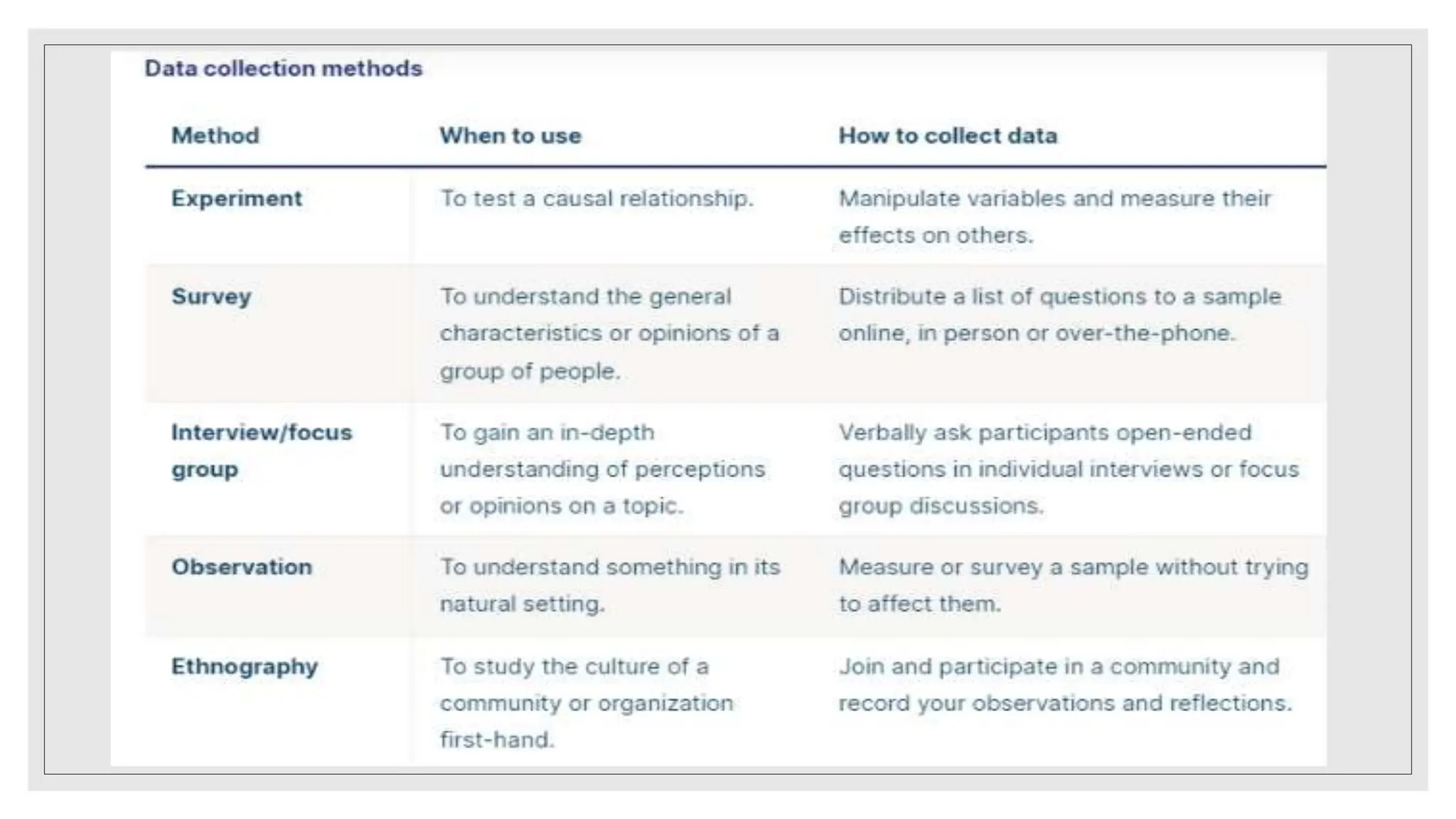
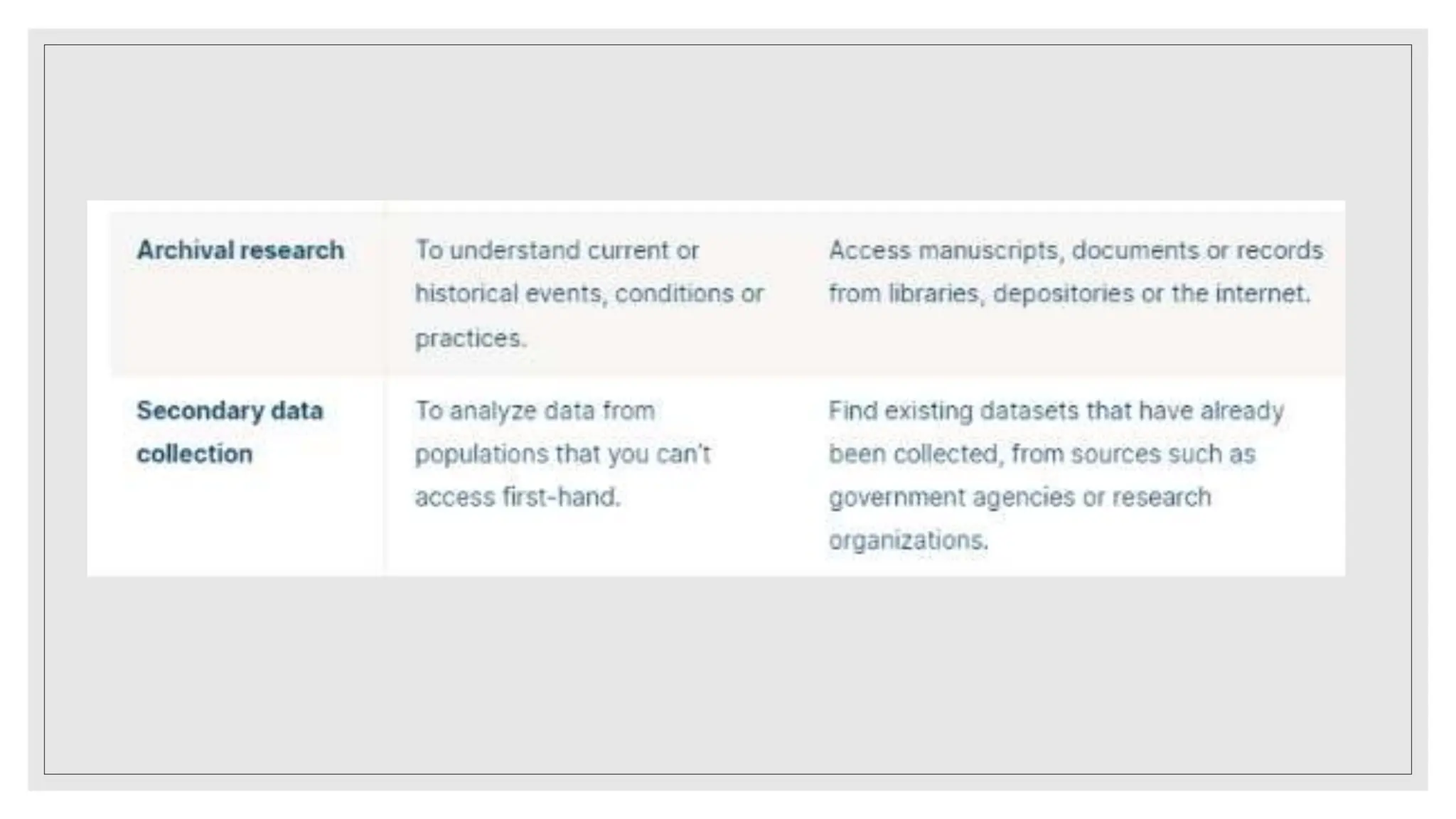
Step 2: Chooseyour data collection method
◦ Based on the data you want to collect, decide which method is best
suited for your research.
10.
◦Experimental research isprimarily a quantitative
method.
◦Interviews, focus groups, and ethnographies are
qualitative methods.
11.
◦ Surveys, observations,archival research and secondary data collection
can be quantitative or qualitative methods.
12.
Carefully consider whatmethod you will use to gather data
that helps you directly answer your research questions.
15.
Step 3: Planyour data collection procedures
◦ When you know which method(s) you are using, you need to plan
exactly how you will implement them. What procedures will you
follow to make accurate observations or measurements of the
variables you are interested in?
16.
◦ For instance,if you’re conducting surveys or interviews, decide what
form the questions will take; if you’re conducting an experiment,
make decisions about your experimental design (e.g., determine
inclusion and exclusion criteria).
17.
Operationalization
◦ Sometimes yourvariables can be measured directly: for example, you
can collect data on the average age of employees simply by asking for
dates of birth. However, often you’ll be interested in collecting data
on more abstract concepts or variables that can’t be directly observed.
18.
◦ Operationalization meansturning abstract conceptual ideas into
measurable observations. When planning how you will collect data,
you need to translate the conceptual definition of what you want to
study into the operational definition of what you will actually
measure.
19.
Example of operationalization
◦You have decided to use surveys to collect quantitative data. The
concept you want to measure is the leadership of managers. You
operationalize this concept in two ways:
◦ You ask managers to rate their own leadership skills on 5-point scales
assessing the ability to delegate, decisiveness and dependability.
◦ You ask their direct employees to provide anonymous feedback on the
managers regarding the same topics.
20.
◦ Using multipleratings of a single concept can help you cross-check
your data and assess the test validity of your measures.
21.
Standardizing procedures
◦ Ifmultiple researchers are involved, write a detailed manual to
standardize data collection procedures in your study.
22.
◦ This meanslaying out specific step-by-step instructions so that
everyone in your research team collects data in a consistent way – for
example, by conducting experiments under the same conditions and
using objective criteria to record and categorize observations. This
helps you avoid common research biases like omitted variable bias or
information bias.
23.
◦This helps ensurethe reliability of your data, and you can
also use it to replicate the study in the future.
24.
Creating a datamanagement plan
◦ Before beginning data collection, you should also decide how you will
organize and store your data.
◦ If you are collecting data from people, you will likely need to
anonymize and safeguard the data to prevent leaks of sensitive
information (e.g. names or identity numbers).
25.
◦If you arecollecting data via interviews or pencil-and-paper
formats, you will need to perform transcriptions or data
entry in systematic ways to minimize distortion.
◦You can prevent loss of data by having an organization
system that is routinely backed up.
26.
Step 4: Collectthe data
◦ Finally, you can implement your chosen methods to measure or
observe the variables you are interested in.
27.
Examples of collectingqualitative and quantitative data
◦ To collect data about perceptions of managers, you administer a
survey with closed- and open-ended questions to a sample of 300
company employees across different departments and locations.
◦ The closed-ended questions ask participants to rate their manager’s
leadership skills on scales from 1–5. The data produced is numerical
and can be statistically analyzed for averages and patterns.
28.
◦The open-ended questionsask participants for examples of
what the manager is doing well now and what they can do
better in the future. The data produced is qualitative and can
be categorized through content analysis for further insights.
29.
◦ To ensurethat high quality data is recorded in a systematic way, here
are some best practices:
◦ Record all relevant information as and when you obtain data. For
example, note down whether or how lab equipment is recalibrated
during an experimental study.
30.
◦ Double-check manualdata entry for errors.
◦ If you collect quantitative data, you can assess the reliability and
validity to get an indication of your data quality.




![[DSC Europe 25] Dragan Vucic - Building the Learning Organization - How AI Tr...](https://cdn.slidesharecdn.com/ss_thumbnails/8brigo2sbu6qur6gxrra-7-251205085715-6ae07d24-thumbnail.jpg?width=640&height=640&fit=bounds)


![[DSC Europe 25] Boris Perkovic - Lost in performance.pptx](https://cdn.slidesharecdn.com/ss_thumbnails/uq5hrp7vsuahqkxzifux-1-251204082258-fd2ee09d-thumbnail.jpg?width=640&height=640&fit=bounds)


![[DSC Europe 25] Dusan Jovicic - AI Story: From on-prem to cloud and back agai...](https://cdn.slidesharecdn.com/ss_thumbnails/8kp49m6uq22ifnbwhfnk-2-251205085715-964d11a6-thumbnail.jpg?width=640&height=640&fit=bounds)

![[DSC Europe 25] Goran Obradovic - The Rise of Sovereign AI: Building the Regi...](https://cdn.slidesharecdn.com/ss_thumbnails/7nw2xxixrxqdxvrb5wca-6-251205085714-ab09a2ac-thumbnail.jpg?width=640&height=640&fit=bounds)