Download to read offline
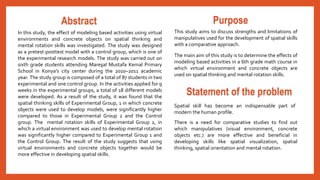
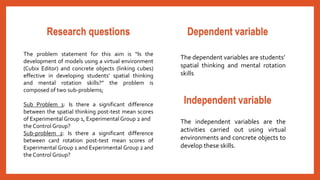
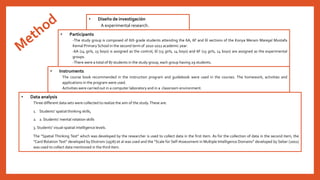

This study investigated the effects of modeling activities using virtual environments and concrete objects on sixth grade students' spatial thinking and mental rotation skills. Students were assigned to two experimental groups that developed models using either a virtual environment or concrete objects, and a control group. Pre- and post-tests were administered to assess spatial thinking and mental rotation skills. The results showed that the spatial thinking skills of the group using concrete objects improved more than the other groups, while the mental rotation skills of the virtual environment group improved more than the others. The study suggests that using both approaches together may be most effective for developing spatial skills.


