Mental Rotation of 3D Objects
Mental Rotation Task

Visual stimulus  Mental rotation of stimulus  Response


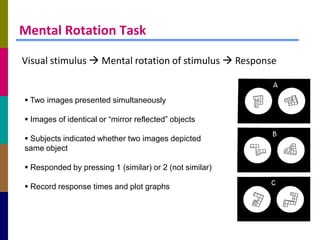
 Two images presented simultaneously

 Images of identical or “mirror reflected” objects

 Subjects indicated whether two images depicted
same object

 Responded by pressing 1 (similar) or 2 (not similar)

 Record response times and plot graphs
Mental Rotation Task Results
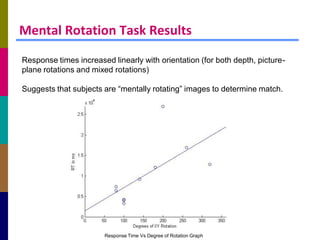
Response times increased linearly with orientation (for both depth, picture-
plane rotations and mixed rotations)

Suggests that subjects are “mentally rotating” images to determine match.


                       Response Time Vs Degree of Rotation Graph
Object recognition

Two fundamental approaches to human object recognition

    I. Alignment approaches
            Object recognition through alignment process

    II. Structural description approach
            Decomposition of features included in an object
            Describe the objects’ shape in terms of their parts and relation
            among the parts.
Mental Rotation

 Data are linear !
 Data   Every additional 50° of stimulus rotation increased RT by 1000 ms
 Interpretation      Objects are mentally rotated at a rate of 50° per 1 s
 Some have exceptionally good mental rotation skills.
 Some can learn and train very fast.
 Effect of Training ??
Hypothesis

Mental rotation can be separated into the following cognitive
stages:

1. Create a mental image of an object

2. Rotate the object mentally until a comparison can be
   made

3. Make the comparison

4. Decide if the objects are the same or not

5. Report the decision
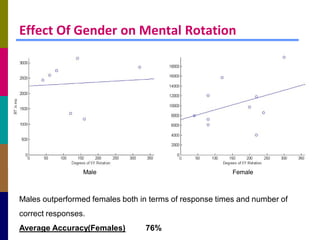
Effect Of Gender on Mental Rotation


                 Male                                    Female


Males outperformed females both in terms of response times and number of
correct responses.
Average Accuracy(Females)        76%
Effect Of Gender on Mental Rotation


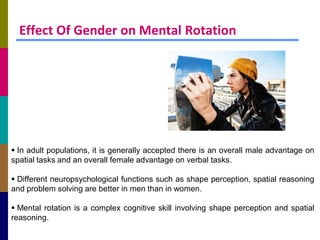
 In adult populations, it is generally accepted there is an overall male advantage on
spatial tasks and an overall female advantage on verbal tasks.

 Different neuropsychological functions such as shape perception, spatial reasoning
and problem solving are better in men than in women.

 Mental rotation is a complex cognitive skill involving shape perception and spatial
reasoning.
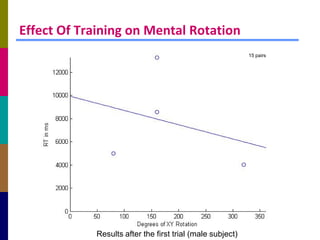
Effect Of Training on Mental Rotation
                                                           15 pairs


            Results after the first trial (male subject)
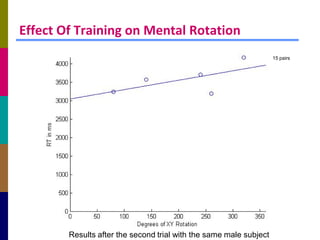
Effect Of Training on Mental Rotation
                                                                    15 pairs


        Results after the second trial with the same male subject
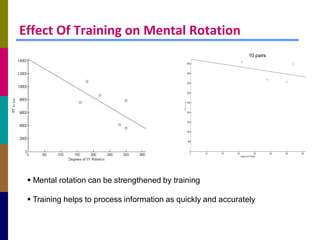
Effect Of Training on Mental Rotation
                                                                10 pairs


  Mental rotation can be strengthened by training

  Training helps to process information as quickly and accurately
Effect of Axis and Direction on Mental
Rotation

 Subjects took more time to respond if the objects had both in-plane
and depth plane rotations

 Explanation they gave was they had to rotate around two axis to arrive
at the results

 Some didn’t rotated and just counted the number of blocks and the
orientation of the boxes if the pairs were rotated in both 2D and 3D or
some even just guessed randomly

 Response Time = Time to analyze the pairs + Time to rotate + additional
time for changing the axis or changing the direction or changing the
reference pair (if needed)
Effect of Incoming Samples Pattern on
Mental Rotation

 Subjects try to guess the output of next incoming sample from
previous experience.

 Response Time and Probability Distribution of Incoming Samples.

 Response Time less if one class of samples is coming continuously.
Future Work

1) Increase the number of subjects, number of trials and number of stimuli to
   further establish the results.

2) Improve precision in measurements by refining the experiment design. This
   will enable to find the improvement in the above results.

3) Effect of age on mental rotation because in other fields age has been
   shown to change the way people perceive images and objects in their
   environment.

4) How males and females mentally rotate objects could be looked into with
   more detail.

5) People from different backgrounds etc.

6) Mental Rotation and intelligence.
Mental rotation of 3D Objects

Mental rotation of 3D Objects

  • 1.
  • 2.
    Mental Rotation Task Visualstimulus  Mental rotation of stimulus  Response  Two images presented simultaneously  Images of identical or “mirror reflected” objects  Subjects indicated whether two images depicted same object  Responded by pressing 1 (similar) or 2 (not similar)  Record response times and plot graphs
  • 3.
    Mental Rotation TaskResults Response times increased linearly with orientation (for both depth, picture- plane rotations and mixed rotations) Suggests that subjects are “mentally rotating” images to determine match. Response Time Vs Degree of Rotation Graph
  • 4.
    Object recognition Two fundamentalapproaches to human object recognition I. Alignment approaches Object recognition through alignment process II. Structural description approach Decomposition of features included in an object Describe the objects’ shape in terms of their parts and relation among the parts.
  • 5.
    Mental Rotation  Dataare linear !  Data Every additional 50° of stimulus rotation increased RT by 1000 ms  Interpretation Objects are mentally rotated at a rate of 50° per 1 s  Some have exceptionally good mental rotation skills.  Some can learn and train very fast.  Effect of Training ??
  • 6.
    Hypothesis Mental rotation canbe separated into the following cognitive stages: 1. Create a mental image of an object 2. Rotate the object mentally until a comparison can be made 3. Make the comparison 4. Decide if the objects are the same or not 5. Report the decision
  • 7.
    Effect Of Genderon Mental Rotation Male Female Males outperformed females both in terms of response times and number of correct responses. Average Accuracy(Females) 76%
  • 8.
    Effect Of Genderon Mental Rotation  In adult populations, it is generally accepted there is an overall male advantage on spatial tasks and an overall female advantage on verbal tasks.  Different neuropsychological functions such as shape perception, spatial reasoning and problem solving are better in men than in women.  Mental rotation is a complex cognitive skill involving shape perception and spatial reasoning.
  • 9.
    Effect Of Trainingon Mental Rotation 15 pairs Results after the first trial (male subject)
  • 10.
    Effect Of Trainingon Mental Rotation 15 pairs Results after the second trial with the same male subject
  • 11.
    Effect Of Trainingon Mental Rotation 10 pairs  Mental rotation can be strengthened by training  Training helps to process information as quickly and accurately
  • 12.
    Effect of Axisand Direction on Mental Rotation  Subjects took more time to respond if the objects had both in-plane and depth plane rotations  Explanation they gave was they had to rotate around two axis to arrive at the results  Some didn’t rotated and just counted the number of blocks and the orientation of the boxes if the pairs were rotated in both 2D and 3D or some even just guessed randomly  Response Time = Time to analyze the pairs + Time to rotate + additional time for changing the axis or changing the direction or changing the reference pair (if needed)
  • 13.
    Effect of IncomingSamples Pattern on Mental Rotation  Subjects try to guess the output of next incoming sample from previous experience.  Response Time and Probability Distribution of Incoming Samples.  Response Time less if one class of samples is coming continuously.
  • 14.
    Future Work 1) Increasethe number of subjects, number of trials and number of stimuli to further establish the results. 2) Improve precision in measurements by refining the experiment design. This will enable to find the improvement in the above results. 3) Effect of age on mental rotation because in other fields age has been shown to change the way people perceive images and objects in their environment. 4) How males and females mentally rotate objects could be looked into with more detail. 5) People from different backgrounds etc. 6) Mental Rotation and intelligence.