Image Source: http://www.philipvaughan.net
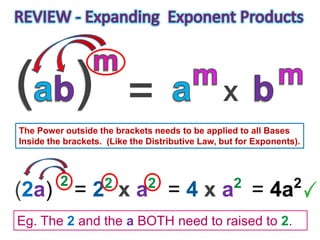
Eg. The 2 and the a BOTH need to raised to 2.
The Power outside the brackets needs to be applied to all Bases
Inside the brackets. (Like the Distributive Law, but for Exponents).
(2a)
2
= 22
x a2
= 4 x a2
= 4a2
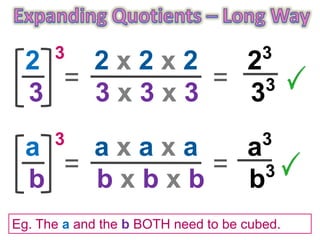
Eg. The a and the b BOTH need to be cubed.
2 3
2 x 2 x 2 23
3 3 x 3 x 3 33==
a 3
a x a x a a3
b b x b x b b3==
Eg. The a and the b BOTH need to be Powered.
The Expanding Quotients Rule involves
applying the Power Outside of the
brackets, onto every item that is inside
the brackets.
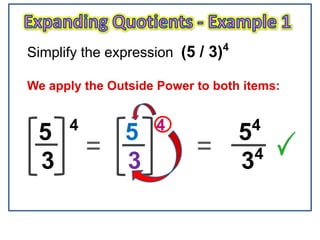
5 4
5 4
54
3 3 34
Simplify the expression (5 / 3)4
We apply the Outside Power to both items:
==
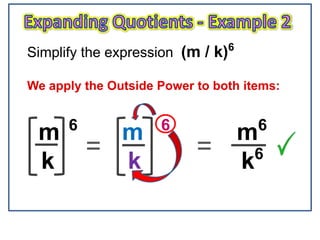
m 6
m 6
m6
k k k6
Simplify the expression (m / k)6
We apply the Outside Power to both items:
==
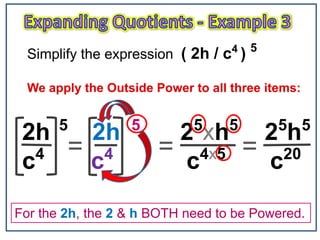
2h 5
2h 5
25
xh5
25
h5
c4
c4
c4x5
c20
Simplify the expression ( 2h / c4
) 5
We apply the Outside Power to all three items:
== =
For the 2h, the 2 & h BOTH need to be Powered.
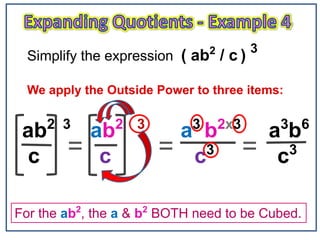
ab2 3
ab2 3
a3
b2x3
a3
b6
c c c3
c3
Simplify the expression ( ab2
/ c ) 3
We apply the Outside Power to three items:
== =
For the ab2
, the a & b2
BOTH need to be Cubed.
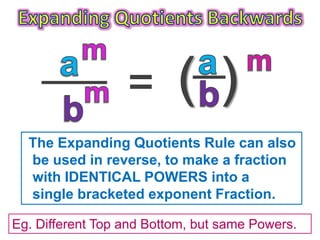
Eg. Different Top and Bottom, but same Powers.
The Expanding Quotients Rule can also
be used in reverse, to make a fraction
with IDENTICAL POWERS into a
single bracketed exponent Fraction.
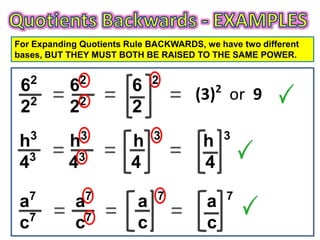
For Expanding Quotients Rule BACKWARDS, we have two different
bases, BUT THEY MUST BOTH BE RAISED TO THE SAME POWER.
62
62
6 2
22
22
2
= = = (3)2
or 9
h3
h3
h 3
h 3
43
43
4 4
= = =
a7
a7
a 7
a 7
c7
c7
c c
= = =
http://passyworldofmathematics.com
Visit our Site for Free Mathematics PowerPoints

Expanding Exponent Quotients

  • 1.
  • 2.
    Eg. The 2and the a BOTH need to raised to 2. The Power outside the brackets needs to be applied to all Bases Inside the brackets. (Like the Distributive Law, but for Exponents). (2a) 2 = 22 x a2 = 4 x a2 = 4a2
  • 3.
    Eg. The aand the b BOTH need to be cubed. 2 3 2 x 2 x 2 23 3 3 x 3 x 3 33== a 3 a x a x a a3 b b x b x b b3==
  • 4.
    Eg. The aand the b BOTH need to be Powered. The Expanding Quotients Rule involves applying the Power Outside of the brackets, onto every item that is inside the brackets.
  • 5.
    5 4 5 4 54 33 34 Simplify the expression (5 / 3)4 We apply the Outside Power to both items: ==
  • 6.
    m 6 m 6 m6 kk k6 Simplify the expression (m / k)6 We apply the Outside Power to both items: ==
  • 7.
    2h 5 2h 5 25 xh5 25 h5 c4 c4 c4x5 c20 Simplifythe expression ( 2h / c4 ) 5 We apply the Outside Power to all three items: == = For the 2h, the 2 & h BOTH need to be Powered.
  • 8.
    ab2 3 ab2 3 a3 b2x3 a3 b6 cc c3 c3 Simplify the expression ( ab2 / c ) 3 We apply the Outside Power to three items: == = For the ab2 , the a & b2 BOTH need to be Cubed.
  • 9.
    Eg. Different Topand Bottom, but same Powers. The Expanding Quotients Rule can also be used in reverse, to make a fraction with IDENTICAL POWERS into a single bracketed exponent Fraction.
  • 10.
    For Expanding QuotientsRule BACKWARDS, we have two different bases, BUT THEY MUST BOTH BE RAISED TO THE SAME POWER. 62 62 6 2 22 22 2 = = = (3)2 or 9 h3 h3 h 3 h 3 43 43 4 4 = = = a7 a7 a 7 a 7 c7 c7 c c = = =
  • 11.
    http://passyworldofmathematics.com Visit our Sitefor Free Mathematics PowerPoints