International Journal of Trend in Scientific Research and Development (IJTSRD)
Volume 5 Issue 5, July-August 2021 Available Online: www.ijtsrd.com e-ISSN: 2456 – 6470
@ IJTSRD | Unique Paper ID – IJTSRD43871 | Volume – 5 | Issue – 5 | Jul-Aug 2021 Page 624
Expanding Beyond Cryptocurrency in the
Digital World using Blockchain Technology
Anirvan Vinod
Anna University, Information Technology, Saranathan College of Engineering, Tiruchirappalli, Tamil Nadu, India
ABSTRACT
A blockchain is principally a distributed database of records or public
ledger of all transactions or digital events that are executed and
shared among the participating parties. Once entered, information can
never be erased. The blockchain encompasses a precise and
supportable record of each solo transaction ever made in the history
of all the transactions. Bitcoin, the decentralized digital currency, is
that the most well-liked example that uses blockchain technology.
The digital currency bitcoin itself is extremely controversial but the
underlying blockchain technology has worked flawlessly and located
a good range of applications in both the financial and nonfinancial
world.
KEYWORDS: Blockchain, Bitcoins, Peers, Decentralized,
Transactions, Cryptocurrencies
How to cite this paper: Anirvan Vinod
"Expanding Beyond Cryptocurrency in
the Digital World using Blockchain
Technology"
Published in
International Journal
of Trend in
Scientific Research
and Development
(ijtsrd), ISSN: 2456-
6470, Volume-5 |
Issue-5, August 2021, pp.624-629, URL:
www.ijtsrd.com/papers/ijtsrd43871.pdf
Copyright © 2021 by author (s) and
International Journal of Trend in
Scientific Research and Development
Journal. This is an
Open Access article
distributed under the
terms of the Creative Commons
Attribution License (CC BY 4.0)
(http://creativecommons.org/licenses/by/4.0)
I. INTRODUCTION
The key premise of blockchain technology is that the
blockchain launches the system of fashioning a
distributed accord in the digital online world. This
permits the contribution of entities to know for certain
that a digital event happened by creating an
irrefutable record in a public ledger. Bitcoin is the
most popular example that is intrinsically tied to
blockchain technology. It is also the most
controversial one since it helps to enable a
multibillion-dollar global market of anonymous
transactions without any governmental control. Hence
it has to deal with a number of regulatory issues
involving national governments and financial
institutions. Bitcoin works on eliminating the middle
man concept of having bank control and view the
transactions which are being made throughout the
world. Once the middle man is eliminated
transactions become more secure and confidential.
Nevertheless, blockchain technology itself is non-
controversial and has worked impeccably, and is
being positively applied to both financial and non-
financial world claims and applications. Last year,
Marc Andreessen, the doyen of Silicon Valley’s
capitalists, listed the blockchain distributed consensus
models as the most important invention since the
Internet itself. The bitcoin’s blockchain, the software
that permits the digital currency to execute should be
measured as a development that has the potential to
transform the world of finance and beyond. The fact
is that we live our life precariously in the digital
world by relying on a third entity for the security and
privacy of our digital assets. The sad fact is that third-
party foundations can be extremely compromised.
This is where blockchain technology comes in handy.
It has the potential to revolutionize the digital world
by enabling a distributed consensus where each and
every online transaction, past and present, involving
digital assets can be verified at any time in the future.
This technology has the power to do this without
negotiating the concealment of the digital assets and
the various different parties involved. The distributed
accord and anonymity are the key factors involved
with the blockchain technology.
A brief history of bitcoins - 1998 – 2009
Although it was an established cryptocurrency, there
had been previous attempts at creating online
currencies with ledgers secured by encryption. Two
IJTSRD43871
International Journal of Trend in Scientific Research and Development @ www.ijtsrd.com eISSN: 2456-6470
@ IJTSRD | Unique Paper ID – IJTSRD43871 | Volume – 5 | Issue – 5 | Jul-Aug 2021 Page 625
examples of these were B-Money and Bit Gold,
which were formulated but never fully developed.
2008 – Satoshi Nakamoto, the Mystery Man
A paper called Bitcoin – A Peer to Peer Electronic
Cash System was posted to a mailing list discussion
on cryptography. It was posted by someone calling
themselves Satoshi Nakamoto, whose real identity
remains a mystery to this day.
2009 – Bitcoin begins
The Bitcoin software is made available to the public
for the first time and mining – the process through
which new Bitcoins are created and transactions are
recorded and verified on the blockchain – begins.
The popularity of the Bitcoin has never ceased to
increase since then. The underlying Blockchain
technology is now finding new range of applications
beyond finance.
II. METHODOLOGY
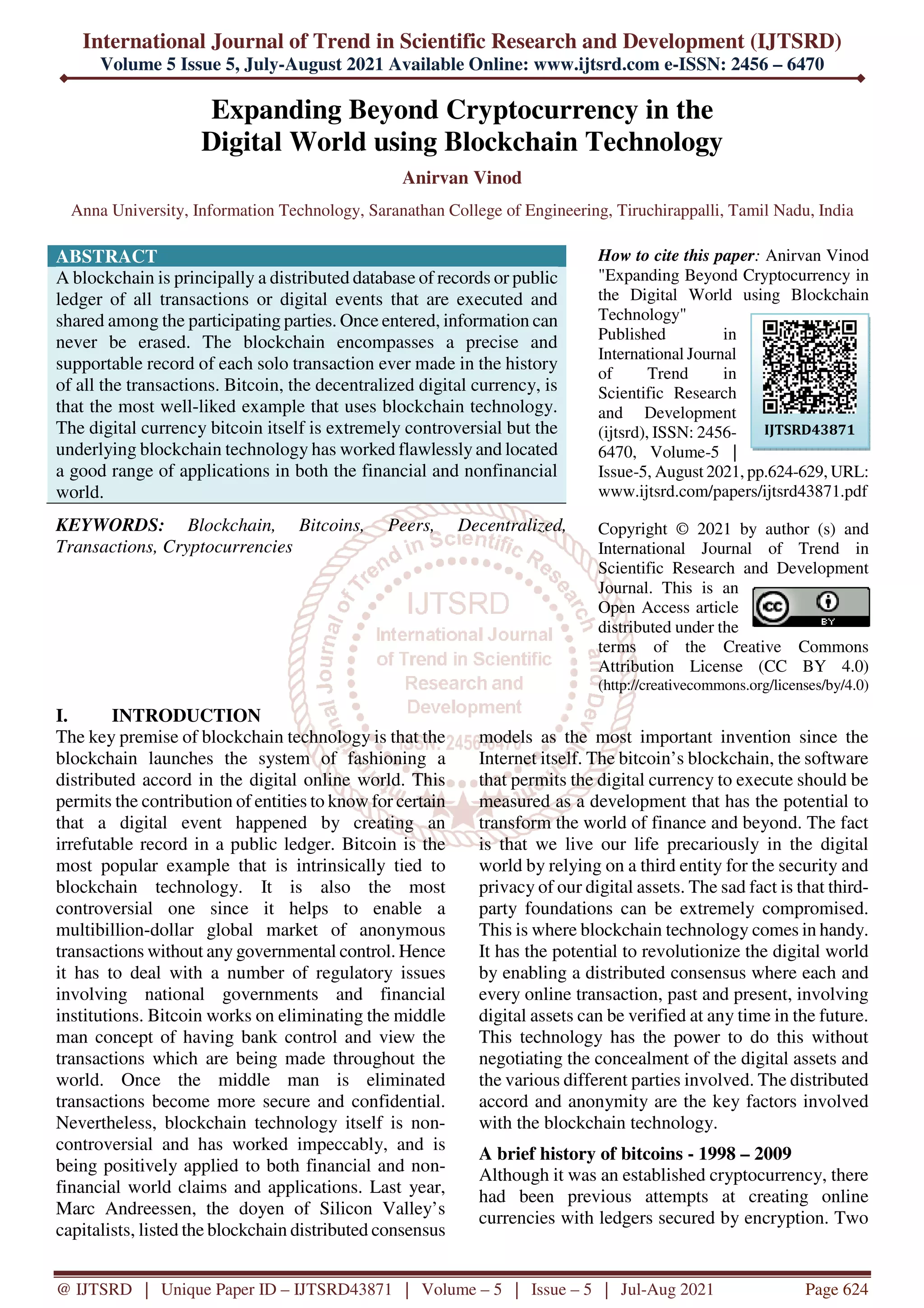
HOW DOES BLOCKCHAIN WORK?
Internet commerce is exclusively tied to the financial
institutions serving as the trusted third party who
process and mediate any electronic transaction. The
role of trusted third party is to validate, safeguard and
preserve transactions. A certain percentage of fraud is
unavoidable in online transactions and that needs
mediation by financial transactions. This results in
high transaction costs. Bitcoin uses cryptographic
proof instead of the trust in the third party for two
willing parties to execute an online transaction over
the Internet. Each transaction is protected through a
digital signature. Each transaction is sent to the
“public key” of the receiver digitally signed using the
“private key” of the sender. In order to spend money,
owner of the cryptocurrency needs to prove the
ownership of the “private key”. The entity receiving
the digital currency verifies the digital signature.
Figure 1: Working of a blockchain.
Thus, the ownership of corresponding “private key” on the transaction using the “public key” of the sender. Each
transaction is broadcast to every node in the Bitcoin network and is then recorded in a public ledger after
verification.
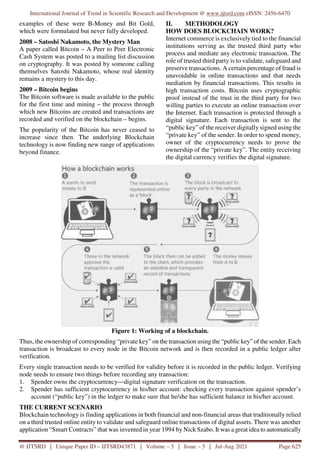
Every single transaction needs to be verified for validity before it is recorded in the public ledger. Verifying
node needs to ensure two things before recording any transaction:
1. Spender owns the cryptocurrency—digital signature verification on the transaction.
2. Spender has sufficient cryptocurrency in his/her account: checking every transaction against spender’s
account (“public key”) in the ledger to make sure that he/she has sufficient balance in his/her account.
THE CURRENT SCENARIO
Blockchain technology is finding applications in both financial and non-financial areas that traditionally relied
on a third trusted online entity to validate and safeguard online transactions of digital assets. There was another
application “Smart Contracts” that was invented in year 1994 by Nick Szabo. It was a great idea to automatically
International Journal of Trend in Scientific Research and Development @ www.ijtsrd.com eISSN: 2456-6470
@ IJTSRD | Unique Paper ID – IJTSRD43871 | Volume – 5 | Issue – 5 | Jul-Aug 2021 Page 626
execute contracts between participating parties. However, it did not find usage until the notion of crypto
currencies or programmable payments came into existence. Now two programs blockchain and smart contract
can work together to trigger payments when a preprogrammed condition of a contractual agreement is triggered.
Smart Contracts are really the killer application of the cryptocurrency world. Smart contracts are contracts which
are automatically enforced by computer protocols. Using blockchain technology it has become much easier to
register, verify and execute Smart Contracts. Open-source companies like Ethereum and Codius are enabling
Smart Contracts using blockchain technology. Many companies which operate on bitcoin and blockchain
technologies are supporting Smart Contracts. Many cases where assets are transferred only on meeting certain
conditions which require Lawyers to create a contract and Banks to provide Escrow service can be replaced by
Smart Contracts. Ethereum has created lot of excitement for its programmable platform capabilities. Ethereum
allows anyone to create their own cryptocurrency and use that to execute, pay for smart contracts. Ethereum
itself has its own cryptocurrency (ether) which is used to pay for the services. Ethereum is already powering
wide range of early applications in areas such as Governance, autonomous banks, keyless access, crowdfunding,
financial derivatives trading and settlement using smart contracts. Also, there are a number of blockchains in
existence to support wide range of applications - not just cryptocurrency. Currently there are three approaches in
Industry to support other applications and also to overcome perceived limitations of Bitcoin blockchain:
Alternative Blockchains is a system of using the blockchain algorithm to achieve distributed consensus on a
particular digital asset. They may share miners with a parent network such as Bitcoin’s- this is called merged
mining. They have been suggested to implement applications such as DNS, SSL certification authority, file
storage and voting. Colored Coins is an open-source protocol that describes class of methods for developers to
create digital assets on top of Bitcoin blockchain by using its functionalities beyond digital currency. Sidechains
are alternative blockchains which are backed by Bitcoins via Bitcoin contract- just as dollars and pounds used to
be backed by Gold. One can possibly have a thousand of sidechains “pegged” to Bitcoin, all with different
characteristics and purposes- all of them taking advantage of scarcity and resilience guaranteed by the Bitcoin
blockchain. The Bitcoin blockchain can in turn iterate to support additional features for the experimental
sidechains - once they have been tried and tested. Companies such as IBM, Samsung, Overstock, Amazon, UBS,
Citi, Ebay, Verizon Wireless to name a few are all exploring alternative and novel uses of the blockchain for
their own applications. Nine of the world’s biggest banks including Barclays and Goldman Sachs have recently
(Sept. 5 15, 2015) joined forces with the New York based financial technology firm R3 to create a framework
for using the blockchain technology in the financial market. This is the first-time banks have come to work
together to find applications of blockchain technology. Banks like JPMorgan, State Street, UBS, Royal Bank of
Scotland, Credit Suisse, BBVA and Commonwealth Bank of Australia have joined this initiative.
Figure 2: Validation Process
International Journal of Trend in Scientific Research and Development @ www.ijtsrd.com eISSN: 2456-6470
@ IJTSRD | Unique Paper ID – IJTSRD43871 | Volume – 5 | Issue – 5 | Jul-Aug 2021 Page 627
III. MODELING AND ANALYSIS
APPLICATIONS OF BLOCKCHAIN IN BOTH
FINANCIAL AND NON-FINANCIAL
MARKETS
FINANCIAL APPLICATIONS
PRIVATE SECTOR SECURITIES
It is very expensive to take a company public. A
syndicate of banks must work to underwrite the deal
and attract investors. The stock exchanges list
company shares for secondary market to function
securely with trades settling and clearing in a timely
manner. It is now theoretically possible for companies
to directly issue the shares via the blockchain. These
shares can then be purchased and sold in a secondary
market that sits on top of the blockchain. A few
examples are:
NASDAQ launched its Private Equity Exchange in
2014. This is meant to provide the key functionalities
like Cap table and investor relationship management
for the pre-IPO or private companies. The current
process of trading stocks in this exchange is
inefficient and slow due to involvement of multiple
3rd parties. NASDAQ has joined hands with a San
Francisco based Start-up called chain.com to
implement private equity exchange on top of
Blockchain. Chain.com is implementing Blockchain
based smart contracts to implement exchange
functionality. This product is expected to be fast,
traceable and efficient.
Medici is being developed as a securities exchange
that uses the Counterparty implementations of Bitcoin
2.0. The goal here is to create a cutting-edge stock
market. Counterparty is a protocol that implements
traditional financial instruments as the self-executing
smart contracts. These smart contracts facilitate,
verify or enforce the negotiation of contract and
eliminate the need for a physical document. This
eliminates the need for an intermediary, such as
broker, exchange or bank.
Blockstream is an open-source project with focus on
sidechains- interoperable blockchains- to avoid
fragmentation, security and other issues related to
alternative crypto-currencies. Uses can range from
registering securities, such as stocks, bonds and
derivatives, to securing bank balances and mortgages.
INSURANCE
Everledger is a company which creates permanent
ledger of diamond certification and the transaction
history of the diamond using blockchain. The
characteristics which uniquely identify the diamond
such as height, width, weight, depth, color etc. are
hashed and registered in the ledger. The verification
of diamonds can be done by insurance companies,
law enforcement agencies, owners and claimants.
Everledger provides a simple to use web service API
for looking at a diamond, create/read/update claims
(by insurance companies) and create/read/update
police reports on diamonds.
NON-FINANCIAL APPLICATIONS
Applications of Blockchain in the Music Industry
The music industry has gone a big change in last
decade due to the growth of Internet and availability
of a number of streaming services over the Internet. It
is impacting everyone in the music industry-artists,
labels, publishers, songwriters and streaming service
providers. The process by which music royalties are
determined has always been convoluted one, but the
rise of the Internet has made it even more complex
giving rise to the demand of transparency in the
royalty payments by artists and songwriters.
Decentralized proof of existence of documents
Validating the existence or the possession of signed
documents is very important in any legal solution.
The traditional document validation models rely on
central authorities for storing and validating the
documents, which present some obvious security
challenges. These models become even more difficult
as the documents become older. The blockchain
technology provides an alternative model to proof-of-
existence and possession of legal documents. By
leveraging the blockchain, a user can simply store the
signature and timestamp associated with a legal
document in the blockchain and validate it anytime
using native blockchain mechanisms. Proof of
existence is a simple service that allows one to
anonymously and securely store online proof of
existence of any document. This service simplystores
the cryptographic digest of the file, linked to the time
in which a user submits his/her document. It is to be
noted here that cryptographic digest or fingerprint-
not the actual document- is stored in blockchain, so
user need not be worried about the privacy aspect.
Decentralized Storage
Cloud file storage solutions such as Dropbox, Google
Drive or One Drive are growing in popularity to store
documents, photos, video and music files. Despite
their popularity, cloud file storage solutions typically
face challenges in areas such as security, privacy and
data control. The major issue is that one has to trust a
third party with one’s confidential files. Storj
provides a blockchain based peer-to-peer distributed
cloud storage platform (see Appendix for detailed
description) that allows users to transfer and share
data without relying on a third-party data provider.
This allows people to share unused internet
bandwidth and spare disk space in their personal
computing devices to those looking to store large files
International Journal of Trend in Scientific Research and Development @ www.ijtsrd.com eISSN: 2456-6470
@ IJTSRD | Unique Paper ID – IJTSRD43871 | Volume – 5 | Issue – 5 | Jul-Aug 2021 Page 628
in return for bitcoin-based micropayments. Absence
of a central control eliminates most traditional data
failures and outages, as well as significantly
increasing security, privacy and data control. Storj
platform depends upon a challenge algorithm to offer
incentivization for users to properly participate in this
network. In this way, Storj platform can periodically
cryptographically check the integrity and availability
of a file, and offer direct rewards to those maintaining
the file. Here, bitcoin-based micropayments serve as
both an incentive and payment while a separate
blockchain is used as a data store for file metadata.
Internet Applications
Namecoin is an alternative blockchain technology
(with small variations) that is used to implement
decentralized version of Domain Name Server (DNS)
that is resilient to censorship. Current DNS servers
are controlled by governments and large corporations,
and could abuse their power to censor, hijack, or spy
on your Internet usage. Use of Blockchain technology
means since DNS or phonebook of the Internet is
maintained in a decentralized manner and every user
can have the same phone book data on their
computer. Public Key Infrastructure (PKI) technology
is widely used for centralized distribution and
management of digital certificates. Every device
needs to have root certificate of the Certification
Authority (CA) to verify digital signature. While PKI
have been widely deployed and incredibly successful,
dependence on a CA makes scalability an issue.
IV. RESULTS AND DISCUSSION
ADVANTAGES OF BLOCKCHAIN
TECHNOLOGY
1. Root Users
Users are in complete control of all their information
and transactions.
2. High Quality Data
Blockchain data is complete, consistent, timely,
accurate, and widely available.
3. Durability, Integrity and Longevity
Due to the decentralized networks which are present
blockchain does not have a central point of failure
and is better able to withstand malicious attacks.
4. Transparency and Immutability
Changes to public blockchains are publicly viewable
by all parties creating transparency, and all
transactions are immutable, meaning they cannot be
altered or deleted.
5. Faster Transactions
Interbank transactions can potentially take days for
clearing and final settlement, especially outside of
working hours.
DISADVANTAGES OF BLOCKCHAIN
TECHNOLOGY
1. Signature verification
Every blockchain transaction must be digitallysigned
using a public-private cryptography scheme such as
ECDSA. This is necessary because transactions
propagate between nodes in a peer-to-peer fashion, so
their source cannot otherwise be proven.
2. Redundancy
This isn’t about the performance of an individual
node, but the total amount of computation that a
blockchain requires. Whereas centralized databases
process transactions once (or twice), in a blockchain
they must be processed independently by every node
in the network. So lots more work is being done for
the same end result.
3. Nascent Technology
Resolving challenges such as transaction speed, the
verification process, and data limits will be crucial in
making blockchain widely applicable.
4. Control, Security, and Privacy
While solutions exist, including private or
permissioned blockchains and strong encryption,
there are still cyber security concerns that need to be
addressed before the general public will entrust their
personal data to a blockchain solution.
5. Cost
Blockchain offers tremendous savings in transaction
costs and time but the high initial capital costs could
be a deterrent.
TYPES OF CRYPTOCURRENCIES
Figure 3: Types of Cryptocurrencies
V. CONCLUSION
The entire process of Blockchain technology has been
discussed in detail and how blockchain can be applied
in many other fields apart from just implementing in
the world of cryptocurrency. Blockchain technology
is a powerful technology and nurturing it with the
proper additional tuning, it can be applied in the
digital world to create wonderful revolutions
enhancing the quality of human life to a great extent.
Blockchain technology can be embedded into the
International Journal of Trend in Scientific Research and Development @ www.ijtsrd.com eISSN: 2456-6470
@ IJTSRD | Unique Paper ID – IJTSRD43871 | Volume – 5 | Issue – 5 | Jul-Aug 2021 Page 629
field where there can be an elimination of middle man
technology to ease in the entire process and save
energy and time thus improving the quality of life. It
also propagates a methodology of being highly secure
since every transaction made gets an entry on the
distributed ledger thus creating a permanent record.
This further drives it to be extremely transparent and
error free making it way more trust worthy than the
traditional systems which are in play in the current
digital world. Blockchain technology is on the rise in
various industries and many adaptations are being
done to the current traditional models. In conclusion,
when the technology is implemented in the right
manner, various industries in the digital world can be
revolutionized enabling humanity to lead a higher
quality of life.
VI. REFERENCES
[1] Michael Crosby, Nachiappan, Pradhan
Pattanayak, Sanjeev Verma, Vignesh
Kalyanaraman Sutardja Center for
Entrepreneurship & Technology Technical
Report Berkeley University of California
[2] https://blockchaintechnologycom.wordpress.co
m/201 6/11/21/advantages-disadvantages/
[3] https://www.allerin.com/blog/wp-
content/uploads/2016/06/Blockchain-
Technology.png
[4] https://en.wikipedia.org/wiki/Blockchain
[5] https://en.wikipedia.org/wiki/Cryptocurrency
[6] https://www.munichre.com/us-
life/en/perspectives/underwriting/blockchain-
implications-insurance-industry.html
[7] Adhami S, Giudici G, Martinazzi S (2018) Why
do businesses go crypto? An empirical analysis
of initial coin offerings. J Econ Bus 100:64–75
[8] Chen Z, Li Y, Wu Y, Luo J (2017) The
transition from traditional banking to mobile
internet finance: an organizational innovation
perspective - a comparative study of Citibank
and ICBC. Financial Innovation 3(1):12

Expanding Beyond Cryptocurrency in the Digital World using Blockchain Technology

  • 1.
    International Journal ofTrend in Scientific Research and Development (IJTSRD) Volume 5 Issue 5, July-August 2021 Available Online: www.ijtsrd.com e-ISSN: 2456 – 6470 @ IJTSRD | Unique Paper ID – IJTSRD43871 | Volume – 5 | Issue – 5 | Jul-Aug 2021 Page 624 Expanding Beyond Cryptocurrency in the Digital World using Blockchain Technology Anirvan Vinod Anna University, Information Technology, Saranathan College of Engineering, Tiruchirappalli, Tamil Nadu, India ABSTRACT A blockchain is principally a distributed database of records or public ledger of all transactions or digital events that are executed and shared among the participating parties. Once entered, information can never be erased. The blockchain encompasses a precise and supportable record of each solo transaction ever made in the history of all the transactions. Bitcoin, the decentralized digital currency, is that the most well-liked example that uses blockchain technology. The digital currency bitcoin itself is extremely controversial but the underlying blockchain technology has worked flawlessly and located a good range of applications in both the financial and nonfinancial world. KEYWORDS: Blockchain, Bitcoins, Peers, Decentralized, Transactions, Cryptocurrencies How to cite this paper: Anirvan Vinod "Expanding Beyond Cryptocurrency in the Digital World using Blockchain Technology" Published in International Journal of Trend in Scientific Research and Development (ijtsrd), ISSN: 2456- 6470, Volume-5 | Issue-5, August 2021, pp.624-629, URL: www.ijtsrd.com/papers/ijtsrd43871.pdf Copyright © 2021 by author (s) and International Journal of Trend in Scientific Research and Development Journal. This is an Open Access article distributed under the terms of the Creative Commons Attribution License (CC BY 4.0) (http://creativecommons.org/licenses/by/4.0) I. INTRODUCTION The key premise of blockchain technology is that the blockchain launches the system of fashioning a distributed accord in the digital online world. This permits the contribution of entities to know for certain that a digital event happened by creating an irrefutable record in a public ledger. Bitcoin is the most popular example that is intrinsically tied to blockchain technology. It is also the most controversial one since it helps to enable a multibillion-dollar global market of anonymous transactions without any governmental control. Hence it has to deal with a number of regulatory issues involving national governments and financial institutions. Bitcoin works on eliminating the middle man concept of having bank control and view the transactions which are being made throughout the world. Once the middle man is eliminated transactions become more secure and confidential. Nevertheless, blockchain technology itself is non- controversial and has worked impeccably, and is being positively applied to both financial and non- financial world claims and applications. Last year, Marc Andreessen, the doyen of Silicon Valley’s capitalists, listed the blockchain distributed consensus models as the most important invention since the Internet itself. The bitcoin’s blockchain, the software that permits the digital currency to execute should be measured as a development that has the potential to transform the world of finance and beyond. The fact is that we live our life precariously in the digital world by relying on a third entity for the security and privacy of our digital assets. The sad fact is that third- party foundations can be extremely compromised. This is where blockchain technology comes in handy. It has the potential to revolutionize the digital world by enabling a distributed consensus where each and every online transaction, past and present, involving digital assets can be verified at any time in the future. This technology has the power to do this without negotiating the concealment of the digital assets and the various different parties involved. The distributed accord and anonymity are the key factors involved with the blockchain technology. A brief history of bitcoins - 1998 – 2009 Although it was an established cryptocurrency, there had been previous attempts at creating online currencies with ledgers secured by encryption. Two IJTSRD43871
  • 2.
    International Journal ofTrend in Scientific Research and Development @ www.ijtsrd.com eISSN: 2456-6470 @ IJTSRD | Unique Paper ID – IJTSRD43871 | Volume – 5 | Issue – 5 | Jul-Aug 2021 Page 625 examples of these were B-Money and Bit Gold, which were formulated but never fully developed. 2008 – Satoshi Nakamoto, the Mystery Man A paper called Bitcoin – A Peer to Peer Electronic Cash System was posted to a mailing list discussion on cryptography. It was posted by someone calling themselves Satoshi Nakamoto, whose real identity remains a mystery to this day. 2009 – Bitcoin begins The Bitcoin software is made available to the public for the first time and mining – the process through which new Bitcoins are created and transactions are recorded and verified on the blockchain – begins. The popularity of the Bitcoin has never ceased to increase since then. The underlying Blockchain technology is now finding new range of applications beyond finance. II. METHODOLOGY HOW DOES BLOCKCHAIN WORK? Internet commerce is exclusively tied to the financial institutions serving as the trusted third party who process and mediate any electronic transaction. The role of trusted third party is to validate, safeguard and preserve transactions. A certain percentage of fraud is unavoidable in online transactions and that needs mediation by financial transactions. This results in high transaction costs. Bitcoin uses cryptographic proof instead of the trust in the third party for two willing parties to execute an online transaction over the Internet. Each transaction is protected through a digital signature. Each transaction is sent to the “public key” of the receiver digitally signed using the “private key” of the sender. In order to spend money, owner of the cryptocurrency needs to prove the ownership of the “private key”. The entity receiving the digital currency verifies the digital signature. Figure 1: Working of a blockchain. Thus, the ownership of corresponding “private key” on the transaction using the “public key” of the sender. Each transaction is broadcast to every node in the Bitcoin network and is then recorded in a public ledger after verification. Every single transaction needs to be verified for validity before it is recorded in the public ledger. Verifying node needs to ensure two things before recording any transaction: 1. Spender owns the cryptocurrency—digital signature verification on the transaction. 2. Spender has sufficient cryptocurrency in his/her account: checking every transaction against spender’s account (“public key”) in the ledger to make sure that he/she has sufficient balance in his/her account. THE CURRENT SCENARIO Blockchain technology is finding applications in both financial and non-financial areas that traditionally relied on a third trusted online entity to validate and safeguard online transactions of digital assets. There was another application “Smart Contracts” that was invented in year 1994 by Nick Szabo. It was a great idea to automatically
  • 3.
    International Journal ofTrend in Scientific Research and Development @ www.ijtsrd.com eISSN: 2456-6470 @ IJTSRD | Unique Paper ID – IJTSRD43871 | Volume – 5 | Issue – 5 | Jul-Aug 2021 Page 626 execute contracts between participating parties. However, it did not find usage until the notion of crypto currencies or programmable payments came into existence. Now two programs blockchain and smart contract can work together to trigger payments when a preprogrammed condition of a contractual agreement is triggered. Smart Contracts are really the killer application of the cryptocurrency world. Smart contracts are contracts which are automatically enforced by computer protocols. Using blockchain technology it has become much easier to register, verify and execute Smart Contracts. Open-source companies like Ethereum and Codius are enabling Smart Contracts using blockchain technology. Many companies which operate on bitcoin and blockchain technologies are supporting Smart Contracts. Many cases where assets are transferred only on meeting certain conditions which require Lawyers to create a contract and Banks to provide Escrow service can be replaced by Smart Contracts. Ethereum has created lot of excitement for its programmable platform capabilities. Ethereum allows anyone to create their own cryptocurrency and use that to execute, pay for smart contracts. Ethereum itself has its own cryptocurrency (ether) which is used to pay for the services. Ethereum is already powering wide range of early applications in areas such as Governance, autonomous banks, keyless access, crowdfunding, financial derivatives trading and settlement using smart contracts. Also, there are a number of blockchains in existence to support wide range of applications - not just cryptocurrency. Currently there are three approaches in Industry to support other applications and also to overcome perceived limitations of Bitcoin blockchain: Alternative Blockchains is a system of using the blockchain algorithm to achieve distributed consensus on a particular digital asset. They may share miners with a parent network such as Bitcoin’s- this is called merged mining. They have been suggested to implement applications such as DNS, SSL certification authority, file storage and voting. Colored Coins is an open-source protocol that describes class of methods for developers to create digital assets on top of Bitcoin blockchain by using its functionalities beyond digital currency. Sidechains are alternative blockchains which are backed by Bitcoins via Bitcoin contract- just as dollars and pounds used to be backed by Gold. One can possibly have a thousand of sidechains “pegged” to Bitcoin, all with different characteristics and purposes- all of them taking advantage of scarcity and resilience guaranteed by the Bitcoin blockchain. The Bitcoin blockchain can in turn iterate to support additional features for the experimental sidechains - once they have been tried and tested. Companies such as IBM, Samsung, Overstock, Amazon, UBS, Citi, Ebay, Verizon Wireless to name a few are all exploring alternative and novel uses of the blockchain for their own applications. Nine of the world’s biggest banks including Barclays and Goldman Sachs have recently (Sept. 5 15, 2015) joined forces with the New York based financial technology firm R3 to create a framework for using the blockchain technology in the financial market. This is the first-time banks have come to work together to find applications of blockchain technology. Banks like JPMorgan, State Street, UBS, Royal Bank of Scotland, Credit Suisse, BBVA and Commonwealth Bank of Australia have joined this initiative. Figure 2: Validation Process
  • 4.
    International Journal ofTrend in Scientific Research and Development @ www.ijtsrd.com eISSN: 2456-6470 @ IJTSRD | Unique Paper ID – IJTSRD43871 | Volume – 5 | Issue – 5 | Jul-Aug 2021 Page 627 III. MODELING AND ANALYSIS APPLICATIONS OF BLOCKCHAIN IN BOTH FINANCIAL AND NON-FINANCIAL MARKETS FINANCIAL APPLICATIONS PRIVATE SECTOR SECURITIES It is very expensive to take a company public. A syndicate of banks must work to underwrite the deal and attract investors. The stock exchanges list company shares for secondary market to function securely with trades settling and clearing in a timely manner. It is now theoretically possible for companies to directly issue the shares via the blockchain. These shares can then be purchased and sold in a secondary market that sits on top of the blockchain. A few examples are: NASDAQ launched its Private Equity Exchange in 2014. This is meant to provide the key functionalities like Cap table and investor relationship management for the pre-IPO or private companies. The current process of trading stocks in this exchange is inefficient and slow due to involvement of multiple 3rd parties. NASDAQ has joined hands with a San Francisco based Start-up called chain.com to implement private equity exchange on top of Blockchain. Chain.com is implementing Blockchain based smart contracts to implement exchange functionality. This product is expected to be fast, traceable and efficient. Medici is being developed as a securities exchange that uses the Counterparty implementations of Bitcoin 2.0. The goal here is to create a cutting-edge stock market. Counterparty is a protocol that implements traditional financial instruments as the self-executing smart contracts. These smart contracts facilitate, verify or enforce the negotiation of contract and eliminate the need for a physical document. This eliminates the need for an intermediary, such as broker, exchange or bank. Blockstream is an open-source project with focus on sidechains- interoperable blockchains- to avoid fragmentation, security and other issues related to alternative crypto-currencies. Uses can range from registering securities, such as stocks, bonds and derivatives, to securing bank balances and mortgages. INSURANCE Everledger is a company which creates permanent ledger of diamond certification and the transaction history of the diamond using blockchain. The characteristics which uniquely identify the diamond such as height, width, weight, depth, color etc. are hashed and registered in the ledger. The verification of diamonds can be done by insurance companies, law enforcement agencies, owners and claimants. Everledger provides a simple to use web service API for looking at a diamond, create/read/update claims (by insurance companies) and create/read/update police reports on diamonds. NON-FINANCIAL APPLICATIONS Applications of Blockchain in the Music Industry The music industry has gone a big change in last decade due to the growth of Internet and availability of a number of streaming services over the Internet. It is impacting everyone in the music industry-artists, labels, publishers, songwriters and streaming service providers. The process by which music royalties are determined has always been convoluted one, but the rise of the Internet has made it even more complex giving rise to the demand of transparency in the royalty payments by artists and songwriters. Decentralized proof of existence of documents Validating the existence or the possession of signed documents is very important in any legal solution. The traditional document validation models rely on central authorities for storing and validating the documents, which present some obvious security challenges. These models become even more difficult as the documents become older. The blockchain technology provides an alternative model to proof-of- existence and possession of legal documents. By leveraging the blockchain, a user can simply store the signature and timestamp associated with a legal document in the blockchain and validate it anytime using native blockchain mechanisms. Proof of existence is a simple service that allows one to anonymously and securely store online proof of existence of any document. This service simplystores the cryptographic digest of the file, linked to the time in which a user submits his/her document. It is to be noted here that cryptographic digest or fingerprint- not the actual document- is stored in blockchain, so user need not be worried about the privacy aspect. Decentralized Storage Cloud file storage solutions such as Dropbox, Google Drive or One Drive are growing in popularity to store documents, photos, video and music files. Despite their popularity, cloud file storage solutions typically face challenges in areas such as security, privacy and data control. The major issue is that one has to trust a third party with one’s confidential files. Storj provides a blockchain based peer-to-peer distributed cloud storage platform (see Appendix for detailed description) that allows users to transfer and share data without relying on a third-party data provider. This allows people to share unused internet bandwidth and spare disk space in their personal computing devices to those looking to store large files
  • 5.
    International Journal ofTrend in Scientific Research and Development @ www.ijtsrd.com eISSN: 2456-6470 @ IJTSRD | Unique Paper ID – IJTSRD43871 | Volume – 5 | Issue – 5 | Jul-Aug 2021 Page 628 in return for bitcoin-based micropayments. Absence of a central control eliminates most traditional data failures and outages, as well as significantly increasing security, privacy and data control. Storj platform depends upon a challenge algorithm to offer incentivization for users to properly participate in this network. In this way, Storj platform can periodically cryptographically check the integrity and availability of a file, and offer direct rewards to those maintaining the file. Here, bitcoin-based micropayments serve as both an incentive and payment while a separate blockchain is used as a data store for file metadata. Internet Applications Namecoin is an alternative blockchain technology (with small variations) that is used to implement decentralized version of Domain Name Server (DNS) that is resilient to censorship. Current DNS servers are controlled by governments and large corporations, and could abuse their power to censor, hijack, or spy on your Internet usage. Use of Blockchain technology means since DNS or phonebook of the Internet is maintained in a decentralized manner and every user can have the same phone book data on their computer. Public Key Infrastructure (PKI) technology is widely used for centralized distribution and management of digital certificates. Every device needs to have root certificate of the Certification Authority (CA) to verify digital signature. While PKI have been widely deployed and incredibly successful, dependence on a CA makes scalability an issue. IV. RESULTS AND DISCUSSION ADVANTAGES OF BLOCKCHAIN TECHNOLOGY 1. Root Users Users are in complete control of all their information and transactions. 2. High Quality Data Blockchain data is complete, consistent, timely, accurate, and widely available. 3. Durability, Integrity and Longevity Due to the decentralized networks which are present blockchain does not have a central point of failure and is better able to withstand malicious attacks. 4. Transparency and Immutability Changes to public blockchains are publicly viewable by all parties creating transparency, and all transactions are immutable, meaning they cannot be altered or deleted. 5. Faster Transactions Interbank transactions can potentially take days for clearing and final settlement, especially outside of working hours. DISADVANTAGES OF BLOCKCHAIN TECHNOLOGY 1. Signature verification Every blockchain transaction must be digitallysigned using a public-private cryptography scheme such as ECDSA. This is necessary because transactions propagate between nodes in a peer-to-peer fashion, so their source cannot otherwise be proven. 2. Redundancy This isn’t about the performance of an individual node, but the total amount of computation that a blockchain requires. Whereas centralized databases process transactions once (or twice), in a blockchain they must be processed independently by every node in the network. So lots more work is being done for the same end result. 3. Nascent Technology Resolving challenges such as transaction speed, the verification process, and data limits will be crucial in making blockchain widely applicable. 4. Control, Security, and Privacy While solutions exist, including private or permissioned blockchains and strong encryption, there are still cyber security concerns that need to be addressed before the general public will entrust their personal data to a blockchain solution. 5. Cost Blockchain offers tremendous savings in transaction costs and time but the high initial capital costs could be a deterrent. TYPES OF CRYPTOCURRENCIES Figure 3: Types of Cryptocurrencies V. CONCLUSION The entire process of Blockchain technology has been discussed in detail and how blockchain can be applied in many other fields apart from just implementing in the world of cryptocurrency. Blockchain technology is a powerful technology and nurturing it with the proper additional tuning, it can be applied in the digital world to create wonderful revolutions enhancing the quality of human life to a great extent. Blockchain technology can be embedded into the
  • 6.
    International Journal ofTrend in Scientific Research and Development @ www.ijtsrd.com eISSN: 2456-6470 @ IJTSRD | Unique Paper ID – IJTSRD43871 | Volume – 5 | Issue – 5 | Jul-Aug 2021 Page 629 field where there can be an elimination of middle man technology to ease in the entire process and save energy and time thus improving the quality of life. It also propagates a methodology of being highly secure since every transaction made gets an entry on the distributed ledger thus creating a permanent record. This further drives it to be extremely transparent and error free making it way more trust worthy than the traditional systems which are in play in the current digital world. Blockchain technology is on the rise in various industries and many adaptations are being done to the current traditional models. In conclusion, when the technology is implemented in the right manner, various industries in the digital world can be revolutionized enabling humanity to lead a higher quality of life. VI. REFERENCES [1] Michael Crosby, Nachiappan, Pradhan Pattanayak, Sanjeev Verma, Vignesh Kalyanaraman Sutardja Center for Entrepreneurship & Technology Technical Report Berkeley University of California [2] https://blockchaintechnologycom.wordpress.co m/201 6/11/21/advantages-disadvantages/ [3] https://www.allerin.com/blog/wp- content/uploads/2016/06/Blockchain- Technology.png [4] https://en.wikipedia.org/wiki/Blockchain [5] https://en.wikipedia.org/wiki/Cryptocurrency [6] https://www.munichre.com/us- life/en/perspectives/underwriting/blockchain- implications-insurance-industry.html [7] Adhami S, Giudici G, Martinazzi S (2018) Why do businesses go crypto? An empirical analysis of initial coin offerings. J Econ Bus 100:64–75 [8] Chen Z, Li Y, Wu Y, Luo J (2017) The transition from traditional banking to mobile internet finance: an organizational innovation perspective - a comparative study of Citibank and ICBC. Financial Innovation 3(1):12