www.infosys.com
THE BLOCKCHAIN REVOLUTION
HOW BLOCKCHAIN AND DISTRIBUTED LEDGER TECHNOLOGY
WILL TRANSFORM FINANCIAL SERVICES
Foreword	
Executive summary	
Introduction	
How blockchain works
Cryptocurrencies and the blockchain	
Applications of blockchain in financial
Services and banking	
Capital Markets	
Insurance	
Asset Management	
Other services	
Start-ups with new services	
The benefits of blockchain	
The barriers to blockchain adoption	
The way forward
CONTENT
2
External Document © 2018 Infosys Limited
THE BLOCKCHAIN REVOLUTION
2
3
5
9
13
16
17
18
19
20
21
22
23
24
25
3
External Document © 2018 Infosys Limited
THE BLOCKCHAIN REVOLUTION
Infosys is pleased to be publishing this in-depth report on
blockchain, one of the key strategic and technology issues
facing financial services firms today. This is the second in a
series of reports, in which we will look at critical topics, with
a focus on case examples from the industry to highlight the
wide range of developments that are taking place. Infosys
is ideally placed to contribute to the debate as it works with
clients across the world in financial services, helping to deal
with their challenges and solve real problems.
The report highlights the acceleration in the deployment
of blockchain technology across the financial services
industry. Leading banks, insurers and asset managers are
joining industry consortia, working on multiple projects,
and investing in related start-ups. In the short term,
blockchain applications can deliver real cost savings. In the
longterm,thetechnologycanhaveamoreprofoundimpact
on the industry - so having a clear vision of how blockchain
technology can benefit an organisation is critical.
FOREWORD
MohitJoshi
President–InfosysLimited
Infosys
4
External Document © 2018 Infosys Limited
THE BLOCKCHAIN REVOLUTION
Blockchain technology has evolved significantly from the
original concept of Bitcoin which was established in 2009.
While Bitcoin and other cryptocurrencies get many of the
headlines, the application of blockchain across financial
services is now advancing steadily.
It has taken a while for the industry to get organised. The
first major banking consortium set up to explore blockchain
applications was R3 in 2015. R3 began with nine members
and now has more than 100 members including trade
associations and technology firms as well as industry
participants. In the insurance industry, it was in 2016 when
the B3i consortium was set up by a group of leading insurers.
Investment in blockchain start-ups, including by banks and
insurers, began to take off in 2014 and, after plateauing
to some extent in 2016, picked up again in 2017 reaching
approximately US$1bn. Traditional equity financing of new
ventures has also been supplemented by a massive surge
of investment in initial coin offerings (ICOs) from blockchain
start-ups. It is essential for established industry players to
work with start-ups in the blockchain space because of the
range of innovations taking place across the ecosystem.
Media focus on cryptocurrencies has become intense with
nearly 1,500 cryptocurrencies in existence (many related
to specific ICOs) and with the market value of Bitcoin in
circulation reaching over US$200bn at the end of 2017.
Central banks have started to research and show interest in
the idea of issuing a central bank digital currency although
at present they remain cautious about the idea except for
use in settlement activities between banks.
The technology underlying cryptocurrencies, i.e. blockchain
or distributed ledger, has evolved rapidly in the past
two years to make it enterprise ready. The requirements
of financial institutions for privacy and transparency,
performance and scalability, and a controlled governance
environment, has made this evolution necessary.
Organisations like the Enterprise Ethereum Alliance have
been set up to work on making blockchain applications
enterprise ready (in this case applications based on the
Ethereum blockchain protocol).
In this report we have set out twelve real case examples
from across banking, capital markets, insurance and asset
management. Most of these are either live applications or
will go live in 2018. The range of use cases is significant and
illustrates how the technology will impact many processes
in the industry and all participants.
The primary reason that implementation is starting to move
soquicklyisthatthecostsavingsarerelativelyhigh.Industry
participants are reporting cost savings of around 30% when
EXECUTIVE SUMMARY
5
External Document © 2018 Infosys Limited
THE BLOCKCHAIN REVOLUTION
blockchain is applied to existing processes, whether that is
the clearing and settlement of a credit default swap, or the
setting up of a trade finance contract. Reduction of risk and
fraud are also reported as being very important benefits.
Barriers to adoption remain. Management understanding
and buy-in are critical. The need for multiple participants
in most projects can slow down development. Technology-
related issues such as performance and scalability, while
being resolved, are still important factors.
Financial services firms should be in no doubt that
blockchain technology is going to have a significant impact
across the industry, so they must be prepared and actively
engaged in the range of developments taking place.
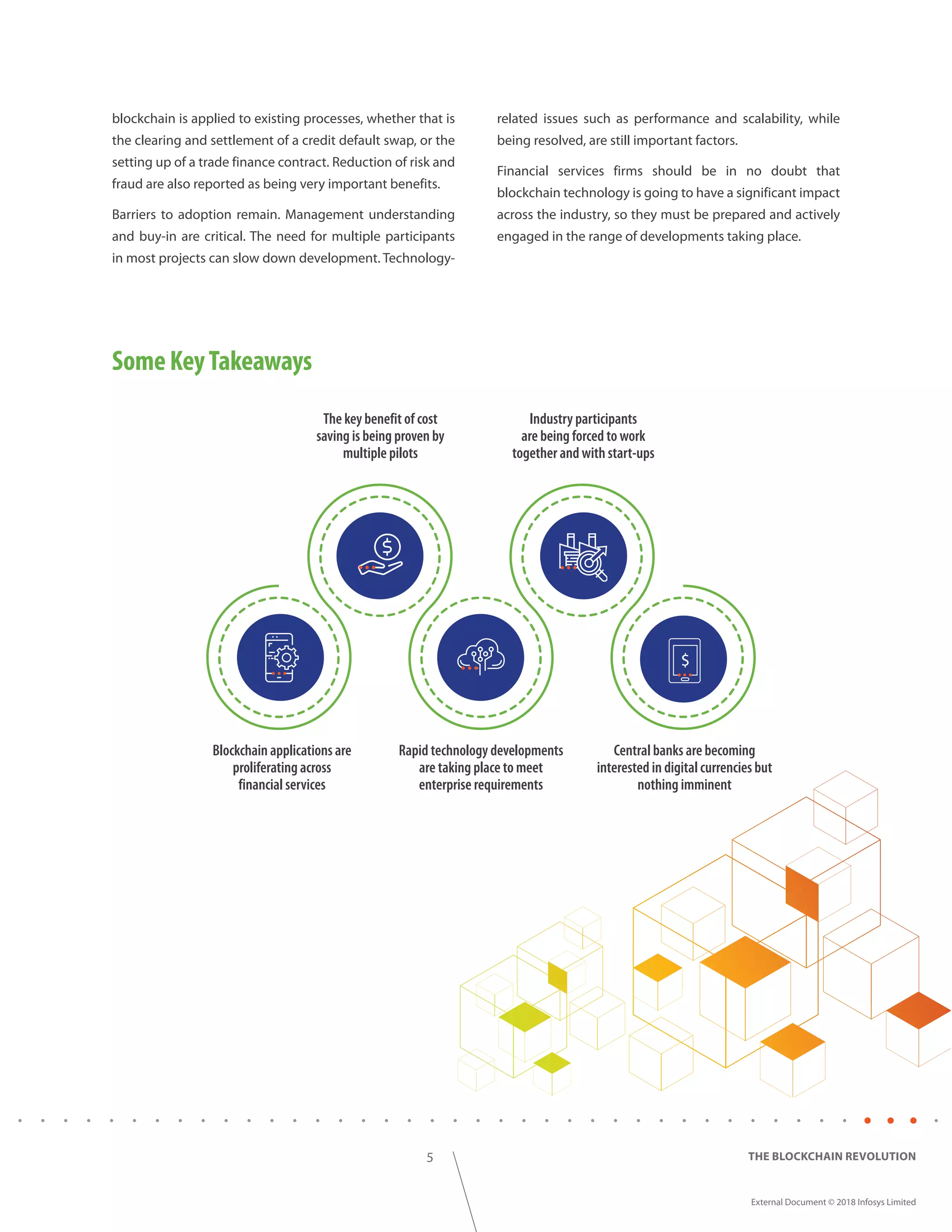
SomeKeyTakeaways
Blockchain applications are
proliferating across
financial services
Rapid technology developments
are taking place to meet
enterprise requirements
The key benefit of cost
saving is being proven by
multiple pilots
Industry participants
are being forced to work
together and with start-ups
Central banks are becoming
interested in digital currencies but
nothing imminent
6
External Document © 2018 Infosys Limited
THE BLOCKCHAIN REVOLUTION
7
External Document © 2018 Infosys Limited
THE BLOCKCHAIN REVOLUTION
Two months after the collapse of Lehman Brothers in October 2008, an event which triggered the global financial crisis, a
whitepaper was released by Satoshi Nakomoto explaining the concept for a new type of electronic cash. It is worthwhile
reminding ourselves of what this concept was. According to the Bitcoin whitepaperi
:
This was a simple concept which relied on complex mathematics and behavioural dynamics to make it work. Less than 10
years later, the Bitcoin currency had grown to a market valuation of over US$200bn (as of the end of 2017); the technology
and concept behind Bitcoin, given the name‘blockchain’, has become one of the most important technological developments
since the establishment of the Internet. The term‘distributed ledger technology’is also sometimes used instead of blockchain.
Industries of all kinds are finding applications for blockchain, but the impact on financial services is likely to be particularly
high. According to Deutsche Bank Wealth Managementii
:
“A purely peer-to-peer version of electronic cash would allow online payments to be sent
directly from one party to another without going through a financial institution. Digital
signatures provide part of the solution, but the main benefits are lost if a trusted third party
is still required to prevent double-spending. We propose a solution to the double-spending
problem using a peer-to-peer network. The network time stamps transactions by hashing
them into an ongoing chain of hash-based proof-of-work, forming a record that cannot be
changed without redoing the proof-of-work.”
“Blockchains and connected cryptocurrencies are probably the inventions
with the most disruptive character for the finance sector and the public since
the invention of the internet. Blockchain has the potential to revolutionize
industries from the bottom-up and also to create new business models...”
INTRODUCTION
8
External Document © 2018 Infosys Limited
THE BLOCKCHAIN REVOLUTION
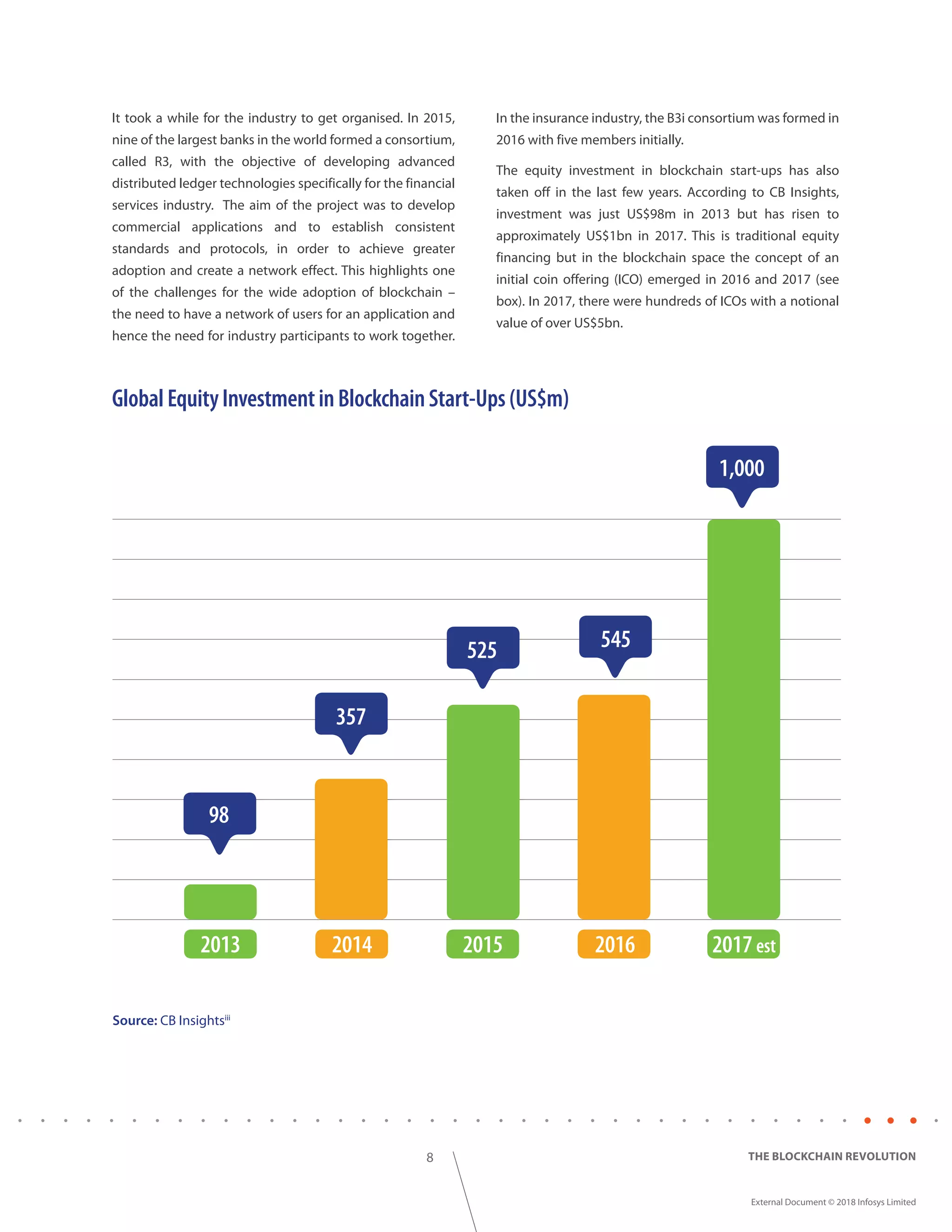
GlobalEquityInvestmentinBlockchainStart-Ups(US$m)
It took a while for the industry to get organised. In 2015,
nine of the largest banks in the world formed a consortium,
called R3, with the objective of developing advanced
distributed ledger technologies specifically for the financial
services industry. The aim of the project was to develop
commercial applications and to establish consistent
standards and protocols, in order to achieve greater
adoption and create a network effect. This highlights one
of the challenges for the wide adoption of blockchain –
the need to have a network of users for an application and
hence the need for industry participants to work together.
In the insurance industry, the B3i consortium was formed in
2016 with five members initially.
The equity investment in blockchain start-ups has also
taken off in the last few years. According to CB Insights,
investment was just US$98m in 2013 but has risen to
approximately US$1bn in 2017. This is traditional equity
financing but in the blockchain space the concept of an
initial coin offering (ICO) emerged in 2016 and 2017 (see
box). In 2017, there were hundreds of ICOs with a notional
value of over US$5bn.
98
2013 2014 2015 2016 2017est
357
525 545
1,000
Source: CB Insightsiii
9
External Document © 2018 Infosys Limited
THE BLOCKCHAIN REVOLUTION
It is essential for established industry players to work with
start-ups in the blockchain space because of the range of
innovations taking place across the ecosystem. Some banks
have been active investors in blockchain start-ups as they
seek to learn how to benefit from the new technologies.
Citi has been the most active investor. It has invested
in companies with which it is also working on specific
projects. Citi’s investments indicate a particular interest in
capital markets and payments solutions:
R3: Originally set up as a consortium of banks, R3 is now
an independent company with investment from many of its
members. It now describes itself as an enterprise software
firm which is developing Corda, a distributed ledger
platform designed specifically for financial services.
Digital Asset: A group which describes itself as
the leading provider of distributed ledger technology
to regulated financial institutions and is the owner of
Hyperledger. A key project is the implementation of
blockchain with the Australian Stock Exchange for post-
trade settlement.
Axoni: Product offerings include distributed ledger
technology deployments, bespoke smart contract
development and analytics tools. Axoni has completed
a successful pilot for the management of equity
swap contracts with banks like Citi, JP Morgan and
Goldman Sachs.
The impact of blockchain on financial services is likely to be
significant although the timing of that impact is somewhat
uncertain. According to Dan Tapscottiv
, in an interview
with the McKinsey Quarterly in 2016, “the blockchain is
the biggest innovation in computer science…and the
financial services industry is up for serious disruption or
transformation, depending on how it approaches this issue.”
However, Marco Iansiti and Karim R. Lakhani, writing in
the Harvard Business Reviewv
, argued that blockchain
is a “foundational” and not a “disruptive” technology
and that blockchain-led transformation of business is
still many years way. According to Iansiti and Lakhani,
“The process of adoption will be gradual and steady, not
sudden, as waves of technological and institutional change
gain momentum.”
What is an initial coin offering?
An initial coin offering (ICO) involves the issuance of a new coin or token in exchange for fiat currency
or other coins, in order to finance a new venture. It is a form of crowdfunding but rather than receiving
shares in the company the investors receive coins. On completion of the ICO, the coins will most likely
be tradeable on cryptocurrency exchanges. Typically, the new coins will have some economic rights
attached such as a share in the revenues of the business once it is operational. ICOs do not have the same
regulatory requirements as a normal issuance of shares to investors, although regulators are considering
how they should be controlled. In some jurisdictions they have already been banned. Another advantage
for the issuer is that no fees are required to be paid to intermediaries for raising capital.
Cobalt: Offers a private peer-to-peer network that
significantlyreducespost-tradecostsandriskforinstitutions
operating in the FX markets. The system is being tested by
several banks and traders in the UK, including Citi.
Chain: A technology company that partners with
organizations to build, deploy, and operate blockchain
networks. Developer of the open source Chain Protocol,
which powers the Chain Core blockchain platform.
Working with Visa on a system for high value payments
for corporates.
10
External Document © 2018 Infosys Limited
THE BLOCKCHAIN REVOLUTION
In this report we will describe how blockchain works, and
some of the different technological developments which
are taking place to make blockchain applications possible
in the financial services industry. We will then explain some
of the developments in cryptocurrencies and how this
might impact the industry as central banks become more
involved in potential digital currency opportunities.
There have been a large number of pilot developments of
blockchain applications in the last two years. We will review
a number of the use cases across banking, capital markets,
insurance and asset management industries, focusing on
applications which have gone live or are likely to go live in
the near future. Our report will also set out the main benefits
of blockchain for the industry and the main challenges for
implementing blockchain applications.
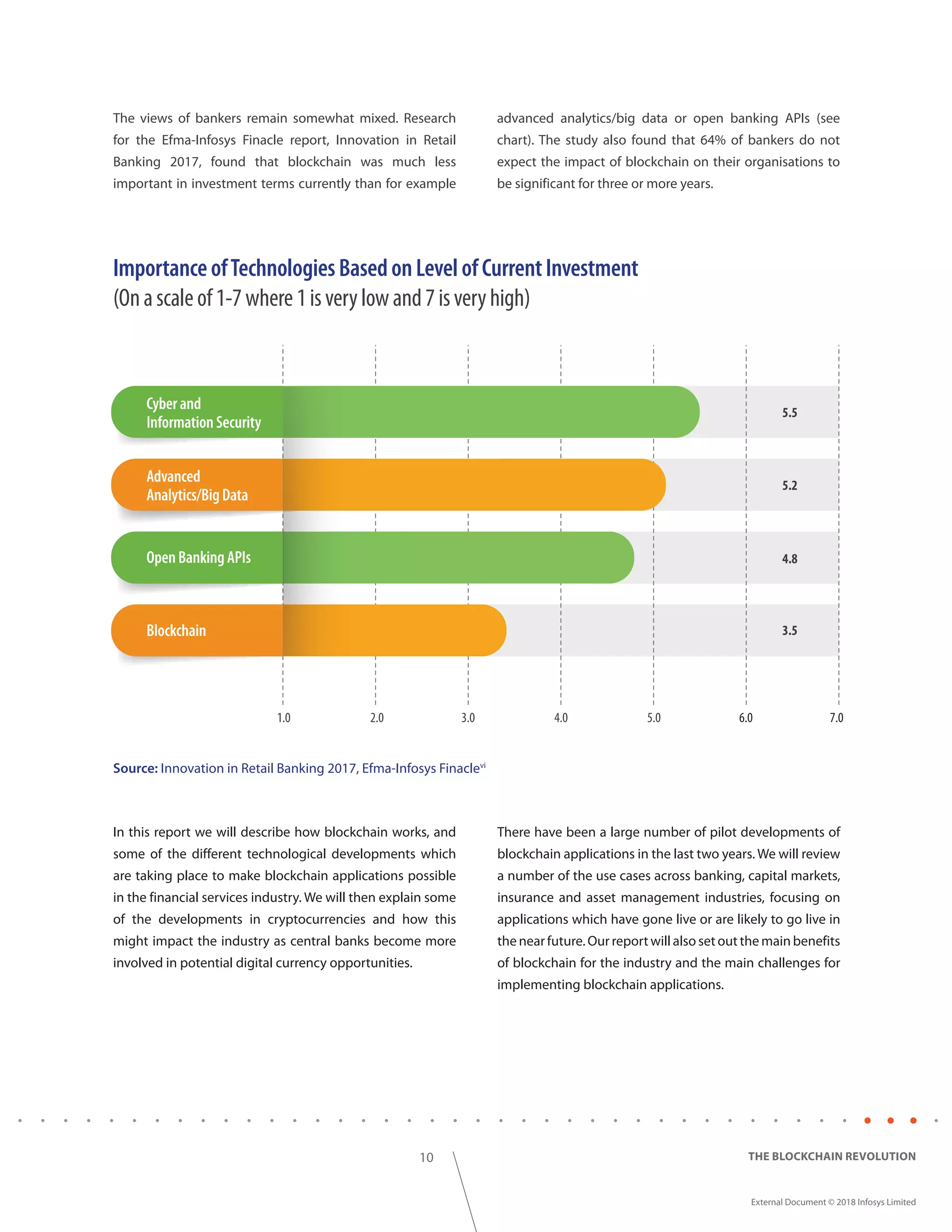
Source: Innovation in Retail Banking 2017, Efma-Infosys Finaclevi
1.0 2.0 3.0 4.0 5.0 6.0 7.0
3.5
4.8
5.2
5.5
Cyberand
InformationSecurity
Advanced
Analytics/BigData
OpenBankingAPIs
Blockchain
ImportanceofTechnologiesBasedonLevelofCurrentInvestment
(Onascaleof1-7where1isverylowand7isveryhigh)
The views of bankers remain somewhat mixed. Research
for the Efma-Infosys Finacle report, Innovation in Retail
Banking 2017, found that blockchain was much less
important in investment terms currently than for example
advanced analytics/big data or open banking APIs (see
chart). The study also found that 64% of bankers do not
expect the impact of blockchain on their organisations to
be significant for three or more years.
11
External Document © 2018 Infosys Limited
THE BLOCKCHAIN REVOLUTION
HOW BLOCKCHAIN WORKS
The term blockchain has been adopted to describe a
network platform which is based on a distributed ledger,
uses cryptography to secure the ledger and the transactions
in it, and relies on the consensus between participants in
the network to validate transactions before they are entered
In the Bitcoin blockchain, proposed transactions are
communicated across the network and, if approved by
consensus, are added to a block of transactions. The block
is then secured by one of the so-called “miners” on the
network solving a mathematical puzzle, for which they are
rewarded in Bitcoin. The reward provides the incentive for
the participants on the network to continue working on
verifying transactions and securing the blocks. As part of
the securing mechanism, each new block is linked to the
previous block in a way that cannot be tampered with. The
in the ledger. The ledger is designed to be append only
and cannot be amended. A permissionless network is one
where anyone can join the network, whereas a so-called
permissioned network is one which limits participation to
selected parties.
secured block is added to the distributed ledger. Hence, a
chain of blocks, or blockchain, is created.
The Bitcoin cryptocurrency was the first blockchain
developed. As described earlier it was set up as a peer-to-
peer network for electronic cash. Bitcoin was followed by
the second most significant development in blockchain
technology, called Ethereum. This is also a decentralized
blockchain platform and was launched in 2015 by the
Ethereum Foundation. The key difference of the Bitcoin
Distributed
Ledger
ConsensusCryptography
Blockchain is a database
that is shared and
synchronized across
multiple parties on
a network without
using a central party
and proliferates across
financial services
Techniques for secure
communication,
preventing third parties
from altering the blocks
in a blockchain once the
block has been secured.
A mechanism for parties
on a network to agree
on appending new
transactions and blocks to
the distributed ledger.
12
External Document © 2018 Infosys Limited
THE BLOCKCHAIN REVOLUTION
platform is that Ethereum allows for smart contracts (see
box) to be implemented on the distributed ledger.
Ethereum is also set up so that applications can be built
on top of it. These apps (referred to as DApps) run on the
Ethereum blockchain and include anything from games to
job platforms. Examples of financial services apps built on
Ethereum are Smartex (for transacting in digital currencies)
and Melonport (a portal for asset management).
The problems for financial services companies with the
public blockchains of Bitcoin and Ethereum have been
identified primarily as:
• Permission and governance
• Privacy and transparency
• Performance and throughput
The Bitcoin and Ethereum blockchains are described as
permissionless, meaning that any participant can join the
network, and then has access to the whole distributed
ledger and the transactions taking place. It is clear that for
an application like Real-Time Gross Settlement (RTGS) in
the financial system (see the example from Singapore on
Page 16), the central bank needs to provide a governance
framework for the participants even if it no longer has to act
as the infrastructure operator.
On a public blockchain, the identities of transactors are
protected by the use of public key encryption (PKI) but
this is not a sufficient level of privacy for many business
applications. The fact that certain transactions are taking
place can be identified. Again, private or “permissioned”
blockchainis neededinmanyfinancialservicesapplications.
At the same time, regulators may need transparency over
the transactions.
Both Bitcoin and Ethereum networks consume significant
amounts of power to operate. According to one sourcevii
,
in January 2018, the Bitcoin network was consuming
more power than New Zealand, and Ethereum was not
far behind. Developers are working on solutions to this
problem because the current situation is not sustainable as
the blockchain grows exponentially.
Performance is one of the other big issues for business.
According to Vitalik Buterin, the founder of Ethereum,
who wrote in January 2018: “The Ethereum community,
key developers and researchers and others have always
recognized scalability as perhaps the single most
important key technical challenge that needs to be solved
for blockchain applications to reach mass adoption.
Blockchain scalability is difficult primarily because a typical
blockchain design requires every node in the network to
process every transaction, which limits the transaction
processing capacity of the entire system to the capacity of
a single node.”
Consequently, developments have taken place, either
building on Ethereum or with new blockchain protocols, to
create solutions which are more applicable in the industry.
These include, amongst others, Quorum, Hyperledger
Fabric, Corda and xCurrent (see table below). Each of these
will have pros and cons for specific types of applications.
One of the objectives of the RTGS pilot in Singapore was
to make comparisons between different blockchainsix
. The
evaluation covered privacy, scalability and performance,
resiliency and finality.
What is a smart contract?
The term smart contract was coined by computer scientist Nick Szabo in 1994, who defined it as a set
of promises, specified in digital form, including protocols within which the parties deliver on these
promises. In the context of blockchain, smart contracts are written into the blockchain as a transaction
between parties and are immutable. The Ethereum blockchain, amongst others, has been designed
to allow the use of smart contracts and defines them as“applications that run exactly as programmed
without any possibility of downtime, censorship, fraud or third-party interference”viii
13
External Document © 2018 Infosys Limited
THE BLOCKCHAIN REVOLUTION
“Ethereum’s intrinsically trusted system is the most promising solution for
enterprise blockchain adoption, given its maturity and multi-purpose design.
Privacy and performance improvements will be mandatory to achieve enterprise-
ready status and will be the focus of Enterprise Ethereum’s roadmap.”
ExamplesofDevelopmentsinBlockchainTechnologyfortheFinancialServicesIndustry
One of the current challenges facing the development
of multiple blockchains is that of interoperability. COMIT
(Cryptographically-secure Off-chain Multi-asset Instant
Transaction network) is an example of a solution to the
problem. COMIT enables instant transactions using
Quorum
(JPMorganetal)
Corda(R3)
HyperledgerFabric
(Hyperledger)
xCurrent(Ripple)
Quorum is a distributed ledger protocol for the financial services industry which allows for the privacy of transactions and
contracts. It is based on the Ethereum blockchain and is described as a‘minimalistic fork’. Hence it leverages the substantial work
of the Ethereum developer community but is an enterprise-focused version of Ethereum. It is ideal for any application requiring
high speed and high throughput processing of private transactions within a permissioned group of known participants.
Hyperledger is an open source solution which was developed for use in multiple industries.The Linux Foundation
hosts Hyperledger as a Collaborative Project. Hyperledger Fabric is one of the Hyperledger projects hosted byThe Linux
Foundation.The objective was to create solutions incorporating smart contracts, using a modular architecture, so that these
solutions could be‘plug-and-play’.
Ripple describes itself as an enterprise blockchain company which is specifically focused on the global payments industry.
xCurrent is Ripple’s enterprise software solution and makes possible instant settlement of cross-border payments. Using xCurrent,
banks can use real-time messages to confirm payment details and then initiate and settle transactions. xCurrent is based on a
rulebook which was developed with the support of the RippleNet Advisory Board (a network of banks and payment providers).
Corda is an enterprise-grade distributed ledger technology solution. It can be built on by third party providers who can then
operate applications (CorDapps) using the platform’s common code and protocols to ensure interoperability. Corda has been
developed by R3.The network of companies working with R3 to develop CorDapps has grown to over 60 and represent many
different industries and regions.
off-chain smart contracts which solves the problem of
double spending attacks. The system depends on liquidity
providers who act as payment hubs and nodes, and as
market-makersxi
Another important development has been the
establishment of the Enterprise Ethereum Alliance (EEA).
The EEA connects large companies, start-ups, academics
and technology vendors to learn from, and build on, the
Ethereum blockchain, and to define enterprise-grade
software capable of handling complex, demanding
business applications. According to the EEA,x
14
External Document © 2018 Infosys Limited
THE BLOCKCHAIN REVOLUTION
Distributed
Ledger
Source: CoinMarketCap
* Bitcoin Cash is a split from the original Bitcoin currency, allowing a larger block size with the objective of speeding up
transactions. The split is described as a‘hard fork’.
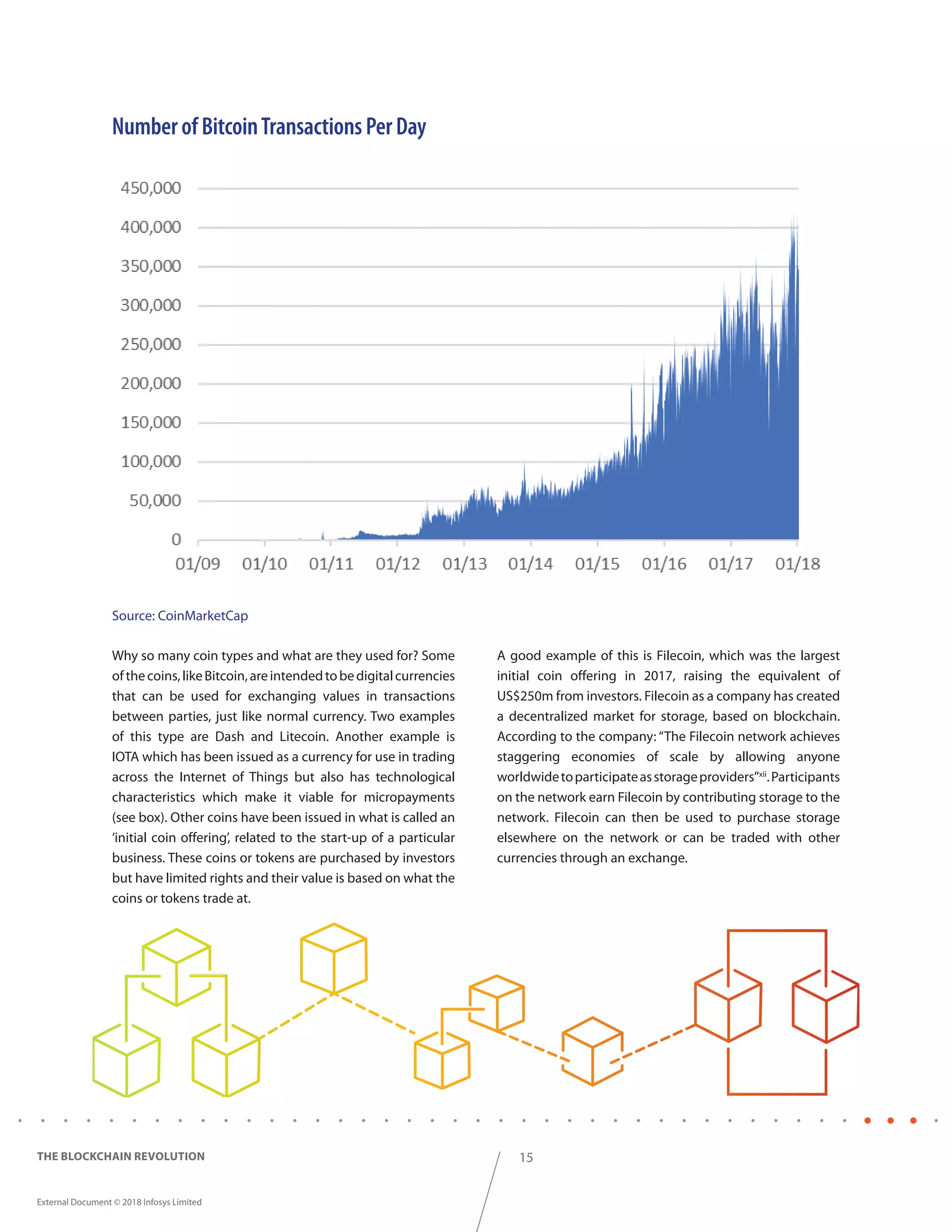
Number of Bitcoin Transactions Per Day Source: CoinMarketCap
Cryptocurrencies with the Highest MarketValue as of 12th February 2018
CRYPTOCURRENCIES AND THE BLOCKCHAIN
The Bitcoin cryptocurrency was the first blockchain
application to have been developed. As of the end of 2017,
there were over 1,400 cryptocurrencies in circulation, with
a total market value, in US dollar terms, of over US$500bn.
The currencies with the highest total market value, as of
February 2018, are shown in the table below but note that
these values are extremely volatile.
Bitcoin was set up in 2009, and at the end of 2009 there
were around 150 Bitcoin transactions per day. In December
2017, the average number of transactions per day was
over 300,000 and the market value of Bitcoin in circulation
reached over US$200bn.
TotalMarketValue
($bn)
Bitcoin 148 708,000
Ripple 43 290,000
Cardano 10 32,000
Ethereum 85 263,000
BitcoinCash 22 57,000
TransactionsPerDay
(Approximate)
15
External Document © 2018 Infosys Limited
THE BLOCKCHAIN REVOLUTION
Why so many coin types and what are they used for? Some
ofthecoins,likeBitcoin,areintendedtobedigitalcurrencies
that can be used for exchanging values in transactions
between parties, just like normal currency. Two examples
of this type are Dash and Litecoin. Another example is
IOTA which has been issued as a currency for use in trading
across the Internet of Things but also has technological
characteristics which make it viable for micropayments
(see box). Other coins have been issued in what is called an
‘initial coin offering’, related to the start-up of a particular
business. These coins or tokens are purchased by investors
but have limited rights and their value is based on what the
coins or tokens trade at.
Source: CoinMarketCap
A good example of this is Filecoin, which was the largest
initial coin offering in 2017, raising the equivalent of
US$250m from investors. Filecoin as a company has created
a decentralized market for storage, based on blockchain.
According to the company: “The Filecoin network achieves
staggering economies of scale by allowing anyone
worldwidetoparticipateasstorageproviders”xii
.Participants
on the network earn Filecoin by contributing storage to the
network. Filecoin can then be used to purchase storage
elsewhere on the network or can be traded with other
currencies through an exchange.
NumberofBitcoinTransactionsPerDay
16
External Document © 2018 Infosys Limited
THE BLOCKCHAIN REVOLUTION
IOTA and the Internet of Things
IOTA is described as a cryptocurrency for the Internet of Things (IoT) industry. IOTA enables micropayment
transactions at virtually no cost, and hence opens up a range of potential new applications. The main
feature of this cryptocurrency is the tangle, a directed acyclic graph (DAG) for storing transactions. The
tangle differs from a blockchain structure and offers features that are required to establish a machine-to-
machine micropayment system. At its core, the tangle has the same underlying principles as blockchain:
it is still a distributed database on a peer-to-peer network, and it too relies on a consensus and validation
mechanism. However, in IOTA there are no‘blocks’in the classical sense.
There were around 800 ICOs in 2017, raising approximately
US$5bn. This was far more than was invested in blockchain
start-ups using traditional investment structures.
Regulators have become very concerned about ICOs and
in some countries they are now banned. Experienced and
successful investors are highly sceptical of the value of
any cryptocurrency. Speaking on CNBC in January 2018,
Warren Buffet said:“In terms of cryptocurrencies, generally,
I can say with almost certainty that they will come to a bad
ending. When it happens or how or anything else, I don’t
know. If I could buy a five-year put on every one of the
cryptocurrencies, I’d be glad to do it.”
There is a risk that a collapse in the value of cryptocurrencies
might disrupt the blockchain ecosystem. This could
happen if the development community is impacted
and if start-ups which are funded by ICOs are unable to
operate normally. However, we expect any disruption to be
temporary, and the work on the underlying blockchain and
distributed technologies for use in enterprise applications
will continue.
We are some way from seeing cryptocurrencies being
widely used, instead of normal currencies, for
buying everyday products and services. This is possible
in some situations with currencies like Bitcoin, but
adoption has been limited. Companies such as
Expedia and Microsoft accept payment in Bitcoin
for selected services. In Switzerland, the national
railway and some local municipalities accept payment
in Bitcoin.
Central banks, including the Bank of England and the
Bank of Canada, have considered the possibility of issuing
a digital currency for general use. However, there are no
immediate plans to do so for a range of reasons. According
to the Bank of England: “A Central Bank Digital Currency
(CBDC) may introduce additional risks to stability by making
it easier for customers of commercial banks to switch from
deposits – even those protected by the Financial Services
Compensation Scheme – to an asset that is perceived
to be completely risk-free (money at the central bank).
Consequently, if a significant proportion of consumers
moved to a CBDC, this may reduce the liquidity, funding
and credit provision of commercial banks. These potential
impacts, which could fundamentally change the structure
of the financial system, must be weighed against any
benefits for financial stability.”xiii
This is not to be confused with the use of a central bank
digital currency for real-time gross settlement (RTGS),
something which the Monetary Authority of Singapore
has been experimenting with. In November 2017, the
MAS announced the results of a pilot programme which
involved testing the use of a digital currency for RTGS on
three different blockchain platforms: Corda, Hyperledger
Fabric and Quorum. This has provided the most significant
comparison to date of the different technologies, and the
implications for a core activity like RTGS in the financial
system. The pilot was considered a success in terms of
learning. However, no immediate plans were announced to
take this pilot forward in Singapore.
17
External Document © 2018 Infosys Limited
THE BLOCKCHAIN REVOLUTION
The range of applications of blockchain in financial services
is growing all the time. Across banking, capital markets,
insurance and asset management there are numerous
APPLICATIONS OF BLOCKCHAIN IN
FINANCIAL SERVICES
pilots in progress and more and more solutions going live.
Some of the services which are already in operation, or are
planned to launch in 2018, are highlighted in the box below.
SomeoftheBlockchainSolutionsLiveorGoingLivein2018
Payments
Credit Default Swaps
Investment Funds
Reinsurance
Ripple and three banks went live in 2017 with a
cross-border payments service for corporate payments
and retail remittances.
The B3i consortium will go live in 2018 with a
blockchain solution for Property Catastrophe Excess of
Loss reinsurance contracts.
The Depository Trust and Clearing Corporation will
implement a blockchain solution for credit default
swap settlement in 2018.
The IZNES blockchain platform for fund
administration, developed by SETL and four asset
management firms, went live in January 2018.
18
External Document © 2018 Infosys Limited
THE BLOCKCHAIN REVOLUTION
There are two types of solutions which are coming into
operation and we have set out examples from across
the industry below. The first type is the application of
blockchain by existing industry participants to re-engineer
an existing service or process, such as cross-border
payments. The second is the launch by new competitors in
the market of services based on blockchain solutions, often
funded by an initial coin offering and linked to the use of
cryptocurrencies.
The re-engineering of existing services or processes is
mostly being done by consortia of industry participants:
banks, insurers or asset managers. Examples from the
banking and insurance industry are the R3 and B3i
consortia. R3 was formed in September 2015, with an
initial with nine members. By the end of 2016 there
were over 70 members and by the end of 2017 there
were over 100 members including regulators, trade
associations, professional services firms and technology
companies. R3 and B3i are formal consortia which are set
up as independent companies and, in the case of R3, now
financed by an equity issue. Other groups, such as the asset
managers working with SETL on the fund administration
platform IZNES (see below) are informally working together
on specific solutions.
Banking
Payments
Ripple
In November 2017, Standard Chartered, Axis Bank and
RAKBANK, announced the commercial launch of a cross-
border payments service using RippleNet. The banks will
use Ripple’s blockchain solution: for real-time, on-demand
corporate payments from Standard Chartered to Axis
Bank; and for retail remittance payments from RAKBANK
to Axis Bank beneficiaries. According to Gautam Jain,
global head of digitisation and client access, transaction
banking at Standard Chartered: “The successful launch
of our commercial cross-border payment service marks a
significant milestone in the financial industry’s progress in
applying distributed ledger technology for corporates.”xiv
Tradefinance
FinacleTrade Connect
The Infosys subsidiary, EdgeVerve Systems, announced
the launch of Finacle Trade Connect in November 2017
following testing with Emirates NBD and ICICI Bank. There
were 11 banks on the network at launch. The solution is
based on the EdgeVerve Blockchain Framework, which
is a permissioned distributed ledger that makes it easier
and quicker for banks to implement blockchain solutions.
The framework is ledger agnostic, so it can work with
leading blockchain platforms such as Bitcoin, Hyperledger,
Ethereum and Corda. According to Infosys: “The solution
allows for a single source of truth, increases trust and
provides a shared picture of granular trades enabling
efficient risk management. It enables higher automation
and increases transparency with real-time availability
of data.xv
Clearingandsettlement
Clearmatics
The Utility Settlement Coin (USC) project began as a joint
enterprise between UBS and Clearmatics Technologies in
late 2015. The USC is described by Clearmatics as an asset-
backed digital cash instrument using distributed ledger
technology and is designed for settlement activities in
global institutional financial markets. The USC is in fact a
series of cash assets, one for each major currency, each of
which can be converted at parity with a bank deposit in the
corresponding currency. The USC is fully backed by cash
which is held at a central bank. Several other major banks
joined the project in the second and third phases including
Santander, Deutsche Bank, Barclays and MUFG, among
others. The third phase is expected to be completed in
2018, following which the operations will go live.
19
External Document © 2018 Infosys Limited
THE BLOCKCHAIN REVOLUTION
CapitalMarkets
Clearingandsettlement
R3/IBM/Axoni
The Depositary Trust and Clearing Corporation (DTCC)
started work with IBM, Axoni and R3, aiming to go live by
the end of 2018 with a blockchain solution for the post-
trade processing of derivatives such as credit default
swaps. The solution will reduce the cost of derivatives
processing across the industry by removing disjointed and
redundant processing capabilities. It has been developed
with the support of various market participants and market
infrastructure providers. According to the DTCC: “The
solution will be deployed in phases, with an end-state vision
to establish a permissioned distributed ledger network for
derivatives, governed by industry-owned DTCC, with peer
nodes at participating firms.”xvi
Trading
Commodity Trading Consortium
A new independent entity, Commodity Trading
Consortium, which is backed by ING, ABN Amro, Société
Générale and various oil businesses, will go live by the end
of 2018 with a blockchain commodity trading solution.
The new blockchain platform will manage physical energy
transactions from end-to-end. This will mean digitising
the process and moving away from paper processes. The
solution is based on an experiment carried out in 2016 and
2017 by ING and others. In the experiment, the average
time for the bank in a transaction went from three hours
to 25 minutesxvii
. The efficiency of traders went up by 33%
and user experience evaluations were much higher than
expected. The risks throughout the process were also
reportedly much reduced.
Syndicatedlending
R3 (Fusion LenderComm)
R3 is developing a blockchain powered marketplace for
syndicated loans with seven global banks including BNP
Paribas, HSBC, ING, BNY Mellon and State Street. A pilot
has already been successfully completed and the platform
will cover 10% of the syndicated loan market when it goes
live next year. The objective of the new platform is to drive
transparency and efficiency in the syndicated loan market
by improving the way data is shared between agents and
lenders. According to ING: “The initial focus is to automate
the predominantly manual process of information sharing
andtoofferbetterinsightindealdata.Furtheralongtheline,
Fusion LenderComm will ensure an increase in speed and
cost reductions which may lead to smaller participations
in syndicated deals and new investment opportunities for
our clients.”xviii
Insurance
Reinsurance
B3i
In September 2017, B3i launched the market beta-testing of
a reinsurance blockchain prototype. The prototype covered
the core functionalities required to enable a distributed
smart contract management system for Property Cat XoL
(Property Catastrophe Excess of Loss) contracts. The plan
is for a first deployment into production in late 2018. The
market testing phase was carried out in October 2017
with 38 participants, each one able to act as an insurer,
broker or reinsurer on the network. A total of 885 contracts
were created and tested against 288 loss events, with 338
claims. The network was run on Hyperledger Fabric as its
distributed ledger technology platform and was deployed
across nine virtual machines on a cloud environment.
20
External Document © 2018 Infosys Limited
THE BLOCKCHAIN REVOLUTION
Marineinsurance
EY/Guardtime
In September 2017, EY and Guardtime announced the
launch of a blockchain platform for the marine insurance
sector. The platform was launched, after a proof of concept,
with A.P. Møller-Maersk A/S, ACORD, Microsoft, MS Amlin,
Willis Towers Watson and XL Catlin. According to EY: “The
platform can create and maintain asset data from multiple
parties; can link data to policy contracts; to receive and
act upon information that results in a pricing or a business
process change; to connect client assets, transactions and
payments; and to capture and validate up-to-date first
notification of data loss.”xix
The application runs on the KSI
(Keyless Signature Infrastructure) blockchain developed
by Guardtime.
Coverageverification
RiskBlock Alliance
The Institutes RiskBlock Alliance is an industry consortium
of insurance companies in the United States. In December
2017, RiskBlock announced the launch of a blockchain
solution for auto insurance coverage verification with
Nationwide, a leading insurer. The RiskBlock framework
uses blockchain to provide insurers with real-time
verification that insurance coverage is accurate and allows
law enforcement officers to verify proof of insurance
confidently and efficiently, without relying on paper forms.
It also provides insurers with a more efficient, cost-effective
way to offer proof of insurance. In due course, insurers
will be able to share trusted, third-party verified proof of
insurance with their mobile phones.
AssetManagement
Funddistribution
Fundsquare/InTech/KPMG
Fundsquare (a subsidiary of the Luxembourg Stock
Exchange), InTech (a subsidiary of POST Group) and KPMG
Luxembourg have collaborated to form FundsDLT. The
FundsDLT blockchain platform will allow asset managers to
sell funds through a new distribution channel, and at the
same time significantly reduce administration costs and
processing times. The platform can be applied to a wide
range of funds across different jurisdictions. According to
Natixis, one of the asset managers involved in the project:
“The successful execution means that, for the first time in
the fund industry, investors are using a blockchain based
platform to purchase real funds’shares with real cash.”xx
Marketdata
Symbiont
In December 2017, Vanguard announced the success of
an initial pilot for index data distribution using blockchain.
Vanguard worked with the Center for Research in Security
Prices and technology provider Symbiont for the pilot. In
the project, index data moved between index providers
and market participants over a decentralized database
instantaneously. Index data transmission is essential to
many operations for market participants but relies on
multiple parties and distribution channels. According to
Vanguard, by using the blockchain platform, “investment
managers will be able to instantly distribute, receive, and
process index data, resulting in better benchmark tracking
and significant cost savings”.xxi
21
External Document © 2018 Infosys Limited
THE BLOCKCHAIN REVOLUTION
Fundadministration
SETL
SETL, a UK based blockchain start-up, and four asset
management firms launched the IZNES platform in
September 2017 and went live in January 2018. The
platform developed by SETL is a proprietary, permissioned
blockchain called OpenCSD. It gives easy and quick access
to fund units for investors, asset managers, distributors and
wealth management advisers. The platform can manage
KYC processes, deal with subscriptions and redemptions,
settle transactions and record positions. According to SETL:
“Compatible with all distribution channels, IZNES reduces
transaction costs, increases transparency, and optimises
operational workflow. It will also enable new value-added
services to be developed.“xxii
OtherServices
Identitymanagement
Secure Key
Secure Key is building a digital identity and attribute
sharing network in Canada, backed by Canada’s major
banks (including CIBC, BMO, RBC, Scotiabank, Toronto
Dominion, National Bank and Desjardins). When
Verified.me is launched, customers will be able to use the
service via a mobile app, which will leverage the
trusted digital credentials they have with the bank
or any other partner of their choice. Other parties include
telecommunications companies, healthcare companies,
government et al-all working together in a collaborative
way to deliver a valuable digital identity service for
Canadians. The network is based on IBM’s blockchain
service, which itself uses Linux Foundation’s open source
Hyperledger Fabric.
KYC/AML
IMDA
In October 2017, three major banks and the Infocomm
Media Development Authority of Singapore (IMDA)
finished a successful pilot project for KYC using a blockchain
platform. The platform enables KYC information to be
recorded, accessed and shared on a distributed ledger and
it enables banks to collect, validate and share customer
information (with the customer’s consent) accurately,
efficiently and in a secure manner. The benefits include
reducing duplication of information and manual checks,
whilst also improving the quality of information being
stored. Information is encrypted on the distributed ledger
and can be easily validated by referring to government
registries, tax authorities and credit bureaus. Banks can
also store secured digital records of the validation process
on the shared KYC platform to streamline auditing and
regulatory reporting.xxiii
Start-upswithNewServices
Payments
TenX
TenX, a Singapore based company, is developing a debit
card and mobile wallet which allows users to pay with
cryptocurrencies, making the conversion to fiat currencies
at the point of transaction. The company graduated from
PayPal’s incubator in Singapore and has arrangements
with major card processing companies worldwide. Initially
limited to Bitcoin, Ether and Dash, the intention is to allow a
wide range of cryptocurrencies to be used on the platform.
To fund the development, an ICO was completed in June
2017 raising around US$80m. As of January 2018, the
PAY token which was issued in the ICO had a total market
value of around US$400m. Owners of the PAY tokens will
get a share of transaction revenue from TenX in exchange
for their investment. The interoperability of TenX across
cryptocurrencies is done by connecting blockchains,
leveraging on the COMIT network.
22
External Document © 2018 Infosys Limited
THE BLOCKCHAIN REVOLUTION
Financialinclusion
Stellar
Stellar Development Foundation’s (SDF) vision is an open
and affordable financial system where people of all income
levels can access simple-to-use, secure, and low cost
financial services. SDF also aims to empower developers
with useful technology to create financial products and
services for their communities. SDF — also known as
Stellar.org — was incorporated in 2014 as a non-stock, non-
profit corporation in the United States. SDF has no stock,
no profits given to individuals, and no private inurement.
Stellar’s solution is described by the company as: “A
distributed, hybrid blockchain that is fully open-source. It is
infrastructure that exists to facilitate cross-asset transfers of
value, including payments.”xxiv
Digitalbanking
BABB
BABB (Bank Account Based Blockchain) is building a new
bank in the UK based on blockchain technology. The
company launched an ICO in January 2018 to raise US$20m
in a first phase of fund raising. The ambition of BABB is to
offer a UK bank account to anyone in the world in order
to increase financial inclusion. It will be managed via a
mobile app, with access to a payment card. BABB is already
authorised by the FCA as an Authorised Payment Institution
(API) and will be applying for a UK banking licence in 2018.
Smart contracts will be used to operate BABB accounts.
The blockchain is used to store the ledger containing bank
account balances and related transactions. Any fiat funds
will be represented as a token in the blockchain.
23
External Document © 2018 Infosys Limited
THE BLOCKCHAIN REVOLUTION
THE BENEFITS OF BLOCKCHAIN
The biggest immediate benefit from adopting blockchain
technology is a reduction in operating costs. Some studies
have suggested cost savings of up to 30% are possible in
certain processesxxvi
.This may be ambitious but many of the
pilot projects that have been completed have announced
that significant savings are being achieved, for example:
Blockchain technology has wide application across the financial services industry as we have seen from the case examples in
the preceding section. Typically, the benefits will be greatest where there is a need forxxv
:
The DTCC project for the
settlement of credit default
swaps has reported savings
of 20-30%
The B3i project for
reinsurance contracts has
reported productivity gains
of up to 30%
The Commodity Trading
Consortium project
reported that efficiency
went up 33% for traders
Reconciliation of data across
multiple market participants
Reducing duplication where
businesses retain the same records
Auditability of records for
regulatory purposes or otherwise
Authentication of
counterparties and verification
of transaction origination
24
External Document © 2018 Infosys Limited
THE BLOCKCHAIN REVOLUTION
Comments from A.P. Møller-Maersk on the marine
insurance application illustrate some of the benefits for the
insurance industry:“Insurance transactions are currently far
too tedious and frictional. The distance between risk and
capital is simply too far. Insurers can use this blockchain
platform to improve their capital and gain efficiencies, with
increased transparency and reduced manual data entry or
reconciliation and administration costs.”xxvii
The potential for cost reduction in a typical financial
transaction, such as in micropayments, also opens up the
possibility of completely new business models. We have
seen this in the example of IOTA and the use of blockchain
to conduct transactions across the Internet of Things. Some
applications of blockchain also make it feasible to capture
and use vast amounts of new data.
After cost reduction, the next most important benefit
of blockchain is probably risk and fraud reduction. For
example, the Monetary Authority of Singapore (MAS)
test of distributed ledger technology for real time gross
settlement(RTGS)highlightedthebenefitsofdecentralising
keyfunctionstomitigatetheriskofacentralisedsystem,and
the benefits of cryptographic security and the immutability
of transactions and contracts. However, decentralisation
comes with challenges. According to the MAS: “To achieve
round-the-clock operations and manage multiple nodes
in a cloud environment, rigorous governance, policies and
operating models need to be put in place.”xxviii
Inabroadersense,theapplicationofblockchaintechnology
allows for the digitisation of more processes which has
bigger and longer-term implications for businesses of
all kinds.
Thebarrierstoblockchainadoption
As we have already shown, it took some time, from the
launch of Bitcoin in 2009 to the start of industry efforts
to experiment with blockchain technology in 2015 and
2016. Progress since then has been steady but slow as
most applications have needed to multiple participants to
co-operate and needed to be tested extensively before
going live. The principal barriers to the adoption of
blockchain technology in the financial services industry are:
• Management buy-in and understanding: Like most 	 	
innovations which can have a significant impact on a 	
business, buy-in and support from senior management is
critical for adoption. In the case of blockchain this can be
hampered by a lack of understanding of the technology,
and also perhaps a general distrust of cryptocurrencies
like Bitcoin.
•	 Need for multiple participants: As we have shown in
all of the use cases set out earlier, the implementation
of blockchain applications is mostly being done by
groups of financial services companies, working with
technology providers. Setting up and managing these
projects is a difficult challenge.
•	 Technology related issues: We have already highlighted
some of the challenges that the financial services
industry has with the core blockchain technology
as originally developed for Bitcoin and Ethereum –
including privacy, transparency, speed, scalability,
interoperability, etc. These challenges
are being tackled by a range of industry and
company initiatives.
•	 Return on investment uncertain: While we have
highlighted the early successes in achieving cost
reduction, no-one is yet being transparent about the
cost of development and implementation for blockchain
applications so the return on investment for these
projects is unclear. However, the fact that many pilots are
now going into live mode suggests that a positive return
is expected.
In some applications there are also regulatory challenges.
However, regulators are now fully engaged with
blockchain developments, so we would expect any
obstacles to be gradually be resolved.
In a broader sense, the adoption of blockchain technologies
and cryptocurrencies will be affected in different countries
and regions by a range of factorsxxix
. These include social,
cultural and economic factors. Some countries are showing
more willingness to experiment (e.g. Singapore or Israel).
In other countries there are driving factors like the benefits
of financial inclusion which can play a part in more rapid
adoption. However, there are also governments and
regulators who may find it difficult to accept the concept
of decentralization and peer-to-peer networks which could
slow down development.
25
External Document © 2018 Infosys Limited
THE BLOCKCHAIN REVOLUTION
While there may be some differences of opinion about
how disruptive blockchain technology might be for the
financial services industry, there is no doubt that the impact
will be significant, probably starting in 2018. The range of
applications being implemented illustrate the fact that
most facets of the industry will be affected.
Leading banks, insurers and asset managers have already
participated in multiple pilot projects, joined industry
consortia, and invested in blockchain start-ups. From
a strategic perspective, when you cannot forecast with
certainty, it is important to experiment and keep your
options open.
For financial services companies of all sizes, we
recommend the following steps:
•	 Make sure you are staying abreast of developments in
blockchain, both in terms of technology and in terms of
real world applications
•	 Ensure that senior management are fully up-to-speed on
developments and strategic issues, and carefully monitor
the potential for disruption in your business
•	 Study your business processes to understand which ones
are likely to be impacted by blockchain applications
and prioritise the areas in which you might want to start
working on pilot projects
•	 Explore partnerships with other financial services
companies, technology providers or start-ups in areas of
interest. If you have not done so already, start some
pilot projects
•	 Develop a broad range of internal capabilities around
blockchain technology and complement these with your
external relationships
If you do not already have a strategy for blockchain, you
need to develop one now, 2018 will see a wide range
of applications going live in financial services, across all
regions and business segments. With continuing pressure
on operating costs, blockchain applications present an
opportunity for near term cost savings, as well as longer
term benefits from process redesign and digitisation.
THE WAY FORWARD
26
External Document © 2018 Infosys Limited
THE BLOCKCHAIN REVOLUTION
References
i-“Bitcoin: A Peer-to-Peer Electronic Cash System”, Satoshi Nakomoto, November 2008: https://bitcoin.org/bitcoin.pdf
ii-“Cryptocurrencies and Blockchains”, Deutsche BankWealth Management, CIO Insights, December 2017: https://www.db.com/
newsroom_news/cio_insights_reflections_-_cryptocurrencies_and_blockchains_-_EMEA_-_client_ready.pdf
iii-“Blockchain Investment Trends in Review”, CB Insights, October 2017: https://www.cbinsights.com/research/report/
blockchain-trends-opportunities/
iv-“How Blockchains Could Change the World”, McKinsey  Co, May 2016: https://www.mckinsey.com/industries/high-tech/
our-insights/how-blockchains-could-change-the-world
v-“The Truth About Blockchain”, Marco Iansiti and Karim R. Lakhani, Harvard Business Review, January-February 2017: https://
hbr.org/2017/01/the-truth-about-blockchain
vi-“Innovation in Retail Banking 2017”, Efma - Infosys Finacle, November 2017: http://explore.finacle.com/efma-2017
vii-Digiconomist, https://digiconomist.net/bitcoin-energy-consumption
viii-Ethereum website, https://www.ethereum.org/
ix-“Project Ubin Phase 2 Report”, Monetary Authority of Singapore/The Association of Banks in Singapore, November 2017:
http://www.mas.gov.sg/~/media/ProjectUbin/Project%20Ubin%20Phase%202%20Reimagining%20RTGS.pdf
x-Enterprise Ethereum Alliance website: https://entethalliance.org
xi-COMIT Whitepaper: http://www.comit.network/doc/COMIT%20white%20paper%20v1.0.2.pdf
xii-Filecoin website: https://filecoin.io
xiii-“Digital Future for Sterling: Assessing the Implications”, Bank of England, July 2017: https://www.bankofengland.co.uk/
article/2017/digital-future-for-sterling-assessing-the-implications---article-by-victoria-cleland
xiv-“Ripple-powered Instant Payment Services Now Live with Axis Bank, RAKBANK, and Standard Chartered”, Ripple Press
Release,November2017,Ripple-poweredInstantPaymentServicesNowLivewithAxisBank,RAKBANK,andStandardChartered
xv-“Infosys Finacle Launches Blockchain Based Trade Finance Solution”, Infosys Press Release, November 2017: https://www.
infosys.com/newsroom/press-releases/Pages/finacle-trade-connect-solution.aspx
xvi-“DTCC Selects IBM, AXONI and R3 to Develop DTCC’s Distributed Ledger Solution for Derivatives Processing”, DTCC Press
Release, January 2017: http://www.dtcc.com/news/2017/january/09/dtcc-selects-ibm-axoni-and-r3-to-develop-dtccs-
distributed-ledger-solution
27
External Document © 2018 Infosys Limited
THE BLOCKCHAIN REVOLUTION
xvii-“Easy Trading Connect on the verge of digitalising an age-old sector”, ING Press Release, February 2017: https://www.ing.
com/Newsroom/All-news/Easy-Trading-Connect-on-the-verge-of-digitalising-an-age-old-sector.htm
xviii-“Finastra, R3 and Seven Leading Banks to Create Distributed Ledger Technology Platform for Syndicated Lending
Community”, Finastra Press Release, October 2017: https://www.finastra.com/about/press-releases/finastra-r3-and-seven-
leading-banks-create-distributed-ledger-technology
xix-“EY, Guardtime and industry participants launch the world’s first marine insurance blockchain platform”, EY Press Release,
September 2017: http://www.ey.com/gl/en/newsroom/news-releases/news-ey-guardtime-and-industry-participants-launch-
the-worlds-first-marine-insurance-blockchain-platform
xx-“First Real Blockchain Transaction Completed in Fund Distribution”, Natixis Asset Management Press Release, July 2017:
http://www.nam.natixis.com/en-DE/p/Press/Press-releases/First-real-blockchain-transaction-completed-in-fund-distribution
xxi-“Vanguard Using Blockchain Technology To Improve Index Data Distribution”, Vanguard Press Release, December 2017:
https://pressroom.vanguard.com/news/Press-Release-Vanguard-Using-Blockchain-Technology-To-Improve-Index-Data-
Distribution-121217.html
xxii-“SETL and four asset management firms are launching IZNES, the pan-European fund record-keeping platform based on
blockchain technology”, SETL Press Release, September 2017: https://setl.io/
xxiii-“OCBC Bank, HSB and MUFG, Together with the Infocomm Media Development Authority, Complete Proof-of-Concept
on ASEAN’s First Industry Know Your Customer Blockchain”, OCBC Press Release, October 2017: https://www.ocbc.com/assets/
pdf/media/2017/october/media%20release%20-%20ocbc%20hsbc%20and%20mufg%20together%20with%20imda%20
complete%20proof%20of%20concept%20on%20aseans%20first%20industry%20kyc%20blockchain_web.pdf
xxiv-Stellar Website: https://www.stellar.org/
xxv-“Unblocking the Blockchain: A Global Legal and Regulatory Guide”, Norton Rose Fulbright, July 2016: http://www.
nortonrosefulbright.com/knowledge/publications/141573/unlocking-the-blockchain-a-global-legal-and-regulatory-guide-
chapter-1
xxvi-“Banking on Blockchain: A Value Analysis for Investment Banks”, Accenture/McClagan, January 2017: https://www.
accenture.com/us-en/_acnmedia/Accenture/Conversion-Assets/DotCom/Documents/Global/PDF/Consulting/Accenture-
Banking-on-Blockchain.pdf
xxvii-“EY, Guardtime and industry participants launch the world’s first marine insurance blockchain platform”, EY Press Release,
September 2017: http://www.ey.com/gl/en/newsroom/news-releases/news-ey-guardtime-and-industry-participants-launch-
the-worlds-first-marine-insurance-blockchain-platform
xxviii-“Project Ubin Phase 2 Report”, Monetary Authority of Singapore/The Association of Banks in Singapore, November
2017:http://www.mas.gov.sg/~/media/ProjectUbin/Project%20Ubin%20Phase%202%20Reimagining%20RTGS.pdf
xxix-“Breaking Barriers: Factors impacting large-scale blockchain adoption”, Infosys Viewpoint, October 2017: https://www.
infosys.com/blockchain/Documents/breaking-barriers.pdf
© 2018 Infosys Limited, Bengaluru, India. All Rights Reserved. Infosys believes the information in this document is accurate as of its publication date; such information is subject to change without notice. Infosys
acknowledges the proprietary rights of other companies to the trademarks, product names and such other intellectual property rights mentioned in this document. Except as expressly permitted, neither this
documentation nor any part of it may be reproduced, stored in a retrieval system, or transmitted in any form or by any means, electronic, mechanical, printing, photocopying, recording or otherwise, without the
prior permission of Infosys Limited and/ or any named intellectual property rights holders under this document.
For more information, contact askus@infosys.com
Infosys.com | NYSE: INFY Stay Connected

Blockchain revolution

  • 1.
    www.infosys.com THE BLOCKCHAIN REVOLUTION HOWBLOCKCHAIN AND DISTRIBUTED LEDGER TECHNOLOGY WILL TRANSFORM FINANCIAL SERVICES
  • 2.
    Foreword Executive summary Introduction How blockchainworks Cryptocurrencies and the blockchain Applications of blockchain in financial Services and banking Capital Markets Insurance Asset Management Other services Start-ups with new services The benefits of blockchain The barriers to blockchain adoption The way forward CONTENT 2 External Document © 2018 Infosys Limited THE BLOCKCHAIN REVOLUTION 2 3 5 9 13 16 17 18 19 20 21 22 23 24 25
  • 3.
    3 External Document ©2018 Infosys Limited THE BLOCKCHAIN REVOLUTION Infosys is pleased to be publishing this in-depth report on blockchain, one of the key strategic and technology issues facing financial services firms today. This is the second in a series of reports, in which we will look at critical topics, with a focus on case examples from the industry to highlight the wide range of developments that are taking place. Infosys is ideally placed to contribute to the debate as it works with clients across the world in financial services, helping to deal with their challenges and solve real problems. The report highlights the acceleration in the deployment of blockchain technology across the financial services industry. Leading banks, insurers and asset managers are joining industry consortia, working on multiple projects, and investing in related start-ups. In the short term, blockchain applications can deliver real cost savings. In the longterm,thetechnologycanhaveamoreprofoundimpact on the industry - so having a clear vision of how blockchain technology can benefit an organisation is critical. FOREWORD MohitJoshi President–InfosysLimited Infosys
  • 4.
    4 External Document ©2018 Infosys Limited THE BLOCKCHAIN REVOLUTION Blockchain technology has evolved significantly from the original concept of Bitcoin which was established in 2009. While Bitcoin and other cryptocurrencies get many of the headlines, the application of blockchain across financial services is now advancing steadily. It has taken a while for the industry to get organised. The first major banking consortium set up to explore blockchain applications was R3 in 2015. R3 began with nine members and now has more than 100 members including trade associations and technology firms as well as industry participants. In the insurance industry, it was in 2016 when the B3i consortium was set up by a group of leading insurers. Investment in blockchain start-ups, including by banks and insurers, began to take off in 2014 and, after plateauing to some extent in 2016, picked up again in 2017 reaching approximately US$1bn. Traditional equity financing of new ventures has also been supplemented by a massive surge of investment in initial coin offerings (ICOs) from blockchain start-ups. It is essential for established industry players to work with start-ups in the blockchain space because of the range of innovations taking place across the ecosystem. Media focus on cryptocurrencies has become intense with nearly 1,500 cryptocurrencies in existence (many related to specific ICOs) and with the market value of Bitcoin in circulation reaching over US$200bn at the end of 2017. Central banks have started to research and show interest in the idea of issuing a central bank digital currency although at present they remain cautious about the idea except for use in settlement activities between banks. The technology underlying cryptocurrencies, i.e. blockchain or distributed ledger, has evolved rapidly in the past two years to make it enterprise ready. The requirements of financial institutions for privacy and transparency, performance and scalability, and a controlled governance environment, has made this evolution necessary. Organisations like the Enterprise Ethereum Alliance have been set up to work on making blockchain applications enterprise ready (in this case applications based on the Ethereum blockchain protocol). In this report we have set out twelve real case examples from across banking, capital markets, insurance and asset management. Most of these are either live applications or will go live in 2018. The range of use cases is significant and illustrates how the technology will impact many processes in the industry and all participants. The primary reason that implementation is starting to move soquicklyisthatthecostsavingsarerelativelyhigh.Industry participants are reporting cost savings of around 30% when EXECUTIVE SUMMARY
  • 5.
    5 External Document ©2018 Infosys Limited THE BLOCKCHAIN REVOLUTION blockchain is applied to existing processes, whether that is the clearing and settlement of a credit default swap, or the setting up of a trade finance contract. Reduction of risk and fraud are also reported as being very important benefits. Barriers to adoption remain. Management understanding and buy-in are critical. The need for multiple participants in most projects can slow down development. Technology- related issues such as performance and scalability, while being resolved, are still important factors. Financial services firms should be in no doubt that blockchain technology is going to have a significant impact across the industry, so they must be prepared and actively engaged in the range of developments taking place. SomeKeyTakeaways Blockchain applications are proliferating across financial services Rapid technology developments are taking place to meet enterprise requirements The key benefit of cost saving is being proven by multiple pilots Industry participants are being forced to work together and with start-ups Central banks are becoming interested in digital currencies but nothing imminent
  • 6.
    6 External Document ©2018 Infosys Limited THE BLOCKCHAIN REVOLUTION
  • 7.
    7 External Document ©2018 Infosys Limited THE BLOCKCHAIN REVOLUTION Two months after the collapse of Lehman Brothers in October 2008, an event which triggered the global financial crisis, a whitepaper was released by Satoshi Nakomoto explaining the concept for a new type of electronic cash. It is worthwhile reminding ourselves of what this concept was. According to the Bitcoin whitepaperi : This was a simple concept which relied on complex mathematics and behavioural dynamics to make it work. Less than 10 years later, the Bitcoin currency had grown to a market valuation of over US$200bn (as of the end of 2017); the technology and concept behind Bitcoin, given the name‘blockchain’, has become one of the most important technological developments since the establishment of the Internet. The term‘distributed ledger technology’is also sometimes used instead of blockchain. Industries of all kinds are finding applications for blockchain, but the impact on financial services is likely to be particularly high. According to Deutsche Bank Wealth Managementii : “A purely peer-to-peer version of electronic cash would allow online payments to be sent directly from one party to another without going through a financial institution. Digital signatures provide part of the solution, but the main benefits are lost if a trusted third party is still required to prevent double-spending. We propose a solution to the double-spending problem using a peer-to-peer network. The network time stamps transactions by hashing them into an ongoing chain of hash-based proof-of-work, forming a record that cannot be changed without redoing the proof-of-work.” “Blockchains and connected cryptocurrencies are probably the inventions with the most disruptive character for the finance sector and the public since the invention of the internet. Blockchain has the potential to revolutionize industries from the bottom-up and also to create new business models...” INTRODUCTION
  • 8.
    8 External Document ©2018 Infosys Limited THE BLOCKCHAIN REVOLUTION GlobalEquityInvestmentinBlockchainStart-Ups(US$m) It took a while for the industry to get organised. In 2015, nine of the largest banks in the world formed a consortium, called R3, with the objective of developing advanced distributed ledger technologies specifically for the financial services industry. The aim of the project was to develop commercial applications and to establish consistent standards and protocols, in order to achieve greater adoption and create a network effect. This highlights one of the challenges for the wide adoption of blockchain – the need to have a network of users for an application and hence the need for industry participants to work together. In the insurance industry, the B3i consortium was formed in 2016 with five members initially. The equity investment in blockchain start-ups has also taken off in the last few years. According to CB Insights, investment was just US$98m in 2013 but has risen to approximately US$1bn in 2017. This is traditional equity financing but in the blockchain space the concept of an initial coin offering (ICO) emerged in 2016 and 2017 (see box). In 2017, there were hundreds of ICOs with a notional value of over US$5bn. 98 2013 2014 2015 2016 2017est 357 525 545 1,000 Source: CB Insightsiii
  • 9.
    9 External Document ©2018 Infosys Limited THE BLOCKCHAIN REVOLUTION It is essential for established industry players to work with start-ups in the blockchain space because of the range of innovations taking place across the ecosystem. Some banks have been active investors in blockchain start-ups as they seek to learn how to benefit from the new technologies. Citi has been the most active investor. It has invested in companies with which it is also working on specific projects. Citi’s investments indicate a particular interest in capital markets and payments solutions: R3: Originally set up as a consortium of banks, R3 is now an independent company with investment from many of its members. It now describes itself as an enterprise software firm which is developing Corda, a distributed ledger platform designed specifically for financial services. Digital Asset: A group which describes itself as the leading provider of distributed ledger technology to regulated financial institutions and is the owner of Hyperledger. A key project is the implementation of blockchain with the Australian Stock Exchange for post- trade settlement. Axoni: Product offerings include distributed ledger technology deployments, bespoke smart contract development and analytics tools. Axoni has completed a successful pilot for the management of equity swap contracts with banks like Citi, JP Morgan and Goldman Sachs. The impact of blockchain on financial services is likely to be significant although the timing of that impact is somewhat uncertain. According to Dan Tapscottiv , in an interview with the McKinsey Quarterly in 2016, “the blockchain is the biggest innovation in computer science…and the financial services industry is up for serious disruption or transformation, depending on how it approaches this issue.” However, Marco Iansiti and Karim R. Lakhani, writing in the Harvard Business Reviewv , argued that blockchain is a “foundational” and not a “disruptive” technology and that blockchain-led transformation of business is still many years way. According to Iansiti and Lakhani, “The process of adoption will be gradual and steady, not sudden, as waves of technological and institutional change gain momentum.” What is an initial coin offering? An initial coin offering (ICO) involves the issuance of a new coin or token in exchange for fiat currency or other coins, in order to finance a new venture. It is a form of crowdfunding but rather than receiving shares in the company the investors receive coins. On completion of the ICO, the coins will most likely be tradeable on cryptocurrency exchanges. Typically, the new coins will have some economic rights attached such as a share in the revenues of the business once it is operational. ICOs do not have the same regulatory requirements as a normal issuance of shares to investors, although regulators are considering how they should be controlled. In some jurisdictions they have already been banned. Another advantage for the issuer is that no fees are required to be paid to intermediaries for raising capital. Cobalt: Offers a private peer-to-peer network that significantlyreducespost-tradecostsandriskforinstitutions operating in the FX markets. The system is being tested by several banks and traders in the UK, including Citi. Chain: A technology company that partners with organizations to build, deploy, and operate blockchain networks. Developer of the open source Chain Protocol, which powers the Chain Core blockchain platform. Working with Visa on a system for high value payments for corporates.
  • 10.
    10 External Document ©2018 Infosys Limited THE BLOCKCHAIN REVOLUTION In this report we will describe how blockchain works, and some of the different technological developments which are taking place to make blockchain applications possible in the financial services industry. We will then explain some of the developments in cryptocurrencies and how this might impact the industry as central banks become more involved in potential digital currency opportunities. There have been a large number of pilot developments of blockchain applications in the last two years. We will review a number of the use cases across banking, capital markets, insurance and asset management industries, focusing on applications which have gone live or are likely to go live in the near future. Our report will also set out the main benefits of blockchain for the industry and the main challenges for implementing blockchain applications. Source: Innovation in Retail Banking 2017, Efma-Infosys Finaclevi 1.0 2.0 3.0 4.0 5.0 6.0 7.0 3.5 4.8 5.2 5.5 Cyberand InformationSecurity Advanced Analytics/BigData OpenBankingAPIs Blockchain ImportanceofTechnologiesBasedonLevelofCurrentInvestment (Onascaleof1-7where1isverylowand7isveryhigh) The views of bankers remain somewhat mixed. Research for the Efma-Infosys Finacle report, Innovation in Retail Banking 2017, found that blockchain was much less important in investment terms currently than for example advanced analytics/big data or open banking APIs (see chart). The study also found that 64% of bankers do not expect the impact of blockchain on their organisations to be significant for three or more years.
  • 11.
    11 External Document ©2018 Infosys Limited THE BLOCKCHAIN REVOLUTION HOW BLOCKCHAIN WORKS The term blockchain has been adopted to describe a network platform which is based on a distributed ledger, uses cryptography to secure the ledger and the transactions in it, and relies on the consensus between participants in the network to validate transactions before they are entered In the Bitcoin blockchain, proposed transactions are communicated across the network and, if approved by consensus, are added to a block of transactions. The block is then secured by one of the so-called “miners” on the network solving a mathematical puzzle, for which they are rewarded in Bitcoin. The reward provides the incentive for the participants on the network to continue working on verifying transactions and securing the blocks. As part of the securing mechanism, each new block is linked to the previous block in a way that cannot be tampered with. The in the ledger. The ledger is designed to be append only and cannot be amended. A permissionless network is one where anyone can join the network, whereas a so-called permissioned network is one which limits participation to selected parties. secured block is added to the distributed ledger. Hence, a chain of blocks, or blockchain, is created. The Bitcoin cryptocurrency was the first blockchain developed. As described earlier it was set up as a peer-to- peer network for electronic cash. Bitcoin was followed by the second most significant development in blockchain technology, called Ethereum. This is also a decentralized blockchain platform and was launched in 2015 by the Ethereum Foundation. The key difference of the Bitcoin Distributed Ledger ConsensusCryptography Blockchain is a database that is shared and synchronized across multiple parties on a network without using a central party and proliferates across financial services Techniques for secure communication, preventing third parties from altering the blocks in a blockchain once the block has been secured. A mechanism for parties on a network to agree on appending new transactions and blocks to the distributed ledger.
  • 12.
    12 External Document ©2018 Infosys Limited THE BLOCKCHAIN REVOLUTION platform is that Ethereum allows for smart contracts (see box) to be implemented on the distributed ledger. Ethereum is also set up so that applications can be built on top of it. These apps (referred to as DApps) run on the Ethereum blockchain and include anything from games to job platforms. Examples of financial services apps built on Ethereum are Smartex (for transacting in digital currencies) and Melonport (a portal for asset management). The problems for financial services companies with the public blockchains of Bitcoin and Ethereum have been identified primarily as: • Permission and governance • Privacy and transparency • Performance and throughput The Bitcoin and Ethereum blockchains are described as permissionless, meaning that any participant can join the network, and then has access to the whole distributed ledger and the transactions taking place. It is clear that for an application like Real-Time Gross Settlement (RTGS) in the financial system (see the example from Singapore on Page 16), the central bank needs to provide a governance framework for the participants even if it no longer has to act as the infrastructure operator. On a public blockchain, the identities of transactors are protected by the use of public key encryption (PKI) but this is not a sufficient level of privacy for many business applications. The fact that certain transactions are taking place can be identified. Again, private or “permissioned” blockchainis neededinmanyfinancialservicesapplications. At the same time, regulators may need transparency over the transactions. Both Bitcoin and Ethereum networks consume significant amounts of power to operate. According to one sourcevii , in January 2018, the Bitcoin network was consuming more power than New Zealand, and Ethereum was not far behind. Developers are working on solutions to this problem because the current situation is not sustainable as the blockchain grows exponentially. Performance is one of the other big issues for business. According to Vitalik Buterin, the founder of Ethereum, who wrote in January 2018: “The Ethereum community, key developers and researchers and others have always recognized scalability as perhaps the single most important key technical challenge that needs to be solved for blockchain applications to reach mass adoption. Blockchain scalability is difficult primarily because a typical blockchain design requires every node in the network to process every transaction, which limits the transaction processing capacity of the entire system to the capacity of a single node.” Consequently, developments have taken place, either building on Ethereum or with new blockchain protocols, to create solutions which are more applicable in the industry. These include, amongst others, Quorum, Hyperledger Fabric, Corda and xCurrent (see table below). Each of these will have pros and cons for specific types of applications. One of the objectives of the RTGS pilot in Singapore was to make comparisons between different blockchainsix . The evaluation covered privacy, scalability and performance, resiliency and finality. What is a smart contract? The term smart contract was coined by computer scientist Nick Szabo in 1994, who defined it as a set of promises, specified in digital form, including protocols within which the parties deliver on these promises. In the context of blockchain, smart contracts are written into the blockchain as a transaction between parties and are immutable. The Ethereum blockchain, amongst others, has been designed to allow the use of smart contracts and defines them as“applications that run exactly as programmed without any possibility of downtime, censorship, fraud or third-party interference”viii
  • 13.
    13 External Document ©2018 Infosys Limited THE BLOCKCHAIN REVOLUTION “Ethereum’s intrinsically trusted system is the most promising solution for enterprise blockchain adoption, given its maturity and multi-purpose design. Privacy and performance improvements will be mandatory to achieve enterprise- ready status and will be the focus of Enterprise Ethereum’s roadmap.” ExamplesofDevelopmentsinBlockchainTechnologyfortheFinancialServicesIndustry One of the current challenges facing the development of multiple blockchains is that of interoperability. COMIT (Cryptographically-secure Off-chain Multi-asset Instant Transaction network) is an example of a solution to the problem. COMIT enables instant transactions using Quorum (JPMorganetal) Corda(R3) HyperledgerFabric (Hyperledger) xCurrent(Ripple) Quorum is a distributed ledger protocol for the financial services industry which allows for the privacy of transactions and contracts. It is based on the Ethereum blockchain and is described as a‘minimalistic fork’. Hence it leverages the substantial work of the Ethereum developer community but is an enterprise-focused version of Ethereum. It is ideal for any application requiring high speed and high throughput processing of private transactions within a permissioned group of known participants. Hyperledger is an open source solution which was developed for use in multiple industries.The Linux Foundation hosts Hyperledger as a Collaborative Project. Hyperledger Fabric is one of the Hyperledger projects hosted byThe Linux Foundation.The objective was to create solutions incorporating smart contracts, using a modular architecture, so that these solutions could be‘plug-and-play’. Ripple describes itself as an enterprise blockchain company which is specifically focused on the global payments industry. xCurrent is Ripple’s enterprise software solution and makes possible instant settlement of cross-border payments. Using xCurrent, banks can use real-time messages to confirm payment details and then initiate and settle transactions. xCurrent is based on a rulebook which was developed with the support of the RippleNet Advisory Board (a network of banks and payment providers). Corda is an enterprise-grade distributed ledger technology solution. It can be built on by third party providers who can then operate applications (CorDapps) using the platform’s common code and protocols to ensure interoperability. Corda has been developed by R3.The network of companies working with R3 to develop CorDapps has grown to over 60 and represent many different industries and regions. off-chain smart contracts which solves the problem of double spending attacks. The system depends on liquidity providers who act as payment hubs and nodes, and as market-makersxi Another important development has been the establishment of the Enterprise Ethereum Alliance (EEA). The EEA connects large companies, start-ups, academics and technology vendors to learn from, and build on, the Ethereum blockchain, and to define enterprise-grade software capable of handling complex, demanding business applications. According to the EEA,x
  • 14.
    14 External Document ©2018 Infosys Limited THE BLOCKCHAIN REVOLUTION Distributed Ledger Source: CoinMarketCap * Bitcoin Cash is a split from the original Bitcoin currency, allowing a larger block size with the objective of speeding up transactions. The split is described as a‘hard fork’. Number of Bitcoin Transactions Per Day Source: CoinMarketCap Cryptocurrencies with the Highest MarketValue as of 12th February 2018 CRYPTOCURRENCIES AND THE BLOCKCHAIN The Bitcoin cryptocurrency was the first blockchain application to have been developed. As of the end of 2017, there were over 1,400 cryptocurrencies in circulation, with a total market value, in US dollar terms, of over US$500bn. The currencies with the highest total market value, as of February 2018, are shown in the table below but note that these values are extremely volatile. Bitcoin was set up in 2009, and at the end of 2009 there were around 150 Bitcoin transactions per day. In December 2017, the average number of transactions per day was over 300,000 and the market value of Bitcoin in circulation reached over US$200bn. TotalMarketValue ($bn) Bitcoin 148 708,000 Ripple 43 290,000 Cardano 10 32,000 Ethereum 85 263,000 BitcoinCash 22 57,000 TransactionsPerDay (Approximate)
  • 15.
    15 External Document ©2018 Infosys Limited THE BLOCKCHAIN REVOLUTION Why so many coin types and what are they used for? Some ofthecoins,likeBitcoin,areintendedtobedigitalcurrencies that can be used for exchanging values in transactions between parties, just like normal currency. Two examples of this type are Dash and Litecoin. Another example is IOTA which has been issued as a currency for use in trading across the Internet of Things but also has technological characteristics which make it viable for micropayments (see box). Other coins have been issued in what is called an ‘initial coin offering’, related to the start-up of a particular business. These coins or tokens are purchased by investors but have limited rights and their value is based on what the coins or tokens trade at. Source: CoinMarketCap A good example of this is Filecoin, which was the largest initial coin offering in 2017, raising the equivalent of US$250m from investors. Filecoin as a company has created a decentralized market for storage, based on blockchain. According to the company: “The Filecoin network achieves staggering economies of scale by allowing anyone worldwidetoparticipateasstorageproviders”xii .Participants on the network earn Filecoin by contributing storage to the network. Filecoin can then be used to purchase storage elsewhere on the network or can be traded with other currencies through an exchange. NumberofBitcoinTransactionsPerDay
  • 16.
    16 External Document ©2018 Infosys Limited THE BLOCKCHAIN REVOLUTION IOTA and the Internet of Things IOTA is described as a cryptocurrency for the Internet of Things (IoT) industry. IOTA enables micropayment transactions at virtually no cost, and hence opens up a range of potential new applications. The main feature of this cryptocurrency is the tangle, a directed acyclic graph (DAG) for storing transactions. The tangle differs from a blockchain structure and offers features that are required to establish a machine-to- machine micropayment system. At its core, the tangle has the same underlying principles as blockchain: it is still a distributed database on a peer-to-peer network, and it too relies on a consensus and validation mechanism. However, in IOTA there are no‘blocks’in the classical sense. There were around 800 ICOs in 2017, raising approximately US$5bn. This was far more than was invested in blockchain start-ups using traditional investment structures. Regulators have become very concerned about ICOs and in some countries they are now banned. Experienced and successful investors are highly sceptical of the value of any cryptocurrency. Speaking on CNBC in January 2018, Warren Buffet said:“In terms of cryptocurrencies, generally, I can say with almost certainty that they will come to a bad ending. When it happens or how or anything else, I don’t know. If I could buy a five-year put on every one of the cryptocurrencies, I’d be glad to do it.” There is a risk that a collapse in the value of cryptocurrencies might disrupt the blockchain ecosystem. This could happen if the development community is impacted and if start-ups which are funded by ICOs are unable to operate normally. However, we expect any disruption to be temporary, and the work on the underlying blockchain and distributed technologies for use in enterprise applications will continue. We are some way from seeing cryptocurrencies being widely used, instead of normal currencies, for buying everyday products and services. This is possible in some situations with currencies like Bitcoin, but adoption has been limited. Companies such as Expedia and Microsoft accept payment in Bitcoin for selected services. In Switzerland, the national railway and some local municipalities accept payment in Bitcoin. Central banks, including the Bank of England and the Bank of Canada, have considered the possibility of issuing a digital currency for general use. However, there are no immediate plans to do so for a range of reasons. According to the Bank of England: “A Central Bank Digital Currency (CBDC) may introduce additional risks to stability by making it easier for customers of commercial banks to switch from deposits – even those protected by the Financial Services Compensation Scheme – to an asset that is perceived to be completely risk-free (money at the central bank). Consequently, if a significant proportion of consumers moved to a CBDC, this may reduce the liquidity, funding and credit provision of commercial banks. These potential impacts, which could fundamentally change the structure of the financial system, must be weighed against any benefits for financial stability.”xiii This is not to be confused with the use of a central bank digital currency for real-time gross settlement (RTGS), something which the Monetary Authority of Singapore has been experimenting with. In November 2017, the MAS announced the results of a pilot programme which involved testing the use of a digital currency for RTGS on three different blockchain platforms: Corda, Hyperledger Fabric and Quorum. This has provided the most significant comparison to date of the different technologies, and the implications for a core activity like RTGS in the financial system. The pilot was considered a success in terms of learning. However, no immediate plans were announced to take this pilot forward in Singapore.
  • 17.
    17 External Document ©2018 Infosys Limited THE BLOCKCHAIN REVOLUTION The range of applications of blockchain in financial services is growing all the time. Across banking, capital markets, insurance and asset management there are numerous APPLICATIONS OF BLOCKCHAIN IN FINANCIAL SERVICES pilots in progress and more and more solutions going live. Some of the services which are already in operation, or are planned to launch in 2018, are highlighted in the box below. SomeoftheBlockchainSolutionsLiveorGoingLivein2018 Payments Credit Default Swaps Investment Funds Reinsurance Ripple and three banks went live in 2017 with a cross-border payments service for corporate payments and retail remittances. The B3i consortium will go live in 2018 with a blockchain solution for Property Catastrophe Excess of Loss reinsurance contracts. The Depository Trust and Clearing Corporation will implement a blockchain solution for credit default swap settlement in 2018. The IZNES blockchain platform for fund administration, developed by SETL and four asset management firms, went live in January 2018.
  • 18.
    18 External Document ©2018 Infosys Limited THE BLOCKCHAIN REVOLUTION There are two types of solutions which are coming into operation and we have set out examples from across the industry below. The first type is the application of blockchain by existing industry participants to re-engineer an existing service or process, such as cross-border payments. The second is the launch by new competitors in the market of services based on blockchain solutions, often funded by an initial coin offering and linked to the use of cryptocurrencies. The re-engineering of existing services or processes is mostly being done by consortia of industry participants: banks, insurers or asset managers. Examples from the banking and insurance industry are the R3 and B3i consortia. R3 was formed in September 2015, with an initial with nine members. By the end of 2016 there were over 70 members and by the end of 2017 there were over 100 members including regulators, trade associations, professional services firms and technology companies. R3 and B3i are formal consortia which are set up as independent companies and, in the case of R3, now financed by an equity issue. Other groups, such as the asset managers working with SETL on the fund administration platform IZNES (see below) are informally working together on specific solutions. Banking Payments Ripple In November 2017, Standard Chartered, Axis Bank and RAKBANK, announced the commercial launch of a cross- border payments service using RippleNet. The banks will use Ripple’s blockchain solution: for real-time, on-demand corporate payments from Standard Chartered to Axis Bank; and for retail remittance payments from RAKBANK to Axis Bank beneficiaries. According to Gautam Jain, global head of digitisation and client access, transaction banking at Standard Chartered: “The successful launch of our commercial cross-border payment service marks a significant milestone in the financial industry’s progress in applying distributed ledger technology for corporates.”xiv Tradefinance FinacleTrade Connect The Infosys subsidiary, EdgeVerve Systems, announced the launch of Finacle Trade Connect in November 2017 following testing with Emirates NBD and ICICI Bank. There were 11 banks on the network at launch. The solution is based on the EdgeVerve Blockchain Framework, which is a permissioned distributed ledger that makes it easier and quicker for banks to implement blockchain solutions. The framework is ledger agnostic, so it can work with leading blockchain platforms such as Bitcoin, Hyperledger, Ethereum and Corda. According to Infosys: “The solution allows for a single source of truth, increases trust and provides a shared picture of granular trades enabling efficient risk management. It enables higher automation and increases transparency with real-time availability of data.xv Clearingandsettlement Clearmatics The Utility Settlement Coin (USC) project began as a joint enterprise between UBS and Clearmatics Technologies in late 2015. The USC is described by Clearmatics as an asset- backed digital cash instrument using distributed ledger technology and is designed for settlement activities in global institutional financial markets. The USC is in fact a series of cash assets, one for each major currency, each of which can be converted at parity with a bank deposit in the corresponding currency. The USC is fully backed by cash which is held at a central bank. Several other major banks joined the project in the second and third phases including Santander, Deutsche Bank, Barclays and MUFG, among others. The third phase is expected to be completed in 2018, following which the operations will go live.
  • 19.
    19 External Document ©2018 Infosys Limited THE BLOCKCHAIN REVOLUTION CapitalMarkets Clearingandsettlement R3/IBM/Axoni The Depositary Trust and Clearing Corporation (DTCC) started work with IBM, Axoni and R3, aiming to go live by the end of 2018 with a blockchain solution for the post- trade processing of derivatives such as credit default swaps. The solution will reduce the cost of derivatives processing across the industry by removing disjointed and redundant processing capabilities. It has been developed with the support of various market participants and market infrastructure providers. According to the DTCC: “The solution will be deployed in phases, with an end-state vision to establish a permissioned distributed ledger network for derivatives, governed by industry-owned DTCC, with peer nodes at participating firms.”xvi Trading Commodity Trading Consortium A new independent entity, Commodity Trading Consortium, which is backed by ING, ABN Amro, Société Générale and various oil businesses, will go live by the end of 2018 with a blockchain commodity trading solution. The new blockchain platform will manage physical energy transactions from end-to-end. This will mean digitising the process and moving away from paper processes. The solution is based on an experiment carried out in 2016 and 2017 by ING and others. In the experiment, the average time for the bank in a transaction went from three hours to 25 minutesxvii . The efficiency of traders went up by 33% and user experience evaluations were much higher than expected. The risks throughout the process were also reportedly much reduced. Syndicatedlending R3 (Fusion LenderComm) R3 is developing a blockchain powered marketplace for syndicated loans with seven global banks including BNP Paribas, HSBC, ING, BNY Mellon and State Street. A pilot has already been successfully completed and the platform will cover 10% of the syndicated loan market when it goes live next year. The objective of the new platform is to drive transparency and efficiency in the syndicated loan market by improving the way data is shared between agents and lenders. According to ING: “The initial focus is to automate the predominantly manual process of information sharing andtoofferbetterinsightindealdata.Furtheralongtheline, Fusion LenderComm will ensure an increase in speed and cost reductions which may lead to smaller participations in syndicated deals and new investment opportunities for our clients.”xviii Insurance Reinsurance B3i In September 2017, B3i launched the market beta-testing of a reinsurance blockchain prototype. The prototype covered the core functionalities required to enable a distributed smart contract management system for Property Cat XoL (Property Catastrophe Excess of Loss) contracts. The plan is for a first deployment into production in late 2018. The market testing phase was carried out in October 2017 with 38 participants, each one able to act as an insurer, broker or reinsurer on the network. A total of 885 contracts were created and tested against 288 loss events, with 338 claims. The network was run on Hyperledger Fabric as its distributed ledger technology platform and was deployed across nine virtual machines on a cloud environment.
  • 20.
    20 External Document ©2018 Infosys Limited THE BLOCKCHAIN REVOLUTION Marineinsurance EY/Guardtime In September 2017, EY and Guardtime announced the launch of a blockchain platform for the marine insurance sector. The platform was launched, after a proof of concept, with A.P. Møller-Maersk A/S, ACORD, Microsoft, MS Amlin, Willis Towers Watson and XL Catlin. According to EY: “The platform can create and maintain asset data from multiple parties; can link data to policy contracts; to receive and act upon information that results in a pricing or a business process change; to connect client assets, transactions and payments; and to capture and validate up-to-date first notification of data loss.”xix The application runs on the KSI (Keyless Signature Infrastructure) blockchain developed by Guardtime. Coverageverification RiskBlock Alliance The Institutes RiskBlock Alliance is an industry consortium of insurance companies in the United States. In December 2017, RiskBlock announced the launch of a blockchain solution for auto insurance coverage verification with Nationwide, a leading insurer. The RiskBlock framework uses blockchain to provide insurers with real-time verification that insurance coverage is accurate and allows law enforcement officers to verify proof of insurance confidently and efficiently, without relying on paper forms. It also provides insurers with a more efficient, cost-effective way to offer proof of insurance. In due course, insurers will be able to share trusted, third-party verified proof of insurance with their mobile phones. AssetManagement Funddistribution Fundsquare/InTech/KPMG Fundsquare (a subsidiary of the Luxembourg Stock Exchange), InTech (a subsidiary of POST Group) and KPMG Luxembourg have collaborated to form FundsDLT. The FundsDLT blockchain platform will allow asset managers to sell funds through a new distribution channel, and at the same time significantly reduce administration costs and processing times. The platform can be applied to a wide range of funds across different jurisdictions. According to Natixis, one of the asset managers involved in the project: “The successful execution means that, for the first time in the fund industry, investors are using a blockchain based platform to purchase real funds’shares with real cash.”xx Marketdata Symbiont In December 2017, Vanguard announced the success of an initial pilot for index data distribution using blockchain. Vanguard worked with the Center for Research in Security Prices and technology provider Symbiont for the pilot. In the project, index data moved between index providers and market participants over a decentralized database instantaneously. Index data transmission is essential to many operations for market participants but relies on multiple parties and distribution channels. According to Vanguard, by using the blockchain platform, “investment managers will be able to instantly distribute, receive, and process index data, resulting in better benchmark tracking and significant cost savings”.xxi
  • 21.
    21 External Document ©2018 Infosys Limited THE BLOCKCHAIN REVOLUTION Fundadministration SETL SETL, a UK based blockchain start-up, and four asset management firms launched the IZNES platform in September 2017 and went live in January 2018. The platform developed by SETL is a proprietary, permissioned blockchain called OpenCSD. It gives easy and quick access to fund units for investors, asset managers, distributors and wealth management advisers. The platform can manage KYC processes, deal with subscriptions and redemptions, settle transactions and record positions. According to SETL: “Compatible with all distribution channels, IZNES reduces transaction costs, increases transparency, and optimises operational workflow. It will also enable new value-added services to be developed.“xxii OtherServices Identitymanagement Secure Key Secure Key is building a digital identity and attribute sharing network in Canada, backed by Canada’s major banks (including CIBC, BMO, RBC, Scotiabank, Toronto Dominion, National Bank and Desjardins). When Verified.me is launched, customers will be able to use the service via a mobile app, which will leverage the trusted digital credentials they have with the bank or any other partner of their choice. Other parties include telecommunications companies, healthcare companies, government et al-all working together in a collaborative way to deliver a valuable digital identity service for Canadians. The network is based on IBM’s blockchain service, which itself uses Linux Foundation’s open source Hyperledger Fabric. KYC/AML IMDA In October 2017, three major banks and the Infocomm Media Development Authority of Singapore (IMDA) finished a successful pilot project for KYC using a blockchain platform. The platform enables KYC information to be recorded, accessed and shared on a distributed ledger and it enables banks to collect, validate and share customer information (with the customer’s consent) accurately, efficiently and in a secure manner. The benefits include reducing duplication of information and manual checks, whilst also improving the quality of information being stored. Information is encrypted on the distributed ledger and can be easily validated by referring to government registries, tax authorities and credit bureaus. Banks can also store secured digital records of the validation process on the shared KYC platform to streamline auditing and regulatory reporting.xxiii Start-upswithNewServices Payments TenX TenX, a Singapore based company, is developing a debit card and mobile wallet which allows users to pay with cryptocurrencies, making the conversion to fiat currencies at the point of transaction. The company graduated from PayPal’s incubator in Singapore and has arrangements with major card processing companies worldwide. Initially limited to Bitcoin, Ether and Dash, the intention is to allow a wide range of cryptocurrencies to be used on the platform. To fund the development, an ICO was completed in June 2017 raising around US$80m. As of January 2018, the PAY token which was issued in the ICO had a total market value of around US$400m. Owners of the PAY tokens will get a share of transaction revenue from TenX in exchange for their investment. The interoperability of TenX across cryptocurrencies is done by connecting blockchains, leveraging on the COMIT network.
  • 22.
    22 External Document ©2018 Infosys Limited THE BLOCKCHAIN REVOLUTION Financialinclusion Stellar Stellar Development Foundation’s (SDF) vision is an open and affordable financial system where people of all income levels can access simple-to-use, secure, and low cost financial services. SDF also aims to empower developers with useful technology to create financial products and services for their communities. SDF — also known as Stellar.org — was incorporated in 2014 as a non-stock, non- profit corporation in the United States. SDF has no stock, no profits given to individuals, and no private inurement. Stellar’s solution is described by the company as: “A distributed, hybrid blockchain that is fully open-source. It is infrastructure that exists to facilitate cross-asset transfers of value, including payments.”xxiv Digitalbanking BABB BABB (Bank Account Based Blockchain) is building a new bank in the UK based on blockchain technology. The company launched an ICO in January 2018 to raise US$20m in a first phase of fund raising. The ambition of BABB is to offer a UK bank account to anyone in the world in order to increase financial inclusion. It will be managed via a mobile app, with access to a payment card. BABB is already authorised by the FCA as an Authorised Payment Institution (API) and will be applying for a UK banking licence in 2018. Smart contracts will be used to operate BABB accounts. The blockchain is used to store the ledger containing bank account balances and related transactions. Any fiat funds will be represented as a token in the blockchain.
  • 23.
    23 External Document ©2018 Infosys Limited THE BLOCKCHAIN REVOLUTION THE BENEFITS OF BLOCKCHAIN The biggest immediate benefit from adopting blockchain technology is a reduction in operating costs. Some studies have suggested cost savings of up to 30% are possible in certain processesxxvi .This may be ambitious but many of the pilot projects that have been completed have announced that significant savings are being achieved, for example: Blockchain technology has wide application across the financial services industry as we have seen from the case examples in the preceding section. Typically, the benefits will be greatest where there is a need forxxv : The DTCC project for the settlement of credit default swaps has reported savings of 20-30% The B3i project for reinsurance contracts has reported productivity gains of up to 30% The Commodity Trading Consortium project reported that efficiency went up 33% for traders Reconciliation of data across multiple market participants Reducing duplication where businesses retain the same records Auditability of records for regulatory purposes or otherwise Authentication of counterparties and verification of transaction origination
  • 24.
    24 External Document ©2018 Infosys Limited THE BLOCKCHAIN REVOLUTION Comments from A.P. Møller-Maersk on the marine insurance application illustrate some of the benefits for the insurance industry:“Insurance transactions are currently far too tedious and frictional. The distance between risk and capital is simply too far. Insurers can use this blockchain platform to improve their capital and gain efficiencies, with increased transparency and reduced manual data entry or reconciliation and administration costs.”xxvii The potential for cost reduction in a typical financial transaction, such as in micropayments, also opens up the possibility of completely new business models. We have seen this in the example of IOTA and the use of blockchain to conduct transactions across the Internet of Things. Some applications of blockchain also make it feasible to capture and use vast amounts of new data. After cost reduction, the next most important benefit of blockchain is probably risk and fraud reduction. For example, the Monetary Authority of Singapore (MAS) test of distributed ledger technology for real time gross settlement(RTGS)highlightedthebenefitsofdecentralising keyfunctionstomitigatetheriskofacentralisedsystem,and the benefits of cryptographic security and the immutability of transactions and contracts. However, decentralisation comes with challenges. According to the MAS: “To achieve round-the-clock operations and manage multiple nodes in a cloud environment, rigorous governance, policies and operating models need to be put in place.”xxviii Inabroadersense,theapplicationofblockchaintechnology allows for the digitisation of more processes which has bigger and longer-term implications for businesses of all kinds. Thebarrierstoblockchainadoption As we have already shown, it took some time, from the launch of Bitcoin in 2009 to the start of industry efforts to experiment with blockchain technology in 2015 and 2016. Progress since then has been steady but slow as most applications have needed to multiple participants to co-operate and needed to be tested extensively before going live. The principal barriers to the adoption of blockchain technology in the financial services industry are: • Management buy-in and understanding: Like most innovations which can have a significant impact on a business, buy-in and support from senior management is critical for adoption. In the case of blockchain this can be hampered by a lack of understanding of the technology, and also perhaps a general distrust of cryptocurrencies like Bitcoin. • Need for multiple participants: As we have shown in all of the use cases set out earlier, the implementation of blockchain applications is mostly being done by groups of financial services companies, working with technology providers. Setting up and managing these projects is a difficult challenge. • Technology related issues: We have already highlighted some of the challenges that the financial services industry has with the core blockchain technology as originally developed for Bitcoin and Ethereum – including privacy, transparency, speed, scalability, interoperability, etc. These challenges are being tackled by a range of industry and company initiatives. • Return on investment uncertain: While we have highlighted the early successes in achieving cost reduction, no-one is yet being transparent about the cost of development and implementation for blockchain applications so the return on investment for these projects is unclear. However, the fact that many pilots are now going into live mode suggests that a positive return is expected. In some applications there are also regulatory challenges. However, regulators are now fully engaged with blockchain developments, so we would expect any obstacles to be gradually be resolved. In a broader sense, the adoption of blockchain technologies and cryptocurrencies will be affected in different countries and regions by a range of factorsxxix . These include social, cultural and economic factors. Some countries are showing more willingness to experiment (e.g. Singapore or Israel). In other countries there are driving factors like the benefits of financial inclusion which can play a part in more rapid adoption. However, there are also governments and regulators who may find it difficult to accept the concept of decentralization and peer-to-peer networks which could slow down development.
  • 25.
    25 External Document ©2018 Infosys Limited THE BLOCKCHAIN REVOLUTION While there may be some differences of opinion about how disruptive blockchain technology might be for the financial services industry, there is no doubt that the impact will be significant, probably starting in 2018. The range of applications being implemented illustrate the fact that most facets of the industry will be affected. Leading banks, insurers and asset managers have already participated in multiple pilot projects, joined industry consortia, and invested in blockchain start-ups. From a strategic perspective, when you cannot forecast with certainty, it is important to experiment and keep your options open. For financial services companies of all sizes, we recommend the following steps: • Make sure you are staying abreast of developments in blockchain, both in terms of technology and in terms of real world applications • Ensure that senior management are fully up-to-speed on developments and strategic issues, and carefully monitor the potential for disruption in your business • Study your business processes to understand which ones are likely to be impacted by blockchain applications and prioritise the areas in which you might want to start working on pilot projects • Explore partnerships with other financial services companies, technology providers or start-ups in areas of interest. If you have not done so already, start some pilot projects • Develop a broad range of internal capabilities around blockchain technology and complement these with your external relationships If you do not already have a strategy for blockchain, you need to develop one now, 2018 will see a wide range of applications going live in financial services, across all regions and business segments. With continuing pressure on operating costs, blockchain applications present an opportunity for near term cost savings, as well as longer term benefits from process redesign and digitisation. THE WAY FORWARD
  • 26.
    26 External Document ©2018 Infosys Limited THE BLOCKCHAIN REVOLUTION References i-“Bitcoin: A Peer-to-Peer Electronic Cash System”, Satoshi Nakomoto, November 2008: https://bitcoin.org/bitcoin.pdf ii-“Cryptocurrencies and Blockchains”, Deutsche BankWealth Management, CIO Insights, December 2017: https://www.db.com/ newsroom_news/cio_insights_reflections_-_cryptocurrencies_and_blockchains_-_EMEA_-_client_ready.pdf iii-“Blockchain Investment Trends in Review”, CB Insights, October 2017: https://www.cbinsights.com/research/report/ blockchain-trends-opportunities/ iv-“How Blockchains Could Change the World”, McKinsey Co, May 2016: https://www.mckinsey.com/industries/high-tech/ our-insights/how-blockchains-could-change-the-world v-“The Truth About Blockchain”, Marco Iansiti and Karim R. Lakhani, Harvard Business Review, January-February 2017: https:// hbr.org/2017/01/the-truth-about-blockchain vi-“Innovation in Retail Banking 2017”, Efma - Infosys Finacle, November 2017: http://explore.finacle.com/efma-2017 vii-Digiconomist, https://digiconomist.net/bitcoin-energy-consumption viii-Ethereum website, https://www.ethereum.org/ ix-“Project Ubin Phase 2 Report”, Monetary Authority of Singapore/The Association of Banks in Singapore, November 2017: http://www.mas.gov.sg/~/media/ProjectUbin/Project%20Ubin%20Phase%202%20Reimagining%20RTGS.pdf x-Enterprise Ethereum Alliance website: https://entethalliance.org xi-COMIT Whitepaper: http://www.comit.network/doc/COMIT%20white%20paper%20v1.0.2.pdf xii-Filecoin website: https://filecoin.io xiii-“Digital Future for Sterling: Assessing the Implications”, Bank of England, July 2017: https://www.bankofengland.co.uk/ article/2017/digital-future-for-sterling-assessing-the-implications---article-by-victoria-cleland xiv-“Ripple-powered Instant Payment Services Now Live with Axis Bank, RAKBANK, and Standard Chartered”, Ripple Press Release,November2017,Ripple-poweredInstantPaymentServicesNowLivewithAxisBank,RAKBANK,andStandardChartered xv-“Infosys Finacle Launches Blockchain Based Trade Finance Solution”, Infosys Press Release, November 2017: https://www. infosys.com/newsroom/press-releases/Pages/finacle-trade-connect-solution.aspx xvi-“DTCC Selects IBM, AXONI and R3 to Develop DTCC’s Distributed Ledger Solution for Derivatives Processing”, DTCC Press Release, January 2017: http://www.dtcc.com/news/2017/january/09/dtcc-selects-ibm-axoni-and-r3-to-develop-dtccs- distributed-ledger-solution
  • 27.
    27 External Document ©2018 Infosys Limited THE BLOCKCHAIN REVOLUTION xvii-“Easy Trading Connect on the verge of digitalising an age-old sector”, ING Press Release, February 2017: https://www.ing. com/Newsroom/All-news/Easy-Trading-Connect-on-the-verge-of-digitalising-an-age-old-sector.htm xviii-“Finastra, R3 and Seven Leading Banks to Create Distributed Ledger Technology Platform for Syndicated Lending Community”, Finastra Press Release, October 2017: https://www.finastra.com/about/press-releases/finastra-r3-and-seven- leading-banks-create-distributed-ledger-technology xix-“EY, Guardtime and industry participants launch the world’s first marine insurance blockchain platform”, EY Press Release, September 2017: http://www.ey.com/gl/en/newsroom/news-releases/news-ey-guardtime-and-industry-participants-launch- the-worlds-first-marine-insurance-blockchain-platform xx-“First Real Blockchain Transaction Completed in Fund Distribution”, Natixis Asset Management Press Release, July 2017: http://www.nam.natixis.com/en-DE/p/Press/Press-releases/First-real-blockchain-transaction-completed-in-fund-distribution xxi-“Vanguard Using Blockchain Technology To Improve Index Data Distribution”, Vanguard Press Release, December 2017: https://pressroom.vanguard.com/news/Press-Release-Vanguard-Using-Blockchain-Technology-To-Improve-Index-Data- Distribution-121217.html xxii-“SETL and four asset management firms are launching IZNES, the pan-European fund record-keeping platform based on blockchain technology”, SETL Press Release, September 2017: https://setl.io/ xxiii-“OCBC Bank, HSB and MUFG, Together with the Infocomm Media Development Authority, Complete Proof-of-Concept on ASEAN’s First Industry Know Your Customer Blockchain”, OCBC Press Release, October 2017: https://www.ocbc.com/assets/ pdf/media/2017/october/media%20release%20-%20ocbc%20hsbc%20and%20mufg%20together%20with%20imda%20 complete%20proof%20of%20concept%20on%20aseans%20first%20industry%20kyc%20blockchain_web.pdf xxiv-Stellar Website: https://www.stellar.org/ xxv-“Unblocking the Blockchain: A Global Legal and Regulatory Guide”, Norton Rose Fulbright, July 2016: http://www. nortonrosefulbright.com/knowledge/publications/141573/unlocking-the-blockchain-a-global-legal-and-regulatory-guide- chapter-1 xxvi-“Banking on Blockchain: A Value Analysis for Investment Banks”, Accenture/McClagan, January 2017: https://www. accenture.com/us-en/_acnmedia/Accenture/Conversion-Assets/DotCom/Documents/Global/PDF/Consulting/Accenture- Banking-on-Blockchain.pdf xxvii-“EY, Guardtime and industry participants launch the world’s first marine insurance blockchain platform”, EY Press Release, September 2017: http://www.ey.com/gl/en/newsroom/news-releases/news-ey-guardtime-and-industry-participants-launch- the-worlds-first-marine-insurance-blockchain-platform xxviii-“Project Ubin Phase 2 Report”, Monetary Authority of Singapore/The Association of Banks in Singapore, November 2017:http://www.mas.gov.sg/~/media/ProjectUbin/Project%20Ubin%20Phase%202%20Reimagining%20RTGS.pdf xxix-“Breaking Barriers: Factors impacting large-scale blockchain adoption”, Infosys Viewpoint, October 2017: https://www. infosys.com/blockchain/Documents/breaking-barriers.pdf
  • 28.
    © 2018 InfosysLimited, Bengaluru, India. All Rights Reserved. Infosys believes the information in this document is accurate as of its publication date; such information is subject to change without notice. Infosys acknowledges the proprietary rights of other companies to the trademarks, product names and such other intellectual property rights mentioned in this document. Except as expressly permitted, neither this documentation nor any part of it may be reproduced, stored in a retrieval system, or transmitted in any form or by any means, electronic, mechanical, printing, photocopying, recording or otherwise, without the prior permission of Infosys Limited and/ or any named intellectual property rights holders under this document. For more information, contact askus@infosys.com Infosys.com | NYSE: INFY Stay Connected