Exercise Programming for
  Weight Management
Physical Activity Recommendations
Surgeon General: 30 minutes of light to moderate
  activity most if not all days of the week.
ACSM: Overweight adults should engage in
  “approximately 45 minutes” of exercise per day
  to lose weight or prevent weight regain.
Institute of Medicine: 60 minutes a day of
  moderate physical activity to prevent weight
  gain.
International Association for the Study of
  Obesity: 45 to 90 minutes of moderate physical
  activity per day.
Getting Started
• Where are you psychologically?

• Where are you physically?

• What are your barriers?

• What do you enjoy doing?
Psychological Readiness
             (Transtheoretical Model)

• Precontemplation – lack of interest in making a
  change.
• Contemplation – thinking about making a
  change.
• Preparation – taking steps to make a change or
  have already made small changes.
• Action – actively engaged in the behavior but for
  less than six months.
• Maintenance – have maintained the behavior for
  more than six months.
Physical Readiness
Step 1 - Self administered questionnaire
   (PAR-Q, AHA/ACSM Health/Fitness
 Facility Preparticipation Questionnaire)
Step 2 – If necessary, obtain physician’s
  clearance (may include stress testing).
   Step 3 – If necessary, professional
           guidance/supervision.
Identifying Barriers
Identifying and overcoming barriers is a critical
   step in successful exercise programming!
           Common barriers include:
                 • Lack of time
               • Lack of support
                 • Lack of skill
                   • Access
                    • Cost
                • Fear of injury
What do you enjoy doing?
To achieve the highest levels of adherence
   choose activities you enjoy. However,
  every program should address the main
      components of physical fitness:
           • Body Composition
  • Cardiorespiratory or Aerobic Fitness
   • Muscular Strength and Endurance
               • Flexibility
Cardiovascular Fitness
 “Cardiorespiratory fitness is related to the
  ability to perform large muscle, dynamic,
   moderate- to high-intensity exercise for
         prolonged periods” (ACSM, 2000, p.68).

Cornerstone of healthy weight management!
Cardiovascular Fitness
Program         Weeks     Frequency     Intensity   Duration
Stage

Initial Stage   1 to 6    3 to 4 days   40% to      15 to 30
                          per week      60% of      minutes
                                        HRR

Improvement     5 to 24   3 to 5 days   60% to      25 to 40
Stage
                          per week      85% of      minutes
                                        HRR

Maintenance     24+       3 to 5 days   70% to      20 to 60
Stage
                          per week      85% of      minutes
                                        HRR
Heart Rate Reserve


A way to measure exercise intensity using
   resting and maximal heart rate. Also
     known as the Karvonen formula.
Cardiovascular Fitness Worksheet

Moderate Heart Rate Range (40%) =
([Heart Rate Max* _____ - Resting Heart
  Rate _____] x .40) + Resting Heart Rate

Vigorous Heart Rate Range (60%) =
([Heart Rate Max* _____ - Resting Heart
  Rate _____] x .60) + Resting Heart Rate
* Heart Rate Max = 220 – age in years (+/- 12).
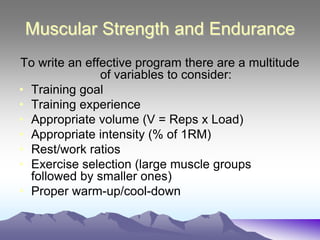
Muscular Strength and Endurance
To write an effective program there are a multitude
               of variables to consider:
• Training goal
• Training experience
• Appropriate volume (V = Reps x Load)
• Appropriate intensity (% of 1RM)
• Rest/work ratios
• Exercise selection (large muscle groups
  followed by smaller ones)
• Proper warm-up/cool-down
Muscular Strength
Program      Weeks    Frequency   Intensity     Duration
Stage                             (reps/sets/
                                  % 1RM

Beginning    6 to 8   2 to 3      8-12 reps     < 1 hour
                      days/week   1-2 sets
                                  60% to 70%
Intermediate 2 to 4   3 to 4      8-12 reps     Variable
                      days/week   Variable
                                  60% to 85%


Advanced     2 to 4   ≤6          1-12 reps     Variable
                      days/week   Variable
                                  80% to
                                  100%
Flexibility
Flexibility is defined as the “ability to move a joint
 through its complete range of motion” (ACSM, 2000, p.85.).


 Including flexibility training into a program may
   reduce injury, facilitate activities of daily living
      and improve performance. Unfortunately,
    flexibility training is often misunderstood and
                         neglected.
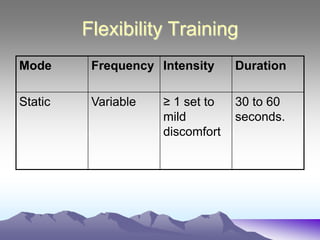
Flexibility Training
Mode      Frequency Intensity     Duration

Static    Variable   ≥ 1 set to   30 to 60
                     mild         seconds.
                     discomfort
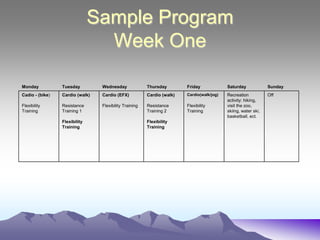
Sample Program
                                 Week One

Monday           Tuesday         Wednesday              Thursday        Friday             Saturday             Sunday
Cadio - (bike)   Cardio (walk)   Cardio (EFX)           Cardio (walk)   Cardio(walk/jog)   Recreation           Off
                                                                                           activity: hiking,
Flexibility      Resistance      Flexibility Training   Resistance      Flexibility        visit the zoo,
Training         Training 1                             Training 2      Training           skiing, water ski,
                                                                                           basketball, ect.
                 Flexibility                            Flexibility
                 Training                               Training
Cardiovascular


Day         Mode       Intensity     Duration
Monday      Bike       121-144 bpm   30 min
Tuesday     Walk       121-144 bpm   20 min
Wednesday   EFX        121-144 bpm   35 min
Thursday    Walk       121-144 bpm   20 min
Friday      Walk/jog   121-144 bpm   30 min
Saturday    Variable   N/A           N/A
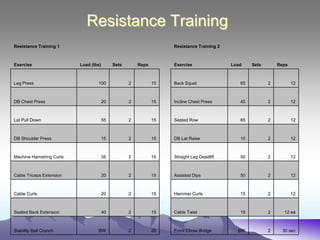
Resistance Training
Resistance Training 1                                              Resistance Training 2


Exercise                  Load (lbs)        Sets       Reps        Exercise                Load    Sets       Reps


Leg Press                         100              2          15   Back Squat                 65          2          12


DB Chest Press                         20          2          15   Incline Chest Press        45          2          12


Lat Pull Down                          55          2          15   Seated Row                 65          2          12


DB Shoulder Press                      15          2          15   DB Lat Raise               10          2          12


Machine Hamstring Curls                35          2          15   Straight Leg Deadlift      50          2          12


Cable Triceps Extension                20          2          15   Assisted Dips              50          2          12


Cable Curls                            20          2          15   Hammer Curls               15          2          12


Seated Back Extension                  40          2          15   Cable Twist                15          2     12 ea


Stability Ball Crunch             BW               2          20   Front Elbow Bridge        BW           2     30 sec
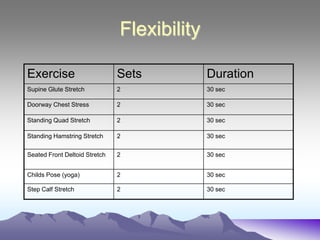
Flexibility

Exercise                       Sets          Duration
Supine Glute Stretch           2             30 sec

Doorway Chest Stress           2             30 sec

Standing Quad Stretch          2             30 sec

Standing Hamstring Stretch     2             30 sec

Seated Front Deltoid Stretch   2             30 sec


Childs Pose (yoga)             2             30 sec

Step Calf Stretch              2             30 sec
Conclusion
The purpose of this workshop is to provide a
      general understanding of exercise
        programming for healthy weight
 management. The examples provided may
    not be appropriate for everyone. Those
  interested in starting an exercise program
  are strongly encouraged to meet with their
        physician or a certified exercise
                 professional.

Exercise programming for_weight_management

  • 1.
    Exercise Programming for Weight Management
  • 2.
    Physical Activity Recommendations SurgeonGeneral: 30 minutes of light to moderate activity most if not all days of the week. ACSM: Overweight adults should engage in “approximately 45 minutes” of exercise per day to lose weight or prevent weight regain. Institute of Medicine: 60 minutes a day of moderate physical activity to prevent weight gain. International Association for the Study of Obesity: 45 to 90 minutes of moderate physical activity per day.
  • 3.
    Getting Started • Whereare you psychologically? • Where are you physically? • What are your barriers? • What do you enjoy doing?
  • 4.
    Psychological Readiness (Transtheoretical Model) • Precontemplation – lack of interest in making a change. • Contemplation – thinking about making a change. • Preparation – taking steps to make a change or have already made small changes. • Action – actively engaged in the behavior but for less than six months. • Maintenance – have maintained the behavior for more than six months.
  • 5.
    Physical Readiness Step 1- Self administered questionnaire (PAR-Q, AHA/ACSM Health/Fitness Facility Preparticipation Questionnaire) Step 2 – If necessary, obtain physician’s clearance (may include stress testing). Step 3 – If necessary, professional guidance/supervision.
  • 6.
    Identifying Barriers Identifying andovercoming barriers is a critical step in successful exercise programming! Common barriers include: • Lack of time • Lack of support • Lack of skill • Access • Cost • Fear of injury
  • 7.
    What do youenjoy doing? To achieve the highest levels of adherence choose activities you enjoy. However, every program should address the main components of physical fitness: • Body Composition • Cardiorespiratory or Aerobic Fitness • Muscular Strength and Endurance • Flexibility
  • 8.
    Cardiovascular Fitness “Cardiorespiratoryfitness is related to the ability to perform large muscle, dynamic, moderate- to high-intensity exercise for prolonged periods” (ACSM, 2000, p.68). Cornerstone of healthy weight management!
  • 9.
    Cardiovascular Fitness Program Weeks Frequency Intensity Duration Stage Initial Stage 1 to 6 3 to 4 days 40% to 15 to 30 per week 60% of minutes HRR Improvement 5 to 24 3 to 5 days 60% to 25 to 40 Stage per week 85% of minutes HRR Maintenance 24+ 3 to 5 days 70% to 20 to 60 Stage per week 85% of minutes HRR
  • 10.
    Heart Rate Reserve Away to measure exercise intensity using resting and maximal heart rate. Also known as the Karvonen formula.
  • 11.
    Cardiovascular Fitness Worksheet ModerateHeart Rate Range (40%) = ([Heart Rate Max* _____ - Resting Heart Rate _____] x .40) + Resting Heart Rate Vigorous Heart Rate Range (60%) = ([Heart Rate Max* _____ - Resting Heart Rate _____] x .60) + Resting Heart Rate * Heart Rate Max = 220 – age in years (+/- 12).
  • 12.
    Muscular Strength andEndurance To write an effective program there are a multitude of variables to consider: • Training goal • Training experience • Appropriate volume (V = Reps x Load) • Appropriate intensity (% of 1RM) • Rest/work ratios • Exercise selection (large muscle groups followed by smaller ones) • Proper warm-up/cool-down
  • 13.
    Muscular Strength Program Weeks Frequency Intensity Duration Stage (reps/sets/ % 1RM Beginning 6 to 8 2 to 3 8-12 reps < 1 hour days/week 1-2 sets 60% to 70% Intermediate 2 to 4 3 to 4 8-12 reps Variable days/week Variable 60% to 85% Advanced 2 to 4 ≤6 1-12 reps Variable days/week Variable 80% to 100%
  • 14.
    Flexibility Flexibility is definedas the “ability to move a joint through its complete range of motion” (ACSM, 2000, p.85.). Including flexibility training into a program may reduce injury, facilitate activities of daily living and improve performance. Unfortunately, flexibility training is often misunderstood and neglected.
  • 15.
    Flexibility Training Mode Frequency Intensity Duration Static Variable ≥ 1 set to 30 to 60 mild seconds. discomfort
  • 16.
    Sample Program Week One Monday Tuesday Wednesday Thursday Friday Saturday Sunday Cadio - (bike) Cardio (walk) Cardio (EFX) Cardio (walk) Cardio(walk/jog) Recreation Off activity: hiking, Flexibility Resistance Flexibility Training Resistance Flexibility visit the zoo, Training Training 1 Training 2 Training skiing, water ski, basketball, ect. Flexibility Flexibility Training Training
  • 17.
    Cardiovascular Day Mode Intensity Duration Monday Bike 121-144 bpm 30 min Tuesday Walk 121-144 bpm 20 min Wednesday EFX 121-144 bpm 35 min Thursday Walk 121-144 bpm 20 min Friday Walk/jog 121-144 bpm 30 min Saturday Variable N/A N/A
  • 18.
    Resistance Training Resistance Training1 Resistance Training 2 Exercise Load (lbs) Sets Reps Exercise Load Sets Reps Leg Press 100 2 15 Back Squat 65 2 12 DB Chest Press 20 2 15 Incline Chest Press 45 2 12 Lat Pull Down 55 2 15 Seated Row 65 2 12 DB Shoulder Press 15 2 15 DB Lat Raise 10 2 12 Machine Hamstring Curls 35 2 15 Straight Leg Deadlift 50 2 12 Cable Triceps Extension 20 2 15 Assisted Dips 50 2 12 Cable Curls 20 2 15 Hammer Curls 15 2 12 Seated Back Extension 40 2 15 Cable Twist 15 2 12 ea Stability Ball Crunch BW 2 20 Front Elbow Bridge BW 2 30 sec
  • 19.
    Flexibility Exercise Sets Duration Supine Glute Stretch 2 30 sec Doorway Chest Stress 2 30 sec Standing Quad Stretch 2 30 sec Standing Hamstring Stretch 2 30 sec Seated Front Deltoid Stretch 2 30 sec Childs Pose (yoga) 2 30 sec Step Calf Stretch 2 30 sec
  • 20.
    Conclusion The purpose ofthis workshop is to provide a general understanding of exercise programming for healthy weight management. The examples provided may not be appropriate for everyone. Those interested in starting an exercise program are strongly encouraged to meet with their physician or a certified exercise professional.