INSEP 
Département de la Recherche – Institut National du Sport, de l’Expertise et de la Performance 
OPTIMISING THE TRAINING LOAD DURING THE PRE-TAPER PHASE 
Yann LE MEUR1 
Collaborators: Julien LOUIS1, Anael AUBRY1, Ludmilla BAUDRILLART1, Jacques GUÉNERON1, Benjamin MAZE², Frank BIGNET², Jean Benoît CORCUFF3, Stéphane HATEM4, Richard ISNARD4, Aaron COUTTS5, Robert DUFFIELD5 & Christophe HAUSSWIRTH1 
1. 
2. 
3. 
4. 
5.
INSEP 
Département de la Recherche – Institut National du Sport, de l’Expertise et de la Performance
INSEP 
Département de la Recherche – Institut National du Sport, de l’Expertise et de la Performance
INSEP 
Département de la Recherche – Institut National du Sport, de l’Expertise et de la Performance 
… but how hard ?
INSEP 
Département de la Recherche – Institut National du Sport, de l’Expertise et de la Performance
INSEP 
Département de la Recherche – Institut National du Sport, de l’Expertise et de la Performance 
TRAINING 
RECOVERY 
INTRODUCTION
INSEP 
Département de la Recherche – Institut National du Sport, de l’Expertise et de la Performance 
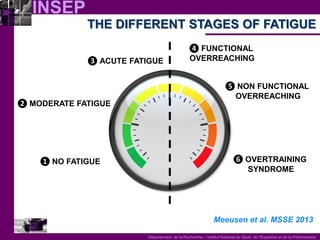
THE DIFFERENT STAGES OF FATIGUE 
❺ NON FUNCTIONAL 
OVERREACHING 
❻ OVERTRAINING 
SYNDROME 
❷ MODERATE FATIGUE 
❶ NO FATIGUE 
❸ ACUTE FATIGUE 
❹ FUNCTIONAL 
OVERREACHING 
Meeusen et al. MSSE 2013
INSEP 
Département de la Recherche – Institut National du Sport, de l’Expertise et de la Performance 
THE DIFFERENT STAGES OF FATIGUE 
❺ NON FUNCTIONAL 
OVERREACHING 
❻ OVERTRAINING 
SYNDROME 
❷ MODERATE FATIGUE 
❶ NO FATIGUE 
❸ ACUTE FATIGUE 
❹ FUNCTIONAL 
OVERREACHING 
Meeusen et al. MSSE 2013
INSEP 
Département de la Recherche – Institut National du Sport, de l’Expertise et de la Performance 
THE DIFFERENT STAGES OF FATIGUE 
Train hard or go home! 
ACUTE FATIGUE 
 High perceived fatigue 
 No performance decrement after a 24/36h rest period, 
 Performance supercompensation 
24/36h 
performance baseline
INSEP 
Département de la Recherche – Institut National du Sport, de l’Expertise et de la Performance 
Train hard or go home! 
 Very high perceived fatigue 
 Short-term performance decrement, 
 Performance restoration takes from several days to several weeks, 
 Performance supercompensation 
FUNCTIONAL OVERREACHING 
Several days to several weeks 
THE DIFFERENT STAGES OF FATIGUE 
performance baseline
INSEP 
Département de la Recherche – Institut National du Sport, de l’Expertise et de la Performance 
Train hard or go home! 
 Very intense perceived fatigue 
 Short-term decrement in performance capacity (< 1 month), 
 Performance restoration… 
 … with no performance supercompensation 
NON FUNCTIONAL 
OVERREACHING 
Several weeks 
THE DIFFERENT STAGES OF FATIGUE 
performance baseline
INSEP 
Département de la Recherche – Institut National du Sport, de l’Expertise et de la Performance 
Train hard or go home! 
… 
 Very intense perceived fatigue 
 Long-term performance decrement (> 1 month) 
THE OVERTRAINING 
SYNDROME 
> One month THE DIFFERENT STAGES OF FATIGUE 
performance baseline
INSEP 
Département de la Recherche – Institut National du Sport, de l’Expertise et de la Performance 
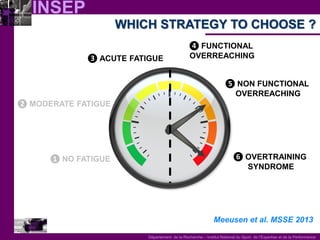
WHICH STRATEGY TO CHOOSE ? 
❺ NON FUNCTIONAL 
OVERREACHING 
❻ OVERTRAINING SYNDROME 
Meeusen et al. MSSE 2013 
❷ MODERATE FATIGUE 
❶ NO FATIGUE 
❸ ACUTE FATIGUE 
❹ FUNCTIONAL 
OVERREACHING
INSEP 
Département de la Recherche – Institut National du Sport, de l’Expertise et de la Performance 
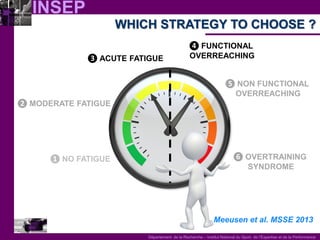
❸ ACUTE FATIGUE 
❹ FUNCTIONAL 
OVERREACHING 
❺ NON FUNCTIONAL 
OVERREACHING 
❻ OVERTRAINING 
SYNDROME 
Meeusen et al. MSSE 2013 
❷ MODERATE FATIGUE 
❶ NO FATIGUE WHICH STRATEGY TO CHOOSE ?
INSEP 
Département de la Recherche – Institut National du Sport, de l’Expertise et de la Performance 
F-OR: THE MOST EFFECTIVE WAY ?
INSEP 
Département de la Recherche – Institut National du Sport, de l’Expertise et de la Performance 
OBJECTIVES 
1. To examine whether the development of a functional overreaching state leads to greater performance supercompensation in comparison to acute fatigue strategy 
?
INSEP 
Département de la Recherche – Institut National du Sport, de l’Expertise et de la Performance 
OBJECTIVES 
2. To better understand the potential factors associated with the functional overreaching development, including: 
 physiological parameters, 
 psychological parameters, 
 behavioral parameters.
INSEP 
Département de la Recherche – Institut National du Sport, de l’Expertise et de la Performance 
PROTOCOL
INSEP 
Département de la Recherche – Institut National du Sport, de l’Expertise et de la Performance 
TRAINING LOAD (% habitual load) 
100% 
60% 
130% 
Control 
group (n = 12) 
Phase II (1 week) 
Phase III 
(3 weeks) 
Simulated Taper 
(4 weeks) 
Pre 
Phase I (3 weeks) 
Post 
T1 
T2 
T3 
T4 
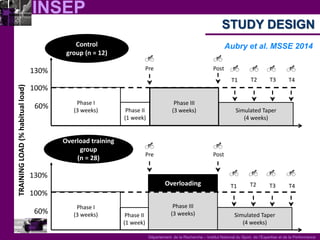
STUDY DESIGN 
Overloading 
100% 
60% 
130% 
Phase I 
(3 weeks) 
Phase II (1 week) 
Phase III 
(3 weeks) 
Overload training group 
(n = 28) 
Simulated Taper (4 weeks) 
Post 
T1 
T2 
T3 
T4 
Pre 
Aubry et al. MSSE 2014
INSEP 
Département de la Recherche – Institut National du Sport, de l’Expertise et de la Performance 
Puissance (W) 
100W 
+25W par 2min EXERCISE TEST 
 36h rest period before each test 
 Same day, same hour 
 Controlled diet during the last 48h 
 Hydration guidelines
INSEP 
Département de la Recherche – Institut National du Sport, de l’Expertise et de la Performance 
ADHERENCE TO THE TRAINING PROTOCOL 
7 subjects did not follow the prescribed training due to injury or personal obligations 
 Control group: n = 10 
 Overload group: n = 23
INSEP 
Département de la Recherche – Institut National du Sport, de l’Expertise et de la Performance 
TRAINING LOAD (% habitual load) 
Overloading 
100% 
60% 
130% 
Phase I (3 weeks) 
Phase II (1 week) 
Phase III 
(3 weeks) 
Overload training group 
(n = 23) 
Simulated Taper (4 weeks) 
Post 
T1 
T2 
T3 
T4 
Pre 
STUDY DESIGN
INSEP 
Département de la Recherche – Institut National du Sport, de l’Expertise et de la Performance 
THE OVERLOAD GROUP 
• HIGH PERCEIVED FATIGUE 
• PRESERVED & ENHANCED PERFORMANCE 
• VERY HIGH PERCEIVED FATIGUE 
• DECREASED PERFORMANCE 
ACUTE FATIGUE 
n = 12 
FUNCTIONAL OVERREACHING 
n = 11
INSEP 
Département de la Recherche – Institut National du Sport, de l’Expertise et de la Performance 
THREE GROUPS 
Control group 
n = 12 
Overload group 
n = 28 
Control group 
n = 10 
Acute Fatigue 
n = 12 
F-OR group 
n = 11 
2 out 
5 out
INSEP 
Département de la Recherche – Institut National du Sport, de l’Expertise et de la Performance 
THE PERFORMANCE REBOUND 
††† 
††† ## 
†# 
†† 
† 
* vs. Pre 
# vs. CTL 
† vs. F-OR 
-4 
-2 
0 
2 
4 
6 
8 
Pre 
Post 
T1 
T2 
T3 
T4 
Performance change (% Pre) 
Control 
Acute Fatigue 
Functional overreaching 
Aubry et al. MSSE 2014
INSEP 
Département de la Recherche – Institut National du Sport, de l’Expertise et de la Performance 
THE PERFORMANCE REBOUND 
* vs. Pre 
# vs. CTL 
† vs. F-OR 
10 ± 7W 
18 ± 8W 
9 ± 4W
INSEP 
Département de la Recherche – Institut National du Sport, de l’Expertise et de la Performance 
PEAKING OCCURENCE 
Train hard or go home! 
Acute fatigue 
Functional overreaching 
Control 
Δ?
INSEP 
Département de la Recherche – Institut National du Sport, de l’Expertise et de la Performance 
Aubry et al. MSSE 2014 
0 
1 
2 
3 
4 
5 
6 
7 
8 
Post 
T1 
T2 
T3 
T4 
Occurrence of peak performance 
(nb/week) 
Control 
Acute Fatigue 
F-Overreaching 
Ø 
75% of peak performances within the two first weeks 
PEAKING OCCURENCE
INSEP 
Département de la Recherche – Institut National du Sport, de l’Expertise et de la Performance
INSEP 
Département de la Recherche – Institut National du Sport, de l’Expertise et de la Performance 
SUBJECTS &TRAINING CHARACTERISTICS 
Age 
Height (cm) 
Weight (kg) 
MAP (W) 
VO2max (mLO2/ 
min/kg) 
Weekly training characteristics 
Endurance sports experience (years) 
Volume (h) 
Distribution of intensity in Z1, 2 and 3 (%) 
Nb of swim/ cycle/ run sessions 
Control 
37 
183 
75 
355 
58 
12 
62/30/8 
3/3/3 
13 
Acute Fatigue 
33 
179 
74 
354 
59 
13 
65/26/9 
3/3/3 
15 
Functional Overreaching 
36 
180 
73 
369 
61 
14 
64/30/7 
3/5/3 
12 
No significant difference between groups at baseline
INSEP 
Département de la Recherche – Institut National du Sport, de l’Expertise et de la Performance 
PHASE 
BASELINE 
TAPER 
OVERLOAD 
TAPER 
Duration (week) 
3 
1 
1 
1 
1 
1 
1 
1 
1 
Control 
Weekly volume (h/m) 
12 ± 3 
6 ± 1 
12 ± 2 
12 ± 2 
12 ± 2 
6 ± 1 
6 ± 1 
6 ± 1 
6 ± 1 
Distribution of training intensity in zone 1, 2 and 3 (%) 
62/30/8 
67/26/7 
67/26/7 
66/26/8 
65/27/8 
64/28/8 
63/28/9 
62/28/8 
66/26/8 
Weekly number of swimming,/ cycling, running sessions 
3/3/3 
2/3/3 
3/3/3 
3/3/3 
3/3/3 
2/3/3 
2/3/3 
2/3/3 
2/3/3 
Acute Fatigue 
Weekly volume (h/m) 
13 ± 3 
7 ± 1 
17 ± 3 
17 ± 3 
17 ± 3 
7 ± 1 
7 ± 1 
7 ± 1 
7 ± 1 
Distribution of training intensity in zone 1, 2 and 3 (%) 
65/26/9 
64/26/9 
65/26/9 
65/27/8 
65/27/8 
60/30/10 
61/29/10 
61/29/10 
60/30/10 
Weekly number of swimming, cycling, running sessions 
3/3/3 
2/3/3 
3/3/3 
3/3/3 
3/3/3 
2/3/3 
2/3/3 
2/3/3 
2/3/3 
F-OR 
Weekly volume (h/m) 
14 ± 3 
7 ± 1 
18 ± 3 
19 ± 3 
19 ± 3 
7 ± 1 
7 ± 1 
7 ± 1 
7 ± 1 
Distribution of training intensity in zone 1, 2 and 3 (%) 
64/30/7 
68/26/6 
69/25/6 
68/26/6 
68/26/6 
66/26/8 
64/28/8 
65/27/8 
67/25/8 
Weekly number of swimming, cycling, running sessions 
3/5/3 
2/4/3 
4/5/3 
4/5/3 
4/5/3 
3/4/3 
3/4/3 
3/4/3 
3/4/3 
TRAINING MONITORING 
No significant difference between groups in training parameters
INSEP 
Département de la Recherche – Institut National du Sport, de l’Expertise et de la Performance 
SO LET’S GO A LITTLE BIT FURTHER!
INSEP 
Département de la Recherche – Institut National du Sport, de l’Expertise et de la Performance PHYSIOLOGICAL RESPONSE DURING EXERCISE 
Oxygen uptake 
Ventilatory parameters 
Cardiac output 
Blood lactate concentration 
Plasmatic catecholamines concentration 
Arterial blood 
pressures
INSEP 
Département de la Recherche – Institut National du Sport, de l’Expertise et de la Performance 
* Different from Pre, p < 0.05 
MAXIMAL OXYGEN UPTAKE 
4100 
4200 
4300 
4400 
4500 
4600 
4700 
Control 
Acute Fatigue 
F - Overreaching 
Maximal oxygen uptake (ml/min/kg) 
Pre 
Post 
T2 
* 
Le Meur et al. JAP 2014
INSEP 
Département de la Recherche – Institut National du Sport, de l’Expertise et de la Performance 
Different from Pre, p < 0.05; † Different from Post, p < 0.05 
CARDIAC FATIGUE ? 
Le Meur et al. JAP 2014
INSEP 
Département de la Recherche – Institut National du Sport, de l’Expertise et de la Performance 
Different from Pre, p < 0.05; † Different from Post, p < 0.05 CARDIAC FATIGUE ? 
Le Meur et al. JAP 2014
INSEP 
Département de la Recherche – Institut National du Sport, de l’Expertise et de la Performance 
Different from Pre, p < 0.05; † Different from Post, p < 0.05 
CATECHOLAMINES RESPONSE 
Le Meur et al. JAP 2014
INSEP 
Département de la Recherche – Institut National du Sport, de l’Expertise et de la Performance 
QUESTIONNAIRES 
Health monitoring questionnaire (URTI & GI infections symptoms)
INSEP 
Département de la Recherche – Institut National du Sport, de l’Expertise et de la Performance 
INFECTIONS 
Hausswirth et al. MSSE 2014 
Phase 
Baseline 
Overload 
Taper 
TOTAL 
Week number 
I 
II 
III 
IV 
V 
VI 
VII 
VIII 
CTL 
0 
0 
0 
0 
0 
1 
0 
0 
1 
AF 
0 
0 
1 
0 
1 
0 
0 
0 
2 
F-OR 
0 
1 
0 
4 
0 
1 
2 
0 
8
INSEP 
Département de la Recherche – Institut National du Sport, de l’Expertise et de la Performance 
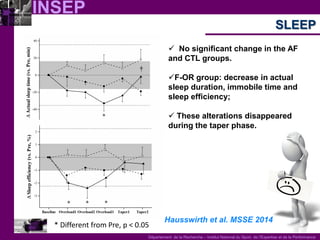
SLEEP 
Hausswirth et al. MSSE 2014 
 No significant change in the AF and CTL groups. 
F-OR group: decrease in actual sleep duration, immobile time and sleep efficiency; 
 These alterations disappeared during the taper phase. 
* Different from Pre, p < 0.05
INSEP 
Département de la Recherche – Institut National du Sport, de l’Expertise et de la Performance 
Training overload leading to functional overreaching may induce higher risk of training maladaptations, including: 
o increased infection risks, 
o sleep disturbances, 
o symptoms of cardiac fatigue at exercise. 
CONCLUSIONS
INSEP 
Département de la Recherche – Institut National du Sport, de l’Expertise et de la Performance 
PERSPECTIVES 
 Further studies are needed to confirm these findings (using ecological performance tests), 
 Longitudinal monitoring of elite athletes.
INSEP 
Département de la Recherche – Institut National du Sport, de l’Expertise et de la Performance 
TAKE HOME MESSAGES 
 Overload periods are essential for performance enhancement; 
 Tapering is critical for the supercompensation process, 
 Training periodisation should be continuoulsy adapted, based on: 
o performance responses after a short rest period using regular testing training sessions, 
o athletes’ feedback.

Optimising the Training Load during the Pre-taper Phase

  • 1.
    INSEP Département dela Recherche – Institut National du Sport, de l’Expertise et de la Performance OPTIMISING THE TRAINING LOAD DURING THE PRE-TAPER PHASE Yann LE MEUR1 Collaborators: Julien LOUIS1, Anael AUBRY1, Ludmilla BAUDRILLART1, Jacques GUÉNERON1, Benjamin MAZE², Frank BIGNET², Jean Benoît CORCUFF3, Stéphane HATEM4, Richard ISNARD4, Aaron COUTTS5, Robert DUFFIELD5 & Christophe HAUSSWIRTH1 1. 2. 3. 4. 5.
  • 2.
    INSEP Département dela Recherche – Institut National du Sport, de l’Expertise et de la Performance
  • 3.
    INSEP Département dela Recherche – Institut National du Sport, de l’Expertise et de la Performance
  • 4.
    INSEP Département dela Recherche – Institut National du Sport, de l’Expertise et de la Performance … but how hard ?
  • 5.
    INSEP Département dela Recherche – Institut National du Sport, de l’Expertise et de la Performance
  • 6.
    INSEP Département dela Recherche – Institut National du Sport, de l’Expertise et de la Performance TRAINING RECOVERY INTRODUCTION
  • 7.
    INSEP Département dela Recherche – Institut National du Sport, de l’Expertise et de la Performance THE DIFFERENT STAGES OF FATIGUE ❺ NON FUNCTIONAL OVERREACHING ❻ OVERTRAINING SYNDROME ❷ MODERATE FATIGUE ❶ NO FATIGUE ❸ ACUTE FATIGUE ❹ FUNCTIONAL OVERREACHING Meeusen et al. MSSE 2013
  • 8.
    INSEP Département dela Recherche – Institut National du Sport, de l’Expertise et de la Performance THE DIFFERENT STAGES OF FATIGUE ❺ NON FUNCTIONAL OVERREACHING ❻ OVERTRAINING SYNDROME ❷ MODERATE FATIGUE ❶ NO FATIGUE ❸ ACUTE FATIGUE ❹ FUNCTIONAL OVERREACHING Meeusen et al. MSSE 2013
  • 9.
    INSEP Département dela Recherche – Institut National du Sport, de l’Expertise et de la Performance THE DIFFERENT STAGES OF FATIGUE Train hard or go home! ACUTE FATIGUE  High perceived fatigue  No performance decrement after a 24/36h rest period,  Performance supercompensation 24/36h performance baseline
  • 10.
    INSEP Département dela Recherche – Institut National du Sport, de l’Expertise et de la Performance Train hard or go home!  Very high perceived fatigue  Short-term performance decrement,  Performance restoration takes from several days to several weeks,  Performance supercompensation FUNCTIONAL OVERREACHING Several days to several weeks THE DIFFERENT STAGES OF FATIGUE performance baseline
  • 11.
    INSEP Département dela Recherche – Institut National du Sport, de l’Expertise et de la Performance Train hard or go home!  Very intense perceived fatigue  Short-term decrement in performance capacity (< 1 month),  Performance restoration…  … with no performance supercompensation NON FUNCTIONAL OVERREACHING Several weeks THE DIFFERENT STAGES OF FATIGUE performance baseline
  • 12.
    INSEP Département dela Recherche – Institut National du Sport, de l’Expertise et de la Performance Train hard or go home! …  Very intense perceived fatigue  Long-term performance decrement (> 1 month) THE OVERTRAINING SYNDROME > One month THE DIFFERENT STAGES OF FATIGUE performance baseline
  • 13.
    INSEP Département dela Recherche – Institut National du Sport, de l’Expertise et de la Performance WHICH STRATEGY TO CHOOSE ? ❺ NON FUNCTIONAL OVERREACHING ❻ OVERTRAINING SYNDROME Meeusen et al. MSSE 2013 ❷ MODERATE FATIGUE ❶ NO FATIGUE ❸ ACUTE FATIGUE ❹ FUNCTIONAL OVERREACHING
  • 14.
    INSEP Département dela Recherche – Institut National du Sport, de l’Expertise et de la Performance ❸ ACUTE FATIGUE ❹ FUNCTIONAL OVERREACHING ❺ NON FUNCTIONAL OVERREACHING ❻ OVERTRAINING SYNDROME Meeusen et al. MSSE 2013 ❷ MODERATE FATIGUE ❶ NO FATIGUE WHICH STRATEGY TO CHOOSE ?
  • 15.
    INSEP Département dela Recherche – Institut National du Sport, de l’Expertise et de la Performance F-OR: THE MOST EFFECTIVE WAY ?
  • 16.
    INSEP Département dela Recherche – Institut National du Sport, de l’Expertise et de la Performance OBJECTIVES 1. To examine whether the development of a functional overreaching state leads to greater performance supercompensation in comparison to acute fatigue strategy ?
  • 17.
    INSEP Département dela Recherche – Institut National du Sport, de l’Expertise et de la Performance OBJECTIVES 2. To better understand the potential factors associated with the functional overreaching development, including:  physiological parameters,  psychological parameters,  behavioral parameters.
  • 18.
    INSEP Département dela Recherche – Institut National du Sport, de l’Expertise et de la Performance PROTOCOL
  • 19.
    INSEP Département dela Recherche – Institut National du Sport, de l’Expertise et de la Performance TRAINING LOAD (% habitual load) 100% 60% 130% Control group (n = 12) Phase II (1 week) Phase III (3 weeks) Simulated Taper (4 weeks) Pre Phase I (3 weeks) Post T1 T2 T3 T4 STUDY DESIGN Overloading 100% 60% 130% Phase I (3 weeks) Phase II (1 week) Phase III (3 weeks) Overload training group (n = 28) Simulated Taper (4 weeks) Post T1 T2 T3 T4 Pre Aubry et al. MSSE 2014
  • 20.
    INSEP Département dela Recherche – Institut National du Sport, de l’Expertise et de la Performance Puissance (W) 100W +25W par 2min EXERCISE TEST  36h rest period before each test  Same day, same hour  Controlled diet during the last 48h  Hydration guidelines
  • 21.
    INSEP Département dela Recherche – Institut National du Sport, de l’Expertise et de la Performance ADHERENCE TO THE TRAINING PROTOCOL 7 subjects did not follow the prescribed training due to injury or personal obligations  Control group: n = 10  Overload group: n = 23
  • 22.
    INSEP Département dela Recherche – Institut National du Sport, de l’Expertise et de la Performance TRAINING LOAD (% habitual load) Overloading 100% 60% 130% Phase I (3 weeks) Phase II (1 week) Phase III (3 weeks) Overload training group (n = 23) Simulated Taper (4 weeks) Post T1 T2 T3 T4 Pre STUDY DESIGN
  • 23.
    INSEP Département dela Recherche – Institut National du Sport, de l’Expertise et de la Performance THE OVERLOAD GROUP • HIGH PERCEIVED FATIGUE • PRESERVED & ENHANCED PERFORMANCE • VERY HIGH PERCEIVED FATIGUE • DECREASED PERFORMANCE ACUTE FATIGUE n = 12 FUNCTIONAL OVERREACHING n = 11
  • 24.
    INSEP Département dela Recherche – Institut National du Sport, de l’Expertise et de la Performance THREE GROUPS Control group n = 12 Overload group n = 28 Control group n = 10 Acute Fatigue n = 12 F-OR group n = 11 2 out 5 out
  • 25.
    INSEP Département dela Recherche – Institut National du Sport, de l’Expertise et de la Performance THE PERFORMANCE REBOUND ††† ††† ## †# †† † * vs. Pre # vs. CTL † vs. F-OR -4 -2 0 2 4 6 8 Pre Post T1 T2 T3 T4 Performance change (% Pre) Control Acute Fatigue Functional overreaching Aubry et al. MSSE 2014
  • 26.
    INSEP Département dela Recherche – Institut National du Sport, de l’Expertise et de la Performance THE PERFORMANCE REBOUND * vs. Pre # vs. CTL † vs. F-OR 10 ± 7W 18 ± 8W 9 ± 4W
  • 27.
    INSEP Département dela Recherche – Institut National du Sport, de l’Expertise et de la Performance PEAKING OCCURENCE Train hard or go home! Acute fatigue Functional overreaching Control Δ?
  • 28.
    INSEP Département dela Recherche – Institut National du Sport, de l’Expertise et de la Performance Aubry et al. MSSE 2014 0 1 2 3 4 5 6 7 8 Post T1 T2 T3 T4 Occurrence of peak performance (nb/week) Control Acute Fatigue F-Overreaching Ø 75% of peak performances within the two first weeks PEAKING OCCURENCE
  • 29.
    INSEP Département dela Recherche – Institut National du Sport, de l’Expertise et de la Performance
  • 30.
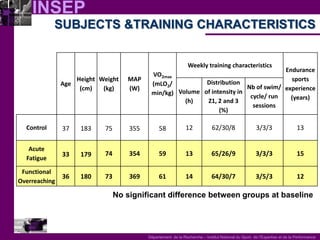
    INSEP Département dela Recherche – Institut National du Sport, de l’Expertise et de la Performance SUBJECTS &TRAINING CHARACTERISTICS Age Height (cm) Weight (kg) MAP (W) VO2max (mLO2/ min/kg) Weekly training characteristics Endurance sports experience (years) Volume (h) Distribution of intensity in Z1, 2 and 3 (%) Nb of swim/ cycle/ run sessions Control 37 183 75 355 58 12 62/30/8 3/3/3 13 Acute Fatigue 33 179 74 354 59 13 65/26/9 3/3/3 15 Functional Overreaching 36 180 73 369 61 14 64/30/7 3/5/3 12 No significant difference between groups at baseline
  • 31.
    INSEP Département dela Recherche – Institut National du Sport, de l’Expertise et de la Performance PHASE BASELINE TAPER OVERLOAD TAPER Duration (week) 3 1 1 1 1 1 1 1 1 Control Weekly volume (h/m) 12 ± 3 6 ± 1 12 ± 2 12 ± 2 12 ± 2 6 ± 1 6 ± 1 6 ± 1 6 ± 1 Distribution of training intensity in zone 1, 2 and 3 (%) 62/30/8 67/26/7 67/26/7 66/26/8 65/27/8 64/28/8 63/28/9 62/28/8 66/26/8 Weekly number of swimming,/ cycling, running sessions 3/3/3 2/3/3 3/3/3 3/3/3 3/3/3 2/3/3 2/3/3 2/3/3 2/3/3 Acute Fatigue Weekly volume (h/m) 13 ± 3 7 ± 1 17 ± 3 17 ± 3 17 ± 3 7 ± 1 7 ± 1 7 ± 1 7 ± 1 Distribution of training intensity in zone 1, 2 and 3 (%) 65/26/9 64/26/9 65/26/9 65/27/8 65/27/8 60/30/10 61/29/10 61/29/10 60/30/10 Weekly number of swimming, cycling, running sessions 3/3/3 2/3/3 3/3/3 3/3/3 3/3/3 2/3/3 2/3/3 2/3/3 2/3/3 F-OR Weekly volume (h/m) 14 ± 3 7 ± 1 18 ± 3 19 ± 3 19 ± 3 7 ± 1 7 ± 1 7 ± 1 7 ± 1 Distribution of training intensity in zone 1, 2 and 3 (%) 64/30/7 68/26/6 69/25/6 68/26/6 68/26/6 66/26/8 64/28/8 65/27/8 67/25/8 Weekly number of swimming, cycling, running sessions 3/5/3 2/4/3 4/5/3 4/5/3 4/5/3 3/4/3 3/4/3 3/4/3 3/4/3 TRAINING MONITORING No significant difference between groups in training parameters
  • 32.
    INSEP Département dela Recherche – Institut National du Sport, de l’Expertise et de la Performance SO LET’S GO A LITTLE BIT FURTHER!
  • 33.
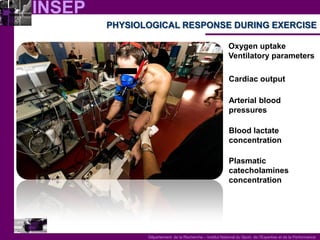
    INSEP Département dela Recherche – Institut National du Sport, de l’Expertise et de la Performance PHYSIOLOGICAL RESPONSE DURING EXERCISE Oxygen uptake Ventilatory parameters Cardiac output Blood lactate concentration Plasmatic catecholamines concentration Arterial blood pressures
  • 34.
    INSEP Département dela Recherche – Institut National du Sport, de l’Expertise et de la Performance * Different from Pre, p < 0.05 MAXIMAL OXYGEN UPTAKE 4100 4200 4300 4400 4500 4600 4700 Control Acute Fatigue F - Overreaching Maximal oxygen uptake (ml/min/kg) Pre Post T2 * Le Meur et al. JAP 2014
  • 35.
    INSEP Département dela Recherche – Institut National du Sport, de l’Expertise et de la Performance Different from Pre, p < 0.05; † Different from Post, p < 0.05 CARDIAC FATIGUE ? Le Meur et al. JAP 2014
  • 36.
    INSEP Département dela Recherche – Institut National du Sport, de l’Expertise et de la Performance Different from Pre, p < 0.05; † Different from Post, p < 0.05 CARDIAC FATIGUE ? Le Meur et al. JAP 2014
  • 37.
    INSEP Département dela Recherche – Institut National du Sport, de l’Expertise et de la Performance Different from Pre, p < 0.05; † Different from Post, p < 0.05 CATECHOLAMINES RESPONSE Le Meur et al. JAP 2014
  • 38.
    INSEP Département dela Recherche – Institut National du Sport, de l’Expertise et de la Performance QUESTIONNAIRES Health monitoring questionnaire (URTI & GI infections symptoms)
  • 39.
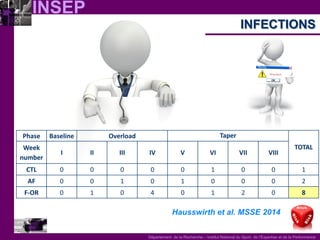
    INSEP Département dela Recherche – Institut National du Sport, de l’Expertise et de la Performance INFECTIONS Hausswirth et al. MSSE 2014 Phase Baseline Overload Taper TOTAL Week number I II III IV V VI VII VIII CTL 0 0 0 0 0 1 0 0 1 AF 0 0 1 0 1 0 0 0 2 F-OR 0 1 0 4 0 1 2 0 8
  • 40.
    INSEP Département dela Recherche – Institut National du Sport, de l’Expertise et de la Performance SLEEP Hausswirth et al. MSSE 2014  No significant change in the AF and CTL groups. F-OR group: decrease in actual sleep duration, immobile time and sleep efficiency;  These alterations disappeared during the taper phase. * Different from Pre, p < 0.05
  • 41.
    INSEP Département dela Recherche – Institut National du Sport, de l’Expertise et de la Performance Training overload leading to functional overreaching may induce higher risk of training maladaptations, including: o increased infection risks, o sleep disturbances, o symptoms of cardiac fatigue at exercise. CONCLUSIONS
  • 42.
    INSEP Département dela Recherche – Institut National du Sport, de l’Expertise et de la Performance PERSPECTIVES  Further studies are needed to confirm these findings (using ecological performance tests),  Longitudinal monitoring of elite athletes.
  • 43.
    INSEP Département dela Recherche – Institut National du Sport, de l’Expertise et de la Performance TAKE HOME MESSAGES  Overload periods are essential for performance enhancement;  Tapering is critical for the supercompensation process,  Training periodisation should be continuoulsy adapted, based on: o performance responses after a short rest period using regular testing training sessions, o athletes’ feedback.