What Can Exercise
Do For You?
Presented by The
Physiotherapy Team
What is Physiotherapy?
Physiotherapists provide a range of
interventions which include treatment,
education and advice. Physiotherapists aim to
restore, maintain and improve a person’s
function and movement and therefore
maximise quality of life.
 In scientific studies all over the world, exercise has
been shown to make the biggest difference to your
overall health.
 It has proven to work for many different conditions &
is the best way of preventing disease and illness.
 The benefits of exercise are yours for the taking,
regardless of your age, sex or physical ability.
Exercise: The Best Medicine
Directions for use: At least 30
minutes 5 times a week
Exercise Fact 1:
Exercise lifts your mood & boosts
energy levels
The Internal Medicine Cabinet
(A Gift From Nature)
 Endorphins &
Enkephalins
 Hormones that mimic the
effects of morphine
 Very effective for pain
control
 Happy Hormones!
Exercise helps you make the
most of these!
Wet & Dry Brains
The brain is full of helpful chemicals that are
ready to flush down & keep you healthy.
Pain & a lack of exercise turns the tap off
Unhelpful ‘danger’
messages from
your body are now
free to flow
upwards.
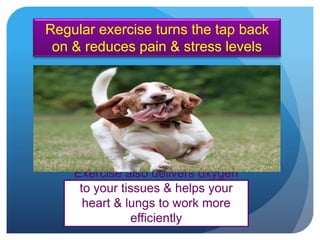
Exercise also delivers oxygen
to your tissues & helps your
heart & lungs to work more
efficiently
Regular exercise turns the tap back
on & reduces pain & stress levels
Exercise Fact 2:
Exercise improves joint movement
and muscle strength
No matter what age you are, your
muscles can always get stronger
Who exercises the most?
A
B
www.youtube.com
23 and ½ hours
Exercise Fact 3:
Exercise helps you take control of
aches & pains
How your brain ‘sees’ your body
This is the brain’s map of all your body parts
The quality & health of this map is dependent on how you
use all of your body parts – use it (normally) or lose it!
You’ve got 3 different roads to
choose from…
START EASY & BUILD
SLOWLY
NO PAIN, NO GAIN DON’T CHANGE
It’s your choice!
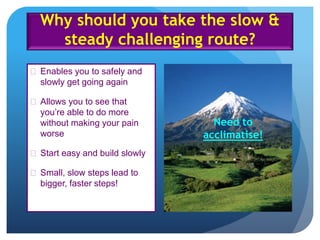
Why should you take the slow &
steady challenging route?
 Enables you to safely and
slowly get going again
 Allows you to see that
you’re able to do more
without making your pain
worse
 Start easy and build slowly
 Small, slow steps lead to
bigger, faster steps!
Need to
acclimatise!
Are you
ready?
Exercise is a great
way to feel better,
gain health benefits
& have fun!
Aim for at least
30 minutes, 5
times a week.
Check with your doctor or
health professional before
starting a new exercise
programme, especially if
you haven’t exercised for a
long time, have long-term
health problems, or you
have any concerns
Remember,
physiotherapists are
here to give you a
helping hand towards
better health &
wellbeing. Talk to
your doctor if you
would like to come
and see us.
Further learning
www.exercise-works.org
www.csp.org.uk/publications/exercise-advice-leaflets
www.youtube.com Search for…23 and a half hours
www.nhs.uk/livewell/fitness
Any Questions?

What Can Exercise Do For You?

  • 1.
    What Can Exercise DoFor You? Presented by The Physiotherapy Team
  • 2.
    What is Physiotherapy? Physiotherapistsprovide a range of interventions which include treatment, education and advice. Physiotherapists aim to restore, maintain and improve a person’s function and movement and therefore maximise quality of life.
  • 3.
     In scientificstudies all over the world, exercise has been shown to make the biggest difference to your overall health.  It has proven to work for many different conditions & is the best way of preventing disease and illness.  The benefits of exercise are yours for the taking, regardless of your age, sex or physical ability. Exercise: The Best Medicine
  • 4.
    Directions for use:At least 30 minutes 5 times a week
  • 6.
    Exercise Fact 1: Exerciselifts your mood & boosts energy levels
  • 7.
    The Internal MedicineCabinet (A Gift From Nature)  Endorphins & Enkephalins  Hormones that mimic the effects of morphine  Very effective for pain control  Happy Hormones! Exercise helps you make the most of these!
  • 8.
    Wet & DryBrains The brain is full of helpful chemicals that are ready to flush down & keep you healthy. Pain & a lack of exercise turns the tap off Unhelpful ‘danger’ messages from your body are now free to flow upwards.
  • 9.
    Exercise also deliversoxygen to your tissues & helps your heart & lungs to work more efficiently Regular exercise turns the tap back on & reduces pain & stress levels
  • 10.
    Exercise Fact 2: Exerciseimproves joint movement and muscle strength
  • 11.
    No matter whatage you are, your muscles can always get stronger Who exercises the most? A B
  • 13.
  • 14.
    Exercise Fact 3: Exercisehelps you take control of aches & pains
  • 15.
    How your brain‘sees’ your body This is the brain’s map of all your body parts The quality & health of this map is dependent on how you use all of your body parts – use it (normally) or lose it!
  • 17.
    You’ve got 3different roads to choose from… START EASY & BUILD SLOWLY NO PAIN, NO GAIN DON’T CHANGE It’s your choice!
  • 18.
    Why should youtake the slow & steady challenging route?  Enables you to safely and slowly get going again  Allows you to see that you’re able to do more without making your pain worse  Start easy and build slowly  Small, slow steps lead to bigger, faster steps! Need to acclimatise!
  • 19.
  • 20.
    Exercise is agreat way to feel better, gain health benefits & have fun! Aim for at least 30 minutes, 5 times a week. Check with your doctor or health professional before starting a new exercise programme, especially if you haven’t exercised for a long time, have long-term health problems, or you have any concerns Remember, physiotherapists are here to give you a helping hand towards better health & wellbeing. Talk to your doctor if you would like to come and see us.
  • 21.
  • 23.

Editor's Notes

  • #6 So many benefits, so little time to discuss all of them, so lets pick 3 today.