Why Is
Exercise So
Important?
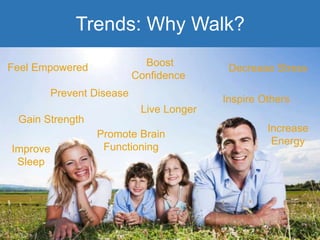
Trends: Why Walk?
Gain Strength
Prevent Disease
Decrease Stress
Improve
Sleep
Promote Brain
Functioning
Live Longer
Inspire Others
Increase
Energy
Feel Empowered Boost
Confidence
What are Chronic
Conditions?
Prevent Chronic Disease
7/10 deaths among Americans each
year are from chronic diseases.
In 2005, almost 1 out of every 2 adults
had a least one chronic disease.
• Heart Disease
• Cancer
• Diabetes
• Obesity
• Stroke
• Arthritis
Chronic Disease and Exercise
Chronic diseases and
conditions are among the
most common, costly,
and preventable of all
health problems (CDC,
2016).
Participants of a major clinical trial group exercised by walking an average of
30 minutes a day, 5 days a week, and lowered their intake of fat and calories.
This resulted in a sustained weight loss of about 10-15 lbs, reducing their risk
of getting diabetes by 58%.
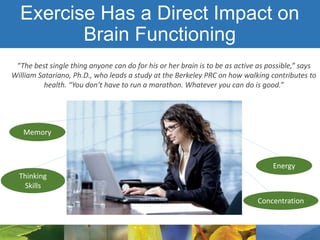
Exercise Has a Direct Impact on
Brain Functioning
“The best single thing anyone can do for his or her brain is to be as active as possible,” says
William Satariano, Ph.D., who leads a study at the Berkeley PRC on how walking contributes to
health. “You don’t have to run a marathon. Whatever you can do is good.”
Memory
Concentration
Energy
Thinking
Skills
Exercise and Brain Functioning
StressDepression
Mood Sleep
Exercise can improve…
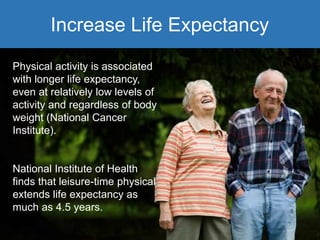
Physical activity is associated
with longer life expectancy,
even at relatively low levels of
activity and regardless of body
weight (National Cancer
Institute).
National Institute of Health
finds that leisure-time physical
extends life expectancy as
much as 4.5 years.
Increase Life Expectancy

Why is Exercise Important

  • 1.
  • 2.
    Trends: Why Walk? GainStrength Prevent Disease Decrease Stress Improve Sleep Promote Brain Functioning Live Longer Inspire Others Increase Energy Feel Empowered Boost Confidence
  • 3.
    What are Chronic Conditions? PreventChronic Disease 7/10 deaths among Americans each year are from chronic diseases. In 2005, almost 1 out of every 2 adults had a least one chronic disease. • Heart Disease • Cancer • Diabetes • Obesity • Stroke • Arthritis
  • 4.
    Chronic Disease andExercise Chronic diseases and conditions are among the most common, costly, and preventable of all health problems (CDC, 2016). Participants of a major clinical trial group exercised by walking an average of 30 minutes a day, 5 days a week, and lowered their intake of fat and calories. This resulted in a sustained weight loss of about 10-15 lbs, reducing their risk of getting diabetes by 58%.
  • 5.
    Exercise Has aDirect Impact on Brain Functioning “The best single thing anyone can do for his or her brain is to be as active as possible,” says William Satariano, Ph.D., who leads a study at the Berkeley PRC on how walking contributes to health. “You don’t have to run a marathon. Whatever you can do is good.” Memory Concentration Energy Thinking Skills
  • 6.
    Exercise and BrainFunctioning StressDepression Mood Sleep Exercise can improve…
  • 7.
    Physical activity isassociated with longer life expectancy, even at relatively low levels of activity and regardless of body weight (National Cancer Institute). National Institute of Health finds that leisure-time physical extends life expectancy as much as 4.5 years. Increase Life Expectancy

Editor's Notes

  • #3 Why Walk? Not only can most everyone do it, but there are many health benefits. It’s a great time to release stress! Walking gives you time to think, as well as time to get away from stressors. Getting out of the stressful work, school, or home environment, breathing fresh air, and feeling your body move is a natural stress reliever.
  • #4 The Power of Prevention, 2009, National Center for Chronic Disease Prevention and Health Promotion (Department of Health and Human Services) Graph: It's clear that southerners are at higher risk of heart problems, according to health researchers who have identified a "stroke belt" in the South, where strokes are more common than elsewhere in the country. It includes North Carolina, South Carolina, Georgia, Mississippi, Alabama, Arkansas, Tennessee and Louisiana. (U.S. News & World Health Report, Heart Health Worst in the South, Dec 19, 2012, Randy Dotinga)
  • #5 Centers for Disease Control and Prevention. (2016). Chronic Disease Overview. Retrieved from http://www.cdc.gov/chronicdisease/overview/index.htm Top of mind: 1. Health care reform – the impact, and what to do about it CHS costs – where have we been, where are we going Population
  • #6  Exercise changes the brain in ways that protect memory and thinking skills Aerobic exercise (the kind that gets you heart pumping, not muscle toning/balance/resistance) increase the size of the hippocampus – responsible for verbal memory and learning Engaging in a program of regular exercise of moderate intensity over six months is associated with increase volume of certain brain regions Prefrontal cortex and medial temporal cortex (control thinking and memory)
  • #7 Walking also combats the rise in blood pressure you get from stress. If your feeling the pressure at work, or have a daunting task ahead of you try taking a power walk during your lunch break or a stroll after work. This gives you time to release the tension, clear you mind and come back with a better outlook on the task ahead. Sleep: - Studies show that being physically active during the day can help you fall asleep more easily at night (CDC).
  • #8  National Cancer Institute. (2012). NIH study finds leisure-time physical activity extends life expectancy as much as 4.5 years. Retrieved from http://www.cancer.gov/news-events/press-releases/2012/PhysicalActivityLifeExpectancy