-Exercise is physicalactivity that enhance or maintains fitness and
overall. It is performed for various reasons ,including weight loss or
maintenance, to aid growth and improve strength , develop muscles and
improve health or simply for enjoyment.
WHAT IS EXERCISE FITNESS?
-Physical fitness is a state of health and well being and , more specifically,
the ability to perform aspect of sports, occupations, and daily activities.
3.
What program arebeing implemented by national and international
institution encourage Filipinos to reduce physical activity?
There is significant increase in awareness on the health benefits of physical
activity an fitness on Filipinos. Health agencies such as Department of Health
(DOH) and the World Health Organization (WHO) have implemented strategies
that promote an active lifestyle in the past decade. Physical activity programs aim
to decrease the prevalence of sedentary lifestyle because studies show that
physical inactivity is significant risk factor for several non communicable diseases.
WHO (Western Pacific Region ) 2000-65% total death caused by non
communicable disease. 2012 -72% death.
4.
What is recommendedlevel or amount of physical activity to maintain
good health?
The general idea of health promotion strategies is to encourage
Filipinos to move more. It is recommended that teenager engage in
physical activity for at least 60 minutes every day.
Physical activity involves any bodily movement caused by
muscular contractions that result in the expenditure of energy.
6.
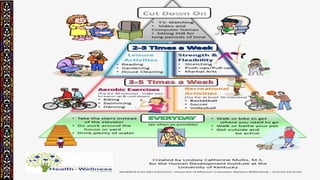
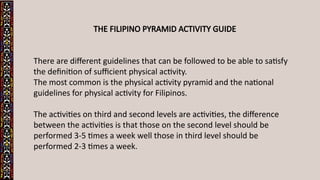
THE FILIPINO PYRAMIDACTIVITY GUIDE
There are different guidelines that can be followed to be able to satisfy
the definition of sufficient physical activity.
The most common is the physical activity pyramid and the national
guidelines for physical activity for Filipinos.
The activities on third and second levels are activities, the difference
between the activities is that those on the second level should be
performed 3-5 times a week well those in third level should be
performed 2-3 times a week.
7.
What are thebenefits of becoming active and being physical fit?
Physical Fitness is a condition that allows body to effectively cope
with the demands of daily activities and still has the energy to enjoy the other
active leisure activities.
The health related components of fitness include Aerobic Capacity,
Muscular Strength, Muscular Endurance, Flexibility and body Composition.
These components are important in preventing injuries and non communicable
disease such as heart and cancer.
8.
1. Aerobic Capacity- is the ability of heart, lungs, and blood vessels to supply oxygen and
nutrients to the working muscles efficiently in order to sustain prolonged rhythmical
exercises.
2. Muscular Strength - it is the ability of the muscle to generate greatest force.
3. Muscular Endurance - it is the ability of muscle to resist fatigue when performing
multiple repetition of a submaximal load.
4. Flexibility - it is the ability to move a joint without pain over its entire range of motion.
5. Body Composition - it refers to the total make up of the body using the concept of two
component model: the lean body and the body fat.
9.
IMPORTANCE OF ANACTIVE LIFESTYLE
Improves bone, joint, and muscle strength.
Develops motor control and coordination.
Helps maintain a healthy body composition.
Improves the psychological functioning of an individual;
Increases the efficiency of the lungs and the heart;
Increases muscle strength and endurance;
Protects from musculoskeletal problems such as “low” back pain.
Possibly delays the aging process.
In general, these benefits can be acquired by adopting a sound exercise program. A good
exercise program will address the weakness or the demands in the occupation of an
individual. It is important to note that an exercise program of a firefighter for instance; is
different from a dancer beacause of different demands for each fitness component.
10.
Exercises to derivehealth benefits
Exercises are repetitive movements that aim to improve one or more
components of fitness.
1. Aerobic Exercise. Aerobic exercises involve large muscle groups (eg.. thighs)
that perform rhythmic and continuous movement time in order to improve
aerobic capacity.
2. Resistance Exercise. Resistance exercises require the muscle to contract
against an external load (e.g., barbell) in order to improve muscular
strength, muscular endurance, and bone strength.
3. Stretching Exercise. Stretching exercises increase the elasticity of muscles
and tendons surrounding the joint in order to improve flexibility.
11.
In addition,
Fitness trainersand coaches can help the individual craft the
details of the plan and teach him/her how to perform the
exercises correctly and increase the individual's understanding of
the changes resulting from the exercise training.
12.
HOW IMPORTANT ISSTRETCHING EXECISE IN IMPROVING PERFORMANCE?
Stretching exercises are important in improving range of motion around
the joints. It helps an individual in performing daily tasks with efficiency.
Exercises that address the flexibility of a joint will improve muscle
coordination connective tissue elasticity and overall joint strength.
13.
ARE THERE PSYCHOLOGICALBENEFITS FROM EXERCISE?
The effect of training go beyond the biological changes. Exercise
psychologist found strong evidence that regular exercise improves the mood of
a individual and reduces anxiety. Some form of stretching exercises trigger
relaxation by reducing muscle tightness . Exercise is also claimed to stimulate
the release of feel-good brain chemicals called endorphins. Exercise help in
increasing self-esteem and confidence.
Likewise , many individuals claim that exercise gives them opportunities to
interact and socialized with other people. The impact of exercise is not just on
physical well being but in improving the quality of life of an individual as well.
Lastly, the psychological and emotional benefits from exercise help the
individual sustain an active lifestyle and choose other habits.
14.
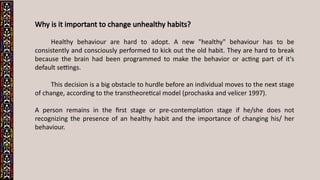
Why is itimportant to change unhealthy habits?
Healthy behaviour are hard to adopt. A new "healthy" behaviour has to be
consistently and consciously performed to kick out the old habit. They are hard to break
because the brain had been programmed to make the behavior or acting part of it's
default settings.
This decision is a big obstacle to hurdle before an individual moves to the next stage
of change, according to the transtheoretical model (prochaska and velicer 1997).
A person remains in the first stage or pre-contemplation stage if he/she does not
recognizing the presence of an healthy habit and the importance of changing his/ her
behaviour.
15.
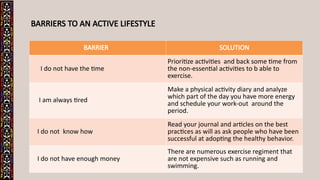
BARRIERS TO ANACTIVE LIFESTYLE
BARRIER SOLUTION
I do not have the time
Prioritize activities and back some time from
the non-essential activities to b able to
exercise.
I am always tired
Make a physical activity diary and analyze
which part of the day you have more energy
and schedule your work-out around the
period.
I do not know how
Read your journal and articles on the best
practices as will as ask people who have been
successful at adopting the healthy behavior.
I do not have enough money
There are numerous exercise regiment that
are not expensive such as running and
swimming.
16.
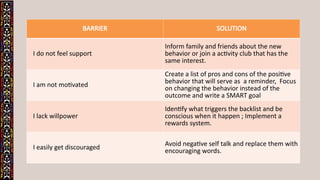
BARRIER SOLUTION
I donot feel support
Inform family and friends about the new
behavior or join a activity club that has the
same interest.
I am not motivated
Create a list of pros and cons of the positive
behavior that will serve as a reminder, Focus
on changing the behavior instead of the
outcome and write a SMART goal
I lack willpower
Identify what triggers the backlist and be
conscious when it happen ; Implement a
rewards system.
I easily get discouraged Avoid negative self talk and replace them with
encouraging words.
Editor's Notes
#10 Examples including: swimming, biking, running and dancing.
Lh
Examples includes: static stretching and dynamic stretching