For additional information
or copies of this publication,
visit the NAE web page at
http://www.cnaf.navy.mil/nae


Approved for public release.

Distribution is unlimited.
NAVAL AVIAT ION VISION
JANUARY 2012
Letter from the Leadership of Naval Aviation
    W     e serve at a time when our nation is simultaneously at war and facing a financial environment never before
          witnessed by those currently serving in uniform. Balancing the challenges of war and the needs for national
    defense amidst fiscal realities demands that Naval Aviation fulfill more global commitments while it operates within
    the margins of tighter budget constraints. These challenges will be successfully overcome. As the Honorable Leon
    Panetta said when he became the 23rd Secretary of Defense on 1 July 2011: “While tough budget choices will need to
    be made, I do not believe in the false choice between fiscal discipline and a strong national defense. We will all work
    together to achieve both.”

    America has a preeminent leadership role in an interconnected world sustained by the confluence of its diplomatic,
    intelligence, economic, and military resources. Preserving this role helps protect America’s national interests, which
    are global in character and realized in part by a military strategy aligned with the nation’s diplomatic strategy. The
    United States must contend with the emergence of near-peer states that can, and will, challenge global economic and
    regional order, and we must continue to meet the challenges of extremism by non-state entities for many years to come. A
    military strategy that addresses both of these challenges is one that: provides capabilities for global reach and dominance
    of the sea as well as the air and space above it, builds and sustains coalitions with other nations, and is supported by
                                credible combat capability throughout the spectrum of conflict. The success of this strategy
                                 hinges on a military capable of influencing and dominating the world’s maritime domain.

                                     Providing resources to fulfill this strategy poses a considerable challenge given the
                                          budgetary pressures imposed by America’s budget deficit and rising debt. In
                                            this environment, a force focused on global reach and access—rather than
                                            intervention and occupation—is the best option, employing deterrence
                                            through global presence, sea control, mission flexibility and, when necessary,
                                            interdiction. Such a strategy is critical to developing the mutual support inherent
                                            in friendly coalitions and leveraging that support to preserve the integrity of
                                            vital sea lines of communication. The naval force needed today and in the future
                                            must be able to exert sea control, ensure access, deter conflict, defeat any threat,
                                            provide prompt striking power, and reassure allies and partners.

                                             America’s Navy and Marine Corps—and in particular Naval Aviation—are
                                              well suited to these tasks.

                                                 Naval Aviation represents a uniquely capable Navy and Marine Corps
                                                 warfighting and peacekeeping partnership. Deployed with aircraft carriers


i        Naval Aviation Vision • January 2012
and amphibious assault ships or as expeditionary units, Naval Aviation forces require no permanent overseas bases.
They move at will across the world’s oceans, seas, and littorals, and they extend the effects of the sea base deep inland.
They provide our nation’s leaders with “offshore options.” These manned and unmanned multimission forces are trained,
equipped, and deployed to provide a range of responses to threats and crises, and their presence fosters coalitions in
peace and war.

Naval Aviation is critical to an evolving military shaped by war and fiscal pressures. The vision of Naval Aviation conveyed
in this document is aligned to meet international responsibilities and national imperatives. As the architecture for
near- and long-term strategic, operational, and fiscal decisions, it describes where Naval Aviation is today, outlines the
transitions necessary for tomorrow, acknowledges the people at the heart of every operational success, and emphasizes
the enterprise culture necessary to unveil efficiencies in the name of force sustainment. We share this vision to inform
and guide the actions of those serving Naval Aviation today, and those whose support is critical to our continued success.


VADM Allen G. Myers, USN                                         LtGen Terry G. Robling, USMC
Commander, Naval Air Forces                                      Deputy Commandant for Aviation


VADM David Architzel, USN                                        RADM Kenneth E. Floyd, USN
Commander, Naval Air Systems Command                             Director, Air Warfare Division


                         RADM William E. Leigher, USN
                         Director of Warfare Integration


                                                                                       L etter   from   L eadership       ii
Table of Contents
Letter from the Leadership of Naval Aviation . . . . . . . . i
Naval Aviation Today . . . . . . . . . . . . . . . . . . . . . . . . . . . . . . . . . . . . . . . . . 1
      A Tale of Two Centennials . . . . . . . . . . . . . . . . . . . . . . . . . . . . . . . . . . . . . . . . . . . . 3
      Naval Aviation in Action . . . . . . . . . . . . . . . . . . . . . . . . . . . . . . . . . . . . . . . . . . .5
Naval Aviation Tomorrow . . . . . . . . . . . . . . . . . . . . . . . . . . . . . . . . . . .13
      Where We Are Going . . . . . . . . . . . . . . . . . . . . . . . . . . . . . . . . . . . . . . . . . . . . . . . . 15
      Transformation Roadmaps . . . . . . . . . . . . . . . . . . . . . . . . . . . . . . . . . . . . . . . . . . 17
        Ships . . . . . . . . . . . . . . . . . . . . . . . . . . . . . . . . . . . . . . . . . . . . . . . . . . . . . . . . . . . . . . . 17
          Aircraft Carriers   . . . . . . . . . . . . . . . . . . . . . . . . . . . . . . . . . . . . . . . . . . . . . . . . . . 17
           Future Carrier Air Wing . . . . . . . . . . . . . . . . . . . . . . . . . . . . . . . . . . . . . . . . . . . . . 19
         Amphibious Assault Ships . . . . . . . . . . . . . . . . . . . . . . . . . . . . . . . . . . . . . . . . . . . . . . . . 21
           Future Aviation Combat Element . . . . . . . . . . . . . . . . . . . . . . . . . . . . . . . . . . . . . . . . . . . 27
        Manned and Unmanned Aircraft . . . . . . . . . . . . . . . . . . . . . . . . . . . . . . . . . . . . . . . 29
         Unmanned Systems . . . . . . . . . . . . . . . . . . . . . . . . . . . . . . . . . . . . . . . . . . . . . . . . . . . . . 29
         Navy Tactical Aircraft . . . . . . . . . . . . . . . . . . . . . . . . . . . . . . . . . . . . . . . . . . . . . . . . . . 31
         Marine Corps Tactical Aircraft . . . . . . . . . . . . . . . . . . . . . . . . . . . . . . . . . . . . . . . . . . . . 35
         Navy Helicopters . . . . . . . . . . . . . . . . . . . . . . . . . . . . . . . . . . . . . . . . . . . . . . . . . . . . . . . 37
         Marine Corps Assault Support Aircraft . . . . . . . . . . . . . . . . . . . . . . . . . . . . . . . . . . . . . . . 41
         MARINE CORPS UNMANNED TACTICAL SUPPORT SYSTEMS . . . . . . . . . . . . . . . . . . . . . . . . . . . . . . 45
         Navy Maritime Patrol and Reconnaissance Aircraft . . . . . . . . . . . . . . . . . . . . . . . . . . . . 47
         Navy and Marine Corps Training, Logistics, and Operational Support Aircraft . . . . . . . . . . 49
         Specialized Naval Aircraft . . . . . . . . . . . . . . . . . . . . . . . . . . . . . . . . . . . . . . . . . . . . . . . . 59
        Weapons . . . . . . . . . . . . . . . . . . . . . . . . . . . . . . . . . . . . . . . . . . . . . . . . . . . . . . . . . . . . . 63
         Long-Range Standoff Weapons . . . . . . . . . . . . . . . . . . . . . . . . . . . . . . . . . . . . . . . . . 63
         Mid-Range Standoff Weapons . . . . . . . . . . . . . . . . . . . . . . . . . . . . . . . . . . . . . . . . . 65
         Direct-Attack Weapons . . . . . . . . . . . . . . . . . . . . . . . . . . . . . . . . . . . . . . . . . . . . . . . . . . 67
         Torpedoes . . . . . . . . . . . . . . . . . . . . . . . . . . . . . . . . . . . . . . . . . . . . . . . . . . . . . . . . . . . . 71
         Air-to-Air Weapons . . . . . . . . . . . . . . . . . . . . . . . . . . . . . . . . . . . . . . . . . . . . . . . . . . . . . 73
         Non-Kinetic Weapons . . . . . . . . . . . . . . . . . . . . . . . . . . . . . . . . . . . . . . . . . . . . . . . . . . . 75

Making Our Vision Real . . . . . . . . . . . . . . . . . . . . . . . . . . . . . . . . . . . . . . 77
      The Challenges of Transitions . . . . . . . . . . . . . . . . . . . . . . . . . . . . . . . . . . . . . . . . 79
      Initiatives and Concepts . . . . . . . . . . . . . . . . . . . . . . . . . . . . . . . . . . . . . . . . . . . . . . 81
        Air-Sea Battle . . . . . . . . . . . . . . . . . . . . . . . . . . . . . . . . . . . . . . . . . . . . . . . . . . . . . . . . . . . . . 81
        Networking and Information Dominance . . . . . . . . . . . . . . . . . . . . . . . . . . . . . . . . . . . . 83
        Integration and Interoperability . . . . . . . . . . . . . . . . . . . . . . . . . . . . . . . . . . . . . . . . . . . . . 85
        Reducing Total Ownership Costs . . . . . . . . . . . . . . . . . . . . . . . . . . . . . . . . . . . . . . . . . . . . 87
        AIRSpeed . . . . . . . . . . . . . . . . . . . . . . . . . . . . . . . . . . . . . . . . . . . . . . . . . . . . . . . . . . . . . . . . . . 90
        Marine Corps Command and Control Transformation . . . . . . . . . . . . . . . . . . . .91
        Marine Corps Logistics Transformation . . . . . . . . . . . . . . . . . . . . . . . . . . . . . . . . .91


iii       Naval Aviation Vision • January 2012
Capabilities . . . . . . . . . . . . . . . . . . . . . . . . . . . . . . . . . . . . . . . . . . . . . . . . . . . . . . .93
      Fleet Readiness Centers . . . . . . . . . . . . . . . . . . . . . . . . . . . . . . . . . . . . . . . . . . . . . . . .93
      Research, Development, Test, and Evaluation . . . . . . . . . . . . . . . . . . . . . . . . . . . . . .95
        Naval Air Warfare Center Weapons Division                 . . . . . . . . . . . . . . . . . . . . . . . . . . . . . . . . . . . . . .95
        Naval Air Warfare Center Aircraft Division                . . . . . . . . . . . . . . . . . . . . . . . . . . . . . . . . . . .97
     Science and Technology. . . . . . . . . . . . . . . . . . . . . . . . . . . . . . . . . . . . . . . . . . . . . . .99
      Naval Aviation Enterprise S&T Objectives . . . . . . . . . . . . . . . . . . . . . . . . . . . . . . . . . . . .102
      Naval Aviation and green Energy . . . . . . . . . . . . . . . . . . . . . . . . . . . . . . . . . . . . . . .103
    People . . . . . . . . . . . . . . . . . . . . . . . . . . . . . . . . . . . . . . . . . . . . . . . . . . . . . . . . . . . . .105
     The Faces of Naval Aviation . . . . . . . . . . . . . . . . . . . . . . . . . . . . . . . . . . . . . . . . .107
    Naval Aviation Enterprise . . . . . . . . . . . . . . . . . . . . . . . . . . . . . . . . . . . . . . . . . . . .111
     Cross-Functional Teams . . . . . . . . . . . . . . . . . . . . . . . . . . . . . . . . . . . . . . . . . . . . .113
     Contributions to Readiness . . . . . . . . . . . . . . . . . . . . . . . . . . . . . . . . . . . . . . . . . . . .115
Summary . . . . . . . . . . . . . . . . . . . . . . . . . . . . . . . . . . . . . . . . . . . . . . . . . . . . . . . .117
Image Credits . . . . . . . . . . . . . . . . . . . . . . . . . . . . . . . . . . . . . . . . . . . . . . .119
Acknowledgments . . . . . . . . . . . . . . . . . . . . . . . . . . . . . . . . . . . . . . . . . . .121


                                                                                                     L etter   from   L eadership           iv
Naval Aviation Today


1   Naval Aviation Vision • January 2012
Naval Aviation Today   2
A Tale of Two Centennials
                                T    he year 2011 marked the 100th anniversary of the birth of U.S. Naval
                                     Aviation, an organization founded under quite humble circumstances.
                                It began, literally, with the stroke of a pen. Spectacular takeoffs and landings
                                heralded the coming of aircraft at sea in late 1910 and early 1911—but Naval
                                Aviation officially started on the desk of Captain Washington I. Chambers,
                                who on 8 May 1911 prepared a requisition for two aircraft to be purchased
                                from the Curtiss Company—the Navy’s first aircraft. U.S. Marine Corps
                                Aviation measures its origins somewhat differently, by commemorating
                                the date (22 May 1912) on which its first pilot—1st Lieutenant Alfred A.
                                Cunningham—reported for training at Marblehead, Mass.

                                The many commemorative events of the Naval Aviation centennial in
                                2011 invited us to contemplate the ways in which aviation has affected
                                the development of modern sea power and contributed to the story of the
                                United States in the 20th and 21st centuries. Both of these are perhaps best
                                illustrated by the Battle of Midway—the 70th anniversary of which this year
                                will be commemorated alongside the Marine Corps Aviation centennial.
                                This engagement between Japanese and American naval forces in June 1942
                                unlocked the potential of modern weaponry to bring a decisive decision at
                                sea—aviation proved it could win battles akin to Trafalgar or Tsushima.
                                And it shifted the strategic momentum in the Pacific to the United States,
                                with ramifications not only for the course of the war but for the politics
                                and economy of the world. Although it was the Navy that brought the most
                                forces to bear, the Marine Corps was there as well—and the two services
                                would rarely be apart from each other afterward.

                                As Marine Corps Aviation celebrates its own centennial in a series of
                                events throughout 2012, it is worthwhile to ponder how the Marine
                                Corps’s use of aircraft in its amphibious and expeditionary strategies has
                                                                       transformed how air, sea, and land
                                                                              power interact and combine
                                                                                     w it h e a c h ot h e r.
                                                                                             In t he pa st


3   Naval Aviation Vision • January 2012
century, Navy and Marine Corps Aviation grew and developed alongside
each other—they shared many of the same aircraft and training facilities,
they went into battle together against the same foes, and they took losses
and shed blood together. The unique nature of expeditionary warfare,
however, dictated that the two air services would also diverge in many
important ways.

The Marine Corps can rightfully claim its own firsts and significant
accomplishments in the air. Marines conducted U.S. Naval Aviation’s first
bombing raid in force on 14 October 1918, when Marine Day Squadron 9
dropped 17 bombs on a railroad junction in German-occupied Belgium.
Although others had developed the tactic, Marine pilots were the first to
implement the new idea of dive-bombing in organized combat during an
attack on Sandinista forces in Nicaragua on 17 July 1927. Marine aviators
served alongside their fellow leathernecks on the front line in places such as
Guadalcanal during World War II, where the “Cactus Air Force” not only
struck well-defended Japanese targets from the air, but also had to endure
air attacks and nightly shellings from Japanese naval forces in return.
Marine pilots have flown from aircraft carriers, amphibious assault ships,
and small combatants; they have flown from jungle strips, mountainous
fire support bases, and desert airfields; and they have gone into combat
in nearly every clime on the planet, from the frigid mountains of Korea,
to the steaming jungles of Central America, Southeast Asia, and the
Pacific, to the low deserts of Iraq and the high deserts of Afghanistan. And
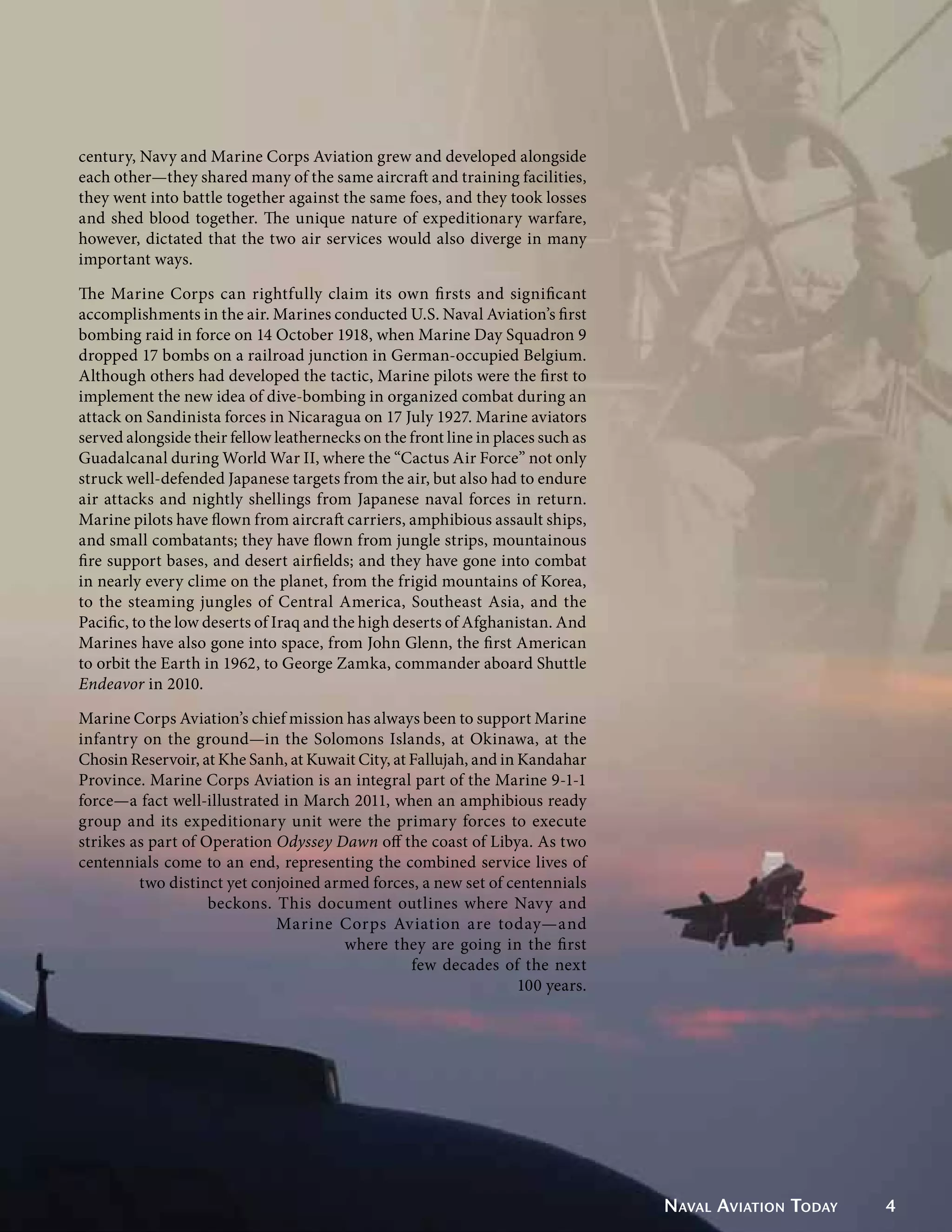
Marines have also gone into space, from John Glenn, the first American
to orbit the Earth in 1962, to George Zamka, commander aboard Shuttle
Endeavor in 2010.

Marine Corps Aviation’s chief mission has always been to support Marine
infantry on the ground—in the Solomons Islands, at Okinawa, at the
Chosin Reservoir, at Khe Sanh, at Kuwait City, at Fallujah, and in Kandahar
Province. Marine Corps Aviation is an integral part of the Marine 9-1-1
force—a fact well-illustrated in March 2011, when an amphibious ready
group and its expeditionary unit were the primary forces to execute
strikes as part of Operation Odyssey Dawn off the coast of Libya. As two
centennials come to an end, representing the combined service lives of
         two distinct yet conjoined armed forces, a new set of centennials
                    beckons. This document outlines where Navy and
                             Marine Corps Aviation are today—and
                                      where they are going in the first
                                                  few decades of the next
                                                                   100 years.


                                                                                 Naval Aviation Today   4
Naval Aviation In Action
    E  very day, 365 days a year, Naval Aviation is at sea, forward deployed, and ready to respond to
       crises anywhere within reach of the world’s oceans. The stories here document the various ways
    Naval Aviation makes sea power relevant today.


EA-18G Growler Makes Combat Debut
In Operation Odyssey Dawn
    Operation Odyssey Dawn, the U.S. component of the U.N.-sanctioned effort to protect Libyan
    civilians from the forces of Moammar Gadhafi, commenced on 19 March 2011 with a large
    salvo of Tomahawk missiles fired from U.S. Navy ships and submarines. U.S. Naval Aviation
    forces entered the fray the following day, striking more than 20 integrated air defense systems
    and facilities ashore in Libya.

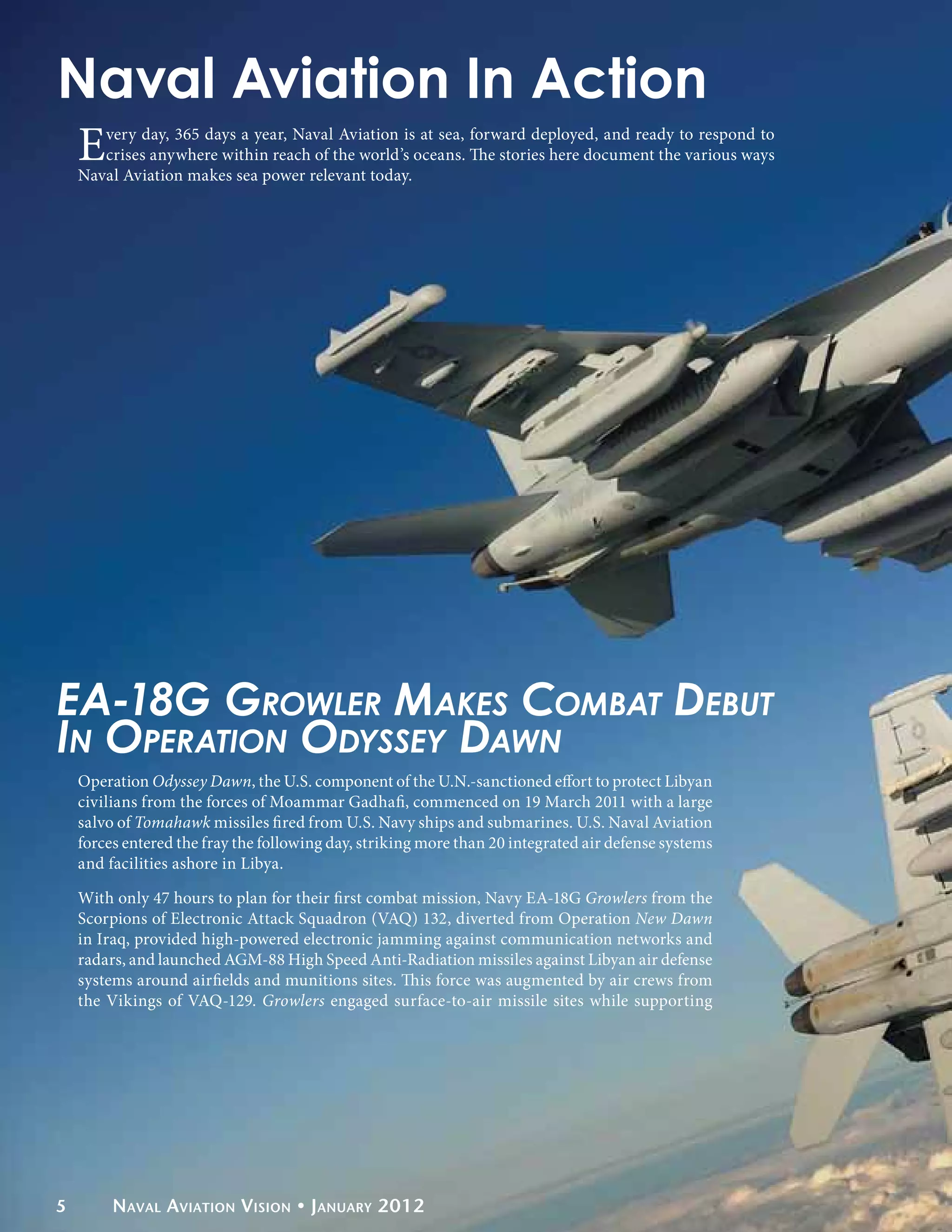
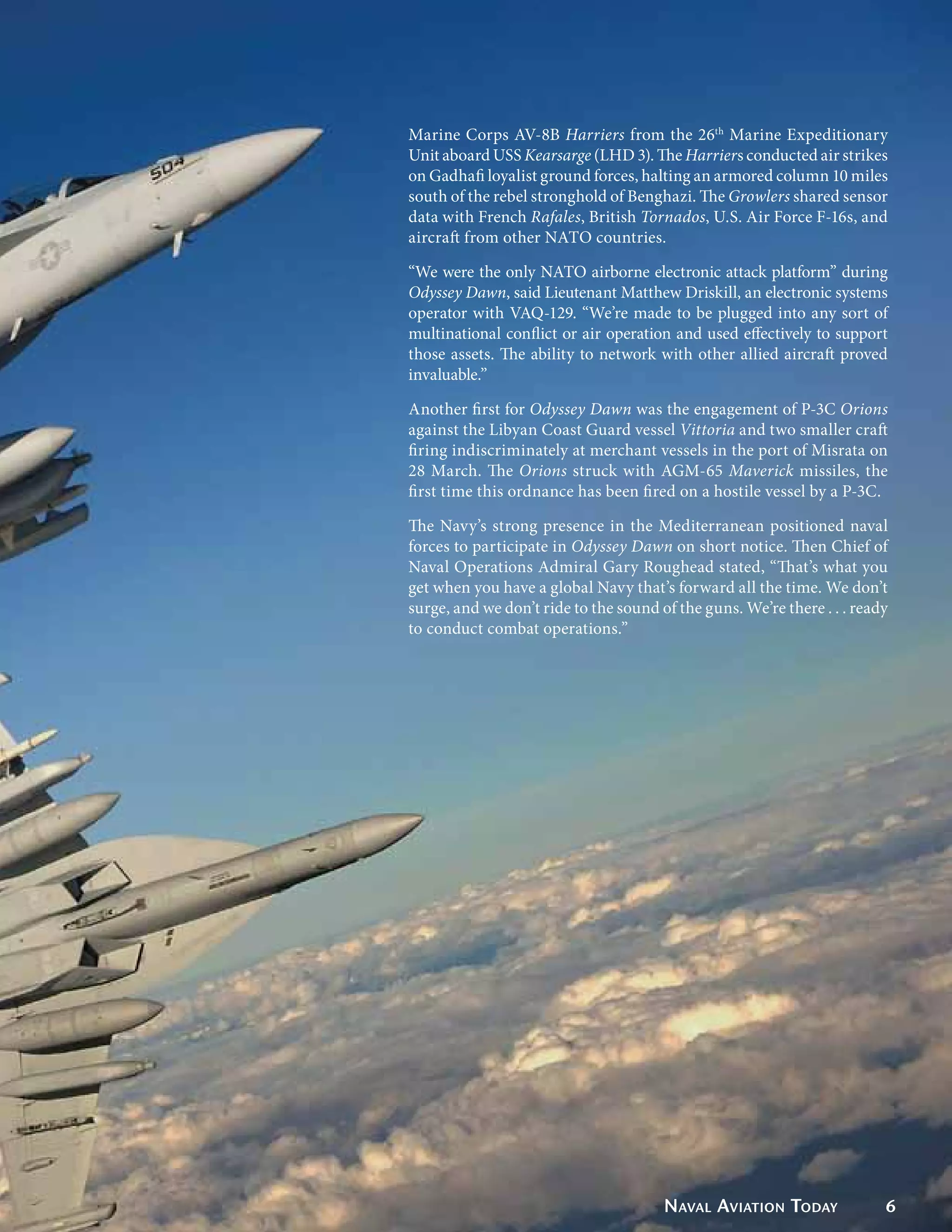
    With only 47 hours to plan for their first combat mission, Navy EA-18G Growlers from the
    Scorpions of Electronic Attack Squadron (VAQ) 132, diverted from Operation New Dawn
    in Iraq, provided high-powered electronic jamming against communication networks and
    radars, and launched AGM-88 High Speed Anti-Radiation missiles against Libyan air defense
    systems around airfields and munitions sites. This force was augmented by air crews from
    the Vikings of VAQ-129. Growlers engaged surface-to-air missile sites while supporting


5        Naval Aviation Vision • January 2012
Marine Corps AV-8B Harriers from the 26th Marine Expeditionary
Unit aboard USS Kearsarge (LHD 3). The Harriers conducted air strikes
on Gadhafi loyalist ground forces, halting an armored column 10 miles
south of the rebel stronghold of Benghazi. The Growlers shared sensor
data with French Rafales, British Tornados, U.S. Air Force F-16s, and
aircraft from other NATO countries.

“We were the only NATO airborne electronic attack platform” during
Odyssey Dawn, said Lieutenant Matthew Driskill, an electronic systems
operator with VAQ-129. “We’re made to be plugged into any sort of
multinational conflict or air operation and used effectively to support
those assets. The ability to network with other allied aircraft proved
invaluable.”

Another first for Odyssey Dawn was the engagement of P-3C Orions
against the Libyan Coast Guard vessel Vittoria and two smaller craft
firing indiscriminately at merchant vessels in the port of Misrata on
28 March. The Orions struck with AGM-65 Maverick missiles, the
first time this ordnance has been fired on a hostile vessel by a P-3C.

The Navy’s strong presence in the Mediterranean positioned naval
forces to participate in Odyssey Dawn on short notice. Then Chief of
Naval Operations Admiral Gary Roughead stated, “That’s what you
get when you have a global Navy that’s forward all the time. We don’t
surge, and we don’t ride to the sound of the guns. We’re there . . . ready
to conduct combat operations.”


                                       Naval Aviation Today              6
Fire Scout Heads to Sea
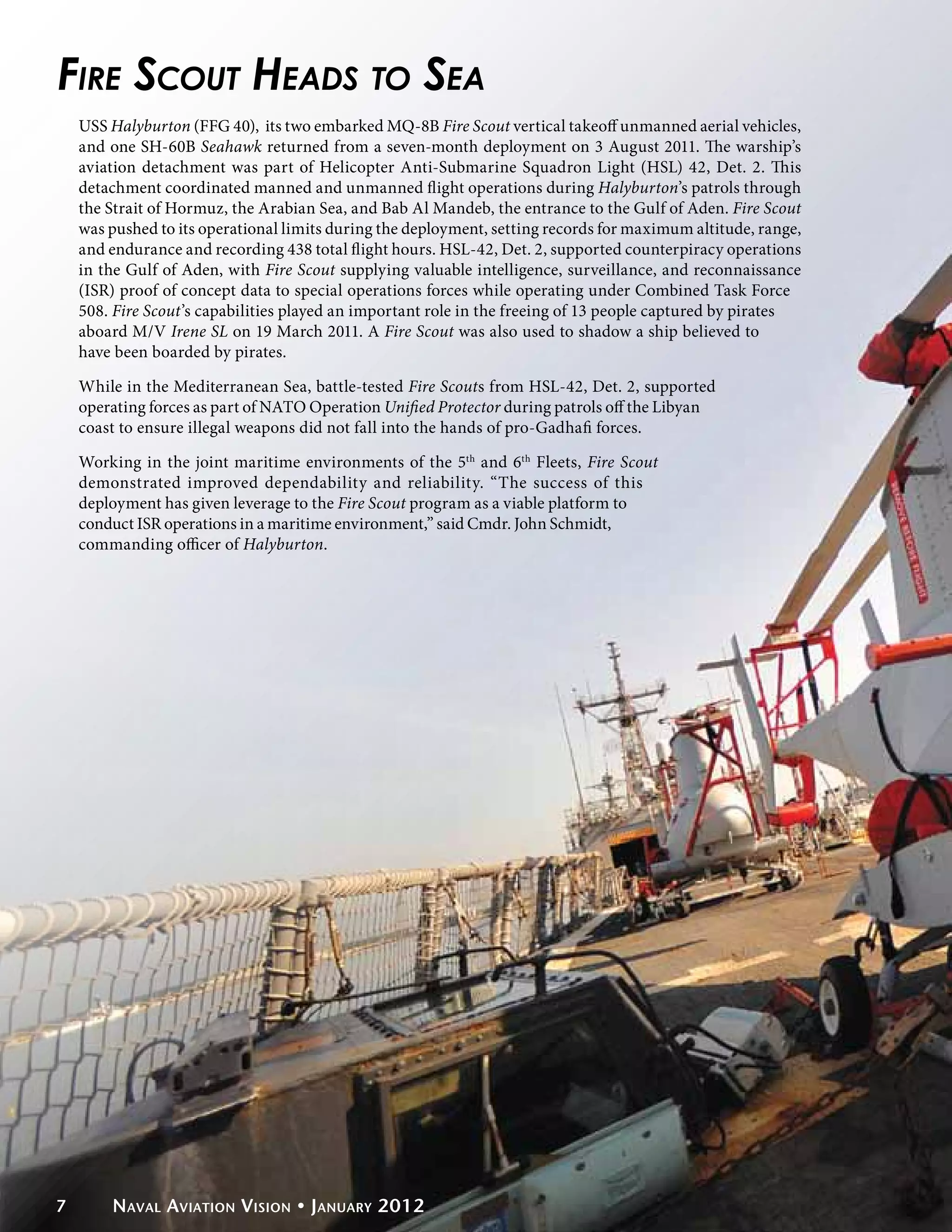
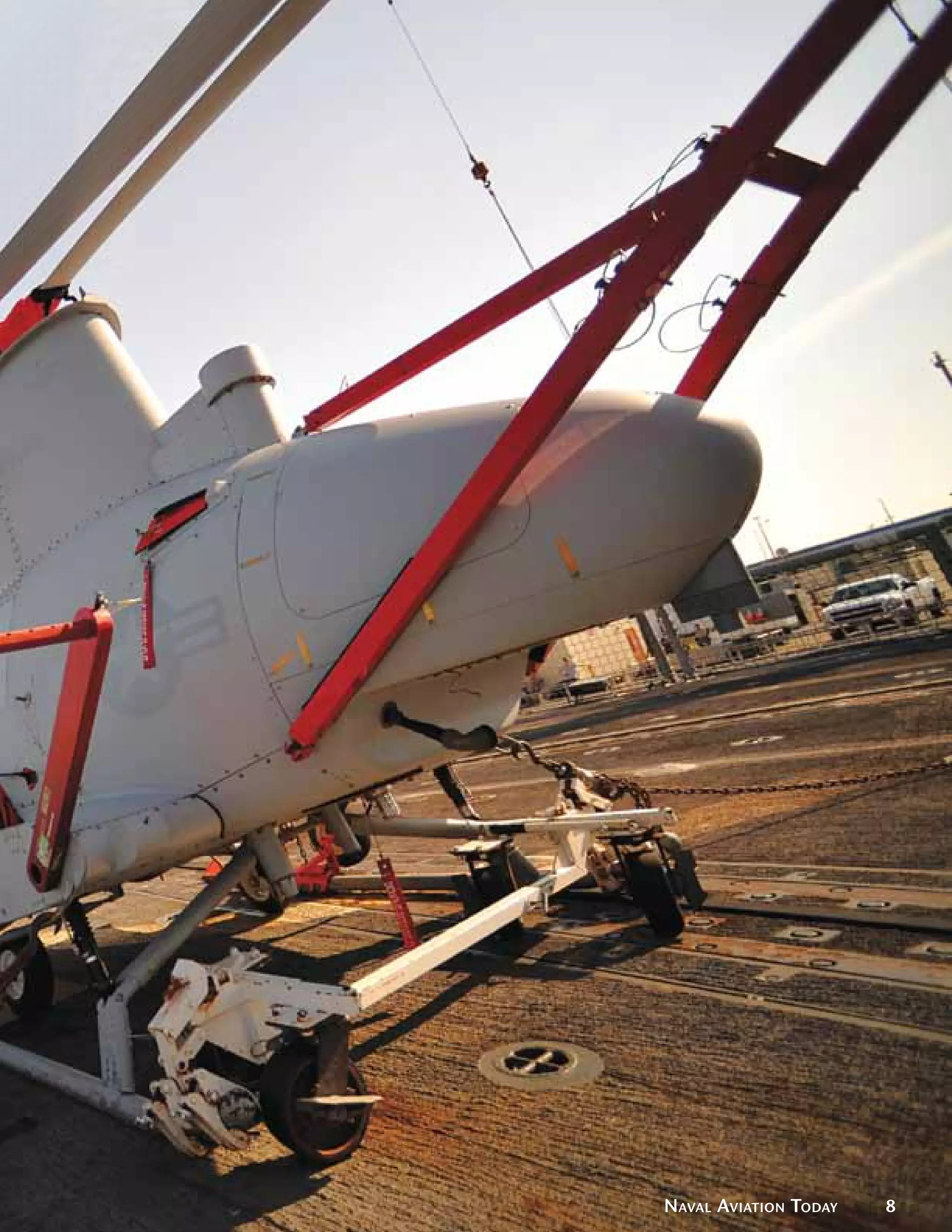
    USS Halyburton (FFG 40), its two embarked MQ-8B Fire Scout vertical takeoff unmanned aerial vehicles,
    and one SH-60B Seahawk returned from a seven-month deployment on 3 August 2011. The warship’s
    aviation detachment was part of Helicopter Anti-Submarine Squadron Light (HSL) 42, Det. 2. This
    detachment coordinated manned and unmanned flight operations during Halyburton’s patrols through
    the Strait of Hormuz, the Arabian Sea, and Bab Al Mandeb, the entrance to the Gulf of Aden. Fire Scout
    was pushed to its operational limits during the deployment, setting records for maximum altitude, range,
    and endurance and recording 438 total flight hours. HSL-42, Det. 2, supported counterpiracy operations
    in the Gulf of Aden, with Fire Scout supplying valuable intelligence, surveillance, and reconnaissance
    (ISR) proof of concept data to special operations forces while operating under Combined Task Force
    508. Fire Scout’s capabilities played an important role in the freeing of 13 people captured by pirates
    aboard M/V Irene SL on 19 March 2011. A Fire Scout was also used to shadow a ship believed to
    have been boarded by pirates.

    While in the Mediterranean Sea, battle-tested Fire Scouts from HSL-42, Det. 2, supported
    operating forces as part of NATO Operation Unified Protector during patrols off the Libyan
    coast to ensure illegal weapons did not fall into the hands of pro-Gadhafi forces.

    Working in the joint maritime environments of the 5th and 6th Fleets, Fire Scout
    demonstrated improved dependability and reliability. “The success of this
    deployment has given leverage to the Fire Scout program as a viable platform to
    conduct ISR operations in a maritime environment,” said Cmdr. John Schmidt,
    commanding officer of Halyburton.


7       Naval Aviation Vision • January 2012
Naval Aviation Today   8
Harvest Hawk Swoops Down On Afghanistan
    Helmand Province in southern Afghanistan—with its dispersed settlements, rough terrain, and limited infrastructure—
    offers ideal places for insurgents to conduct guerrilla warfare. To fight more effectively in this demanding environment,
    Marines on the ground turned to Naval Aviation for a precise weapon that could be fielded as rapidly as possible and
    deliver persistent presence, intelligence, and high-volume fire. Responding to a mission requirement in record time,
    Naval Aviation integrated the Harvest Airborne Weapons Kit (HAWK) with intelligence, surveillance, reconnaissance,
    and weapon systems that allow KC-130J Super Hercules to provide close air support while taking advantage of the
    aircraft’s ability to stay on station for up to three hours.

    The Harvest HAWK is a modular weapons/sensor kit consisting of a fire-control
    console located in the aircraft’s cargo compartment, an AN/AAQ-30 target
    sight system with infrared, electro-optic sensors, and a TV camera.
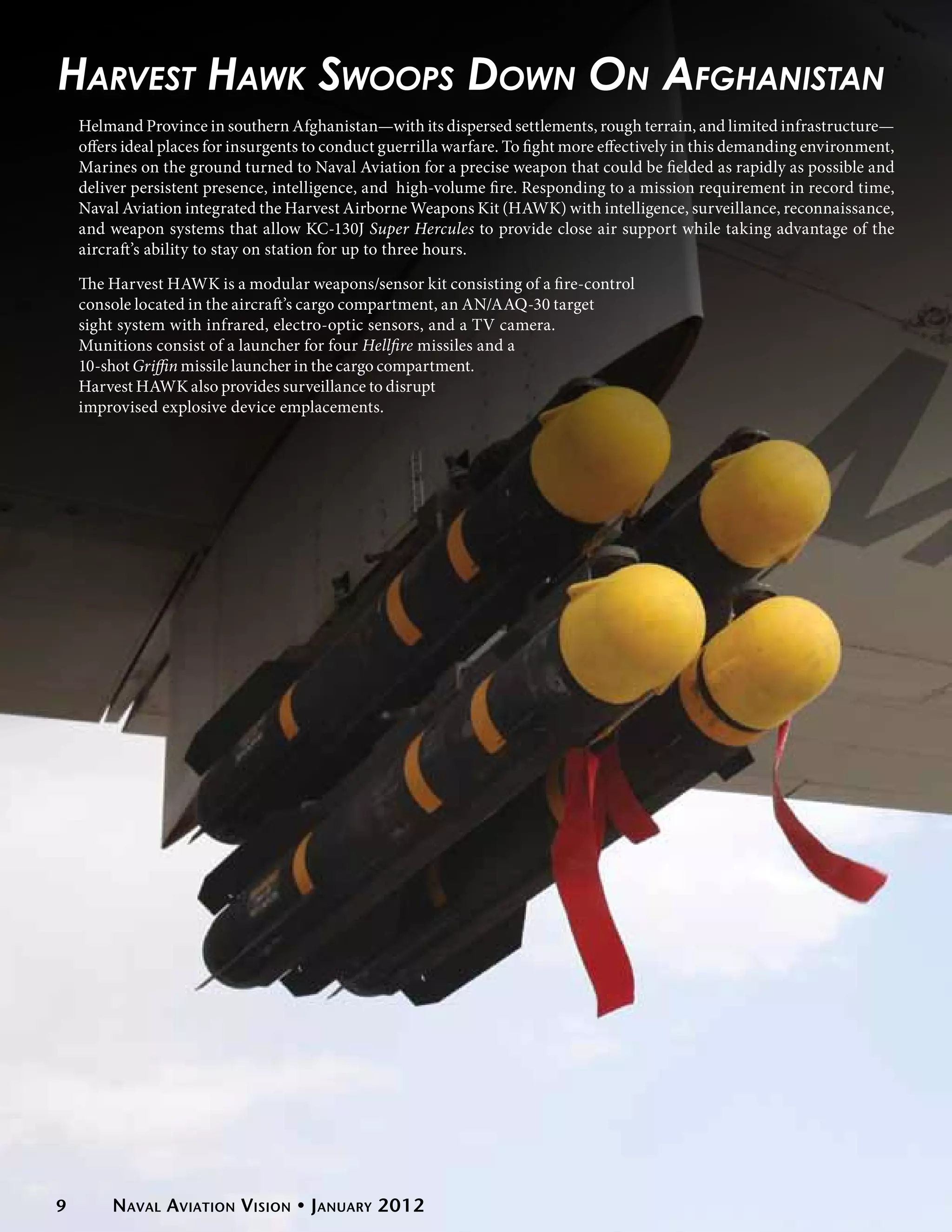
    Munitions consist of a launcher for four Hellfire missiles and a
    10-shot Griffin missile launcher in the cargo compartment.
    Harvest HAWK also provides surveillance to disrupt
    improvised explosive device emplacements.


9        Naval Aviation Vision • January 2012
Harvest HAWK deployed to Afghanistan for the first time in October 2010 with Marine Aerial Refueler Transport
Squadron (VMGR) 352. The system saw its first combat on 4 November, supporting Marines in Sangin. One Hellfire
was fired and five enemy insurgents were killed, with no civilian casualties or property damage during the firefight. By
August 2011, Harvest HAWK systems had fired 42 Hellfire and 11 Griffin missiles, flown more than 1,300 flight hours,
and spotted 11 roadside bombs.

Television monitors provide detailed ground images, allowing operators to engage targets with laser-guided bombs with
pinpoint accuracy. Harvest HAWK was the weapon of choice to neutralize insurgents in Marjah, where civilian casualties
and property damage were major concerns. The system is capable of hitting time-sensitive as well as stationary targets.
During night operations, Marines can track insurgents back to their bases and then take out an entire roadside bomb
operation. “Our Marines now have their very own eye in the sky able to track and eliminate enemy threats, shortening
the kill chain,” said Captain Michelle Guidry, program manager for the KC-130J and Harvest HAWK.


                                                                                     Naval Aviation Today           10
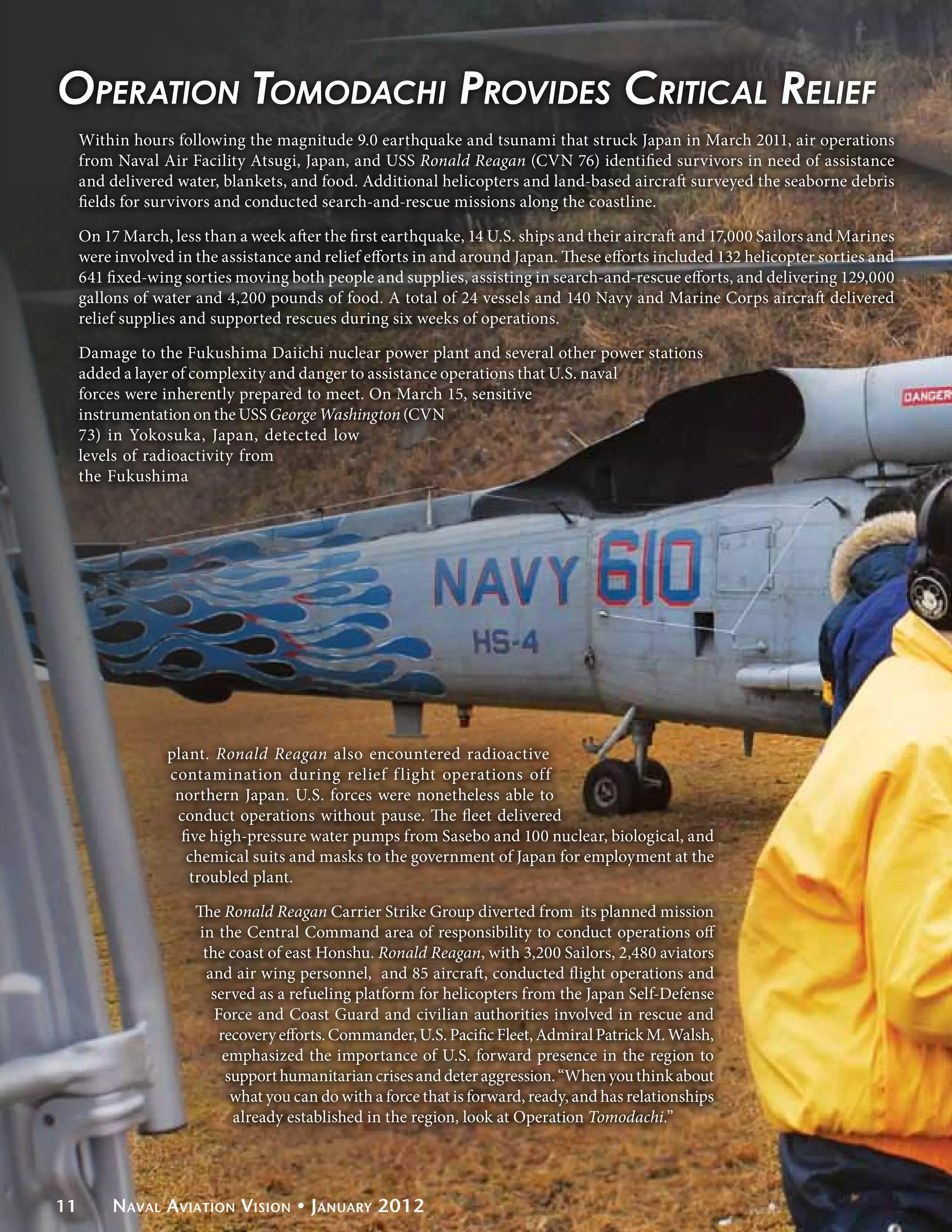
Operation Tomodachi Provides Critical Relief
     Within hours following the magnitude 9.0 earthquake and tsunami that struck Japan in March 2011, air operations
     from Naval Air Facility Atsugi, Japan, and USS Ronald Reagan (CVN 76) identified survivors in need of assistance
     and delivered water, blankets, and food. Additional helicopters and land-based aircraft surveyed the seaborne debris
     fields for survivors and conducted search-and-rescue missions along the coastline.

     On 17 March, less than a week after the first earthquake, 14 U.S. ships and their aircraft and 17,000 Sailors and Marines
     were involved in the assistance and relief efforts in and around Japan. These efforts included 132 helicopter sorties and
     641 fixed-wing sorties moving both people and supplies, assisting in search-and-rescue efforts, and delivering 129,000
     gallons of water and 4,200 pounds of food. A total of 24 vessels and 140 Navy and Marine Corps aircraft delivered
     relief supplies and supported rescues during six weeks of operations.

     Damage to the Fukushima Daiichi nuclear power plant and several other power stations
     added a layer of complexity and danger to assistance operations that U.S. naval
     forces were inherently prepared to meet. On March 15, sensitive
     instrumentation on the USS George Washington (CVN
     73) in Yokosuka, Japan, detected low
     levels of radioactivity from
     the Fukushima


                  plant. Ronald Reagan also encountered radioactive
                  contamination during relief f light operations off
                   northern Japan. U.S. forces were nonetheless able to
                   conduct operations without pause. The fleet delivered
                    five high-pressure water pumps from Sasebo and 100 nuclear, biological, and
                     chemical suits and masks to the government of Japan for employment at the
                      troubled plant.

                      The Ronald Reagan Carrier Strike Group diverted from its planned mission
                       in the Central Command area of responsibility to conduct operations off
                        the coast of east Honshu. Ronald Reagan, with 3,200 Sailors, 2,480 aviators
                         and air wing personnel, and 85 aircraft, conducted flight operations and
                          served as a refueling platform for helicopters from the Japan Self-Defense
                          Force and Coast Guard and civilian authorities involved in rescue and
                           recovery efforts. Commander, U.S. Pacific Fleet, Admiral Patrick M. Walsh,
                            emphasized the importance of U.S. forward presence in the region to
                            support humanitarian crises and deter aggression. “When you think about
                             what you can do with a force that is forward, ready, and has relationships
                             already established in the region, look at Operation Tomodachi.”


11        Naval Aviation Vision • January 2012
Naval Aviation Today   12
Naval Aviation Tomorrow


13   Naval Aviation Vision • January 2012
Naval Aviation Tomorrow   14
Where We Are Going
 N     aval Aviation is executing one of the largest aircraft transitions in its history. In the
       past two years, new platforms have moved from development to production and test.
 Several test aircraft are currently on the line at Naval Air Station Patuxent River, Md.,
 home to the Naval Air Systems Command—Naval Aviation’s organization for research,
 development, test, evaluation, acquisition, and program management. The P-8A Poseidon,
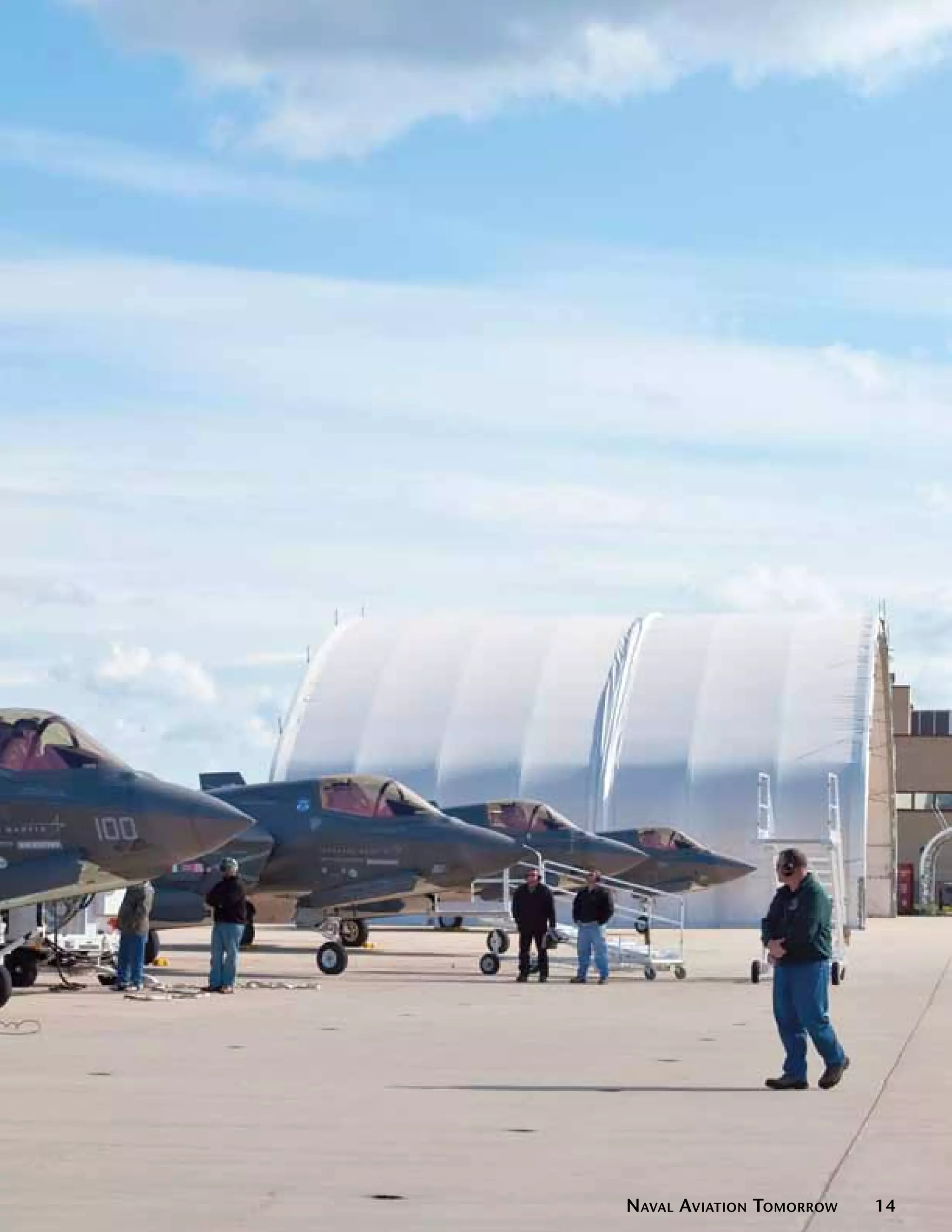
 the E-2D Advanced Hawkeye, and the F-35B and C versions of the Joint Strike Fighter are
 being evaluated by test pilots and naval flight officers so they are fully mission ready when
 they join the fleet. On the systems front, the Electromagnetic Aircraft Launch System
 (EMALS)—a completely new all electric carrier-based aircraft launch system designed for
 the Gerald R. Ford (CVN 78)-class aircraft carrier—is progressing on schedule. EMALS
 uses stored kinetic energy and solid-state electrical power conversion technology, which
 permits a high degree of computer control, monitoring, and automation. The system will
 provide the capability to launch all current and future carrier air wing platforms, from
 lightweight unmanned aerial vehicles to heavy strike fighters. It is designed to achieve
 increased sortie rates, improve reliability, lower operating costs, and better control launch
 forces resulting in reduced wear and tear on our aircraft. The first EMALS test launch, an
 F/A-18E Super Hornet, was conducted at Naval Air Engineering Station Lakehurst, N.J.,
 on 18 December 2010. Compatibility testing has continued with additional F/A-18E, E-2D
 Advanced Hawkeye, T-45 Goshawk, and C-2A Greyhound launches. The first set of EMALS
 components were delivered to CVN 78 in May 2011. Developing alongside EMALS, an
 equally revolutionary aircraft recovery system, Advanced Arresting Gear (AAG), is under
 development and testing at Lakehurst. AAG will be installed on Ford-class carriers and has
 the potential to be retrofitted on Nimitz-class carriers. Like EMALS, AAG will contribute
 to increased sortie generation rates, reduced manning, and lower total ownership costs.


15    Naval Aviation Vision • January 2012
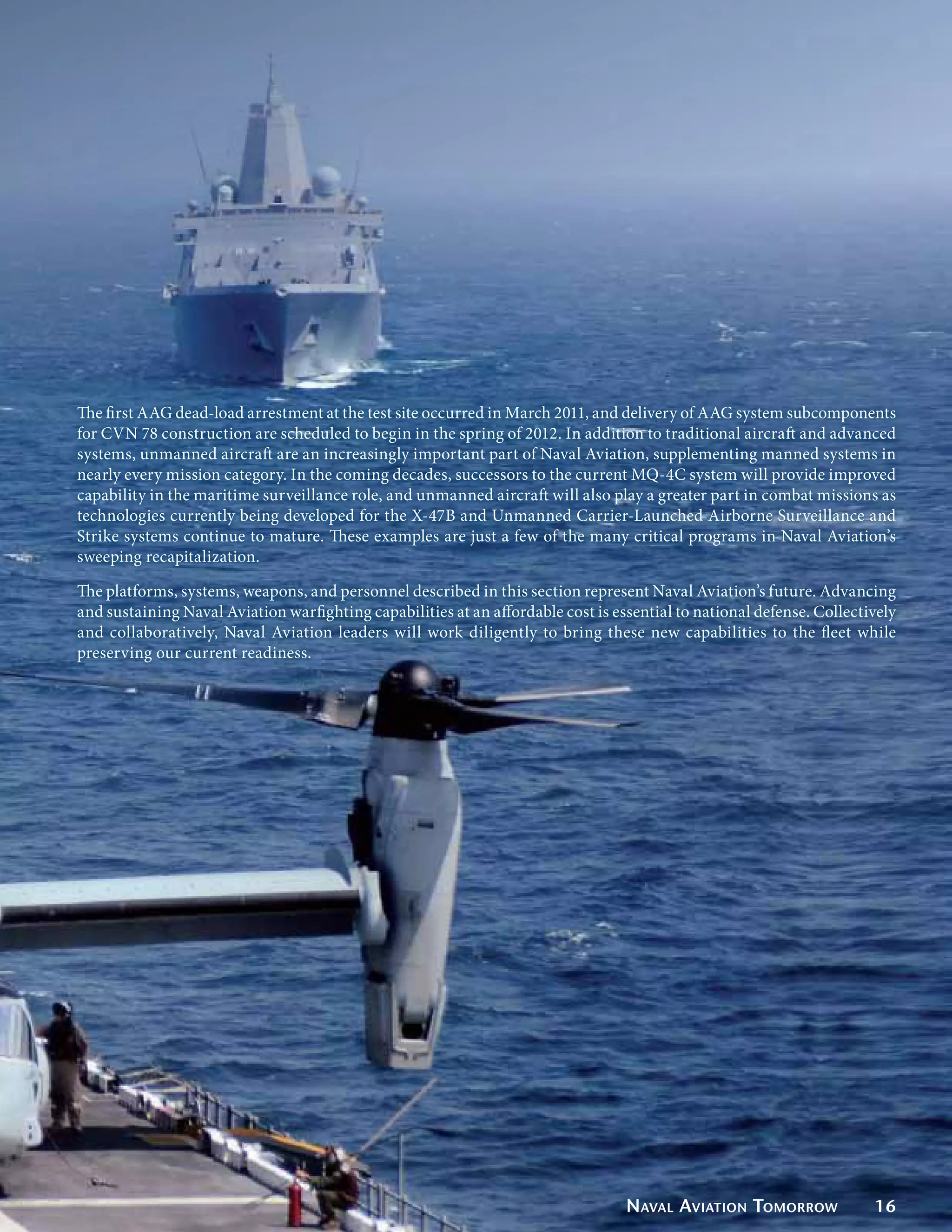
The first AAG dead-load arrestment at the test site occurred in March 2011, and delivery of AAG system subcomponents
for CVN 78 construction are scheduled to begin in the spring of 2012. In addition to traditional aircraft and advanced
systems, unmanned aircraft are an increasingly important part of Naval Aviation, supplementing manned systems in
nearly every mission category. In the coming decades, successors to the current MQ-4C system will provide improved
capability in the maritime surveillance role, and unmanned aircraft will also play a greater part in combat missions as
technologies currently being developed for the X-47B and Unmanned Carrier-Launched Airborne Surveillance and
Strike systems continue to mature. These examples are just a few of the many critical programs in Naval Aviation’s
sweeping recapitalization.

The platforms, systems, weapons, and personnel described in this section represent Naval Aviation’s future. Advancing
and sustaining Naval Aviation warfighting capabilities at an affordable cost is essential to national defense. Collectively
and collaboratively, Naval Aviation leaders will work diligently to bring these new capabilities to the fleet while
preserving our current readiness.


                                                                                  Naval Aviation Tomorrow              16
Transformation Roadmaps
Ships
AIRCRAFT CARRIERS
     The U.S. Navy’s aircraft carriers, with their embarked carrier air wings, provide the right balance of forward presence
     and surge capability to conduct warfighting and peacetime operations around the globe in support of national
     priorities. Sailing the world’s oceans, each carrier strike group possesses a versatile, independent, and deadly striking
     force capable of engaging targets hundreds of miles at sea or inland. The mobility and operational independence of
     aircraft carriers provides a unique level of access that does not require host-nation support. Nuclear-powered aircraft
     carriers can remain on-station for months at a time, replenishing ordnance, spare parts, food, consumables, and aircraft
     fuel while conducting air strikes and other critical missions. This capability demonstrates the carrier’s remarkable
     operational flexibility and self-reliance that is so vital to conducting time-critical strike operations. Aircraft carriers
     and their strike groups are always within reach of where they need to be and are ready on arrival.

     The Navy’s 11 aircraft carriers became a completely nuclear-powered force in May
     2009 with the decommissioning of the last conventionally powered carrier and
     the delivery of USS George H. W. Bush (CVN 77). USS Enterprise (CVN 65) will
     be inactivated in fiscal year 2013 after 51 years of service, resulting in a fleet of all
     Nimitz-class aircraft carriers. The last Nimitz-class carrier will serve until 2059.

     In 2004, a new design was approved to ensure the aircraft carrier’s role as the
     centerpiece of the 21st-century carrier strike group.

     Construction of Gerald R. Ford (CVN 78), the lead ship of the new class of aircraft
     carriers, began in 2008. The Ford class is the first new aircraft carrier design in more
     than 40 years. The Ford design boasts improved nuclear reactors and converts all
     auxiliary systems outside the main propulsion plant from steam to electric power.
     This change will greatly reduce the requirement for costly steam, hydraulic, and
     pneumatic piping and the repair of those distributed systems. The improved reactor
     and zoned electrical distribution system will also increase electrical generating capacity
     by nearly 300 percent. This will enable new technologies such as the Electromagnetic Aircraft
     Launch System and advanced command-and-control systems. The new ship design, based on
     the Nimitz hull, also includes an advanced arresting gear system, dual-band radar, joint precision
     approach and landing system, and redesigned flight and hangar decks. The redesigned flight deck allows
     greater flexibility during aircraft turnaround and launch-and-recovery cycles, leading to a 25-percent
     increase in daily sortie generation rate capability. The second ship of the Ford class, John F. Kennedy (CVN
     79), began advanced construction phase in December 2010; the first ceremonial steel cutting was conducted in
     February 2011. Kennedy is the planned force-level replacement for USS Nimitz (CVN 68).

     To meet the demands of 21st-century warfare, Nimitz- and Ford-class aircraft carriers will deploy long-range manned
     and unmanned strike aircraft. Advanced weapons and sensors, combined with high-speed sealift platforms, tilt-
     rotor aircraft, and advanced amphibious assault vehicles, will generate more flexible combat power. Joint concepts of
     operation, centered on the aircraft carrier, will leverage the military strengths of all the services, bringing cooperative
     muscle to the fight and a potent synergy across the warfare continuum.


17        Naval Aviation Vision • January 2012
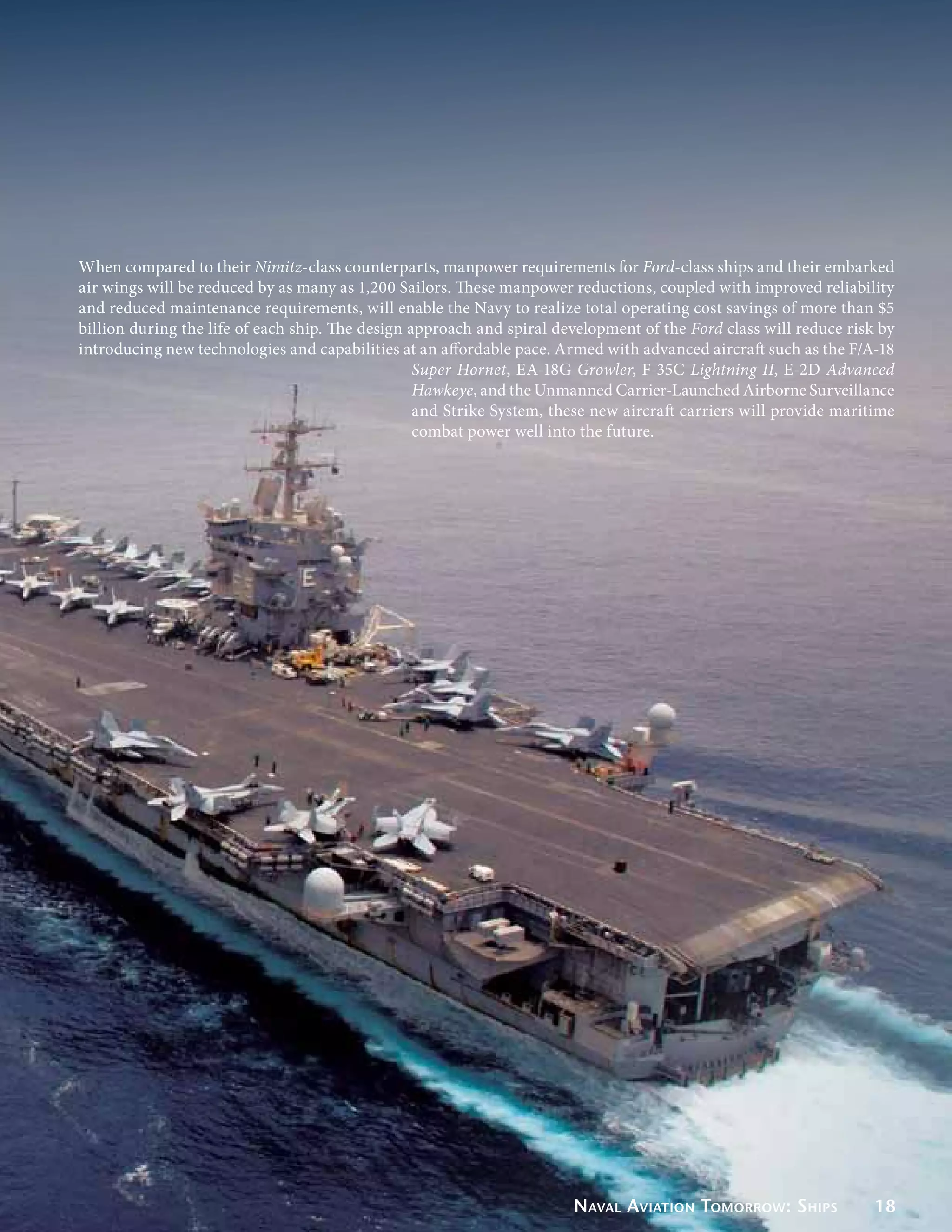
When compared to their Nimitz-class counterparts, manpower requirements for Ford-class ships and their embarked
air wings will be reduced by as many as 1,200 Sailors. These manpower reductions, coupled with improved reliability
and reduced maintenance requirements, will enable the Navy to realize total operating cost savings of more than $5
billion during the life of each ship. The design approach and spiral development of the Ford class will reduce risk by
introducing new technologies and capabilities at an affordable pace. Armed with advanced aircraft such as the F/A-18
                                                  Super Hornet, EA-18G Growler, F-35C Lightning II, E-2D Advanced
                                                  Hawkeye, and the Unmanned Carrier-Launched Airborne Surveillance
                                                  and Strike System, these new aircraft carriers will provide maritime
                                                  combat power well into the future.


                                                                       Naval Aviation Tomorrow: Ships              18
FUTURE CARRIER AIR WING
 The carrier air wing of the future will consist of the following aircraft:

     •	 44 strike fighters (F/A-18E/F, F-35C, F/A-18E/F Replacement*)
     •	 5 electronic attack aircraft (EA-18G, EA-18G Replacement)
     •	 5 airborne early warning and command and control aircraft (E-2D)
     •	 19 helicopters (MH-60R/S or MH-60R/S Replacement). Current projections include
        deploying 11 helicopters aboard the carrier, with the remaining 8 dispersed to other
        ships in the strike group
     •	 2-3 Future Carrier Onboard Delivery aircraft will normally be embarked to support
        the air wing and strike group
     •	 The Navy Unmanned Carrier-Launched Airborne Surveillance and Strike System
        is expected to reach an initial capability in 2018. One option is to have 4-6 aircraft
        embarked.


 * The F/A-18E/F Replacement may include a mix of manned, optionally manned,
 or unmanned platforms.


19      Naval Aviation Vision • January 2012
Naval Aviation Tomorrow: Ships   20
AMPHIBIOUS ASSAULT SHIPS
 The Marine Corps is our nation’s amphibious, expeditionary, air-ground team
 that has the flexibility to conduct military operations from the air, land, and sea.
 Relevant in conventional as well as irregular warfare, amphibious forces provide
 highly versatile options for any joint force commander tasked with conducting
 operations in the littoral regions of the world. Amphibious assault ships are the
 largest of all amphibious warfare ships, resembling small aircraft carriers. In
 addition to launching aircraft, they deliver Marine expeditionary forces and their
 equipment to the beach by way of small watercraft. Perhaps more than any other
 asset, these ships symbolize the warfighting relationship between the Navy and
 the Marine Corps, delivering the fight to the enemy in “every clime and place.”

 Large-deck amphibious assault ships were designed to embark, deploy, and land
 elements of Marine Corps and special operations forces by tilt-rotor and rotary-
 wing aircraft, landing craft, and amphibious vehicles while providing organic
 ground support with fixed-wing aviation. These very capable platforms are routinely
 deployed as the centerpieces of forward-deployed expeditionary strike groups,
 which also include San Antonio-class, Whidbey Island-class, and/or Harpers Ferry-
 class vessels with embarked Marine air-ground task forces. They provide a unique
 tool capable of supporting the full range of military operations.


21    Naval Aviation Vision • January 2012
Naval Aviation Tomorrow: Ships   22
LHA: Amphibious Assault Ship – General Purpose
 These vessels have been modified to accommodate fixed-wing and tilt-rotor aircraft. Each ship can carry a mix of
 31 rotary-wing and fixed-wing vertical/short takeoff and landing and vertical takeoff and landing aircraft with one
 air-cushioned landing craft or four utility landing craft, and more than 1,700 troops. They can also support sea-based
 command and control of waterborne and aerial ship-to-shore movements. With a fleet surgical team embarked,
 an LHA can function as a primary casualty receiving and treatment ship with 17 intensive care unit beds, four
 operating rooms, 300 hospital beds, a 1,000-unit blood bank, and dental and X-ray facilities. USS Peleliu (LHA 5),
 the remaining Tarawa-class LHA, will reach the end of its service life in 2015.


23    Naval Aviation Vision • January 2012
LHD: Amphibious Assault Ship – Multipurpose
 Wasp-class LHDs have an improved flight deck and elevator scheme and can accommodate a mix of 31 rotary-wing
 and fixed-wing aircraft. LHDs were the first amphibious vessels designed to carry both the AV-8B Harrier aircraft and
 multiple air-cushioned landing craft. Their enhanced well decks are capable of carrying three air-cushion or three
 utility landing craft, and they can embark more than 1,680 troops. Wasp-class LHDs have the same Navy and Marine
 Corps command-and-control facilities as the Tarawa class and also have six operating rooms and 600 hospital beds. All
 LHDs are being modified to operate the MV-22 Osprey and the F-35B Lightning II. USS Makin Island (LHD 8), the last
 of the Wasp-class LHDs to be commissioned, has a gas-turbine propulsion system and an all-electric auxiliary system.


                                                                       Naval Aviation Tomorrow: Ships             24
25   Naval Aviation Vision • January 2012
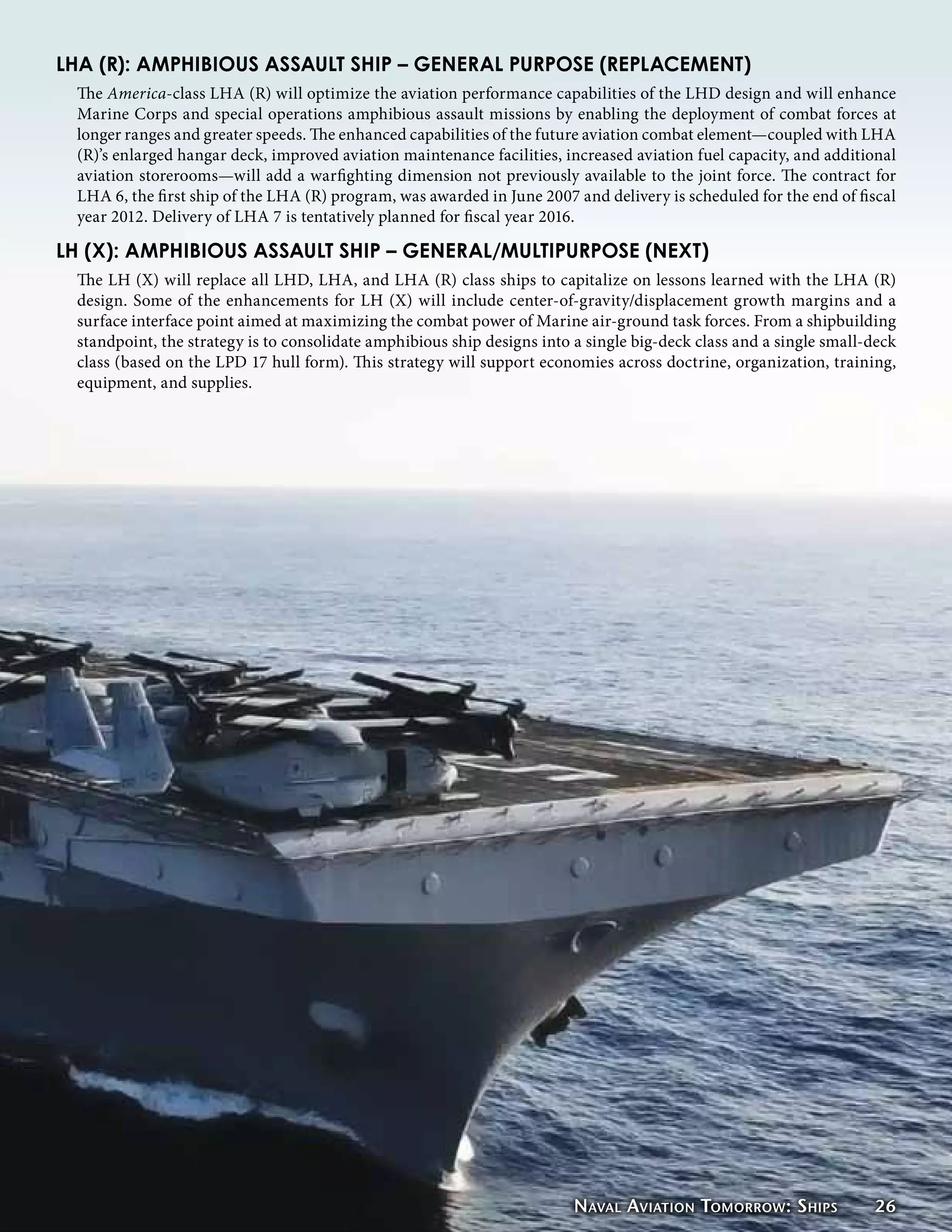
LHA (R): Amphibious Assault Ship – General Purpose (Replacement)
 The America-class LHA (R) will optimize the aviation performance capabilities of the LHD design and will enhance
 Marine Corps and special operations amphibious assault missions by enabling the deployment of combat forces at
 longer ranges and greater speeds. The enhanced capabilities of the future aviation combat element—coupled with LHA
 (R)’s enlarged hangar deck, improved aviation maintenance facilities, increased aviation fuel capacity, and additional
 aviation storerooms—will add a warfighting dimension not previously available to the joint force. The contract for
 LHA 6, the first ship of the LHA (R) program, was awarded in June 2007 and delivery is scheduled for the end of fiscal
 year 2012. Delivery of LHA 7 is tentatively planned for fiscal year 2016.

LH (X): Amphibious Assault Ship – General/Multipurpose (Next)
 The LH (X) will replace all LHD, LHA, and LHA (R) class ships to capitalize on lessons learned with the LHA (R)
 design. Some of the enhancements for LH (X) will include center-of-gravity/displacement growth margins and a
 surface interface point aimed at maximizing the combat power of Marine air-ground task forces. From a shipbuilding
 standpoint, the strategy is to consolidate amphibious ship designs into a single big-deck class and a single small-deck
 class (based on the LPD 17 hull form). This strategy will support economies across doctrine, organization, training,
 equipment, and supplies.


                                                                         Naval Aviation Tomorrow: Ships             26
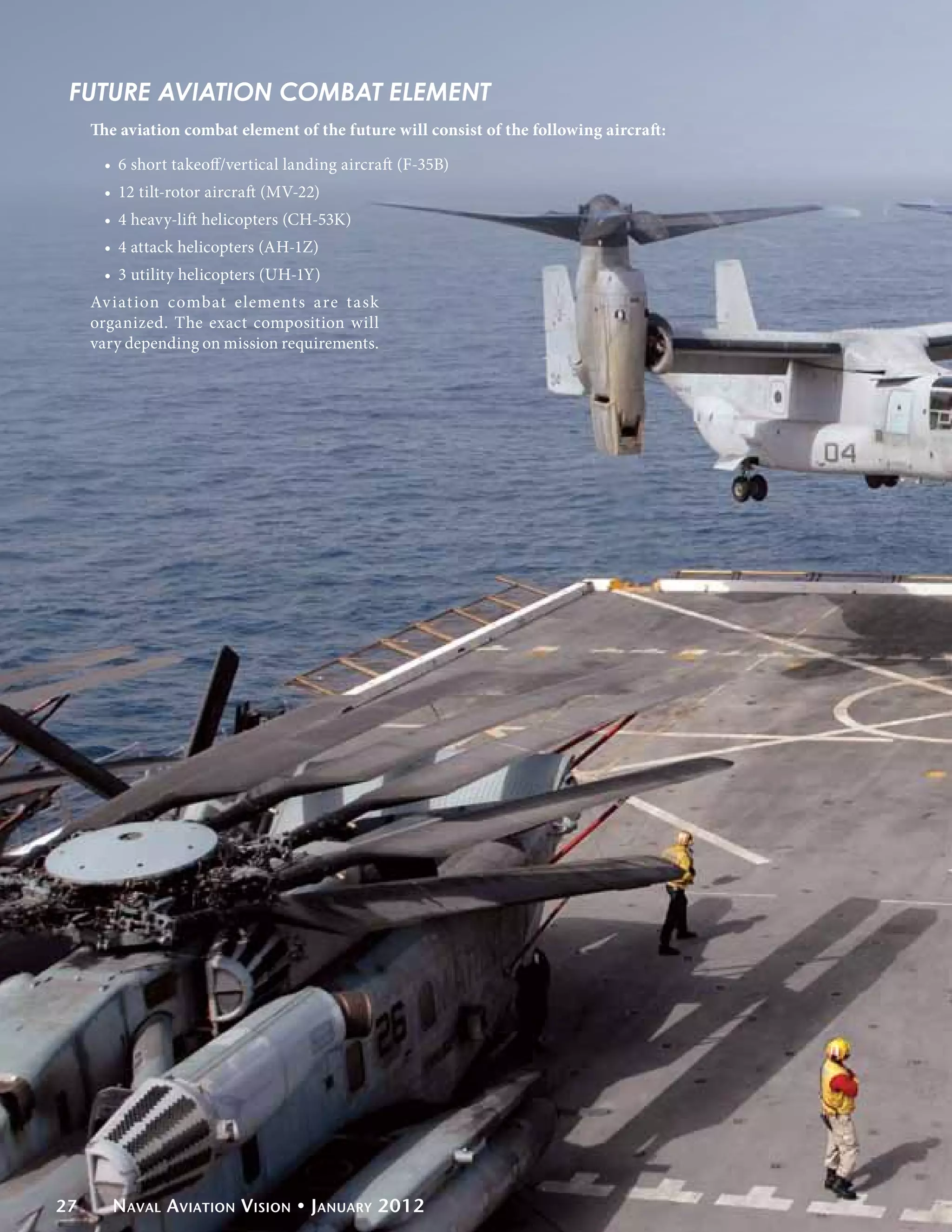
FUTURE AVIATION COMBAT ELEMENT
     The aviation combat element of the future will consist of the following aircraft:

      •	 6 short takeoff/vertical landing aircraft (F-35B)
      •	 12 tilt-rotor aircraft (MV-22)
      •	 4 heavy-lift helicopters (CH-53K)
      •	 4 attack helicopters (AH-1Z)
      •	 3 utility helicopters (UH-1Y)
     Av iat ion combat elements a re task
     organized. The exact composition will
     vary depending on mission requirements.


27      Naval Aviation Vision • January 2012
Naval Aviation Tomorrow: Ships   28
Manned and Unmanned Aircraft
UNMANNED SYSTEMS
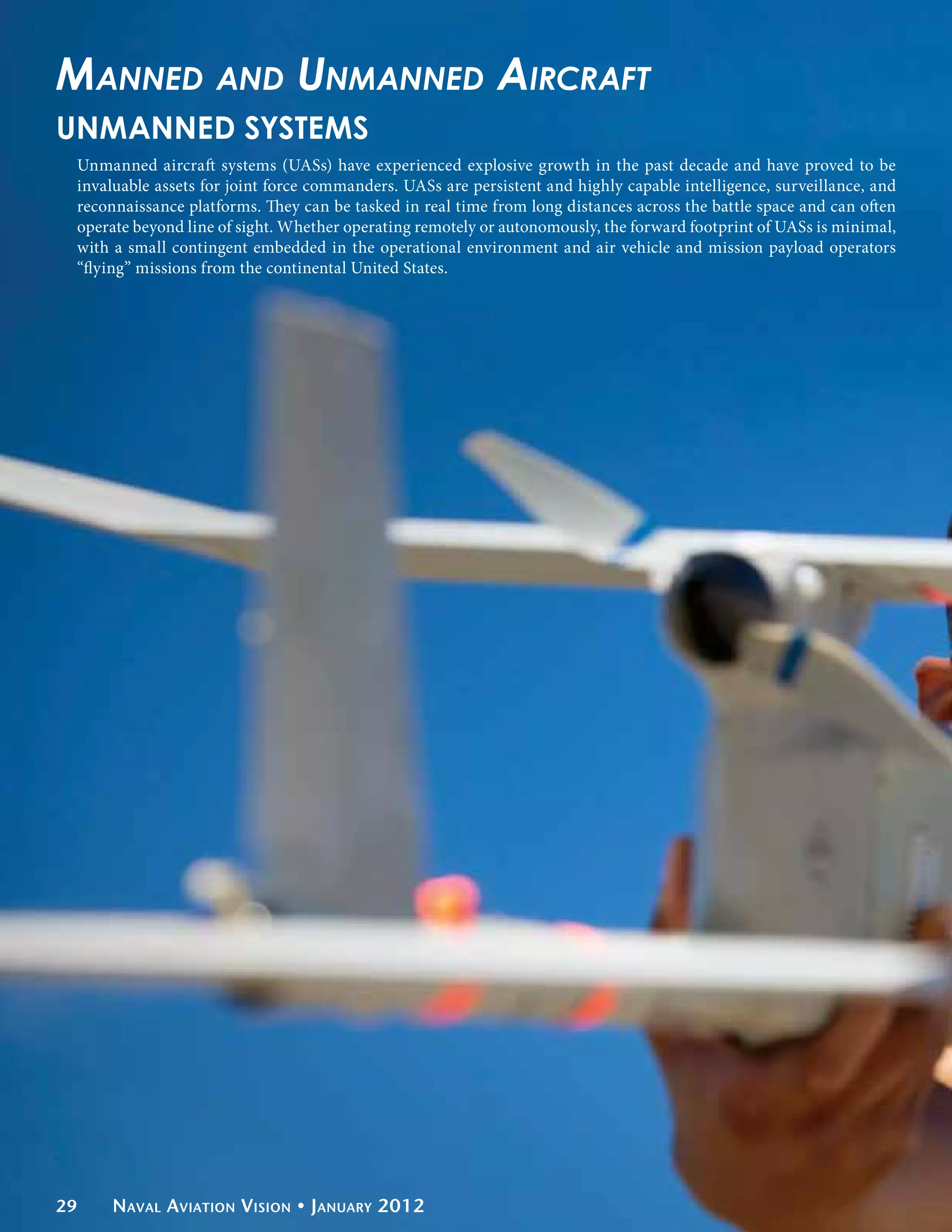
 Unmanned aircraft systems (UASs) have experienced explosive growth in the past decade and have proved to be
 invaluable assets for joint force commanders. UASs are persistent and highly capable intelligence, surveillance, and
 reconnaissance platforms. They can be tasked in real time from long distances across the battle space and can often
 operate beyond line of sight. Whether operating remotely or autonomously, the forward footprint of UASs is minimal,
 with a small contingent embedded in the operational environment and air vehicle and mission payload operators
 “flying” missions from the continental United States.


29    Naval Aviation Vision • January 2012
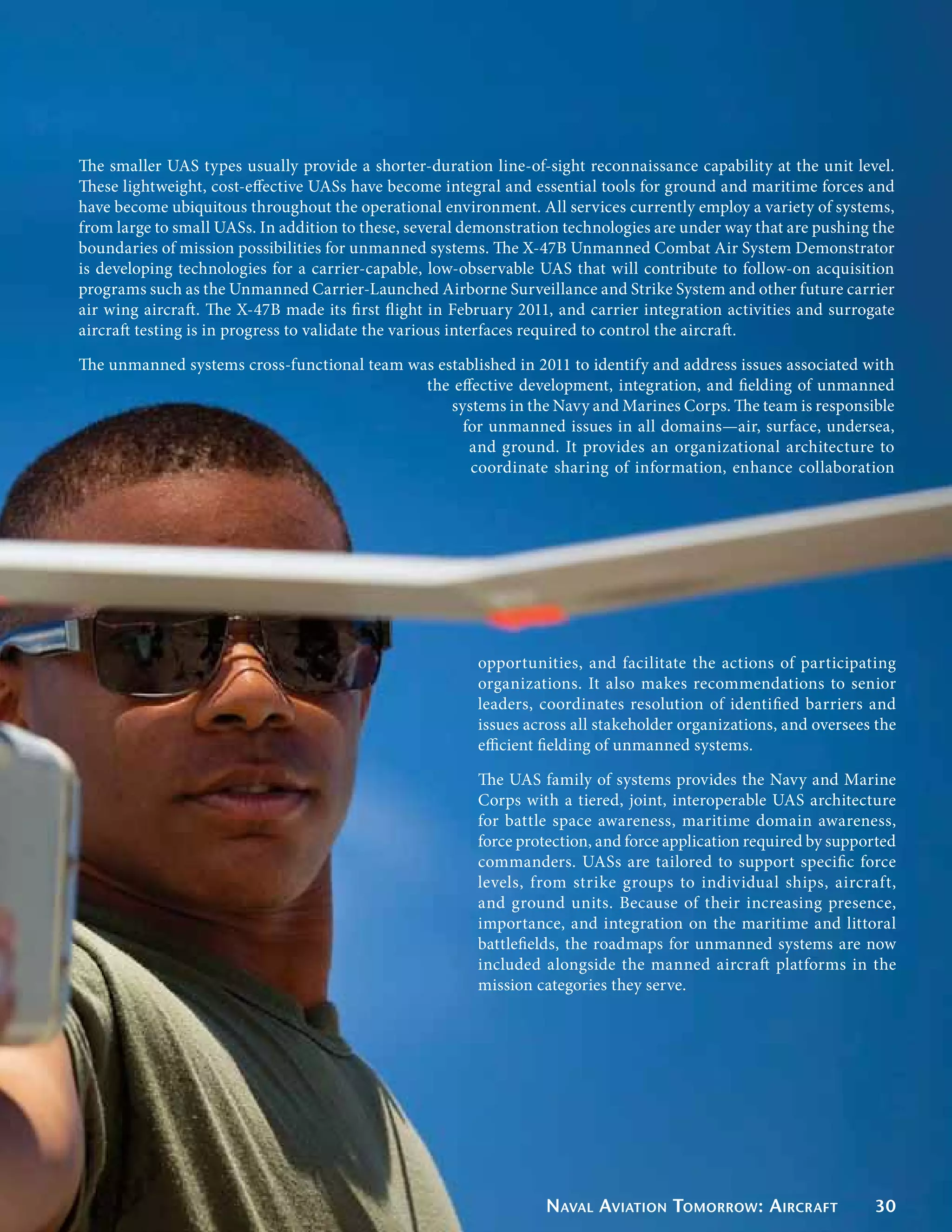
The smaller UAS types usually provide a shorter-duration line-of-sight reconnaissance capability at the unit level.
These lightweight, cost-effective UASs have become integral and essential tools for ground and maritime forces and
have become ubiquitous throughout the operational environment. All services currently employ a variety of systems,
from large to small UASs. In addition to these, several demonstration technologies are under way that are pushing the
boundaries of mission possibilities for unmanned systems. The X-47B Unmanned Combat Air System Demonstrator
is developing technologies for a carrier-capable, low-observable UAS that will contribute to follow-on acquisition
programs such as the Unmanned Carrier-Launched Airborne Surveillance and Strike System and other future carrier
air wing aircraft. The X-47B made its first flight in February 2011, and carrier integration activities and surrogate
aircraft testing is in progress to validate the various interfaces required to control the aircraft.

The unmanned systems cross-functional team was established in 2011 to identify and address issues associated with
                                             the effective development, integration, and fielding of unmanned
                                                 systems in the Navy and Marines Corps. The team is responsible
                                                   for unmanned issues in all domains—air, surface, undersea,
                                                    and ground. It provides an organizational architecture to
                                                    coordinate sharing of information, enhance collaboration


                                                         opportunities, and facilitate the actions of participating
                                                         organizations. It also makes recommendations to senior
                                                         leaders, coordinates resolution of identified barriers and
                                                         issues across all stakeholder organizations, and oversees the
                                                         efficient fielding of unmanned systems.

                                                         The UAS family of systems provides the Navy and Marine
                                                         Corps with a tiered, joint, interoperable UAS architecture
                                                         for battle space awareness, maritime domain awareness,
                                                         force protection, and force application required by supported
                                                         commanders. UASs are tailored to support specific force
                                                         levels, from strike groups to individual ships, aircraft,
                                                         and ground units. Because of their increasing presence,
                                                         importance, and integration on the maritime and littoral
                                                         battlefields, the roadmaps for unmanned systems are now
                                                         included alongside the manned aircraft platforms in the
                                                         mission categories they serve.


                                                                   Naval Aviation Tomorrow: A ircraft             30
NAVY TACTICAL AIRCRAFT
F-35C Lightning II
 The Joint Strike Fighter program is building a tri-service family of next-generation, “day one”-capable, strike-fighter
 aircraft that is flexible and survivable. With its all-aspect stealth strike design, internal weapon carriage, fully fused
 mission systems, and unrefueled combat radius of greater than 600 nautical miles, the Navy’s F-35C Lightning II will
 complement the capabilities of the F/A-18E/F Super Hornet now serving as the Navy’s premier strike fighter. The F-35C
 will enhance the flexibility, power projection, and strike capabilities of carrier air wings and joint task forces.

F/A-18E/F Super Hornet / F/A-18E/F Replacement
 There are a number of enhancements to the F/A-18E/F Super Hornet that will sustain its lethality well into the 21st
 century. Upgrades include critical growth capability, enhanced survivability, and the ability to land on carriers with
 a greater quantity of unexpended ordnance without exceeding maximum landing weight. Avionics upgrades for the
 F/A-18E/F Block II include the APG-79 Active Electronically Scanned Array Radar System, the Infrared Search and
 Track System, and advanced sensor integration. Future avionics upgrades will enable network-centric operations, which
 will enhance situational awareness and the transfer of data to command-and-control nodes. The Super Hornet also fills
 the critical organic tanking mission for carrier air wings, extending the operational reach of the nation’s sea power.

 Naval Aviation continues to study the capabilities required when the F/A-18E/F reaches the limits of its service life
 beginning in 2025. The assessment is the initial stage of the requirements and acquisition process; it will evaluate a full
 range of considerations for addressing future Navy needs and recapitalization issues, including manned, unmanned,
 and system-of-systems options. The capabilities assessed during the study will be further developed and refined through
 operational analytical modeling and simulation, potentially leading to an analysis of alternatives and, eventually, a
 competitive fly-off between various industry proposals for the F/A-18E/F Replacement.


31    Naval Aviation Vision • January 2012
2012                            2032


F/A-18A/B/C/D                       F-35C


                               F/A-18E/F BL II


F/A-18E/F BL I/II


                    Naval Aviation Tomorrow: A ircraft   32
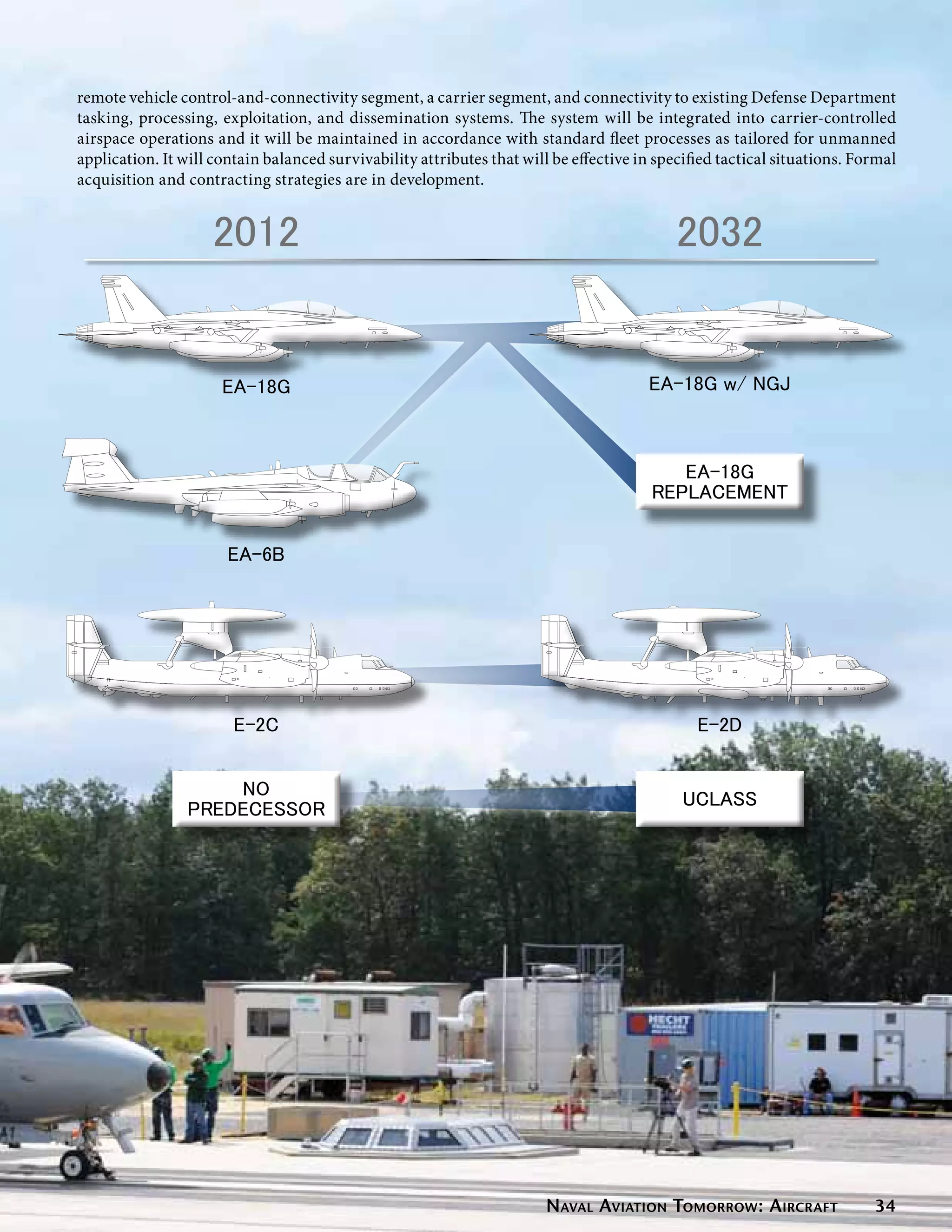
EA-18G Growler / EA-18G Replacement
 The EA-6B Prowler has long served as the nation’s foremost tactical airborne electronic attack platform. In December
 2001, the Navy completed an analysis of alternatives for electronic attack, laying the foundation for the replacement
 of the Prowler with the EA-18G Growler. The Growler leveraged the investments made in the ALQ-218 receiver system,
 which is the heart of the EA-6B Improved Capability III program. The next step is to replace the ALQ-99 Tactical
 Jamming System with the Next Generation Jammer (NGJ), with an initial operational capability anticipated in 2020.
 Development of NGJ is critical to the Navy’s vision for the future of airborne electronic attack and is a vital component
 of the Defense Department’s plan to build a joint system-of-systems electronic attack capability. The EA-18G is already
 in service, and saw its first combat sorties in Libya. Full operational capability is scheduled for 2015. By 2032, the EA-
 18G Replacement aircraft will have begun replacing the EA-18G Growler.

E-2C Hawkeye / E-2D Advanced Hawkeye
 The E-2C Hawkeye provides all-weather airborne early warning, airborne battle management, and command-and-
 control functions for strike group and joint force commanders. An integral component of carrier air wings, the E-2C
 uses its radar, identification friend or foe, electronic surveillance sensors, and offboard data sources to provide early
 warning threat analysis against potentially hostile air, surface, and ground targets. E-2C/D usage of Link-11, Link-16,
 Cooperative Engagement Capability, and a communication suite connects carrier air wings and strike groups at the
 tactical level to the operational level of warfare. The E-2D Advanced Hawkeye will replace the current E-2C aircraft
 beginning in 2014, with the final squadron transition scheduled for 2022. The E-2D’s electronically scanned array
 radar will provide enhanced capabilities in the overland and littoral environments, while significantly improving
 performance against clutter and small targets and providing integrated air and missile defense capabilities. The E-2D
 is currently undergoing flight testing and has been approved for all four years of low-rate initial production. Initial
 operational capability for the aircraft will be October 2014.

Unmanned Carrier-Launched Airborne Surveillance and Strike System
 The Unmanned Carrier-Launched Airborne Surveillance and Strike System (UCLASS) will provide a persistent,
 aircraft carrier-based reconnaissance and strike capability to support carrier air wing operations beginning in the
 2018 timeframe. The system will maximize use of existing technology to launch and control the air vehicle, transfer
 data in support of precision strike, and conduct persistent surveillance operations. It will consist of an air vehicle, a


33    Naval Aviation Vision • January 2012
remote vehicle control-and-connectivity segment, a carrier segment, and connectivity to existing Defense Department
tasking, processing, exploitation, and dissemination systems. The system will be integrated into carrier-controlled
airspace operations and it will be maintained in accordance with standard fleet processes as tailored for unmanned
application. It will contain balanced survivability attributes that will be effective in specified tactical situations. Formal
acquisition and contracting strategies are in development.


                    2012                                                                    2032


                      EA-18G                                                            EA-18G w/ NGJ


                       EA-6B


                        E-2C                                                                   E-2D


                                                                        Naval Aviation Tomorrow: A ircraft                34
MARINE CORPS TACTICAL AIRCRAFT
F-35B/C Lightning II
 The Marine Corps’s AV-8B Harrier, EA-6B Prowler, and F/A-18A/C/D Hornet aircraft
 will be replaced with the F-35 Lightning II B and C models. The Lightning II combines
 multirole, low-observable, fifth-generation capabilities with the flexibility required for
 expeditionary basing. The F-35 will allow the Marine Corps to provide a wide range of
 air operational options and tactical supremacy to task force commanders.

EA-6B Prowler / Electronic Warfare System of Systems
 The Marine Corps will continue to fly the Improved Capability III EA-6B Prowler as a
 capability bridge to a scalable system of systems able to support the needs of Marine air-
 ground task force (MAGTF) and joint commanders. Unmanned systems payloads, ground
 systems, and joint improvements to the F-35 under development will enable a distributed
 electronic warfare capability suitable for Marine operations.


35    Naval Aviation Vision • January 2012
2012                         2032


F/A-18A/C/D


                             F-35B/C
  AV-8B               w/ Electronic Attack
                            PAYLOADS


  EA-6B

              Naval Aviation Tomorrow: A ircraft   36
NAVY HELICOPTERS


                          2012              2032


                           MH-60R


                          SH-60B/F


37   Naval Aviation Vision • January 2012
MH-60R/S Seahawk
 The MH-60R and MH-60S multimission combat helicopters are the pillars of the naval helicopter concept of operations
 for the 21st century. These two variants share 85 percent commonality to facilitate maintenance and logistics support.
 For the first time, they were deployed as carrier air group squadrons embarked on aircraft carriers and strike group
 escort ships under the leadership of carrier air wing commanders. The expeditionary squadrons deploy as detachments
 embarked on LHAs/LHDs, surface combatants, and logistics vessels. The MH-60R/S aircraft are integral components
 of littoral combat ship mission modules, with the MH-60R supporting anti-submarine and surface modules and the
 MH-60S supporting surface warfare and mine countermeasures modules.

 The MH-60R/S Replacement is envisioned for the 2032 time frame when the Seahawks reach the end of their planned
 service lives.

MH-60R / MH-60R Replacement
 The MH-60R provides surface and subsurface warfare support with its airborne low-frequency sonar, inverse synthetic
 aperture radar with automatic periscope detection and discrimination modes, electronic support measures, an advanced
 forward-looking infrared system, precision air-to-ground missiles, machine guns, and lightweight torpedoes. The
 MH-60R is the only organic airborne anti-submarine warfare asset within strike groups and is critical to ensuring
 maritime dominance.


                                                                    Naval Aviation Tomorrow: A ircraft             38
MH-60S / MH-60S Replacement
 The MH-60S multimission helicopter is currently conducting search-and-rescue, combat search-and-rescue, special
 operations forces support, air ambulance, anti-piracy, combat support, and fleet logistics operations. (Through the 2020s,
 the HH-60H will also provide special operations forces support in addition to the MH-60S.) Its utility has been critical
 to successful humanitarian assistance and disaster relief efforts since the devastating 2004 Indian Ocean tsunami. Using
 the forward-looking infrared sensor, Link-16, and an array of current and programmed air-to-ground weaponry as well
 as crew-served weapons, the MH-60S operates independently or as part of a “hunter/killer” team with the MH-60R
 for anti-surface warfare missions. In addition, the platform provides critical airborne mine countermeasures as part
 of the littoral combat ship mine countermeasures mission package. Using one of four advanced sensor and weapon
 packages to provide detection, localization, and neutralization of anti-access mine threats, these systems enable naval
 forces to operate and maneuver in littoral and blue-water environments.


39    Naval Aviation Vision • January 2012
MH-53E Replacement
 The MH-53E Sea Dragon continues to conduct dedicated airborne mine countermeasures and vertical on-board-
 delivery, heavy-lift missions in the fleet. Future plans include transitioning the mine countermeasures capability from
 the Sea Dragon to the MH-60S and identifying an MH-53E Replacement for the Navy’s future heavy-lift capability.
 Initial operational capability will be required in the 2026 time frame.

MQ-8B Fire Scout
 The MQ-8B Fire Scout vertical takeoff and landing unmanned aerial vehicle is designed to operate from all air-capable
 ships with the Tactical Control System. Initial operational capability is planned for fiscal year 2013. With the current
 electro-optical/infrared payload and other modular mission payloads, Fire Scout has a range of 125 nautical miles and
 can remain on station for up to five-and-a-half hours. Fire Scout is operated and maintained by members of a composite
 MQ-8/MH-60R/S aviation detachment. Fire Scout conducted a military utility assessment aboard USS Halyburton (FFG
 40) to develop fleet concepts for operation of the system and to support data collection and intelligence, surveillance,
 and reconnaissance for counterpiracy operations in the Gulf of Aden and NATO operations off the coast of Libya. In
 addition, a Fire Scout expeditionary detachment is currently supporting full-motion video intelligence, surveillance, and
 reconnaissance requirements in Afghanistan.


                                2012                                                     2032


                                 HH-60H


                                 MH-60S


                                 MH-53E


                                  MQ-8B


                                                                      Naval Aviation Tomorrow: A ircraft              40
MARINE CORPS ASSAULT SUPPORT AIRCRAFT
AH-1Z Viper and UH-1Y Venom
 Having achieved full-rate production and initial operational capability for both the UH-1Y and the AH-1Z, focus for
 the H-1 upgrade program has shifted toward fielding and sustaining these capable airframes. H-1 upgrade aircraft
 are equipped with a four-bladed rotor system, 10,000-hour airframes, integrated avionics, glass cockpits, significantly
 improved sensors, and helmet-mounted displays, and have vastly increased payload, range, and time-on-station. The
 UH-1Y has supported combat operations in Operation Enduring Freedom since October 2009, and the AH-1Z deployed
 for the first time in November 2011 alongside the UH-1Y as part of an “all upgrades” Marine expeditionary unit. The
 AH-1Z/UH-1Y combined deployment showcased the advantages of sharing 84 percent of components, significantly
 increasing maintainability while reducing the logistics footprint and associated training requirements.

MV-22B Osprey
 The MV-22B Osprey is a tiltrotor vertical/short takeoff and landing aircraft designed as the medium-lift replacement for
 the Vietnam-era CH-46E Sea Knight assault support helicopter. The Osprey can operate as a helicopter or as a turboprop
 aircraft and incorporates advances in composite materials, airfoil design, fly-by-wire controls, and digital avionics. It
 has twice the speed, six times the range, and three times the payload of the aircraft it replaces. In February 2011 the
 V-22 program surpassed 100,000 flight hours and has successfully deployed multiple times to Iraq and Afghanistan and
 aboard U.S. naval shipping. It currently supports combat operations in the Central Command area of responsibility.


41    Naval Aviation Vision • January 2012
2012                    2032


AH-1Z


                         AH-1Z


AH-1W


UH-1Y


                         UH-1Y

UH-1N


MV-22B


                         MV-22B


CH-46E


         Naval Aviation Tomorrow: A ircraft   42
KC-130J Super Hercules
     The KC-130J Super Hercules is a multimission tactical tanker and assault support aircraft well suited to the mission needs
     of forward-deployed Marine air-ground task forces. As the replacement for active-component KC-130T model aircraft,
     the KC-130J provides increased speed, range, and survivability; an improved refueling system; and a digital cockpit
     with heads-up display. The KC-130J will replace reserve KC-130T aircraft beginning in 2015, bringing commonality and
     interoperability to active and reserve Marine Corps components. With the addition of the Harvest HAWK mission kit,
     the KC-130J can be rapidly reconfigured into a platform capable of persistent targeting and precision fires.

CH-53K Heavy-Lift Helicopter
     The CH-53D is reaching the end of its service life and will be retired by the fall of 2012. Approaching 30 years of service,
     the CH-53E is undergoing required sustainment efforts to maintain its heavy-lift capability until delivery of the CH-
     53K. Expeditionary heavy-lift requirements are expanding and will continue to be critical to successful land- and sea-
     based operations. The new CH-53K will have heavy-lift capabilities not possessed by any of today’s platforms, and will
     contribute directly to the increased agility, lethality, and persistence of Marine and joint task forces. The CH-53K will
     transport 27,000 pounds of external cargo to a range of 110 nautical miles, nearly tripling the CH-53E’s lift capability
     under similar environmental conditions, while fitting within the same shipboard footprint. The CH-53K also will provide
     lift capability under high-altitude and hot-weather conditions. Maintainability and reliability enhancements of the CH-
     53K will significantly decrease recurring operating costs, and will greatly improve aircraft efficiency and operational
     effectiveness. In addition, survivability and force protection enhancements will dramatically increase protection for
     both air crew members and passengers, thereby broadening the depth and breadth of heavy-lift operational support to
     Marine and joint commanders.

Cargo Resupply Unmanned Aerial System
     The Cargo Resupply Unmanned Aerial System (CRUAS) effort supports the Marine Corps’s requirements captured in a joint
     urgent operational needs statement to “get trucks off the roads” in combat zones and minimize the threat of improvised
     explosive devices to logistics convoys. The system will provide a low-risk, persistent capability for dispersed forces on the
     battlefield that will mitigate the requirement for manned ground vehicles to resupply forces in remote locations. CRUAS
     will also augment manned aviation assault support assets and airdrop methods when weather, terrain, and enemy threats
     elevate the levels of risk. A ground control station at a main operating base and a remote terminal at
     the drop-off zone will will deliver cargo by air between main logistical hubs and remote
     “spokes.” This initiative began as a military user assessment in November
     2011 that will inform a follow-on program of record.


43        Naval Aviation Vision • January 2012
2012                  2032


KC-130T


                           KC-130J


KC-130J


CH-53E                 CH-53K


          Naval Aviation Tomorrow: A ircraft   44
MARINE CORPS UNMANNED TACTICAL SUPPORT SYSTEMS
RQ-7B Shadow
 Shadow is an expeditionary, multimission tactical umanned system that provides dedicated reconnaissance, surveillance,
 target acquisition and designation, and communications relay to regimental-sized and larger Marine Corps units.
 Since 2007, Shadow systems have deployed to Iraq, Afghanistan, and elsewhere, where they have flown more than
 20,000 combat hours in support of Marine Corps, joint, and allied operations. Four Marine unmanned aerial vehicle
 squadrons now operate 13 Shadow systems.

RQ-21A Integrator
 The RQ-21A Integrator Small Tactical Unmanned Aircraft System will provide a tactical intelligence, surveillance, and
 reconnaissance capability for Navy special warfare operators, amphibious assault ships, and Marine Corps battalion- and
 company-sized units. The Integrator is a 135-pound unmanned aerial vehicle (fully loaded) with a 37-pound payload
 consisting of an electro-optical/infrared sensor ball and communications relay package. The Integrator completed its
 first operational test phase in January 2011 at the Yuma Proving Ground in Arizona. The Marine Corps procured two
 early operational capability systems in 2011. The Navy will begin procurement in fiscal year 2012 with the purchase of
 two early operational capability systems.

Scan Eagle
 Scan Eagle is a 40-pound vehicle with a cruising speed of 50 knots and a ceiling of 15,000 feet. Designed to fly missions
 of 15 hours or more, it is used for both land- and ship-based operations. The Scan Eagle system includes the Sky Wedge
 hydraulic launcher, the Sky Hook retrieving system, and a mobile ground-control element. The vehicle is equipped
 with a nose-mounted inertial-stabilized camera turret that carries either a digital camera or infrared sensor. The Scan
 Eagle system is being used to fill a capability gap on an interim basis; intelligence, surveillance, and reconnaissance
 services will be partially replaced by the RQ-21A beginning in fiscal year 2013.


RQ-11B Raven B
 The Raven B provides small Marine Corps units with near-real-time reconnaissance and surveillance information. The
 system consists of a ground control station, three air vehicles, and a field support kit. The system has an endurance of up
 to two hours with a range of 10 kilometers. It provides day/night live video feedback to users by way of a laptop-based
 ground control station with color electro-optical, black-and-white low-light, and infrared payloads. Raven B systems
 are currently being upgraded to a digital data link.


45    Naval Aviation Vision • January 2012
2012                                                           2032


                        RQ-7B


                       RQ-21A


                    SCAN EAGLE


                       RQ-11B


                       WASP III


Wasp III
 The Wasp III is a micro aerial vehicle that weighs approximately one pound and has an endurance of 45 minutes and
 a five-kilometer range. It shares a common ground control station with the RQ-11B Raven B. The Marine Corps is
 fielding 135 Wasp III systems to answer an urgent operational need for additional man-portable unmanned aircraft
 systems. A program of record decision is expected in fiscal year 2012 following fleet evaluation.


                                                                 Naval Aviation Tomorrow: A ircraft            46
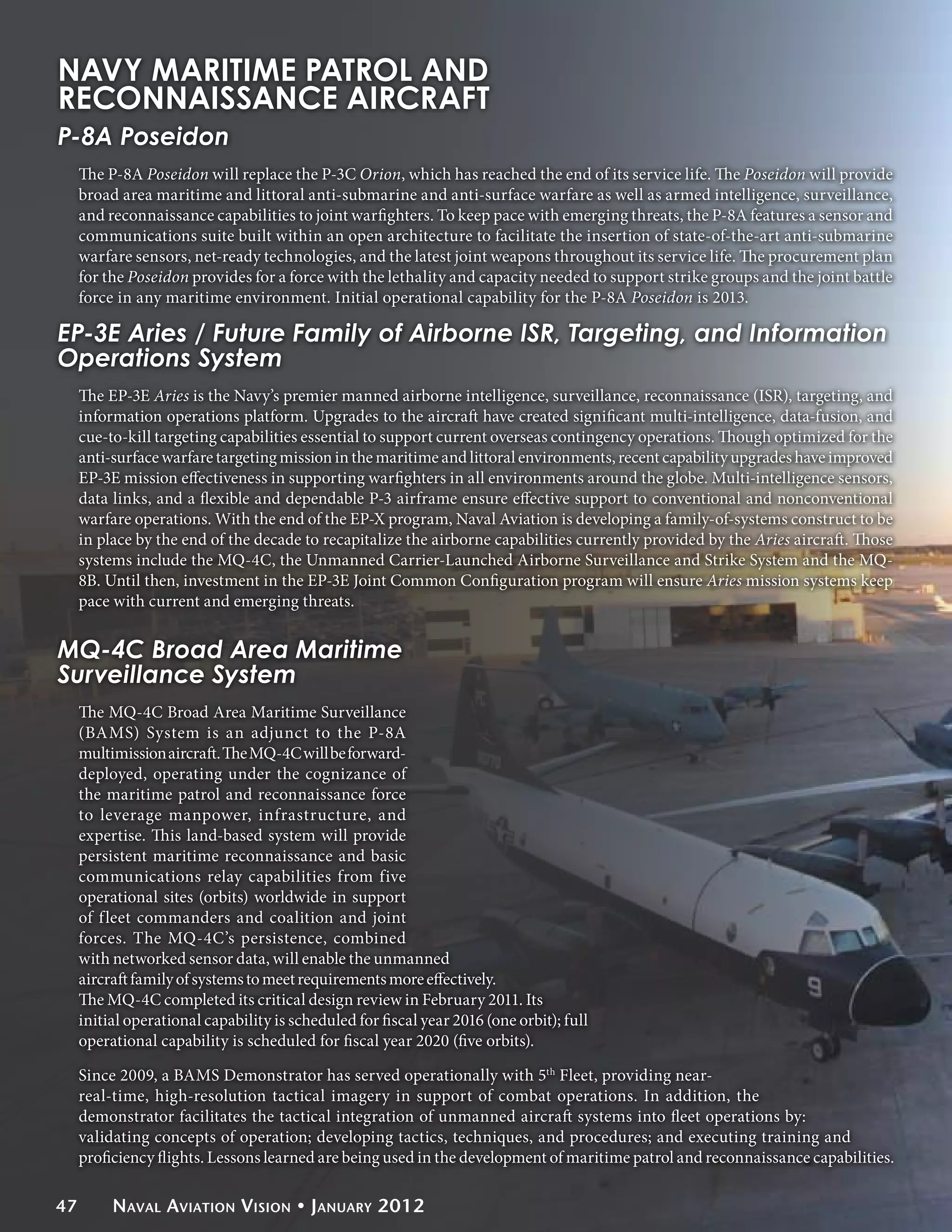
NAVY MARITIME PATROL AND
RECONNAISSANCE AIRCRAFT
P-8A Poseidon
     The P-8A Poseidon will replace the P-3C Orion, which has reached the end of its service life. The Poseidon will provide
     broad area maritime and littoral anti-submarine and anti-surface warfare as well as armed intelligence, surveillance,
     and reconnaissance capabilities to joint warfighters. To keep pace with emerging threats, the P-8A features a sensor and
     communications suite built within an open architecture to facilitate the insertion of state-of-the-art anti-submarine
     warfare sensors, net-ready technologies, and the latest joint weapons throughout its service life. The procurement plan
     for the Poseidon provides for a force with the lethality and capacity needed to support strike groups and the joint battle
     force in any maritime environment. Initial operational capability for the P-8A Poseidon is 2013.

EP-3E Aries / Future Family of Airborne ISR, Targeting, and Information
Operations System
     The EP-3E Aries is the Navy’s premier manned airborne intelligence, surveillance, reconnaissance (ISR), targeting, and
     information operations platform. Upgrades to the aircraft have created significant multi-intelligence, data-fusion, and
     cue-to-kill targeting capabilities essential to support current overseas contingency operations. Though optimized for the
     anti-surface warfare targeting mission in the maritime and littoral environments, recent capability upgrades have improved
     EP-3E mission effectiveness in supporting warfighters in all environments around the globe. Multi-intelligence sensors,
     data links, and a flexible and dependable P-3 airframe ensure effective support to conventional and nonconventional
     warfare operations. With the end of the EP-X program, Naval Aviation is developing a family-of-systems construct to be
     in place by the end of the decade to recapitalize the airborne capabilities currently provided by the Aries aircraft. Those
     systems include the MQ-4C, the Unmanned Carrier-Launched Airborne Surveillance and Strike System and the MQ-
     8B. Until then, investment in the EP-3E Joint Common Configuration program will ensure Aries mission systems keep
     pace with current and emerging threats.


MQ-4C Broad Area Maritime
Surveillance System
     The MQ-4C Broad Area Maritime Surveillance
     (BAMS) System is an adjunct to the P-8A
     multimission aircraft. The MQ-4C will be forward-
     deployed, operating under the cognizance of
     the maritime patrol and reconnaissance force
     to leverage manpower, infrastructure, and
     expertise. This land-based system will provide
     persistent maritime reconnaissance and basic
     communications relay capabilities from five
     operational sites (orbits) worldwide in support
     of fleet commanders and coalition and joint
     forces. The MQ-4C’s persistence, combined
     with networked sensor data, will enable the unmanned
     aircraft family of systems to meet requirements more effectively.
     The MQ-4C completed its critical design review in February 2011. Its
     initial operational capability is scheduled for fiscal year 2016 (one orbit); full
     operational capability is scheduled for fiscal year 2020 (five orbits).

     Since 2009, a BAMS Demonstrator has served operationally with 5th Fleet, providing near-
     real-time, high-resolution tactical imagery in support of combat operations. In addition, the
     demonstrator facilitates the tactical integration of unmanned aircraft systems into fleet operations by:
     validating concepts of operation; developing tactics, techniques, and procedures; and executing training and
     proficiency flights. Lessons learned are being used in the development of maritime patrol and reconnaissance capabilities.

47        Naval Aviation Vision • January 2012
2012                 2032


                        P-8A


 P-3C


EP-3E


BAMS-D                 MQ-4C


         Naval Aviation Tomorrow: A ircraft   48
NAVY AND MARINE CORPS TRAINING, LOGISTICS, AND
OPERATIONAL SUPPORT AIRCRAFT
Training Aircraft
T-6B Texan II Joint Primary Trainer
  Navy and Marine Corps primary pilot training is transitioning to the T-6B Texan II as the T-34C TurboMentor is
  retired after more than 30 years of service. The T-6A will continue to be used for naval flight officer and Air Force
  combat systems officer training.

T-45C
  The T-45C Goshawk will be the single advanced strike trainer for tailhook pilots and naval flight officers as the T-39G/N
  Sabreliner is retired and the T-45A aircraft is retrofitted to the T-45C configuration. All T-45A cockpits will be digitized
  through the required avionics modernization program, which consists of a glass cockpit upgrade with two multifunction
  displays, mission display processor, recorder, and cockpit controls. The virtual mission training system program will
  integrate a virtual multimode radar capability into the T-45C to enable basic tactical skills training that will prepare
  students for the advanced tactical jet aircraft of the future. By 2020, work will have begun to identify a replacement
  for the T-45C as this aircraft reaches the end of its service life.


49      Naval Aviation Vision • January 2012
2012                 2032

T-6A/B


                      T-6A/B

 T-34C


T-39G/N
                       T-45C


T-45A/C


          Naval Aviation Tomorrow: A ircraft   50
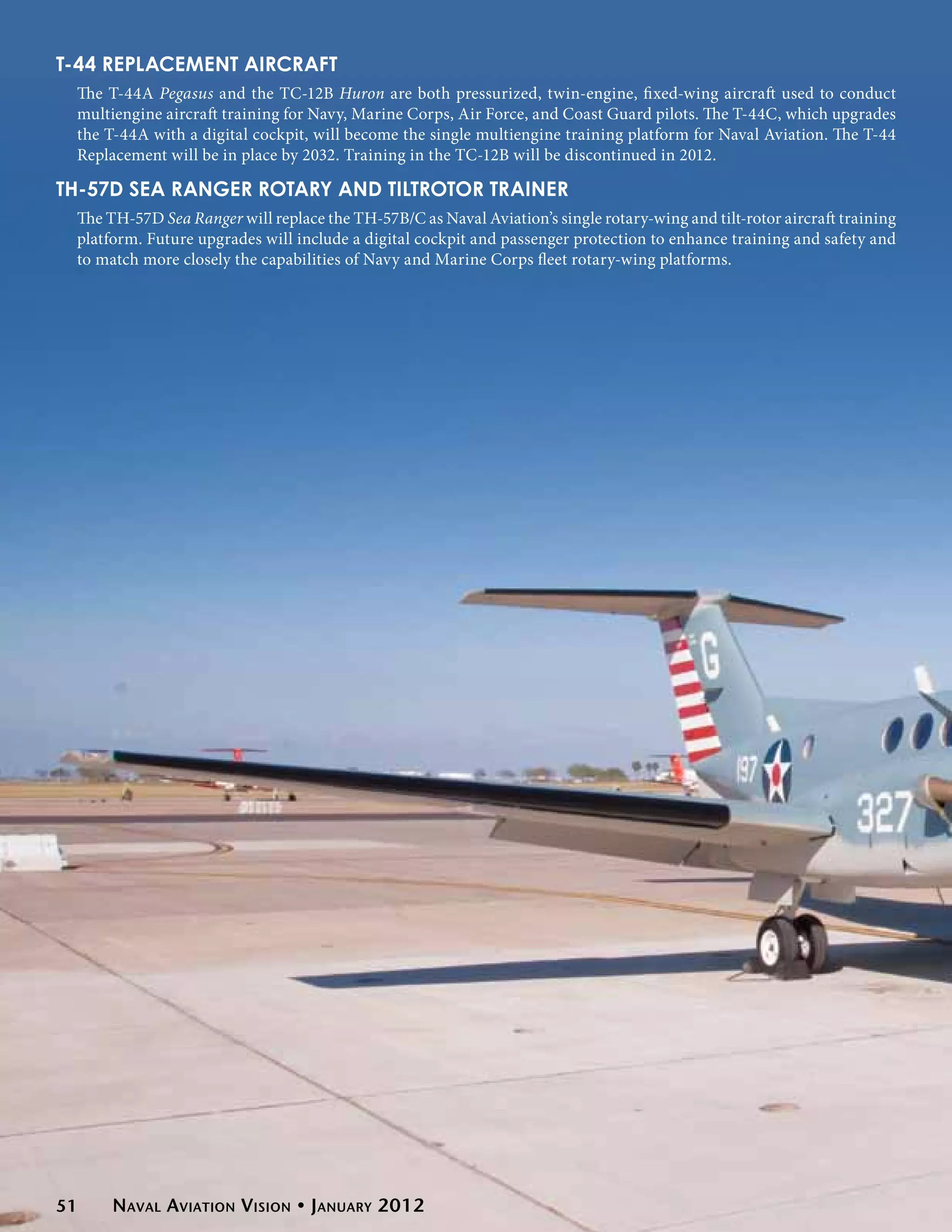
T-44 Replacement Aircraft
 The T-44A Pegasus and the TC-12B Huron are both pressurized, twin-engine, fixed-wing aircraft used to conduct
 multiengine aircraft training for Navy, Marine Corps, Air Force, and Coast Guard pilots. The T-44C, which upgrades
 the T-44A with a digital cockpit, will become the single multiengine training platform for Naval Aviation. The T-44
 Replacement will be in place by 2032. Training in the TC-12B will be discontinued in 2012.

TH-57D Sea Ranger Rotary and Tiltrotor Trainer
 The TH-57D Sea Ranger will replace the TH-57B/C as Naval Aviation’s single rotary-wing and tilt-rotor aircraft training
 platform. Future upgrades will include a digital cockpit and passenger protection to enhance training and safety and
 to match more closely the capabilities of Navy and Marine Corps fleet rotary-wing platforms.


51    Naval Aviation Vision • January 2012
2012                      2032


T-44A/C


 TC-12B


TH-57B/C                   TH-57D


           Naval Aviation Tomorrow: A ircraft   52
Navy-Unique, Fleet-Essential Airlift
 Navy-unique, fleet-essential airlift provides combatant commanders with short-notice, fast-response, intratheater
 logistics support when and where it is needed. This family of aircraft platforms delivers medium- and heavy-lift
 capabilities in support of the fleet. Designed primarily to provide a reliable and highly flexible airborne logistics
 capability for the wartime movement of personnel and heavy cargo, these aircraft respond to immediate demands for
 the movement of essential fleet personnel and cargo to mobile sea-based forces worldwide.

 The Marine Corps considers the C-9B to be an operational support airlift asset. Marine Aviation is pursuing the C-40A
 as the C-9B Replacement Aircraft to meet its medium-lift requirements.

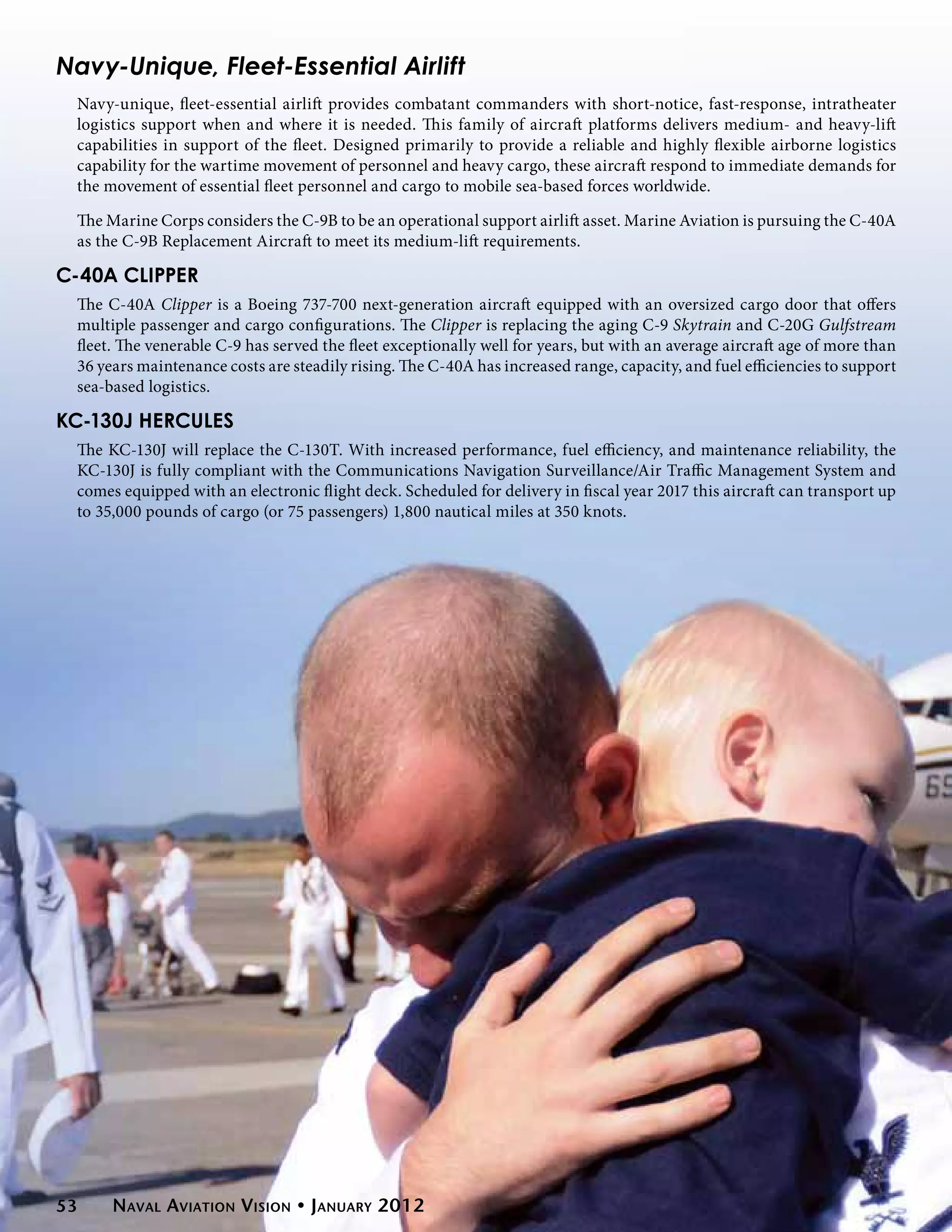
C-40A Clipper
 The C-40A Clipper is a Boeing 737-700 next-generation aircraft equipped with an oversized cargo door that offers
 multiple passenger and cargo configurations. The Clipper is replacing the aging C-9 Skytrain and C-20G Gulfstream
 fleet. The venerable C-9 has served the fleet exceptionally well for years, but with an average aircraft age of more than
 36 years maintenance costs are steadily rising. The C-40A has increased range, capacity, and fuel efficiencies to support
 sea-based logistics.

KC-130J Hercules
 The KC-130J will replace the C-130T. With increased performance, fuel efficiency, and maintenance reliability, the
 KC-130J is fully compliant with the Communications Navigation Surveillance/Air Traffic Management System and
 comes equipped with an electronic flight deck. Scheduled for delivery in fiscal year 2017 this aircraft can transport up
 to 35,000 pounds of cargo (or 75 passengers) 1,800 nautical miles at 350 knots.


53    Naval Aviation Vision • January 2012
2012                    2032


C-9B


                         C-40A


C-40A


C-130T                  KC-130J


         Naval Aviation Tomorrow: A ircraft   54
Operational Support Aircraft
     Operational support aircraft are used to transport high-
     priority passengers and cargo when requirements are
     time-, place-, or mission-sensitive. They are stationed
     worldwide and perform critical airlift missions for the
     geographic combatant commanders to and from remote
     locations where commercial sources are not available
     or viable.

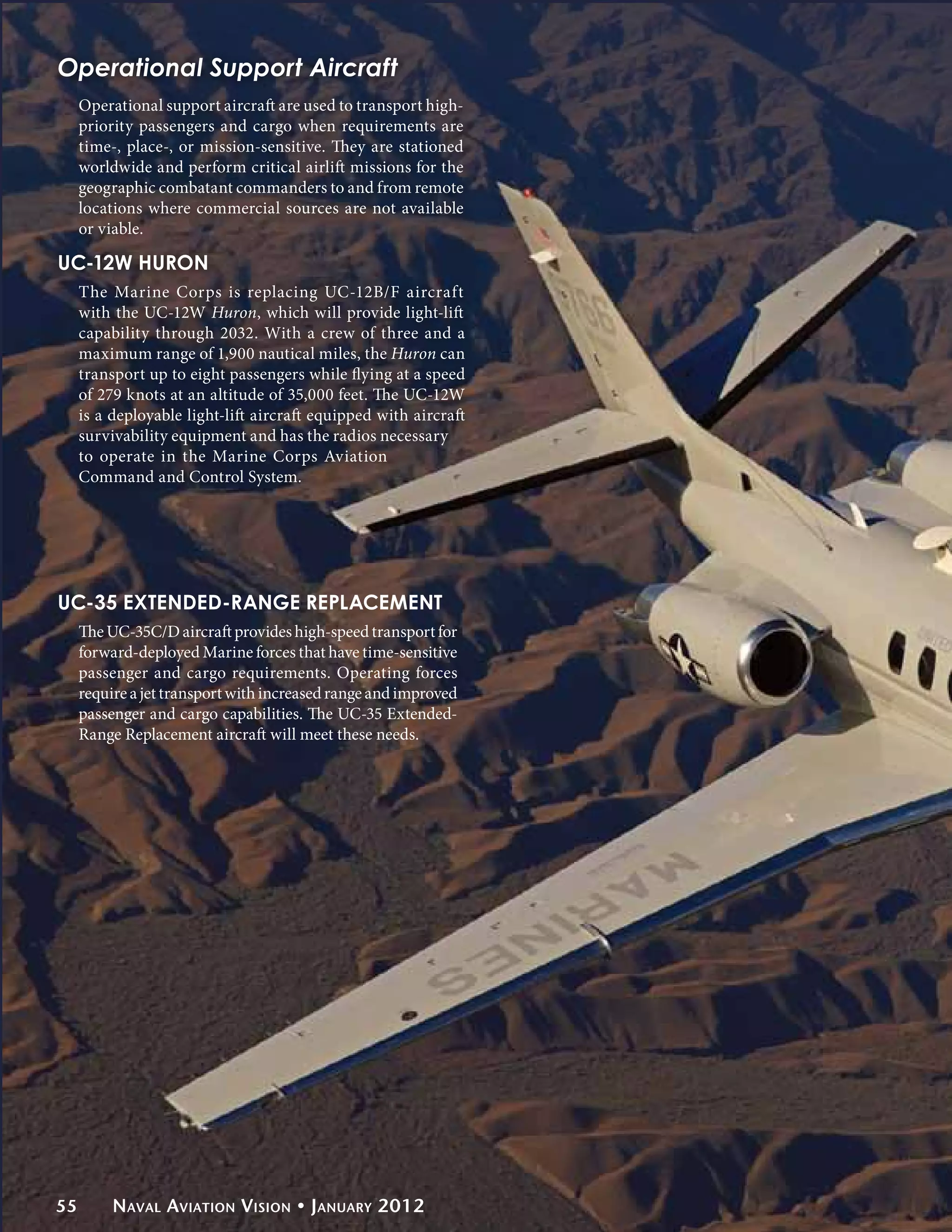
UC-12W Huron
     The Marine Corps is replacing UC-12B/F aircraft
     with the UC-12W Huron, which will provide light-lift
     capability through 2032. With a crew of three and a
     maximum range of 1,900 nautical miles, the Huron can
     transport up to eight passengers while flying at a speed
     of 279 knots at an altitude of 35,000 feet. The UC-12W
     is a deployable light-lift aircraft equipped with aircraft
     survivability equipment and has the radios necessary
     to operate in the Marine Corps Aviation
     Command and Control System.


UC-35 Extended-Range Replacement
     The UC-35C/D aircraft provides high-speed transport for
     forward-deployed Marine forces that have time-sensitive
     passenger and cargo requirements. Operating forces
     require a jet transport with increased range and improved
     passenger and cargo capabilities. The UC-35 Extended-
     Range Replacement aircraft will meet these needs.


55        Naval Aviation Vision • January 2012
2012                                           2032

UC-12B/F

                                                UC-12W
UC-12W


UC-35C/D                                        UC-35ER


 C-20G


           C-20G Replacement
            Marine Corps Aviation has identified a need to replace the C-20G to
            support Marines. Range, payload, and performance characteristics
            similar to those of the C-20G will be required.


                             Naval Aviation Tomorrow: A ircraft            56
57   Naval Aviation Vision • January 2012
2012                                                     2032

          UC-12F/M


             C-26D


           C-20A/D


                                                                    C-37A/B

           C-37A/B


C-12 Replacement
 A C-12 Replacement aircraft will be identified to replace the Navy’s current
 fleet of UC-12F/M Huron and C-26D Metroliner aircraft to provide light-lift
 capability through 2032.

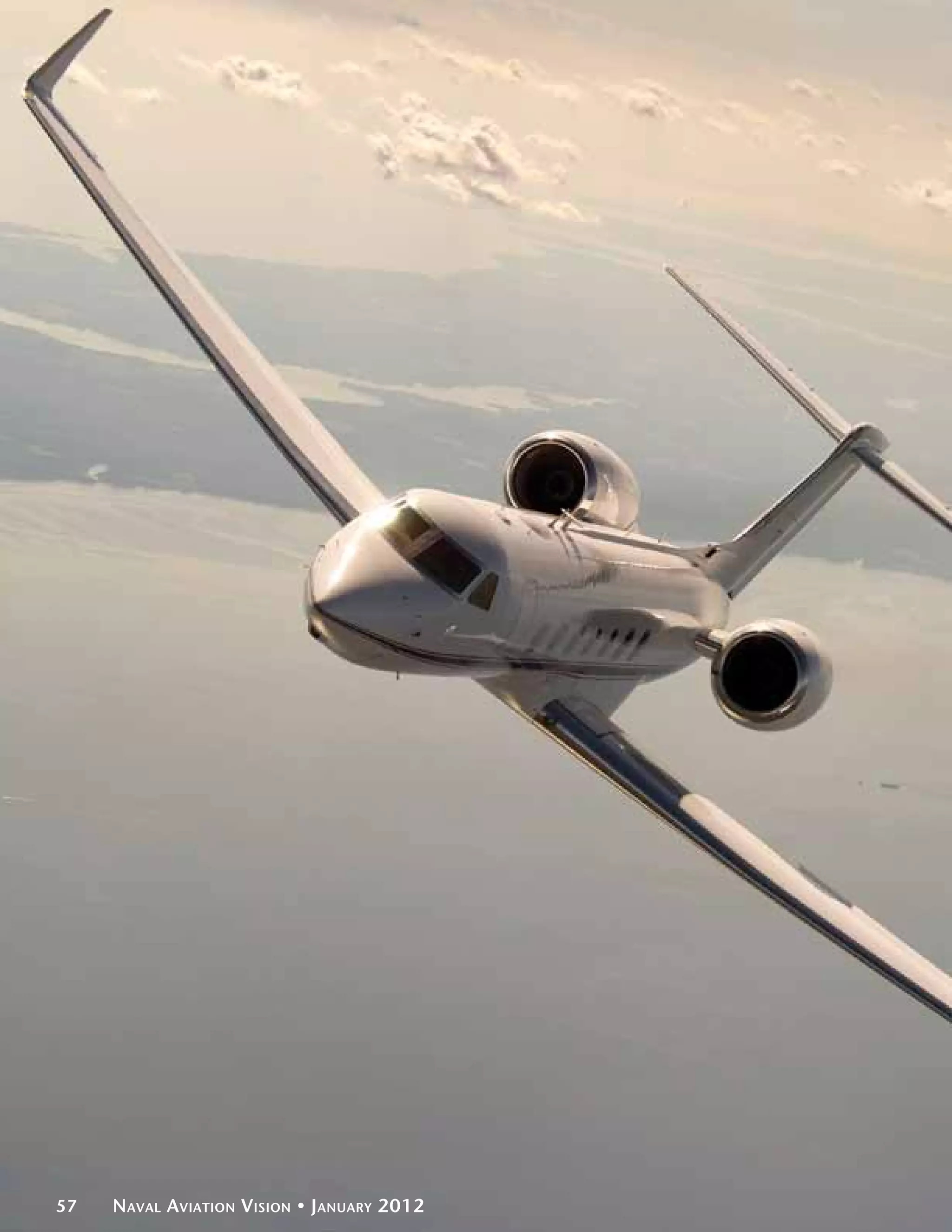
C-37A/B Gulfstream G550
 The C-37A/B Gulfstream executive transport aircraft replaces the aging C-20A/D
 to provide senior Navy Department personnel with high-speed, long-range
 transportation with a secure communications capability. Flying at speeds up to
 585 knots, the G550 can travel 6,750 nautical miles at 45,000 feet and transport
 12 or 14 passengers depending on how it is configured.


                                                 Naval Aviation Tomorrow: A ircraft   58
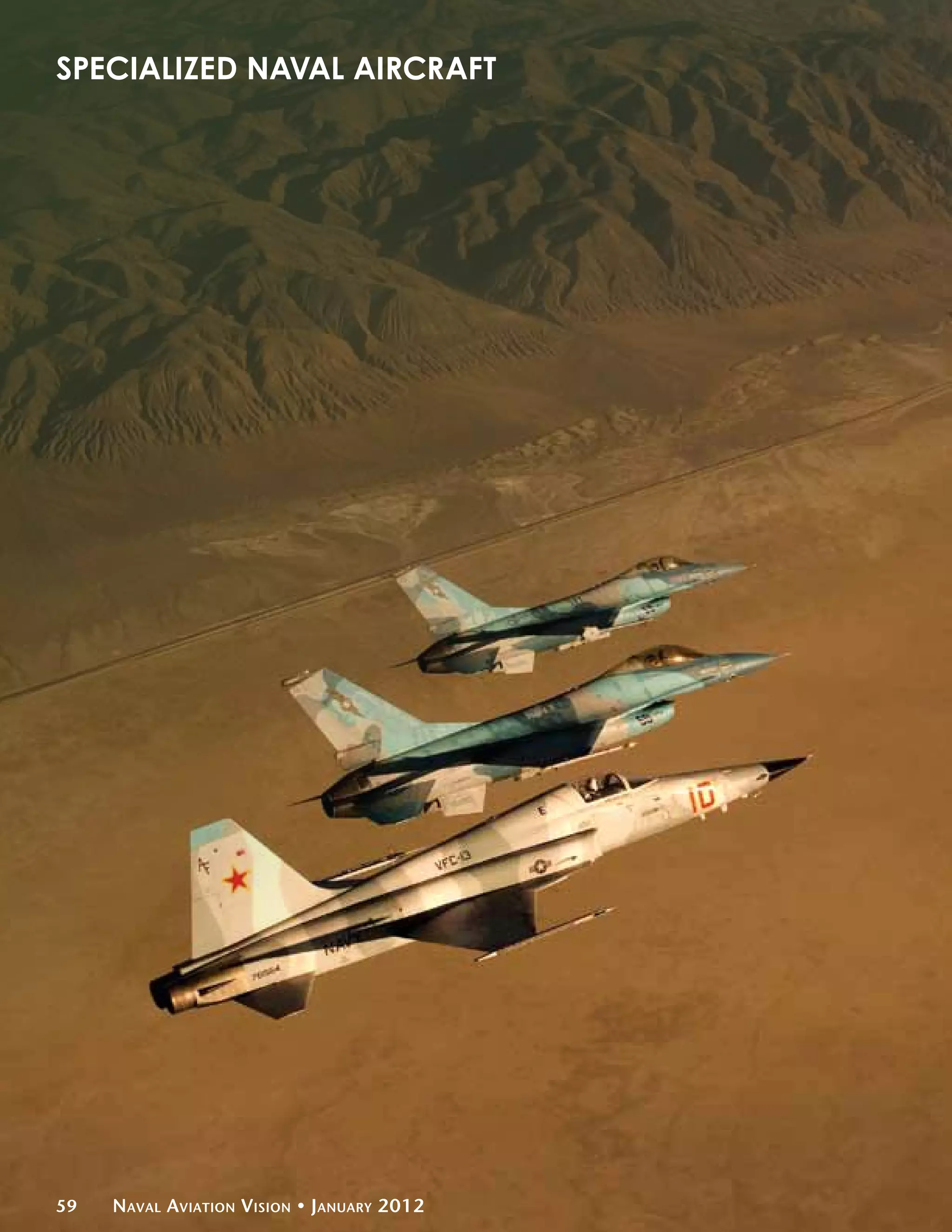
Specialized Naval Aircraft


59   Naval Aviation Vision • January 2012
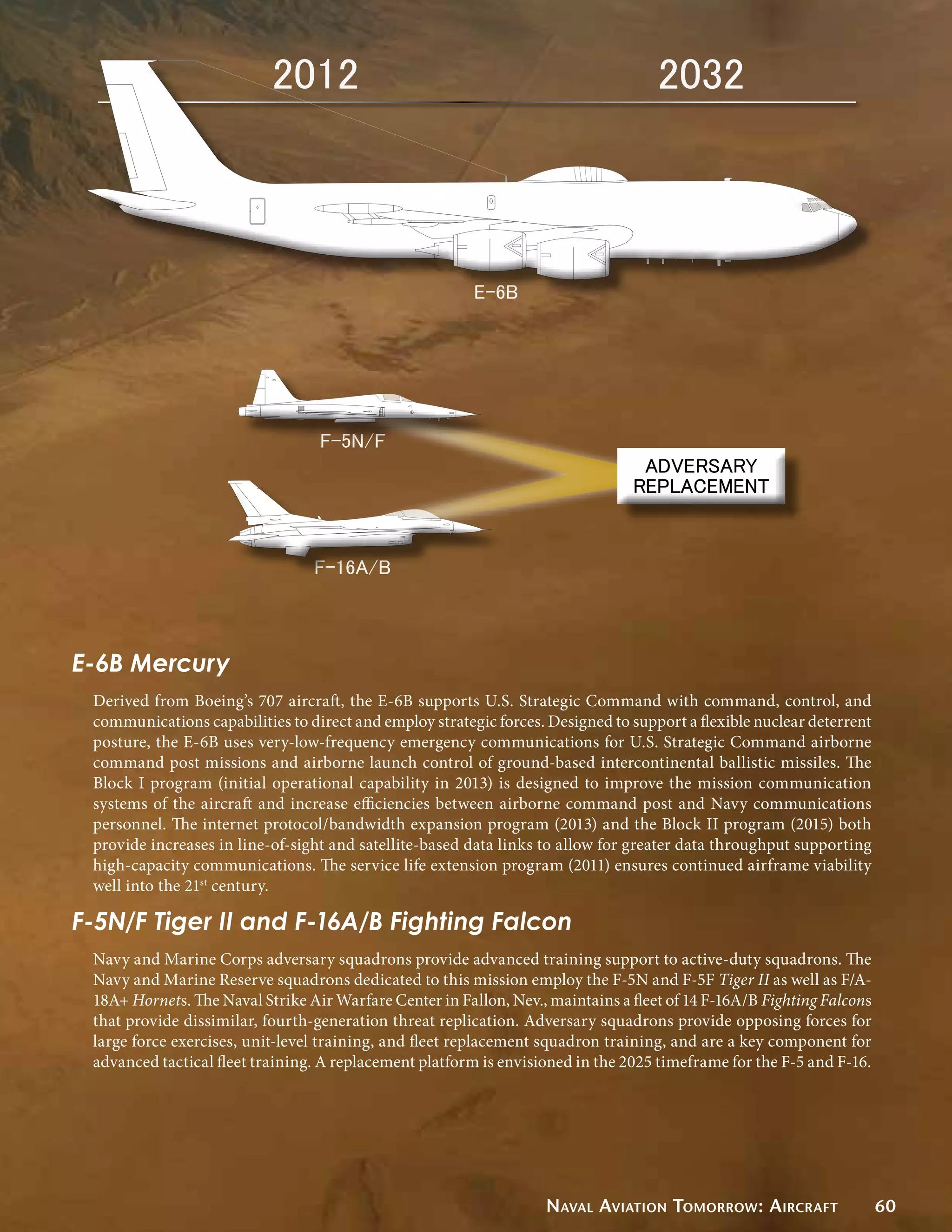
2012                                                     2032


                                                         E-6B


                                  F-5N/F


                                 F-16A/B


E-6B Mercury
 Derived from Boeing’s 707 aircraft, the E-6B supports U.S. Strategic Command with command, control, and
 communications capabilities to direct and employ strategic forces. Designed to support a flexible nuclear deterrent
 posture, the E-6B uses very-low-frequency emergency communications for U.S. Strategic Command airborne
 command post missions and airborne launch control of ground-based intercontinental ballistic missiles. The
 Block I program (initial operational capability in 2013) is designed to improve the mission communication
 systems of the aircraft and increase efficiencies between airborne command post and Navy communications
 personnel. The internet protocol/bandwidth expansion program (2013) and the Block II program (2015) both
 provide increases in line-of-sight and satellite-based data links to allow for greater data throughput supporting
 high-capacity communications. The service life extension program (2011) ensures continued airframe viability
 well into the 21st century.

F-5N/F Tiger II and F-16A/B Fighting Falcon
 Navy and Marine Corps adversary squadrons provide advanced training support to active-duty squadrons. The
 Navy and Marine Reserve squadrons dedicated to this mission employ the F-5N and F-5F Tiger II as well as F/A-
 18A+ Hornets. The Naval Strike Air Warfare Center in Fallon, Nev., maintains a fleet of 14 F-16A/B Fighting Falcons
 that provide dissimilar, fourth-generation threat replication. Adversary squadrons provide opposing forces for
 large force exercises, unit-level training, and fleet replacement squadron training, and are a key component for
 advanced tactical fleet training. A replacement platform is envisioned in the 2025 timeframe for the F-5 and F-16.


                                                                   Naval Aviation Tomorrow: A ircraft                  60
C-2A Greyhound / Future Carrier Onboard Delivery Aircraft
 The C-2A Greyhound is the Navy’s medium-lift/long-range logistics support aircraft, transporting high-priority cargo,
 mail, and passengers between carrier strike groups and forward logistics sites. It can deliver a combined payload of
 10,000 pounds a distance of 1,000 nautical miles, and the interior cabin can be easily rearranged to accommodate
 passengers, litter patients, or time-critical cargo. The large cargo ramp at the rear of the aircraft allows rear loading
 and unloading for fast turnaround and can be operated in flight to air drop supplies and personnel. Equipped with
 an auxiliary power unit for unassisted engine starts, the versatile Greyhound can operate independently from remote
 locations. The aircraft is undergoing several modifications and a service life extension program, which include structural
 enhancements, improvements to the avionics system, rewiring, and a new propeller system. These modifications will
 extend the Greyhound’s service life until a Future Carrier Onboard Delivery Aircraft can be fielded. Initial operational
 capability will be required by 2026.

VXX Replacement Presidential Helicopter
 A replacement is under development for the 35-year-old VH-3D and the 25-year old VH-60N helicopters, currently
 providing transportation for the President of the United States, foreign heads of states, and other dignitaries as directed
 by the White House Military Office. The Replacement Presidential Helicopter (VXX) will provide a hardened, mobile
 command-and-control transportation capability and a system of integrated systems necessary to meet current and
 future presidential transport mission requirements.


61    Naval Aviation Vision • January 2012
2012                    2032


C-2A


VH-3D


VH-60N


         Naval Aviation Tomorrow: A ircraft   62
WEAPONS
LONG-RANGE STANDOFF WEAPONS
AGM-84H/K Standoff Land-Attack Missile – Expanded
Response
     The Standoff Land Attack Missile–Expanded Response (SLAM-ER) is a long-range, highly
     precise, air-launched strike missile capable of attacking fixed and mobile land targets as well
     as surface ships. Terminal control of the weapon is achieved when the pilot designates the
     impact point on the imaging infrared scene transmitted by the weapon to the cockpit display.
     Man-in-the-loop commands are sent to the SLAM-ER by way of a data-link pod carried
     by the launching (or secondary control) aircraft. An analysis of alternatives is defining a
     follow-on weapon solution to meet the maritime standoff strike mission currently filled
     by SLAM-ER and Harpoon Block 1C.

AGM/RGM-84D Harpoon Block 1C
     The Harpoon Block 1C is an air- or surface-launched, anti-ship, all-weather cruise missile
     that employs an autonomous active radar seeker to attack a wide variety of surface ship
     targets from standoff ranges. The Harpoon, which entered service in 1977, is currently
     carried by F/A-18 and P-3C aircraft as well as a portion of the Navy’s DDG-51 and
     CG-47 surface ship classes. Numerous air, surface, and submarine platforms currently
     deploy Harpoon for 27 international customers. An analysis of alternatives is being
     conducted to scope and define a follow-on weapon solution to meet the maritime
     standoff strike mission currently addressed by SLAM-ER and Harpoon Block 1C.

Tomahawk Land-Attack Missile
     The Tomahawk Land Attack Missile is a long-range, subsonic cruise missile
     used for deep land attack warfare that is launched from U.S. Navy surface
     ships and U.S. Navy and United Kingdom Royal Navy submarines. There are
     currently three main versions: the Block II nuclear variant, which contains
     the W80 warhead; the Block III conventional variant, which can carry either
     a 1,000-pound unitary warhead or a submunition-dispensing warhead;
     and the Block IV, or Tactical Tomahawk, which is network-enabled and
     capable of changing targets while in flight. Tomahawk provides on-scene
     commanders with the flexibility to attack long-range fixed targets or
     to support special operations forces with a lethal, responsive, precise
     weapon system. Potential future capabilities for the Tomahawk Block
     IV include improvements to the warhead (the Joint Multiple Effects
     Warhead System) and a maritime interdiction multimission capability
     (Multimission Tomahawk). The former system will demonstrate the


63        Naval Aviation Vision • January 2012
military utility of a programmable warhead with increased effects of penetration and blast against the
 full range of targets, from area to hardened targets. Multimission Tomahawk adds a moving target
  seeker and upgraded data link to the existing Tactical Tomahawk missile. The Tomahawk program
    office is currently investigating industry seeker technologies for maritime interdiction that could
     potentially be integrated into the existing Block IV weapon system. Additional studies have been
       initiated to develop a next-generation supersonic cruise missile capability for Tomahawk that
        will increase responsiveness against time-critical targets.


                        2012                                                     2032


                         SLAM-ER


                        HARPOON


                  TOMAHAWK BL II/III


                   TOMAHAWK BL IV


                                                   Naval Aviation Tomorrow: Weapons                 64
MID-RANGE STANDOFF WEAPONS
AGM-88E Advanced Anti-Radiation
Guided Missile
 The Advanced Anti-Radiation Guided Missile (AARGM) upgrade
 program transforms a portion of the existing AGM-88 HARM inventory
 into lethal strike weapons with enhanced time-critical strike and precision
 attack capabilities. The AARGM upgrade includes: an advanced digital
 anti-radiation homing receiver for greater sensitivity and enhanced air
 defense system capabilities; an active millimeter wave terminal radar to
 increase lethality against modern air defense units, such as surface-to-air
 missile radars that use radar shutdown and countermeasures designed
 to defeat anti-radiation missiles; inertial navigation/global positioning
 systems; a weapon impact assessment transmitter to aid and cue the
 battle damage assessment process; and an integrated broadcast service
 receiver for network-centric connectivity reception of off-board targeting
 information. AARGM correlates multiple sensors and geo-specific
 capabilities to locate and attack both stationary and fixed targets with
 precision while countering enemy tactics designed to defeat anti-radiation
 missiles. Initial operational capability for AARGM is fiscal year 2012.

AGM-154 Joint Standoff Weapon
 The Joint Standoff Weapon (JSOW) is a joint family of armaments that
 permits Navy and Air Force aircraft to attack targets at increased standoff
 distances. The weapon uses inertial navigation/global positioning systems
 for guidance. JSOW provides low- and high-altitude launch capabilities
 to enable launch platforms to remain outside the range of defenses,
 enhancing aircraft survivability. All JSOW variants share a common body
 but can be configured for use against area targets or bunker penetration.
 The JSOW-C unitary variant adds an imaging infrared seeker and an
 autonomous target acquisition capability to attack targets with precision
 accuracy. The JSOW-C-1 will incorporate new target tracking algorithms
 into the seeker and a strike common weapon data link, giving joint force
 commanders an affordable, air-delivered, standoff weapon effective
 against moving maritime targets as well as fixed land targets. The system
 will maintain JSOW-C functionality to be effective against targets in
 or through adverse weather conditions, in both day and night. Used
 in conjunction with accurate targeting information and anti-radiation
 weapons, JSOW-C-1 will defeat enemy air defenses.

Small-Diameter Bomb Increment II
 The Small-Diameter Bomb Increment II (SDB II) is a joint program that
 will provide warfighters with the capability to attack mobile targets at
 standoff ranges in all types of weather. This 250-pound-class weapon
 addresses the following additional requirements: multiple ordnance
 carriage; precision munitions capability; reduced munitions footprint;
 increased weapon effectiveness; minimized potential for collateral
 damage; reduced susceptibility of munitions to countermeasures; and an
 incremental development path to a network-centric operations capability.
 SDB II integration is planned for the F-35B/C Lightning II.


65    Naval Aviation Vision • January 2012
2012                       2032


HARM BL V            HARM BL V / AARGM


JSOW-A/C                 JSOW-A/C-1


                             SDB II


            Naval Aviation Tomorrow: Weapons   66
DIRECT-ATTACK WEAPONS
General Purpose Bombs
 Mark 80/BLU series General Purpose 500-, 1,000-, and 2,000-pound bombs provide blast and fragmentation effects
 against a variety of non-hardened targets and are used extensively for direct attack, close air support, and suppression
 missions. The thermally protected warhead is used for Joint Direct Attack Munitions (JDAMs), Laser JDAMs, Dual
 Mode Laser-Guided Bombs (DMLGBs), and Low Collateral Damage Bombs (LCDBs). General Purpose bombs are
 expected to remain in the inventory through 2032.

Laser Joint Direct-Attack Munition
 The Laser JDAM is a retrofit weapon that converts laser-guided bombs currently in the inventory to a dual mode
 configuration using common components. The retrofit replaces the existing computer control group with inertial
 navigation/global positioning systems that provides fire-and-forget, all-weather terminal guidance. The retrofit strategy
 streamlines qualification timelines, putting a new weapon in the hands of warfighters that much faster. The Direct-Attack
 Moving Target Capability (DAMTC) is intended to provide naval and joint warfighters with a lethal, interoperable, and
 cost-effective precision strike weapon system that can engage moving, semi-mobile, and stationary targets. DAMTC
 will be retrofitted to the JDAM weapon and reach initial operational capability in 2012.


Low Collateral Damage Bomb
 The LCDB is ideal for modern urban warfare where target
 discrimination between friendly, noncombatants, and enemy
 forces requires exceptional blast control. LCDB provides a
 reduced blast that yields lower collateral damage and adheres
 to the rules of engagement currently dictated by U.S. Central
 Command. A precision strike weapon, LCDB can be used
 with the same guidance kits as those used for laser-guided
 bombs, DMLGBs, JDAMs, and Laser JDAMs. LCDB is the
 result of a modification of an existing weapon system, which
 reduced its design, production, and sustainment costs.


67    Naval Aviation Vision • January 2012
2012                      2032


GP BOMBS                  GP BOMBS


  LGB


 JDAM


 LCDB                       LCDB


           Naval Aviation Tomorrow: Weapons   68
Joint Air-to-Ground Missile
 The Joint Air-to-Ground Missile (JAGM) is a joint Army-Navy initiative, with the Army designated as the lead service.
 It is an all-weather, direct-attack, 100-pound-class weapon system that will use a tri-mode seeker (semi-active laser,
 millimeter wave radar, and imaging infrared), multipurpose warhead, and single configuration rocket motor to destroy
 high-value hardened and non-armored stationary and moving targets. JAGM as a direct-attack capability is envisioned
 as the eventual replacement for the AGM-114 Hellfire, AGM-65 Maverick, and tube-launched, optically tracked, wire-
 guided missile systems. Threshold platforms include the AH-1Z, the MH-60R, and other joint service manned and
 unmanned aircraft. It is expected to reach initial operational capability in fiscal year 2016 for the AH-1Z and fiscal year
 2017 for the MH-60R.

Advanced Precision Kill Weapon System II
 The Advanced Precision Kill Weapon System II (APKWS II) provides precision guidance to the existing Hydra 70, 2.75-
 inch rocket system by placing a laser-guided seeker on existing rocket motors and warheads. APKWS II provides an
 excellent low-cost, mid-range weapon that is well suited to urban environments. Accurate to within two meters of the
 aim point, the weapon will destroy target sets consisting of personnel, unarmored vehicles, lightly armored vehicles,
 armored personnel carriers, structures, and man-portable air defense systems at ranges from one and a half to five
 kilometers. Initial operational capability is expected in fiscal year 2012.


                         2012                                                           2032


                         MAVERICK


                             TOW                                                          JAGM


                         HELLFIRE


                                                                                        APKWS II

                         ROCKETS


69    Naval Aviation Vision • January 2012
Low-Cost Guided Imaging Rocket
 The Low-Cost Guided Imaging Rocket (LOGIR) is a 2.75-inch rocket with a front-end imaging/infrared guidance
 kit. In 2012, the LOGIR team from the weapons division of the Naval Air Warfare Center will complete
 the final deployment testing. Preliminary results exhibit excellent functionality. In
 addition, researchers have made significant theoretical advances that
 will lead to the elimination of nearly all image processing
 thresholds—technologies that are now being
 incorporated into LOGIR.


                                                             Naval Aviation Tomorrow: Weapons            70
TORPEDOeS
MK-54
     By 2032, the MK-54 will have replaced the current inventory of MK-46 and MK-50 lightweight torpedoes. The MK-54 was
     created by combining the homing section of the MK-50 with the propulsion unit and warhead of the MK-46 (improved
     for better performance in shallow water), and adding commercial off-the-shelf technology. The MK-54 has both analog
     and digital fire control capabilities in addition to a software upgrade capability. Aircraft capable of employing the MK-54
     are the SH-60F, MH-60R, P-3C, and P-8A (in 2013). Still in the design phase, a special variant of the MK-54—the High-
     Altitude Anti-Submarine Warfare Weapon—is an air-launch accessory that allows fixed-wing aircraft to employ the
     MK-54 torpedo outside the current air-launch envelope. Beginning in 2016 this variant will provide the P-8A Poseidon
     with the ability to engage undersea targets with precision at high altitude and long range without the need for dedicated
     attack runs. Future developments may include a data link allowing in-flight control and mid-
     course guidance by 2019.


71        Naval Aviation Vision • January 2012
2012                  2032

MK-46


MK-50                   MK-54


MK-54


        Naval Aviation Tomorrow: Weapons   72
AIR-TO-AIR WEAPONS
AIM-9X Block II/P3I Sidewinder
     The AIM-9X Sidewinder is a major upgrade to the AIM-9M short-range air-to-air
     missile that provides U.S. fighters with the ability to defeat tomorrow’s advanced threats.
     The AIM-9X system contains a focal-plane-array guidance-control section, a highly
     maneuverable airframe, and signal processors that enhance kinematics and infrared
     countermeasure capabilities. The AIM-9X Block II/Pre-Planned Product Improvement (P3I)
     program will provide warfighters with increased lethality, high off-boresight capability, and a
     data link to take full advantage of increased kinematics and range. When combined with the
     Joint Helmet-Mounted Cueing System, AIM-9X provides a “first-look, first-shoot” weapon
     option. Sidewinder was originally a “within visual-range missile”; with modernization, it
     has become a “beyond visual-range missile.”

AIM-120D/P3I Advanced Medium-Range
Air-to-Air Missile
     The Advanced Medium-Range Air-to-Air Missile (AMRAAM) is fielded on the F/A-
     18A/B/C/D Hornet, F/A-18E/F Super Hornet, EA-18G Growler, and AV-8B Harrier.
     AMRAAM will also be utilized by the F-35. The AIM-120D program modernizes
     prior versions of this missile to maintain a beyond-visual-range engagement
     capability. This modernization plan includes an enhanced data link, a GPS
     system, improved high off-boresight capability, enhanced kinematics, and
     improved electronic counter-countermeasures capabilities through software
     upgrades. Initial acceptance of the AIM-120Ds began in 2009.


73        Naval Aviation Vision • January 2012
2012                   2032

  AIM-9M


                      AIM-9X BL II/P3I


   AIM-9X


   AIM-7

                       AIM-120D/P3I


AIM-120A/B/C


               Naval Aviation Tomorrow: Weapons   74
75   Naval Aviation Vision • January 2012
NON-KINETIC WEAPONS
AN/ALQ-99 Tactical Jamming System
 The AN/ALQ-99 is the primary electronic attack capability carried on Navy and Marine Corps EA-6Bs and Navy EA-
 18Gs. Introduced during the Vietnam War, it consists of up to five externally mounted transmitter pods and an onboard
 system. The system jams high-power surveillance, acquisition, and tracking radars. The onboard system intercepts
 and automatically processes radar signals to jam diverse radar threats with very high radiated power. The modular
 architecture of the jammer system, which facilitates optimizing transmitters and antennas for a given frequency range,
 also facilitates tailored mission configurations. The EA-6B and EA-18G can carry up to five ALQ-99 tactical jammer
 pods—two under each wing and one under the fuselage.

 Next Generation Jammer
 The Next Generation Jammer (NGJ) will replace and improve the capability currently enabled by the AN/ALQ-99
 system, providing a significant enhancement to the EA-18G’s capabilities at reduced operations and sustainment costs.
 NGJ mitigates growing ALQ-99 obsolescence and inventory issues and provides higher availability and capability. It
 will be a vital component of the joint airborne electronic attack system of systems. The EA-18G, and eventually the
 F-35, will employ NGJ as the electronic attack payload. The NGJ will allow the Department of Defense to conduct
 electronic warfare on a broader and more integrated basis than is currently possible. It will be a stand-alone asset,
 capable of performing a variety of functions over a wide section of the electromagnetic spectrum. Like the ALQ-99
 Tactical Jamming System it will replace, NGJ is designed to be a wide-spectrum jammer that can be used in a variety
 of different missions and scenarios. It is scheduled for initial operational capability in 2020.

                                                                      Naval Aviation Tomorrow: Weapons             76
Making Our Vision Real


77   Naval Aviation Vision • January 2012
Making O ur Vision Real   78
The Challenges of Transitions


     T    ransitions are complex and must be planned, coordinated, and executed
          very carefully. Many entities are involved: the program office responsible for
     the transitioning platform or system; personnel from Naval Air System Command
     (NAVAIR) who provide the program office with the technical expertise necessary
     to enact the transition; Director, Air Warfare (N88), which connects warfighting
     requirements to resources and funding; the staff of the type wing commander,
     responsible for both the incumbent and transitioning type/model/series aircraft; fleet
     introduction teams that represent the concerns of the squadrons that actually fly, operate,
     and maintain new aircraft and systems; and the fleet itself, on whose shoulders rests the
     responsibility to maintain specific warfighting capabilities with old platforms while learning
     to fly and tactically employ new ones.

     The squadron is where much of the heavy lifting occurs. Pilots and naval flight officers already
     qualified in one type/model/series aircraft must be cycled back through the fleet replacement squadron
     to learn how to fly and operate new platforms and systems. Aircrews transitioning from the SH-60B/F
     helicopter to the MH-60R/S, for example, change to a “glass” cockpit where information on airspeed,
     attitude, altitude, heading, engine performance, and more is presented on a video display instead of analog
     gauges. SH-60 maintenance crews must be trained on how to fix and sustain the MH-60 while remaining
     qualified to preserve the SH-60 until it is completely gone from the squadron.

     Integrating air and ship systems, such as the Electromagnetic Aircraft Launch System (EMALS), pose additional
     design, test, and installation challenges. EMALS is a completely new launch system designed for a new carrier class
     that required simultaneous system and ship design, as well as the design and construction of a test facility at Lakehurst.
     Since the test facility had to be completed first, it accelerated many design decisions for the overall system and the

79        Naval Aviation Vision • January 2012
ship, such as the configuration of the EMALS trough. While launch energies and other key performance parameters were
already known, EMALS hardware had to be designed and tested to meet many other shipboard requirements, such as
shock, vibration, deck loads, electromagnetic effects, and the impact of the harsh flight deck environment on the launch
motors located in the trough (salt spray, heat, cold, humidity, fire extinguishing agents, etc.).

Another challenging transition is integrating unmanned systems into the air wing of the future. The Unmanned Combat
Aircraft System Demonstrator program will help manage this risk through the phased testing of shipboard digital
messaging and a control architecture using manned surrogates and the X-47B unmanned aircraft for operations on
and around the carrier, including launch and recovery. The program will ensure that the technologies and operational
procedures are available to support Unmanned Carrier-Launched Airborne Surveillance and Strike System development.

   The Aviation/Ship Integration team is the executive agent for upgrading legacy ships to meet new aviation requirements.
        NAVAIR teams support Naval Sea Systems Command at the Program Executive Office (PEO) for Carriers, the
             PEO for Littoral Combat Ships, and the PEO for Ships to meet the aviation requirements of new vessels such
                  as Ford-class carriers, Freedom/Independence-class littoral combat ships, Zumwalt-class destroyers,
                       Spearhead-class joint high speed vessels, and LHA (R). The Aviation/Ship Integration team leverages
                            mid-life availabilities of carriers and amphibious assault ships to incorporate major aviation
                                  facility upgrades. An example of this is the joint effort between NAVAIR, Naval Sea
                                        Systems Command, and the F-35 Joint Program Office to manage the integration
                                          of F-35Bs with LHDs and F-35Cs with CVNs.

                                         The sum of all transitions across the Naval Aviation Enterprise is subject to the
                                         realities of current and future defense fiscal environments. This fact, coupled
                                         with the increasing complexity of new products and the rising costs to maintain
                                                                      current inventory, presents significant challenges in
                                                                         terms of affordability. Even as we test and deliver
                                                                            new platforms and systems, we must also
                                                                                upgrade and maintain those currently in
                                                                                   the fleet, and do so throughout their
                                                                                      complete life cycles—which can be
                                                                                          30 years or more.


  The following section outlines several initiatives and concepts that are helping Naval Aviation fight better, organize its
  resources more effectively, and meet the many challenges of transition in the coming decades. Here also are descriptions
  of the vital tools and capabilities at Naval Aviation’s disposal that are implementing the vision.

                                                                                     Making O ur Vision Real             80
Initiatives and Concepts
Air-Sea Battle
 The Air-Sea Battle concept leverages current and future military and technological capabilities that reflect unprecedented
 Navy, Marine Corps, and Air Force collaboration, cooperation, and resource investments. The capabilities needed to conduct
 operations described in Air-Sea Battle will inform Department of the Air Force and Department of the Navy investment
 planning and drive institutional change in both departments. The Air-Sea Battle concept is both a natural and deliberate
 evolution of U.S. power projection and a key supporting component of U.S. national security strategy for the 21st century.
 Air-Sea Battle is a limited operational concept that focuses the development of integrated air and naval forces to address
 evolving anti-access and area denial threats—i.e., the ability of an adversary to deny entry of U.S. forces into a theater of
 operations (anti-access) or to prevent the maneuver of U.S. forces within an area (area denial). This concept exploits and
 improves on the advantage U.S. forces have in operating across domains. This advantage is essential to defeat increasingly
 sophisticated weapon systems such as homing ballistic missiles and supersonic cruise missiles.

 The Air-Sea Battle operational design employs a networked and integrated attack in depth to disrupt, destroy, and defeat
 anti-access and area denial threats. Networked actions are tightly coordinated in real time across domains by mission-
 organized physical and human networks able to command and control air and naval forces in a contested environment.


81    Naval Aviation Vision • January 2012
The forces they direct are organized to conduct integrated operations across all domains: attacking in depth to disrupt
the ability of adversaries to use command and control to employ anti-access and area denial weapon systems; destroying
or neutralizing weapon systems within effective range of U.S. forces; and defeating an adversary’s weapons to preserve
essential joint forces to sustain offensive and defensive operations.

Aging hardware, the accelerating anti-access and area denial threats to global stability, and U.S. national interests
demand the adoption of a smarter, more collaborative approach to addressing this challenge. Air-Sea Battle provides a
framework to deter, defend against, and defeat aggression by adversaries employing anti-access and area-denial strategies
and capabilities. It will also advance the longstanding U.S. role as a trusted partner to maintain the safety and openness
of the global commons.


                                                                                    Making O ur Vision Real           82
NETWORKing AND INFORMATION DOMINANCE
 Warfighters consistently face the challenge of understanding the battlefield, exploiting information, and applying
 that knowledge to achieve victory. The concept of “information dominance” opens new horizons for Naval Aviation
 to use information against adversaries to achieve effective kinetic and non-kinetic results. The benefits of mastering
 information as a main battery of U.S. naval warfighting capability include compressed kill chains, enhanced lethality,
 increased survivability, synchronized effects, and reduced fratricide and collateral damage.

 Naval Aviation will leverage the information dominance revolution by improving the core networking capabilities of
 tactical data links such as Link 16, common data links such as Hawk Link, and critical enabling networks such as the
 Cooperative Engagement Capability and future capabilities as they mature. Naval Aviation assets will increasingly
 tap into the global information grid through redundant and flexible pathways to enable command and control,
 coordination, and enhanced mission execution. In the future, platforms, weapons, systems, and operators must
 cognitively collaborate within the battle space to assemble information and knowledge that allow U.S. forces to maintain
 a decisive advantage over their adversaries. We will pursue these game-changing capabilities through the employment
 of advanced networking technologies.

 The information dominance guiding principle of “every platform a sensor; every sensor networked,” is driving a
 closer relationship between the Naval Aviation Enterprise (NAE) and the Naval Information Dominance Enterprise


83    Naval Aviation Vision • January 2012
(NIDE). In a time of decreasing resources, substantial investments in platforms and systems must be leveraged and
their capabilities integrated across all missions and domains through flexible, adaptive networks. Creating a networked
family of systems will generate effects greater than the sum of individual components.

To achieve alignment, the NAE and NIDE are laying the foundation for compatible processes to deliver integrated
capability. The primary tools are the Naval Aviation integrated capabilities packages and the information dominance
roadmaps such as intelligence, surveillance, and reconnaissance and integrated targeting and fire control. Requirements,
resourcing, acquisition, validation, and science and technology efforts will be synchronized among the enterprises.
Solutions such as common waveforms, radios, and network management approaches, and modular computing
environments will culminate in machine-to-machine collaboration at the mission software application level.

This collaboration of platforms and systems will first aim to deliver sufficient targeting for future weapons, enabling
more flexibility with less complexity. The right technology solutions will also enable better fire control, electronic warfare
battle management, sensor fusion, and unmanned systems. Follow-on increments will lead to a collaborative family
of systems where platforms, weapons, and unmanned systems are capable of joining an integrated, survivable, and
flexible network and discovering other nodes of information. These assets will rapidly assemble actionable knowledge
in an ad hoc manner and work together across domains, providing dynamic mission execution as never before.


                                                                                      Making O ur Vision Real             84
85   Naval Aviation Vision • January 2012
INTEGRATION AND INTEROPERABILITY
 Today’s exceedingly complex and interdependent weapon systems cannot
 be viewed individually—they require a system-of-systems approach in
 developing warfighting capability. To be successful, they must be resourced,
 developed, tested, and fielded as integrated and interoperable systems.

 The development, integration, and testing of weapon systems to deliver air,
 surface, and subsurface mission capabilities is an inherently governmental
 function. The expertise and tools necessary to improve the delivery of
 integrated capabilities reside within the Navy; government system engineers
 in the systems commands and warfare centers are focused on essential mission
 engineering. The government’s role is leveraged to provide technical authority
 across program boundaries to ensure the integrity of mission requirements
 is maintained as systems are integrated. Improvements are underway to
 translate operational capability at the mission level more effectively into
 system requirements at the program level. Warfighting gaps are being
 identified and resolved while systems are in development, before they are
 fielded. The development and test capabilities of the systems commands’
 and warfare centers’ laboratory and range infrastructures are being linked
 together to create a realistic operational environment to horizontally integrate
 systems as well as to validate warfighting capabilities across all domains prior
 to system deployment. In addition, mission-level processes and tools that
 focus on developing, integrating, testing, and delivering warfighting effects
 at best value are being implemented and institutionalized. These tools are the
 enablers to support data-driven decision-making on warfighting capability.


                                                                Making O ur Vision Real   86
REDUCING TOTAL OWNERSHIP COSTS
     A big part of acquisition strategy is program cost and performance improvement, which begins with a solid
     understanding of requirements, a clear description of what is being procured, and a systematic understanding of
     when capabilities and costs are out of synch. During execution, we must balance marginal increases in capability
     gains versus disproportionate increases in cost to attain the optimum affordable solution. By evaluating how various
     baseline assumptions influence a program’s cost and schedule requirements, we determine technical and programmatic
     risk and uncertainty.

     The V-22 program is an example of total ownership cost reduction at work. The V-22 cost-per-flight-hour budget
     estimates were developed several years before the aircraft was fielded using comparisons with existing rotary- and
     fixed-wing aircraft. The estimate incorporated reliability predictions and repair capability assumptions that were below
     the actual cost per flight hour once the aircraft became operational. The V-22 team implemented a plan to reduce costs
     as well as improve readiness through a variety of initiatives, including reliability and maintainability improvements,
     maintenance concept changes, additional repair capabilities, improved repair turnaround times, repair price reductions,
     and changes to contract strategy. By June 2011, these efforts resulted in the V-22’s cost per flight hour decreasing by
     nearly 30 percent over the previous two fiscal years.

     Complete transparency of performance data is a vital requirement for the successful management and execution of
     acquisition programs. We have made great strides in the past few years transforming program data into graphic formats
     that facilitate understanding and analysis, effectively transforming data into actionable information. The “command
     information center” (CIC) concept in particular has helped organize critical program planning and performance data
     for integrated analysis, issue identification, action planning, prioritization, decision making, and corrective action
     follow through. The CIC has been deployed at both the program and command levels.

     Six focus initiatives are helping to provide the insight, tools, and business processes targeted to enable “should-cost
     management” and achieve better buying power, reduced acquisition cycle times, and lower total ownership costs
     within the Naval Aviation portfolio:

       •	 The total ownership cost transparency initiative identifies the drivers of total life-cycle costs for both legacy and
          new acquisition programs. A portfolio analysis capability will also facilitate cross platform/program analyses and
          strategic affordability assessments. Understanding of programmatic, technical, and cost-related issues provides
          the basis for cost reduction, cost avoidance, and informed should-cost management opportunities.
       •	 The contractor cost structure and rates initiative is targeted to develop an understanding of
          contractors’ cost and rate structures and the business pressures and decisions that
          drive cost and rate growth in our programs. The objective is to engage
          Naval Air Systems Command (NAVAIR), the Defense
          Contract Management Agency (DCMA), and
          industry to target greater efficiency
          and affordability.


87       Naval Aviation Vision • January 2012
•	 The supplier network initiative’s objective is to work with DCMA and other Defense Department services to develop
     a comprehensive understanding of who is supporting Naval Aviation Enterprise programs and to identify program
     and portfolio risks and opportunities for risk mitigation and cost improvements.
  •	 The production management initiative recognizes that NAVAIR’s current portfolio of programs is shifting from
     a research-and-development-centric to a production-centric mode, and we must have insights into production
     planning and performance, as well as into the processes, tools, training, and business disciplines to manage product
     quality, delivery, and cost performance.
  •	 The business collaboration initiative engages industry in a three-tiered strategy focused on obtaining greater
     efficiency and productivity. The Joint Management Council (JMC) is an important part of NAVAIR’s overarching
     business collaboration strategy with industry and directly supports better buying power initiatives. The JMC looks
     at critical common processes such as supplier management, production/manufacturing/cost-of-poor-quality rates,
     proposal quality/cycle time, and alignment with government science and technology to illuminate affordability
     and cycle-time reduction opportunities. The JMC examines these issues within a portfolio of programs and is
     considered the middle level of NAVAIR’s tiered engagement strategy. In contrast, the program management review
     is a lower-tier process focused on program-specific issues and the business collaborative exchange is the upper-tier
     process looking at enterprise-wide issues and NAVAIR strategic initiatives.
  •	 The enculturation (or “changing the culture”) initiative helps build the professional work force for total ownership
     cost improvements through effective should-cost management. Enculturation includes the dissemination of
     skills and knowledge through focused training and development, assisting program offices with planning and
     management through project consulting, and managing knowledge.
We are making progress on our transition challenges using Naval Aviation Enterprise principles and by
collaborating with industry, DCMA, and other Defense Department services on specific
areas of improvement. The goal is to develop and incorporate acquisition
strategies and business efficiencies that enable effective should-
cost management and reduce the total ownership
costs of our platforms and systems.


                                                                                   Making O ur Vision Real            88
89   Naval Aviation Vision • January 2012
AIRSpeed
AIRSpeed is the name of the Naval Aviation
Enterprise’s continuous process improvement
effort. This term encompasses all improvement
tools and methodologies that produce readiness,
improve quality of life for Sailors, Marines,
and civilians, and assist with meeting cost
constraints. The industry-proven tools used
under the AIRSpeed effort include Theory
of Constraints, Lean, Six Sigma, barrier
removal teams, and Kaizen initiatives. Their
application to the processes associated with
Naval Aviation maintenance, supply, and
administration is driving the development
of improved operating practices that deliver
greater readiness with greater efficiency.
Because of its scope and flexibility, AIRSpeed
can be tailored to the needs of multiple areas
within the Naval Aviation Enterprise. AIRSpeed
enables readiness production by increasing
the speed, reliability, and predictability of
the processes associated with integrated
maintenance and supply replenishment. It has
contributed to reductions in the cycle time of
aircraft, engine, and component repair and
overhaul, leading to fewer items in the repair
pipeline and more of them available for fleet
use. Within the systems commands, AIRSpeed
and similar continuous process improvement
tool sets reduce the response times and costs of
processes employed in the course of acquiring,
testing, and sustaining new aircraft, weapons,
and their related systems.


                                 Making O ur Vision Real   90
MARINE CORPS COMMAND AND CONTROL
TRANSFORMATION
 One of Marine Corps Aviation’s highest priorities is to ensure that the Marine Air Command-and-Control System
 (MACCS) is prepared for emerging operational environments while it continues to support current operations. This
 system enhances capability by improving deployability, flexibility, adaptability, Marine air-ground task force (MAGTF)
 integration, data fusion, and training.

 All future enhancements to MACCS will focus on the “command” aspect of aviation command and control. By leveraging
 technological advancements and innovation to increase capability, MACCS will ensure that tactical air commanders can
 execute their battle command and management functions in support of MAGTF commanders.


MARINE CORPS LOGISTICS TRANSFORMATION
 Marine Corps Aviation logistics continues to transform its business practices and processes through End-to-End Alignment
 (EEA). As a centerpiece of the Marine Corps’s aviation transformation strategy, EEA affects the underlying processes
 that support current readiness goals and objectives in all environments. EEA provides squadron commanders with a
 system-of-systems approach to planning, scheduling, and executing the sortie-based training program to achieve greater
 core competency and increased combat power. A focused continuous process improvement program, EEA harnesses
 best practices from Theory of Constraints, Lean, and Six Sigma to institutionalize demand-pull logistics across the
 entire aviation logistics chain. A focus on the production and replenishment of “ready mission sets” by aviation logistics
 squadrons, organic depots, and original equipment manufacturers establishes conditions for successful migrations toward
 the Marine Aviation Logistics Support Program II (MALSP II). By linking EEA and MALSP II, Marine Corps Aviation
 supports legacy, transition, and future platforms.

 MALSP II is transforming a logistics capability from a historical data-based “push” system to a modern demand-driven
 “pull” system. In 2011, MALSP II focused on completing a demand-pull nodal logistics proof of concept in the Horn of
 Africa, sustaining critical information technology known as the “Expeditionary Pack-Up Kit” for detached and deployed
 operations. The project office is also working with the Naval Aviation Enterprise retail policy group on the future of
 logistics inventory allowance processes and procedures in support of MALSP II’s initial operational capability goal at
 the end of fiscal year 2014.

 The aviation and ground logistics communities have embarked on similar logistics transformation efforts in response
 to current operational demands and in preparation for an uncertain future. Marine Corps Aviation’s MALSP II and the
 ground element’s logistics modernization present opportunities for alignment, interoperability, and integration to improve
 the overall performance of MAGTFs. MAGTF logistics integration seeks to identify and exploit these opportunities in ways
 that will positively impact logistic support to naval forces, and provides a forum for constant and dynamic engagement
 between the two logistics communities.


91    Naval Aviation Vision • January 2012
Making O ur Vision Real   92
Capabilities
FLEET READINESS CENTERS
 Naval Aviation’s maintenance and repair organization developed a new way of doing business
 in 2005, when the Base Realignment and Closure Act mandated a consolidation of depots and
 intermediate maintenance detachments into the eight fleet readiness centers (FRCs) that exist
 today. FRCs provide Naval Aviation with maintenance, repair, and overhaul products and services
 that enable the fleet to project power around the globe. The FRCs’ mission is to produce quality
 airframes, engines, components, and support equipment, and provide services that meet the Naval
 Aviation Enterprise’s aircraft ready for tasking goals with improved effectiveness and efficiency.

 Every year, the FRCs produce more than 500 aircraft, more than 5,000 engines and engine
 modules, and more than 600,000 aircraft components for naval aircraft at every fleet concentration
 area in the continental United States. The FRCs have a combined workforce of approximately
 18,000 personnel in locations around the world. With three FRCs on the East Coast, three on
 the West Coast, Support Equipment Facilities in Solomons Island, Md., and FRC Western Pacific
 in Atsugi, Japan, the FRCs are geographically dispersed and positioned to provide maximum
 aircraft maintenance and repair support at the lowest cost and highest efficiency. This streamlined
 enterprise enables the Navy to move industrial maintenance capability closer to warfighters when
 needed for greater efficiency, agility, and speed. In 2010, for example, this included conducting
 219 depot-level repairs on aircraft at sea.

 The past decade of worldwide combat operations has generated significant wear and tear on Naval
 Aviation equipment and personnel. One of the challenges of keeping aging aircraft operational is
 the premature failure of parts and their replacement when the original equipment manufacturer
 is out of business or no longer manufactures them. One of the FRCs’ innovative solutions to this
 problem is the direct digital manufacturing of metallic components and other tools. Another is
 the use of aluminum and magnesium cold-spray technologies to re-deposit metal for repair of
 H-60 and H-1 helicopter transmission gearbox casings, which will result in significant material
 savings. Digital manufacturing and similar technologies provide Level III maintenance activities
 with the capability to restore formerly unserviceable cases to ready-for-issue condition.

 Commander, Fleet Readiness Centers, is also procuring and developing back-scatter X-ray
 technology that will result in significant man-hour reductions in the time required to inspect wing
 fittings, hinge points, and hard mounting flanges for the F/A-18 and other systems. This technology
 will eliminate the need to remove the wing from the aircraft for nondestructive inspections.
 Other technological solutions include advanced composite manufacturing, rapid manufacturing
 technology, and three-dimensional manufacturing processes. To mitigate environmental and
 durability issues with paint processes, FRCs are investigating the use of robotic paint stripping
 to reduce workers’ exposure to hazardous materials and new advanced coating technologies such
 as powder coating and nonchromate paints to provide more durable surface finishes.

 Naval Aviation faces major challenges in the future with the transition of legacy systems to new
 platforms. The FRCs ensure new systems have the right support when they are fielded and legacy
 platforms are safely flown until the last one is retired. They are preparing facilities and capabilities
 to support transitions such as replacing the P-3 with the P-8A. While preparing for this transition,
 maintenance and sustainment of the aging P-3 will present additional challenges that must be
 managed, such as corrosion caused by age, re-winging, and periodic repairs. With the F-35, the
 FRCs are building new capability to support the Joint Strike Fighter’s new engines and to provide
 maintenance for an aircraft that will operate in demanding physical environments. The EA-18G,
 MV-22, AH-1Z, UH-1Y, CH-53K, E-2D, MQ-4C, MQ-8B, and Naval Aviation’s other new platforms
 will similarly all demand new maintenance and support technologies and facilities.


93    Naval Aviation Vision • January 2012
Making O ur Vision Real   94
RESEARCH, DEVELOPMENT, TEST, AND
EVALUATION
NAVAL AIR WARFARE CENTER WEAPONS DIVISION
     Designated the Department of the Navy’s weapons and armament center of
     excellence, the Naval Air Warfare Center Weapons Division (NAWCWD) is the
     NAE’s principal center for naval weapons, weapons energetics, electronic warfare,
     threat/target systems, manned/unmanned integrated warfare systems, system-
     of-systems integration, and science and technology applied research. NAWCWD
     consists of three primary sites in California: China Lake, Point Mugu, and San
     Nicolas Island.

     China Lake is NAWCWD’s headquarters, managing more than one million
     acres that represent nearly 40 percent of the Navy’s worldwide land holdings.
     Overlaying this fully instrumented land range is the R2508 airspace complex
     which includes an additional 1,700 square miles of restricted airspace. The
     range complex is ideally suited for air-to-air and air-to-surface weapons
     and weapon system testing and evaluation as well as fleet training and
     tactics development. NAWCWD bridges the gap between laboratory and
     open-air testing with its electronic combat range, used for testing and evaluation
     of airborne electronic combat systems. The range provides a realistic electronic
     combat environment and offers a wide variety of threat simulations, surrogates,
     and actual systems, providing an operationally-realistic environment. Current
     efforts using these land test environments include the AIM-9X, AIM-120D, AGM-
     65, AGM-164, AGM-88E, Laser Direct-Attack Munition, Advanced Precision Kill
     Weapon System II, numerous unmanned aerial systems, and mission system suites
     for F/A-18, EA-18G, AV-8B, AH-1, and UH-1 aircraft.

     The NAWCWD sea range at Point Mugu encompasses 36,000 square miles of
     instrumented, controlled sea and airspace. The range supports the testing and
     evaluation of a wide variety of weapons, sensors, ships, aircraft, and specialized


95       Naval Aviation Vision • January 2012
systems for a range of military, government, allied, and private-sector programs. The sea range hosts numerous
exercises (joint task force, composite training unit, combat systems ship qualification test, etc.) that verify tactics,
techniques, and procedures of various weapon systems such as Harpoon, the Standard Missile family, AGM-84H/K,
Rolling Airframe Missile, Tomahawk, and Joint Standoff Weapon C-1.

San Nicolas Island is located 60 miles south of Point Mugu within the NAWCWD sea range. This 14,500-acre island
provides a 10,000-foot runway, hangar, and logistic support in a controlled maritime test environment. Test facilities
include missile and target launch facilities, littoral target impact areas, radar tracking and instrumentation, electro-
optical/laser targeting, telemetry, and communication equipment.

                                                   Located within these three sites are more than 40 laboratories and
                                                  nearly 2,000 facilities suited for developing and testing weapon
                                                 systems up to fifth generation. NAWCWD is home to the largest applied
                                                 research center outside the Naval Research Laboratory, with more
                                                than 100 research scientists, physicists, chemists, and mathematicians
                                                 generating more than 100 innovative patent actions annually.
                                                   NAWCWD’s leading research chemist recently discovered a unique
                                                     way to convert biomass-based alcohol (butanol) into gasoline,
                                                      diesel, and jet fuel using a sustainable green process, helping
                                                        Naval Aviation and the Navy advance the goal of fielding the
                                                          “Great Green Fleet.”

                                                             NAWCWD has charge over NAVAIR’s Test Wing Pacific
                                                              Echelon IV command composed of Air Test and Evaluation
                                                               Squadron (VX) 30 and VX-31. The wing has an inventory
                                                                 of 53 manned/unmanned aircraft of 21 types/models/
                                                                   series, providing operationally experienced test
                                                                     pilots, naval flight officers, and engineers executing
                                                                      ground and airborne testing evaluation of the
                                                                      NAE’s weapon and warfare systems.


                                                                                     Making Our Vision Real             96
NAVAL AIR WARFARE CENTER AIRCRAFT DIVISION
     Located at Patuxent River, Md., Lakehurst, N.J., and Orlando, Fla., the Naval Air Warfare Center Aircraft Division’s
     (NAWCAD) facilities support research, development, test, evaluation, engineering, and fleet support of Navy and
     Marine Corps air vehicle systems and trainers. NAWCAD is steward of the ranges, test facilities, laboratories, and
     aircraft necessary to support the fleet’s acquisition requirements. One of two product centers within Naval Air
     Systems Command, NAWCAD provides a variety of services to the Department of Defense, other federal agencies,
     and nongovernment customers.

     NAWCAD operates Naval Test Wing Atlantic, composed of the U.S. Naval Test Pilot School, Air Test and Evaluation
     Squadron (VX) 23, VX-20, and HX-21. Together these organizations maintain 140 aircraft of 40 types/models/series.

     The Integrated Battlespace Simulation and Test Department operates, maintains, and manages the testing and evaluation
     of Navy and Marine Corps aircraft. From launch to recovery, every aspect of a mission is simulated to enable engineers
     to assess the performance, mission effectiveness, and interoperability of avionics and weapon systems. The department
     is a collection of diverse laboratories and facilities, each with its own mission and identity. These labs provide a full-
     range testing capability that makes use of modeling and simulation, distributed testing, and ground testing.

     The fully instrumented and integrated Atlantic Test Range supports cradle-to-grave testing of aircraft and aircraft
     systems and training for aircrews. Test range engineers design, develop, integrate, install, maintain, and operate all
     test range instrumentation, communications, and digital data gathering and handling equipment at Patuxent River,
     including acquisition, surveillance and tracking radar, special-purpose electronic combat emitters, videographic and
     photographic instrumentation, and laser and optical tracking systems.

     In 2010, the test range completed 1,924 test events, including 102 remote operations. These test
     flight customers included the Program Executive Office Joint Strike Fighter, PMA-265 (F/A-18 and
     EA-18G program office), PMA-231 (E-2C, E-2D, and C-2A program office), PMA-275 (V-22 joint
     program office), U.S. Coast Guard, U.S. Air Force, and Naval Sea Systems Command. On a typical


97        Naval Aviation Vision • January 2012
day, tests were conducted on the F-35B, V-22, E-2D, P-8A, F/A-18, MH-60, VH-3, and CH-53. The workload will continue
to increase with the F-35B and C.

NAWCAD also operates numerous engineering laboratories at Patuxent River specializing in systems engineering,
cost, air vehicle engineering, propulsion and power, human systems, weapons, energetics, warfare analysis, avionics,
research, and intelligence.

Patent holders representing 33 inventions developed in the NAWCAD labs were honored in the past year for their
work. Many of these inventions directly support warfighters. Working with the Navy and Marine Corps multimission
tactical unmanned air systems program office, NAWCAD recently integrated and tested two ground control stations
for the RQ-8B Fire Scout. NAWCAD efforts included: procurement, fabrication, integration, and installation of internal
communications cabinets; integration of air vehicle operator, mission payload operator, and exterior communications
cabinets; and fabrication of antenna mounts and interconnecting cables. In April 2011, these Fire Scout systems deployed
to Central Command to provide intelligence, surveillance, and reconnaissance services in northern Afghanistan.

The Naval Air Engineering Station Lakehurst is the critical link between Naval Aviation and carrier strike groups
worldwide. Lakehurst is the Navy’s lead engineering support activity for existing aircraft launch and recovery equipment
and support equipment, as well as for the development and test of new systems such as the Electromagnetic Aircraft
Launch System (EMALS) and Advanced Arresting Gear. In 2011, the C-2, T-45, E-2D, and F/A-18E/F aircraft completed
successful test launches from EMALS.

The NAWC Training Systems Division in Orlando, Fla., is responsible for research, development, test, evaluation,
acquisition, and product support of training systems. Simulation and training are key to ensuring military preparedness
and to adapting to new and changing roles and missions. The research, development, and acquisition teams of Training
Systems Division, in concert with their military and private industry partners, deliver aviation training systems that
enhance capabilities, reduce risk, and lower costs. In 2010 and 2011, the division developed tactical operational flight
trainers for the MH-60R and EA-18G with full mission and weapon system simulations, an avionics maintenance trainer
for the MH-60R, and an air crew tactical team trainer for the P-3C designed to be easily adapted for P-8A Poseidon
crews when that aircraft joins the fleet.


                                                                                  Making O ur Vision Real           98
99   Naval Aviation Vision • January 2012
SCIENCE AND TECHNOLOGY
 To meet current and emerging warfighter needs and to deliver future force
 capabilities, the Naval Research Enterprise invests in research in a wide
 variety of areas to provide the best technology solutions to warfighting
 problems. The science and technology portfolio is balanced to ensure
 near-term warfighting needs are addressed without sacrificing the pursuit
 of long-term revolutionary capabilities. To do this, innovative solutions
 must be developed through investments that span all time frames: near-
 term (0-5 years) efforts that demonstrate mature technology in operational
 environments and facilitate transition of technology to acquisition; mid-
 term (6-15 years) efforts that translate research into militarily useful
 technology applications; and far-term (15+ years) research that creates new
 understandings of technologies that offer paradigm-shifting capabilities.
 The distribution and balance among these efforts is critical to ensure that
 science and technology investments are healthy and relevant.

 Naval Aviation Enterprise leaders have collectively identified science
 and technology objectives that guide alignment of investments with
 requirements. These objectives represent the goals of the Naval Aviation
 Enterprise, and are used as the baseline for identifying, prioritizing,
 aligning, and synchronizing investment efforts throughout the enterprise.
       They represent a broad strategy that provides focused direction for
                    the future, while retaining sufficient flexibility to allow
                                 the science and technology community to
                                                 meet emerging challenges.


                                        Making O ur Vision Real           100
101   Naval Aviation Vision • January 2012
Naval Aviation Enterprise Science and
Technology Objectives
 The evolution of autonomous technologies and their use in the battle space
 poses many technical challenges for the Naval Research Enterprise (NAE).
 The Autonomous Aerial Cargo/Utility System program is addressing these
 issues by developing and demonstrating intelligent autonomous capability
 for a future aerial cargo/utility system that can provide timely, affordable,
 reliable, and shipboard-compatible supply logistics and casualty evacuation.

 New aircraft will need to carry a diverse suite of both offensive and defensive
 systems, including high-power directed-energy weapons and networked
 sensors and electronics. Sustained investment in programs such as Variable-
 Cycle Advanced Technology will deliver propulsion technology for the
 next-generation carrier-based tactical aircraft and intelligence, surveillance,
 reconnaissance systems resulting in dramatic improvements in range,
 cruise speed, endurance, thermal management, power generation, and
 signatures. Early research investment in areas such as dynamic interfaces,
 aeromechanics, and structures will address naval-unique technology
 challenges associated with future vertical lift platforms.

    The NAE strives to reduce tactical petroleum consumption by investing
        in more efficient engines, decreased aircraft drag, power and thermal
            management integration, optimized mission planning, and
                  increased simulator usage. Small business investment in
                  areas such as converting biomass into renewable jet fuels
            and other green energy projects will provide the NAE with
       viable alternatives to traditional fossil fuels.

 The NAE science and technology program will develop technologies to
 reduce the cost of all naval systems, including air platforms, weapons, support
 equipment, training systems, and aircraft carriers. Projects such as the
 Integrated Hybrid Structural Management System Future Naval Capability
 will provide low-impact solutions to reduce maintenance costs and increase
 readiness through real-time health monitoring and prognostics capability.

 Increasing mission and technological complexity demands new education
 and training technologies to maximize the transfer of knowledge from the
 classroom and trainer to the operational environment. Development of
 improved training technologies, such as the Live, Virtual, and Constructive
 Training Fidelity Future Naval Capability, will allow aviators to train in
 dynamic, customized, and low-cost environments, resulting in improved
 aviator proficiency and readiness.


                                                              Making O ur Vision Real   102
Naval Aviation and Green Energy
 Naval Aviation is headed toward a future powered by green energy. Biofuels for powering
 aircraft—the largest consumers of the 100,000 barrels of oil the Navy uses every day—are high
 on the agenda to reach that future. A successful series of biofuel aircraft test flights completed
 in 2011 by Naval Air Systems Command began in 2008 when the Navy Fuels Team began to test
 small quantities of biofuels at its Patuxent River laboratory.

 Based on this evaluation, a procurement specification for the jet propulsion 5 (JP-5) biofuel was
 developed and the team initiated testing with the F/A-18, also known as the “Green Hornet.”
 Secretary of the Navy Ray Mabus’s announcement of the Navy and Marine Corps’s energy goals,
 designed to lessen the services’ dependence on foreign oil, helped accelerate the team’s efforts
 in October 2009. These goals include: incorporating lifetime system energy costs in Navy and
 Marine Corps contracts; by 2012, creating a “Green Strike Group” composed of nuclear vessels
 and ships powered by biofuels and deploying that fleet by 2016; by 2015, reducing petroleum use
 in the Navy Department’s 50,000 commercial vehicle fleet by 50 percent; producing at least half
 of shore-based energy requirements from renewable sources; and, by 2020, ensuring at least 40
 percent of the Navy’s total energy consumption comes from alternative sources.

 To date, the most promising fuel has come from Camelina sativa (a type of mustard plant). The
 oils that come from crushing the camelina seed are structurally more similar to petroleum than
 other bio-based products. Used by the ancient Romans as lamp oil, camelina oil was produced
 in Europe and Asia throughout the 19th century for a variety of mostly industrial applications.


103   Naval Aviation Vision • January 2012
After World War II, however, the crop fell out of favor and is now largely regarded as a minor non-food crop in Europe
and a weed in North America.

Camelina moved to the forefront of the renewable fuels scene only in 2009. It is best grown in rotation with dryland
wheat during the part of the cycle when the land would otherwise lie fallow. As a result, camelina does not compete
with food crops, and requires little irrigation. It has even been shown to enhance the yield of subsequent crops by up
to 15 percent. In addition, the oil it produces is more cold-tolerant than other biofuel feedstocks.

On 22 April 2010 (Earth Day), what appeared to be a routine flight of the Green Hornet attracted hundreds of onlookers.
For the first time, the jet was powered with a 50/50 blend of camelina-based biofuel and petroleum-based fuel. The
flight, one of a series of test flights held in 2010 and 2011 at Patuxent River, marked the first time an aircraft has flown
faster than the speed of sound on a biomass-derived fuel.

Since that first flight, Naval Air Systems Command has also tested other versions of the F/A-18 Hornet, the EA-6B
Prowler, T-45A Goshawk, and AV-8B Harrier fixed-wing aircraft using a 50/50 blend of camelina-based fuel and JP-5.
Rotary-wing aircraft biofuel tests were also conducted on the MV-22 Osprey and the MH-60S Seahawk. The MH-60S
was tested on both camelina- and algae-based biofuels. In September, 2011, the Blue Angels even flew an entire air show
on the biofuel blend. The final scheduled test included the MQ-8B Fire Scout vertical takeoff and landing unmanned
aerial vehicle. The first military unmanned aircraft to operate with biofuel flew for an hour checking performance and
handling. All aircraft tested showed no perceivable differences in flying characteristics or power levels, proving that
biofuel-blended fuels can be used to operate combat aircraft and add to the nation’s energy security.


                                                                                     Making O ur Vision Real           104
People


The Naval Aviation Enterprise (NAE) total force strategy reflects the belief that Naval Aviation’s competitive advantage
is, and always will be, its dedicated and highly talented people. The primary goal of this strategy is to enrich, shape, and
deliver a proficient, diverse, and cost-effective total force comprising Sailors and Marines, government civilians, and
contract support personnel. Their job is to perform all of the functions required for Naval Aviation to fight and win
in combat. The total force strategy relies on readiness and capability demand signals from the fleet to define work
requirements clearly, shape the workforce correctly, and affect budgeting and programming decisions positively.
It is a living management tool—one that is continually assessed, improved, and refined to maintain relevance
and effectiveness.

To accomplish this goal, the NAE will continue to work across the total force supply chain to overcome
systemic barriers and constraints adversely impacting our ability to deliver the right force with the right
readiness, at the right time. The NAE will apply the tools of continuous process improvement to attack
those barriers so we build capability efficiently and transition to new platforms successfully.

105     Naval Aviation Vision • January 2012
The NAE has implemented metrics to evaluate the effectiveness of recruiting, training, and assigning
   personnel. These metrics are already helping to assess readiness and the performance of the end-to-end
  total force supply chain.

  The NAE will focus on improving the capability and capacity of the total force so that it is better prepared
 to meet the challenges of the future. To accomplish this, the NAE will work to improve the force’s technical
 skill sets through better training and an emphasis on continuous learning.

 In the years ahead, new type/model/series aircraft, unmanned systems, and a new class of aircraft carrier
 will enter the fleet, providing new capabilities to warfighters and changing manpower requirements. The
NAE will assess the personnel support requirements of these transitioning platforms, use that information
to drive training strategies, and grow the total force required to support the future of Naval Aviation.


                                                                        Making O ur Vision Real          106
The Faces of
          Naval Aviation
            Included here are profiles of                                              fpo
           some of the people who make
          Naval Aviation what it is today,
          and who are making the force of
                tomorrow a reality.


                                                               Aviation Boatswain’s Mate (Fuels) Airman (AW)
                                                               Erika D. Williams
                                                               Title: Pump Room/Fuels Filter Operator
Naval Aircrewman (Operator) 1st Class (AW)                     Unit: USS Bonhomme Richard (LHD 6)
Anthony M. McKenna
                                                               My contribution to Naval Aviation includes providing clean
Title: Tactical Auxiliary Ground Station Sensor Operator       and bright fuel and lubricating oil to embarked aircraft,
                                                               support equipment, and amphibious assault vehicles. My
Unit: Commander, Patrol and Reconnaissance Wing 2,             job is multifaceted, as I participate on teams that enforce
      Broad Area Maritime Surveillance (BAMS)                  safety precautions and maintain fuel quality. My job also
      Demonstrator Detachment                                  involves participating in training exercises with fire-fighting
I work with naval and civilian counterparts on the latest,     crews and damage control parties. My crewmates and I are
cutting-edge unmanned platform in Naval Aviation known         responsible for major roles in launching and recovering
as the BAMS Demonstrator. As a key team member in the          naval aircraft quickly and safely aboard ship. We frequently
development of tactics, techniques, and procedures in the      work in a fast-paced and often potentially hazardous
Navy-designed tactical auxiliary ground station, I use the     environment: the flight deck, in all climatic conditions. Our
data from the demonstrator’s integrated sensor suite to        most important task is maintaining the safety of our fellow
provide near-real-time intelligence in support of real-world   U.S. personnel. Naval Aviation has given me the opportunity
contingency operations. Our job is to provide the fleet with   to play a key role in executing our mission: helping naval
what they need to complete the mission, as well as lessons     aircraft support and transport Marines and equipment,
learned for the introduction of BAMS. As an adjunct to the     afloat and ashore.
P-8A Poseidon, BAMS is integral to the Navy’s maritime
patrol and reconnaissance force family of systems.


107     Naval Aviation Vision • January 2012
fpo


Lieutenant Robert Stochel
                                                               Corporal Carrie R. Carlson
Title: E-2C Hawkeye Instructor Pilot/E-2D Advanced
                                                               Title: AV-8B Harrier Avionics Technician
       Hawkeye Initial Operational Test and
       Evaluation Team                                         Unit: Marine Attack Squadron (VMA) 214
Unit: Airborne Early Warning Squadron (VAW) 120                My contribution to Naval Aviation is my duty as a collateral
                                                               duty inspector. My responsibility is to inspect the work of
As an E-2 instructor pilot, you directly affect the next
                                                               my fellow Marines and ensure the job is complete and the
generation of naval aviators in the Hawkeye community.
                                                               aircraft is functional. I assist the maintenance effort by
At the beginning of 2012, I and 11 other instructors will
                                                               providing on-the-job training to junior Marines. Our task is
lead the operational testing of the E-2D Advanced Hawkeye
                                                               to troubleshoot the discrepancies down to faulty wire bundles
over the course of eight months. After this evaluation,
                                                               or electronic components and repair the wiring or replace the
VAW-120 will begin accepting E-2Ds into our inventory
                                                               components so the aircraft can be returned to mission-ready
to begin training more instructors prior to the aircraft
                                                               status. The most important aspect of my job is ensuring my
joining the fleet in 2013. My love for Naval Aviation began
                                                               fellow technicians take the time to do each job effectively
when I was five, looking through a book called American
                                                               and efficiently. I strive to complete repairs correctly the first
Warplanes. I excitedly flipped through the pages, coming
                                                               time so Marines do not have to repeat the repair again after
across warplanes that naval aviators know by name alone:
                                                               minimum flight time. I want my Marines to know that they
Corsair, Hellcat, Avenger, Skyraider, Phantom, Intruder,
                                                               do not need to rush; they should be confident in their abilities
Hawkeye, and Tomcat. From flying off the last conventional
                                                               to do the job properly. I ensure they have the ability to ask any
aircraft carrier, USS Kitty Hawk (CV 63), to taking part in
                                                               questions while working on the aircraft. My job is to train
Yellow Sea operations with the Republic of Korea, to signing
                                                               my future replacements because their knowledge is the key
for my first aircraft at “the Boat,” to walking the beaches
                                                               to successful future missions.
of Iwo Jima prior to field carrier landing practices—these
are just some of the awesome memories I cherish as a naval
aviator. As I continue my journey through Naval Aviation,
I’m thrilled to know that the Hawkeye community’s future
is secure and healthy and will be taking “cats” and “traps”
for many years to come.


                                                                                       Making O ur Vision Real            108
Sergeant Jesus J. Castro
                                                               Title: KC-130J Super Hercules Aircraft Communications/	
                                                                      Navigation Systems Technician Collateral
                                                                      Duty Inspector

                                                               Unit: Marine Aerial Refueler Transport Squadron
                                                                     (VMGR) 152

                                                               I am responsible for the safe and successful operation of all
Lieutenant Commander Geoff Hughes                              avionics systems on the KC-130J. My contribution to Naval
                                                               Aviation is to ensure our avionics systems are fully operational
Title: Naval Aviator Production Process and                    and able to meet the speedy deployments of VMGR-152 in the
       Adversary Officer                                       Pacific Theater to support humanitarian missions, training
                                                               exercises, and combat deployments to Afghanistan. Being
Unit: Commander, Naval Air Forces                              technically proficient, helping to make missions safe, and training
For the naval aviator production process, I oversee fleet      Marines to be successful technicians are my most important
replacement squadron activities. I ensure their syllabi        contributions to Naval Aviation. Naval Aviation means to me
match fleet requirements and that Commander, Naval Air         that America has greater presence in the world, not only by
Forces (CNAF), provides them with the requisite amount         having the most powerful Navy but also having the capability to
of aircraft, flight time, equipment, and instructors to meet   arrive anywhere on Earth to engage enemies, put troops on the
their missions. I also oversee the operational portion of      ground, or provide humanitarian relief at a moment’s notice. It
the Navy’s adversary program and provide the CNAF              means that by combining an expeditionary force like the Marine
perspective on future adversary requirements. I make sure      Corps with self-contained air support you give the naval services
the fleet replacement squadrons have everything they need      an advantage over other armed forces.
to succeed, and ensure that fleet squadrons have the correct
amount of adversary support to keep them sharp at the tip of
the spear. Becoming a Navy pilot was my childhood dream.
Whether I’m flying a Hornet, an F-5, or a big particle board
desk, I’m just happy to be here.


109     Naval Aviation Vision • January 2012
Chief Aviation Boatswain’s Mate (Aircraft Handling)
(AW/SW) Anthony A. Thomas Sr.
                                                               Sergeant Nicholas A. Inca
Title: Crash and Salvage Leading Chief Petty Officer
                                                               Title: CH-46E Sea Knight Avionics Technician/Aerial           	
Unit: USS Enterprise (CVN 65)                                         Observer/Aerial Gunner

Most of my professional career of more than 20 years has       Unit: Marine Medium Helicopter Squadron (HMM) 265	
been immersed in Naval Aviation. I have served on the                (Reinforced), 31st Marine Expeditionary Unit
decks of USS Dwight D. Eisenhower (CVN 69), USS Harry
                                                               I have contributed to Naval Aviation by becoming an
S. Truman (CVN 75), USS George Washington (CVN 73),
                                                               avionics collateral duty inspector, which means I inspect
and Enterprise. In addition, I’ve trained corpsmen on the
                                                               maintenance actions and make sure they’re done properly
helicopter flight deck of the hospital ship USNS Comfort (T-
                                                               and safely. I work on multiple systems, including the
AH 20). Launching and recovering aircraft on Enterprise is
                                                               automatic f light control system, communications and
a unique and very rewarding task. There are many complex
                                                               navigation, electronic countermeasures, power plants,
and ongoing challenges aboard a 50-year-old aircraft carrier
                                                               and everything that has an electrical wire attached. As an
that, through persistence and dedication to duty, make
                                                               aerial observer I get to crew the aircraft during missions,
my job gratifying. Ensuring my Sailors are safe, trained,
                                                               including troop and cargo transport, casualty evacuation,
and understand their positions is my top priority. It is my
                                                               and humanitarian aid. The most important part of my job is
responsibility to train more than 1,000 Sailors of our ship
                                                               ensuring that all the aircraft maintenance is done properly
and air wing in aircraft firefighting safety, and I know we
                                                               and safely, which will keep our squadron’s combat readiness
are ready to respond when needed. As we get ready for the
                                                               at its highest potential and ensure both the aircrew and the
ship’s 22nd and final deployment, I could not be more proud
                                                               aircraft are safe for flight. When I joined the Marine Corps
of my team on the flight deck and their contributions to
                                                               I wanted to be part of a Marine air wing. I sincerely believe
Naval Aviation.
                                                               Naval Aviation is the best of all the branches of service.
                                                               Naval air power dominates the skies during combat, delivers
                                                               ground combat elements to the fight on the ground, and
                                                               provides humanitarian assistance when called on to do so.


                                                                                      Making O ur Vision Real          110
Naval Aviation Enterprise
 The Naval Aviation Enterprise (NAE) is a partnership among Naval Aviation leaders and stakeholders that supports
 the readiness requirements of Naval Aviation by enhancing communication, fostering organizational alignment,
 encouraging interservice integration, stimulating a culture of continuous process improvement, and facilitating change
 when needed. The NAE remains keenly aware of the single fleet-driven metric—Naval Aviation forces efficiently delivered
 for tasking—yet more broadly seeks to advance and sustain Naval Aviation warfighting capabilities at an affordable cost.

 The NAE provides Naval Aviation leadership with relevant and in-depth information, focused processes, and a culture
 of transparency and collaboration to balance the interests of, and requirements placed on Naval Aviation. As a result of
 the NAE, leaders are able to make informed decisions that benefit all of Naval Aviation, improve warfighting readiness
 and effectiveness, and generate the greatest possible efficiencies in a transparent and seamless manner.

 The NAE is spearheaded by Commander, Naval Air Forces, the Marine Corps Deputy Commandant for Aviation, and
 Commander, Naval Air Systems Command. Together with every major Naval Aviation stakeholder, they align efforts to
 ensure that Naval Aviation is best served to address challenges and affordability in current readiness, future readiness,
 and total force. The NAE is now executing its third two-year strategic plan and has conducted a major update to its
 organizational structure and governance document. These updates ensure that the Enterprise remains relevant to, and
 focused on, the deliverables expected from Naval Aviation.


111   Naval Aviation Vision • January 2012
The NAE has a set of principles that form the basis of behavior and action. These principles encourage leaders to share
information and participate in dialogue that result in informed decision-making, and places the welfare of Naval
Aviation ahead of individual organizational interests. This is the bedrock of the enterprise culture, and it is inextricably
linked to the following principles:

  •	 Consistently apply cross-functional process thinking
  •	 Establish and maintain process discipline
  •	 Use consistent, integrated, and hierarchical metrics
  •	 Ensure full and consistent transparency of data, information, and activities
  •	 Establish and maintain accountability for actions and results
  •	 Apply an integrated governance structure
  •	 Maintain a total ownership cost perspective
  •	 Tie efforts to a single fleet-driven metric: Naval Aviation forces efficiently delivered for tasking.


                                                                                      Making O ur Vision Real          112
CROSS-FUNCTIONAL TEAMS
CURRENT READINESS
 The Current Readiness Cross-Function Team brings operators and providers together to produce “ready for tasking”
 Naval Aviation assets at a cost the nation can afford. The team accomplishes this by working together with leadership
 teams and the other Naval Aviation Enterprise (NAE) teams to identify and resolve barriers in producing the right
 readiness at the right time at the right cost. These leadership teams are composed of Navy wing and Marine Corps
 group commanders, program managers, resource sponsors, and leaders from provider commands representing 20
 different type/model/series aircraft groupings, an Air-Launched Weapons Team, a Carrier Readiness Team, and the
 Naval Aviation Production Team, as well as the 30-plus staffs that make up the NAE. The Current Readiness Cross-
 Functional Team is also the NAE single-process owner for training readiness.

 The Maintenance and Supply Chain Management Team, a sub-team within Current Readiness, oversees maintenance
 and supply processes to ensure the production of prescribed levels of equipment “ready for tasking” at reduced product
 line costs. This team focuses on the efficiency and effectiveness of all integrated logistics support processes, including
 material requirements forecasting, scheduling, contracting, purchasing, buying management, inventory management,
 distribution, repair induction, planning, scheduling, diagnostics, repair, quality assurance, and analysis.

TOTAL FORCE
 The Total Force Cross-Functional Team delivers the technically superior, diverse, and cost-effective total force required
 to fight and win in combat. The team enriches the skills of Sailors, Marines, and civilians by adding technical skill
 sets and programmatic improvements to Naval Aviation training. It uses innovations like the People-Master Aviation
 Plan tool, manpower war games, and other workforce planning initiatives, and conducts manpower and manning risk


113   Naval Aviation Vision • January 2012
assessments for transitioning air systems. It also optimizes the delivery of Sailors and Marines by examining current
 processes, identifying systemic barriers and constraints, and assigning resources to tackle them through continuous
 process improvement.

FUTURE READINESS
 The Future Readiness Cross-Functional Team improves the reliability, maintainability, and availability of Naval Aviation
 systems at optimized costs. During the fiscal year 2012 and 2013 budget cycles, 12 future readiness/total ownership
 cost initiatives were advanced for funding with an investment of more than $300 million and a calculated return on
 investment of $2.4 billion. The team increases awareness of requirements and acquisition processes as well as systems
 engineering technical reviews and independent logistics assessments for new programs. In addition, the team leverages
 science and technology projects for future systems and facilitates the transition to programs of record.

INTEGRATED RESOURCE MANAGEMENT
 The Integrated Resource Management Team maintains a future-year focus and manages a balanced risk approach to
 Naval Aviation resource and investment decision making. The team concentrates on providing, planning, programming,
 budgeting, and execution support to resource sponsors developing budgets in the Office of the Chief of Naval Operations.
 It provides an integrated view of the Naval Aviation portfolio to the leadership of the Naval Aviation Enterprise, and
 offers financial analysis and recommendations to create a balanced portfolio. It also identifies those who need to
 participate in solving issues and works to resolve financial conflicts between resource sponsors.


                                                                                   Making O ur Vision Real          114
CONTRIBUTIONS TO READINESS
 The Naval Aviation Enterprise (NAE) is a partnership as well as
 a way of doing business. It relies on its members to take action
 under their command and control responsibilities, to commit the
 necessary resources (e.g., time, people, funding) and to lend their
 personal resolve so the best interests of Naval Aviation are served
 in a collaborative manner. The cultural changes, improvements
 in aircraft and personnel readiness, cost avoidance, and outright
 savings that have resulted from the NAE are helping to ensure
 the right readiness continues to be produced more efficiently.
 Quality data and a culture of collaboration have provided Naval
 Aviation’s leaders with the insight and information that assists
 them in managing the transitions and readiness that are required,
 and gauging the potential impact of efficiency initiatives before
 they are implemented.

 Qualitative contributions attributable to NAE actions and
 processes include: the establishment of metrics and processes
 that link readiness to resource requirements, resulting in
 better budgeting and execution; increased transparency and
 the elimination of “stovepiped” decisions; the development of a
 culture of continuous process improvement; and the top-down
 implementation of best behavior by leadership.

 Quantitative contributions include a dramatic flattening in
 the cost growth of flying naval aircraft for the past six years,
 avoiding as much as $4 billion in increased costs if the growth
 had gone unchecked. NAE future readiness initiatives now in
 the fiscal year 2012 budget will result in a $1.5-billion return on
 investment over the remaining life of those systems. Proposed
 fiscal year 2013 initiatives could return as much as $900 million.
 Fleet readiness centers originated by the NAE significantly
 changed how Naval Aviation maintenance is performed, and
 they have implemented process changes that surpassed a
 $1-billion goal of reduced costs, ahead of Base Realignment
 and Closure Commission timelines.

 We remain a warfighting organization first and foremost, but
 we must do it in a cost-effective way. Across the NAE, it’s clear
 that the Navy and Marine Corps team “gets it,” whether it is
 $192,000 saved annually at Marine Aviation Logistics Squadron
 24 at Kaneohe, Hawaii, which implemented a new cross-service
 repair process for the P-3 intercommunications system, or
 process improvements employed at Fleet Readiness Center
 Northwest’s paint shop that reduced unanticipated maintenance
 delays. (This process improvement prevented significant
 undocumented rework removing rust that accumulated on
 parts during handoffs. Designated parts were immediately sent
 for nondestructive inspection and rust prevention, resulting in
 saving more than $1.2 million.) Many more such examples can
 be found across Naval Aviation as this culture continues to grow.


115   Naval Aviation Vision • January 2012
Making O ur Vision Real   116
Summary


 N    aval Aviation is a warfighting force that is integral to the ability of the Navy, Marine Corps, and joint
      forces to deter or win regional conflicts and major power wars. Our aircraft carriers, amphibious assault
 ships, carrier air wings, aviation combat elements, and maritime patrol and reconnaissance forces maintain
 a combat-ready posture that is deployed forward as an instrument of our nation’s will. We understand the
 importance of cooperative multinational relationships because no one nation has the resources required to
 guarantee the complete safety of the world’s oceans and the air space above them. As a key component of
 a global force for good, Naval Aviation provides not only sea-based combat power to resolve conflict and
 protect national and international interests, but also sea-based peace power to provide disaster relief and
 humanitarian assistance.

 Naval Aviation is a warfighting enterprise that will continue to develop, deliver, and sustain the aircraft,
 weapons, and systems our Sailors and Marines need to serve America in defense of freedom. We embrace
 the privilege of this awesome responsibility with pride, determination, and enthusiasm.


117   Naval Aviation Vision • January 2012
Summary   118
IMAGE CREDITS
	        	   Cover design by Jennifer Faunce
i-ii	    	   U.S. Navy photo by Mass Communication Specialist 3rd Class Deven B. King
i
 ii-iv	 	   Photo by Erik Hildebrandt
1-2	     	   U.S. Navy photo by Mass Communication Specialist 2nd Class James R. Evans
3-4	     	   Composite of U.S. Navy and Marine Corps photos by Ken Collins
5-6	     	   Photo by Erik Hildebrandt
7-8	     	   U.S. Navy photo by Mass Communication Specialist 2nd Class Gary Granger Jr.
9-10	    	   U.S. Marine Corps photo by Corporal Samantha H. Arrington
11-12	 	     U.S. Navy photo by Mass Communication Specialist 3rd Class Dylan McCord
13-14	 	     Lockheed Martin Photo by Phaedra Loftis
15-16	 	     U.S. Navy photo by Mass Communication Specialist 2nd Class Julio Rivera
17-18	 	     U.S. Navy photo by Mass Communication Specialist 2nd Class Brooks B. Patton Jr.
19-20	 	     U.S. Navy photo by Mass Communication Specialist 2nd Class Tony D. Curtis
21-22	 	     U.S. Navy photo by Mass Communication Specialist 2nd Class Joseph M. Buliavac
23-24	 	     U.S. Navy photo by Chief Mass Communication Specialist John Lill
25-26	 	     U.S. Navy photo by Mass Communication Specialist 2nd Class Julio Rivera
27-28	 	     U.S. Navy photo by Mass Communication Specialist 1st Class Steve Smith
29-30	 	     U.S. Marine Corps photo by Corporal Reece E. Lodder
31-32	 	     U.S. Navy photo by Liz Goettee
33-34	 	     U.S. Navy photo by Kelly Schindler
35-36	 	     U.S. Navy photo By Mass Communication Specialist Seaman Andrew Rivard
37-38	 	     U.S. Navy photo by Mass Communication Specialist 3rd Class Sebastian McCormack
39-40	 	     U.S. Navy photo by Mass Communication Specialist 3rd Class Bryan Blair
41-42	 	     U.S. Navy photo by Mass Communication Specialist 1st Class Rebekah Adler
43-44	 	     U.S. Marine Corps photo by Staff Sergeant James R. Richardson
45-46	 	     U.S. Marine Corps photo by Corporal Richard A. Tetreau
47-48	 	     U.S. Navy photo by Chief Mass Communication Specialist William Lovelady	 	        	
49-50	 	     U.S. Navy photo by Mass Communication Specialist 3rd Class Nathan Parde
51-52	 	     U.S. Navy photo by Richard Stewart
53-54	 	     U.S. Navy photo by Mass Communication Specialist 2nd Class Nardel Gervacio
55-56	 	     Photo by Ted Carlson
57-58	 	     Photo by Erik Hildebrandt
59-60	 	     Photo by Erik Hildebrandt
61-62	 	     U.S. Navy photo by Mass Communication Specialist Seaman Rosa A. Arzola
63-64	 	     U.S. Navy photo by Mass Communication Specialist 3rd Class Jonathan Sunderman


119      Naval Aviation Vision • January 2012
65-66	 	     U.S. Navy photo by Mass Communication Specialist 2nd Class Orrin Batiste
67-68	 	     U.S. Navy photo by Mass Communication Specialist Seaman Apprentice Michael Feddersen
69-70	 	     U.S. Marine Corps photo by Staff Sergeant James R. Richardson
71-72	 	     U.S. Navy photo by Mass Communication Specialist 3rd Class Betsy Lynn Knapper
73-74	 	     U.S. Navy photo by Mass Communication Specialist 3rd Class Timothy A. Hazel
75-76	 	     U.S. Navy photo by Mass Communication Specialist 3rd Class Shawn J. Stewart
77-78	 	     U.S. Navy photo by Mass Communication Specialist 2nd Class Walter M. Wayman
79-80	 	     Photo by Andy Wolfe, courtesy Lockheed Martin
81-82	 	     U.S. Navy photo by Lieutenant Marques Jackson
83-84	 	     Photo by Ted Carlson
85-86	 	     U.S. Navy photo by Mass Communication Specialist Seaman Apprentice Brian Read Castillo
87-88	 	     U.S. Navy photo by Mass Communication Specialist 2nd Class Josue L. Escobosa
89-90	 	     U.S. Marine Corps photo by Private First Class Kevin A. Crist
91-92	 	     U.S. Marine Corps photo by Gunnery Sergeant Scott Dunn
93-94	 	     U.S. Navy photo provided by FRC East
95-96	 	     U.S. Navy photo provided by NAWCWD
97-98	 	     U.S. Navy photo
99-100	 	    U.S. Navy photo by Greg Vojtko
101-102	     Photo by Christian Turner, AFFTC Aerial Photographer
103-104	     US Navy Photo by MC1 Rachel McMarr
105-106	     U.S. Navy photo by Mass Communication Specialist 2nd Class Walter M. Wayman
107-108	     U.S. Navy photo by Mass Communication Specialist 3rd Class Travis J. Kuykendall
107 (l)	 	   Photo by Tara Collis, courtesy SAIC
107 (r)	 	   U.S. Navy photo by Mass Communications Specialist 3rd Class Ryan McLearnon
107 (l)	 	   U.S. Navy photo by Mass Communications Specialist 3rd Class Katherine K. Barkley
108 (r)	 	   U.S. Marine Corps photo courtesy of VMA-214
109-110	     U.S. Navy photo by Mass Communication Specialist Seaman Jesse L. Gonzalez
109 (l)	 	   U.S. Navy photo by Lieutenant Aaron Kakiel
109 (r)	 	   U.S. Marine Corps photo courtesy of VMGR-152
110 (l)	 	   U.S. Navy photo by Senior Chief Mass Communications Specialist Dave Nagle
110 (r)	 	   U.S. Marine Corps photo courtesy of HMM-265
111-112		    Composite of U.S. Navy photos by Ken Collins
113-114	
       	     U.S. Navy photo by Mass Communication Specialist 3rd Class Benjamin Crossley
115-116	
       	     U.S. Navy photo by Mass Communication Specialist 3rd Class Benjamin Crossley
117-118	
       	     U.S. Navy photo by Liz Wolter
119-120	     U.S. Navy photo by Mass Communication Specialist 3rd Class Alexander Tidd
121-122	     U.S. Navy photo by Mass Communication Specialist 3rd Class Travis K. Mendoza


                                                                                         Image Credits   120
ACKNOWLEDGMENTS
                               Naval Aviation Vision • January 2012
                                                  Project Sponsor
                                          RDML Paul Grosklags, USN
                                  Vice Commander, Naval Air Systems Command

                                                   Project Director
                                                  Gary E. Shrout
                         Naval Aviation Enterprise Strategic Communication Coordinator

                                                  Project Manager
                                                       Suzy Lang

                                                  Managing Editor
                                                     Colin E. Babb

                                                     Art Director
                                                      Ken Collins

                                                 Design and Layout
                                                    Dave Bradford

                                           Research and Editing Team
                                                     John Pierce
                                                     Mimi Kotner

                                          NAE Publication Distribution
                                                      Arlene Guy

                                          Subject Area Representatives
                                             Mike Warriner    RDML Jeffrey Penfield, USN
                             Commander, Naval Air Forces      Naval Air Systems Command,
          Deputy Director for the Naval Aviation Enterprise   Integration and Interoperability

                                            Robert Ghisolfi   Rebecca Ahne
                             Naval Air Systems Command,       Naval Air Systems Command,
                             Strategic Leadership Support     Science and Technology

                                           Brett Matthews     Kevin Davis
                                     Headquarters, USMC       Information Dominance (OPNAV N2/N6)
                                 Aviation Logistics Branch
                                                              Doug Abbotts
                                                Gregg Sears   Naval Air Warfare Center Aircraft Division
                                 Air Warfare (OPNAV N88),
                              Policy, Plans, and Operations   Desiree Jones
                                                              Naval Air Warfare Center Weapons Division
                                              Rick Meana
                                Air Warfare (OPNAV N88),      David Walton
                              Operations Research Advisor     NAE Total Force Cross-Functional Team

                                          Micheal Kitchens    Kim Mozingo
                             Naval Air Systems Command,       Commander, Fleet Readiness Centers
                           Reducing Total Ownership Cost      Senior Executive Advisor

         Thanks to the many others in Naval Aviation who contributed to the creation of this document.

            Special thanks to the members of the strategic planning and communications team from
                                              Omnitec Solutions, Inc.
                       for their expertise in writing, editing, and designing this document.


121   Naval Aviation Vision • January 2012
Acknowledgments   122

Naval aviation vision

  • 1.
    For additional information orcopies of this publication, visit the NAE web page at http://www.cnaf.navy.mil/nae Approved for public release. Distribution is unlimited.
  • 2.
    NAVAL AVIAT IONVISION JANUARY 2012
  • 3.
    Letter from theLeadership of Naval Aviation W e serve at a time when our nation is simultaneously at war and facing a financial environment never before witnessed by those currently serving in uniform. Balancing the challenges of war and the needs for national defense amidst fiscal realities demands that Naval Aviation fulfill more global commitments while it operates within the margins of tighter budget constraints. These challenges will be successfully overcome. As the Honorable Leon Panetta said when he became the 23rd Secretary of Defense on 1 July 2011: “While tough budget choices will need to be made, I do not believe in the false choice between fiscal discipline and a strong national defense. We will all work together to achieve both.” America has a preeminent leadership role in an interconnected world sustained by the confluence of its diplomatic, intelligence, economic, and military resources. Preserving this role helps protect America’s national interests, which are global in character and realized in part by a military strategy aligned with the nation’s diplomatic strategy. The United States must contend with the emergence of near-peer states that can, and will, challenge global economic and regional order, and we must continue to meet the challenges of extremism by non-state entities for many years to come. A military strategy that addresses both of these challenges is one that: provides capabilities for global reach and dominance of the sea as well as the air and space above it, builds and sustains coalitions with other nations, and is supported by credible combat capability throughout the spectrum of conflict. The success of this strategy hinges on a military capable of influencing and dominating the world’s maritime domain. Providing resources to fulfill this strategy poses a considerable challenge given the budgetary pressures imposed by America’s budget deficit and rising debt. In this environment, a force focused on global reach and access—rather than intervention and occupation—is the best option, employing deterrence through global presence, sea control, mission flexibility and, when necessary, interdiction. Such a strategy is critical to developing the mutual support inherent in friendly coalitions and leveraging that support to preserve the integrity of vital sea lines of communication. The naval force needed today and in the future must be able to exert sea control, ensure access, deter conflict, defeat any threat, provide prompt striking power, and reassure allies and partners. America’s Navy and Marine Corps—and in particular Naval Aviation—are well suited to these tasks. Naval Aviation represents a uniquely capable Navy and Marine Corps warfighting and peacekeeping partnership. Deployed with aircraft carriers i Naval Aviation Vision • January 2012
  • 4.
    and amphibious assaultships or as expeditionary units, Naval Aviation forces require no permanent overseas bases. They move at will across the world’s oceans, seas, and littorals, and they extend the effects of the sea base deep inland. They provide our nation’s leaders with “offshore options.” These manned and unmanned multimission forces are trained, equipped, and deployed to provide a range of responses to threats and crises, and their presence fosters coalitions in peace and war. Naval Aviation is critical to an evolving military shaped by war and fiscal pressures. The vision of Naval Aviation conveyed in this document is aligned to meet international responsibilities and national imperatives. As the architecture for near- and long-term strategic, operational, and fiscal decisions, it describes where Naval Aviation is today, outlines the transitions necessary for tomorrow, acknowledges the people at the heart of every operational success, and emphasizes the enterprise culture necessary to unveil efficiencies in the name of force sustainment. We share this vision to inform and guide the actions of those serving Naval Aviation today, and those whose support is critical to our continued success. VADM Allen G. Myers, USN LtGen Terry G. Robling, USMC Commander, Naval Air Forces Deputy Commandant for Aviation VADM David Architzel, USN RADM Kenneth E. Floyd, USN Commander, Naval Air Systems Command Director, Air Warfare Division RADM William E. Leigher, USN Director of Warfare Integration L etter from L eadership ii
  • 5.
    Table of Contents Letterfrom the Leadership of Naval Aviation . . . . . . . . i Naval Aviation Today . . . . . . . . . . . . . . . . . . . . . . . . . . . . . . . . . . . . . . . . . 1 A Tale of Two Centennials . . . . . . . . . . . . . . . . . . . . . . . . . . . . . . . . . . . . . . . . . . . . 3 Naval Aviation in Action . . . . . . . . . . . . . . . . . . . . . . . . . . . . . . . . . . . . . . . . . . .5 Naval Aviation Tomorrow . . . . . . . . . . . . . . . . . . . . . . . . . . . . . . . . . . .13 Where We Are Going . . . . . . . . . . . . . . . . . . . . . . . . . . . . . . . . . . . . . . . . . . . . . . . . 15 Transformation Roadmaps . . . . . . . . . . . . . . . . . . . . . . . . . . . . . . . . . . . . . . . . . . 17 Ships . . . . . . . . . . . . . . . . . . . . . . . . . . . . . . . . . . . . . . . . . . . . . . . . . . . . . . . . . . . . . . . 17 Aircraft Carriers . . . . . . . . . . . . . . . . . . . . . . . . . . . . . . . . . . . . . . . . . . . . . . . . . . 17 Future Carrier Air Wing . . . . . . . . . . . . . . . . . . . . . . . . . . . . . . . . . . . . . . . . . . . . . 19 Amphibious Assault Ships . . . . . . . . . . . . . . . . . . . . . . . . . . . . . . . . . . . . . . . . . . . . . . . . 21 Future Aviation Combat Element . . . . . . . . . . . . . . . . . . . . . . . . . . . . . . . . . . . . . . . . . . . 27 Manned and Unmanned Aircraft . . . . . . . . . . . . . . . . . . . . . . . . . . . . . . . . . . . . . . . 29 Unmanned Systems . . . . . . . . . . . . . . . . . . . . . . . . . . . . . . . . . . . . . . . . . . . . . . . . . . . . . 29 Navy Tactical Aircraft . . . . . . . . . . . . . . . . . . . . . . . . . . . . . . . . . . . . . . . . . . . . . . . . . . 31 Marine Corps Tactical Aircraft . . . . . . . . . . . . . . . . . . . . . . . . . . . . . . . . . . . . . . . . . . . . 35 Navy Helicopters . . . . . . . . . . . . . . . . . . . . . . . . . . . . . . . . . . . . . . . . . . . . . . . . . . . . . . . 37 Marine Corps Assault Support Aircraft . . . . . . . . . . . . . . . . . . . . . . . . . . . . . . . . . . . . . . . 41 MARINE CORPS UNMANNED TACTICAL SUPPORT SYSTEMS . . . . . . . . . . . . . . . . . . . . . . . . . . . . . . 45 Navy Maritime Patrol and Reconnaissance Aircraft . . . . . . . . . . . . . . . . . . . . . . . . . . . . 47 Navy and Marine Corps Training, Logistics, and Operational Support Aircraft . . . . . . . . . . 49 Specialized Naval Aircraft . . . . . . . . . . . . . . . . . . . . . . . . . . . . . . . . . . . . . . . . . . . . . . . . 59 Weapons . . . . . . . . . . . . . . . . . . . . . . . . . . . . . . . . . . . . . . . . . . . . . . . . . . . . . . . . . . . . . 63 Long-Range Standoff Weapons . . . . . . . . . . . . . . . . . . . . . . . . . . . . . . . . . . . . . . . . . 63 Mid-Range Standoff Weapons . . . . . . . . . . . . . . . . . . . . . . . . . . . . . . . . . . . . . . . . . 65 Direct-Attack Weapons . . . . . . . . . . . . . . . . . . . . . . . . . . . . . . . . . . . . . . . . . . . . . . . . . . 67 Torpedoes . . . . . . . . . . . . . . . . . . . . . . . . . . . . . . . . . . . . . . . . . . . . . . . . . . . . . . . . . . . . 71 Air-to-Air Weapons . . . . . . . . . . . . . . . . . . . . . . . . . . . . . . . . . . . . . . . . . . . . . . . . . . . . . 73 Non-Kinetic Weapons . . . . . . . . . . . . . . . . . . . . . . . . . . . . . . . . . . . . . . . . . . . . . . . . . . . 75 Making Our Vision Real . . . . . . . . . . . . . . . . . . . . . . . . . . . . . . . . . . . . . . 77 The Challenges of Transitions . . . . . . . . . . . . . . . . . . . . . . . . . . . . . . . . . . . . . . . . 79 Initiatives and Concepts . . . . . . . . . . . . . . . . . . . . . . . . . . . . . . . . . . . . . . . . . . . . . . 81 Air-Sea Battle . . . . . . . . . . . . . . . . . . . . . . . . . . . . . . . . . . . . . . . . . . . . . . . . . . . . . . . . . . . . . 81 Networking and Information Dominance . . . . . . . . . . . . . . . . . . . . . . . . . . . . . . . . . . . . 83 Integration and Interoperability . . . . . . . . . . . . . . . . . . . . . . . . . . . . . . . . . . . . . . . . . . . . . 85 Reducing Total Ownership Costs . . . . . . . . . . . . . . . . . . . . . . . . . . . . . . . . . . . . . . . . . . . . 87 AIRSpeed . . . . . . . . . . . . . . . . . . . . . . . . . . . . . . . . . . . . . . . . . . . . . . . . . . . . . . . . . . . . . . . . . . 90 Marine Corps Command and Control Transformation . . . . . . . . . . . . . . . . . . . .91 Marine Corps Logistics Transformation . . . . . . . . . . . . . . . . . . . . . . . . . . . . . . . . .91 iii Naval Aviation Vision • January 2012
  • 6.
    Capabilities . .. . . . . . . . . . . . . . . . . . . . . . . . . . . . . . . . . . . . . . . . . . . . . . . . . . . . .93 Fleet Readiness Centers . . . . . . . . . . . . . . . . . . . . . . . . . . . . . . . . . . . . . . . . . . . . . . . .93 Research, Development, Test, and Evaluation . . . . . . . . . . . . . . . . . . . . . . . . . . . . . .95 Naval Air Warfare Center Weapons Division . . . . . . . . . . . . . . . . . . . . . . . . . . . . . . . . . . . . . .95 Naval Air Warfare Center Aircraft Division . . . . . . . . . . . . . . . . . . . . . . . . . . . . . . . . . . .97 Science and Technology. . . . . . . . . . . . . . . . . . . . . . . . . . . . . . . . . . . . . . . . . . . . . . .99 Naval Aviation Enterprise S&T Objectives . . . . . . . . . . . . . . . . . . . . . . . . . . . . . . . . . . . .102 Naval Aviation and green Energy . . . . . . . . . . . . . . . . . . . . . . . . . . . . . . . . . . . . . . .103 People . . . . . . . . . . . . . . . . . . . . . . . . . . . . . . . . . . . . . . . . . . . . . . . . . . . . . . . . . . . . .105 The Faces of Naval Aviation . . . . . . . . . . . . . . . . . . . . . . . . . . . . . . . . . . . . . . . . .107 Naval Aviation Enterprise . . . . . . . . . . . . . . . . . . . . . . . . . . . . . . . . . . . . . . . . . . . .111 Cross-Functional Teams . . . . . . . . . . . . . . . . . . . . . . . . . . . . . . . . . . . . . . . . . . . . .113 Contributions to Readiness . . . . . . . . . . . . . . . . . . . . . . . . . . . . . . . . . . . . . . . . . . . .115 Summary . . . . . . . . . . . . . . . . . . . . . . . . . . . . . . . . . . . . . . . . . . . . . . . . . . . . . . . .117 Image Credits . . . . . . . . . . . . . . . . . . . . . . . . . . . . . . . . . . . . . . . . . . . . . . .119 Acknowledgments . . . . . . . . . . . . . . . . . . . . . . . . . . . . . . . . . . . . . . . . . . .121 L etter from L eadership iv
  • 7.
    Naval Aviation Today 1 Naval Aviation Vision • January 2012
  • 8.
  • 9.
    A Tale ofTwo Centennials T he year 2011 marked the 100th anniversary of the birth of U.S. Naval Aviation, an organization founded under quite humble circumstances. It began, literally, with the stroke of a pen. Spectacular takeoffs and landings heralded the coming of aircraft at sea in late 1910 and early 1911—but Naval Aviation officially started on the desk of Captain Washington I. Chambers, who on 8 May 1911 prepared a requisition for two aircraft to be purchased from the Curtiss Company—the Navy’s first aircraft. U.S. Marine Corps Aviation measures its origins somewhat differently, by commemorating the date (22 May 1912) on which its first pilot—1st Lieutenant Alfred A. Cunningham—reported for training at Marblehead, Mass. The many commemorative events of the Naval Aviation centennial in 2011 invited us to contemplate the ways in which aviation has affected the development of modern sea power and contributed to the story of the United States in the 20th and 21st centuries. Both of these are perhaps best illustrated by the Battle of Midway—the 70th anniversary of which this year will be commemorated alongside the Marine Corps Aviation centennial. This engagement between Japanese and American naval forces in June 1942 unlocked the potential of modern weaponry to bring a decisive decision at sea—aviation proved it could win battles akin to Trafalgar or Tsushima. And it shifted the strategic momentum in the Pacific to the United States, with ramifications not only for the course of the war but for the politics and economy of the world. Although it was the Navy that brought the most forces to bear, the Marine Corps was there as well—and the two services would rarely be apart from each other afterward. As Marine Corps Aviation celebrates its own centennial in a series of events throughout 2012, it is worthwhile to ponder how the Marine Corps’s use of aircraft in its amphibious and expeditionary strategies has transformed how air, sea, and land power interact and combine w it h e a c h ot h e r. In t he pa st 3 Naval Aviation Vision • January 2012
  • 10.
    century, Navy andMarine Corps Aviation grew and developed alongside each other—they shared many of the same aircraft and training facilities, they went into battle together against the same foes, and they took losses and shed blood together. The unique nature of expeditionary warfare, however, dictated that the two air services would also diverge in many important ways. The Marine Corps can rightfully claim its own firsts and significant accomplishments in the air. Marines conducted U.S. Naval Aviation’s first bombing raid in force on 14 October 1918, when Marine Day Squadron 9 dropped 17 bombs on a railroad junction in German-occupied Belgium. Although others had developed the tactic, Marine pilots were the first to implement the new idea of dive-bombing in organized combat during an attack on Sandinista forces in Nicaragua on 17 July 1927. Marine aviators served alongside their fellow leathernecks on the front line in places such as Guadalcanal during World War II, where the “Cactus Air Force” not only struck well-defended Japanese targets from the air, but also had to endure air attacks and nightly shellings from Japanese naval forces in return. Marine pilots have flown from aircraft carriers, amphibious assault ships, and small combatants; they have flown from jungle strips, mountainous fire support bases, and desert airfields; and they have gone into combat in nearly every clime on the planet, from the frigid mountains of Korea, to the steaming jungles of Central America, Southeast Asia, and the Pacific, to the low deserts of Iraq and the high deserts of Afghanistan. And Marines have also gone into space, from John Glenn, the first American to orbit the Earth in 1962, to George Zamka, commander aboard Shuttle Endeavor in 2010. Marine Corps Aviation’s chief mission has always been to support Marine infantry on the ground—in the Solomons Islands, at Okinawa, at the Chosin Reservoir, at Khe Sanh, at Kuwait City, at Fallujah, and in Kandahar Province. Marine Corps Aviation is an integral part of the Marine 9-1-1 force—a fact well-illustrated in March 2011, when an amphibious ready group and its expeditionary unit were the primary forces to execute strikes as part of Operation Odyssey Dawn off the coast of Libya. As two centennials come to an end, representing the combined service lives of two distinct yet conjoined armed forces, a new set of centennials beckons. This document outlines where Navy and Marine Corps Aviation are today—and where they are going in the first few decades of the next 100 years. Naval Aviation Today 4
  • 11.
    Naval Aviation InAction E very day, 365 days a year, Naval Aviation is at sea, forward deployed, and ready to respond to crises anywhere within reach of the world’s oceans. The stories here document the various ways Naval Aviation makes sea power relevant today. EA-18G Growler Makes Combat Debut In Operation Odyssey Dawn Operation Odyssey Dawn, the U.S. component of the U.N.-sanctioned effort to protect Libyan civilians from the forces of Moammar Gadhafi, commenced on 19 March 2011 with a large salvo of Tomahawk missiles fired from U.S. Navy ships and submarines. U.S. Naval Aviation forces entered the fray the following day, striking more than 20 integrated air defense systems and facilities ashore in Libya. With only 47 hours to plan for their first combat mission, Navy EA-18G Growlers from the Scorpions of Electronic Attack Squadron (VAQ) 132, diverted from Operation New Dawn in Iraq, provided high-powered electronic jamming against communication networks and radars, and launched AGM-88 High Speed Anti-Radiation missiles against Libyan air defense systems around airfields and munitions sites. This force was augmented by air crews from the Vikings of VAQ-129. Growlers engaged surface-to-air missile sites while supporting 5 Naval Aviation Vision • January 2012
  • 12.
    Marine Corps AV-8BHarriers from the 26th Marine Expeditionary Unit aboard USS Kearsarge (LHD 3). The Harriers conducted air strikes on Gadhafi loyalist ground forces, halting an armored column 10 miles south of the rebel stronghold of Benghazi. The Growlers shared sensor data with French Rafales, British Tornados, U.S. Air Force F-16s, and aircraft from other NATO countries. “We were the only NATO airborne electronic attack platform” during Odyssey Dawn, said Lieutenant Matthew Driskill, an electronic systems operator with VAQ-129. “We’re made to be plugged into any sort of multinational conflict or air operation and used effectively to support those assets. The ability to network with other allied aircraft proved invaluable.” Another first for Odyssey Dawn was the engagement of P-3C Orions against the Libyan Coast Guard vessel Vittoria and two smaller craft firing indiscriminately at merchant vessels in the port of Misrata on 28 March. The Orions struck with AGM-65 Maverick missiles, the first time this ordnance has been fired on a hostile vessel by a P-3C. The Navy’s strong presence in the Mediterranean positioned naval forces to participate in Odyssey Dawn on short notice. Then Chief of Naval Operations Admiral Gary Roughead stated, “That’s what you get when you have a global Navy that’s forward all the time. We don’t surge, and we don’t ride to the sound of the guns. We’re there . . . ready to conduct combat operations.” Naval Aviation Today 6
  • 13.
    Fire Scout Headsto Sea USS Halyburton (FFG 40), its two embarked MQ-8B Fire Scout vertical takeoff unmanned aerial vehicles, and one SH-60B Seahawk returned from a seven-month deployment on 3 August 2011. The warship’s aviation detachment was part of Helicopter Anti-Submarine Squadron Light (HSL) 42, Det. 2. This detachment coordinated manned and unmanned flight operations during Halyburton’s patrols through the Strait of Hormuz, the Arabian Sea, and Bab Al Mandeb, the entrance to the Gulf of Aden. Fire Scout was pushed to its operational limits during the deployment, setting records for maximum altitude, range, and endurance and recording 438 total flight hours. HSL-42, Det. 2, supported counterpiracy operations in the Gulf of Aden, with Fire Scout supplying valuable intelligence, surveillance, and reconnaissance (ISR) proof of concept data to special operations forces while operating under Combined Task Force 508. Fire Scout’s capabilities played an important role in the freeing of 13 people captured by pirates aboard M/V Irene SL on 19 March 2011. A Fire Scout was also used to shadow a ship believed to have been boarded by pirates. While in the Mediterranean Sea, battle-tested Fire Scouts from HSL-42, Det. 2, supported operating forces as part of NATO Operation Unified Protector during patrols off the Libyan coast to ensure illegal weapons did not fall into the hands of pro-Gadhafi forces. Working in the joint maritime environments of the 5th and 6th Fleets, Fire Scout demonstrated improved dependability and reliability. “The success of this deployment has given leverage to the Fire Scout program as a viable platform to conduct ISR operations in a maritime environment,” said Cmdr. John Schmidt, commanding officer of Halyburton. 7 Naval Aviation Vision • January 2012
  • 14.
  • 15.
    Harvest Hawk SwoopsDown On Afghanistan Helmand Province in southern Afghanistan—with its dispersed settlements, rough terrain, and limited infrastructure— offers ideal places for insurgents to conduct guerrilla warfare. To fight more effectively in this demanding environment, Marines on the ground turned to Naval Aviation for a precise weapon that could be fielded as rapidly as possible and deliver persistent presence, intelligence, and high-volume fire. Responding to a mission requirement in record time, Naval Aviation integrated the Harvest Airborne Weapons Kit (HAWK) with intelligence, surveillance, reconnaissance, and weapon systems that allow KC-130J Super Hercules to provide close air support while taking advantage of the aircraft’s ability to stay on station for up to three hours. The Harvest HAWK is a modular weapons/sensor kit consisting of a fire-control console located in the aircraft’s cargo compartment, an AN/AAQ-30 target sight system with infrared, electro-optic sensors, and a TV camera. Munitions consist of a launcher for four Hellfire missiles and a 10-shot Griffin missile launcher in the cargo compartment. Harvest HAWK also provides surveillance to disrupt improvised explosive device emplacements. 9 Naval Aviation Vision • January 2012
  • 16.
    Harvest HAWK deployedto Afghanistan for the first time in October 2010 with Marine Aerial Refueler Transport Squadron (VMGR) 352. The system saw its first combat on 4 November, supporting Marines in Sangin. One Hellfire was fired and five enemy insurgents were killed, with no civilian casualties or property damage during the firefight. By August 2011, Harvest HAWK systems had fired 42 Hellfire and 11 Griffin missiles, flown more than 1,300 flight hours, and spotted 11 roadside bombs. Television monitors provide detailed ground images, allowing operators to engage targets with laser-guided bombs with pinpoint accuracy. Harvest HAWK was the weapon of choice to neutralize insurgents in Marjah, where civilian casualties and property damage were major concerns. The system is capable of hitting time-sensitive as well as stationary targets. During night operations, Marines can track insurgents back to their bases and then take out an entire roadside bomb operation. “Our Marines now have their very own eye in the sky able to track and eliminate enemy threats, shortening the kill chain,” said Captain Michelle Guidry, program manager for the KC-130J and Harvest HAWK. Naval Aviation Today 10
  • 17.
    Operation Tomodachi ProvidesCritical Relief Within hours following the magnitude 9.0 earthquake and tsunami that struck Japan in March 2011, air operations from Naval Air Facility Atsugi, Japan, and USS Ronald Reagan (CVN 76) identified survivors in need of assistance and delivered water, blankets, and food. Additional helicopters and land-based aircraft surveyed the seaborne debris fields for survivors and conducted search-and-rescue missions along the coastline. On 17 March, less than a week after the first earthquake, 14 U.S. ships and their aircraft and 17,000 Sailors and Marines were involved in the assistance and relief efforts in and around Japan. These efforts included 132 helicopter sorties and 641 fixed-wing sorties moving both people and supplies, assisting in search-and-rescue efforts, and delivering 129,000 gallons of water and 4,200 pounds of food. A total of 24 vessels and 140 Navy and Marine Corps aircraft delivered relief supplies and supported rescues during six weeks of operations. Damage to the Fukushima Daiichi nuclear power plant and several other power stations added a layer of complexity and danger to assistance operations that U.S. naval forces were inherently prepared to meet. On March 15, sensitive instrumentation on the USS George Washington (CVN 73) in Yokosuka, Japan, detected low levels of radioactivity from the Fukushima plant. Ronald Reagan also encountered radioactive contamination during relief f light operations off northern Japan. U.S. forces were nonetheless able to conduct operations without pause. The fleet delivered five high-pressure water pumps from Sasebo and 100 nuclear, biological, and chemical suits and masks to the government of Japan for employment at the troubled plant. The Ronald Reagan Carrier Strike Group diverted from its planned mission in the Central Command area of responsibility to conduct operations off the coast of east Honshu. Ronald Reagan, with 3,200 Sailors, 2,480 aviators and air wing personnel, and 85 aircraft, conducted flight operations and served as a refueling platform for helicopters from the Japan Self-Defense Force and Coast Guard and civilian authorities involved in rescue and recovery efforts. Commander, U.S. Pacific Fleet, Admiral Patrick M. Walsh, emphasized the importance of U.S. forward presence in the region to support humanitarian crises and deter aggression. “When you think about what you can do with a force that is forward, ready, and has relationships already established in the region, look at Operation Tomodachi.” 11 Naval Aviation Vision • January 2012
  • 18.
  • 19.
    Naval Aviation Tomorrow 13 Naval Aviation Vision • January 2012
  • 20.
  • 21.
    Where We AreGoing N aval Aviation is executing one of the largest aircraft transitions in its history. In the past two years, new platforms have moved from development to production and test. Several test aircraft are currently on the line at Naval Air Station Patuxent River, Md., home to the Naval Air Systems Command—Naval Aviation’s organization for research, development, test, evaluation, acquisition, and program management. The P-8A Poseidon, the E-2D Advanced Hawkeye, and the F-35B and C versions of the Joint Strike Fighter are being evaluated by test pilots and naval flight officers so they are fully mission ready when they join the fleet. On the systems front, the Electromagnetic Aircraft Launch System (EMALS)—a completely new all electric carrier-based aircraft launch system designed for the Gerald R. Ford (CVN 78)-class aircraft carrier—is progressing on schedule. EMALS uses stored kinetic energy and solid-state electrical power conversion technology, which permits a high degree of computer control, monitoring, and automation. The system will provide the capability to launch all current and future carrier air wing platforms, from lightweight unmanned aerial vehicles to heavy strike fighters. It is designed to achieve increased sortie rates, improve reliability, lower operating costs, and better control launch forces resulting in reduced wear and tear on our aircraft. The first EMALS test launch, an F/A-18E Super Hornet, was conducted at Naval Air Engineering Station Lakehurst, N.J., on 18 December 2010. Compatibility testing has continued with additional F/A-18E, E-2D Advanced Hawkeye, T-45 Goshawk, and C-2A Greyhound launches. The first set of EMALS components were delivered to CVN 78 in May 2011. Developing alongside EMALS, an equally revolutionary aircraft recovery system, Advanced Arresting Gear (AAG), is under development and testing at Lakehurst. AAG will be installed on Ford-class carriers and has the potential to be retrofitted on Nimitz-class carriers. Like EMALS, AAG will contribute to increased sortie generation rates, reduced manning, and lower total ownership costs. 15 Naval Aviation Vision • January 2012
  • 22.
    The first AAGdead-load arrestment at the test site occurred in March 2011, and delivery of AAG system subcomponents for CVN 78 construction are scheduled to begin in the spring of 2012. In addition to traditional aircraft and advanced systems, unmanned aircraft are an increasingly important part of Naval Aviation, supplementing manned systems in nearly every mission category. In the coming decades, successors to the current MQ-4C system will provide improved capability in the maritime surveillance role, and unmanned aircraft will also play a greater part in combat missions as technologies currently being developed for the X-47B and Unmanned Carrier-Launched Airborne Surveillance and Strike systems continue to mature. These examples are just a few of the many critical programs in Naval Aviation’s sweeping recapitalization. The platforms, systems, weapons, and personnel described in this section represent Naval Aviation’s future. Advancing and sustaining Naval Aviation warfighting capabilities at an affordable cost is essential to national defense. Collectively and collaboratively, Naval Aviation leaders will work diligently to bring these new capabilities to the fleet while preserving our current readiness. Naval Aviation Tomorrow 16
  • 23.
    Transformation Roadmaps Ships AIRCRAFT CARRIERS The U.S. Navy’s aircraft carriers, with their embarked carrier air wings, provide the right balance of forward presence and surge capability to conduct warfighting and peacetime operations around the globe in support of national priorities. Sailing the world’s oceans, each carrier strike group possesses a versatile, independent, and deadly striking force capable of engaging targets hundreds of miles at sea or inland. The mobility and operational independence of aircraft carriers provides a unique level of access that does not require host-nation support. Nuclear-powered aircraft carriers can remain on-station for months at a time, replenishing ordnance, spare parts, food, consumables, and aircraft fuel while conducting air strikes and other critical missions. This capability demonstrates the carrier’s remarkable operational flexibility and self-reliance that is so vital to conducting time-critical strike operations. Aircraft carriers and their strike groups are always within reach of where they need to be and are ready on arrival. The Navy’s 11 aircraft carriers became a completely nuclear-powered force in May 2009 with the decommissioning of the last conventionally powered carrier and the delivery of USS George H. W. Bush (CVN 77). USS Enterprise (CVN 65) will be inactivated in fiscal year 2013 after 51 years of service, resulting in a fleet of all Nimitz-class aircraft carriers. The last Nimitz-class carrier will serve until 2059. In 2004, a new design was approved to ensure the aircraft carrier’s role as the centerpiece of the 21st-century carrier strike group. Construction of Gerald R. Ford (CVN 78), the lead ship of the new class of aircraft carriers, began in 2008. The Ford class is the first new aircraft carrier design in more than 40 years. The Ford design boasts improved nuclear reactors and converts all auxiliary systems outside the main propulsion plant from steam to electric power. This change will greatly reduce the requirement for costly steam, hydraulic, and pneumatic piping and the repair of those distributed systems. The improved reactor and zoned electrical distribution system will also increase electrical generating capacity by nearly 300 percent. This will enable new technologies such as the Electromagnetic Aircraft Launch System and advanced command-and-control systems. The new ship design, based on the Nimitz hull, also includes an advanced arresting gear system, dual-band radar, joint precision approach and landing system, and redesigned flight and hangar decks. The redesigned flight deck allows greater flexibility during aircraft turnaround and launch-and-recovery cycles, leading to a 25-percent increase in daily sortie generation rate capability. The second ship of the Ford class, John F. Kennedy (CVN 79), began advanced construction phase in December 2010; the first ceremonial steel cutting was conducted in February 2011. Kennedy is the planned force-level replacement for USS Nimitz (CVN 68). To meet the demands of 21st-century warfare, Nimitz- and Ford-class aircraft carriers will deploy long-range manned and unmanned strike aircraft. Advanced weapons and sensors, combined with high-speed sealift platforms, tilt- rotor aircraft, and advanced amphibious assault vehicles, will generate more flexible combat power. Joint concepts of operation, centered on the aircraft carrier, will leverage the military strengths of all the services, bringing cooperative muscle to the fight and a potent synergy across the warfare continuum. 17 Naval Aviation Vision • January 2012
  • 24.
    When compared totheir Nimitz-class counterparts, manpower requirements for Ford-class ships and their embarked air wings will be reduced by as many as 1,200 Sailors. These manpower reductions, coupled with improved reliability and reduced maintenance requirements, will enable the Navy to realize total operating cost savings of more than $5 billion during the life of each ship. The design approach and spiral development of the Ford class will reduce risk by introducing new technologies and capabilities at an affordable pace. Armed with advanced aircraft such as the F/A-18 Super Hornet, EA-18G Growler, F-35C Lightning II, E-2D Advanced Hawkeye, and the Unmanned Carrier-Launched Airborne Surveillance and Strike System, these new aircraft carriers will provide maritime combat power well into the future. Naval Aviation Tomorrow: Ships 18
  • 25.
    FUTURE CARRIER AIRWING The carrier air wing of the future will consist of the following aircraft: • 44 strike fighters (F/A-18E/F, F-35C, F/A-18E/F Replacement*) • 5 electronic attack aircraft (EA-18G, EA-18G Replacement) • 5 airborne early warning and command and control aircraft (E-2D) • 19 helicopters (MH-60R/S or MH-60R/S Replacement). Current projections include deploying 11 helicopters aboard the carrier, with the remaining 8 dispersed to other ships in the strike group • 2-3 Future Carrier Onboard Delivery aircraft will normally be embarked to support the air wing and strike group • The Navy Unmanned Carrier-Launched Airborne Surveillance and Strike System is expected to reach an initial capability in 2018. One option is to have 4-6 aircraft embarked. * The F/A-18E/F Replacement may include a mix of manned, optionally manned, or unmanned platforms. 19 Naval Aviation Vision • January 2012
  • 26.
  • 27.
    AMPHIBIOUS ASSAULT SHIPS The Marine Corps is our nation’s amphibious, expeditionary, air-ground team that has the flexibility to conduct military operations from the air, land, and sea. Relevant in conventional as well as irregular warfare, amphibious forces provide highly versatile options for any joint force commander tasked with conducting operations in the littoral regions of the world. Amphibious assault ships are the largest of all amphibious warfare ships, resembling small aircraft carriers. In addition to launching aircraft, they deliver Marine expeditionary forces and their equipment to the beach by way of small watercraft. Perhaps more than any other asset, these ships symbolize the warfighting relationship between the Navy and the Marine Corps, delivering the fight to the enemy in “every clime and place.” Large-deck amphibious assault ships were designed to embark, deploy, and land elements of Marine Corps and special operations forces by tilt-rotor and rotary- wing aircraft, landing craft, and amphibious vehicles while providing organic ground support with fixed-wing aviation. These very capable platforms are routinely deployed as the centerpieces of forward-deployed expeditionary strike groups, which also include San Antonio-class, Whidbey Island-class, and/or Harpers Ferry- class vessels with embarked Marine air-ground task forces. They provide a unique tool capable of supporting the full range of military operations. 21 Naval Aviation Vision • January 2012
  • 28.
  • 29.
    LHA: Amphibious AssaultShip – General Purpose These vessels have been modified to accommodate fixed-wing and tilt-rotor aircraft. Each ship can carry a mix of 31 rotary-wing and fixed-wing vertical/short takeoff and landing and vertical takeoff and landing aircraft with one air-cushioned landing craft or four utility landing craft, and more than 1,700 troops. They can also support sea-based command and control of waterborne and aerial ship-to-shore movements. With a fleet surgical team embarked, an LHA can function as a primary casualty receiving and treatment ship with 17 intensive care unit beds, four operating rooms, 300 hospital beds, a 1,000-unit blood bank, and dental and X-ray facilities. USS Peleliu (LHA 5), the remaining Tarawa-class LHA, will reach the end of its service life in 2015. 23 Naval Aviation Vision • January 2012
  • 30.
    LHD: Amphibious AssaultShip – Multipurpose Wasp-class LHDs have an improved flight deck and elevator scheme and can accommodate a mix of 31 rotary-wing and fixed-wing aircraft. LHDs were the first amphibious vessels designed to carry both the AV-8B Harrier aircraft and multiple air-cushioned landing craft. Their enhanced well decks are capable of carrying three air-cushion or three utility landing craft, and they can embark more than 1,680 troops. Wasp-class LHDs have the same Navy and Marine Corps command-and-control facilities as the Tarawa class and also have six operating rooms and 600 hospital beds. All LHDs are being modified to operate the MV-22 Osprey and the F-35B Lightning II. USS Makin Island (LHD 8), the last of the Wasp-class LHDs to be commissioned, has a gas-turbine propulsion system and an all-electric auxiliary system. Naval Aviation Tomorrow: Ships 24
  • 31.
    25 Naval Aviation Vision • January 2012
  • 32.
    LHA (R): AmphibiousAssault Ship – General Purpose (Replacement) The America-class LHA (R) will optimize the aviation performance capabilities of the LHD design and will enhance Marine Corps and special operations amphibious assault missions by enabling the deployment of combat forces at longer ranges and greater speeds. The enhanced capabilities of the future aviation combat element—coupled with LHA (R)’s enlarged hangar deck, improved aviation maintenance facilities, increased aviation fuel capacity, and additional aviation storerooms—will add a warfighting dimension not previously available to the joint force. The contract for LHA 6, the first ship of the LHA (R) program, was awarded in June 2007 and delivery is scheduled for the end of fiscal year 2012. Delivery of LHA 7 is tentatively planned for fiscal year 2016. LH (X): Amphibious Assault Ship – General/Multipurpose (Next) The LH (X) will replace all LHD, LHA, and LHA (R) class ships to capitalize on lessons learned with the LHA (R) design. Some of the enhancements for LH (X) will include center-of-gravity/displacement growth margins and a surface interface point aimed at maximizing the combat power of Marine air-ground task forces. From a shipbuilding standpoint, the strategy is to consolidate amphibious ship designs into a single big-deck class and a single small-deck class (based on the LPD 17 hull form). This strategy will support economies across doctrine, organization, training, equipment, and supplies. Naval Aviation Tomorrow: Ships 26
  • 33.
    FUTURE AVIATION COMBATELEMENT The aviation combat element of the future will consist of the following aircraft: • 6 short takeoff/vertical landing aircraft (F-35B) • 12 tilt-rotor aircraft (MV-22) • 4 heavy-lift helicopters (CH-53K) • 4 attack helicopters (AH-1Z) • 3 utility helicopters (UH-1Y) Av iat ion combat elements a re task organized. The exact composition will vary depending on mission requirements. 27 Naval Aviation Vision • January 2012
  • 34.
  • 35.
    Manned and UnmannedAircraft UNMANNED SYSTEMS Unmanned aircraft systems (UASs) have experienced explosive growth in the past decade and have proved to be invaluable assets for joint force commanders. UASs are persistent and highly capable intelligence, surveillance, and reconnaissance platforms. They can be tasked in real time from long distances across the battle space and can often operate beyond line of sight. Whether operating remotely or autonomously, the forward footprint of UASs is minimal, with a small contingent embedded in the operational environment and air vehicle and mission payload operators “flying” missions from the continental United States. 29 Naval Aviation Vision • January 2012
  • 36.
    The smaller UAStypes usually provide a shorter-duration line-of-sight reconnaissance capability at the unit level. These lightweight, cost-effective UASs have become integral and essential tools for ground and maritime forces and have become ubiquitous throughout the operational environment. All services currently employ a variety of systems, from large to small UASs. In addition to these, several demonstration technologies are under way that are pushing the boundaries of mission possibilities for unmanned systems. The X-47B Unmanned Combat Air System Demonstrator is developing technologies for a carrier-capable, low-observable UAS that will contribute to follow-on acquisition programs such as the Unmanned Carrier-Launched Airborne Surveillance and Strike System and other future carrier air wing aircraft. The X-47B made its first flight in February 2011, and carrier integration activities and surrogate aircraft testing is in progress to validate the various interfaces required to control the aircraft. The unmanned systems cross-functional team was established in 2011 to identify and address issues associated with the effective development, integration, and fielding of unmanned systems in the Navy and Marines Corps. The team is responsible for unmanned issues in all domains—air, surface, undersea, and ground. It provides an organizational architecture to coordinate sharing of information, enhance collaboration opportunities, and facilitate the actions of participating organizations. It also makes recommendations to senior leaders, coordinates resolution of identified barriers and issues across all stakeholder organizations, and oversees the efficient fielding of unmanned systems. The UAS family of systems provides the Navy and Marine Corps with a tiered, joint, interoperable UAS architecture for battle space awareness, maritime domain awareness, force protection, and force application required by supported commanders. UASs are tailored to support specific force levels, from strike groups to individual ships, aircraft, and ground units. Because of their increasing presence, importance, and integration on the maritime and littoral battlefields, the roadmaps for unmanned systems are now included alongside the manned aircraft platforms in the mission categories they serve. Naval Aviation Tomorrow: A ircraft 30
  • 37.
    NAVY TACTICAL AIRCRAFT F-35CLightning II The Joint Strike Fighter program is building a tri-service family of next-generation, “day one”-capable, strike-fighter aircraft that is flexible and survivable. With its all-aspect stealth strike design, internal weapon carriage, fully fused mission systems, and unrefueled combat radius of greater than 600 nautical miles, the Navy’s F-35C Lightning II will complement the capabilities of the F/A-18E/F Super Hornet now serving as the Navy’s premier strike fighter. The F-35C will enhance the flexibility, power projection, and strike capabilities of carrier air wings and joint task forces. F/A-18E/F Super Hornet / F/A-18E/F Replacement There are a number of enhancements to the F/A-18E/F Super Hornet that will sustain its lethality well into the 21st century. Upgrades include critical growth capability, enhanced survivability, and the ability to land on carriers with a greater quantity of unexpended ordnance without exceeding maximum landing weight. Avionics upgrades for the F/A-18E/F Block II include the APG-79 Active Electronically Scanned Array Radar System, the Infrared Search and Track System, and advanced sensor integration. Future avionics upgrades will enable network-centric operations, which will enhance situational awareness and the transfer of data to command-and-control nodes. The Super Hornet also fills the critical organic tanking mission for carrier air wings, extending the operational reach of the nation’s sea power. Naval Aviation continues to study the capabilities required when the F/A-18E/F reaches the limits of its service life beginning in 2025. The assessment is the initial stage of the requirements and acquisition process; it will evaluate a full range of considerations for addressing future Navy needs and recapitalization issues, including manned, unmanned, and system-of-systems options. The capabilities assessed during the study will be further developed and refined through operational analytical modeling and simulation, potentially leading to an analysis of alternatives and, eventually, a competitive fly-off between various industry proposals for the F/A-18E/F Replacement. 31 Naval Aviation Vision • January 2012
  • 38.
    2012 2032 F/A-18A/B/C/D F-35C F/A-18E/F BL II F/A-18E/F BL I/II Naval Aviation Tomorrow: A ircraft 32
  • 39.
    EA-18G Growler /EA-18G Replacement The EA-6B Prowler has long served as the nation’s foremost tactical airborne electronic attack platform. In December 2001, the Navy completed an analysis of alternatives for electronic attack, laying the foundation for the replacement of the Prowler with the EA-18G Growler. The Growler leveraged the investments made in the ALQ-218 receiver system, which is the heart of the EA-6B Improved Capability III program. The next step is to replace the ALQ-99 Tactical Jamming System with the Next Generation Jammer (NGJ), with an initial operational capability anticipated in 2020. Development of NGJ is critical to the Navy’s vision for the future of airborne electronic attack and is a vital component of the Defense Department’s plan to build a joint system-of-systems electronic attack capability. The EA-18G is already in service, and saw its first combat sorties in Libya. Full operational capability is scheduled for 2015. By 2032, the EA- 18G Replacement aircraft will have begun replacing the EA-18G Growler. E-2C Hawkeye / E-2D Advanced Hawkeye The E-2C Hawkeye provides all-weather airborne early warning, airborne battle management, and command-and- control functions for strike group and joint force commanders. An integral component of carrier air wings, the E-2C uses its radar, identification friend or foe, electronic surveillance sensors, and offboard data sources to provide early warning threat analysis against potentially hostile air, surface, and ground targets. E-2C/D usage of Link-11, Link-16, Cooperative Engagement Capability, and a communication suite connects carrier air wings and strike groups at the tactical level to the operational level of warfare. The E-2D Advanced Hawkeye will replace the current E-2C aircraft beginning in 2014, with the final squadron transition scheduled for 2022. The E-2D’s electronically scanned array radar will provide enhanced capabilities in the overland and littoral environments, while significantly improving performance against clutter and small targets and providing integrated air and missile defense capabilities. The E-2D is currently undergoing flight testing and has been approved for all four years of low-rate initial production. Initial operational capability for the aircraft will be October 2014. Unmanned Carrier-Launched Airborne Surveillance and Strike System The Unmanned Carrier-Launched Airborne Surveillance and Strike System (UCLASS) will provide a persistent, aircraft carrier-based reconnaissance and strike capability to support carrier air wing operations beginning in the 2018 timeframe. The system will maximize use of existing technology to launch and control the air vehicle, transfer data in support of precision strike, and conduct persistent surveillance operations. It will consist of an air vehicle, a 33 Naval Aviation Vision • January 2012
  • 40.
    remote vehicle control-and-connectivitysegment, a carrier segment, and connectivity to existing Defense Department tasking, processing, exploitation, and dissemination systems. The system will be integrated into carrier-controlled airspace operations and it will be maintained in accordance with standard fleet processes as tailored for unmanned application. It will contain balanced survivability attributes that will be effective in specified tactical situations. Formal acquisition and contracting strategies are in development. 2012 2032 EA-18G EA-18G w/ NGJ EA-6B E-2C E-2D Naval Aviation Tomorrow: A ircraft 34
  • 41.
    MARINE CORPS TACTICALAIRCRAFT F-35B/C Lightning II The Marine Corps’s AV-8B Harrier, EA-6B Prowler, and F/A-18A/C/D Hornet aircraft will be replaced with the F-35 Lightning II B and C models. The Lightning II combines multirole, low-observable, fifth-generation capabilities with the flexibility required for expeditionary basing. The F-35 will allow the Marine Corps to provide a wide range of air operational options and tactical supremacy to task force commanders. EA-6B Prowler / Electronic Warfare System of Systems The Marine Corps will continue to fly the Improved Capability III EA-6B Prowler as a capability bridge to a scalable system of systems able to support the needs of Marine air- ground task force (MAGTF) and joint commanders. Unmanned systems payloads, ground systems, and joint improvements to the F-35 under development will enable a distributed electronic warfare capability suitable for Marine operations. 35 Naval Aviation Vision • January 2012
  • 42.
    2012 2032 F/A-18A/C/D F-35B/C AV-8B w/ Electronic Attack PAYLOADS EA-6B Naval Aviation Tomorrow: A ircraft 36
  • 43.
    NAVY HELICOPTERS 2012 2032 MH-60R SH-60B/F 37 Naval Aviation Vision • January 2012
  • 44.
    MH-60R/S Seahawk TheMH-60R and MH-60S multimission combat helicopters are the pillars of the naval helicopter concept of operations for the 21st century. These two variants share 85 percent commonality to facilitate maintenance and logistics support. For the first time, they were deployed as carrier air group squadrons embarked on aircraft carriers and strike group escort ships under the leadership of carrier air wing commanders. The expeditionary squadrons deploy as detachments embarked on LHAs/LHDs, surface combatants, and logistics vessels. The MH-60R/S aircraft are integral components of littoral combat ship mission modules, with the MH-60R supporting anti-submarine and surface modules and the MH-60S supporting surface warfare and mine countermeasures modules. The MH-60R/S Replacement is envisioned for the 2032 time frame when the Seahawks reach the end of their planned service lives. MH-60R / MH-60R Replacement The MH-60R provides surface and subsurface warfare support with its airborne low-frequency sonar, inverse synthetic aperture radar with automatic periscope detection and discrimination modes, electronic support measures, an advanced forward-looking infrared system, precision air-to-ground missiles, machine guns, and lightweight torpedoes. The MH-60R is the only organic airborne anti-submarine warfare asset within strike groups and is critical to ensuring maritime dominance. Naval Aviation Tomorrow: A ircraft 38
  • 45.
    MH-60S / MH-60SReplacement The MH-60S multimission helicopter is currently conducting search-and-rescue, combat search-and-rescue, special operations forces support, air ambulance, anti-piracy, combat support, and fleet logistics operations. (Through the 2020s, the HH-60H will also provide special operations forces support in addition to the MH-60S.) Its utility has been critical to successful humanitarian assistance and disaster relief efforts since the devastating 2004 Indian Ocean tsunami. Using the forward-looking infrared sensor, Link-16, and an array of current and programmed air-to-ground weaponry as well as crew-served weapons, the MH-60S operates independently or as part of a “hunter/killer” team with the MH-60R for anti-surface warfare missions. In addition, the platform provides critical airborne mine countermeasures as part of the littoral combat ship mine countermeasures mission package. Using one of four advanced sensor and weapon packages to provide detection, localization, and neutralization of anti-access mine threats, these systems enable naval forces to operate and maneuver in littoral and blue-water environments. 39 Naval Aviation Vision • January 2012
  • 46.
    MH-53E Replacement TheMH-53E Sea Dragon continues to conduct dedicated airborne mine countermeasures and vertical on-board- delivery, heavy-lift missions in the fleet. Future plans include transitioning the mine countermeasures capability from the Sea Dragon to the MH-60S and identifying an MH-53E Replacement for the Navy’s future heavy-lift capability. Initial operational capability will be required in the 2026 time frame. MQ-8B Fire Scout The MQ-8B Fire Scout vertical takeoff and landing unmanned aerial vehicle is designed to operate from all air-capable ships with the Tactical Control System. Initial operational capability is planned for fiscal year 2013. With the current electro-optical/infrared payload and other modular mission payloads, Fire Scout has a range of 125 nautical miles and can remain on station for up to five-and-a-half hours. Fire Scout is operated and maintained by members of a composite MQ-8/MH-60R/S aviation detachment. Fire Scout conducted a military utility assessment aboard USS Halyburton (FFG 40) to develop fleet concepts for operation of the system and to support data collection and intelligence, surveillance, and reconnaissance for counterpiracy operations in the Gulf of Aden and NATO operations off the coast of Libya. In addition, a Fire Scout expeditionary detachment is currently supporting full-motion video intelligence, surveillance, and reconnaissance requirements in Afghanistan. 2012 2032 HH-60H MH-60S MH-53E MQ-8B Naval Aviation Tomorrow: A ircraft 40
  • 47.
    MARINE CORPS ASSAULTSUPPORT AIRCRAFT AH-1Z Viper and UH-1Y Venom Having achieved full-rate production and initial operational capability for both the UH-1Y and the AH-1Z, focus for the H-1 upgrade program has shifted toward fielding and sustaining these capable airframes. H-1 upgrade aircraft are equipped with a four-bladed rotor system, 10,000-hour airframes, integrated avionics, glass cockpits, significantly improved sensors, and helmet-mounted displays, and have vastly increased payload, range, and time-on-station. The UH-1Y has supported combat operations in Operation Enduring Freedom since October 2009, and the AH-1Z deployed for the first time in November 2011 alongside the UH-1Y as part of an “all upgrades” Marine expeditionary unit. The AH-1Z/UH-1Y combined deployment showcased the advantages of sharing 84 percent of components, significantly increasing maintainability while reducing the logistics footprint and associated training requirements. MV-22B Osprey The MV-22B Osprey is a tiltrotor vertical/short takeoff and landing aircraft designed as the medium-lift replacement for the Vietnam-era CH-46E Sea Knight assault support helicopter. The Osprey can operate as a helicopter or as a turboprop aircraft and incorporates advances in composite materials, airfoil design, fly-by-wire controls, and digital avionics. It has twice the speed, six times the range, and three times the payload of the aircraft it replaces. In February 2011 the V-22 program surpassed 100,000 flight hours and has successfully deployed multiple times to Iraq and Afghanistan and aboard U.S. naval shipping. It currently supports combat operations in the Central Command area of responsibility. 41 Naval Aviation Vision • January 2012
  • 48.
    2012 2032 AH-1Z AH-1Z AH-1W UH-1Y UH-1Y UH-1N MV-22B MV-22B CH-46E Naval Aviation Tomorrow: A ircraft 42
  • 49.
    KC-130J Super Hercules The KC-130J Super Hercules is a multimission tactical tanker and assault support aircraft well suited to the mission needs of forward-deployed Marine air-ground task forces. As the replacement for active-component KC-130T model aircraft, the KC-130J provides increased speed, range, and survivability; an improved refueling system; and a digital cockpit with heads-up display. The KC-130J will replace reserve KC-130T aircraft beginning in 2015, bringing commonality and interoperability to active and reserve Marine Corps components. With the addition of the Harvest HAWK mission kit, the KC-130J can be rapidly reconfigured into a platform capable of persistent targeting and precision fires. CH-53K Heavy-Lift Helicopter The CH-53D is reaching the end of its service life and will be retired by the fall of 2012. Approaching 30 years of service, the CH-53E is undergoing required sustainment efforts to maintain its heavy-lift capability until delivery of the CH- 53K. Expeditionary heavy-lift requirements are expanding and will continue to be critical to successful land- and sea- based operations. The new CH-53K will have heavy-lift capabilities not possessed by any of today’s platforms, and will contribute directly to the increased agility, lethality, and persistence of Marine and joint task forces. The CH-53K will transport 27,000 pounds of external cargo to a range of 110 nautical miles, nearly tripling the CH-53E’s lift capability under similar environmental conditions, while fitting within the same shipboard footprint. The CH-53K also will provide lift capability under high-altitude and hot-weather conditions. Maintainability and reliability enhancements of the CH- 53K will significantly decrease recurring operating costs, and will greatly improve aircraft efficiency and operational effectiveness. In addition, survivability and force protection enhancements will dramatically increase protection for both air crew members and passengers, thereby broadening the depth and breadth of heavy-lift operational support to Marine and joint commanders. Cargo Resupply Unmanned Aerial System The Cargo Resupply Unmanned Aerial System (CRUAS) effort supports the Marine Corps’s requirements captured in a joint urgent operational needs statement to “get trucks off the roads” in combat zones and minimize the threat of improvised explosive devices to logistics convoys. The system will provide a low-risk, persistent capability for dispersed forces on the battlefield that will mitigate the requirement for manned ground vehicles to resupply forces in remote locations. CRUAS will also augment manned aviation assault support assets and airdrop methods when weather, terrain, and enemy threats elevate the levels of risk. A ground control station at a main operating base and a remote terminal at the drop-off zone will will deliver cargo by air between main logistical hubs and remote “spokes.” This initiative began as a military user assessment in November 2011 that will inform a follow-on program of record. 43 Naval Aviation Vision • January 2012
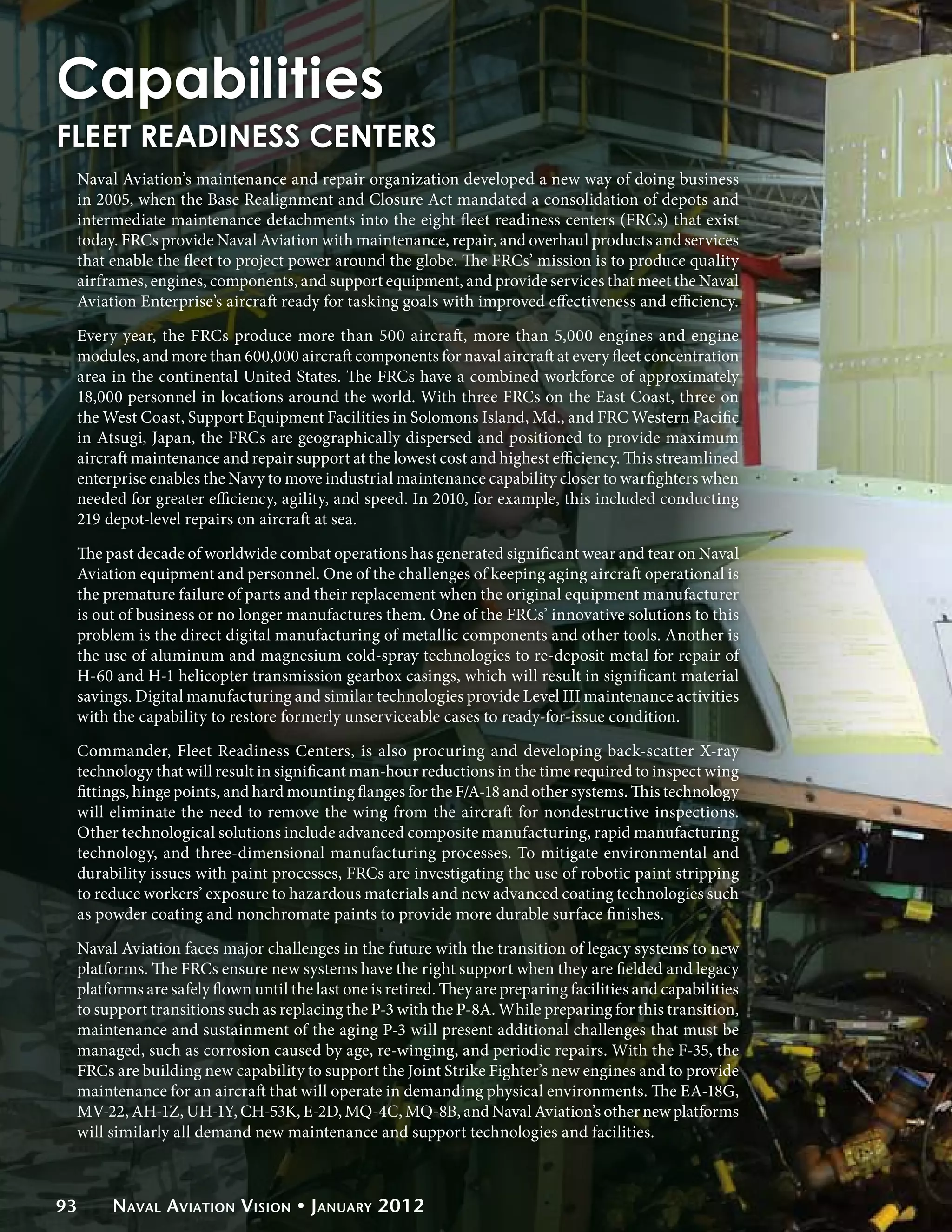
  • 50.
    2012 2032 KC-130T KC-130J KC-130J CH-53E CH-53K Naval Aviation Tomorrow: A ircraft 44
  • 51.
    MARINE CORPS UNMANNEDTACTICAL SUPPORT SYSTEMS RQ-7B Shadow Shadow is an expeditionary, multimission tactical umanned system that provides dedicated reconnaissance, surveillance, target acquisition and designation, and communications relay to regimental-sized and larger Marine Corps units. Since 2007, Shadow systems have deployed to Iraq, Afghanistan, and elsewhere, where they have flown more than 20,000 combat hours in support of Marine Corps, joint, and allied operations. Four Marine unmanned aerial vehicle squadrons now operate 13 Shadow systems. RQ-21A Integrator The RQ-21A Integrator Small Tactical Unmanned Aircraft System will provide a tactical intelligence, surveillance, and reconnaissance capability for Navy special warfare operators, amphibious assault ships, and Marine Corps battalion- and company-sized units. The Integrator is a 135-pound unmanned aerial vehicle (fully loaded) with a 37-pound payload consisting of an electro-optical/infrared sensor ball and communications relay package. The Integrator completed its first operational test phase in January 2011 at the Yuma Proving Ground in Arizona. The Marine Corps procured two early operational capability systems in 2011. The Navy will begin procurement in fiscal year 2012 with the purchase of two early operational capability systems. Scan Eagle Scan Eagle is a 40-pound vehicle with a cruising speed of 50 knots and a ceiling of 15,000 feet. Designed to fly missions of 15 hours or more, it is used for both land- and ship-based operations. The Scan Eagle system includes the Sky Wedge hydraulic launcher, the Sky Hook retrieving system, and a mobile ground-control element. The vehicle is equipped with a nose-mounted inertial-stabilized camera turret that carries either a digital camera or infrared sensor. The Scan Eagle system is being used to fill a capability gap on an interim basis; intelligence, surveillance, and reconnaissance services will be partially replaced by the RQ-21A beginning in fiscal year 2013. RQ-11B Raven B The Raven B provides small Marine Corps units with near-real-time reconnaissance and surveillance information. The system consists of a ground control station, three air vehicles, and a field support kit. The system has an endurance of up to two hours with a range of 10 kilometers. It provides day/night live video feedback to users by way of a laptop-based ground control station with color electro-optical, black-and-white low-light, and infrared payloads. Raven B systems are currently being upgraded to a digital data link. 45 Naval Aviation Vision • January 2012
  • 52.
    2012 2032 RQ-7B RQ-21A SCAN EAGLE RQ-11B WASP III Wasp III The Wasp III is a micro aerial vehicle that weighs approximately one pound and has an endurance of 45 minutes and a five-kilometer range. It shares a common ground control station with the RQ-11B Raven B. The Marine Corps is fielding 135 Wasp III systems to answer an urgent operational need for additional man-portable unmanned aircraft systems. A program of record decision is expected in fiscal year 2012 following fleet evaluation. Naval Aviation Tomorrow: A ircraft 46
  • 53.
    NAVY MARITIME PATROLAND RECONNAISSANCE AIRCRAFT P-8A Poseidon The P-8A Poseidon will replace the P-3C Orion, which has reached the end of its service life. The Poseidon will provide broad area maritime and littoral anti-submarine and anti-surface warfare as well as armed intelligence, surveillance, and reconnaissance capabilities to joint warfighters. To keep pace with emerging threats, the P-8A features a sensor and communications suite built within an open architecture to facilitate the insertion of state-of-the-art anti-submarine warfare sensors, net-ready technologies, and the latest joint weapons throughout its service life. The procurement plan for the Poseidon provides for a force with the lethality and capacity needed to support strike groups and the joint battle force in any maritime environment. Initial operational capability for the P-8A Poseidon is 2013. EP-3E Aries / Future Family of Airborne ISR, Targeting, and Information Operations System The EP-3E Aries is the Navy’s premier manned airborne intelligence, surveillance, reconnaissance (ISR), targeting, and information operations platform. Upgrades to the aircraft have created significant multi-intelligence, data-fusion, and cue-to-kill targeting capabilities essential to support current overseas contingency operations. Though optimized for the anti-surface warfare targeting mission in the maritime and littoral environments, recent capability upgrades have improved EP-3E mission effectiveness in supporting warfighters in all environments around the globe. Multi-intelligence sensors, data links, and a flexible and dependable P-3 airframe ensure effective support to conventional and nonconventional warfare operations. With the end of the EP-X program, Naval Aviation is developing a family-of-systems construct to be in place by the end of the decade to recapitalize the airborne capabilities currently provided by the Aries aircraft. Those systems include the MQ-4C, the Unmanned Carrier-Launched Airborne Surveillance and Strike System and the MQ- 8B. Until then, investment in the EP-3E Joint Common Configuration program will ensure Aries mission systems keep pace with current and emerging threats. MQ-4C Broad Area Maritime Surveillance System The MQ-4C Broad Area Maritime Surveillance (BAMS) System is an adjunct to the P-8A multimission aircraft. The MQ-4C will be forward- deployed, operating under the cognizance of the maritime patrol and reconnaissance force to leverage manpower, infrastructure, and expertise. This land-based system will provide persistent maritime reconnaissance and basic communications relay capabilities from five operational sites (orbits) worldwide in support of fleet commanders and coalition and joint forces. The MQ-4C’s persistence, combined with networked sensor data, will enable the unmanned aircraft family of systems to meet requirements more effectively. The MQ-4C completed its critical design review in February 2011. Its initial operational capability is scheduled for fiscal year 2016 (one orbit); full operational capability is scheduled for fiscal year 2020 (five orbits). Since 2009, a BAMS Demonstrator has served operationally with 5th Fleet, providing near- real-time, high-resolution tactical imagery in support of combat operations. In addition, the demonstrator facilitates the tactical integration of unmanned aircraft systems into fleet operations by: validating concepts of operation; developing tactics, techniques, and procedures; and executing training and proficiency flights. Lessons learned are being used in the development of maritime patrol and reconnaissance capabilities. 47 Naval Aviation Vision • January 2012
  • 54.
    2012 2032 P-8A P-3C EP-3E BAMS-D MQ-4C Naval Aviation Tomorrow: A ircraft 48
  • 55.
    NAVY AND MARINECORPS TRAINING, LOGISTICS, AND OPERATIONAL SUPPORT AIRCRAFT Training Aircraft T-6B Texan II Joint Primary Trainer Navy and Marine Corps primary pilot training is transitioning to the T-6B Texan II as the T-34C TurboMentor is retired after more than 30 years of service. The T-6A will continue to be used for naval flight officer and Air Force combat systems officer training. T-45C The T-45C Goshawk will be the single advanced strike trainer for tailhook pilots and naval flight officers as the T-39G/N Sabreliner is retired and the T-45A aircraft is retrofitted to the T-45C configuration. All T-45A cockpits will be digitized through the required avionics modernization program, which consists of a glass cockpit upgrade with two multifunction displays, mission display processor, recorder, and cockpit controls. The virtual mission training system program will integrate a virtual multimode radar capability into the T-45C to enable basic tactical skills training that will prepare students for the advanced tactical jet aircraft of the future. By 2020, work will have begun to identify a replacement for the T-45C as this aircraft reaches the end of its service life. 49 Naval Aviation Vision • January 2012
  • 56.
    2012 2032 T-6A/B T-6A/B T-34C T-39G/N T-45C T-45A/C Naval Aviation Tomorrow: A ircraft 50
  • 57.
    T-44 Replacement Aircraft The T-44A Pegasus and the TC-12B Huron are both pressurized, twin-engine, fixed-wing aircraft used to conduct multiengine aircraft training for Navy, Marine Corps, Air Force, and Coast Guard pilots. The T-44C, which upgrades the T-44A with a digital cockpit, will become the single multiengine training platform for Naval Aviation. The T-44 Replacement will be in place by 2032. Training in the TC-12B will be discontinued in 2012. TH-57D Sea Ranger Rotary and Tiltrotor Trainer The TH-57D Sea Ranger will replace the TH-57B/C as Naval Aviation’s single rotary-wing and tilt-rotor aircraft training platform. Future upgrades will include a digital cockpit and passenger protection to enhance training and safety and to match more closely the capabilities of Navy and Marine Corps fleet rotary-wing platforms. 51 Naval Aviation Vision • January 2012
  • 58.
    2012 2032 T-44A/C TC-12B TH-57B/C TH-57D Naval Aviation Tomorrow: A ircraft 52
  • 59.
    Navy-Unique, Fleet-Essential Airlift Navy-unique, fleet-essential airlift provides combatant commanders with short-notice, fast-response, intratheater logistics support when and where it is needed. This family of aircraft platforms delivers medium- and heavy-lift capabilities in support of the fleet. Designed primarily to provide a reliable and highly flexible airborne logistics capability for the wartime movement of personnel and heavy cargo, these aircraft respond to immediate demands for the movement of essential fleet personnel and cargo to mobile sea-based forces worldwide. The Marine Corps considers the C-9B to be an operational support airlift asset. Marine Aviation is pursuing the C-40A as the C-9B Replacement Aircraft to meet its medium-lift requirements. C-40A Clipper The C-40A Clipper is a Boeing 737-700 next-generation aircraft equipped with an oversized cargo door that offers multiple passenger and cargo configurations. The Clipper is replacing the aging C-9 Skytrain and C-20G Gulfstream fleet. The venerable C-9 has served the fleet exceptionally well for years, but with an average aircraft age of more than 36 years maintenance costs are steadily rising. The C-40A has increased range, capacity, and fuel efficiencies to support sea-based logistics. KC-130J Hercules The KC-130J will replace the C-130T. With increased performance, fuel efficiency, and maintenance reliability, the KC-130J is fully compliant with the Communications Navigation Surveillance/Air Traffic Management System and comes equipped with an electronic flight deck. Scheduled for delivery in fiscal year 2017 this aircraft can transport up to 35,000 pounds of cargo (or 75 passengers) 1,800 nautical miles at 350 knots. 53 Naval Aviation Vision • January 2012
  • 60.
    2012 2032 C-9B C-40A C-40A C-130T KC-130J Naval Aviation Tomorrow: A ircraft 54
  • 61.
    Operational Support Aircraft Operational support aircraft are used to transport high- priority passengers and cargo when requirements are time-, place-, or mission-sensitive. They are stationed worldwide and perform critical airlift missions for the geographic combatant commanders to and from remote locations where commercial sources are not available or viable. UC-12W Huron The Marine Corps is replacing UC-12B/F aircraft with the UC-12W Huron, which will provide light-lift capability through 2032. With a crew of three and a maximum range of 1,900 nautical miles, the Huron can transport up to eight passengers while flying at a speed of 279 knots at an altitude of 35,000 feet. The UC-12W is a deployable light-lift aircraft equipped with aircraft survivability equipment and has the radios necessary to operate in the Marine Corps Aviation Command and Control System. UC-35 Extended-Range Replacement The UC-35C/D aircraft provides high-speed transport for forward-deployed Marine forces that have time-sensitive passenger and cargo requirements. Operating forces require a jet transport with increased range and improved passenger and cargo capabilities. The UC-35 Extended- Range Replacement aircraft will meet these needs. 55 Naval Aviation Vision • January 2012
  • 62.
    2012 2032 UC-12B/F UC-12W UC-12W UC-35C/D UC-35ER C-20G C-20G Replacement Marine Corps Aviation has identified a need to replace the C-20G to support Marines. Range, payload, and performance characteristics similar to those of the C-20G will be required. Naval Aviation Tomorrow: A ircraft 56
  • 63.
    57 Naval Aviation Vision • January 2012
  • 64.
    2012 2032 UC-12F/M C-26D C-20A/D C-37A/B C-37A/B C-12 Replacement A C-12 Replacement aircraft will be identified to replace the Navy’s current fleet of UC-12F/M Huron and C-26D Metroliner aircraft to provide light-lift capability through 2032. C-37A/B Gulfstream G550 The C-37A/B Gulfstream executive transport aircraft replaces the aging C-20A/D to provide senior Navy Department personnel with high-speed, long-range transportation with a secure communications capability. Flying at speeds up to 585 knots, the G550 can travel 6,750 nautical miles at 45,000 feet and transport 12 or 14 passengers depending on how it is configured. Naval Aviation Tomorrow: A ircraft 58
  • 65.
    Specialized Naval Aircraft 59 Naval Aviation Vision • January 2012
  • 66.
    2012 2032 E-6B F-5N/F F-16A/B E-6B Mercury Derived from Boeing’s 707 aircraft, the E-6B supports U.S. Strategic Command with command, control, and communications capabilities to direct and employ strategic forces. Designed to support a flexible nuclear deterrent posture, the E-6B uses very-low-frequency emergency communications for U.S. Strategic Command airborne command post missions and airborne launch control of ground-based intercontinental ballistic missiles. The Block I program (initial operational capability in 2013) is designed to improve the mission communication systems of the aircraft and increase efficiencies between airborne command post and Navy communications personnel. The internet protocol/bandwidth expansion program (2013) and the Block II program (2015) both provide increases in line-of-sight and satellite-based data links to allow for greater data throughput supporting high-capacity communications. The service life extension program (2011) ensures continued airframe viability well into the 21st century. F-5N/F Tiger II and F-16A/B Fighting Falcon Navy and Marine Corps adversary squadrons provide advanced training support to active-duty squadrons. The Navy and Marine Reserve squadrons dedicated to this mission employ the F-5N and F-5F Tiger II as well as F/A- 18A+ Hornets. The Naval Strike Air Warfare Center in Fallon, Nev., maintains a fleet of 14 F-16A/B Fighting Falcons that provide dissimilar, fourth-generation threat replication. Adversary squadrons provide opposing forces for large force exercises, unit-level training, and fleet replacement squadron training, and are a key component for advanced tactical fleet training. A replacement platform is envisioned in the 2025 timeframe for the F-5 and F-16. Naval Aviation Tomorrow: A ircraft 60
  • 67.
    C-2A Greyhound /Future Carrier Onboard Delivery Aircraft The C-2A Greyhound is the Navy’s medium-lift/long-range logistics support aircraft, transporting high-priority cargo, mail, and passengers between carrier strike groups and forward logistics sites. It can deliver a combined payload of 10,000 pounds a distance of 1,000 nautical miles, and the interior cabin can be easily rearranged to accommodate passengers, litter patients, or time-critical cargo. The large cargo ramp at the rear of the aircraft allows rear loading and unloading for fast turnaround and can be operated in flight to air drop supplies and personnel. Equipped with an auxiliary power unit for unassisted engine starts, the versatile Greyhound can operate independently from remote locations. The aircraft is undergoing several modifications and a service life extension program, which include structural enhancements, improvements to the avionics system, rewiring, and a new propeller system. These modifications will extend the Greyhound’s service life until a Future Carrier Onboard Delivery Aircraft can be fielded. Initial operational capability will be required by 2026. VXX Replacement Presidential Helicopter A replacement is under development for the 35-year-old VH-3D and the 25-year old VH-60N helicopters, currently providing transportation for the President of the United States, foreign heads of states, and other dignitaries as directed by the White House Military Office. The Replacement Presidential Helicopter (VXX) will provide a hardened, mobile command-and-control transportation capability and a system of integrated systems necessary to meet current and future presidential transport mission requirements. 61 Naval Aviation Vision • January 2012
  • 68.
    2012 2032 C-2A VH-3D VH-60N Naval Aviation Tomorrow: A ircraft 62
  • 69.
    WEAPONS LONG-RANGE STANDOFF WEAPONS AGM-84H/KStandoff Land-Attack Missile – Expanded Response The Standoff Land Attack Missile–Expanded Response (SLAM-ER) is a long-range, highly precise, air-launched strike missile capable of attacking fixed and mobile land targets as well as surface ships. Terminal control of the weapon is achieved when the pilot designates the impact point on the imaging infrared scene transmitted by the weapon to the cockpit display. Man-in-the-loop commands are sent to the SLAM-ER by way of a data-link pod carried by the launching (or secondary control) aircraft. An analysis of alternatives is defining a follow-on weapon solution to meet the maritime standoff strike mission currently filled by SLAM-ER and Harpoon Block 1C. AGM/RGM-84D Harpoon Block 1C The Harpoon Block 1C is an air- or surface-launched, anti-ship, all-weather cruise missile that employs an autonomous active radar seeker to attack a wide variety of surface ship targets from standoff ranges. The Harpoon, which entered service in 1977, is currently carried by F/A-18 and P-3C aircraft as well as a portion of the Navy’s DDG-51 and CG-47 surface ship classes. Numerous air, surface, and submarine platforms currently deploy Harpoon for 27 international customers. An analysis of alternatives is being conducted to scope and define a follow-on weapon solution to meet the maritime standoff strike mission currently addressed by SLAM-ER and Harpoon Block 1C. Tomahawk Land-Attack Missile The Tomahawk Land Attack Missile is a long-range, subsonic cruise missile used for deep land attack warfare that is launched from U.S. Navy surface ships and U.S. Navy and United Kingdom Royal Navy submarines. There are currently three main versions: the Block II nuclear variant, which contains the W80 warhead; the Block III conventional variant, which can carry either a 1,000-pound unitary warhead or a submunition-dispensing warhead; and the Block IV, or Tactical Tomahawk, which is network-enabled and capable of changing targets while in flight. Tomahawk provides on-scene commanders with the flexibility to attack long-range fixed targets or to support special operations forces with a lethal, responsive, precise weapon system. Potential future capabilities for the Tomahawk Block IV include improvements to the warhead (the Joint Multiple Effects Warhead System) and a maritime interdiction multimission capability (Multimission Tomahawk). The former system will demonstrate the 63 Naval Aviation Vision • January 2012
  • 70.
    military utility ofa programmable warhead with increased effects of penetration and blast against the full range of targets, from area to hardened targets. Multimission Tomahawk adds a moving target seeker and upgraded data link to the existing Tactical Tomahawk missile. The Tomahawk program office is currently investigating industry seeker technologies for maritime interdiction that could potentially be integrated into the existing Block IV weapon system. Additional studies have been initiated to develop a next-generation supersonic cruise missile capability for Tomahawk that will increase responsiveness against time-critical targets. 2012 2032 SLAM-ER HARPOON TOMAHAWK BL II/III TOMAHAWK BL IV Naval Aviation Tomorrow: Weapons 64
  • 71.
    MID-RANGE STANDOFF WEAPONS AGM-88EAdvanced Anti-Radiation Guided Missile The Advanced Anti-Radiation Guided Missile (AARGM) upgrade program transforms a portion of the existing AGM-88 HARM inventory into lethal strike weapons with enhanced time-critical strike and precision attack capabilities. The AARGM upgrade includes: an advanced digital anti-radiation homing receiver for greater sensitivity and enhanced air defense system capabilities; an active millimeter wave terminal radar to increase lethality against modern air defense units, such as surface-to-air missile radars that use radar shutdown and countermeasures designed to defeat anti-radiation missiles; inertial navigation/global positioning systems; a weapon impact assessment transmitter to aid and cue the battle damage assessment process; and an integrated broadcast service receiver for network-centric connectivity reception of off-board targeting information. AARGM correlates multiple sensors and geo-specific capabilities to locate and attack both stationary and fixed targets with precision while countering enemy tactics designed to defeat anti-radiation missiles. Initial operational capability for AARGM is fiscal year 2012. AGM-154 Joint Standoff Weapon The Joint Standoff Weapon (JSOW) is a joint family of armaments that permits Navy and Air Force aircraft to attack targets at increased standoff distances. The weapon uses inertial navigation/global positioning systems for guidance. JSOW provides low- and high-altitude launch capabilities to enable launch platforms to remain outside the range of defenses, enhancing aircraft survivability. All JSOW variants share a common body but can be configured for use against area targets or bunker penetration. The JSOW-C unitary variant adds an imaging infrared seeker and an autonomous target acquisition capability to attack targets with precision accuracy. The JSOW-C-1 will incorporate new target tracking algorithms into the seeker and a strike common weapon data link, giving joint force commanders an affordable, air-delivered, standoff weapon effective against moving maritime targets as well as fixed land targets. The system will maintain JSOW-C functionality to be effective against targets in or through adverse weather conditions, in both day and night. Used in conjunction with accurate targeting information and anti-radiation weapons, JSOW-C-1 will defeat enemy air defenses. Small-Diameter Bomb Increment II The Small-Diameter Bomb Increment II (SDB II) is a joint program that will provide warfighters with the capability to attack mobile targets at standoff ranges in all types of weather. This 250-pound-class weapon addresses the following additional requirements: multiple ordnance carriage; precision munitions capability; reduced munitions footprint; increased weapon effectiveness; minimized potential for collateral damage; reduced susceptibility of munitions to countermeasures; and an incremental development path to a network-centric operations capability. SDB II integration is planned for the F-35B/C Lightning II. 65 Naval Aviation Vision • January 2012
  • 72.
    2012 2032 HARM BL V HARM BL V / AARGM JSOW-A/C JSOW-A/C-1 SDB II Naval Aviation Tomorrow: Weapons 66
  • 73.
    DIRECT-ATTACK WEAPONS General PurposeBombs Mark 80/BLU series General Purpose 500-, 1,000-, and 2,000-pound bombs provide blast and fragmentation effects against a variety of non-hardened targets and are used extensively for direct attack, close air support, and suppression missions. The thermally protected warhead is used for Joint Direct Attack Munitions (JDAMs), Laser JDAMs, Dual Mode Laser-Guided Bombs (DMLGBs), and Low Collateral Damage Bombs (LCDBs). General Purpose bombs are expected to remain in the inventory through 2032. Laser Joint Direct-Attack Munition The Laser JDAM is a retrofit weapon that converts laser-guided bombs currently in the inventory to a dual mode configuration using common components. The retrofit replaces the existing computer control group with inertial navigation/global positioning systems that provides fire-and-forget, all-weather terminal guidance. The retrofit strategy streamlines qualification timelines, putting a new weapon in the hands of warfighters that much faster. The Direct-Attack Moving Target Capability (DAMTC) is intended to provide naval and joint warfighters with a lethal, interoperable, and cost-effective precision strike weapon system that can engage moving, semi-mobile, and stationary targets. DAMTC will be retrofitted to the JDAM weapon and reach initial operational capability in 2012. Low Collateral Damage Bomb The LCDB is ideal for modern urban warfare where target discrimination between friendly, noncombatants, and enemy forces requires exceptional blast control. LCDB provides a reduced blast that yields lower collateral damage and adheres to the rules of engagement currently dictated by U.S. Central Command. A precision strike weapon, LCDB can be used with the same guidance kits as those used for laser-guided bombs, DMLGBs, JDAMs, and Laser JDAMs. LCDB is the result of a modification of an existing weapon system, which reduced its design, production, and sustainment costs. 67 Naval Aviation Vision • January 2012
  • 74.
    2012 2032 GP BOMBS GP BOMBS LGB JDAM LCDB LCDB Naval Aviation Tomorrow: Weapons 68
  • 75.
    Joint Air-to-Ground Missile The Joint Air-to-Ground Missile (JAGM) is a joint Army-Navy initiative, with the Army designated as the lead service. It is an all-weather, direct-attack, 100-pound-class weapon system that will use a tri-mode seeker (semi-active laser, millimeter wave radar, and imaging infrared), multipurpose warhead, and single configuration rocket motor to destroy high-value hardened and non-armored stationary and moving targets. JAGM as a direct-attack capability is envisioned as the eventual replacement for the AGM-114 Hellfire, AGM-65 Maverick, and tube-launched, optically tracked, wire- guided missile systems. Threshold platforms include the AH-1Z, the MH-60R, and other joint service manned and unmanned aircraft. It is expected to reach initial operational capability in fiscal year 2016 for the AH-1Z and fiscal year 2017 for the MH-60R. Advanced Precision Kill Weapon System II The Advanced Precision Kill Weapon System II (APKWS II) provides precision guidance to the existing Hydra 70, 2.75- inch rocket system by placing a laser-guided seeker on existing rocket motors and warheads. APKWS II provides an excellent low-cost, mid-range weapon that is well suited to urban environments. Accurate to within two meters of the aim point, the weapon will destroy target sets consisting of personnel, unarmored vehicles, lightly armored vehicles, armored personnel carriers, structures, and man-portable air defense systems at ranges from one and a half to five kilometers. Initial operational capability is expected in fiscal year 2012. 2012 2032 MAVERICK TOW JAGM HELLFIRE APKWS II ROCKETS 69 Naval Aviation Vision • January 2012
  • 76.
    Low-Cost Guided ImagingRocket The Low-Cost Guided Imaging Rocket (LOGIR) is a 2.75-inch rocket with a front-end imaging/infrared guidance kit. In 2012, the LOGIR team from the weapons division of the Naval Air Warfare Center will complete the final deployment testing. Preliminary results exhibit excellent functionality. In addition, researchers have made significant theoretical advances that will lead to the elimination of nearly all image processing thresholds—technologies that are now being incorporated into LOGIR. Naval Aviation Tomorrow: Weapons 70
  • 77.
    TORPEDOeS MK-54 By 2032, the MK-54 will have replaced the current inventory of MK-46 and MK-50 lightweight torpedoes. The MK-54 was created by combining the homing section of the MK-50 with the propulsion unit and warhead of the MK-46 (improved for better performance in shallow water), and adding commercial off-the-shelf technology. The MK-54 has both analog and digital fire control capabilities in addition to a software upgrade capability. Aircraft capable of employing the MK-54 are the SH-60F, MH-60R, P-3C, and P-8A (in 2013). Still in the design phase, a special variant of the MK-54—the High- Altitude Anti-Submarine Warfare Weapon—is an air-launch accessory that allows fixed-wing aircraft to employ the MK-54 torpedo outside the current air-launch envelope. Beginning in 2016 this variant will provide the P-8A Poseidon with the ability to engage undersea targets with precision at high altitude and long range without the need for dedicated attack runs. Future developments may include a data link allowing in-flight control and mid- course guidance by 2019. 71 Naval Aviation Vision • January 2012
  • 78.
    2012 2032 MK-46 MK-50 MK-54 MK-54 Naval Aviation Tomorrow: Weapons 72
  • 79.
    AIR-TO-AIR WEAPONS AIM-9X BlockII/P3I Sidewinder The AIM-9X Sidewinder is a major upgrade to the AIM-9M short-range air-to-air missile that provides U.S. fighters with the ability to defeat tomorrow’s advanced threats. The AIM-9X system contains a focal-plane-array guidance-control section, a highly maneuverable airframe, and signal processors that enhance kinematics and infrared countermeasure capabilities. The AIM-9X Block II/Pre-Planned Product Improvement (P3I) program will provide warfighters with increased lethality, high off-boresight capability, and a data link to take full advantage of increased kinematics and range. When combined with the Joint Helmet-Mounted Cueing System, AIM-9X provides a “first-look, first-shoot” weapon option. Sidewinder was originally a “within visual-range missile”; with modernization, it has become a “beyond visual-range missile.” AIM-120D/P3I Advanced Medium-Range Air-to-Air Missile The Advanced Medium-Range Air-to-Air Missile (AMRAAM) is fielded on the F/A- 18A/B/C/D Hornet, F/A-18E/F Super Hornet, EA-18G Growler, and AV-8B Harrier. AMRAAM will also be utilized by the F-35. The AIM-120D program modernizes prior versions of this missile to maintain a beyond-visual-range engagement capability. This modernization plan includes an enhanced data link, a GPS system, improved high off-boresight capability, enhanced kinematics, and improved electronic counter-countermeasures capabilities through software upgrades. Initial acceptance of the AIM-120Ds began in 2009. 73 Naval Aviation Vision • January 2012
  • 80.
    2012 2032 AIM-9M AIM-9X BL II/P3I AIM-9X AIM-7 AIM-120D/P3I AIM-120A/B/C Naval Aviation Tomorrow: Weapons 74
  • 81.
    75 Naval Aviation Vision • January 2012
  • 82.
    NON-KINETIC WEAPONS AN/ALQ-99 TacticalJamming System The AN/ALQ-99 is the primary electronic attack capability carried on Navy and Marine Corps EA-6Bs and Navy EA- 18Gs. Introduced during the Vietnam War, it consists of up to five externally mounted transmitter pods and an onboard system. The system jams high-power surveillance, acquisition, and tracking radars. The onboard system intercepts and automatically processes radar signals to jam diverse radar threats with very high radiated power. The modular architecture of the jammer system, which facilitates optimizing transmitters and antennas for a given frequency range, also facilitates tailored mission configurations. The EA-6B and EA-18G can carry up to five ALQ-99 tactical jammer pods—two under each wing and one under the fuselage.  Next Generation Jammer The Next Generation Jammer (NGJ) will replace and improve the capability currently enabled by the AN/ALQ-99 system, providing a significant enhancement to the EA-18G’s capabilities at reduced operations and sustainment costs. NGJ mitigates growing ALQ-99 obsolescence and inventory issues and provides higher availability and capability. It will be a vital component of the joint airborne electronic attack system of systems. The EA-18G, and eventually the F-35, will employ NGJ as the electronic attack payload. The NGJ will allow the Department of Defense to conduct electronic warfare on a broader and more integrated basis than is currently possible. It will be a stand-alone asset, capable of performing a variety of functions over a wide section of the electromagnetic spectrum. Like the ALQ-99 Tactical Jamming System it will replace, NGJ is designed to be a wide-spectrum jammer that can be used in a variety of different missions and scenarios. It is scheduled for initial operational capability in 2020. Naval Aviation Tomorrow: Weapons 76
  • 83.
    Making Our VisionReal 77 Naval Aviation Vision • January 2012
  • 84.
    Making O urVision Real 78
  • 85.
    The Challenges ofTransitions T ransitions are complex and must be planned, coordinated, and executed very carefully. Many entities are involved: the program office responsible for the transitioning platform or system; personnel from Naval Air System Command (NAVAIR) who provide the program office with the technical expertise necessary to enact the transition; Director, Air Warfare (N88), which connects warfighting requirements to resources and funding; the staff of the type wing commander, responsible for both the incumbent and transitioning type/model/series aircraft; fleet introduction teams that represent the concerns of the squadrons that actually fly, operate, and maintain new aircraft and systems; and the fleet itself, on whose shoulders rests the responsibility to maintain specific warfighting capabilities with old platforms while learning to fly and tactically employ new ones. The squadron is where much of the heavy lifting occurs. Pilots and naval flight officers already qualified in one type/model/series aircraft must be cycled back through the fleet replacement squadron to learn how to fly and operate new platforms and systems. Aircrews transitioning from the SH-60B/F helicopter to the MH-60R/S, for example, change to a “glass” cockpit where information on airspeed, attitude, altitude, heading, engine performance, and more is presented on a video display instead of analog gauges. SH-60 maintenance crews must be trained on how to fix and sustain the MH-60 while remaining qualified to preserve the SH-60 until it is completely gone from the squadron. Integrating air and ship systems, such as the Electromagnetic Aircraft Launch System (EMALS), pose additional design, test, and installation challenges. EMALS is a completely new launch system designed for a new carrier class that required simultaneous system and ship design, as well as the design and construction of a test facility at Lakehurst. Since the test facility had to be completed first, it accelerated many design decisions for the overall system and the 79 Naval Aviation Vision • January 2012
  • 86.
    ship, such asthe configuration of the EMALS trough. While launch energies and other key performance parameters were already known, EMALS hardware had to be designed and tested to meet many other shipboard requirements, such as shock, vibration, deck loads, electromagnetic effects, and the impact of the harsh flight deck environment on the launch motors located in the trough (salt spray, heat, cold, humidity, fire extinguishing agents, etc.). Another challenging transition is integrating unmanned systems into the air wing of the future. The Unmanned Combat Aircraft System Demonstrator program will help manage this risk through the phased testing of shipboard digital messaging and a control architecture using manned surrogates and the X-47B unmanned aircraft for operations on and around the carrier, including launch and recovery. The program will ensure that the technologies and operational procedures are available to support Unmanned Carrier-Launched Airborne Surveillance and Strike System development. The Aviation/Ship Integration team is the executive agent for upgrading legacy ships to meet new aviation requirements. NAVAIR teams support Naval Sea Systems Command at the Program Executive Office (PEO) for Carriers, the PEO for Littoral Combat Ships, and the PEO for Ships to meet the aviation requirements of new vessels such as Ford-class carriers, Freedom/Independence-class littoral combat ships, Zumwalt-class destroyers, Spearhead-class joint high speed vessels, and LHA (R). The Aviation/Ship Integration team leverages mid-life availabilities of carriers and amphibious assault ships to incorporate major aviation facility upgrades. An example of this is the joint effort between NAVAIR, Naval Sea Systems Command, and the F-35 Joint Program Office to manage the integration of F-35Bs with LHDs and F-35Cs with CVNs. The sum of all transitions across the Naval Aviation Enterprise is subject to the realities of current and future defense fiscal environments. This fact, coupled with the increasing complexity of new products and the rising costs to maintain current inventory, presents significant challenges in terms of affordability. Even as we test and deliver new platforms and systems, we must also upgrade and maintain those currently in the fleet, and do so throughout their complete life cycles—which can be 30 years or more. The following section outlines several initiatives and concepts that are helping Naval Aviation fight better, organize its resources more effectively, and meet the many challenges of transition in the coming decades. Here also are descriptions of the vital tools and capabilities at Naval Aviation’s disposal that are implementing the vision. Making O ur Vision Real 80
  • 87.
    Initiatives and Concepts Air-SeaBattle The Air-Sea Battle concept leverages current and future military and technological capabilities that reflect unprecedented Navy, Marine Corps, and Air Force collaboration, cooperation, and resource investments. The capabilities needed to conduct operations described in Air-Sea Battle will inform Department of the Air Force and Department of the Navy investment planning and drive institutional change in both departments. The Air-Sea Battle concept is both a natural and deliberate evolution of U.S. power projection and a key supporting component of U.S. national security strategy for the 21st century. Air-Sea Battle is a limited operational concept that focuses the development of integrated air and naval forces to address evolving anti-access and area denial threats—i.e., the ability of an adversary to deny entry of U.S. forces into a theater of operations (anti-access) or to prevent the maneuver of U.S. forces within an area (area denial). This concept exploits and improves on the advantage U.S. forces have in operating across domains. This advantage is essential to defeat increasingly sophisticated weapon systems such as homing ballistic missiles and supersonic cruise missiles. The Air-Sea Battle operational design employs a networked and integrated attack in depth to disrupt, destroy, and defeat anti-access and area denial threats. Networked actions are tightly coordinated in real time across domains by mission- organized physical and human networks able to command and control air and naval forces in a contested environment. 81 Naval Aviation Vision • January 2012
  • 88.
    The forces theydirect are organized to conduct integrated operations across all domains: attacking in depth to disrupt the ability of adversaries to use command and control to employ anti-access and area denial weapon systems; destroying or neutralizing weapon systems within effective range of U.S. forces; and defeating an adversary’s weapons to preserve essential joint forces to sustain offensive and defensive operations. Aging hardware, the accelerating anti-access and area denial threats to global stability, and U.S. national interests demand the adoption of a smarter, more collaborative approach to addressing this challenge. Air-Sea Battle provides a framework to deter, defend against, and defeat aggression by adversaries employing anti-access and area-denial strategies and capabilities. It will also advance the longstanding U.S. role as a trusted partner to maintain the safety and openness of the global commons. Making O ur Vision Real 82
  • 89.
    NETWORKing AND INFORMATIONDOMINANCE Warfighters consistently face the challenge of understanding the battlefield, exploiting information, and applying that knowledge to achieve victory. The concept of “information dominance” opens new horizons for Naval Aviation to use information against adversaries to achieve effective kinetic and non-kinetic results. The benefits of mastering information as a main battery of U.S. naval warfighting capability include compressed kill chains, enhanced lethality, increased survivability, synchronized effects, and reduced fratricide and collateral damage. Naval Aviation will leverage the information dominance revolution by improving the core networking capabilities of tactical data links such as Link 16, common data links such as Hawk Link, and critical enabling networks such as the Cooperative Engagement Capability and future capabilities as they mature. Naval Aviation assets will increasingly tap into the global information grid through redundant and flexible pathways to enable command and control, coordination, and enhanced mission execution. In the future, platforms, weapons, systems, and operators must cognitively collaborate within the battle space to assemble information and knowledge that allow U.S. forces to maintain a decisive advantage over their adversaries. We will pursue these game-changing capabilities through the employment of advanced networking technologies. The information dominance guiding principle of “every platform a sensor; every sensor networked,” is driving a closer relationship between the Naval Aviation Enterprise (NAE) and the Naval Information Dominance Enterprise 83 Naval Aviation Vision • January 2012
  • 90.
    (NIDE). In atime of decreasing resources, substantial investments in platforms and systems must be leveraged and their capabilities integrated across all missions and domains through flexible, adaptive networks. Creating a networked family of systems will generate effects greater than the sum of individual components. To achieve alignment, the NAE and NIDE are laying the foundation for compatible processes to deliver integrated capability. The primary tools are the Naval Aviation integrated capabilities packages and the information dominance roadmaps such as intelligence, surveillance, and reconnaissance and integrated targeting and fire control. Requirements, resourcing, acquisition, validation, and science and technology efforts will be synchronized among the enterprises. Solutions such as common waveforms, radios, and network management approaches, and modular computing environments will culminate in machine-to-machine collaboration at the mission software application level. This collaboration of platforms and systems will first aim to deliver sufficient targeting for future weapons, enabling more flexibility with less complexity. The right technology solutions will also enable better fire control, electronic warfare battle management, sensor fusion, and unmanned systems. Follow-on increments will lead to a collaborative family of systems where platforms, weapons, and unmanned systems are capable of joining an integrated, survivable, and flexible network and discovering other nodes of information. These assets will rapidly assemble actionable knowledge in an ad hoc manner and work together across domains, providing dynamic mission execution as never before. Making O ur Vision Real 84
  • 91.
    85 Naval Aviation Vision • January 2012
  • 92.
    INTEGRATION AND INTEROPERABILITY Today’s exceedingly complex and interdependent weapon systems cannot be viewed individually—they require a system-of-systems approach in developing warfighting capability. To be successful, they must be resourced, developed, tested, and fielded as integrated and interoperable systems. The development, integration, and testing of weapon systems to deliver air, surface, and subsurface mission capabilities is an inherently governmental function. The expertise and tools necessary to improve the delivery of integrated capabilities reside within the Navy; government system engineers in the systems commands and warfare centers are focused on essential mission engineering. The government’s role is leveraged to provide technical authority across program boundaries to ensure the integrity of mission requirements is maintained as systems are integrated. Improvements are underway to translate operational capability at the mission level more effectively into system requirements at the program level. Warfighting gaps are being identified and resolved while systems are in development, before they are fielded. The development and test capabilities of the systems commands’ and warfare centers’ laboratory and range infrastructures are being linked together to create a realistic operational environment to horizontally integrate systems as well as to validate warfighting capabilities across all domains prior to system deployment. In addition, mission-level processes and tools that focus on developing, integrating, testing, and delivering warfighting effects at best value are being implemented and institutionalized. These tools are the enablers to support data-driven decision-making on warfighting capability. Making O ur Vision Real 86
  • 93.
    REDUCING TOTAL OWNERSHIPCOSTS A big part of acquisition strategy is program cost and performance improvement, which begins with a solid understanding of requirements, a clear description of what is being procured, and a systematic understanding of when capabilities and costs are out of synch. During execution, we must balance marginal increases in capability gains versus disproportionate increases in cost to attain the optimum affordable solution. By evaluating how various baseline assumptions influence a program’s cost and schedule requirements, we determine technical and programmatic risk and uncertainty. The V-22 program is an example of total ownership cost reduction at work. The V-22 cost-per-flight-hour budget estimates were developed several years before the aircraft was fielded using comparisons with existing rotary- and fixed-wing aircraft. The estimate incorporated reliability predictions and repair capability assumptions that were below the actual cost per flight hour once the aircraft became operational. The V-22 team implemented a plan to reduce costs as well as improve readiness through a variety of initiatives, including reliability and maintainability improvements, maintenance concept changes, additional repair capabilities, improved repair turnaround times, repair price reductions, and changes to contract strategy. By June 2011, these efforts resulted in the V-22’s cost per flight hour decreasing by nearly 30 percent over the previous two fiscal years. Complete transparency of performance data is a vital requirement for the successful management and execution of acquisition programs. We have made great strides in the past few years transforming program data into graphic formats that facilitate understanding and analysis, effectively transforming data into actionable information. The “command information center” (CIC) concept in particular has helped organize critical program planning and performance data for integrated analysis, issue identification, action planning, prioritization, decision making, and corrective action follow through. The CIC has been deployed at both the program and command levels. Six focus initiatives are helping to provide the insight, tools, and business processes targeted to enable “should-cost management” and achieve better buying power, reduced acquisition cycle times, and lower total ownership costs within the Naval Aviation portfolio: • The total ownership cost transparency initiative identifies the drivers of total life-cycle costs for both legacy and new acquisition programs. A portfolio analysis capability will also facilitate cross platform/program analyses and strategic affordability assessments. Understanding of programmatic, technical, and cost-related issues provides the basis for cost reduction, cost avoidance, and informed should-cost management opportunities. • The contractor cost structure and rates initiative is targeted to develop an understanding of contractors’ cost and rate structures and the business pressures and decisions that drive cost and rate growth in our programs. The objective is to engage Naval Air Systems Command (NAVAIR), the Defense Contract Management Agency (DCMA), and industry to target greater efficiency and affordability. 87 Naval Aviation Vision • January 2012
  • 94.
    • The suppliernetwork initiative’s objective is to work with DCMA and other Defense Department services to develop a comprehensive understanding of who is supporting Naval Aviation Enterprise programs and to identify program and portfolio risks and opportunities for risk mitigation and cost improvements. • The production management initiative recognizes that NAVAIR’s current portfolio of programs is shifting from a research-and-development-centric to a production-centric mode, and we must have insights into production planning and performance, as well as into the processes, tools, training, and business disciplines to manage product quality, delivery, and cost performance. • The business collaboration initiative engages industry in a three-tiered strategy focused on obtaining greater efficiency and productivity. The Joint Management Council (JMC) is an important part of NAVAIR’s overarching business collaboration strategy with industry and directly supports better buying power initiatives. The JMC looks at critical common processes such as supplier management, production/manufacturing/cost-of-poor-quality rates, proposal quality/cycle time, and alignment with government science and technology to illuminate affordability and cycle-time reduction opportunities. The JMC examines these issues within a portfolio of programs and is considered the middle level of NAVAIR’s tiered engagement strategy. In contrast, the program management review is a lower-tier process focused on program-specific issues and the business collaborative exchange is the upper-tier process looking at enterprise-wide issues and NAVAIR strategic initiatives. • The enculturation (or “changing the culture”) initiative helps build the professional work force for total ownership cost improvements through effective should-cost management. Enculturation includes the dissemination of skills and knowledge through focused training and development, assisting program offices with planning and management through project consulting, and managing knowledge. We are making progress on our transition challenges using Naval Aviation Enterprise principles and by collaborating with industry, DCMA, and other Defense Department services on specific areas of improvement. The goal is to develop and incorporate acquisition strategies and business efficiencies that enable effective should- cost management and reduce the total ownership costs of our platforms and systems. Making O ur Vision Real 88
  • 95.
    89 Naval Aviation Vision • January 2012
  • 96.
    AIRSpeed AIRSpeed is thename of the Naval Aviation Enterprise’s continuous process improvement effort. This term encompasses all improvement tools and methodologies that produce readiness, improve quality of life for Sailors, Marines, and civilians, and assist with meeting cost constraints. The industry-proven tools used under the AIRSpeed effort include Theory of Constraints, Lean, Six Sigma, barrier removal teams, and Kaizen initiatives. Their application to the processes associated with Naval Aviation maintenance, supply, and administration is driving the development of improved operating practices that deliver greater readiness with greater efficiency. Because of its scope and flexibility, AIRSpeed can be tailored to the needs of multiple areas within the Naval Aviation Enterprise. AIRSpeed enables readiness production by increasing the speed, reliability, and predictability of the processes associated with integrated maintenance and supply replenishment. It has contributed to reductions in the cycle time of aircraft, engine, and component repair and overhaul, leading to fewer items in the repair pipeline and more of them available for fleet use. Within the systems commands, AIRSpeed and similar continuous process improvement tool sets reduce the response times and costs of processes employed in the course of acquiring, testing, and sustaining new aircraft, weapons, and their related systems. Making O ur Vision Real 90
  • 97.
    MARINE CORPS COMMANDAND CONTROL TRANSFORMATION One of Marine Corps Aviation’s highest priorities is to ensure that the Marine Air Command-and-Control System (MACCS) is prepared for emerging operational environments while it continues to support current operations. This system enhances capability by improving deployability, flexibility, adaptability, Marine air-ground task force (MAGTF) integration, data fusion, and training. All future enhancements to MACCS will focus on the “command” aspect of aviation command and control. By leveraging technological advancements and innovation to increase capability, MACCS will ensure that tactical air commanders can execute their battle command and management functions in support of MAGTF commanders. MARINE CORPS LOGISTICS TRANSFORMATION Marine Corps Aviation logistics continues to transform its business practices and processes through End-to-End Alignment (EEA). As a centerpiece of the Marine Corps’s aviation transformation strategy, EEA affects the underlying processes that support current readiness goals and objectives in all environments. EEA provides squadron commanders with a system-of-systems approach to planning, scheduling, and executing the sortie-based training program to achieve greater core competency and increased combat power. A focused continuous process improvement program, EEA harnesses best practices from Theory of Constraints, Lean, and Six Sigma to institutionalize demand-pull logistics across the entire aviation logistics chain. A focus on the production and replenishment of “ready mission sets” by aviation logistics squadrons, organic depots, and original equipment manufacturers establishes conditions for successful migrations toward the Marine Aviation Logistics Support Program II (MALSP II). By linking EEA and MALSP II, Marine Corps Aviation supports legacy, transition, and future platforms. MALSP II is transforming a logistics capability from a historical data-based “push” system to a modern demand-driven “pull” system. In 2011, MALSP II focused on completing a demand-pull nodal logistics proof of concept in the Horn of Africa, sustaining critical information technology known as the “Expeditionary Pack-Up Kit” for detached and deployed operations. The project office is also working with the Naval Aviation Enterprise retail policy group on the future of logistics inventory allowance processes and procedures in support of MALSP II’s initial operational capability goal at the end of fiscal year 2014. The aviation and ground logistics communities have embarked on similar logistics transformation efforts in response to current operational demands and in preparation for an uncertain future. Marine Corps Aviation’s MALSP II and the ground element’s logistics modernization present opportunities for alignment, interoperability, and integration to improve the overall performance of MAGTFs. MAGTF logistics integration seeks to identify and exploit these opportunities in ways that will positively impact logistic support to naval forces, and provides a forum for constant and dynamic engagement between the two logistics communities. 91 Naval Aviation Vision • January 2012
  • 98.
    Making O urVision Real 92
  • 99.
    Capabilities FLEET READINESS CENTERS Naval Aviation’s maintenance and repair organization developed a new way of doing business in 2005, when the Base Realignment and Closure Act mandated a consolidation of depots and intermediate maintenance detachments into the eight fleet readiness centers (FRCs) that exist today. FRCs provide Naval Aviation with maintenance, repair, and overhaul products and services that enable the fleet to project power around the globe. The FRCs’ mission is to produce quality airframes, engines, components, and support equipment, and provide services that meet the Naval Aviation Enterprise’s aircraft ready for tasking goals with improved effectiveness and efficiency. Every year, the FRCs produce more than 500 aircraft, more than 5,000 engines and engine modules, and more than 600,000 aircraft components for naval aircraft at every fleet concentration area in the continental United States. The FRCs have a combined workforce of approximately 18,000 personnel in locations around the world. With three FRCs on the East Coast, three on the West Coast, Support Equipment Facilities in Solomons Island, Md., and FRC Western Pacific in Atsugi, Japan, the FRCs are geographically dispersed and positioned to provide maximum aircraft maintenance and repair support at the lowest cost and highest efficiency. This streamlined enterprise enables the Navy to move industrial maintenance capability closer to warfighters when needed for greater efficiency, agility, and speed. In 2010, for example, this included conducting 219 depot-level repairs on aircraft at sea. The past decade of worldwide combat operations has generated significant wear and tear on Naval Aviation equipment and personnel. One of the challenges of keeping aging aircraft operational is the premature failure of parts and their replacement when the original equipment manufacturer is out of business or no longer manufactures them. One of the FRCs’ innovative solutions to this problem is the direct digital manufacturing of metallic components and other tools. Another is the use of aluminum and magnesium cold-spray technologies to re-deposit metal for repair of H-60 and H-1 helicopter transmission gearbox casings, which will result in significant material savings. Digital manufacturing and similar technologies provide Level III maintenance activities with the capability to restore formerly unserviceable cases to ready-for-issue condition. Commander, Fleet Readiness Centers, is also procuring and developing back-scatter X-ray technology that will result in significant man-hour reductions in the time required to inspect wing fittings, hinge points, and hard mounting flanges for the F/A-18 and other systems. This technology will eliminate the need to remove the wing from the aircraft for nondestructive inspections. Other technological solutions include advanced composite manufacturing, rapid manufacturing technology, and three-dimensional manufacturing processes. To mitigate environmental and durability issues with paint processes, FRCs are investigating the use of robotic paint stripping to reduce workers’ exposure to hazardous materials and new advanced coating technologies such as powder coating and nonchromate paints to provide more durable surface finishes. Naval Aviation faces major challenges in the future with the transition of legacy systems to new platforms. The FRCs ensure new systems have the right support when they are fielded and legacy platforms are safely flown until the last one is retired. They are preparing facilities and capabilities to support transitions such as replacing the P-3 with the P-8A. While preparing for this transition, maintenance and sustainment of the aging P-3 will present additional challenges that must be managed, such as corrosion caused by age, re-winging, and periodic repairs. With the F-35, the FRCs are building new capability to support the Joint Strike Fighter’s new engines and to provide maintenance for an aircraft that will operate in demanding physical environments. The EA-18G, MV-22, AH-1Z, UH-1Y, CH-53K, E-2D, MQ-4C, MQ-8B, and Naval Aviation’s other new platforms will similarly all demand new maintenance and support technologies and facilities. 93 Naval Aviation Vision • January 2012
  • 100.
    Making O urVision Real 94
  • 101.
    RESEARCH, DEVELOPMENT, TEST,AND EVALUATION NAVAL AIR WARFARE CENTER WEAPONS DIVISION Designated the Department of the Navy’s weapons and armament center of excellence, the Naval Air Warfare Center Weapons Division (NAWCWD) is the NAE’s principal center for naval weapons, weapons energetics, electronic warfare, threat/target systems, manned/unmanned integrated warfare systems, system- of-systems integration, and science and technology applied research. NAWCWD consists of three primary sites in California: China Lake, Point Mugu, and San Nicolas Island. China Lake is NAWCWD’s headquarters, managing more than one million acres that represent nearly 40 percent of the Navy’s worldwide land holdings. Overlaying this fully instrumented land range is the R2508 airspace complex which includes an additional 1,700 square miles of restricted airspace. The range complex is ideally suited for air-to-air and air-to-surface weapons and weapon system testing and evaluation as well as fleet training and tactics development. NAWCWD bridges the gap between laboratory and open-air testing with its electronic combat range, used for testing and evaluation of airborne electronic combat systems. The range provides a realistic electronic combat environment and offers a wide variety of threat simulations, surrogates, and actual systems, providing an operationally-realistic environment. Current efforts using these land test environments include the AIM-9X, AIM-120D, AGM- 65, AGM-164, AGM-88E, Laser Direct-Attack Munition, Advanced Precision Kill Weapon System II, numerous unmanned aerial systems, and mission system suites for F/A-18, EA-18G, AV-8B, AH-1, and UH-1 aircraft. The NAWCWD sea range at Point Mugu encompasses 36,000 square miles of instrumented, controlled sea and airspace. The range supports the testing and evaluation of a wide variety of weapons, sensors, ships, aircraft, and specialized 95 Naval Aviation Vision • January 2012
  • 102.
    systems for arange of military, government, allied, and private-sector programs. The sea range hosts numerous exercises (joint task force, composite training unit, combat systems ship qualification test, etc.) that verify tactics, techniques, and procedures of various weapon systems such as Harpoon, the Standard Missile family, AGM-84H/K, Rolling Airframe Missile, Tomahawk, and Joint Standoff Weapon C-1. San Nicolas Island is located 60 miles south of Point Mugu within the NAWCWD sea range. This 14,500-acre island provides a 10,000-foot runway, hangar, and logistic support in a controlled maritime test environment. Test facilities include missile and target launch facilities, littoral target impact areas, radar tracking and instrumentation, electro- optical/laser targeting, telemetry, and communication equipment. Located within these three sites are more than 40 laboratories and nearly 2,000 facilities suited for developing and testing weapon systems up to fifth generation. NAWCWD is home to the largest applied research center outside the Naval Research Laboratory, with more than 100 research scientists, physicists, chemists, and mathematicians generating more than 100 innovative patent actions annually. NAWCWD’s leading research chemist recently discovered a unique way to convert biomass-based alcohol (butanol) into gasoline, diesel, and jet fuel using a sustainable green process, helping Naval Aviation and the Navy advance the goal of fielding the “Great Green Fleet.” NAWCWD has charge over NAVAIR’s Test Wing Pacific Echelon IV command composed of Air Test and Evaluation Squadron (VX) 30 and VX-31. The wing has an inventory of 53 manned/unmanned aircraft of 21 types/models/ series, providing operationally experienced test pilots, naval flight officers, and engineers executing ground and airborne testing evaluation of the NAE’s weapon and warfare systems. Making Our Vision Real 96
  • 103.
    NAVAL AIR WARFARECENTER AIRCRAFT DIVISION Located at Patuxent River, Md., Lakehurst, N.J., and Orlando, Fla., the Naval Air Warfare Center Aircraft Division’s (NAWCAD) facilities support research, development, test, evaluation, engineering, and fleet support of Navy and Marine Corps air vehicle systems and trainers. NAWCAD is steward of the ranges, test facilities, laboratories, and aircraft necessary to support the fleet’s acquisition requirements. One of two product centers within Naval Air Systems Command, NAWCAD provides a variety of services to the Department of Defense, other federal agencies, and nongovernment customers. NAWCAD operates Naval Test Wing Atlantic, composed of the U.S. Naval Test Pilot School, Air Test and Evaluation Squadron (VX) 23, VX-20, and HX-21. Together these organizations maintain 140 aircraft of 40 types/models/series. The Integrated Battlespace Simulation and Test Department operates, maintains, and manages the testing and evaluation of Navy and Marine Corps aircraft. From launch to recovery, every aspect of a mission is simulated to enable engineers to assess the performance, mission effectiveness, and interoperability of avionics and weapon systems. The department is a collection of diverse laboratories and facilities, each with its own mission and identity. These labs provide a full- range testing capability that makes use of modeling and simulation, distributed testing, and ground testing. The fully instrumented and integrated Atlantic Test Range supports cradle-to-grave testing of aircraft and aircraft systems and training for aircrews. Test range engineers design, develop, integrate, install, maintain, and operate all test range instrumentation, communications, and digital data gathering and handling equipment at Patuxent River, including acquisition, surveillance and tracking radar, special-purpose electronic combat emitters, videographic and photographic instrumentation, and laser and optical tracking systems. In 2010, the test range completed 1,924 test events, including 102 remote operations. These test flight customers included the Program Executive Office Joint Strike Fighter, PMA-265 (F/A-18 and EA-18G program office), PMA-231 (E-2C, E-2D, and C-2A program office), PMA-275 (V-22 joint program office), U.S. Coast Guard, U.S. Air Force, and Naval Sea Systems Command. On a typical 97 Naval Aviation Vision • January 2012
  • 104.
    day, tests wereconducted on the F-35B, V-22, E-2D, P-8A, F/A-18, MH-60, VH-3, and CH-53. The workload will continue to increase with the F-35B and C. NAWCAD also operates numerous engineering laboratories at Patuxent River specializing in systems engineering, cost, air vehicle engineering, propulsion and power, human systems, weapons, energetics, warfare analysis, avionics, research, and intelligence. Patent holders representing 33 inventions developed in the NAWCAD labs were honored in the past year for their work. Many of these inventions directly support warfighters. Working with the Navy and Marine Corps multimission tactical unmanned air systems program office, NAWCAD recently integrated and tested two ground control stations for the RQ-8B Fire Scout. NAWCAD efforts included: procurement, fabrication, integration, and installation of internal communications cabinets; integration of air vehicle operator, mission payload operator, and exterior communications cabinets; and fabrication of antenna mounts and interconnecting cables. In April 2011, these Fire Scout systems deployed to Central Command to provide intelligence, surveillance, and reconnaissance services in northern Afghanistan. The Naval Air Engineering Station Lakehurst is the critical link between Naval Aviation and carrier strike groups worldwide. Lakehurst is the Navy’s lead engineering support activity for existing aircraft launch and recovery equipment and support equipment, as well as for the development and test of new systems such as the Electromagnetic Aircraft Launch System (EMALS) and Advanced Arresting Gear. In 2011, the C-2, T-45, E-2D, and F/A-18E/F aircraft completed successful test launches from EMALS. The NAWC Training Systems Division in Orlando, Fla., is responsible for research, development, test, evaluation, acquisition, and product support of training systems. Simulation and training are key to ensuring military preparedness and to adapting to new and changing roles and missions. The research, development, and acquisition teams of Training Systems Division, in concert with their military and private industry partners, deliver aviation training systems that enhance capabilities, reduce risk, and lower costs. In 2010 and 2011, the division developed tactical operational flight trainers for the MH-60R and EA-18G with full mission and weapon system simulations, an avionics maintenance trainer for the MH-60R, and an air crew tactical team trainer for the P-3C designed to be easily adapted for P-8A Poseidon crews when that aircraft joins the fleet. Making O ur Vision Real 98
  • 105.
    99 Naval Aviation Vision • January 2012
  • 106.
    SCIENCE AND TECHNOLOGY To meet current and emerging warfighter needs and to deliver future force capabilities, the Naval Research Enterprise invests in research in a wide variety of areas to provide the best technology solutions to warfighting problems. The science and technology portfolio is balanced to ensure near-term warfighting needs are addressed without sacrificing the pursuit of long-term revolutionary capabilities. To do this, innovative solutions must be developed through investments that span all time frames: near- term (0-5 years) efforts that demonstrate mature technology in operational environments and facilitate transition of technology to acquisition; mid- term (6-15 years) efforts that translate research into militarily useful technology applications; and far-term (15+ years) research that creates new understandings of technologies that offer paradigm-shifting capabilities. The distribution and balance among these efforts is critical to ensure that science and technology investments are healthy and relevant. Naval Aviation Enterprise leaders have collectively identified science and technology objectives that guide alignment of investments with requirements. These objectives represent the goals of the Naval Aviation Enterprise, and are used as the baseline for identifying, prioritizing, aligning, and synchronizing investment efforts throughout the enterprise. They represent a broad strategy that provides focused direction for the future, while retaining sufficient flexibility to allow the science and technology community to meet emerging challenges. Making O ur Vision Real 100
  • 107.
    101 Naval Aviation Vision • January 2012
  • 108.
    Naval Aviation EnterpriseScience and Technology Objectives The evolution of autonomous technologies and their use in the battle space poses many technical challenges for the Naval Research Enterprise (NAE). The Autonomous Aerial Cargo/Utility System program is addressing these issues by developing and demonstrating intelligent autonomous capability for a future aerial cargo/utility system that can provide timely, affordable, reliable, and shipboard-compatible supply logistics and casualty evacuation. New aircraft will need to carry a diverse suite of both offensive and defensive systems, including high-power directed-energy weapons and networked sensors and electronics. Sustained investment in programs such as Variable- Cycle Advanced Technology will deliver propulsion technology for the next-generation carrier-based tactical aircraft and intelligence, surveillance, reconnaissance systems resulting in dramatic improvements in range, cruise speed, endurance, thermal management, power generation, and signatures. Early research investment in areas such as dynamic interfaces, aeromechanics, and structures will address naval-unique technology challenges associated with future vertical lift platforms. The NAE strives to reduce tactical petroleum consumption by investing in more efficient engines, decreased aircraft drag, power and thermal management integration, optimized mission planning, and increased simulator usage. Small business investment in areas such as converting biomass into renewable jet fuels and other green energy projects will provide the NAE with viable alternatives to traditional fossil fuels. The NAE science and technology program will develop technologies to reduce the cost of all naval systems, including air platforms, weapons, support equipment, training systems, and aircraft carriers. Projects such as the Integrated Hybrid Structural Management System Future Naval Capability will provide low-impact solutions to reduce maintenance costs and increase readiness through real-time health monitoring and prognostics capability. Increasing mission and technological complexity demands new education and training technologies to maximize the transfer of knowledge from the classroom and trainer to the operational environment. Development of improved training technologies, such as the Live, Virtual, and Constructive Training Fidelity Future Naval Capability, will allow aviators to train in dynamic, customized, and low-cost environments, resulting in improved aviator proficiency and readiness. Making O ur Vision Real 102
  • 109.
    Naval Aviation andGreen Energy Naval Aviation is headed toward a future powered by green energy. Biofuels for powering aircraft—the largest consumers of the 100,000 barrels of oil the Navy uses every day—are high on the agenda to reach that future. A successful series of biofuel aircraft test flights completed in 2011 by Naval Air Systems Command began in 2008 when the Navy Fuels Team began to test small quantities of biofuels at its Patuxent River laboratory. Based on this evaluation, a procurement specification for the jet propulsion 5 (JP-5) biofuel was developed and the team initiated testing with the F/A-18, also known as the “Green Hornet.” Secretary of the Navy Ray Mabus’s announcement of the Navy and Marine Corps’s energy goals, designed to lessen the services’ dependence on foreign oil, helped accelerate the team’s efforts in October 2009. These goals include: incorporating lifetime system energy costs in Navy and Marine Corps contracts; by 2012, creating a “Green Strike Group” composed of nuclear vessels and ships powered by biofuels and deploying that fleet by 2016; by 2015, reducing petroleum use in the Navy Department’s 50,000 commercial vehicle fleet by 50 percent; producing at least half of shore-based energy requirements from renewable sources; and, by 2020, ensuring at least 40 percent of the Navy’s total energy consumption comes from alternative sources. To date, the most promising fuel has come from Camelina sativa (a type of mustard plant). The oils that come from crushing the camelina seed are structurally more similar to petroleum than other bio-based products. Used by the ancient Romans as lamp oil, camelina oil was produced in Europe and Asia throughout the 19th century for a variety of mostly industrial applications. 103 Naval Aviation Vision • January 2012
  • 110.
    After World WarII, however, the crop fell out of favor and is now largely regarded as a minor non-food crop in Europe and a weed in North America. Camelina moved to the forefront of the renewable fuels scene only in 2009. It is best grown in rotation with dryland wheat during the part of the cycle when the land would otherwise lie fallow. As a result, camelina does not compete with food crops, and requires little irrigation. It has even been shown to enhance the yield of subsequent crops by up to 15 percent. In addition, the oil it produces is more cold-tolerant than other biofuel feedstocks. On 22 April 2010 (Earth Day), what appeared to be a routine flight of the Green Hornet attracted hundreds of onlookers. For the first time, the jet was powered with a 50/50 blend of camelina-based biofuel and petroleum-based fuel. The flight, one of a series of test flights held in 2010 and 2011 at Patuxent River, marked the first time an aircraft has flown faster than the speed of sound on a biomass-derived fuel. Since that first flight, Naval Air Systems Command has also tested other versions of the F/A-18 Hornet, the EA-6B Prowler, T-45A Goshawk, and AV-8B Harrier fixed-wing aircraft using a 50/50 blend of camelina-based fuel and JP-5. Rotary-wing aircraft biofuel tests were also conducted on the MV-22 Osprey and the MH-60S Seahawk. The MH-60S was tested on both camelina- and algae-based biofuels. In September, 2011, the Blue Angels even flew an entire air show on the biofuel blend. The final scheduled test included the MQ-8B Fire Scout vertical takeoff and landing unmanned aerial vehicle. The first military unmanned aircraft to operate with biofuel flew for an hour checking performance and handling. All aircraft tested showed no perceivable differences in flying characteristics or power levels, proving that biofuel-blended fuels can be used to operate combat aircraft and add to the nation’s energy security. Making O ur Vision Real 104
  • 111.
    People The Naval AviationEnterprise (NAE) total force strategy reflects the belief that Naval Aviation’s competitive advantage is, and always will be, its dedicated and highly talented people. The primary goal of this strategy is to enrich, shape, and deliver a proficient, diverse, and cost-effective total force comprising Sailors and Marines, government civilians, and contract support personnel. Their job is to perform all of the functions required for Naval Aviation to fight and win in combat. The total force strategy relies on readiness and capability demand signals from the fleet to define work requirements clearly, shape the workforce correctly, and affect budgeting and programming decisions positively. It is a living management tool—one that is continually assessed, improved, and refined to maintain relevance and effectiveness. To accomplish this goal, the NAE will continue to work across the total force supply chain to overcome systemic barriers and constraints adversely impacting our ability to deliver the right force with the right readiness, at the right time. The NAE will apply the tools of continuous process improvement to attack those barriers so we build capability efficiently and transition to new platforms successfully. 105 Naval Aviation Vision • January 2012
  • 112.
    The NAE hasimplemented metrics to evaluate the effectiveness of recruiting, training, and assigning personnel. These metrics are already helping to assess readiness and the performance of the end-to-end total force supply chain. The NAE will focus on improving the capability and capacity of the total force so that it is better prepared to meet the challenges of the future. To accomplish this, the NAE will work to improve the force’s technical skill sets through better training and an emphasis on continuous learning. In the years ahead, new type/model/series aircraft, unmanned systems, and a new class of aircraft carrier will enter the fleet, providing new capabilities to warfighters and changing manpower requirements. The NAE will assess the personnel support requirements of these transitioning platforms, use that information to drive training strategies, and grow the total force required to support the future of Naval Aviation. Making O ur Vision Real 106
  • 113.
    The Faces of Naval Aviation Included here are profiles of fpo some of the people who make Naval Aviation what it is today, and who are making the force of tomorrow a reality. Aviation Boatswain’s Mate (Fuels) Airman (AW) Erika D. Williams Title: Pump Room/Fuels Filter Operator Naval Aircrewman (Operator) 1st Class (AW) Unit: USS Bonhomme Richard (LHD 6) Anthony M. McKenna My contribution to Naval Aviation includes providing clean Title: Tactical Auxiliary Ground Station Sensor Operator and bright fuel and lubricating oil to embarked aircraft, support equipment, and amphibious assault vehicles. My Unit: Commander, Patrol and Reconnaissance Wing 2, job is multifaceted, as I participate on teams that enforce Broad Area Maritime Surveillance (BAMS) safety precautions and maintain fuel quality. My job also Demonstrator Detachment involves participating in training exercises with fire-fighting I work with naval and civilian counterparts on the latest, crews and damage control parties. My crewmates and I are cutting-edge unmanned platform in Naval Aviation known responsible for major roles in launching and recovering as the BAMS Demonstrator. As a key team member in the naval aircraft quickly and safely aboard ship. We frequently development of tactics, techniques, and procedures in the work in a fast-paced and often potentially hazardous Navy-designed tactical auxiliary ground station, I use the environment: the flight deck, in all climatic conditions. Our data from the demonstrator’s integrated sensor suite to most important task is maintaining the safety of our fellow provide near-real-time intelligence in support of real-world U.S. personnel. Naval Aviation has given me the opportunity contingency operations. Our job is to provide the fleet with to play a key role in executing our mission: helping naval what they need to complete the mission, as well as lessons aircraft support and transport Marines and equipment, learned for the introduction of BAMS. As an adjunct to the afloat and ashore. P-8A Poseidon, BAMS is integral to the Navy’s maritime patrol and reconnaissance force family of systems. 107 Naval Aviation Vision • January 2012
  • 114.
    fpo Lieutenant Robert Stochel Corporal Carrie R. Carlson Title: E-2C Hawkeye Instructor Pilot/E-2D Advanced Title: AV-8B Harrier Avionics Technician Hawkeye Initial Operational Test and Evaluation Team Unit: Marine Attack Squadron (VMA) 214 Unit: Airborne Early Warning Squadron (VAW) 120 My contribution to Naval Aviation is my duty as a collateral duty inspector. My responsibility is to inspect the work of As an E-2 instructor pilot, you directly affect the next my fellow Marines and ensure the job is complete and the generation of naval aviators in the Hawkeye community. aircraft is functional. I assist the maintenance effort by At the beginning of 2012, I and 11 other instructors will providing on-the-job training to junior Marines. Our task is lead the operational testing of the E-2D Advanced Hawkeye to troubleshoot the discrepancies down to faulty wire bundles over the course of eight months. After this evaluation, or electronic components and repair the wiring or replace the VAW-120 will begin accepting E-2Ds into our inventory components so the aircraft can be returned to mission-ready to begin training more instructors prior to the aircraft status. The most important aspect of my job is ensuring my joining the fleet in 2013. My love for Naval Aviation began fellow technicians take the time to do each job effectively when I was five, looking through a book called American and efficiently. I strive to complete repairs correctly the first Warplanes. I excitedly flipped through the pages, coming time so Marines do not have to repeat the repair again after across warplanes that naval aviators know by name alone: minimum flight time. I want my Marines to know that they Corsair, Hellcat, Avenger, Skyraider, Phantom, Intruder, do not need to rush; they should be confident in their abilities Hawkeye, and Tomcat. From flying off the last conventional to do the job properly. I ensure they have the ability to ask any aircraft carrier, USS Kitty Hawk (CV 63), to taking part in questions while working on the aircraft. My job is to train Yellow Sea operations with the Republic of Korea, to signing my future replacements because their knowledge is the key for my first aircraft at “the Boat,” to walking the beaches to successful future missions. of Iwo Jima prior to field carrier landing practices—these are just some of the awesome memories I cherish as a naval aviator. As I continue my journey through Naval Aviation, I’m thrilled to know that the Hawkeye community’s future is secure and healthy and will be taking “cats” and “traps” for many years to come. Making O ur Vision Real 108
  • 115.
    Sergeant Jesus J.Castro Title: KC-130J Super Hercules Aircraft Communications/ Navigation Systems Technician Collateral Duty Inspector Unit: Marine Aerial Refueler Transport Squadron (VMGR) 152 I am responsible for the safe and successful operation of all Lieutenant Commander Geoff Hughes avionics systems on the KC-130J. My contribution to Naval Aviation is to ensure our avionics systems are fully operational Title: Naval Aviator Production Process and and able to meet the speedy deployments of VMGR-152 in the Adversary Officer Pacific Theater to support humanitarian missions, training exercises, and combat deployments to Afghanistan. Being Unit: Commander, Naval Air Forces technically proficient, helping to make missions safe, and training For the naval aviator production process, I oversee fleet Marines to be successful technicians are my most important replacement squadron activities. I ensure their syllabi contributions to Naval Aviation. Naval Aviation means to me match fleet requirements and that Commander, Naval Air that America has greater presence in the world, not only by Forces (CNAF), provides them with the requisite amount having the most powerful Navy but also having the capability to of aircraft, flight time, equipment, and instructors to meet arrive anywhere on Earth to engage enemies, put troops on the their missions. I also oversee the operational portion of ground, or provide humanitarian relief at a moment’s notice. It the Navy’s adversary program and provide the CNAF means that by combining an expeditionary force like the Marine perspective on future adversary requirements. I make sure Corps with self-contained air support you give the naval services the fleet replacement squadrons have everything they need an advantage over other armed forces. to succeed, and ensure that fleet squadrons have the correct amount of adversary support to keep them sharp at the tip of the spear. Becoming a Navy pilot was my childhood dream. Whether I’m flying a Hornet, an F-5, or a big particle board desk, I’m just happy to be here. 109 Naval Aviation Vision • January 2012
  • 116.
    Chief Aviation Boatswain’sMate (Aircraft Handling) (AW/SW) Anthony A. Thomas Sr. Sergeant Nicholas A. Inca Title: Crash and Salvage Leading Chief Petty Officer Title: CH-46E Sea Knight Avionics Technician/Aerial Unit: USS Enterprise (CVN 65) Observer/Aerial Gunner Most of my professional career of more than 20 years has Unit: Marine Medium Helicopter Squadron (HMM) 265 been immersed in Naval Aviation. I have served on the (Reinforced), 31st Marine Expeditionary Unit decks of USS Dwight D. Eisenhower (CVN 69), USS Harry I have contributed to Naval Aviation by becoming an S. Truman (CVN 75), USS George Washington (CVN 73), avionics collateral duty inspector, which means I inspect and Enterprise. In addition, I’ve trained corpsmen on the maintenance actions and make sure they’re done properly helicopter flight deck of the hospital ship USNS Comfort (T- and safely. I work on multiple systems, including the AH 20). Launching and recovering aircraft on Enterprise is automatic f light control system, communications and a unique and very rewarding task. There are many complex navigation, electronic countermeasures, power plants, and ongoing challenges aboard a 50-year-old aircraft carrier and everything that has an electrical wire attached. As an that, through persistence and dedication to duty, make aerial observer I get to crew the aircraft during missions, my job gratifying. Ensuring my Sailors are safe, trained, including troop and cargo transport, casualty evacuation, and understand their positions is my top priority. It is my and humanitarian aid. The most important part of my job is responsibility to train more than 1,000 Sailors of our ship ensuring that all the aircraft maintenance is done properly and air wing in aircraft firefighting safety, and I know we and safely, which will keep our squadron’s combat readiness are ready to respond when needed. As we get ready for the at its highest potential and ensure both the aircrew and the ship’s 22nd and final deployment, I could not be more proud aircraft are safe for flight. When I joined the Marine Corps of my team on the flight deck and their contributions to I wanted to be part of a Marine air wing. I sincerely believe Naval Aviation. Naval Aviation is the best of all the branches of service. Naval air power dominates the skies during combat, delivers ground combat elements to the fight on the ground, and provides humanitarian assistance when called on to do so. Making O ur Vision Real 110
  • 117.
    Naval Aviation Enterprise The Naval Aviation Enterprise (NAE) is a partnership among Naval Aviation leaders and stakeholders that supports the readiness requirements of Naval Aviation by enhancing communication, fostering organizational alignment, encouraging interservice integration, stimulating a culture of continuous process improvement, and facilitating change when needed. The NAE remains keenly aware of the single fleet-driven metric—Naval Aviation forces efficiently delivered for tasking—yet more broadly seeks to advance and sustain Naval Aviation warfighting capabilities at an affordable cost. The NAE provides Naval Aviation leadership with relevant and in-depth information, focused processes, and a culture of transparency and collaboration to balance the interests of, and requirements placed on Naval Aviation. As a result of the NAE, leaders are able to make informed decisions that benefit all of Naval Aviation, improve warfighting readiness and effectiveness, and generate the greatest possible efficiencies in a transparent and seamless manner. The NAE is spearheaded by Commander, Naval Air Forces, the Marine Corps Deputy Commandant for Aviation, and Commander, Naval Air Systems Command. Together with every major Naval Aviation stakeholder, they align efforts to ensure that Naval Aviation is best served to address challenges and affordability in current readiness, future readiness, and total force. The NAE is now executing its third two-year strategic plan and has conducted a major update to its organizational structure and governance document. These updates ensure that the Enterprise remains relevant to, and focused on, the deliverables expected from Naval Aviation. 111 Naval Aviation Vision • January 2012
  • 118.
    The NAE hasa set of principles that form the basis of behavior and action. These principles encourage leaders to share information and participate in dialogue that result in informed decision-making, and places the welfare of Naval Aviation ahead of individual organizational interests. This is the bedrock of the enterprise culture, and it is inextricably linked to the following principles: • Consistently apply cross-functional process thinking • Establish and maintain process discipline • Use consistent, integrated, and hierarchical metrics • Ensure full and consistent transparency of data, information, and activities • Establish and maintain accountability for actions and results • Apply an integrated governance structure • Maintain a total ownership cost perspective • Tie efforts to a single fleet-driven metric: Naval Aviation forces efficiently delivered for tasking. Making O ur Vision Real 112
  • 119.
    CROSS-FUNCTIONAL TEAMS CURRENT READINESS The Current Readiness Cross-Function Team brings operators and providers together to produce “ready for tasking” Naval Aviation assets at a cost the nation can afford. The team accomplishes this by working together with leadership teams and the other Naval Aviation Enterprise (NAE) teams to identify and resolve barriers in producing the right readiness at the right time at the right cost. These leadership teams are composed of Navy wing and Marine Corps group commanders, program managers, resource sponsors, and leaders from provider commands representing 20 different type/model/series aircraft groupings, an Air-Launched Weapons Team, a Carrier Readiness Team, and the Naval Aviation Production Team, as well as the 30-plus staffs that make up the NAE. The Current Readiness Cross- Functional Team is also the NAE single-process owner for training readiness. The Maintenance and Supply Chain Management Team, a sub-team within Current Readiness, oversees maintenance and supply processes to ensure the production of prescribed levels of equipment “ready for tasking” at reduced product line costs. This team focuses on the efficiency and effectiveness of all integrated logistics support processes, including material requirements forecasting, scheduling, contracting, purchasing, buying management, inventory management, distribution, repair induction, planning, scheduling, diagnostics, repair, quality assurance, and analysis. TOTAL FORCE The Total Force Cross-Functional Team delivers the technically superior, diverse, and cost-effective total force required to fight and win in combat. The team enriches the skills of Sailors, Marines, and civilians by adding technical skill sets and programmatic improvements to Naval Aviation training. It uses innovations like the People-Master Aviation Plan tool, manpower war games, and other workforce planning initiatives, and conducts manpower and manning risk 113 Naval Aviation Vision • January 2012
  • 120.
    assessments for transitioningair systems. It also optimizes the delivery of Sailors and Marines by examining current processes, identifying systemic barriers and constraints, and assigning resources to tackle them through continuous process improvement. FUTURE READINESS The Future Readiness Cross-Functional Team improves the reliability, maintainability, and availability of Naval Aviation systems at optimized costs. During the fiscal year 2012 and 2013 budget cycles, 12 future readiness/total ownership cost initiatives were advanced for funding with an investment of more than $300 million and a calculated return on investment of $2.4 billion. The team increases awareness of requirements and acquisition processes as well as systems engineering technical reviews and independent logistics assessments for new programs. In addition, the team leverages science and technology projects for future systems and facilitates the transition to programs of record. INTEGRATED RESOURCE MANAGEMENT The Integrated Resource Management Team maintains a future-year focus and manages a balanced risk approach to Naval Aviation resource and investment decision making. The team concentrates on providing, planning, programming, budgeting, and execution support to resource sponsors developing budgets in the Office of the Chief of Naval Operations. It provides an integrated view of the Naval Aviation portfolio to the leadership of the Naval Aviation Enterprise, and offers financial analysis and recommendations to create a balanced portfolio. It also identifies those who need to participate in solving issues and works to resolve financial conflicts between resource sponsors. Making O ur Vision Real 114
  • 121.
    CONTRIBUTIONS TO READINESS The Naval Aviation Enterprise (NAE) is a partnership as well as a way of doing business. It relies on its members to take action under their command and control responsibilities, to commit the necessary resources (e.g., time, people, funding) and to lend their personal resolve so the best interests of Naval Aviation are served in a collaborative manner. The cultural changes, improvements in aircraft and personnel readiness, cost avoidance, and outright savings that have resulted from the NAE are helping to ensure the right readiness continues to be produced more efficiently. Quality data and a culture of collaboration have provided Naval Aviation’s leaders with the insight and information that assists them in managing the transitions and readiness that are required, and gauging the potential impact of efficiency initiatives before they are implemented. Qualitative contributions attributable to NAE actions and processes include: the establishment of metrics and processes that link readiness to resource requirements, resulting in better budgeting and execution; increased transparency and the elimination of “stovepiped” decisions; the development of a culture of continuous process improvement; and the top-down implementation of best behavior by leadership. Quantitative contributions include a dramatic flattening in the cost growth of flying naval aircraft for the past six years, avoiding as much as $4 billion in increased costs if the growth had gone unchecked. NAE future readiness initiatives now in the fiscal year 2012 budget will result in a $1.5-billion return on investment over the remaining life of those systems. Proposed fiscal year 2013 initiatives could return as much as $900 million. Fleet readiness centers originated by the NAE significantly changed how Naval Aviation maintenance is performed, and they have implemented process changes that surpassed a $1-billion goal of reduced costs, ahead of Base Realignment and Closure Commission timelines. We remain a warfighting organization first and foremost, but we must do it in a cost-effective way. Across the NAE, it’s clear that the Navy and Marine Corps team “gets it,” whether it is $192,000 saved annually at Marine Aviation Logistics Squadron 24 at Kaneohe, Hawaii, which implemented a new cross-service repair process for the P-3 intercommunications system, or process improvements employed at Fleet Readiness Center Northwest’s paint shop that reduced unanticipated maintenance delays. (This process improvement prevented significant undocumented rework removing rust that accumulated on parts during handoffs. Designated parts were immediately sent for nondestructive inspection and rust prevention, resulting in saving more than $1.2 million.) Many more such examples can be found across Naval Aviation as this culture continues to grow. 115 Naval Aviation Vision • January 2012
  • 122.
    Making O urVision Real 116
  • 123.
    Summary N aval Aviation is a warfighting force that is integral to the ability of the Navy, Marine Corps, and joint forces to deter or win regional conflicts and major power wars. Our aircraft carriers, amphibious assault ships, carrier air wings, aviation combat elements, and maritime patrol and reconnaissance forces maintain a combat-ready posture that is deployed forward as an instrument of our nation’s will. We understand the importance of cooperative multinational relationships because no one nation has the resources required to guarantee the complete safety of the world’s oceans and the air space above them. As a key component of a global force for good, Naval Aviation provides not only sea-based combat power to resolve conflict and protect national and international interests, but also sea-based peace power to provide disaster relief and humanitarian assistance. Naval Aviation is a warfighting enterprise that will continue to develop, deliver, and sustain the aircraft, weapons, and systems our Sailors and Marines need to serve America in defense of freedom. We embrace the privilege of this awesome responsibility with pride, determination, and enthusiasm. 117 Naval Aviation Vision • January 2012
  • 124.
  • 125.
    IMAGE CREDITS Cover design by Jennifer Faunce i-ii U.S. Navy photo by Mass Communication Specialist 3rd Class Deven B. King i ii-iv Photo by Erik Hildebrandt 1-2 U.S. Navy photo by Mass Communication Specialist 2nd Class James R. Evans 3-4 Composite of U.S. Navy and Marine Corps photos by Ken Collins 5-6 Photo by Erik Hildebrandt 7-8 U.S. Navy photo by Mass Communication Specialist 2nd Class Gary Granger Jr. 9-10 U.S. Marine Corps photo by Corporal Samantha H. Arrington 11-12 U.S. Navy photo by Mass Communication Specialist 3rd Class Dylan McCord 13-14 Lockheed Martin Photo by Phaedra Loftis 15-16 U.S. Navy photo by Mass Communication Specialist 2nd Class Julio Rivera 17-18 U.S. Navy photo by Mass Communication Specialist 2nd Class Brooks B. Patton Jr. 19-20 U.S. Navy photo by Mass Communication Specialist 2nd Class Tony D. Curtis 21-22 U.S. Navy photo by Mass Communication Specialist 2nd Class Joseph M. Buliavac 23-24 U.S. Navy photo by Chief Mass Communication Specialist John Lill 25-26 U.S. Navy photo by Mass Communication Specialist 2nd Class Julio Rivera 27-28 U.S. Navy photo by Mass Communication Specialist 1st Class Steve Smith 29-30 U.S. Marine Corps photo by Corporal Reece E. Lodder 31-32 U.S. Navy photo by Liz Goettee 33-34 U.S. Navy photo by Kelly Schindler 35-36 U.S. Navy photo By Mass Communication Specialist Seaman Andrew Rivard 37-38 U.S. Navy photo by Mass Communication Specialist 3rd Class Sebastian McCormack 39-40 U.S. Navy photo by Mass Communication Specialist 3rd Class Bryan Blair 41-42 U.S. Navy photo by Mass Communication Specialist 1st Class Rebekah Adler 43-44 U.S. Marine Corps photo by Staff Sergeant James R. Richardson 45-46 U.S. Marine Corps photo by Corporal Richard A. Tetreau 47-48 U.S. Navy photo by Chief Mass Communication Specialist William Lovelady 49-50 U.S. Navy photo by Mass Communication Specialist 3rd Class Nathan Parde 51-52 U.S. Navy photo by Richard Stewart 53-54 U.S. Navy photo by Mass Communication Specialist 2nd Class Nardel Gervacio 55-56 Photo by Ted Carlson 57-58 Photo by Erik Hildebrandt 59-60 Photo by Erik Hildebrandt 61-62 U.S. Navy photo by Mass Communication Specialist Seaman Rosa A. Arzola 63-64 U.S. Navy photo by Mass Communication Specialist 3rd Class Jonathan Sunderman 119 Naval Aviation Vision • January 2012
  • 126.
    65-66 U.S. Navy photo by Mass Communication Specialist 2nd Class Orrin Batiste 67-68 U.S. Navy photo by Mass Communication Specialist Seaman Apprentice Michael Feddersen 69-70 U.S. Marine Corps photo by Staff Sergeant James R. Richardson 71-72 U.S. Navy photo by Mass Communication Specialist 3rd Class Betsy Lynn Knapper 73-74 U.S. Navy photo by Mass Communication Specialist 3rd Class Timothy A. Hazel 75-76 U.S. Navy photo by Mass Communication Specialist 3rd Class Shawn J. Stewart 77-78 U.S. Navy photo by Mass Communication Specialist 2nd Class Walter M. Wayman 79-80 Photo by Andy Wolfe, courtesy Lockheed Martin 81-82 U.S. Navy photo by Lieutenant Marques Jackson 83-84 Photo by Ted Carlson 85-86 U.S. Navy photo by Mass Communication Specialist Seaman Apprentice Brian Read Castillo 87-88 U.S. Navy photo by Mass Communication Specialist 2nd Class Josue L. Escobosa 89-90 U.S. Marine Corps photo by Private First Class Kevin A. Crist 91-92 U.S. Marine Corps photo by Gunnery Sergeant Scott Dunn 93-94 U.S. Navy photo provided by FRC East 95-96 U.S. Navy photo provided by NAWCWD 97-98 U.S. Navy photo 99-100 U.S. Navy photo by Greg Vojtko 101-102 Photo by Christian Turner, AFFTC Aerial Photographer 103-104 US Navy Photo by MC1 Rachel McMarr 105-106 U.S. Navy photo by Mass Communication Specialist 2nd Class Walter M. Wayman 107-108 U.S. Navy photo by Mass Communication Specialist 3rd Class Travis J. Kuykendall 107 (l) Photo by Tara Collis, courtesy SAIC 107 (r) U.S. Navy photo by Mass Communications Specialist 3rd Class Ryan McLearnon 107 (l) U.S. Navy photo by Mass Communications Specialist 3rd Class Katherine K. Barkley 108 (r) U.S. Marine Corps photo courtesy of VMA-214 109-110 U.S. Navy photo by Mass Communication Specialist Seaman Jesse L. Gonzalez 109 (l) U.S. Navy photo by Lieutenant Aaron Kakiel 109 (r) U.S. Marine Corps photo courtesy of VMGR-152 110 (l) U.S. Navy photo by Senior Chief Mass Communications Specialist Dave Nagle 110 (r) U.S. Marine Corps photo courtesy of HMM-265 111-112 Composite of U.S. Navy photos by Ken Collins 113-114 U.S. Navy photo by Mass Communication Specialist 3rd Class Benjamin Crossley 115-116 U.S. Navy photo by Mass Communication Specialist 3rd Class Benjamin Crossley 117-118 U.S. Navy photo by Liz Wolter 119-120 U.S. Navy photo by Mass Communication Specialist 3rd Class Alexander Tidd 121-122 U.S. Navy photo by Mass Communication Specialist 3rd Class Travis K. Mendoza Image Credits 120
  • 127.
    ACKNOWLEDGMENTS Naval Aviation Vision • January 2012 Project Sponsor RDML Paul Grosklags, USN Vice Commander, Naval Air Systems Command Project Director Gary E. Shrout Naval Aviation Enterprise Strategic Communication Coordinator Project Manager Suzy Lang Managing Editor Colin E. Babb Art Director Ken Collins Design and Layout Dave Bradford Research and Editing Team John Pierce Mimi Kotner NAE Publication Distribution Arlene Guy Subject Area Representatives Mike Warriner RDML Jeffrey Penfield, USN Commander, Naval Air Forces Naval Air Systems Command, Deputy Director for the Naval Aviation Enterprise Integration and Interoperability Robert Ghisolfi Rebecca Ahne Naval Air Systems Command, Naval Air Systems Command, Strategic Leadership Support Science and Technology Brett Matthews Kevin Davis Headquarters, USMC Information Dominance (OPNAV N2/N6) Aviation Logistics Branch Doug Abbotts Gregg Sears Naval Air Warfare Center Aircraft Division Air Warfare (OPNAV N88), Policy, Plans, and Operations Desiree Jones Naval Air Warfare Center Weapons Division Rick Meana Air Warfare (OPNAV N88), David Walton Operations Research Advisor NAE Total Force Cross-Functional Team Micheal Kitchens Kim Mozingo Naval Air Systems Command, Commander, Fleet Readiness Centers Reducing Total Ownership Cost Senior Executive Advisor Thanks to the many others in Naval Aviation who contributed to the creation of this document. Special thanks to the members of the strategic planning and communications team from Omnitec Solutions, Inc. for their expertise in writing, editing, and designing this document. 121 Naval Aviation Vision • January 2012
  • 128.