1. Nerve and muscle cells maintain a resting membrane potential through the selective permeability of their membranes and the active transport of ions by the sodium-potassium pump.
2. When stimulated, rapid changes in the membrane potential called action potentials are generated by the sequential opening of voltage-gated sodium and potassium channels.
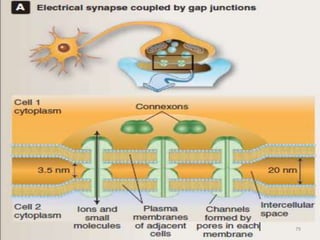
3. In neurons, action potentials propagate along axons to transmit signals presynaptically via the release of neurotransmitters, which may elicit further signals postsynaptically. This synaptic transmission allows communication between neurons.


![Concentration of ions
Electrostatic
Inside Outside [ ] gradient pressure
• Sodium (Na+) 12mM 145mM into cell into cell
• Potassium (K+) 150mM 5mM out of cell into cell
• Chloride (Cl-) 9mM 125mM into out of
• Calcium (Ca2+) 10-4mM 2.5mM into cell into cell
• Organic anions: Fixed anions (Proteins, nucleotides, polyphosphates…)
7/28/2022 10](https://image.slidesharecdn.com/excitabletissues-220728113943-ce8fe866/85/Excitable-Tissues-pptx-10-320.jpg)




![Unit=4=Nervous system Physiology=AAU=2017 [Recovered].pdf](https://cdn.slidesharecdn.com/ss_thumbnails/unit4nervoussystemphysiologyaau2017recovered-250402223207-dbf86133-thumbnail.jpg?width=640&height=640&fit=bounds)


