DIRECT AND INDIRECT TAX
   CENTRAL EXCISE ND VAT..
            BY
   PROF.HEMA SHIRODKAR.
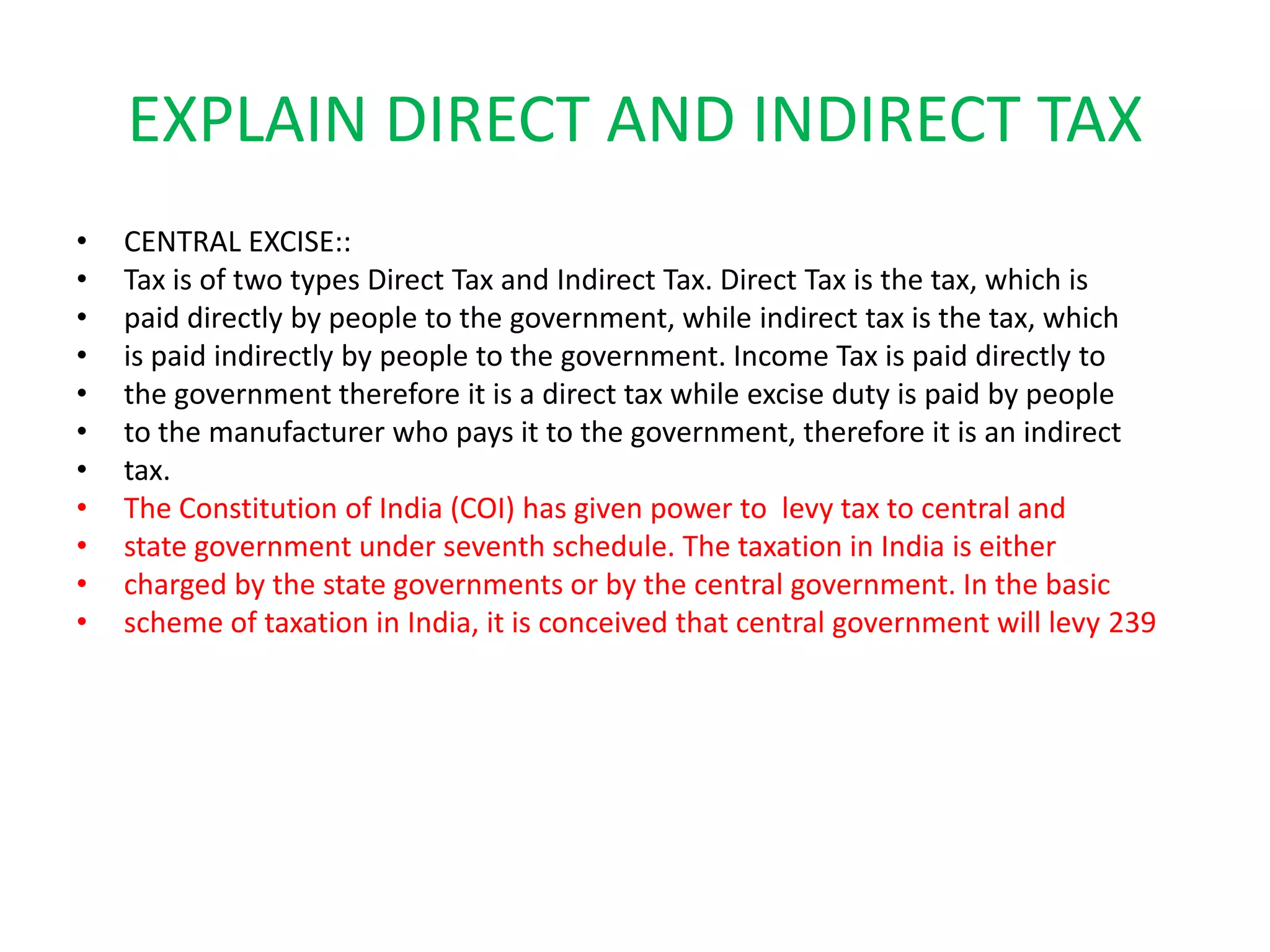
EXPLAIN DIRECT AND INDIRECT TAX
•   CENTRAL EXCISE::
•   Tax is of two types Direct Tax and Indirect Tax. Direct Tax is the tax, which is
•   paid directly by people to the government, while indirect tax is the tax, which
•   is paid indirectly by people to the government. Income Tax is paid directly to
•   the government therefore it is a direct tax while excise duty is paid by people
•   to the manufacturer who pays it to the government, therefore it is an indirect
•   tax.
•   The Constitution of India (COI) has given power to levy tax to central and
•   state government under seventh schedule. The taxation in India is either
•   charged by the state governments or by the central government. In the basic
•   scheme of taxation in India, it is conceived that central government will levy 239
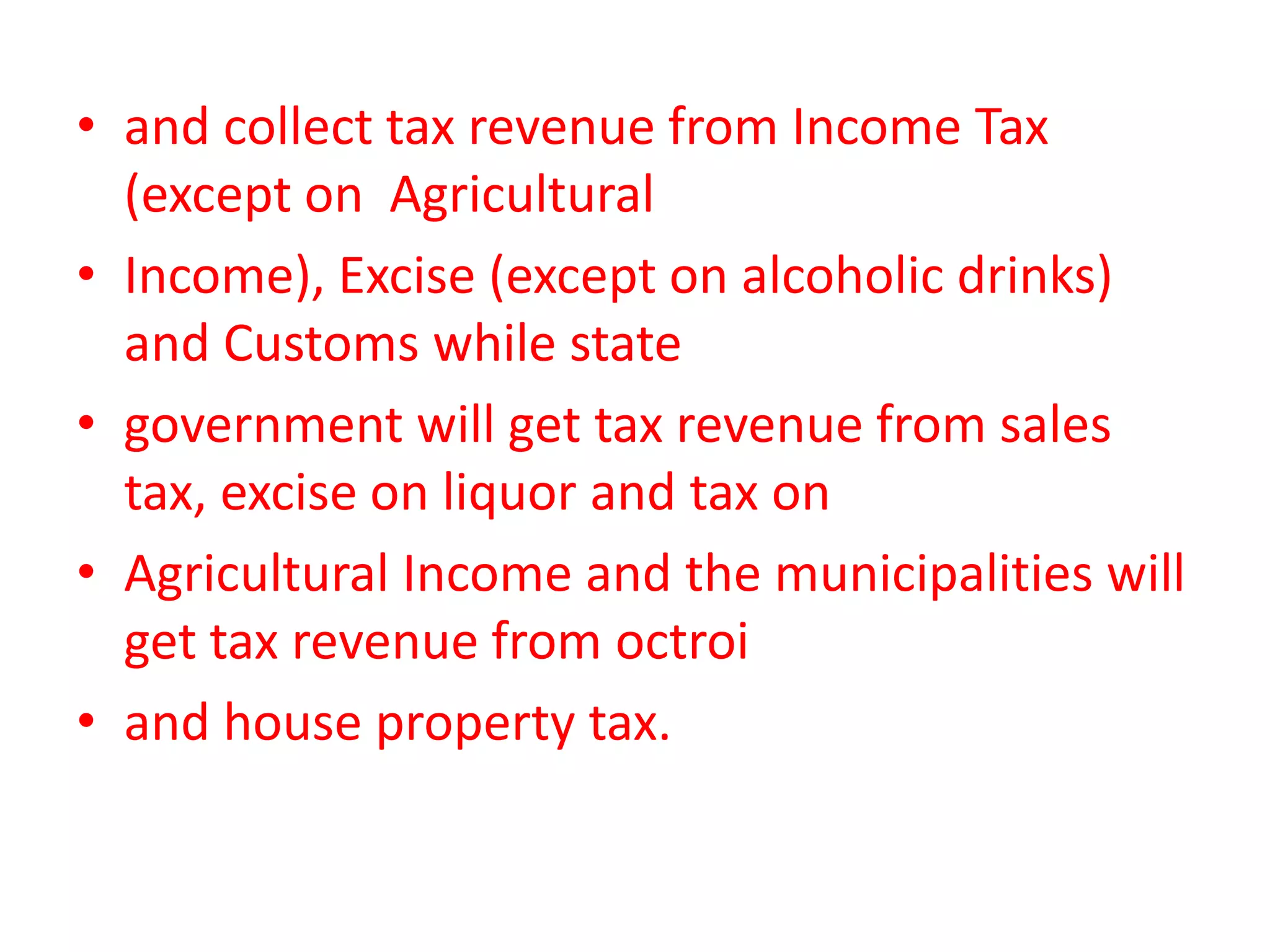
• and collect tax revenue from Income Tax
  (except on Agricultural
• Income), Excise (except on alcoholic drinks)
  and Customs while state
• government will get tax revenue from sales
  tax, excise on liquor and tax on
• Agricultural Income and the municipalities will
  get tax revenue from octroi
• and house property tax.
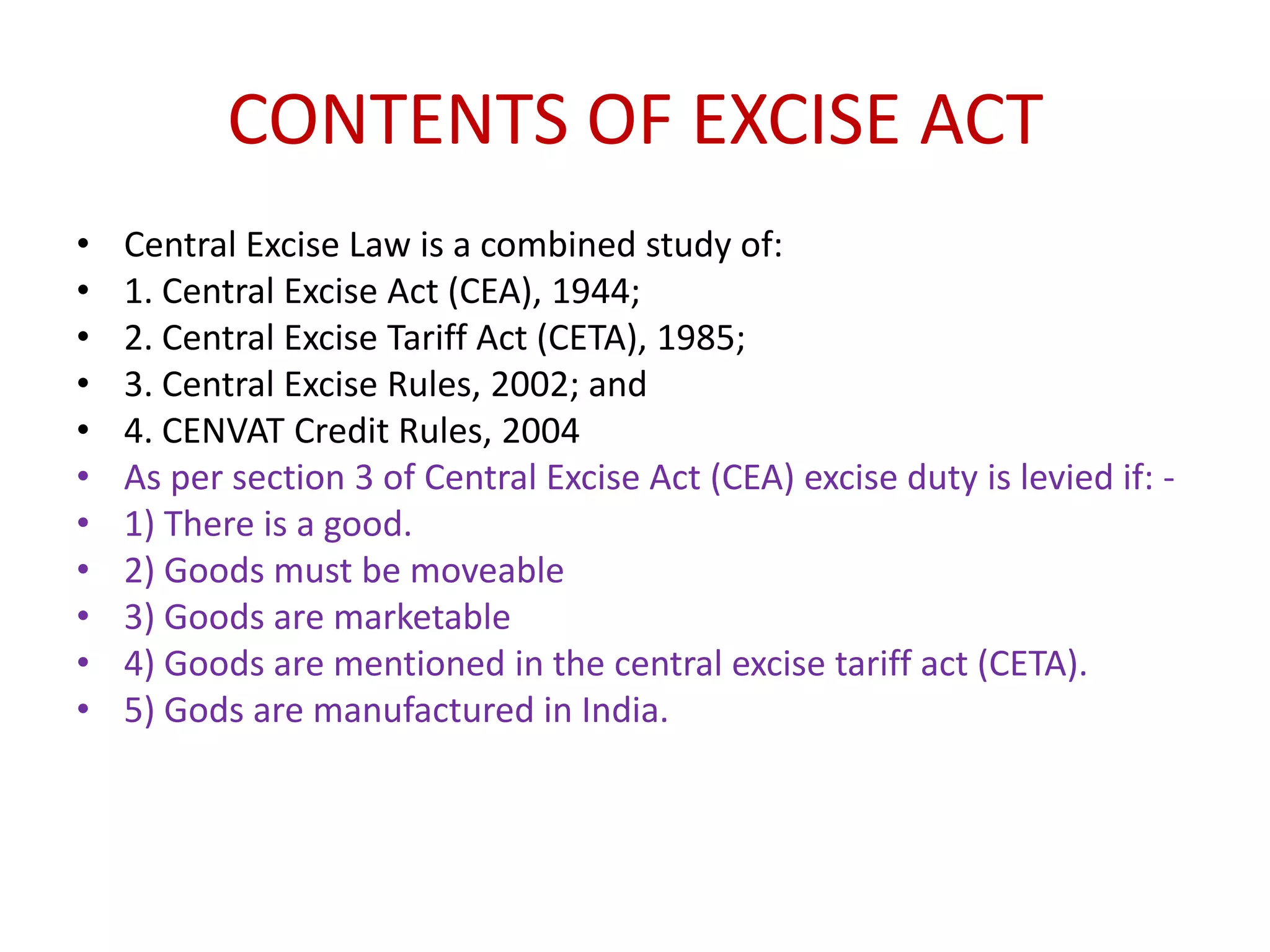
CONTENTS OF EXCISE ACT
•   Central Excise Law is a combined study of:
•   1. Central Excise Act (CEA), 1944;
•   2. Central Excise Tariff Act (CETA), 1985;
•   3. Central Excise Rules, 2002; and
•   4. CENVAT Credit Rules, 2004
•   As per section 3 of Central Excise Act (CEA) excise duty is levied if: -
•   1) There is a good.
•   2) Goods must be moveable
•   3) Goods are marketable
•   4) Goods are mentioned in the central excise tariff act (CETA).
•   5) Gods are manufactured in India.
TAXABLE EVENT?
•   Therefore we can say that excise duty is not levied on:
•   1) Services such as doctors treating the patients, accountants preparing
•   the accounts, in these cases service tax are levied.
•   2) Immovable goods such as roads, bridges and buildings.
•   3) Non-Marketable goods, i.e., goods for which no market exists, e.g.,
•   melted iron ore at 1600 degree Celsius.
•   4) Goods that are not mentioned in CETA; and
•   5) Goods manufactured or produced out of India.
•   If production or manufacture is in special economic zone then no excise
•   duty is levied. 240
•   19.2.1 TAXABLE EVENT
•   Taxable event means the stage when tax is levied/ applied. Manufacture or
•   production in India is the stage of levying tax. However, the government, at
•   the time, when the goods are removed from the factory, i.e., goods are taken
•   out from factory, collects tax.
RATES OF EXCISE DUTY
• Since, excise duty is levied at the time of removal of goods. Thus, it
  becomes
• taxable at the time of their removal and therefore, the date of its actual
• production is not relevant. The date of removal is relevant and the rate of
• excise duty applicable on the date of removal shall be actual rate of excise
• duty to be paid.
• 19.2.2 RATES OF EXCISE DUTY
• The basic rate of excise duty is 16% while in some cases there is a special
  duty
• if 8% which makes the excise duty in those cases at 24%. There is at
  present a
• cess for education called education cess, which is 2% of the excise duty;
• therefore, the effective excise duty comes out as 16.32% or 24.48%.
• CHECK YOUR PROGRESS
DISCUSS WHETHR THESE ARE TAXBLE
• Discuss whether the following are liable for excise duty:
• a) Telephone and mobile operators like Airtel, Hutch, Idea or MTNL
• b) Education in schools and colleges
• c) Books used in schools and colleges
• d) Mobile phone instruments like NOKIA or MOTOROLA
• e) LAPTOP produced in USA.
• f) Dams and electricity plant installed at the bank of a river.
• g) Unmarketable waste produced from a factory.
• Activity B
• An item was exempted from Excise when it was produced. When it was
  sent
• out of factory the central government withdraws the exemption. Whether
• excise duty will be payable on it or not
ARTICLE366 (12) OF INDIAN
               CONSTITUTION..GOODS
•   Excise duty is levied on production or manufacture andGoods have not been defined in Central
    Excise Act. As per Article 366(12) of
•   Constitution of India, Goods includes all material commodities and articles.
•   Sale of Goods Act defines that “Goods” means every kind of movable
•   property other than actionable claims and money; and includes stocks and
•   shares, growing crops, grass and things attached to or forming part of the land
•   which are agreed to be severed before sale or under the contract of sale.
•   Goods must be: i) Movable; and
•   ii) Marketable
•   Moveable means goods, which can be shifted from one place to another place,
•   e.g., motor car, mobile phone, computer etc.
•   The goods attached to earth are immovable goods, such as, Dams, Roads, and
•   Buildings etc.
•   Marketable means goods which are capable of being sold, e.g., Molten iron
•   ore at 1300 degree to 1400 degree Celsius is not marketable, therefore not a
•   good. Similarly, flour produced in own factory for use as raw material in own
• factory for further production of bread is a good because it is marketable.
• Actual sales are not relevant for calling any item as goods.
• Moveable Goods are manufactured or produced but immoveable goods
  are
• constructed.
• Remember Sales Tax or VAT is applicable
• on actual sales. Excise duty is applicable on production of goods.
• ActExcise Duty on Assessable Value: Assessable Value is the value of

• transaction i.e., the value at which transaction takes place, in other words
  it is
• the price actually paid or payable for the goods on sales. It is also called
• transaction value. It includes freight and transportation charges,
  commissions
• to dealer etc.
•   Excise duty is paid on transaction value or assessable value if:
•   1. Goods are sold at the time and place of removal.
•   2. Buyer and assessee (Manufacturer/seller) are not related.
•   3. Price is the only consideration for sale, i.e., money or some valuable
•   item is received on sale.
•   Assessable Value excludes amount of excise duty, sales tax or other tax
•   actually paid.
•   Following items are included:
•   1. Primary packing or main packing or necessary packing.
•   2. Royalty charges.
•   3. Commission to sales agent.
•   Following items are excluded:
•   1. Secondary packing.
•   2. Returnable primary packing like cold drinks bottles, LPG cylinders.
•   3. Discount given at the time of sales.
•   Illustration 19.1
•   If the sales price of a good is Rs. 10, which includes th
•   e cost of bottle of Rs. 2
•   and the excise duty of 16% plus 2% education
ASSESABLE VALUE:
•   Excise duty is paid on transaction value or assessable value if:
•   1. Goods are sold at the time and place of removal.
•   2. Buyer and assessee (Manufacturer/seller) are not related.
•   3. Price is the only consideration for sale, i.e., money or some valuable
•   item is received on sale.
•   Assessable Value excludes amount of excise duty, sales tax or other tax
•   actually paid.
•   Following items are included:
•   1. Primary packing or main packing or necessary packing.
•   2. Royalty charges.
•   3. Commission to sales agent.
•   Following items are excluded:
•   1. Secondary packing.
•   2. Returnable primary packing like cold drinks bottles, LPG cylinders.
•   3. Discount given at the time of sales.
•   Illustration 19.1
•   If the sales price of a good is Rs. 10, which includes th
•   e cost of bottle of Rs. 2
•   and the excise duty of 16% plus 2% education
ASSESSABLE VALUE
•   Assessable Value: Assessable value is the value at which the transaction of
•   sale takes place. It is also known as transaction value.
•   CENVAT: Stands for Central Value Added Tax It is a scheme of giving tax
•   credit in the Central Excise Law.
•   Excisable Goods: Excisable goods mean those goods, which are mentioned in
•   the Central Excise Tariff Act, 1985. These are the goods on which the excise
•   duty is paid.
•   Factory: Factory is the place where the excisable goods are produced.
•   Goods: Goods means every kind of moveable property other than actionable
•   claim and money, and includes stock and shares, growing crops, grass and
•   things attached to or forming part of the land, which are agreed to be severed
•   before sale or under the contract of sale.
• Assessable Value: Assessable value is the value at which the transaction of
• sale takes place. It is also known as transaction value.
• CENVAT: Stands for Central Value Added Tax It is a scheme of giving tax
• credit in the Central Excise Law.
• Excisable Goods: Excisable goods mean those goods, which are mentioned
  in
• the Central Excise Tariff Act, 1985. These are the goods on which the
  excise
• duty is paid.

• Factory: Factory is the place where the excisable goods are produced.
• Goods: Goods means every kind of moveable property other than
  actionable
• claim and money, and includes stock and shares, growing crops, grass and
• things attached to or forming part of the land, which are agreed to be
  severed
• before sale or under the contract of sale.
THANK YOU..
central excise andVAT

central excise andVAT

  • 1.
    DIRECT AND INDIRECTTAX CENTRAL EXCISE ND VAT.. BY PROF.HEMA SHIRODKAR.
  • 2.
    EXPLAIN DIRECT ANDINDIRECT TAX • CENTRAL EXCISE:: • Tax is of two types Direct Tax and Indirect Tax. Direct Tax is the tax, which is • paid directly by people to the government, while indirect tax is the tax, which • is paid indirectly by people to the government. Income Tax is paid directly to • the government therefore it is a direct tax while excise duty is paid by people • to the manufacturer who pays it to the government, therefore it is an indirect • tax. • The Constitution of India (COI) has given power to levy tax to central and • state government under seventh schedule. The taxation in India is either • charged by the state governments or by the central government. In the basic • scheme of taxation in India, it is conceived that central government will levy 239
  • 3.
    • and collecttax revenue from Income Tax (except on Agricultural • Income), Excise (except on alcoholic drinks) and Customs while state • government will get tax revenue from sales tax, excise on liquor and tax on • Agricultural Income and the municipalities will get tax revenue from octroi • and house property tax.
  • 4.
    CONTENTS OF EXCISEACT • Central Excise Law is a combined study of: • 1. Central Excise Act (CEA), 1944; • 2. Central Excise Tariff Act (CETA), 1985; • 3. Central Excise Rules, 2002; and • 4. CENVAT Credit Rules, 2004 • As per section 3 of Central Excise Act (CEA) excise duty is levied if: - • 1) There is a good. • 2) Goods must be moveable • 3) Goods are marketable • 4) Goods are mentioned in the central excise tariff act (CETA). • 5) Gods are manufactured in India.
  • 5.
    TAXABLE EVENT? • Therefore we can say that excise duty is not levied on: • 1) Services such as doctors treating the patients, accountants preparing • the accounts, in these cases service tax are levied. • 2) Immovable goods such as roads, bridges and buildings. • 3) Non-Marketable goods, i.e., goods for which no market exists, e.g., • melted iron ore at 1600 degree Celsius. • 4) Goods that are not mentioned in CETA; and • 5) Goods manufactured or produced out of India. • If production or manufacture is in special economic zone then no excise • duty is levied. 240 • 19.2.1 TAXABLE EVENT • Taxable event means the stage when tax is levied/ applied. Manufacture or • production in India is the stage of levying tax. However, the government, at • the time, when the goods are removed from the factory, i.e., goods are taken • out from factory, collects tax.
  • 6.
    RATES OF EXCISEDUTY • Since, excise duty is levied at the time of removal of goods. Thus, it becomes • taxable at the time of their removal and therefore, the date of its actual • production is not relevant. The date of removal is relevant and the rate of • excise duty applicable on the date of removal shall be actual rate of excise • duty to be paid. • 19.2.2 RATES OF EXCISE DUTY • The basic rate of excise duty is 16% while in some cases there is a special duty • if 8% which makes the excise duty in those cases at 24%. There is at present a • cess for education called education cess, which is 2% of the excise duty; • therefore, the effective excise duty comes out as 16.32% or 24.48%. • CHECK YOUR PROGRESS
  • 7.
    DISCUSS WHETHR THESEARE TAXBLE • Discuss whether the following are liable for excise duty: • a) Telephone and mobile operators like Airtel, Hutch, Idea or MTNL • b) Education in schools and colleges • c) Books used in schools and colleges • d) Mobile phone instruments like NOKIA or MOTOROLA • e) LAPTOP produced in USA. • f) Dams and electricity plant installed at the bank of a river. • g) Unmarketable waste produced from a factory. • Activity B • An item was exempted from Excise when it was produced. When it was sent • out of factory the central government withdraws the exemption. Whether • excise duty will be payable on it or not
  • 8.
    ARTICLE366 (12) OFINDIAN CONSTITUTION..GOODS • Excise duty is levied on production or manufacture andGoods have not been defined in Central Excise Act. As per Article 366(12) of • Constitution of India, Goods includes all material commodities and articles. • Sale of Goods Act defines that “Goods” means every kind of movable • property other than actionable claims and money; and includes stocks and • shares, growing crops, grass and things attached to or forming part of the land • which are agreed to be severed before sale or under the contract of sale. • Goods must be: i) Movable; and • ii) Marketable • Moveable means goods, which can be shifted from one place to another place, • e.g., motor car, mobile phone, computer etc. • The goods attached to earth are immovable goods, such as, Dams, Roads, and • Buildings etc. • Marketable means goods which are capable of being sold, e.g., Molten iron • ore at 1300 degree to 1400 degree Celsius is not marketable, therefore not a • good. Similarly, flour produced in own factory for use as raw material in own
  • 9.
    • factory forfurther production of bread is a good because it is marketable. • Actual sales are not relevant for calling any item as goods. • Moveable Goods are manufactured or produced but immoveable goods are • constructed. • Remember Sales Tax or VAT is applicable • on actual sales. Excise duty is applicable on production of goods. • ActExcise Duty on Assessable Value: Assessable Value is the value of • transaction i.e., the value at which transaction takes place, in other words it is • the price actually paid or payable for the goods on sales. It is also called • transaction value. It includes freight and transportation charges, commissions • to dealer etc.
  • 10.
    Excise duty is paid on transaction value or assessable value if: • 1. Goods are sold at the time and place of removal. • 2. Buyer and assessee (Manufacturer/seller) are not related. • 3. Price is the only consideration for sale, i.e., money or some valuable • item is received on sale. • Assessable Value excludes amount of excise duty, sales tax or other tax • actually paid. • Following items are included: • 1. Primary packing or main packing or necessary packing. • 2. Royalty charges. • 3. Commission to sales agent. • Following items are excluded: • 1. Secondary packing. • 2. Returnable primary packing like cold drinks bottles, LPG cylinders. • 3. Discount given at the time of sales. • Illustration 19.1 • If the sales price of a good is Rs. 10, which includes th • e cost of bottle of Rs. 2 • and the excise duty of 16% plus 2% education
  • 11.
    ASSESABLE VALUE: • Excise duty is paid on transaction value or assessable value if: • 1. Goods are sold at the time and place of removal. • 2. Buyer and assessee (Manufacturer/seller) are not related. • 3. Price is the only consideration for sale, i.e., money or some valuable • item is received on sale. • Assessable Value excludes amount of excise duty, sales tax or other tax • actually paid. • Following items are included: • 1. Primary packing or main packing or necessary packing. • 2. Royalty charges. • 3. Commission to sales agent. • Following items are excluded: • 1. Secondary packing. • 2. Returnable primary packing like cold drinks bottles, LPG cylinders. • 3. Discount given at the time of sales. • Illustration 19.1 • If the sales price of a good is Rs. 10, which includes th • e cost of bottle of Rs. 2 • and the excise duty of 16% plus 2% education
  • 12.
    ASSESSABLE VALUE • Assessable Value: Assessable value is the value at which the transaction of • sale takes place. It is also known as transaction value. • CENVAT: Stands for Central Value Added Tax It is a scheme of giving tax • credit in the Central Excise Law. • Excisable Goods: Excisable goods mean those goods, which are mentioned in • the Central Excise Tariff Act, 1985. These are the goods on which the excise • duty is paid. • Factory: Factory is the place where the excisable goods are produced. • Goods: Goods means every kind of moveable property other than actionable • claim and money, and includes stock and shares, growing crops, grass and • things attached to or forming part of the land, which are agreed to be severed • before sale or under the contract of sale.
  • 13.
    • Assessable Value:Assessable value is the value at which the transaction of • sale takes place. It is also known as transaction value. • CENVAT: Stands for Central Value Added Tax It is a scheme of giving tax • credit in the Central Excise Law. • Excisable Goods: Excisable goods mean those goods, which are mentioned in • the Central Excise Tariff Act, 1985. These are the goods on which the excise • duty is paid. • Factory: Factory is the place where the excisable goods are produced. • Goods: Goods means every kind of moveable property other than actionable • claim and money, and includes stock and shares, growing crops, grass and • things attached to or forming part of the land, which are agreed to be severed • before sale or under the contract of sale.
  • 14.