Exchange Server 2007
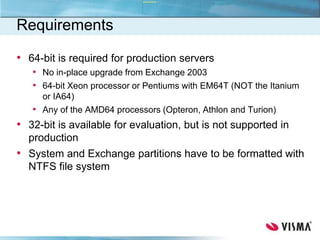
Requirements
• 64-bit is required for production servers
• No in-place upgrade from Exchange 2003
• 64-bit Xeon processor or Pentiums with EM64T (NOT the Itanium
or IA64)
• Any of the AMD64 processors (Opteron, Athlon and Turion)
• 32-bit is available for evaluation, but is not supported in
production
• System and Exchange partitions have to be formatted with
NTFS file system
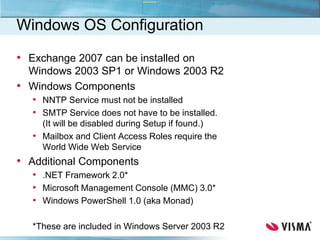
Windows OS Configuration
• Exchange 2007 can be installed on
Windows 2003 SP1 or Windows 2003 R2
• Windows Components
• NNTP Service must not be installed
• SMTP Service does not have to be installed.
(It will be disabled during Setup if found.)
• Mailbox and Client Access Roles require the
World Wide Web Service
• Additional Components
• .NET Framework 2.0*
• Microsoft Management Console (MMC) 3.0*
• Windows PowerShell 1.0 (aka Monad)
*These are included in Windows Server 2003 R2
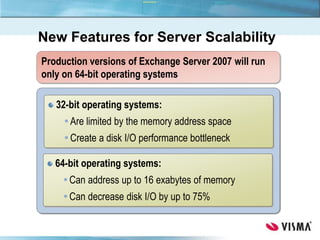
Production versions of Exchange Server 2007 will run
only on 64-bit operating systems
32-bit operating systems:
Are limited by the memory address space
Create a disk I/O performance bottleneck
64-bit operating systems:
Can address up to 16 exabytes of memory
Can decrease disk I/O by up to 75%
New Features for Server Scalability
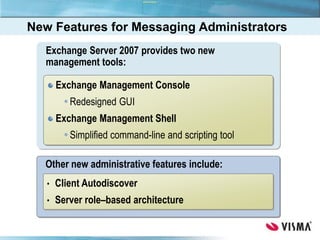
Exchange Server 2007 provides two new
management tools:
Exchange Management Console
Redesigned GUI
Exchange Management Shell
Simplified command-line and scripting tool
Other new administrative features include:
• Client Autodiscover
• Server role–based architecture
New Features for Messaging Administrators
Exchange Server 2007 provides:
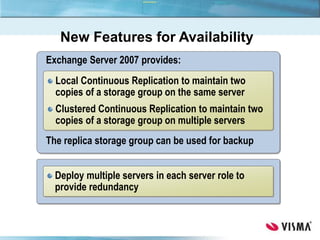
The replica storage group can be used for backup
Local Continuous Replication to maintain two
copies of a storage group on the same server
Clustered Continuous Replication to maintain two
copies of a storage group on multiple servers
Deploy multiple servers in each server role to
provide redundancy
New Features for Availability
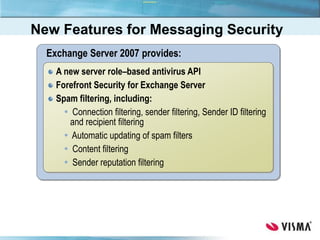
Exchange Server 2007 provides:
A new server role–based antivirus API
Forefront Security for Exchange Server
Spam filtering, including:
 Connection filtering, sender filtering, Sender ID filtering
and recipient filtering
 Automatic updating of spam filters
 Content filtering
 Sender reputation filtering
New Features for Messaging Security
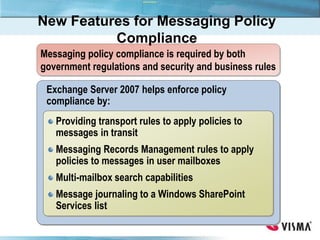
Messaging policy compliance is required by both
government regulations and security and business rules
Exchange Server 2007 helps enforce policy
compliance by:
Providing transport rules to apply policies to
messages in transit
Messaging Records Management rules to apply
policies to messages in user mailboxes
Multi-mailbox search capabilities
Message journaling to a Windows SharePoint
Services list
New Features for Messaging Policy
Compliance
Exchange Server 2007 provides:
Outlook Web Access enhancements
Unified Messaging
Out-of-Office Assistant enhancements
Calendar Concierge
Improved mobile access to e-mail
New Features for Exchange Server
Users
In Exchange Server 2007, servers are installed with
specific functional roles:
Hub Transport server role
Mailbox server role
Edge Transport server role
Client Access server role
Unified Messaging server role
Exchange Server Roles Overview
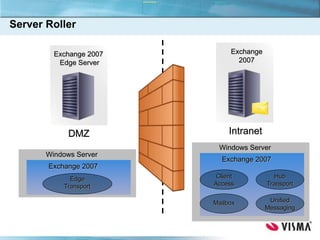
DMZ
Exchange 2007
Edge Server
Windows Server
Exchange 2007
Edge
Transport
Windows Server
Exchange 2007
Client
Access
Hub
Transport
Mailbox Unified
Messaging
Intranet
Exchange
2007
Server Roller
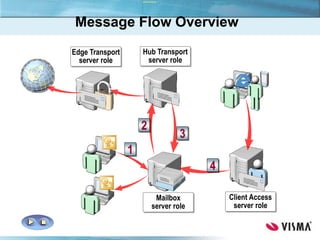
Message Flow Overview
Hub Transport
server role
Mailbox
server role
Client Access
server role
Edge Transport
server role
1
2
3
4
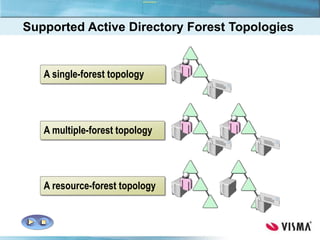
Supported Active Directory Forest Topologies
A single-forest topology
A multiple-forest topology
A resource-forest topology
What Features Are Not Available in Exchange Server 2007?
OWA access to public folders
IMAP and NNTP access to public folders
OMA
Coexistence with Exchange 5.5 Server
GroupWise and Lotus Notes connector and
migration tools
Administrative groups
Routing groups
Active/active Clustering
Interoperability with X.400 messaging systems
Updating Your Skills from
Microsoft® Exchange Server 2000 or
Microsoft Exchange Server 2003 to
Microsoft Exchange Server 2007
Beta 2
Course 3938A

Exchange server 2007

  • 1.
  • 2.
    Requirements • 64-bit isrequired for production servers • No in-place upgrade from Exchange 2003 • 64-bit Xeon processor or Pentiums with EM64T (NOT the Itanium or IA64) • Any of the AMD64 processors (Opteron, Athlon and Turion) • 32-bit is available for evaluation, but is not supported in production • System and Exchange partitions have to be formatted with NTFS file system
  • 3.
    Windows OS Configuration •Exchange 2007 can be installed on Windows 2003 SP1 or Windows 2003 R2 • Windows Components • NNTP Service must not be installed • SMTP Service does not have to be installed. (It will be disabled during Setup if found.) • Mailbox and Client Access Roles require the World Wide Web Service • Additional Components • .NET Framework 2.0* • Microsoft Management Console (MMC) 3.0* • Windows PowerShell 1.0 (aka Monad) *These are included in Windows Server 2003 R2
  • 4.
    Production versions ofExchange Server 2007 will run only on 64-bit operating systems 32-bit operating systems: Are limited by the memory address space Create a disk I/O performance bottleneck 64-bit operating systems: Can address up to 16 exabytes of memory Can decrease disk I/O by up to 75% New Features for Server Scalability
  • 5.
    Exchange Server 2007provides two new management tools: Exchange Management Console Redesigned GUI Exchange Management Shell Simplified command-line and scripting tool Other new administrative features include: • Client Autodiscover • Server role–based architecture New Features for Messaging Administrators
  • 6.
    Exchange Server 2007provides: The replica storage group can be used for backup Local Continuous Replication to maintain two copies of a storage group on the same server Clustered Continuous Replication to maintain two copies of a storage group on multiple servers Deploy multiple servers in each server role to provide redundancy New Features for Availability
  • 7.
    Exchange Server 2007provides: A new server role–based antivirus API Forefront Security for Exchange Server Spam filtering, including:  Connection filtering, sender filtering, Sender ID filtering and recipient filtering  Automatic updating of spam filters  Content filtering  Sender reputation filtering New Features for Messaging Security
  • 8.
    Messaging policy complianceis required by both government regulations and security and business rules Exchange Server 2007 helps enforce policy compliance by: Providing transport rules to apply policies to messages in transit Messaging Records Management rules to apply policies to messages in user mailboxes Multi-mailbox search capabilities Message journaling to a Windows SharePoint Services list New Features for Messaging Policy Compliance
  • 9.
    Exchange Server 2007provides: Outlook Web Access enhancements Unified Messaging Out-of-Office Assistant enhancements Calendar Concierge Improved mobile access to e-mail New Features for Exchange Server Users
  • 10.
    In Exchange Server2007, servers are installed with specific functional roles: Hub Transport server role Mailbox server role Edge Transport server role Client Access server role Unified Messaging server role Exchange Server Roles Overview
  • 11.
    DMZ Exchange 2007 Edge Server WindowsServer Exchange 2007 Edge Transport Windows Server Exchange 2007 Client Access Hub Transport Mailbox Unified Messaging Intranet Exchange 2007 Server Roller
  • 12.
    Message Flow Overview HubTransport server role Mailbox server role Client Access server role Edge Transport server role 1 2 3 4
  • 13.
    Supported Active DirectoryForest Topologies A single-forest topology A multiple-forest topology A resource-forest topology
  • 14.
    What Features AreNot Available in Exchange Server 2007? OWA access to public folders IMAP and NNTP access to public folders OMA Coexistence with Exchange 5.5 Server GroupWise and Lotus Notes connector and migration tools Administrative groups Routing groups Active/active Clustering Interoperability with X.400 messaging systems
  • 15.
    Updating Your Skillsfrom Microsoft® Exchange Server 2000 or Microsoft Exchange Server 2003 to Microsoft Exchange Server 2007 Beta 2 Course 3938A

Editor's Notes