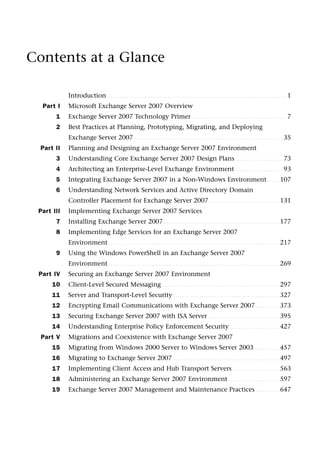
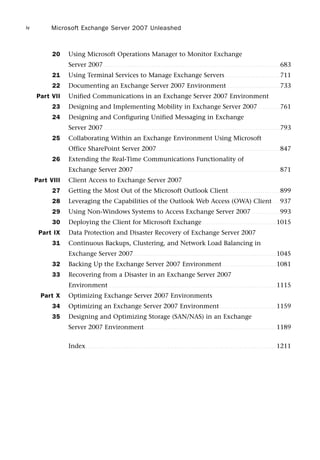
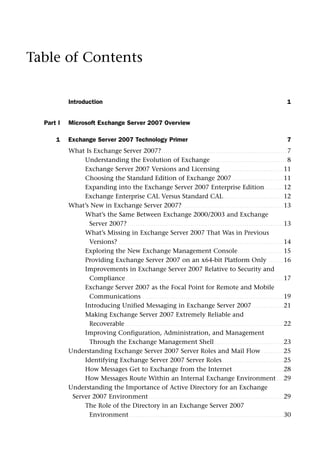
Microsoft Exchange server 2007 unleashed 1st Edition Rand Morimoto
Microsoft Exchange server 2007 unleashed 1st Edition Rand Morimoto
Microsoft Exchange server 2007 unleashed 1st Edition Rand Morimoto
Microsoft Exchange server 2007 unleashed 1st Edition Rand Morimoto
Microsoft Exchange server 2007 unleashed 1st Edition Rand Morimoto
1.
Download the fullversion and explore a variety of ebooks
or textbooks at https://ebookultra.com
Microsoft Exchange server 2007 unleashed 1st
Edition Rand Morimoto
_____ Follow the link below to get your download now _____
https://ebookultra.com/download/microsoft-exchange-
server-2007-unleashed-1st-edition-rand-morimoto/
Access ebookultra.com now to download high-quality
ebooks or textbooks
2.
Here are somerecommended products for you. Click the link to
download, or explore more at ebookultra.com
Mastering Microsoft Exchange Server 2007 SP1 2nd ed
Edition Jim Mcbee
https://ebookultra.com/download/mastering-microsoft-exchange-
server-2007-sp1-2nd-ed-edition-jim-mcbee/
Microsoft Exchange Server 2003 1st Edition Jim Mcbee
https://ebookultra.com/download/microsoft-exchange-server-2003-1st-
edition-jim-mcbee/
Mastering Microsoft Exchange Server 2010 1st Edition Jim
Mcbee
https://ebookultra.com/download/mastering-microsoft-exchange-
server-2010-1st-edition-jim-mcbee/
Microsoft SQL Server 2008 Analysis Services Unleashed 1st
Edition Irina Gorbach
https://ebookultra.com/download/microsoft-sql-server-2008-analysis-
services-unleashed-1st-edition-irina-gorbach/
3.
Microsoft Office PerformancePointServer 2007 1st Edition
Elaine Andersen
https://ebookultra.com/download/microsoft-office-performancepoint-
server-2007-1st-edition-elaine-andersen/
Microsoft Office Project Server 2007 The Complete
Reference 1st Edition Dave Gochberg
https://ebookultra.com/download/microsoft-office-project-
server-2007-the-complete-reference-1st-edition-dave-gochberg/
Microsoft Windows Vista Unleashed Paul Mcfedries
https://ebookultra.com/download/microsoft-windows-vista-unleashed-
paul-mcfedries/
Microsoft Visual Studio 2010 Unleashed Mike Snell
https://ebookultra.com/download/microsoft-visual-
studio-2010-unleashed-mike-snell/
Administering Exchange 2000 Server 1st Edition Mitch
Tulloch
https://ebookultra.com/download/administering-
exchange-2000-server-1st-edition-mitch-tulloch/
5.
Microsoft Exchange server2007 unleashed 1st Edition
Rand Morimoto Digital Instant Download
Author(s): Rand Morimoto, Michael Noel, AndrewAbbate, Chris Amaris,
Mark Weinhardt
ISBN(s): 9780672329203, 0672329204
Edition: 1
File Details: PDF, 23.41 MB
Year: 2007
Language: english
7.
UNLEASHED
800 East 96thStreet, Indianapolis, Indiana 46240 USA
Rand H. Morimoto, Ph.D., MCSE
Michael Noel, MCSE, MVP
Andrew Abbate, MCSE
Chris Amaris, MCSE, CISSP
Mark Weinhardt, MCSE
Microsoft®
Exchange
Server 2007
Cynicism
of de
Brosses.
The Présidentde Brosses describes the death of Clement XII.[40],
which he witnessed, and saw the election of Benedict XIV.[41]—as I
saw Leo XII. the Pontiff lying dead on his abandoned bed: the
Cardinal Camerlingo had struck Clement XII. twice or thrice on the
forehead, according to the custom, with a little hammer, calling him
by his name, Lorenzo Corsini.
"He made no reply," says de Brosses, and adds, "That is how
your daughter comes to be dumb[42]."
And that is how at that time the most serious things were treated: a
dead pope at whose head one knocks as it were at the gate of
understanding, while calling on the deceased and voiceless man by
his name, could, it seems to me, have inspired a witness with
something else than raillery, even though it were borrowed from
Molière. What would the frivolous Dijon magistrate have said had
Clement XII. answered him from the depths of eternity:
"What do you want with me?"
The Président de Brosses sends his friend the Abbé
Courtois a list of the cardinals of the Conclave, with a
word on each of them to his honour:
"Guadagni[43], a bigot, a hypocrite, witless, tasteless, a poor
monk.
"Aquaviva of Aragon, a fine presence, although somewhat heavy
in figure, as he is also in mind.
"Ottoboni[44], no morals, no credit, debauched, ruined, a lover of
the arts.
"Alberoni[45], full of ardour, anxious, restless, despised, no
morals, no decency, no consideration, no judgment: according to
him, a cardinal is a ——- dressed in red."
23.
The rest ofthe list is all of a piece; cynicism here takes the place of
wit.
A singular piece of buffoonery took place: de Brosses went to dine
with some Englishmen at the Porta San Pancrazio; they had a mock
election of a pope: a certain Sir Ashwood took off his wig and
represented the dean of the cardinals; they sang Oremus, and
Cardinal Alberoni was elected by the ballot of that orgy. The
Protestant soldiers in the Constable de Bourbon's army nominated
Martin Luther pope in the Church of St. Peter. Nowadays the English,
who are at once the plague and the providence of Rome, respect the
Catholic Religion which has permitted them to build a church outside
the Porta del Popolo. The government and manners of the day would
no longer suffer such scandals.
So soon as a cardinal is imprisoned in the conclave, the first thing he
does is, with the aid of his servants, in the dark, to scratch at the
newly blocked-up walls until they have made a little hole. Through
this, during the night, they pass strings by means of which news is
sent and received between the inside and the outside. For the rest,
the Cardinal de Retz, whose opinion is above suspicion, after
speaking of the miseries of the conclave in which he took part, ends
his story with these fine words:
"We lived there, always together, with the same mutual respect
and the same civility that are observed in the closets of kings;
with the same politeness that obtained at the Court of Henry
III.; with the same familiarity that is seen in the colleges; with
the same modesty that prevails in noviciates, and the same
charity, at least in appearance, that might exist among brothers
wholly united."
I am struck, in finishing this epitome of a vast history, by the serious
manner in which it commences and the almost burlesque manner in
which it ends: the greatness of the Son of God opens the scene
which, shrinking in proportion as the Catholic Religion moves farther
from its source, ends in the littleness of the son of Adam. We
24.
Dispatches
to Portalis.
scarcely findagain the primitive loftiness of the Cross until we come
to the decease of the Sovereign Pontiff: that childless, friendless
pope, whose corpse lies neglected on its couch, shows that the man
was reckoned as naught in the head of the evangelical world.
Honours are rendered to the Pope as a temporal prince; as a man,
his abandoned corpse is flung down at the door of the church where
of old the sinner did penance.
Dispatches to M. Le Comte Portalis
"Rome, 17 February 1829.
"Monsieur le comte,
"I do not know whether the King will be pleased to send an
extraordinary ambassador to Rome, or whether it will suit him to
accredit me to the Sacred College. In the latter case, I have the
honour to observe to you that I allowed M. le Duc de Laval, for
his expenses for extraordinary service in a similar circumstance,
in 1823, a sum which amounted, as far as I can remember, to
40,000 or 50,000 francs. The Austrian Ambassador, M. le Comte
d'Apponyi[46], at first received from his Court a sum of 36,000
francs for the first requirements, a supplementary allowance of
7,200 francs per month over and above his ordinary salary
during the sitting of the Conclave, and 10,000 francs for
presents, chancery expenses, etc. I do not, monsieur le comte,
pretend to compete in magnificence with His Excellency the
Austrian Ambassador, as M. le Duc de Laval did; I shall hire no
horses, carriages, nor liveries to dazzle the Roman mob; the King
of France is a great enough lord to pay for the pomp of his
ambassadors, if he wishes it: borrowed magnificence is
wretched. I shall therefore go modestly to the Conclave with my
ordinary footmen and in my ordinary carriages. It only remains
for me to know whether the King will not think that, as long as
the Conclave lasts, I shall be bound to keep up a display for
which my ordinary salary will not be sufficient I ask nothing, I
25.
merely submit thequestion to your judgment and to the royal
decision.
"I have the honour to be, etc."
"Rome, 19 February 1829.
"Monsieur le comte,
"I had the honour yesterday to be presented to the Sacred
College and to deliver the little speech of which I sent you a
copy in advance in my Dispatch No. 17, which left on Tuesday
the 17th inst. by a special courier. I was listened to with the
most auspicious marks of satisfaction, and the Senior Cardinal,
the venerable Della Somaglia, replied to me in terms most
affectionate towards the King and France.
"Having informed you of everything in my last dispatch, I have
absolutely nothing new to tell you to-day, unless it be that
Cardinal Bussi[47] arrived yesterday from Benevento. Cardinals
Albani, Macchi[48], and Oppizzoni are expected to-day.
"The members of the Sacred College will lock themselves up in
the Quirinal Palace on Monday evening the 23rd of this month.
Ten days will then elapse to await the arrival of the foreign
cardinals, after which the serious operations of the Conclave will
commence, and, if they were to come to an understanding at
once, the pope could be elected in the first week of Lent.
"I am, monsieur le comte, awaiting the King's orders. I presume
that you dispatched a courier to me after M. de Montebello's
arrival in Paris. It is urgent that I should receive either the
announcement of an extraordinary embassy, or my new
credentials together with the instructions of the Government.
"Are my five French cardinals coming? Politically speaking, their
presence here is very little necessary. I have written to
Monseigneur le Cardinal de Latil[49] to offer him my services in
case he should decide to come,
26.
Letters to
Madame
Récamier.
"I havethe honour to be, etc.
"P.S. I enclose a copy of a letter which M. le Comte de Funchal
has written to me. I have not replied to this ambassador in
writing; I only went to talk to him."
To Madame Récamier
"Rome, Monday 23 February 1829.
"Yesterday the Pope's obsequies were finished. The pyramid of
'paper' and the four candelabra were fine enough, because they
were of immense proportions and reached up to the cornice of
the church. The last Dies iræ was admirable. It is composed by
an unknown man, who belongs to the pope's chapel, and who
seems to me to possess a very different sort of genius from
Rossini's. To-day we pass from sorrow to joy; we sing the Veni
Creator for the opening of the Conclave; then we shall go every
evening to see if the ballot-papers are burnt, if the smoke issues
from a certain chimney: on the day on which there is no smoke,
the pope will have been appointed, and I shall go to see you
again; that is the whole business as it affects me. The King of
England's speech is very insolent to France! What a deplorable
expedition that Morean Expedition is! Are they beginning to see
it? General Guilleminot wrote me a letter on the subject which
made me laugh; he can only have written as he did because he
presumed me to be a minister."
"25 February.
"Death is here; Torlonia went yesterday evening after
two days' illness; I have seen him lying all painted on
his death-bed, his sword at his side. He lent money on pledges,
but on such pledges! On antiquities, on pictures huddled
promiscuously in an old, dusty palace. That was different from
the shop in which the Miser put away 'a Bologna lute, fitted with
27.
all its strings,or nearly... the skin of a lizard three feet long...
and a four-foot bedstead with slips in Hungarian point[50].'
"One sees nothing but dead people carried dressed-up through
the streets; one of them passes regularly under my windows
when we sit down to dinner. For the rest, everything proclaims
the spring parting; people are beginning to disperse; they are
leaving for Naples; they will come back a moment for Holy
Week, and then separate for good. Next year there will be
different travellers, different faces, a different society. There is
something melancholy in this journey over ruins: the Romans are
like the remains of their city; the world passes at their feet. I
picture those persons going back to their families in the various
countries of Europe, the young 'Misses' returning to the midst of
their fogs. If, by chance, thirty years hence, one of them is
brought back to Italy, who will remember to have seen her in the
palaces whose masters shall be no more. St. Peter's and the
Coliseum: that is all that she herself would recognise."
Dispatch to M. le comte Portalis
"Rome, 3 March 1829.
"Monsieur le comte,
"My first courier having reached Lyons, on the 14th of last
month, at nine o'clock in the evening, you must have learned the
news of the Pope's death, by telegraph, on the morning of the
15th. It is to-day the 3rd of March, and I am still without
instructions and without an official reply. The newspapers have
announced the departure of two or three cardinals. I had written
to Paris to Monseigneur le Cardinal de Latil to place the Embassy
Palace at his disposal; I have just written to him again at
different points on his road to renew my offers.
"I am sorry to be obliged to tell you, monsieur le comte, that I
notice some little intrigues here to keep the cardinals away from
the Embassy, to lodge them where they might be placed more
28.
within reach ofthe influences which it is hoped to exercise over
them.
"As far as I am concerned, this is a matter of indifference to me.
I shall show Their Eminences all the services which depend upon
myself. If they question me touching things which it is well that
they should know, I shall tell them what I can; if you transmit
the King's orders for them to me, I will communicate these to
them; but, if they were to arrive here in a spirit hostile to the
views of His Majesty's Government, if it were perceived that they
were not in agreement with the King's Ambassador, if they held a
language contrary to mine, if they went so far as to give their
votes in the Conclave to some exaggerated man, if even they
were divided among themselves, nothing would be more fatal. It
would be better for the King's service that I should instantly
hand in my resignation rather than present this public spectacle
of our discords. Austria and Spain have a line of conduct with
reference to their clergy which leaves no opening for intrigue. No
Austrian or Spanish priest, cardinal or bishop, can have any
other agent or correspondent in Rome than the ambassador of
his Court himself; the latter has the right to remove from Rome,
at a moment's notice, any ecclesiastic of his nationality who may
obstruct him.
"I hope, monsieur le comte, that no division will take place, that
Their Eminences the cardinals will have formal orders to submit
to the instructions which I shall before long receive from you,
and that I shall know which of them will be charged with the
exercise of the exclusion, in case of need, and which heads that
exclusion is to strike.
"It is very necessary that we should be on our guard; the last
ballots revealed the awakening of a party. This party, which gave
twenty or twenty-one votes to Cardinals Della Marmora[51] and
Pedicini, forms what is known here as the Sardinian faction. The
other cardinals, alarmed, want all to give their suffrages to
Oppizzoni, a man both firm and moderate. Although an Austrian,
29.
To Portalis
and
Récamier.
Dispatch
to Portalis.
thatis to say, a Milanese, he coped against Austria at Bologna.
He would be an excellent choice. The votes of the French might,
by settling on one candidate or another, decide the election.
Rightly or wrongly, these cardinals are believed to be hostile to
the present system of His Majesty's Government, and the
Sardinian faction is reckoning on them.
"I have the honour to be, etc[52]."
To Madame Récamier
"Rome, 3 March 1829.
"I am quite surprised at your acquaintance with the story of my
excavation; I did not remember having written you so well on
that subject. I am, as you think, very busy: left without
directions or instructions, I am obliged to take everything upon
myself. I believe, however, that I can promise you a moderate
and enlightened pope, if God only grant that he be made at the
expiration of the interim of M. Portalis' ministry."
"4 March.
"Yesterday, Ash Wednesday, I was on my knees alone in the
Church of Santa Croce, which rests against the walls of Rome,
near the Porta di Napoli. I heard the monotonous and lugubrious
chanting of the monks within that solitude: I should have liked
myself to be in a frock, singing among those ruins. What a spot
to appease ambition and to contemplate the vanities of earth!
While I am suffering, I hear that M. de La Ferronnays is getting
better; he rides on horseback, and his convalescence is looked
upon in the country as miraculous: God grant that it be so, and
that he may resume work at the end of the interim. What a
number of questions that would solve for me!"
Dispatch to M. le comte Portalis
"Sunday[53] 15 March 1829.
30.
"Monsieur le comte,
"Ihave had the honour to inform you of the successive arrivals
of their Eminences the French cardinals. Three of them,
Messieurs de Latil, de La Fare[54] and de Croy[55] have done me
the honour to be my guests. The first entered the Conclave on
Thursday evening the 12th, with M. le Cardinal Isoard[56]; the
two others locked themselves in on Friday evening the 13th.
"I told them all I know; I gave them important notes on the
minority and majority in the Conclave, and on the sentiments
which animate the different parties. We agreed that they should
support the candidates of whom I have already spoken to you,
namely, Cardinals Capellari, Oppizzoni, Benvenuti, Zurla,
Castiglioni and, lastly, Pacca and Di Gregorio; and that they
should reject the cardinals of the Sardinian faction: Pedicini,
Giustiniani, Galleffi, and Cristaldi[57].
"I hope that this good intelligence between the ambassadors and
cardinals will have the best effect: at least I shall have nothing
with which to reproach myself if passions or interests intervene
to deceive my hopes.
"I have, monsieur le comte, discovered dangerous and
contemptible intrigues carried on between Paris and Rome
through the channel of Monsignor Lambruschini, the Nuncio[58].
It was no less a question than to cause to be read, in open
conclave, a copy of some pretended secret instructions, divided
into several clauses and given (so it was impudently asserted) to
M. le Cardinal de Latil. The majority of the Conclave has
pronounced strongly against these machinations; it wished the
Nuncio to be instructed to break off all relations with those men
of discord who, while troubling France, would end by making the
Catholic Religion hateful to all. I am, monsieur le comte, making
a collection of these authentic revelations, and I will send it to
you after the election of the pope: that will be worth more than
all the dispatches in the world. The King will learn to know who
31.
are his friendsand who his enemies, and the Government will be
able to rely on facts suited to guide its conduct
"Your Dispatch No. 14 informs me of the encroachments which
His Holiness' Nuncio endeavoured to renew in France in
connection with the death of Leo XII. The same thing had
happened before, when I was Foreign Minister, at the time of the
death of Pius VII.: fortunately, we always have means of
defending ourselves against those public attacks; it is much
more difficult to escape the plots laid in the dark.
"The conclavists who accompany our cardinals appeared to me
to be reasonable men: the Abbé Coudrin[59] alone, whom you
mentioned to me, is one of those cramped and narrow minds
into which nothing can enter, one of those men who have
mistaken their profession. As you are well aware, he is a monk,
head of an order, and he even has bulls of institution: this is but
little in agreement with our civil laws and our political
institutions.
"It may happen that the pope will be elected at the end of this
week. But, if the French cardinals fail to make their presence felt
at once, it will become impossible to assign a limit to the
duration of the Conclave. New combinations would perhaps bring
about an unexpected nomination: to have done with it, they
might agree on some insignificant cardinal, such as Dandini[60].
"In times gone by, monsieur le comte, I have found myself
placed in difficult circumstances, whether as Ambassador to
London, or as Minister during the Spanish War, or as a member
of the House of Peers, or Leader of the Opposition; but nothing
has given me so much anxiety and care as my present position
in the midst of every kind of intrigue. I have to act upon an
invisible body locked up in a prison, the approaches to which are
strictly guarded. I have no money to give, no places to promise;
the decaying passions of fifty old men give me no hold on them.
I have to fight against stupidity in some, against ignorance of
the times in others; fanaticism in these, craft and duplicity in
32.
Letter to
Madame
Récamier.
those; inalmost all, ambition, self-interest, political hatred: and I
am separated by walls and mysteries from the assembly in which
so many elements of division are fermenting. At each moment,
the scene varies; every quarter of an hour, contradictory reports
plunge me into fresh perplexities. I am not, monsieur le comte,
telling you of these difficulties to show my importance, but
rather to serve as my excuse in case the election should result in
a pope contrary to what it seems to promise and to the nature of
our wishes. At the time of the death of Pius VII., public opinion
was not excited over religious questions: to-day, these questions
have begun to play their part in politics, and never did the
election of the Head of the Church fall at a less auspicious
moment
"I have the honour to be, etc."
To Madame Récamier
Rome, 17 March 1829.
"The King of Bavaria[61] has called in mufti to see me. We spoke
of you. This 'Greek' sovereign, though he wears a crown, seems
to know what he has on his head, and to understand that you
cannot nail the present to the past. He is to dine with me on
Thursday, and wants no one there.
"For the rest, behold us in the midst of great events: a pope to
be made; what will he be like? Will Catholic Emancipation be
passed? A new campaign in the East: on which side will victory
be? Shall we profit by this position? Who will conduct our affairs?
Is there a head capable of perceiving all that this contains for
France and of profiting by it according to events? I am
persuaded that they do not so much as think of it in Paris and
that, what with the salons and the Chambers, pleasures and
legislation, worldly joys and ministerial anxieties, they don't
trouble about Europe or anything else. Only I myself, in my exile,
have time to indulge in dreams and to look about me. Yesterday
33.
I went fora walk in a sort of gale on the old Tivoli Road. I came
to the old Roman pavement, which is so well preserved that one
would believe it had been newly laid. Yet Horace had trod the
stones which I was treading: where is Horace?"
34.
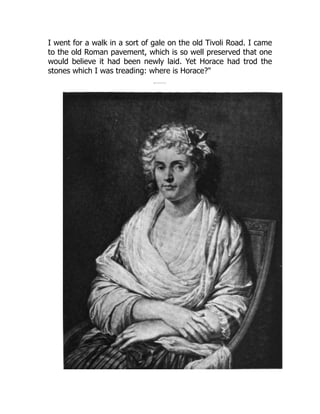
Louise of Stolberg(Countess of Albany)
The Marquis Capponi[62] arrived from Florence, bringing me letters of
recommendation from ladies in Paris. I replied to one of these letters
on the 21st of March 1829:
"I have received your letters: the services I am able to do are
nothing, but I am entirely at your orders. I was already well
acquainted with the Marquis Capponi's merits. I can tell you that
he is still good-looking; he has weathered time. I did not answer
your first letter, so full of enthusiasm for the sublime Mahmud
and for 'disciplined' barbarism, for those slaves 'bastinadoed' into
soldiers[63]. I can imagine that women are carried away with
admiration for men who marry hundreds of them at a time, and
that they take that for the progress of enlightenment and
civilization; but, as for me, I cling to my poor Greeks; I desire
their liberty as I do that of France. I also want frontiers which
will cover Paris and ensure our independence; and it is not by
means of the triple alliance of the pale of Constantinople, the
schlag of Vienna and the fisticuffs of London that you will obtain
the bank of the Rhine. Many thanks for the fur-coat of honour
which our glory might obtain from the invincible Commander of
the Faithful, who has not yet sallied from the outskirts of his
seraglio; I prefer that glory naked; she is a woman and
beautiful: Phidias would certainly never have robed her in a
Turkish dressing-gown."
To Madame Récamier
Rome, 21 March 1829.
"Well, I am right and you are wrong! I went yesterday, between
two ballots and while waiting for a pope, to Sant' Onofrio: and it
is two orange-trees that grow in the cloister, and not an
evergreen oak. I am quite proud of this fidelity of my memory. I
35.
Letters to
Madame
ran, almostwith my eyes shut, to the little stone that covers
your friend; I prefer it to the great monument they are going to
raise to him. What a charming solitude! What an admirable view!
What happiness to lie there between the frescoes of
Domenichino[64] and Leonardo da Vinci! I wish I were there, I
never felt so tempted. Did they let you enter the interior of the
convent? Did you see, in a long corridor, that delicious, though
half-obliterated, head of a Madonna by Leonardo da Vinci? Did
you see in the library Tasso's mask, his withered laurel-wreath, a
mirror which he used, his ink-stand, his pen and the letter
written by his hand, pasted to a board that hangs below his
bust? In this letter, in a small, scratched-out, but easily legible
hand, he speaks of 'friendship' and the 'wind of fortune;' the
latter scarcely ever blew for him, and the former often failed
him.
"No pope yet, we expect him hourly; but, if the choice has been
delayed, if obstacles have arisen on every hand, it is not my
fault: they ought to have listened to me a little more, and not
acted in a sense exactly opposite to that which they seemed to
decide upon. For the rest, it seems to me at present that every
one wants to be at peace with me. The Cardinal de Clermont-
Tonnerre himself has just written to tell me that he claims my
former kindness for him; and after all that he comes to stay with
me resolved to vote for the most moderate pope.
"You have read my second speech. Thank M. Kératry[65], who
has spoken so obligingly of the first; I hope he will be still more
pleased with the other. We shall both of us try to make liberty
Christian, and we shall succeed. What do you say to the answer
Cardinal Castiglioni made me? Have I been finely enough praised
'in open conclave'? You could not have done better in the days
when you spoilt me."
"24 March 1829.
36.
Récamier. "If Iwere to believe the rumours of Rome, we should
have a pope to-morrow; but I am in a moment of
discouragement, and I refuse to believe in such happiness. You
can understand that that happiness is not political happiness, the
joy of a triumph, but the happiness of being free and seeing you
again. When I speak to you so much about the Conclave, I am
like the people who have a fixed idea and who believe that the
whole world is interested in that idea. And yet, in Paris, who
thinks of the Conclave, who troubles about a pope or my
tribulations? French light-heartedness, the interests of the
moment, the discussions in the Chambers, excited ambitions
have very different things to do. When the Duc de Laval used
also to write to me of his cares about the Conclave, preoccupied
with the Spanish War as I was, I used to say, when I received
his dispatches, 'Oh, good Heavens, I have something else to
think of!' and M. Portalis is applying the lex talionis to me to-day.
Nevertheless, one may fairly say that things at that time were
not what they are now: religious ideas were not mixed up with
political ideas as they have since been throughout Europe; the
quarrel did not lie there; the nomination could not, as it does
now, disturb or pacify States.
"Since the letter which informed me that M. de La Ferronnays'
leave had been extended and that he had left for Rome, I have
heard nothing: still, I believe that news true.
"M. Thierry has written me a touching letter from Hyères; he
tells me that he is dying, and still he wants a place in the
Academy of Inscriptions and asks me to write for him. I am
going to do so. My excavation continues to give me
sarcophaguses; death can only yield what it possesses. The
Poussin monument is getting on. It will be noble and large. You
cannot imagine how the picture of the Arcadian Shepherds was
made for a bas-relief, nor how well it suits sculpture."
"28 March.
37.
"M. le Cardinalde Clermont-Tonnerre, who has been staying with
me, enters the Conclave to-day; this is an age of marvels. I have
with me the son of Marshal Lannes and the grandson of the
Chancellor[66]; Messieurs du Constitutionnel dine at my table
beside Messieurs de la Quotidienne. That is the advantage of
being sincere; let every one think what he pleases, provided I
am allowed the same liberty; I only endeavour that my opinion
shall have the majority, because I think it, and rightly, better
than the others. I attribute to this sincerity the tendency of the
most diverging opinions to gather round me. I exercise the right
of sanctuary towards them: they cannot be seized beneath my
roof."
To M. le Duc de Blacas
[67]
"Rome, 24 March 1829.
"I am sorry, monsieur le duc, that a phrase in my letter should
have been able to cause you any anxiety. I have no reason
whatever to complain of a man of sense and intelligence[68],
who told me nothing save diplomatic commonplaces. Do we
ambassadors ever talk anything else? As to the cardinal of whom
you do me the honour to speak, the French Government has not
designated any one in particular; it has left the matter entirely as
I reported it. Seven or eight moderate and peaceful cardinals,
who seem to attract the wishes of all the Courts alike, are the
candidates among whom we wish to see the votes fall. But, if we
lay no claim to impose a choice upon the majority of the
Conclave, we do with all our might and by every means repel
two or three fanatical, intriguing, or incapable cardinals, whom
the minority are supporting.
"I have no other possible means of sending you this letter,
monsieur le duc; I am therefore very simply posting it, because
it contains nothing that you and I cannot confess aloud.
"I have the honour to be, etc."
38.
To Blacas
and
Récamier.
To MadameRécamier
"Rome, 31 March 1829.
"M. de Montebello has arrived and has brought me
your letter, with a letter from M. Bertin and from M. Villemain.
"My excavations are doing well: I find plenty of empty
sarcophaguses; I shall be able to choose one for myself, without
my ashes being obliged to turn out those of the old dead men
whom the wind has carried away. Depopulated sepulchres afford
the spectacle of a resurrection, and yet they await only a more
profound death. It is not life but annihilation which has made
those tombs deserted.
"To finish my little diary of the moment, I will tell you that the
day before yesterday I climbed to the ball of St. Peter's during a
storm. You cannot imagine the noise of the wind in mid-sky,
around that cupola of Michael Angelo and above that temple of
the Christians which crushes Ancient Rome."
"31 March, evening.
"Victory! I have one of the Popes whom I had placed on my list:
it is Castiglioni, the very cardinal whom I was supporting for the
Papacy in 1823, when I was Minister, he who lately replied to me
in the Conclave with 'many praises.' Castiglioni is a moderate
man and devoted to France; it is a complete triumph. The
Conclave, before separating, gave orders to write to the Nuncio
in Paris, to tell him to express to the King the satisfaction of the
Sacred College with my conduct. I have already dispatched the
news to Paris by the telegraph. The Prefect of the Rhone is the
intermediary of this aerial correspondence, and this prefect is M.
de Brosses, son of that Comte de Brosses, the frivolous traveller
to Rome, whom I have often quoted in the notes which I collect
while writing to you. The courier who carries this letter to you
carries my dispatch to M. Portalis.
39.
Dispatch
to Portalis.
"I neverhave two consecutive days of good health now; this
makes me furious, for I have no heart for anything in the midst
of my sufferings. Still, I am awaiting with some impatience to
hear the effect in Paris of the nomination of my Pope, what they
will say, what they will do, what will become of me. The most
certain thing is that my leave has been applied for. I have seen
in the papers the great quarrel raised by the Constitutionnel
about my speech; it accuses the Messager of not printing it, and
we in Rome have Messagers of the 22nd of March (the quarrel
belongs to the 24th or 25th) containing the speech. Isn't it
singular? It seems clear that there are two editions, one for
Rome and the other for Paris. Poor people! I am thinking of the
mistake made by another paper; it assures its readers that the
Conclave was very much dissatisfied with this speech: what can
it have said when it read the praises given me by Cardinal
Castiglioni, who has become Pope?
"When shall I have done talking to you of all these trifles? When
shall I busy myself only with finishing the Memoirs of my Life
and my life also, as the last page of those Memoirs? I have great
need of it; I am very weary, the weight of my days increases and
makes itself felt on my head; I amuse myself by calling it
'rheumatism' but it is the kind that one cannot cure. One word
only sustains me, when I again say:
"'Soon.'"
"3 April.
"I forgot to tell you that, as Cardinal Fesch behaved very well in
the Conclave and voted with our cardinals, I took a resolution
and invited him to dinner. He refused in a very tactful note."
Dispatch to M. le comte Portalis
"Rome, 2 April 1829.
40.
"Monsieur le comte,
"CardinalAlbani has been appointed Secretary of State, as I had
the honour to inform you in my first letter carried to Lyons by
the mounted messenger dispatched on the evening of the 31st
of March. The new minister is not pleasing to the Sardinian
faction, nor to the majority of the Sacred College, nor even to
Austria, because he is violent, an Anti-Jesuit, rude in his manner,
and an Italian above everything. Rich and excessively avaricious,
Cardinal Albani is mixed up in all sorts of enterprises and
speculations. I went yesterday to pay him my first visit; the
moment he saw me, he exclaimed:
"'I am a pig!' He was, in fact, exceedingly dirty. 'You shall see
that I am not an enemy.'
"I am giving you his own words, monsieur le comte. I replied
that I was very far from regarding him as an enemy.
"'You people' he resumed, 'want water, not fire: don't I know
your country? Haven't I lived in France?' He speaks French like a
Frenchman. 'You will be satisfied, and your master too. How is
the King? Good-morning. Let us go to St. Peter's!'
"It was eight o'clock in the morning; I had already seen His
Holiness, and all Rome was hastening to the ceremony of the
Adoration.
"Cardinal Albani is a man of intelligence, false by nature and
frank by temperament; his violence foils his cunning; one can
make use of him by flattering his pride and satisfying his avarice.
"Pius VIII. is very learned, especially in matters of theology; he
speaks French, but with less facility and grace than Leo XII. He
is attacked on the right side with partial paralysis, and is subject
to convulsive movements: the supreme power will cure him. He
is to be crowned on Sunday next, Passion Sunday, the 5th of
April.
41.
"Now, monsieur lecomte, that the principal business which kept
me in Rome is ended, I shall be infinitely obliged to you if you
will obtain for me from His Majesty's kindness a leave of a few
months. I shall not take it until after I have handed the Pope the
letter in which the King will reply to that which Pius VIII. has
written or is going to write to him to announce his elevation to
the Chair of St Peter. Permit me to beg once more, on behalf of
my two secretaries of Legation, M. Bellocq[69] and M. de
Givré[70], the favours which I have asked of you for them.
"The intrigues of Cardinal Albani in the Conclave, the partisans
whom he had won, even among the majority, had made me fear
some unexpected stroke to carry him to the Sovereign
Pontificate. It seemed to me impossible to allow ourselves to be
thus surprised and to permit the Austrian chargé d'affaires to put
on the tiara under the eyes of the French Ambassador. I
therefore availed myself of the arrival of M. le Cardinal de
Clermont-Tonnerre to charge him against all eventualities with
the letter enclosed, the terms of which I framed on my own
responsibility. Fortunately he was not called upon to make use of
this letter; he handed it back to me, and I have the honour to
send it to you.
"I have the honour to be, etc."
To His Eminence Monseigneur le Cardinal de Clermont-Tonnerre
"Rome, 28 March 1829.
"Monseigneur,
"Unable to communicate with your colleagues, Messieurs the
French cardinals, confined in the Monte Cavallo Palace; obliged
to provide for every thing to the advantage of His Majesty's
service, and in the interests of our country; knowing how often
unexpected nominations have been made in the conclaves, I find
myself, to my regret, in the disagreeable necessity of confiding
to Your Eminence a power of eventual exclusion.
42.
The letter
of
exclusion.
"Although M.le Cardinal Albani appears to have no chance, he is
none the less a man of capacity on whom, in case of a prolonged
struggle, they might turn their eyes; but he is the cardinal
charged at the Conclave with the instructions of Austria: M. le
Comte de Lützow has already designated him in that quality in
his speech. Now it is impossible to allow the elevation to the
Sovereign Pontificate of a cardinal openly belonging to a crown,
whether it be the Crown of France or any other.
"Consequently, monseigneur, I charge you, by virtue of my full
powers as His Most Christian Majesty's Ambassador, and taking
all the responsibility upon myself alone, to give the exclusion to
M. le Cardinal Albani, if, on the one hand, by a fortuitous
juncture, or, on the other, by a secret combination, he should
come to obtain the majority of the suffrages.
"I am, etc., etc."
This letter of exclusion, entrusted to a cardinal by an
ambassador who is not formally authorized to that effect,
is a piece of diplomatic temerity: it is enough to send a
shudder through all stay-at-home statesmen, all the
heads of departments, all the chief clerks, all the copiers at the
Foreign Office; but, as the Minister knew so little about his business
as not even to think of an eventual case of exclusion, needs must
that I should think of it for him. Suppose that Albani had been made
Pope by accident: what would have become of me? I should have
been ruined for ever as a politician.
I say this, not for myself, who care little for a politician's fame, but for
the future generation of writers who would be browbeaten because
of my accident and who would expiate my misfortune at the cost of
their career, even as the whipping-boy is punished when M. le
Dauphin commits a blunder. But neither should my daring foresight,
in taking the letter of exclusion upon myself, be too much admired:
that which appears enormous, when measured by the stunted scale
of the old diplomatic ideas, is really nothing at all, in the actual order
of society. I owed my audacity on the one hand to my insensibility to
43.
Welcome to ourwebsite – the ideal destination for book lovers and
knowledge seekers. With a mission to inspire endlessly, we offer a
vast collection of books, ranging from classic literary works to
specialized publications, self-development books, and children's
literature. Each book is a new journey of discovery, expanding
knowledge and enriching the soul of the reade
Our website is not just a platform for buying books, but a bridge
connecting readers to the timeless values of culture and wisdom. With
an elegant, user-friendly interface and an intelligent search system,
we are committed to providing a quick and convenient shopping
experience. Additionally, our special promotions and home delivery
services ensure that you save time and fully enjoy the joy of reading.
Let us accompany you on the journey of exploring knowledge and
personal growth!
ebookultra.com








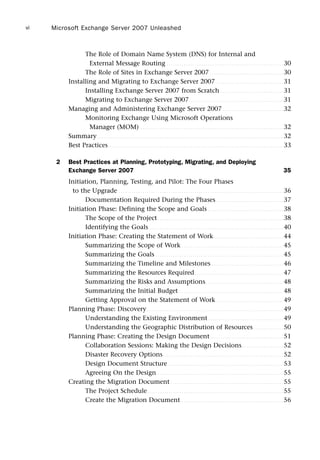
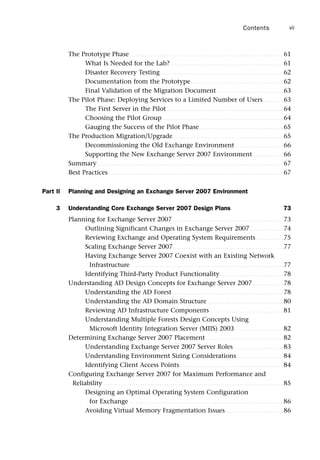
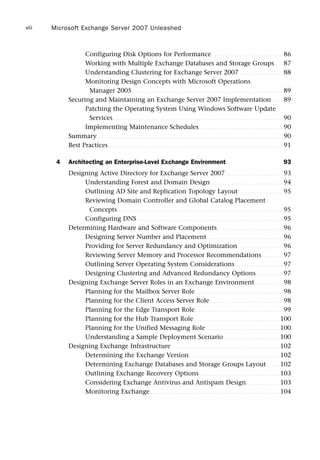
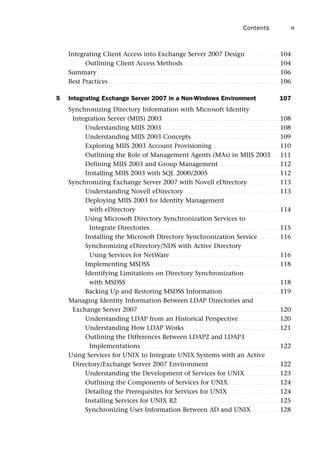
![Microsoft® Exchange Server 2007 Unleashed
Copyright © 2007 by Pearson Education
All rights reserved. No part of this book shall be reproduced, stored in a retrieval system, or
transmitted by any means, electronic, mechanical, photocopying, recording, or otherwise,
without written permission from the publisher. No patent liability is assumed with respect to
the use of the information contained herein. Although every precaution has been taken in the
preparation of this book, the publisher and author assume no responsibility for errors or omis-
sions. Nor is any liability assumed for damages resulting from the use of the information
contained herein.
International Standard Book Number: 0-672-32920-4
Library of Congress Cataloging-in-Publication Data
Microsoft Exchange server 2007 unleashed / Rand H. Morimoto ... [et al.].
p. cm.
ISBN 0-672-32920-4
1. Microsoft Exchange server. 2. Client/server computing. I. Morimoto, Rand.
QA76.9.C55M5296 2006
005.7’1376—dc22
2006038777
Printed in the United States of America
First Printing: January 2007
06 05 04 03 4 3 2 1
Trademarks
All terms mentioned in this book that are known to be trademarks or service marks have been
appropriately capitalized. Sams Publishing cannot attest to the accuracy of this information.
Use of a term in this book should not be regarded as affecting the validity of any trademark or
service mark.
Warning and Disclaimer
Every effort has been made to make this book as complete and as accurate as possible, but
no warranty or fitness is implied. The information provided is on an “as is” basis. The authors
and the publisher shall have neither liability nor responsibility to any person or entity with
respect to any loss or damages arising from the information contained in this book.
Bulk Sales
Sams Publishing offers excellent discounts on this book when ordered in quantity for bulk
purchases or special sales. For more information, please contact
U.S. Corporate and Government Sales
1-800-382-3419
corpsales@pearsontechgroup.com
For sales outside of the U.S., please contact
International Sales
international@pearsoned.com
Editor-in-Chief
Karen Gettman
Senior Acquisitions
Editor
Neil Rowe
Development Editor
Mark Renfrow
Managing Editor
Gina Kanouse
Project Editor
Betsy Harris
Copy Editor
Karen Annett
Indexers
Ken Johnson
Lisa Stumpf
Proofreader
Kathy Bidwell
Technical Editor
Brian Barber
Publishing
Coordinator
Cindy Teeters
Cover Designer
Gary Adair
Composition
Bronkella Publishing
LLC
Contributing Writers
Alec Minty, MCSE,
MVP
Jeff Guillet,
MCSE:Messaging,
MCSA:Messaging,
MCP+I
Kim Amaris, PMP
Ross Mistry, MCSE,
MCDBA, MCSA
Scott Chimner,
MCSE, TCSE, A+](https://image.slidesharecdn.com/65260-250325153939-f392ce49/85/Microsoft-Exchange-server-2007-unleashed-1st-Edition-Rand-Morimoto-8-320.jpg)

![Cynicism
of de
Brosses.
The Président de Brosses describes the death of Clement XII.[40],
which he witnessed, and saw the election of Benedict XIV.[41]—as I
saw Leo XII. the Pontiff lying dead on his abandoned bed: the
Cardinal Camerlingo had struck Clement XII. twice or thrice on the
forehead, according to the custom, with a little hammer, calling him
by his name, Lorenzo Corsini.
"He made no reply," says de Brosses, and adds, "That is how
your daughter comes to be dumb[42]."
And that is how at that time the most serious things were treated: a
dead pope at whose head one knocks as it were at the gate of
understanding, while calling on the deceased and voiceless man by
his name, could, it seems to me, have inspired a witness with
something else than raillery, even though it were borrowed from
Molière. What would the frivolous Dijon magistrate have said had
Clement XII. answered him from the depths of eternity:
"What do you want with me?"
The Président de Brosses sends his friend the Abbé
Courtois a list of the cardinals of the Conclave, with a
word on each of them to his honour:
"Guadagni[43], a bigot, a hypocrite, witless, tasteless, a poor
monk.
"Aquaviva of Aragon, a fine presence, although somewhat heavy
in figure, as he is also in mind.
"Ottoboni[44], no morals, no credit, debauched, ruined, a lover of
the arts.
"Alberoni[45], full of ardour, anxious, restless, despised, no
morals, no decency, no consideration, no judgment: according to
him, a cardinal is a ——- dressed in red."](https://image.slidesharecdn.com/65260-250325153939-f392ce49/85/Microsoft-Exchange-server-2007-unleashed-1st-Edition-Rand-Morimoto-22-320.jpg)
![Dispatches
to Portalis.
scarcely find again the primitive loftiness of the Cross until we come
to the decease of the Sovereign Pontiff: that childless, friendless
pope, whose corpse lies neglected on its couch, shows that the man
was reckoned as naught in the head of the evangelical world.
Honours are rendered to the Pope as a temporal prince; as a man,
his abandoned corpse is flung down at the door of the church where
of old the sinner did penance.
Dispatches to M. Le Comte Portalis
"Rome, 17 February 1829.
"Monsieur le comte,
"I do not know whether the King will be pleased to send an
extraordinary ambassador to Rome, or whether it will suit him to
accredit me to the Sacred College. In the latter case, I have the
honour to observe to you that I allowed M. le Duc de Laval, for
his expenses for extraordinary service in a similar circumstance,
in 1823, a sum which amounted, as far as I can remember, to
40,000 or 50,000 francs. The Austrian Ambassador, M. le Comte
d'Apponyi[46], at first received from his Court a sum of 36,000
francs for the first requirements, a supplementary allowance of
7,200 francs per month over and above his ordinary salary
during the sitting of the Conclave, and 10,000 francs for
presents, chancery expenses, etc. I do not, monsieur le comte,
pretend to compete in magnificence with His Excellency the
Austrian Ambassador, as M. le Duc de Laval did; I shall hire no
horses, carriages, nor liveries to dazzle the Roman mob; the King
of France is a great enough lord to pay for the pomp of his
ambassadors, if he wishes it: borrowed magnificence is
wretched. I shall therefore go modestly to the Conclave with my
ordinary footmen and in my ordinary carriages. It only remains
for me to know whether the King will not think that, as long as
the Conclave lasts, I shall be bound to keep up a display for
which my ordinary salary will not be sufficient I ask nothing, I](https://image.slidesharecdn.com/65260-250325153939-f392ce49/85/Microsoft-Exchange-server-2007-unleashed-1st-Edition-Rand-Morimoto-24-320.jpg)
![merely submit the question to your judgment and to the royal
decision.
"I have the honour to be, etc."
"Rome, 19 February 1829.
"Monsieur le comte,
"I had the honour yesterday to be presented to the Sacred
College and to deliver the little speech of which I sent you a
copy in advance in my Dispatch No. 17, which left on Tuesday
the 17th inst. by a special courier. I was listened to with the
most auspicious marks of satisfaction, and the Senior Cardinal,
the venerable Della Somaglia, replied to me in terms most
affectionate towards the King and France.
"Having informed you of everything in my last dispatch, I have
absolutely nothing new to tell you to-day, unless it be that
Cardinal Bussi[47] arrived yesterday from Benevento. Cardinals
Albani, Macchi[48], and Oppizzoni are expected to-day.
"The members of the Sacred College will lock themselves up in
the Quirinal Palace on Monday evening the 23rd of this month.
Ten days will then elapse to await the arrival of the foreign
cardinals, after which the serious operations of the Conclave will
commence, and, if they were to come to an understanding at
once, the pope could be elected in the first week of Lent.
"I am, monsieur le comte, awaiting the King's orders. I presume
that you dispatched a courier to me after M. de Montebello's
arrival in Paris. It is urgent that I should receive either the
announcement of an extraordinary embassy, or my new
credentials together with the instructions of the Government.
"Are my five French cardinals coming? Politically speaking, their
presence here is very little necessary. I have written to
Monseigneur le Cardinal de Latil[49] to offer him my services in
case he should decide to come,](https://image.slidesharecdn.com/65260-250325153939-f392ce49/85/Microsoft-Exchange-server-2007-unleashed-1st-Edition-Rand-Morimoto-25-320.jpg)
![all its strings, or nearly... the skin of a lizard three feet long...
and a four-foot bedstead with slips in Hungarian point[50].'
"One sees nothing but dead people carried dressed-up through
the streets; one of them passes regularly under my windows
when we sit down to dinner. For the rest, everything proclaims
the spring parting; people are beginning to disperse; they are
leaving for Naples; they will come back a moment for Holy
Week, and then separate for good. Next year there will be
different travellers, different faces, a different society. There is
something melancholy in this journey over ruins: the Romans are
like the remains of their city; the world passes at their feet. I
picture those persons going back to their families in the various
countries of Europe, the young 'Misses' returning to the midst of
their fogs. If, by chance, thirty years hence, one of them is
brought back to Italy, who will remember to have seen her in the
palaces whose masters shall be no more. St. Peter's and the
Coliseum: that is all that she herself would recognise."
Dispatch to M. le comte Portalis
"Rome, 3 March 1829.
"Monsieur le comte,
"My first courier having reached Lyons, on the 14th of last
month, at nine o'clock in the evening, you must have learned the
news of the Pope's death, by telegraph, on the morning of the
15th. It is to-day the 3rd of March, and I am still without
instructions and without an official reply. The newspapers have
announced the departure of two or three cardinals. I had written
to Paris to Monseigneur le Cardinal de Latil to place the Embassy
Palace at his disposal; I have just written to him again at
different points on his road to renew my offers.
"I am sorry to be obliged to tell you, monsieur le comte, that I
notice some little intrigues here to keep the cardinals away from
the Embassy, to lodge them where they might be placed more](https://image.slidesharecdn.com/65260-250325153939-f392ce49/85/Microsoft-Exchange-server-2007-unleashed-1st-Edition-Rand-Morimoto-27-320.jpg)
![within reach of the influences which it is hoped to exercise over
them.
"As far as I am concerned, this is a matter of indifference to me.
I shall show Their Eminences all the services which depend upon
myself. If they question me touching things which it is well that
they should know, I shall tell them what I can; if you transmit
the King's orders for them to me, I will communicate these to
them; but, if they were to arrive here in a spirit hostile to the
views of His Majesty's Government, if it were perceived that they
were not in agreement with the King's Ambassador, if they held a
language contrary to mine, if they went so far as to give their
votes in the Conclave to some exaggerated man, if even they
were divided among themselves, nothing would be more fatal. It
would be better for the King's service that I should instantly
hand in my resignation rather than present this public spectacle
of our discords. Austria and Spain have a line of conduct with
reference to their clergy which leaves no opening for intrigue. No
Austrian or Spanish priest, cardinal or bishop, can have any
other agent or correspondent in Rome than the ambassador of
his Court himself; the latter has the right to remove from Rome,
at a moment's notice, any ecclesiastic of his nationality who may
obstruct him.
"I hope, monsieur le comte, that no division will take place, that
Their Eminences the cardinals will have formal orders to submit
to the instructions which I shall before long receive from you,
and that I shall know which of them will be charged with the
exercise of the exclusion, in case of need, and which heads that
exclusion is to strike.
"It is very necessary that we should be on our guard; the last
ballots revealed the awakening of a party. This party, which gave
twenty or twenty-one votes to Cardinals Della Marmora[51] and
Pedicini, forms what is known here as the Sardinian faction. The
other cardinals, alarmed, want all to give their suffrages to
Oppizzoni, a man both firm and moderate. Although an Austrian,](https://image.slidesharecdn.com/65260-250325153939-f392ce49/85/Microsoft-Exchange-server-2007-unleashed-1st-Edition-Rand-Morimoto-28-320.jpg)
![To Portalis
and
Récamier.
Dispatch
to Portalis.
that is to say, a Milanese, he coped against Austria at Bologna.
He would be an excellent choice. The votes of the French might,
by settling on one candidate or another, decide the election.
Rightly or wrongly, these cardinals are believed to be hostile to
the present system of His Majesty's Government, and the
Sardinian faction is reckoning on them.
"I have the honour to be, etc[52]."
To Madame Récamier
"Rome, 3 March 1829.
"I am quite surprised at your acquaintance with the story of my
excavation; I did not remember having written you so well on
that subject. I am, as you think, very busy: left without
directions or instructions, I am obliged to take everything upon
myself. I believe, however, that I can promise you a moderate
and enlightened pope, if God only grant that he be made at the
expiration of the interim of M. Portalis' ministry."
"4 March.
"Yesterday, Ash Wednesday, I was on my knees alone in the
Church of Santa Croce, which rests against the walls of Rome,
near the Porta di Napoli. I heard the monotonous and lugubrious
chanting of the monks within that solitude: I should have liked
myself to be in a frock, singing among those ruins. What a spot
to appease ambition and to contemplate the vanities of earth!
While I am suffering, I hear that M. de La Ferronnays is getting
better; he rides on horseback, and his convalescence is looked
upon in the country as miraculous: God grant that it be so, and
that he may resume work at the end of the interim. What a
number of questions that would solve for me!"
Dispatch to M. le comte Portalis
"Sunday[53] 15 March 1829.](https://image.slidesharecdn.com/65260-250325153939-f392ce49/85/Microsoft-Exchange-server-2007-unleashed-1st-Edition-Rand-Morimoto-29-320.jpg)
!["Monsieur le comte,
"I have had the honour to inform you of the successive arrivals
of their Eminences the French cardinals. Three of them,
Messieurs de Latil, de La Fare[54] and de Croy[55] have done me
the honour to be my guests. The first entered the Conclave on
Thursday evening the 12th, with M. le Cardinal Isoard[56]; the
two others locked themselves in on Friday evening the 13th.
"I told them all I know; I gave them important notes on the
minority and majority in the Conclave, and on the sentiments
which animate the different parties. We agreed that they should
support the candidates of whom I have already spoken to you,
namely, Cardinals Capellari, Oppizzoni, Benvenuti, Zurla,
Castiglioni and, lastly, Pacca and Di Gregorio; and that they
should reject the cardinals of the Sardinian faction: Pedicini,
Giustiniani, Galleffi, and Cristaldi[57].
"I hope that this good intelligence between the ambassadors and
cardinals will have the best effect: at least I shall have nothing
with which to reproach myself if passions or interests intervene
to deceive my hopes.
"I have, monsieur le comte, discovered dangerous and
contemptible intrigues carried on between Paris and Rome
through the channel of Monsignor Lambruschini, the Nuncio[58].
It was no less a question than to cause to be read, in open
conclave, a copy of some pretended secret instructions, divided
into several clauses and given (so it was impudently asserted) to
M. le Cardinal de Latil. The majority of the Conclave has
pronounced strongly against these machinations; it wished the
Nuncio to be instructed to break off all relations with those men
of discord who, while troubling France, would end by making the
Catholic Religion hateful to all. I am, monsieur le comte, making
a collection of these authentic revelations, and I will send it to
you after the election of the pope: that will be worth more than
all the dispatches in the world. The King will learn to know who](https://image.slidesharecdn.com/65260-250325153939-f392ce49/85/Microsoft-Exchange-server-2007-unleashed-1st-Edition-Rand-Morimoto-30-320.jpg)
![are his friends and who his enemies, and the Government will be
able to rely on facts suited to guide its conduct
"Your Dispatch No. 14 informs me of the encroachments which
His Holiness' Nuncio endeavoured to renew in France in
connection with the death of Leo XII. The same thing had
happened before, when I was Foreign Minister, at the time of the
death of Pius VII.: fortunately, we always have means of
defending ourselves against those public attacks; it is much
more difficult to escape the plots laid in the dark.
"The conclavists who accompany our cardinals appeared to me
to be reasonable men: the Abbé Coudrin[59] alone, whom you
mentioned to me, is one of those cramped and narrow minds
into which nothing can enter, one of those men who have
mistaken their profession. As you are well aware, he is a monk,
head of an order, and he even has bulls of institution: this is but
little in agreement with our civil laws and our political
institutions.
"It may happen that the pope will be elected at the end of this
week. But, if the French cardinals fail to make their presence felt
at once, it will become impossible to assign a limit to the
duration of the Conclave. New combinations would perhaps bring
about an unexpected nomination: to have done with it, they
might agree on some insignificant cardinal, such as Dandini[60].
"In times gone by, monsieur le comte, I have found myself
placed in difficult circumstances, whether as Ambassador to
London, or as Minister during the Spanish War, or as a member
of the House of Peers, or Leader of the Opposition; but nothing
has given me so much anxiety and care as my present position
in the midst of every kind of intrigue. I have to act upon an
invisible body locked up in a prison, the approaches to which are
strictly guarded. I have no money to give, no places to promise;
the decaying passions of fifty old men give me no hold on them.
I have to fight against stupidity in some, against ignorance of
the times in others; fanaticism in these, craft and duplicity in](https://image.slidesharecdn.com/65260-250325153939-f392ce49/85/Microsoft-Exchange-server-2007-unleashed-1st-Edition-Rand-Morimoto-31-320.jpg)
![Letter to
Madame
Récamier.
those; in almost all, ambition, self-interest, political hatred: and I
am separated by walls and mysteries from the assembly in which
so many elements of division are fermenting. At each moment,
the scene varies; every quarter of an hour, contradictory reports
plunge me into fresh perplexities. I am not, monsieur le comte,
telling you of these difficulties to show my importance, but
rather to serve as my excuse in case the election should result in
a pope contrary to what it seems to promise and to the nature of
our wishes. At the time of the death of Pius VII., public opinion
was not excited over religious questions: to-day, these questions
have begun to play their part in politics, and never did the
election of the Head of the Church fall at a less auspicious
moment
"I have the honour to be, etc."
To Madame Récamier
Rome, 17 March 1829.
"The King of Bavaria[61] has called in mufti to see me. We spoke
of you. This 'Greek' sovereign, though he wears a crown, seems
to know what he has on his head, and to understand that you
cannot nail the present to the past. He is to dine with me on
Thursday, and wants no one there.
"For the rest, behold us in the midst of great events: a pope to
be made; what will he be like? Will Catholic Emancipation be
passed? A new campaign in the East: on which side will victory
be? Shall we profit by this position? Who will conduct our affairs?
Is there a head capable of perceiving all that this contains for
France and of profiting by it according to events? I am
persuaded that they do not so much as think of it in Paris and
that, what with the salons and the Chambers, pleasures and
legislation, worldly joys and ministerial anxieties, they don't
trouble about Europe or anything else. Only I myself, in my exile,
have time to indulge in dreams and to look about me. Yesterday](https://image.slidesharecdn.com/65260-250325153939-f392ce49/85/Microsoft-Exchange-server-2007-unleashed-1st-Edition-Rand-Morimoto-32-320.jpg)
![Louise of Stolberg (Countess of Albany)
The Marquis Capponi[62] arrived from Florence, bringing me letters of
recommendation from ladies in Paris. I replied to one of these letters
on the 21st of March 1829:
"I have received your letters: the services I am able to do are
nothing, but I am entirely at your orders. I was already well
acquainted with the Marquis Capponi's merits. I can tell you that
he is still good-looking; he has weathered time. I did not answer
your first letter, so full of enthusiasm for the sublime Mahmud
and for 'disciplined' barbarism, for those slaves 'bastinadoed' into
soldiers[63]. I can imagine that women are carried away with
admiration for men who marry hundreds of them at a time, and
that they take that for the progress of enlightenment and
civilization; but, as for me, I cling to my poor Greeks; I desire
their liberty as I do that of France. I also want frontiers which
will cover Paris and ensure our independence; and it is not by
means of the triple alliance of the pale of Constantinople, the
schlag of Vienna and the fisticuffs of London that you will obtain
the bank of the Rhine. Many thanks for the fur-coat of honour
which our glory might obtain from the invincible Commander of
the Faithful, who has not yet sallied from the outskirts of his
seraglio; I prefer that glory naked; she is a woman and
beautiful: Phidias would certainly never have robed her in a
Turkish dressing-gown."
To Madame Récamier
Rome, 21 March 1829.
"Well, I am right and you are wrong! I went yesterday, between
two ballots and while waiting for a pope, to Sant' Onofrio: and it
is two orange-trees that grow in the cloister, and not an
evergreen oak. I am quite proud of this fidelity of my memory. I](https://image.slidesharecdn.com/65260-250325153939-f392ce49/85/Microsoft-Exchange-server-2007-unleashed-1st-Edition-Rand-Morimoto-34-320.jpg)
![Letters to
Madame
ran, almost with my eyes shut, to the little stone that covers
your friend; I prefer it to the great monument they are going to
raise to him. What a charming solitude! What an admirable view!
What happiness to lie there between the frescoes of
Domenichino[64] and Leonardo da Vinci! I wish I were there, I
never felt so tempted. Did they let you enter the interior of the
convent? Did you see, in a long corridor, that delicious, though
half-obliterated, head of a Madonna by Leonardo da Vinci? Did
you see in the library Tasso's mask, his withered laurel-wreath, a
mirror which he used, his ink-stand, his pen and the letter
written by his hand, pasted to a board that hangs below his
bust? In this letter, in a small, scratched-out, but easily legible
hand, he speaks of 'friendship' and the 'wind of fortune;' the
latter scarcely ever blew for him, and the former often failed
him.
"No pope yet, we expect him hourly; but, if the choice has been
delayed, if obstacles have arisen on every hand, it is not my
fault: they ought to have listened to me a little more, and not
acted in a sense exactly opposite to that which they seemed to
decide upon. For the rest, it seems to me at present that every
one wants to be at peace with me. The Cardinal de Clermont-
Tonnerre himself has just written to tell me that he claims my
former kindness for him; and after all that he comes to stay with
me resolved to vote for the most moderate pope.
"You have read my second speech. Thank M. Kératry[65], who
has spoken so obligingly of the first; I hope he will be still more
pleased with the other. We shall both of us try to make liberty
Christian, and we shall succeed. What do you say to the answer
Cardinal Castiglioni made me? Have I been finely enough praised
'in open conclave'? You could not have done better in the days
when you spoilt me."
"24 March 1829.](https://image.slidesharecdn.com/65260-250325153939-f392ce49/85/Microsoft-Exchange-server-2007-unleashed-1st-Edition-Rand-Morimoto-35-320.jpg)
!["M. le Cardinal de Clermont-Tonnerre, who has been staying with
me, enters the Conclave to-day; this is an age of marvels. I have
with me the son of Marshal Lannes and the grandson of the
Chancellor[66]; Messieurs du Constitutionnel dine at my table
beside Messieurs de la Quotidienne. That is the advantage of
being sincere; let every one think what he pleases, provided I
am allowed the same liberty; I only endeavour that my opinion
shall have the majority, because I think it, and rightly, better
than the others. I attribute to this sincerity the tendency of the
most diverging opinions to gather round me. I exercise the right
of sanctuary towards them: they cannot be seized beneath my
roof."
To M. le Duc de Blacas
[67]
"Rome, 24 March 1829.
"I am sorry, monsieur le duc, that a phrase in my letter should
have been able to cause you any anxiety. I have no reason
whatever to complain of a man of sense and intelligence[68],
who told me nothing save diplomatic commonplaces. Do we
ambassadors ever talk anything else? As to the cardinal of whom
you do me the honour to speak, the French Government has not
designated any one in particular; it has left the matter entirely as
I reported it. Seven or eight moderate and peaceful cardinals,
who seem to attract the wishes of all the Courts alike, are the
candidates among whom we wish to see the votes fall. But, if we
lay no claim to impose a choice upon the majority of the
Conclave, we do with all our might and by every means repel
two or three fanatical, intriguing, or incapable cardinals, whom
the minority are supporting.
"I have no other possible means of sending you this letter,
monsieur le duc; I am therefore very simply posting it, because
it contains nothing that you and I cannot confess aloud.
"I have the honour to be, etc."](https://image.slidesharecdn.com/65260-250325153939-f392ce49/85/Microsoft-Exchange-server-2007-unleashed-1st-Edition-Rand-Morimoto-37-320.jpg)
!["Now, monsieur le comte, that the principal business which kept
me in Rome is ended, I shall be infinitely obliged to you if you
will obtain for me from His Majesty's kindness a leave of a few
months. I shall not take it until after I have handed the Pope the
letter in which the King will reply to that which Pius VIII. has
written or is going to write to him to announce his elevation to
the Chair of St Peter. Permit me to beg once more, on behalf of
my two secretaries of Legation, M. Bellocq[69] and M. de
Givré[70], the favours which I have asked of you for them.
"The intrigues of Cardinal Albani in the Conclave, the partisans
whom he had won, even among the majority, had made me fear
some unexpected stroke to carry him to the Sovereign
Pontificate. It seemed to me impossible to allow ourselves to be
thus surprised and to permit the Austrian chargé d'affaires to put
on the tiara under the eyes of the French Ambassador. I
therefore availed myself of the arrival of M. le Cardinal de
Clermont-Tonnerre to charge him against all eventualities with
the letter enclosed, the terms of which I framed on my own
responsibility. Fortunately he was not called upon to make use of
this letter; he handed it back to me, and I have the honour to
send it to you.
"I have the honour to be, etc."
To His Eminence Monseigneur le Cardinal de Clermont-Tonnerre
"Rome, 28 March 1829.
"Monseigneur,
"Unable to communicate with your colleagues, Messieurs the
French cardinals, confined in the Monte Cavallo Palace; obliged
to provide for every thing to the advantage of His Majesty's
service, and in the interests of our country; knowing how often
unexpected nominations have been made in the conclaves, I find
myself, to my regret, in the disagreeable necessity of confiding
to Your Eminence a power of eventual exclusion.](https://image.slidesharecdn.com/65260-250325153939-f392ce49/85/Microsoft-Exchange-server-2007-unleashed-1st-Edition-Rand-Morimoto-41-320.jpg)