Examining Attitudes Toward Aging
and Disability Among Occupational
Therapy Trainees
Arielle Silverman
Jennifer Pitonyak
Ivan Molton
October 18, 2015
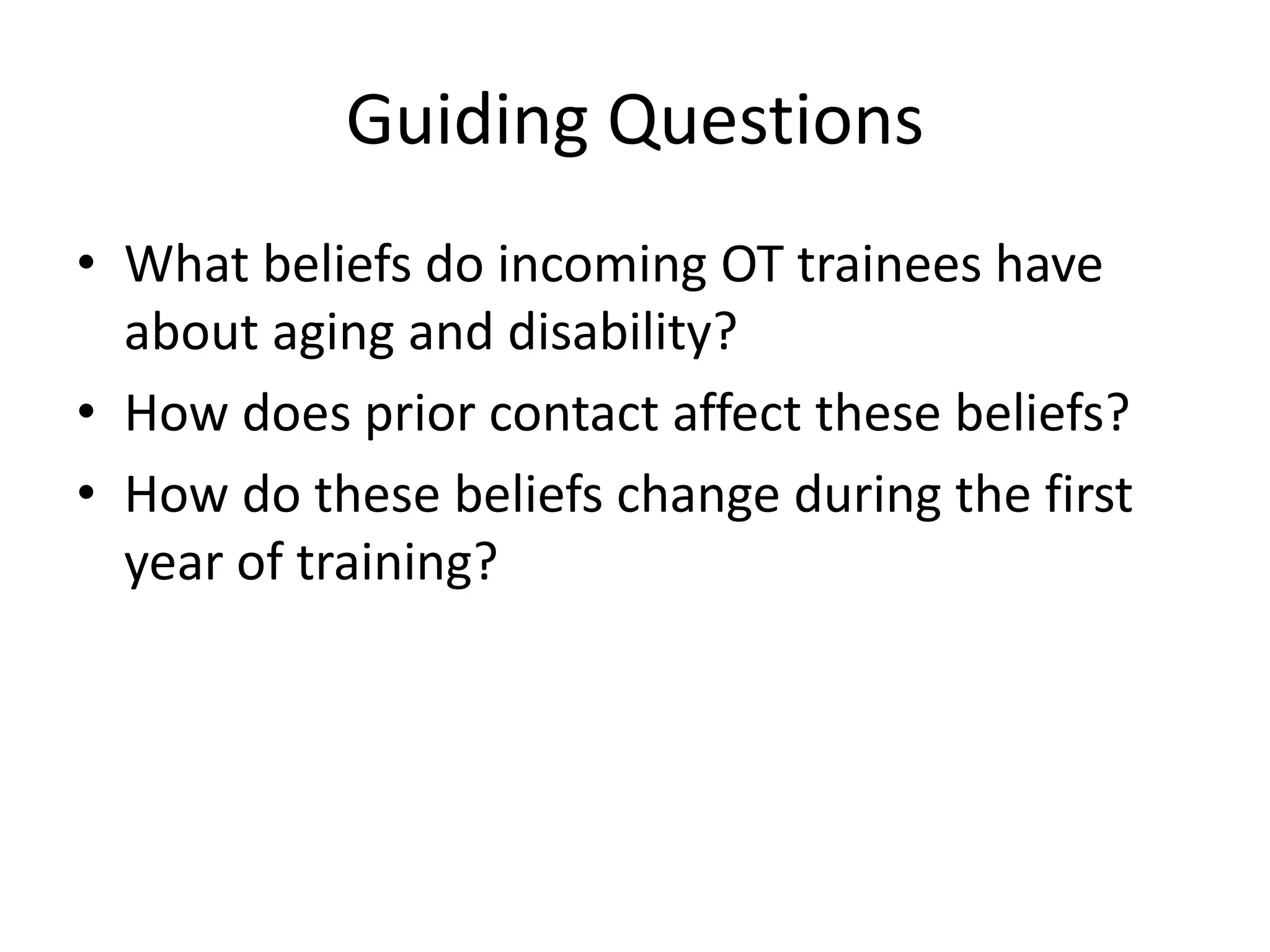
Guiding Questions
• What beliefs do incoming OT trainees have
about aging and disability?
• How does prior contact affect these beliefs?
• How do these beliefs change during the first
year of training?
OT curriculum:
Disability theory & culture
• Disability theory and culture are important
components of OT curriculum (AOTA, 2009;
Baum et al., 2010).
• We need to understand the attitudes
incoming students have and how specific
learning activities affect them.
Ambivalent Attitudes and Mixed
Stereotypes
Group Positive Negative
PWD Innocent, heroic, inspiring,
warm
Helpless, childlike,
dependent, depressed
Older adults Wise, friendly Dependent, rigid, forgetful
Fiske et al. 2002
Study Participants
• Twelve incoming OT students (11 women;
mean age = 25).
• All had some contact with PWD and older
adults.
• Seven had relatives with disabilities.
• Five had taken disability studies courses.
• Most had unequal-status contact (e.g.,
working with children or in assisted-living
center).
Procedures
• Students completed a survey online within a
month of enrolling at UW.
• Completed the same survey six months later,
near end of their first year.
• Procedures were approved by the Institutional
Review Board.
Attitude Measures
Scale Subscale Sample Item Source
IDP Discomfort with
PWD
I feel
uncomfortable and
find it hard to relax.
Gething & Wheeler
1992
IDP Paternalistic
sympathy
It hurts me when
they try to do
something and
can’t.
Gething & Wheeler
1992
IDP Vulnerability to
disability
I am grateful that I
don’t have such a
burden.
Gething & Wheeler
1992
Quality of life with
spinal cord injury
Single Item What percentage of
people with SCI are
clinically
depressed?
Developed in-house
Facts on Aging Quiz Single scale Personality changes
with age. [false]
Palmore, 1977
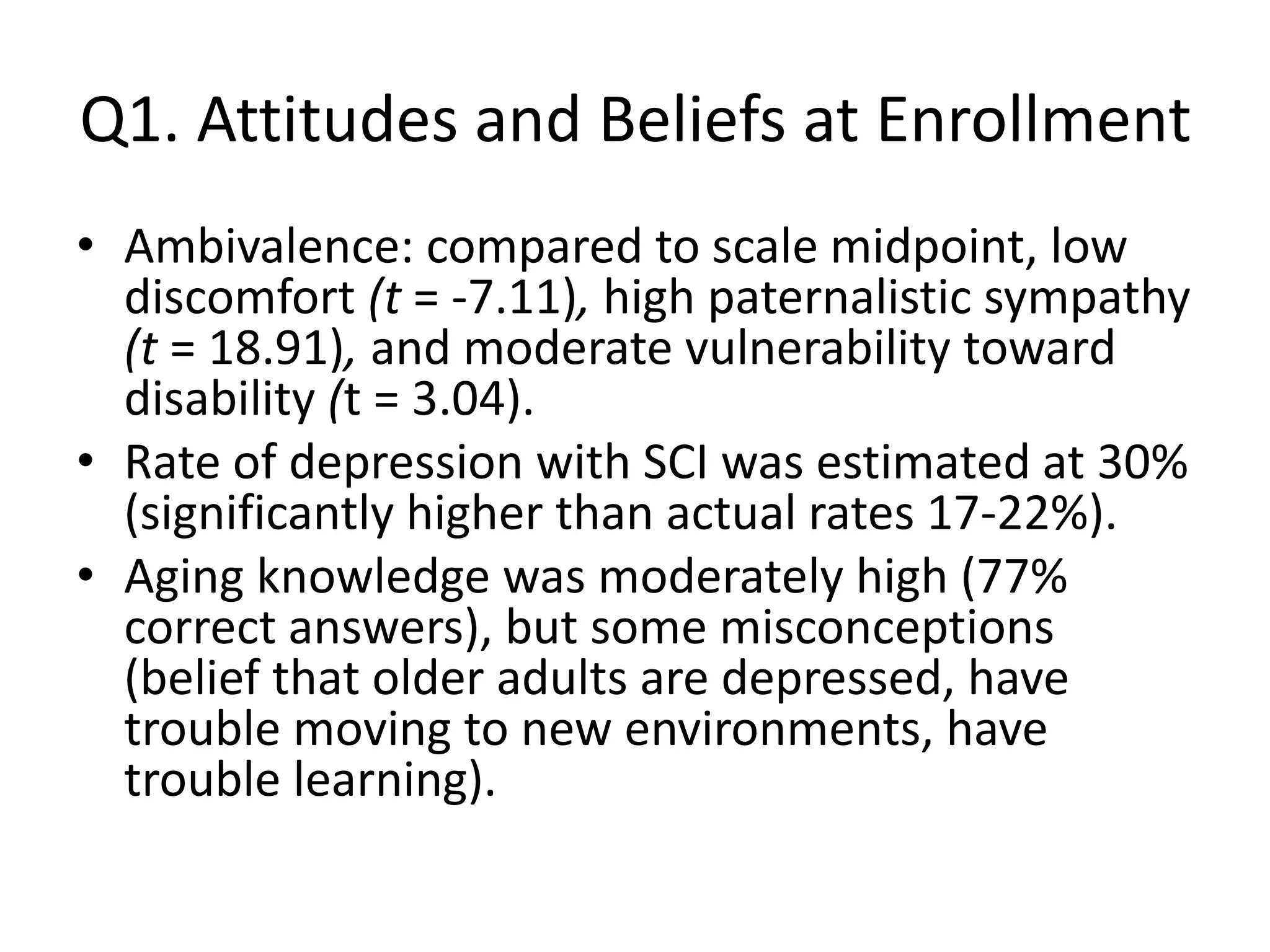
Q1. Attitudes and Beliefs at Enrollment
• Ambivalence: compared to scale midpoint, low
discomfort (t = -7.11), high paternalistic sympathy
(t = 18.91), and moderate vulnerability toward
disability (t = 3.04).
• Rate of depression with SCI was estimated at 30%
(significantly higher than actual rates 17-22%).
• Aging knowledge was moderately high (77%
correct answers), but some misconceptions
(belief that older adults are depressed, have
trouble moving to new environments, have
trouble learning).
Q2. Associations between contact and
beliefs
• Students with disability studies background
felt less vulnerable (p = .10).
• Working with children with disabilities was
associated with more paternalistic sympathy
(p = .01). Students with disability in their
families over-estimated depression in SCI
(37%), but students without disability in their
families did not (21%).
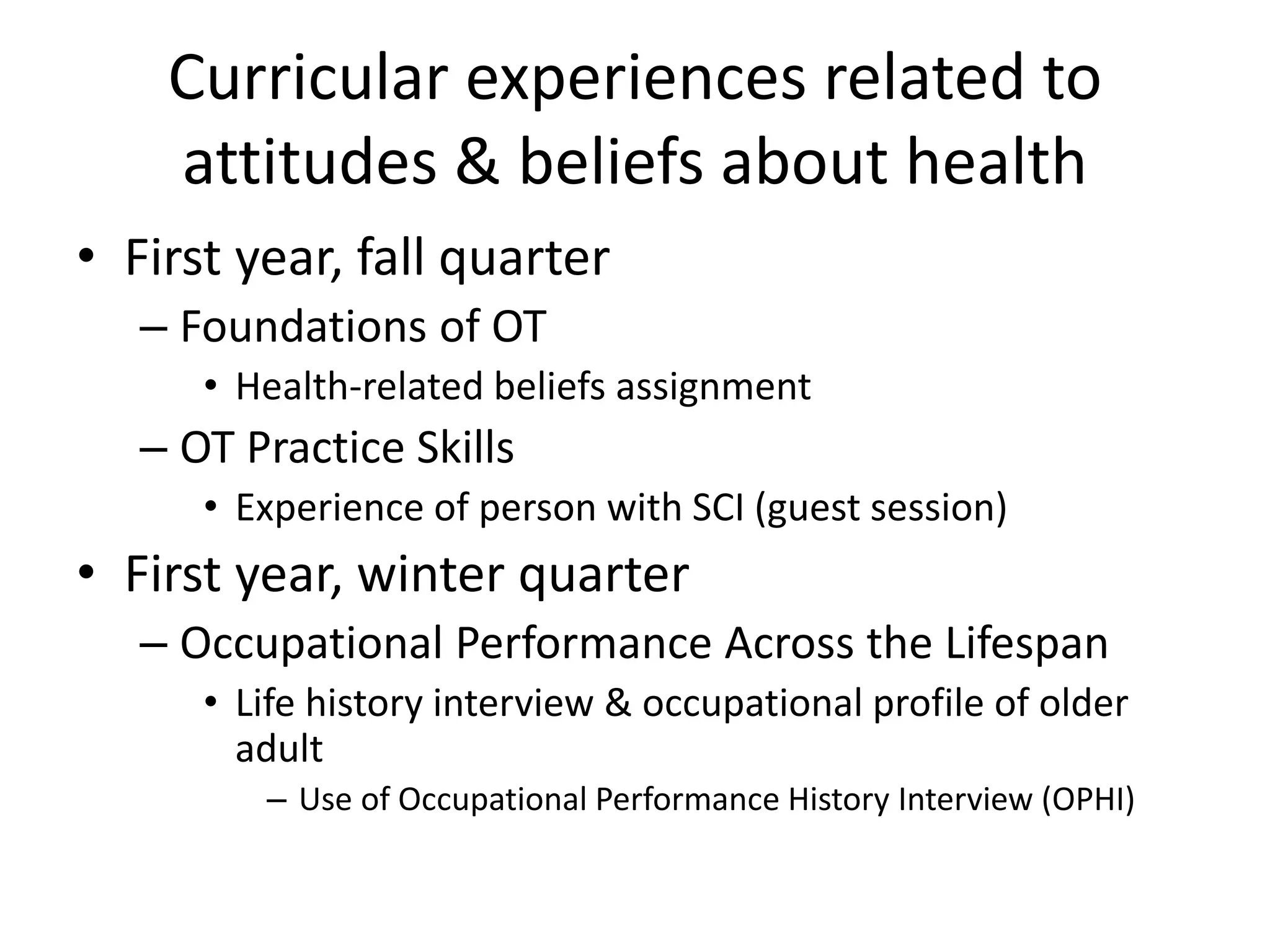
Curricular experiences related to
attitudes & beliefs about health
• First year, fall quarter
– Foundations of OT
• Health-related beliefs assignment
– OT Practice Skills
• Experience of person with SCI (guest session)
• First year, winter quarter
– Occupational Performance Across the Lifespan
• Life history interview & occupational profile of older
adult
– Use of Occupational Performance History Interview (OPHI)
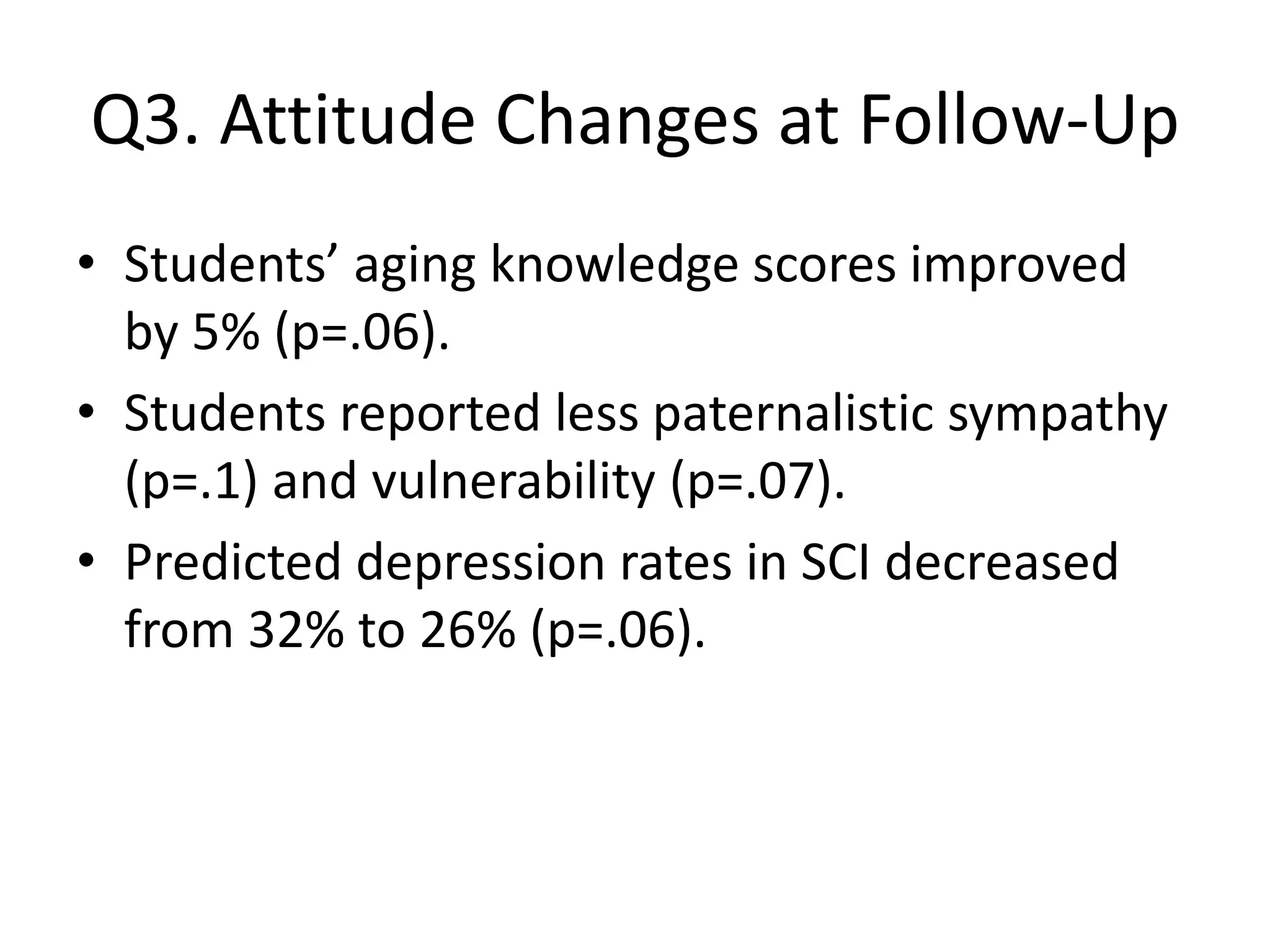
Q3. Attitude Changes at Follow-Up
• Students’ aging knowledge scores improved
by 5% (p=.06).
• Students reported less paternalistic sympathy
(p=.1) and vulnerability (p=.07).
• Predicted depression rates in SCI decreased
from 32% to 26% (p=.06).
Next Steps
• What instructional methods and pedagogical
approaches (e.g., problem-based learning,
simulation, service learning, video cases,
discussion, and so on) are most suited to
developing positive student attitudes and values
for working with individuals with disability?
• Simulations are popular and attractive, but if not
done carefully, can increase paternalism
(Silverman, Gwinn, & Van Boven, 2015).
Next Steps
• Designed a simulation to teach OT students
how to use basic assistive devices.
• Students will learn to transfer to a wheelchair
and to make a sandwich using adapted
kitchen utensils.
• Hoped to promote identification with and
empowerment of PWD.
Conclusions
• Incoming OT students hold ambivalent
attitudes toward PWD and older adults,
consistent with the general population.
• Disability theory and culture coursework at
the undergraduate level can reduce
misconceptions about PWD.
• Structured contact with PWD and older adults
as part of the first-year OT curriculum can
improve knowledge and attitudes.
Acknowledgments
• I would like to thank the faculty and students
of the occupational therapy program at UW
for their support of this research, as well as
research staff Amanda Smith, Aimee Verrall,
and Ian Nelson.
• This research was supported by a grant from
the Department of Education, NIDRR under
grant no. H133B080024.
References
1. AOTA. (2009). Occupational Therapy Model Curriculum. Retrieved from:
http://www.aota.org/-
/media/Corporate/Files/EducationCareers/Educators/FINAL%20Copy%20Edit%20OT
%20Model%20Curriculum%20Guide%2012-08.pdf
2. Baum et al. (2010). Blueprint for Entry-Level Education. American Journal of
Occupational Therapy, 64(1), 186-203.
3. Fiske, S. T., Cuddy, A. J. C., Glick, P., and Xu, J. (2002). A model of (often mixed)
stereotype content: Competence and warmth respectively follow from perceived
status and competition. Journal of Personality and Social Psychology, 82, 878-902.
4. Gething, L. & Wheeler, B. (1992). The interaction with disabled persons scale: A new
Australian instrument to measure attitudes toward people with disabilities.
Australian Journal of Psychology, 44, 75-82.
5. Palmore, E. (1977). Facts on aging: A short quiz. Gerontologist, 17, 315-320.
6. Silverman, A. M., Gwinn, J. D. & Van Boven, L. (2015). Stumbling in their shoes:
Disability simulations reduce judged capabilities of disabled people. Social
Psychological and Personality Science, 6, 464-471.

Examining attitudes toward aging and disability

  • 1.
    Examining Attitudes TowardAging and Disability Among Occupational Therapy Trainees Arielle Silverman Jennifer Pitonyak Ivan Molton October 18, 2015
  • 2.
    Guiding Questions • Whatbeliefs do incoming OT trainees have about aging and disability? • How does prior contact affect these beliefs? • How do these beliefs change during the first year of training?
  • 3.
    OT curriculum: Disability theory& culture • Disability theory and culture are important components of OT curriculum (AOTA, 2009; Baum et al., 2010). • We need to understand the attitudes incoming students have and how specific learning activities affect them.
  • 4.
    Ambivalent Attitudes andMixed Stereotypes Group Positive Negative PWD Innocent, heroic, inspiring, warm Helpless, childlike, dependent, depressed Older adults Wise, friendly Dependent, rigid, forgetful Fiske et al. 2002
  • 5.
    Study Participants • Twelveincoming OT students (11 women; mean age = 25). • All had some contact with PWD and older adults. • Seven had relatives with disabilities. • Five had taken disability studies courses. • Most had unequal-status contact (e.g., working with children or in assisted-living center).
  • 6.
    Procedures • Students completeda survey online within a month of enrolling at UW. • Completed the same survey six months later, near end of their first year. • Procedures were approved by the Institutional Review Board.
  • 7.
    Attitude Measures Scale SubscaleSample Item Source IDP Discomfort with PWD I feel uncomfortable and find it hard to relax. Gething & Wheeler 1992 IDP Paternalistic sympathy It hurts me when they try to do something and can’t. Gething & Wheeler 1992 IDP Vulnerability to disability I am grateful that I don’t have such a burden. Gething & Wheeler 1992 Quality of life with spinal cord injury Single Item What percentage of people with SCI are clinically depressed? Developed in-house Facts on Aging Quiz Single scale Personality changes with age. [false] Palmore, 1977
  • 8.
    Q1. Attitudes andBeliefs at Enrollment • Ambivalence: compared to scale midpoint, low discomfort (t = -7.11), high paternalistic sympathy (t = 18.91), and moderate vulnerability toward disability (t = 3.04). • Rate of depression with SCI was estimated at 30% (significantly higher than actual rates 17-22%). • Aging knowledge was moderately high (77% correct answers), but some misconceptions (belief that older adults are depressed, have trouble moving to new environments, have trouble learning).
  • 9.
    Q2. Associations betweencontact and beliefs • Students with disability studies background felt less vulnerable (p = .10). • Working with children with disabilities was associated with more paternalistic sympathy (p = .01). Students with disability in their families over-estimated depression in SCI (37%), but students without disability in their families did not (21%).
  • 10.
    Curricular experiences relatedto attitudes & beliefs about health • First year, fall quarter – Foundations of OT • Health-related beliefs assignment – OT Practice Skills • Experience of person with SCI (guest session) • First year, winter quarter – Occupational Performance Across the Lifespan • Life history interview & occupational profile of older adult – Use of Occupational Performance History Interview (OPHI)
  • 11.
    Q3. Attitude Changesat Follow-Up • Students’ aging knowledge scores improved by 5% (p=.06). • Students reported less paternalistic sympathy (p=.1) and vulnerability (p=.07). • Predicted depression rates in SCI decreased from 32% to 26% (p=.06).
  • 12.
    Next Steps • Whatinstructional methods and pedagogical approaches (e.g., problem-based learning, simulation, service learning, video cases, discussion, and so on) are most suited to developing positive student attitudes and values for working with individuals with disability? • Simulations are popular and attractive, but if not done carefully, can increase paternalism (Silverman, Gwinn, & Van Boven, 2015).
  • 13.
    Next Steps • Designeda simulation to teach OT students how to use basic assistive devices. • Students will learn to transfer to a wheelchair and to make a sandwich using adapted kitchen utensils. • Hoped to promote identification with and empowerment of PWD.
  • 14.
    Conclusions • Incoming OTstudents hold ambivalent attitudes toward PWD and older adults, consistent with the general population. • Disability theory and culture coursework at the undergraduate level can reduce misconceptions about PWD. • Structured contact with PWD and older adults as part of the first-year OT curriculum can improve knowledge and attitudes.
  • 15.
    Acknowledgments • I wouldlike to thank the faculty and students of the occupational therapy program at UW for their support of this research, as well as research staff Amanda Smith, Aimee Verrall, and Ian Nelson. • This research was supported by a grant from the Department of Education, NIDRR under grant no. H133B080024.
  • 16.
    References 1. AOTA. (2009).Occupational Therapy Model Curriculum. Retrieved from: http://www.aota.org/- /media/Corporate/Files/EducationCareers/Educators/FINAL%20Copy%20Edit%20OT %20Model%20Curriculum%20Guide%2012-08.pdf 2. Baum et al. (2010). Blueprint for Entry-Level Education. American Journal of Occupational Therapy, 64(1), 186-203. 3. Fiske, S. T., Cuddy, A. J. C., Glick, P., and Xu, J. (2002). A model of (often mixed) stereotype content: Competence and warmth respectively follow from perceived status and competition. Journal of Personality and Social Psychology, 82, 878-902. 4. Gething, L. & Wheeler, B. (1992). The interaction with disabled persons scale: A new Australian instrument to measure attitudes toward people with disabilities. Australian Journal of Psychology, 44, 75-82. 5. Palmore, E. (1977). Facts on aging: A short quiz. Gerontologist, 17, 315-320. 6. Silverman, A. M., Gwinn, J. D. & Van Boven, L. (2015). Stumbling in their shoes: Disability simulations reduce judged capabilities of disabled people. Social Psychological and Personality Science, 6, 464-471.