Study Tips &
Strategies
By: DeAnna Henson
Take Care of Your Brain
 Exercise.
 30-45 minutes of moderate exercise at least 3-4 times
per week.
 Eat good foods.
 Whole foods- vegetables, fruits, fatty fish, walnuts,
almonds, lean meats, etc.
 Drink plenty of water.
 Carry a water bottle with you so you remember to stay
hydrated.
 Get plenty of sleep.
 ~8 hours/ night.
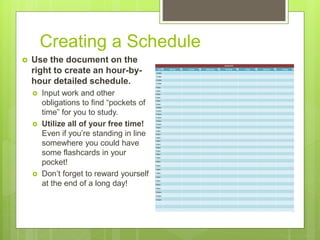
Creating a Schedule
Spring 2016
Time Monday Tuesday Wednesday Thursday Friday Saturday Sunday
5:00am
5:30am
6:00am
6:30am
7:00am
7:30am
8:00am
8:30am
9:00am
9:30am
10:00am
10:30am
11:00am
11:30am
12:00pm
12:30pm
1:00pm
1:30pm
2:00pm
2:30pm
3:00pm
3:30pm
4:00pm
4:30pm
5:00pm
5:30pm
6:00pm
6:30pm
7:00pm
7:30pm
8:00pm
8:30pm
9:00pm
9:30pm
10:00pm
10:30pm
11:00pm
 Use the document on the
right to create an hour-by-
hour detailed schedule.
 Input work and other
obligations to find “pockets of
time” for you to study.
 Utilize all of your free time!
Even if you’re standing in line
somewhere you could have
some flashcards in your
pocket!
 Don’t forget to reward yourself
at the end of a long day!
Creating a Schedule cont’d . . .
 Be flexible.
 If your schedule doesn’t go according to plan, rewrite it
and adjust it until it works for you and your life. You
might find that making a new one each week helps you
to plan your week ahead of time, keeping you in control
of your time and how it’s spent.
 Be specific.
 When you block off study times don’t just write “Study
Time”- be specific! You will utilize your time more
efficiently if you plan ahead what you’re going to study
and when.
How to Study
 Study in chunks of time.
 30-45 minutes, then take a 5 minute break; repeat.
 Know what you’re going to study.
 Plan what you’re going to study and when you’re going to
study it.
 Create a study environment.
 Your brain has queues for certain environments: kitchen =
food, living room = entertainment, bedroom = sleep;
create a space your brain can associate with studying.
 Review your notes.
 Review notes 24 hours after taking them, and weekly.
While you’re studying...
 Read the textbook – SQR3
 Survey, Question, Read, Recite, and Review.
 Flip through the chapter and do a survey- look at
images, headings, titles, bolded words, italicized words,
and the summary.
 Ask yourself questions about what you’re seeing.
 Read the chapter and highlight the most important parts.
The purpose of reading is to find the most important
content, don’t spend too much time on the parts you
have already mastered.
 Recite what you have learned after reading it.
 Review what you have learned within the next 24 hours.
While you’re studying, cont’d...
 Make your learning active.
 Learning facts . . .
 Utilize mnemonics- find some with a simple Google search!
 Learning concepts . . .
 Explain it in your own words and you know it!
 Don’t be afraid to experiment!
 Time of day to study? Location to study?
 Drawing pictures and using colors?
 Using flashcards or sticky notes?
 It will take time to find what works best for your brain but
it will be worth it when you discover it!
Lecture Tips
 Read the assigned material before class.
 Create a study schedule so you are always one week
ahead.
 Take handwritten notes.
 Immediately review your notes after class and
expand on them.
 Look over your notes immediately after lecture, while
the information is still fresh in your mind, and expand
on your notes. Review your notes again in the next
24 hours.
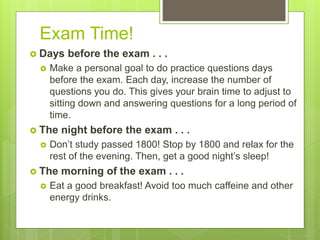
Exam Time!
 Days before the exam . . .
 Make a personal goal to do practice questions days
before the exam. Each day, increase the number of
questions you do. This gives your brain time to adjust to
sitting down and answering questions for a long period of
time.
 The night before the exam . . .
 Don’t study passed 1800! Stop by 1800 and relax for the
rest of the evening. Then, get a good night’s sleep!
 The morning of the exam . . .
 Eat a good breakfast! Avoid too much caffeine and other
energy drinks.
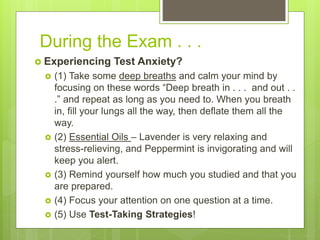
During the Exam . . .
 Experiencing Test Anxiety?
 (1) Take some deep breaths and calm your mind by
focusing on these words “Deep breath in . . . and out . .
.” and repeat as long as you need to. When you breath
in, fill your lungs all the way, then deflate them all the
way.
 (2) Essential Oils – Lavender is very relaxing and
stress-relieving, and Peppermint is invigorating and will
keep you alert.
 (3) Remind yourself how much you studied and that you
are prepared.
 (4) Focus your attention on one question at a time.
 (5) Use Test-Taking Strategies!
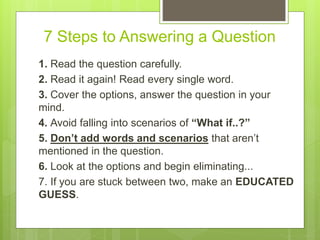
7 Steps to Answering a Question
1. Read the question carefully.
2. Read it again! Read every single word.
3. Cover the options, answer the question in your
mind.
4. Avoid falling into scenarios of “What if..?”
5. Don’t add words and scenarios that aren’t
mentioned in the question.
6. Look at the options and begin eliminating...
7. If you are stuck between two, make an EDUCATED
GUESS.
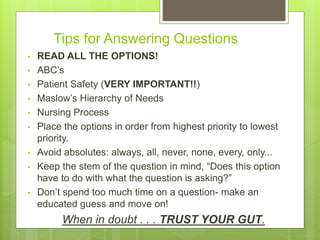
Tips for Answering Questions
• READ ALL THE OPTIONS!
• ABC’s
• Patient Safety (VERY IMPORTANT!!)
• Maslow’s Hierarchy of Needs
• Nursing Process
• Place the options in order from highest priority to lowest
priority.
• Avoid absolutes: always, all, never, none, every, only...
• Keep the stem of the question in mind, “Does this option
have to do with what the question is asking?”
• Don’t spend too much time on a question- make an
educated guess and move on!
When in doubt . . . TRUST YOUR GUT.
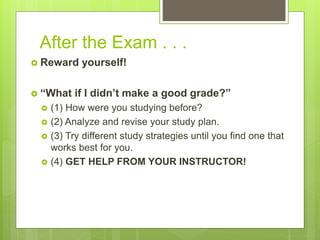
After the Exam . . .
 Reward yourself!
 “What if I didn’t make a good grade?”
 (1) How were you studying before?
 (2) Analyze and revise your study plan.
 (3) Try different study strategies until you find one that
works best for you.
 (4) GET HELP FROM YOUR INSTRUCTOR!
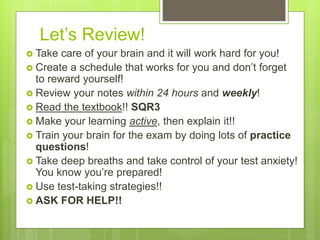
Let’s Review!
 Take care of your brain and it will work hard for you!
 Create a schedule that works for you and don’t forget
to reward yourself!
 Review your notes within 24 hours and weekly!
 Read the textbook!! SQR3
 Make your learning active, then explain it!!
 Train your brain for the exam by doing lots of practice
questions!
 Take deep breaths and take control of your test anxiety!
You know you’re prepared!
 Use test-taking strategies!!
 ASK FOR HELP!!
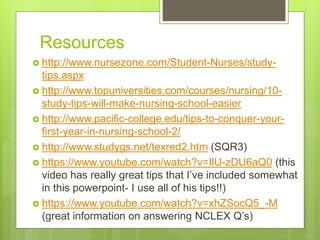
Resources
 http://www.nursezone.com/Student-Nurses/study-
tips.aspx
 http://www.topuniversities.com/courses/nursing/10-
study-tips-will-make-nursing-school-easier
 http://www.pacific-college.edu/tips-to-conquer-your-
first-year-in-nursing-school-2/
 http://www.studygs.net/texred2.htm (SQR3)
 https://www.youtube.com/watch?v=IlU-zDU6aQ0 (this
video has really great tips that I’ve included somewhat
in this powerpoint- I use all of his tips!!)
 https://www.youtube.com/watch?v=xhZSocQ5_-M
(great information on answering NCLEX Q’s)
Thank you and Good luck!! (:

StudyTips_Strategies

  • 1.
  • 2.
    Take Care ofYour Brain  Exercise.  30-45 minutes of moderate exercise at least 3-4 times per week.  Eat good foods.  Whole foods- vegetables, fruits, fatty fish, walnuts, almonds, lean meats, etc.  Drink plenty of water.  Carry a water bottle with you so you remember to stay hydrated.  Get plenty of sleep.  ~8 hours/ night.
  • 3.
    Creating a Schedule Spring2016 Time Monday Tuesday Wednesday Thursday Friday Saturday Sunday 5:00am 5:30am 6:00am 6:30am 7:00am 7:30am 8:00am 8:30am 9:00am 9:30am 10:00am 10:30am 11:00am 11:30am 12:00pm 12:30pm 1:00pm 1:30pm 2:00pm 2:30pm 3:00pm 3:30pm 4:00pm 4:30pm 5:00pm 5:30pm 6:00pm 6:30pm 7:00pm 7:30pm 8:00pm 8:30pm 9:00pm 9:30pm 10:00pm 10:30pm 11:00pm  Use the document on the right to create an hour-by- hour detailed schedule.  Input work and other obligations to find “pockets of time” for you to study.  Utilize all of your free time! Even if you’re standing in line somewhere you could have some flashcards in your pocket!  Don’t forget to reward yourself at the end of a long day!
  • 4.
    Creating a Schedulecont’d . . .  Be flexible.  If your schedule doesn’t go according to plan, rewrite it and adjust it until it works for you and your life. You might find that making a new one each week helps you to plan your week ahead of time, keeping you in control of your time and how it’s spent.  Be specific.  When you block off study times don’t just write “Study Time”- be specific! You will utilize your time more efficiently if you plan ahead what you’re going to study and when.
  • 5.
    How to Study Study in chunks of time.  30-45 minutes, then take a 5 minute break; repeat.  Know what you’re going to study.  Plan what you’re going to study and when you’re going to study it.  Create a study environment.  Your brain has queues for certain environments: kitchen = food, living room = entertainment, bedroom = sleep; create a space your brain can associate with studying.  Review your notes.  Review notes 24 hours after taking them, and weekly.
  • 6.
    While you’re studying... Read the textbook – SQR3  Survey, Question, Read, Recite, and Review.  Flip through the chapter and do a survey- look at images, headings, titles, bolded words, italicized words, and the summary.  Ask yourself questions about what you’re seeing.  Read the chapter and highlight the most important parts. The purpose of reading is to find the most important content, don’t spend too much time on the parts you have already mastered.  Recite what you have learned after reading it.  Review what you have learned within the next 24 hours.
  • 7.
    While you’re studying,cont’d...  Make your learning active.  Learning facts . . .  Utilize mnemonics- find some with a simple Google search!  Learning concepts . . .  Explain it in your own words and you know it!  Don’t be afraid to experiment!  Time of day to study? Location to study?  Drawing pictures and using colors?  Using flashcards or sticky notes?  It will take time to find what works best for your brain but it will be worth it when you discover it!
  • 8.
    Lecture Tips  Readthe assigned material before class.  Create a study schedule so you are always one week ahead.  Take handwritten notes.  Immediately review your notes after class and expand on them.  Look over your notes immediately after lecture, while the information is still fresh in your mind, and expand on your notes. Review your notes again in the next 24 hours.
  • 9.
    Exam Time!  Daysbefore the exam . . .  Make a personal goal to do practice questions days before the exam. Each day, increase the number of questions you do. This gives your brain time to adjust to sitting down and answering questions for a long period of time.  The night before the exam . . .  Don’t study passed 1800! Stop by 1800 and relax for the rest of the evening. Then, get a good night’s sleep!  The morning of the exam . . .  Eat a good breakfast! Avoid too much caffeine and other energy drinks.
  • 10.
    During the Exam. . .  Experiencing Test Anxiety?  (1) Take some deep breaths and calm your mind by focusing on these words “Deep breath in . . . and out . . .” and repeat as long as you need to. When you breath in, fill your lungs all the way, then deflate them all the way.  (2) Essential Oils – Lavender is very relaxing and stress-relieving, and Peppermint is invigorating and will keep you alert.  (3) Remind yourself how much you studied and that you are prepared.  (4) Focus your attention on one question at a time.  (5) Use Test-Taking Strategies!
  • 11.
    7 Steps toAnswering a Question 1. Read the question carefully. 2. Read it again! Read every single word. 3. Cover the options, answer the question in your mind. 4. Avoid falling into scenarios of “What if..?” 5. Don’t add words and scenarios that aren’t mentioned in the question. 6. Look at the options and begin eliminating... 7. If you are stuck between two, make an EDUCATED GUESS.
  • 12.
    Tips for AnsweringQuestions • READ ALL THE OPTIONS! • ABC’s • Patient Safety (VERY IMPORTANT!!) • Maslow’s Hierarchy of Needs • Nursing Process • Place the options in order from highest priority to lowest priority. • Avoid absolutes: always, all, never, none, every, only... • Keep the stem of the question in mind, “Does this option have to do with what the question is asking?” • Don’t spend too much time on a question- make an educated guess and move on! When in doubt . . . TRUST YOUR GUT.
  • 13.
    After the Exam. . .  Reward yourself!  “What if I didn’t make a good grade?”  (1) How were you studying before?  (2) Analyze and revise your study plan.  (3) Try different study strategies until you find one that works best for you.  (4) GET HELP FROM YOUR INSTRUCTOR!
  • 14.
    Let’s Review!  Takecare of your brain and it will work hard for you!  Create a schedule that works for you and don’t forget to reward yourself!  Review your notes within 24 hours and weekly!  Read the textbook!! SQR3  Make your learning active, then explain it!!  Train your brain for the exam by doing lots of practice questions!  Take deep breaths and take control of your test anxiety! You know you’re prepared!  Use test-taking strategies!!  ASK FOR HELP!!
  • 15.
    Resources  http://www.nursezone.com/Student-Nurses/study- tips.aspx  http://www.topuniversities.com/courses/nursing/10- study-tips-will-make-nursing-school-easier http://www.pacific-college.edu/tips-to-conquer-your- first-year-in-nursing-school-2/  http://www.studygs.net/texred2.htm (SQR3)  https://www.youtube.com/watch?v=IlU-zDU6aQ0 (this video has really great tips that I’ve included somewhat in this powerpoint- I use all of his tips!!)  https://www.youtube.com/watch?v=xhZSocQ5_-M (great information on answering NCLEX Q’s)
  • 16.
    Thank you andGood luck!! (: