Examen – Law 120
Allen Steeves
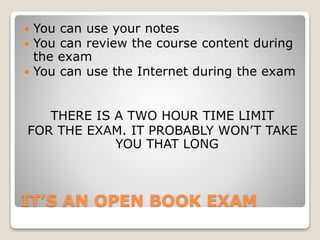
IT’S AN OPEN BOOK EXAM
 You can use your notes
 You can review the course content during
the exam
 You can use the Internet during the exam
THERE IS A TWO HOUR TIME LIMIT
FOR THE EXAM. IT PROBABLY WON’T TAKE
YOU THAT LONG
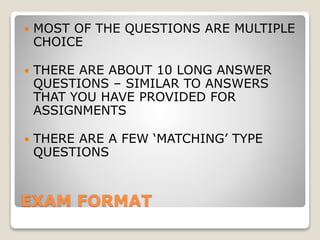
EXAM FORMAT
 MOST OF THE QUESTIONS ARE MULTIPLE
CHOICE
 THERE ARE ABOUT 10 LONG ANSWER
QUESTIONS – SIMILAR TO ANSWERS
THAT YOU HAVE PROVIDED FOR
ASSIGNMENTS
 THERE ARE A FEW ‘MATCHING’ TYPE
QUESTIONS
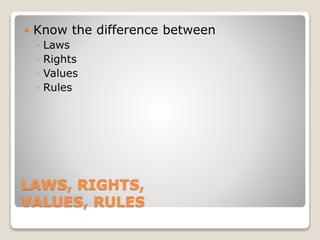
LAWS, RIGHTS,
VALUES, RULES
 Know the difference between
◦ Laws
◦ Rights
◦ Values
◦ Rules
LAWS, RIGHTS,
VALUES, RULES
 RELIGION (VALUES)
 NO TALKING IN THE HALLWAY (RULE)
 QUALITY WE GET FROM OUR FAMILY, FROM
SCHOOL, FROM RELIGION (VALUES)
 YOU MUST OBEY THE SPEED LIMIT (LAW)
 PEOPLE OF ALL RACES, RELIGIONS, ETC MAY
VOTE IN CANADA (RIGHTS)
 CELLPHONES NOT PERMITTED IN CLASS (RULE)
 CDN CITIZENS ARE FREE TO TRAVEL ANYWHERE
IN CANADA (RIGHT)
 MOST SPORTS HAVE GUIDELINES TO ENSURE
THAT THINGS RUN SMOOTHLY (RULES)
LEGAL TRADITIONS
 ABORIGINAL LAW
 OMMON LAW
 CHARTER OF RIGHTS AND FREEDOMS
 CONSTITUTION
 CIVIL LAW
LEGAL TRADITIONS
 KNOW WHERE THE LEGAL TRADITIONS
COME FROM AND WHAT THEY MEAN
◦ The Constitution is the supreme law of the land
◦ Le Common Law tire ses origines de la
conquête Normande du Moyen Âge (1066)
◦ La Loi Civile est basé sur les lois romaines et
les coutumes françaises
LAWS IN CANADA TODAY
 The English Law is the foundation of the
Canadian legal system, with the exception
of the law of Quebec.
 So, Canadian law is base on the laws of
France and England.
 French law was codified in extensive legal
texts and is referred to as “civil law”.
 English law was not codified until much
later in history and was known as
“Common Law”
COMMON LAW
 In 1066, William the Conqueror defeated King Harold at the
battle of Hastings, and was in control of England. His
grandson, Henry II, tried to bring consistency and fairness to
the law.
 Judges (called circuit judges) traveled to villages to hear cases
and began to record the cases and their decisions. (these
traveling courts were called assizes)This helped to establish a
common method of dealing with similar legal cases, which
became known as “common law”, that is, that it was
common to everyone. (aka. Case law)
 As these written reports became available, judges would
follow the precedent or example in deciding a case before
them. This practice led to a principle known as “stare
decisis” which means to “stand by the decision.”
 This led to the “rule of precedent”, applying a previous
decision to a case that has similar circumstances.
COMMON LAW
Common Law can be traced to ancient, unwritten laws
in England.
 It was common to all and has a general application.
 Is also called CASE LAW because its sources include
the decisions made by judges in previous cases.
 Constantly evolves as judges decide new cases.
 Canadian courts still rely on STARE DECISIS (relying
on previous decisions / cases).
 When there is new information (like new technology,
or new morals), judges can reject previous decisions
and create a new precedent. This is called
DISTINGUISHING A CASE.
STATUTE LAW
• Laws that are passed by elected representatives in the
form of acts.
• Acts become the law when they pass through a formal
procedure in Parliament or provincial legislatures.
• Many of our laws today are statutes – common law
decisions that have been codified.
• Statutes override previous common law. When no statute
exists to deal with a situation, the common law will prevail.
• Statutes and common law co-exist in Canada. When a
judge interprets and applies a statute, that decision sets a
precedent and. From that point on, similar cases must be
interpreted in the same way by all lower courts.
STATUTE LAW - MUNICIPALITIES
• Municipal or local governments make laws called
BYLAWS, which are regulations that deal with local
issues, such as how high the backyard fence should
be, who should clear the snow from the sidewalk, or
how often the garbage should be collected.
• Research the bylaws in your community: Is there a
noise bylaw? Could you keep chickens in your
backyard? Can you have an open fire pit? Can you
use pesticides on your lawn in your community? Is
there a curfew in your community? Is there a bylaw
for dangerous or unsightly properties? Is there a
bylaw for recycling / garbage collection?
COMMON LAW AND STATUTE LAW
 Common law was judged in the courts
with judges trying cases. Common law is
frequently referred to as “case law”.
 It was combined with the Law of Equity,
where each case must be judged on its
merits.
 Eventually, many of these decisions were
codified and referred to as statute laws.
 Thus, the 2 main categories of law for all
of Canada, except Quebec, are common
law (law of equity) and statute law.
CONSTITUTIONAL LAW
 The Canadian Constitution is a document that
determines the structure of the federal
government and divides law-making powers
between the federal and provincial governments.
 Constitutional Law limits the powers of
government by setting out certain basic laws,
principles and standards that all other law must
adhere to. It overrides all other law.
 If a law is found to be in violation with the
constitution, it is struck down by the courts as
“unconstitutional”.
LEGAL TRADITIONS
 Know that if the Municipal, Provincial or
Federal Government wants to pass a new
law, it cannot go against:
◦ The Constitution
◦ The Charter of Rights and Freedoms
TYPES OF LAWS
 Know the difference between the types of
laws
◦ Criminal
◦ Succession
◦ International
◦ Administrative
◦ Tort
◦ Contract
◦ Property
◦ Family
◦ Private/Civil
◦ Constitutional
◦ Domestic
RULE OF LAW
 Know what ‘Rule of Law’ means
◦ Politicians, police officers, judges, etc must
follow the same laws as everybody else –
nobody is above the law
 Make sure that you really read up on this
– even if it’s an open book exam
COURTS
 Make sure that you are knowledgeable about
the various courts that exist in New
Brunswick.. And Federally as well
◦ Court of Queen’s Bench (Trials)
◦ Court of Queen’s Bench (Family)
◦ Military Court (Court Martial)
◦ Youth Court
◦ NB Court of Appeals
◦ Provincial Court
◦ Supreme Court of Canada
◦ Small Claims Court
CHARTER OU
NB HUMAN RIGHTS ACT?
 A NB citizen refuses to sell his/her house
to a person of a different race
 Canadian citizens can move anywhere
within the country
 The police cannot search you or your
house without a justifiable reason
 You have the right to vote (18 and up)
CHARTER OU
NB HUMAN RIGHTS ACT?
 A federal election must be held at least
every five years
 Your employer cannot pay you, a female,
less money than a male doing the same
work (with same experience,
qualifications, etc)
 Federal services must be offered in both
official languages
CHARTER OU
NB HUMAN RIGHTS ACT?
 You are stopped by the RCMP in a
francophone community. You have a right
to be served in either English or French
 A flower shop refuses to sell flowers to
people who are organizing a same-sex
marriage ceremony
 You have a right to not be harrassed at
your place of work
CRIMINAL LAW VS CIVIL LAW
 Know the difference between Criminal Law
and Civil Law
◦ Check out the assignment that you did that
had a comparison table …
CIVIL DEFENCES
 Be familiar with civil law defences. Examples:
◦ Contributory negligences
◦ Use the facilities at your own risk
◦ The accident was not avoidable
◦ Natural disaster
 Review your assignments from Unit 3
◦ Read the case studies from the unit, such as
 A military base was established in Gagetown… a new
resident to the area claims that his hearing was
damaged by the bombing exercises
◦ In this case, he knew that he was moving near a base, and
thus his claim is unsubstantiated as he assumed the risk.
REMEDIES FOR DAMAGES
 Pecuniary damages
 Non-pecuniary damages
 Aggravated damages
 Punitive damages
 Nominal damages
 Specific performance damages

Exam review law120 (2015)

  • 1.
    Examen – Law120 Allen Steeves
  • 2.
    IT’S AN OPENBOOK EXAM  You can use your notes  You can review the course content during the exam  You can use the Internet during the exam THERE IS A TWO HOUR TIME LIMIT FOR THE EXAM. IT PROBABLY WON’T TAKE YOU THAT LONG
  • 3.
    EXAM FORMAT  MOSTOF THE QUESTIONS ARE MULTIPLE CHOICE  THERE ARE ABOUT 10 LONG ANSWER QUESTIONS – SIMILAR TO ANSWERS THAT YOU HAVE PROVIDED FOR ASSIGNMENTS  THERE ARE A FEW ‘MATCHING’ TYPE QUESTIONS
  • 4.
    LAWS, RIGHTS, VALUES, RULES Know the difference between ◦ Laws ◦ Rights ◦ Values ◦ Rules
  • 5.
    LAWS, RIGHTS, VALUES, RULES RELIGION (VALUES)  NO TALKING IN THE HALLWAY (RULE)  QUALITY WE GET FROM OUR FAMILY, FROM SCHOOL, FROM RELIGION (VALUES)  YOU MUST OBEY THE SPEED LIMIT (LAW)  PEOPLE OF ALL RACES, RELIGIONS, ETC MAY VOTE IN CANADA (RIGHTS)  CELLPHONES NOT PERMITTED IN CLASS (RULE)  CDN CITIZENS ARE FREE TO TRAVEL ANYWHERE IN CANADA (RIGHT)  MOST SPORTS HAVE GUIDELINES TO ENSURE THAT THINGS RUN SMOOTHLY (RULES)
  • 6.
    LEGAL TRADITIONS  ABORIGINALLAW  OMMON LAW  CHARTER OF RIGHTS AND FREEDOMS  CONSTITUTION  CIVIL LAW
  • 7.
    LEGAL TRADITIONS  KNOWWHERE THE LEGAL TRADITIONS COME FROM AND WHAT THEY MEAN ◦ The Constitution is the supreme law of the land ◦ Le Common Law tire ses origines de la conquête Normande du Moyen Âge (1066) ◦ La Loi Civile est basé sur les lois romaines et les coutumes françaises
  • 8.
    LAWS IN CANADATODAY  The English Law is the foundation of the Canadian legal system, with the exception of the law of Quebec.  So, Canadian law is base on the laws of France and England.  French law was codified in extensive legal texts and is referred to as “civil law”.  English law was not codified until much later in history and was known as “Common Law”
  • 9.
    COMMON LAW  In1066, William the Conqueror defeated King Harold at the battle of Hastings, and was in control of England. His grandson, Henry II, tried to bring consistency and fairness to the law.  Judges (called circuit judges) traveled to villages to hear cases and began to record the cases and their decisions. (these traveling courts were called assizes)This helped to establish a common method of dealing with similar legal cases, which became known as “common law”, that is, that it was common to everyone. (aka. Case law)  As these written reports became available, judges would follow the precedent or example in deciding a case before them. This practice led to a principle known as “stare decisis” which means to “stand by the decision.”  This led to the “rule of precedent”, applying a previous decision to a case that has similar circumstances.
  • 10.
    COMMON LAW Common Lawcan be traced to ancient, unwritten laws in England.  It was common to all and has a general application.  Is also called CASE LAW because its sources include the decisions made by judges in previous cases.  Constantly evolves as judges decide new cases.  Canadian courts still rely on STARE DECISIS (relying on previous decisions / cases).  When there is new information (like new technology, or new morals), judges can reject previous decisions and create a new precedent. This is called DISTINGUISHING A CASE.
  • 11.
    STATUTE LAW • Lawsthat are passed by elected representatives in the form of acts. • Acts become the law when they pass through a formal procedure in Parliament or provincial legislatures. • Many of our laws today are statutes – common law decisions that have been codified. • Statutes override previous common law. When no statute exists to deal with a situation, the common law will prevail. • Statutes and common law co-exist in Canada. When a judge interprets and applies a statute, that decision sets a precedent and. From that point on, similar cases must be interpreted in the same way by all lower courts.
  • 12.
    STATUTE LAW -MUNICIPALITIES • Municipal or local governments make laws called BYLAWS, which are regulations that deal with local issues, such as how high the backyard fence should be, who should clear the snow from the sidewalk, or how often the garbage should be collected. • Research the bylaws in your community: Is there a noise bylaw? Could you keep chickens in your backyard? Can you have an open fire pit? Can you use pesticides on your lawn in your community? Is there a curfew in your community? Is there a bylaw for dangerous or unsightly properties? Is there a bylaw for recycling / garbage collection?
  • 13.
    COMMON LAW ANDSTATUTE LAW  Common law was judged in the courts with judges trying cases. Common law is frequently referred to as “case law”.  It was combined with the Law of Equity, where each case must be judged on its merits.  Eventually, many of these decisions were codified and referred to as statute laws.  Thus, the 2 main categories of law for all of Canada, except Quebec, are common law (law of equity) and statute law.
  • 14.
    CONSTITUTIONAL LAW  TheCanadian Constitution is a document that determines the structure of the federal government and divides law-making powers between the federal and provincial governments.  Constitutional Law limits the powers of government by setting out certain basic laws, principles and standards that all other law must adhere to. It overrides all other law.  If a law is found to be in violation with the constitution, it is struck down by the courts as “unconstitutional”.
  • 15.
    LEGAL TRADITIONS  Knowthat if the Municipal, Provincial or Federal Government wants to pass a new law, it cannot go against: ◦ The Constitution ◦ The Charter of Rights and Freedoms
  • 16.
    TYPES OF LAWS Know the difference between the types of laws ◦ Criminal ◦ Succession ◦ International ◦ Administrative ◦ Tort ◦ Contract ◦ Property ◦ Family ◦ Private/Civil ◦ Constitutional ◦ Domestic
  • 17.
    RULE OF LAW Know what ‘Rule of Law’ means ◦ Politicians, police officers, judges, etc must follow the same laws as everybody else – nobody is above the law  Make sure that you really read up on this – even if it’s an open book exam
  • 18.
    COURTS  Make surethat you are knowledgeable about the various courts that exist in New Brunswick.. And Federally as well ◦ Court of Queen’s Bench (Trials) ◦ Court of Queen’s Bench (Family) ◦ Military Court (Court Martial) ◦ Youth Court ◦ NB Court of Appeals ◦ Provincial Court ◦ Supreme Court of Canada ◦ Small Claims Court
  • 19.
    CHARTER OU NB HUMANRIGHTS ACT?  A NB citizen refuses to sell his/her house to a person of a different race  Canadian citizens can move anywhere within the country  The police cannot search you or your house without a justifiable reason  You have the right to vote (18 and up)
  • 20.
    CHARTER OU NB HUMANRIGHTS ACT?  A federal election must be held at least every five years  Your employer cannot pay you, a female, less money than a male doing the same work (with same experience, qualifications, etc)  Federal services must be offered in both official languages
  • 21.
    CHARTER OU NB HUMANRIGHTS ACT?  You are stopped by the RCMP in a francophone community. You have a right to be served in either English or French  A flower shop refuses to sell flowers to people who are organizing a same-sex marriage ceremony  You have a right to not be harrassed at your place of work
  • 22.
    CRIMINAL LAW VSCIVIL LAW  Know the difference between Criminal Law and Civil Law ◦ Check out the assignment that you did that had a comparison table …
  • 23.
    CIVIL DEFENCES  Befamiliar with civil law defences. Examples: ◦ Contributory negligences ◦ Use the facilities at your own risk ◦ The accident was not avoidable ◦ Natural disaster  Review your assignments from Unit 3 ◦ Read the case studies from the unit, such as  A military base was established in Gagetown… a new resident to the area claims that his hearing was damaged by the bombing exercises ◦ In this case, he knew that he was moving near a base, and thus his claim is unsubstantiated as he assumed the risk.
  • 24.
    REMEDIES FOR DAMAGES Pecuniary damages  Non-pecuniary damages  Aggravated damages  Punitive damages  Nominal damages  Specific performance damages