CHAPTER 3 Traditional and Online Dispute Resolution
What is judicial review? How and when was the power of judicial review established? Before a court can hear a case, it must have jurisdiction.  Over what must it have jurisdiction? How are the courts applying traditional jurisdictional concepts to cases involving Internet transactions? What is the difference between a trial court and an appellate court? In a lawsuit, what are pleadings?  What is discovery, and how does electronic discovery differ? How are online forums being used to resolve disputes?  Learning Objectives
Judicial Review was established by the U.S. Supreme Court in  Marbury v. Madison  (1803) where Chief Justice Marshall wrote: “ It is emphatically the province and duty of the judiciary to say what the law is….”   The Judiciary’s Role in American Government
Basic Judicial Requirements Jurisdiction :  “Juris” (law) “diction” (to speak) is the power of a court to hear a dispute and to “speak the law” into a controversy and render a verdict that is legally binding on the parties to the dispute.
Jurisdiction Over Persons Power of a court to compel the presence of the parties (including corporations) to a dispute to appear before the court and litigate. Courts use long-arm statutes for non-resident parties based on “minimum contacts” with state. Cole v. Mileti  (1998).
Jurisdiction Over Property Also called “in rem” jurisdiction. Power to decide issues relating to property, whether the property is real, personal, tangible, or intangible.  A court generally has in rem jurisdiction over any property situated within its geographical borders.
Jurisdiction over Subject Matter This is a limitation on the types of cases a court can hear, usually determined by federal or state statutes. For example, bankruptcy, family or criminal cases. General (unlimited) jurisdiction. Limited jurisdiction.
Original and Appellate Jurisdiction Courts of original jurisdiction is where the case started (trial). Courts of appellate jurisdiction have the power to hear an appeal from another court.
Federal Court Jurisdiction “Federal Question” cases in which  the rights or obligations of a party are created or defined by some federal law. “Diversity” cases where: The parties are not from the same state, and The amount in controversy is greater than $75,000.
Exclusive vs.  Concurrent Jurisdiction Exclusive: only one court (state or federal) has the power (jurisdiction) to hear the case.  Concurrent: more than one court can hear the case.
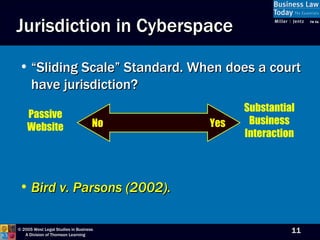
Jurisdiction in Cyberspace “Sliding Scale” Standard. When does a court have jurisdiction? Bird v. Parsons (2002). No   Yes Substantial Business Interaction Passive Website
Venue Venue is concerned with the most appropriate location for the trial. Generally, proper venue is whether the injury occurred.
Standing to Sue In order to bring a lawsuit, a party must have “standing” to sue. Standing is sufficient “stake” in the controversy; party must have suffered a legal injury.
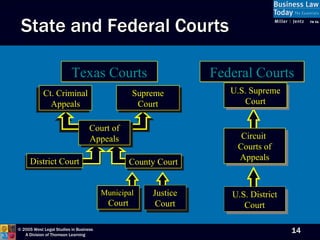
State and Federal Courts Ct. Criminal  Appeals Supreme Court Court of Appeals District Court County Court Municipal  Court Justice Court Texas Courts U.S. Supreme Court Circuit  Courts of Appeals U.S. District Court Federal Courts
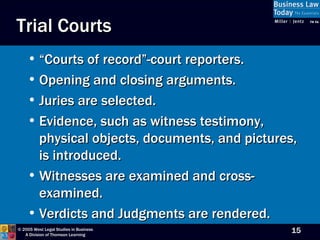
“Courts of record”-court reporters. Opening and closing arguments. Juries are selected. Evidence, such as witness testimony, physical objects, documents, and pictures, is introduced. Witnesses are examined and cross-examined. Verdicts and Judgments are rendered. Trial Courts
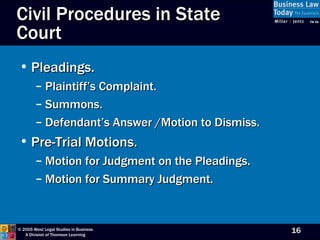
Civil Procedures in State Court Pleadings. Plaintiff’s Complaint. Summons. Defendant’s Answer /Motion to Dismiss. Pre-Trial Motions. Motion for Judgment on the Pleadings. Motion for Summary Judgment.
Civil Procedures in State Court Discovery. Depositions and Interrogatories. Requests for Documents. Requests for Admission. Pre-Trial Conference. Jury Selection (Voir Dire).
Civil Procedures in State Court Trial. Opening arguments. Plaintiff’s Case in Chief. Defense cross-examines Plaintiff’s witnesses. Defense Case in Chief. Plaintiff cross-examines Defense witnesses. Closing Arguments. Verdict  / Motion JNOV /Judgment. Appeal.
Appellate Courts Middle level of the court systems. Review proceedings conducted in the trial court to determine whether the trial was according to the procedural and substantive rules of law. Generally, appellate courts will consider questions of law, but not questions of fact.
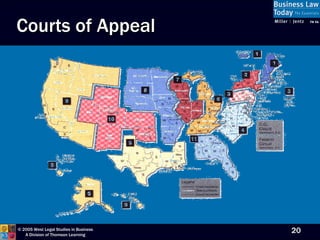
Courts of Appeal
Supreme Courts  Also known as courts of last resort. The two most fundamental ways to have your case heard in a supreme court are: Appeals of Right. By  Writ of Certiorari . See the  U.S.  Supreme  Court  and the  Texas Supreme Court .
Electronic Filing. Courts Online (websites, court dockets). Cyber Courts and Online Dispute Resolution (Michigan legislation). Online Dispute Resolution (ODR). Negotiation. Mediation. Arbitration (employment contracts). Phansalkar v. Anderson, Weinroth & Co. (2004). Courts Adapt to the Online World
Trials are a means of dispute resolution that are very expensive and sometimes take many months to resolve. There are “alternative dispute resolution” (ADR) methods to resolve disputes that are inexpensive, relatively quick and leave more control with the parties involved. Alternative Dispute Resolution
ADR ADR describes any procedure or device for resolving disputes other than the traditional judicial process.  Unless court-ordered, there is no record which is an important factor in commercial litigation due to trade secrets.  Most common:  negotiation ,  mediation ,  arbitration .
Negotiation Less than 10% of cases reach trial. Negotiation is informal discussion of the parties, sometimes without attorneys, where differences are aired with the goal of coming to a “meeting of the minds” in resolving the case. Successful negotiation involves thorough preparation, from a position of strength.
Assisted Negotiation Mini-Trial: Attorneys for each side informally present their case before a mutually agreed-upon neutral 3 rd  party ( e.g.,  a retired judge) who renders a non-binding “verdict.”  This facilitates further discussion and settlement. Expert evaluations. Conciliation: 3 rd  party assists in reconciling differences.
Mediation Involves a neutral 3 rd  party (mediator). Mediator talks face-to-face with parties (who typically are in different adjoining rooms) to determine “common ground.” Advantages: few rules, customize process, parties control results (win-win). Disadvantages: mediator fees, no sanctions or deadlines.
Arbitration Many employment contracts have binding arbitration clauses.  Settling of a dispute by a neutral 3 rd  party (arbitrator) who renders a legally-binding decision; usually an expert or well-respected government official.
Arbitration Disadvantages Results may be unpredictable because arbitrators do not have to follow precedent or rules of procedure or evidence. Arbitrators do not have to issue written opinions. Generally, no discovery available.
Arbitration Process Case begins with a  submission  to an arbitrator. Next comes the hearing where parties present evidence and arguments. Finally, the arbitrator renders an award. Courts are not involved in arbitration unless  an arbitration clause in a contract needs enforcement.
Providers of ADR Services Non-profit organizations: American Arbitration Association . Better Business Bureau . For Profit:  JAMS-ADR.com (Flash enabled).
Online Dispute Resolution Also called ODR. Uses the Internet to resolve disputes. Still in its infancy but is gaining momentum. See,  e.g.,   www.cybersettle.com  .

Chapter 3

  • 1.
    CHAPTER 3 Traditionaland Online Dispute Resolution
  • 2.
    What is judicialreview? How and when was the power of judicial review established? Before a court can hear a case, it must have jurisdiction. Over what must it have jurisdiction? How are the courts applying traditional jurisdictional concepts to cases involving Internet transactions? What is the difference between a trial court and an appellate court? In a lawsuit, what are pleadings? What is discovery, and how does electronic discovery differ? How are online forums being used to resolve disputes? Learning Objectives
  • 3.
    Judicial Review wasestablished by the U.S. Supreme Court in Marbury v. Madison (1803) where Chief Justice Marshall wrote: “ It is emphatically the province and duty of the judiciary to say what the law is….” The Judiciary’s Role in American Government
  • 4.
    Basic Judicial RequirementsJurisdiction : “Juris” (law) “diction” (to speak) is the power of a court to hear a dispute and to “speak the law” into a controversy and render a verdict that is legally binding on the parties to the dispute.
  • 5.
    Jurisdiction Over PersonsPower of a court to compel the presence of the parties (including corporations) to a dispute to appear before the court and litigate. Courts use long-arm statutes for non-resident parties based on “minimum contacts” with state. Cole v. Mileti (1998).
  • 6.
    Jurisdiction Over PropertyAlso called “in rem” jurisdiction. Power to decide issues relating to property, whether the property is real, personal, tangible, or intangible. A court generally has in rem jurisdiction over any property situated within its geographical borders.
  • 7.
    Jurisdiction over SubjectMatter This is a limitation on the types of cases a court can hear, usually determined by federal or state statutes. For example, bankruptcy, family or criminal cases. General (unlimited) jurisdiction. Limited jurisdiction.
  • 8.
    Original and AppellateJurisdiction Courts of original jurisdiction is where the case started (trial). Courts of appellate jurisdiction have the power to hear an appeal from another court.
  • 9.
    Federal Court Jurisdiction“Federal Question” cases in which the rights or obligations of a party are created or defined by some federal law. “Diversity” cases where: The parties are not from the same state, and The amount in controversy is greater than $75,000.
  • 10.
    Exclusive vs. Concurrent Jurisdiction Exclusive: only one court (state or federal) has the power (jurisdiction) to hear the case. Concurrent: more than one court can hear the case.
  • 11.
    Jurisdiction in Cyberspace“Sliding Scale” Standard. When does a court have jurisdiction? Bird v. Parsons (2002). No Yes Substantial Business Interaction Passive Website
  • 12.
    Venue Venue isconcerned with the most appropriate location for the trial. Generally, proper venue is whether the injury occurred.
  • 13.
    Standing to SueIn order to bring a lawsuit, a party must have “standing” to sue. Standing is sufficient “stake” in the controversy; party must have suffered a legal injury.
  • 14.
    State and FederalCourts Ct. Criminal Appeals Supreme Court Court of Appeals District Court County Court Municipal Court Justice Court Texas Courts U.S. Supreme Court Circuit Courts of Appeals U.S. District Court Federal Courts
  • 15.
    “Courts of record”-courtreporters. Opening and closing arguments. Juries are selected. Evidence, such as witness testimony, physical objects, documents, and pictures, is introduced. Witnesses are examined and cross-examined. Verdicts and Judgments are rendered. Trial Courts
  • 16.
    Civil Procedures inState Court Pleadings. Plaintiff’s Complaint. Summons. Defendant’s Answer /Motion to Dismiss. Pre-Trial Motions. Motion for Judgment on the Pleadings. Motion for Summary Judgment.
  • 17.
    Civil Procedures inState Court Discovery. Depositions and Interrogatories. Requests for Documents. Requests for Admission. Pre-Trial Conference. Jury Selection (Voir Dire).
  • 18.
    Civil Procedures inState Court Trial. Opening arguments. Plaintiff’s Case in Chief. Defense cross-examines Plaintiff’s witnesses. Defense Case in Chief. Plaintiff cross-examines Defense witnesses. Closing Arguments. Verdict / Motion JNOV /Judgment. Appeal.
  • 19.
    Appellate Courts Middlelevel of the court systems. Review proceedings conducted in the trial court to determine whether the trial was according to the procedural and substantive rules of law. Generally, appellate courts will consider questions of law, but not questions of fact.
  • 20.
  • 21.
    Supreme Courts Also known as courts of last resort. The two most fundamental ways to have your case heard in a supreme court are: Appeals of Right. By Writ of Certiorari . See the U.S. Supreme Court and the Texas Supreme Court .
  • 22.
    Electronic Filing. CourtsOnline (websites, court dockets). Cyber Courts and Online Dispute Resolution (Michigan legislation). Online Dispute Resolution (ODR). Negotiation. Mediation. Arbitration (employment contracts). Phansalkar v. Anderson, Weinroth & Co. (2004). Courts Adapt to the Online World
  • 23.
    Trials are ameans of dispute resolution that are very expensive and sometimes take many months to resolve. There are “alternative dispute resolution” (ADR) methods to resolve disputes that are inexpensive, relatively quick and leave more control with the parties involved. Alternative Dispute Resolution
  • 24.
    ADR ADR describesany procedure or device for resolving disputes other than the traditional judicial process. Unless court-ordered, there is no record which is an important factor in commercial litigation due to trade secrets. Most common: negotiation , mediation , arbitration .
  • 25.
    Negotiation Less than10% of cases reach trial. Negotiation is informal discussion of the parties, sometimes without attorneys, where differences are aired with the goal of coming to a “meeting of the minds” in resolving the case. Successful negotiation involves thorough preparation, from a position of strength.
  • 26.
    Assisted Negotiation Mini-Trial:Attorneys for each side informally present their case before a mutually agreed-upon neutral 3 rd party ( e.g., a retired judge) who renders a non-binding “verdict.” This facilitates further discussion and settlement. Expert evaluations. Conciliation: 3 rd party assists in reconciling differences.
  • 27.
    Mediation Involves aneutral 3 rd party (mediator). Mediator talks face-to-face with parties (who typically are in different adjoining rooms) to determine “common ground.” Advantages: few rules, customize process, parties control results (win-win). Disadvantages: mediator fees, no sanctions or deadlines.
  • 28.
    Arbitration Many employmentcontracts have binding arbitration clauses. Settling of a dispute by a neutral 3 rd party (arbitrator) who renders a legally-binding decision; usually an expert or well-respected government official.
  • 29.
    Arbitration Disadvantages Resultsmay be unpredictable because arbitrators do not have to follow precedent or rules of procedure or evidence. Arbitrators do not have to issue written opinions. Generally, no discovery available.
  • 30.
    Arbitration Process Casebegins with a submission to an arbitrator. Next comes the hearing where parties present evidence and arguments. Finally, the arbitrator renders an award. Courts are not involved in arbitration unless an arbitration clause in a contract needs enforcement.
  • 31.
    Providers of ADRServices Non-profit organizations: American Arbitration Association . Better Business Bureau . For Profit: JAMS-ADR.com (Flash enabled).
  • 32.
    Online Dispute ResolutionAlso called ODR. Uses the Internet to resolve disputes. Still in its infancy but is gaining momentum. See, e.g., www.cybersettle.com .