Generally - Thelaw is a system of rules that a society or government
develops in order to deal with crime, business agreements, and
social relationships.
WHAT IS LAW ?
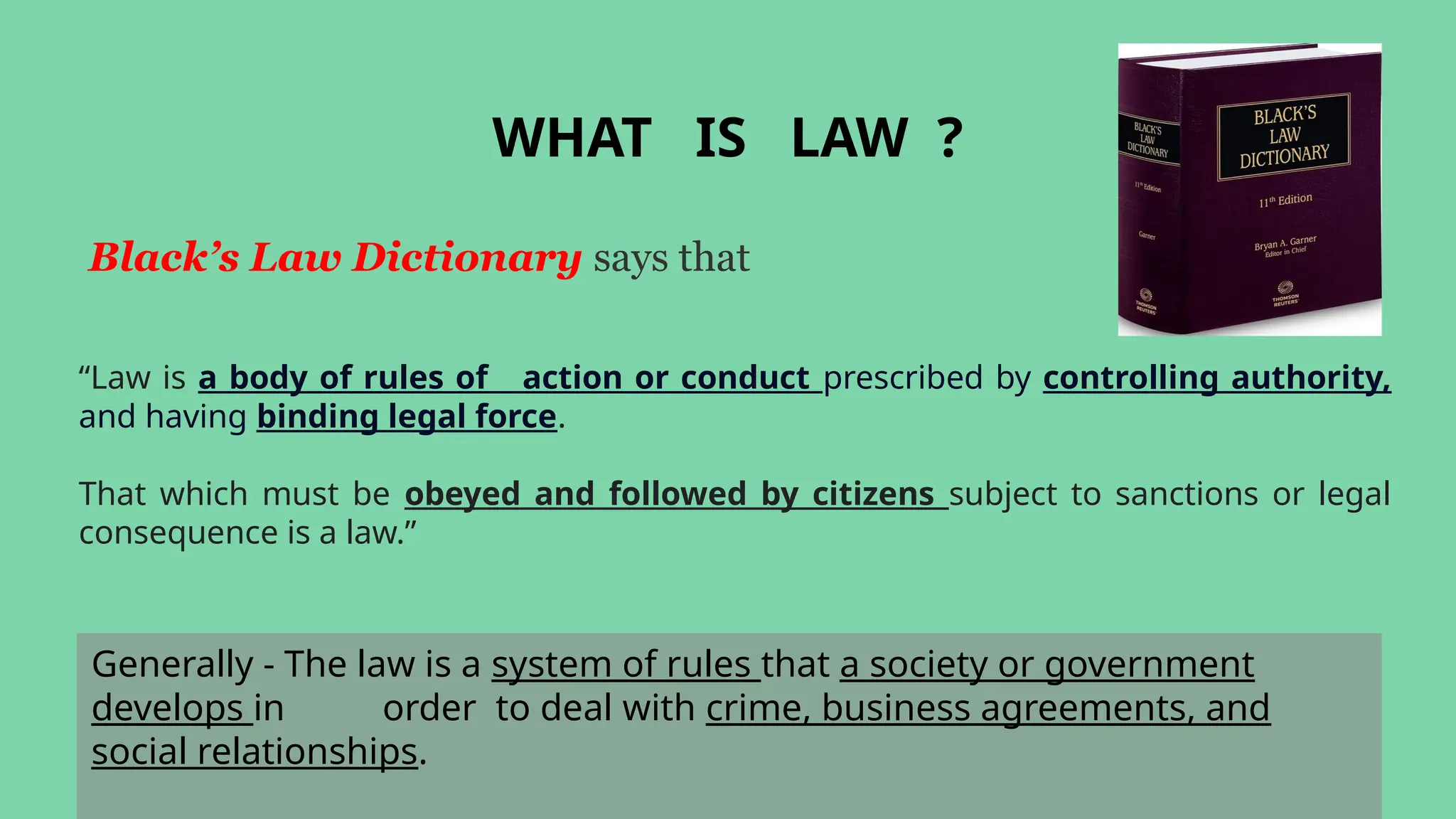
Black’s Law Dictionary says that
“Law is a body of rules of action or conduct prescribed by controlling authority,
and having binding legal force.
That which must be obeyed and followed by citizens subject to sanctions or legal
consequence is a law.”
4.
● Law isa body of official rules and regulations generally found in constitutions,
legislations, judicial opinions used for the governance and control of the state
and the behavior of its inhabitants.
● Law is made by a legislature and a body created for the purpose, and is
reinforced by the imposition of penalties and remedies
WHAT IS LAW
5.
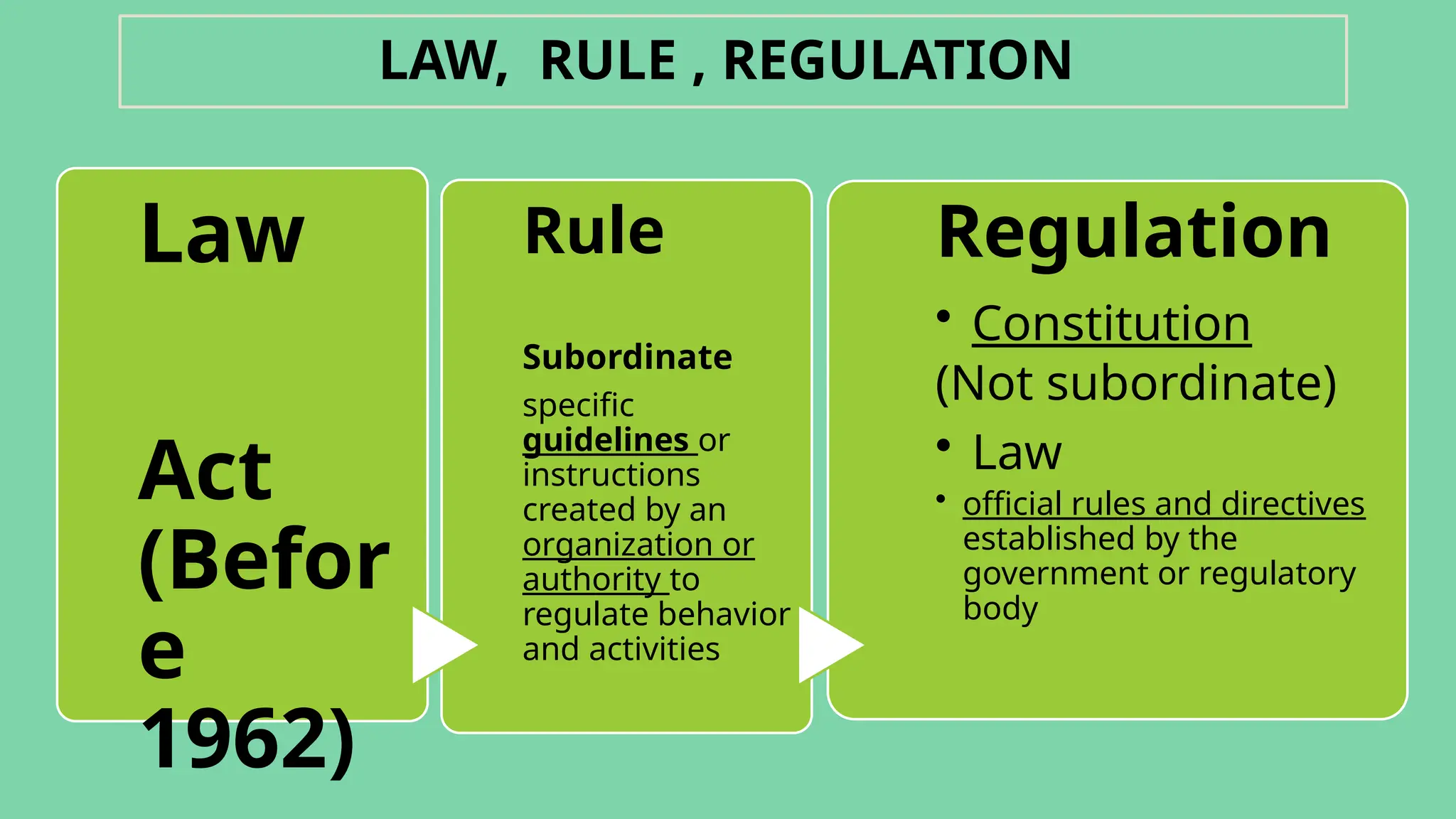
LAW, RULE ,REGULATION
Law
Act
(Befor
e
1962)
Rule
Subordinate
specific
guidelines or
instructions
created by an
organization or
authority to
regulate behavior
and activities
Regulation
• Constitution
(Not subordinate)
• Law
• official rules and directives
established by the
government or regulatory
body
6.
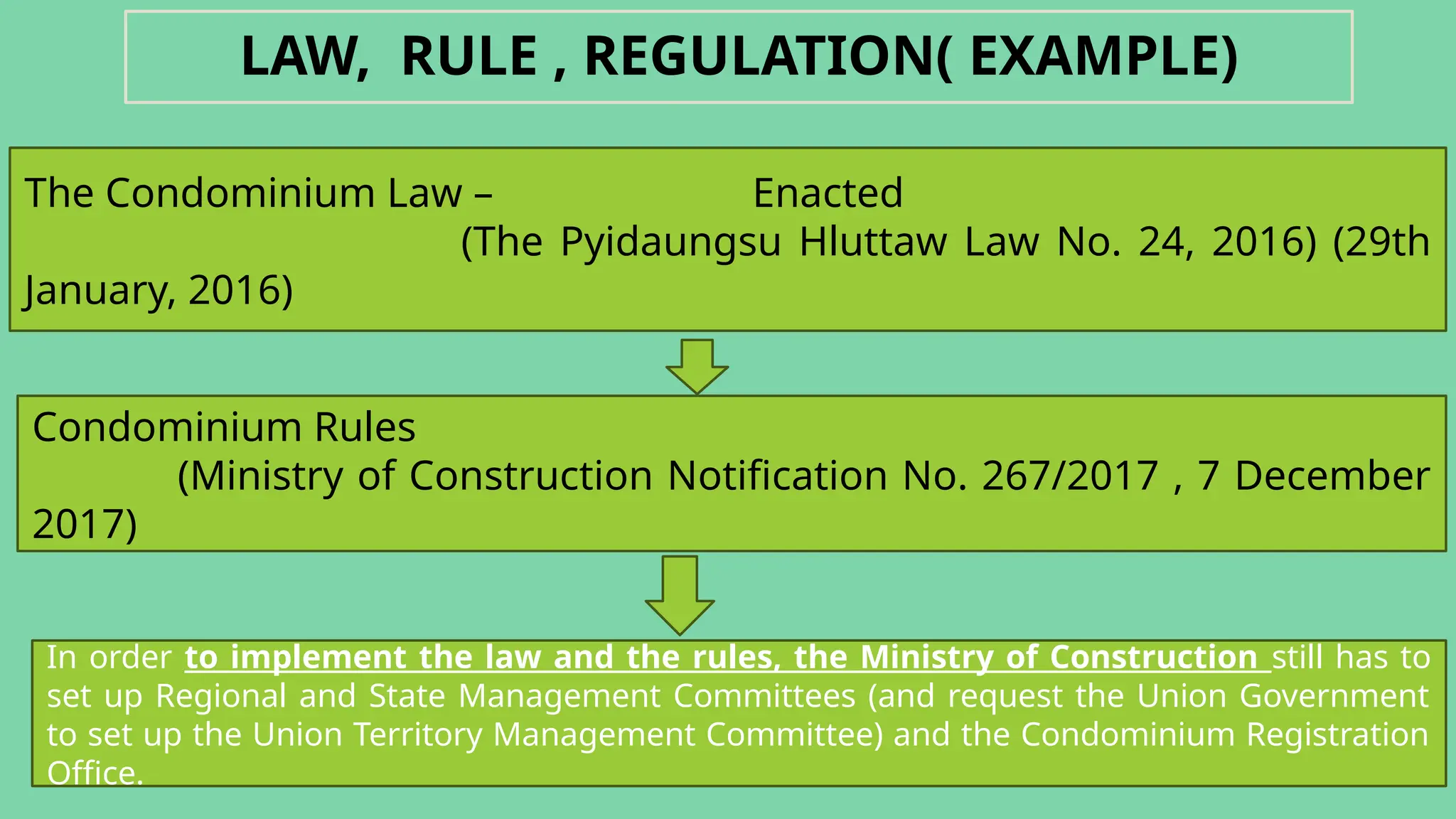
LAW, RULE ,REGULATION( EXAMPLE)
The Condominium Law – Enacted
(The Pyidaungsu Hluttaw Law No. 24, 2016) (29th
January, 2016)
Condominium Rules
(Ministry of Construction Notification No. 267/2017 , 7 December
2017)
In order to implement the law and the rules, the Ministry of Construction still has to
set up Regional and State Management Committees (and request the Union Government
to set up the Union Territory Management Committee) and the Condominium Registration
Office.
7.
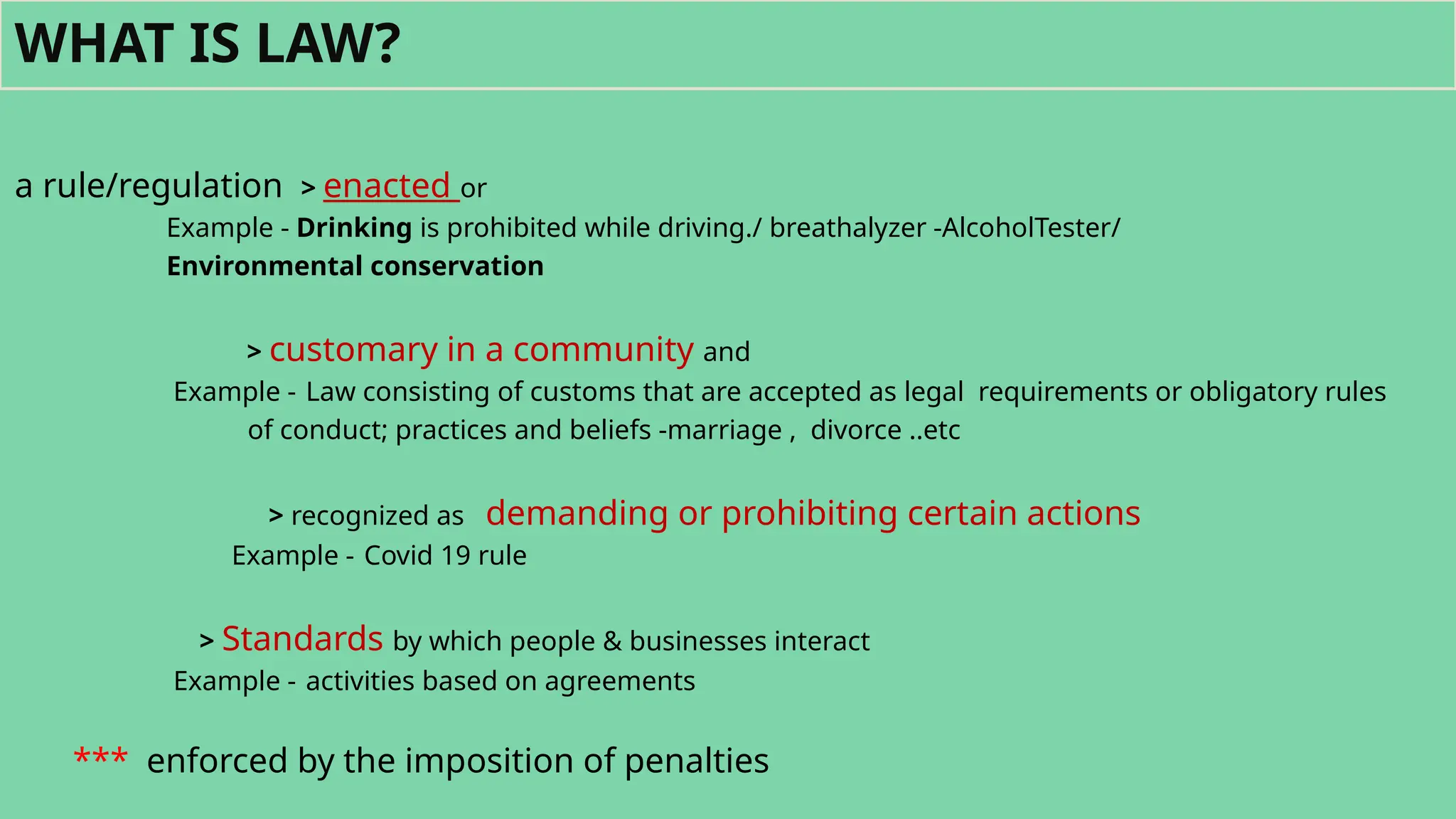
a rule/regulation >enacted or
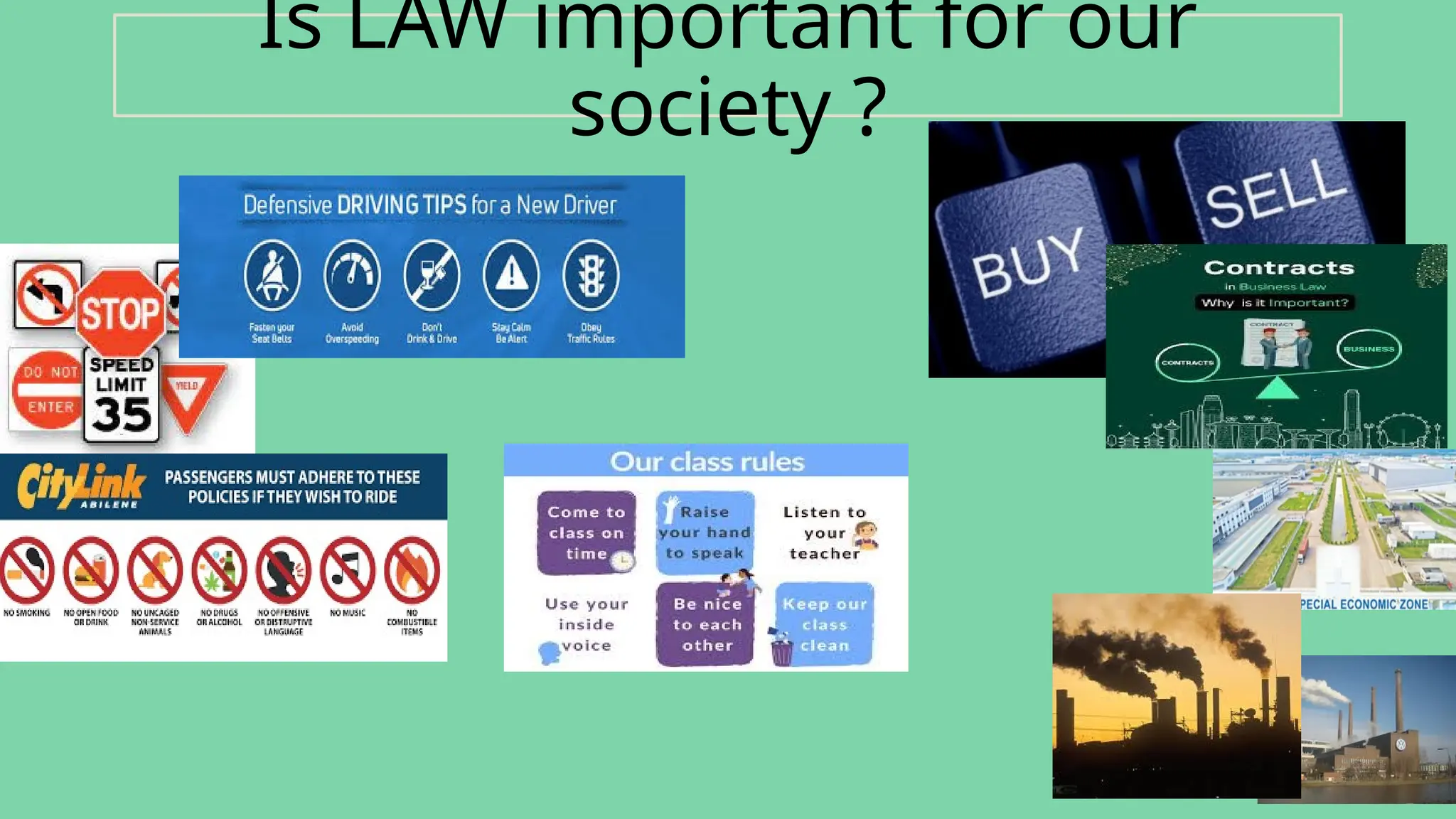
Example - Drinking is prohibited while driving./ breathalyzer -AlcoholTester/
Environmental conservation
> customary in a community and
Example - Law consisting of customs that are accepted as legal requirements or obligatory rules
of conduct; practices and beliefs -marriage , divorce ..etc
> recognized as demanding or prohibiting certain actions
Example - Covid 19 rule
> Standards by which people & businesses interact
Example - activities based on agreements
*** enforced by the imposition of penalties
WHAT IS LAW?
8.
● Principles oflaw –
● Legal systems in the world
● Classifications of law
LAW
9.
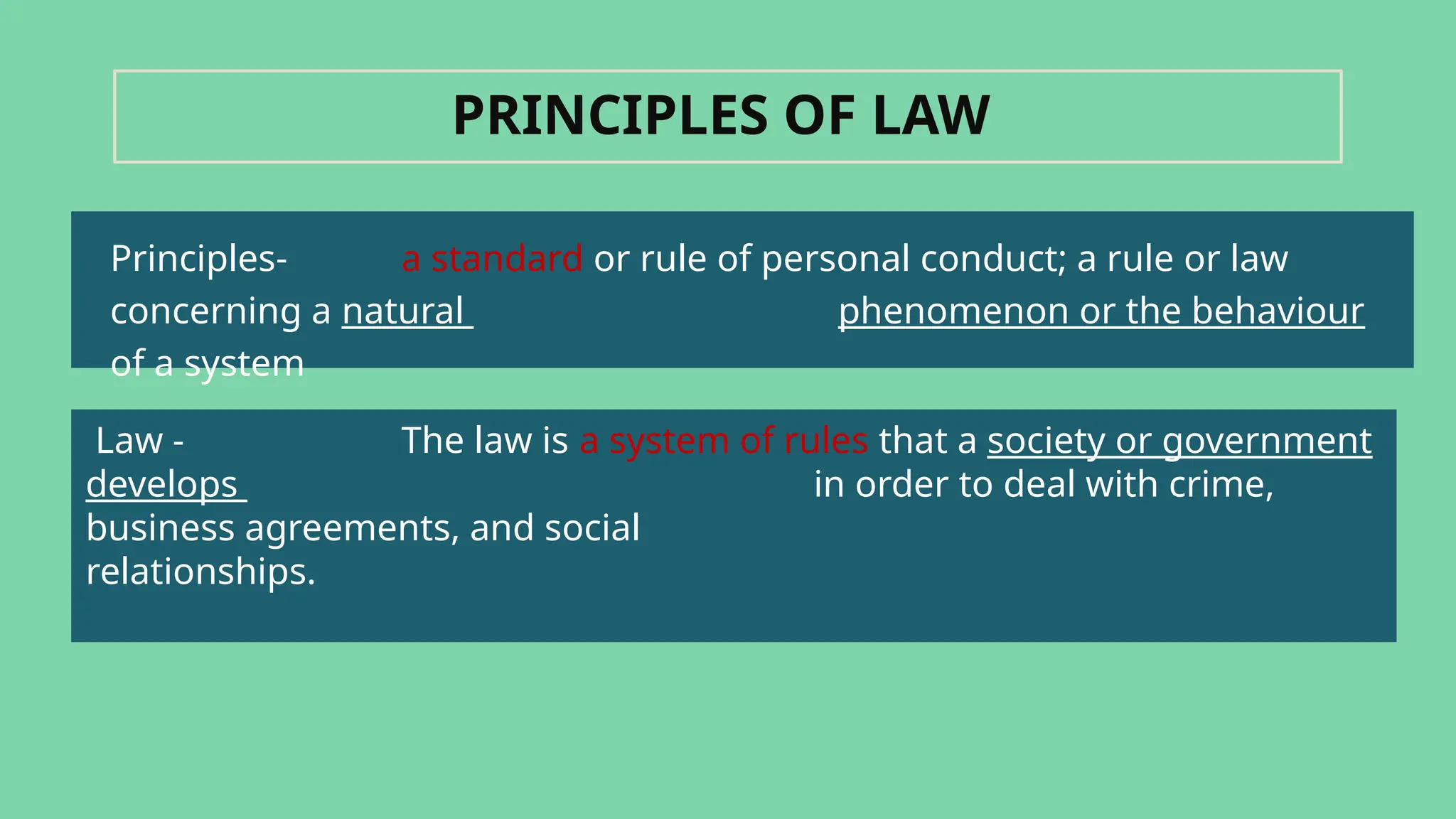
Principles- a standardor rule of personal conduct; a rule or law
concerning a natural phenomenon or the behaviour
of a system
PRINCIPLES OF LAW
Law - The law is a system of rules that a society or government
develops in order to deal with crime,
business agreements, and social
relationships.
10.
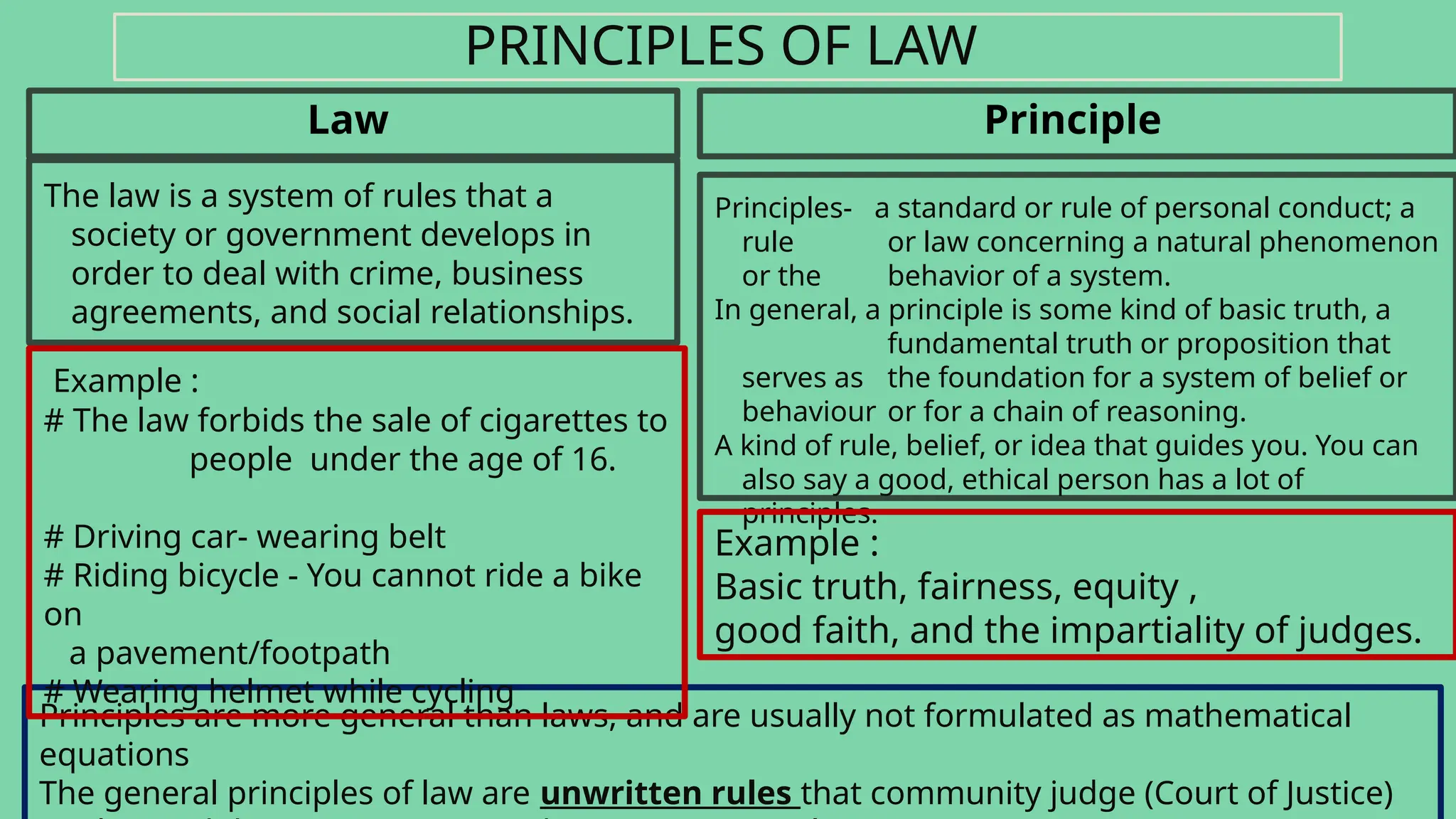
Principles- a standardor rule of personal conduct; a
rule or law concerning a natural phenomenon
or the behavior of a system.
In general, a principle is some kind of basic truth, a
fundamental truth or proposition that
serves as the foundation for a system of belief or
behaviour or for a chain of reasoning.
A kind of rule, belief, or idea that guides you. You can
also say a good, ethical person has a lot of
principles.
The law is a system of rules that a
society or government develops in
order to deal with crime, business
agreements, and social relationships.
Law Principle
PRINCIPLES OF LAW
Principles are more general than laws, and are usually not formulated as mathematical
equations
The general principles of law are unwritten rules that community judge (Court of Justice)
Example :
# The law forbids the sale of cigarettes to
people under the age of 16.
# Driving car- wearing belt
# Riding bicycle - You cannot ride a bike
on
a pavement/footpath
# Wearing helmet while cycling
Example :
Basic truth, fairness, equity ,
good faith, and the impartiality of judges.
11.
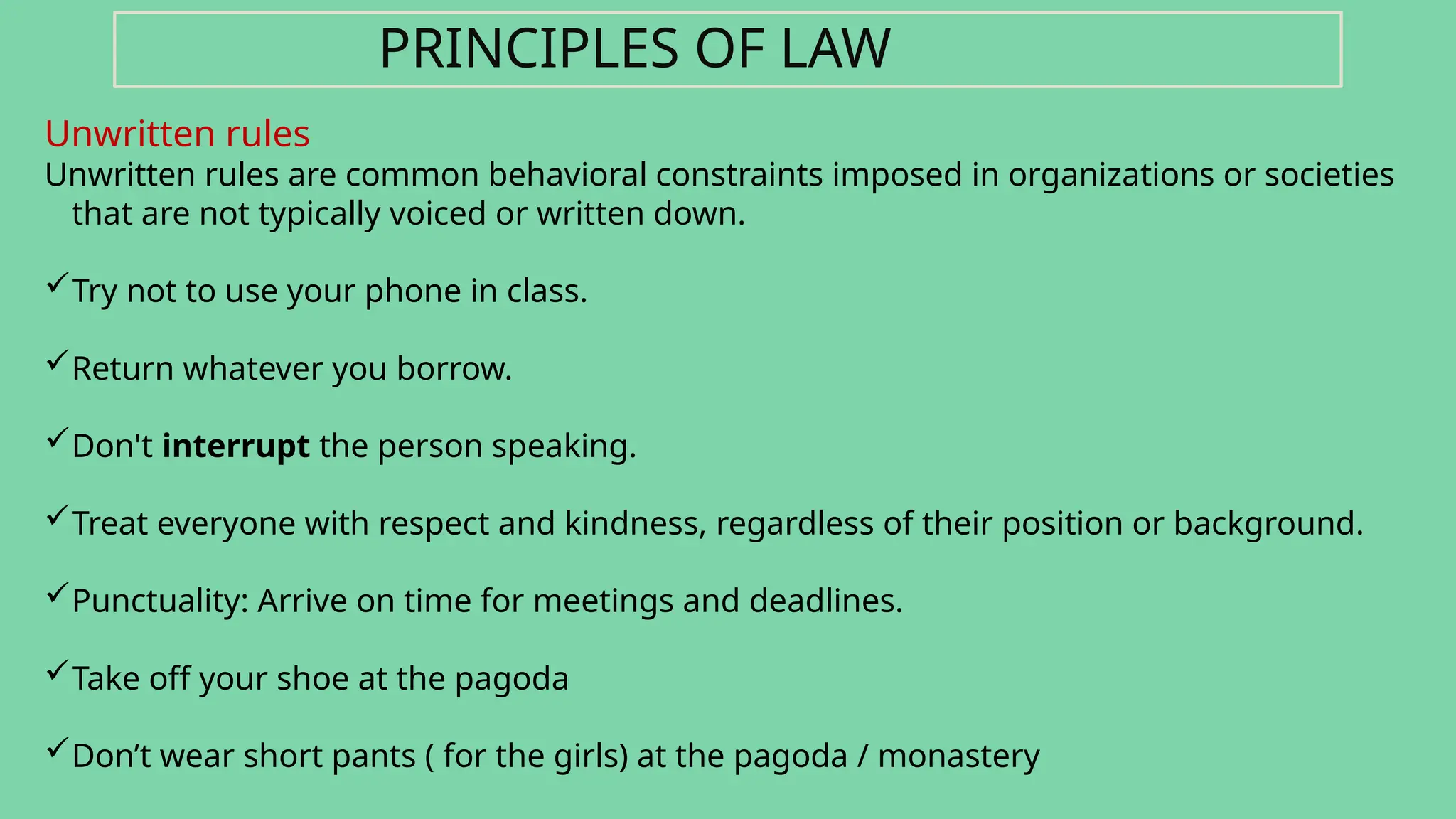
Unwritten rules
Unwritten rulesare common behavioral constraints imposed in organizations or societies
that are not typically voiced or written down.
Try not to use your phone in class.
Return whatever you borrow.
Don't interrupt the person speaking.
Treat everyone with respect and kindness, regardless of their position or background.
Punctuality: Arrive on time for meetings and deadlines.
Take off your shoe at the pagoda
Don’t wear short pants ( for the girls) at the pagoda / monastery
PRINCIPLES OF LAW
12.
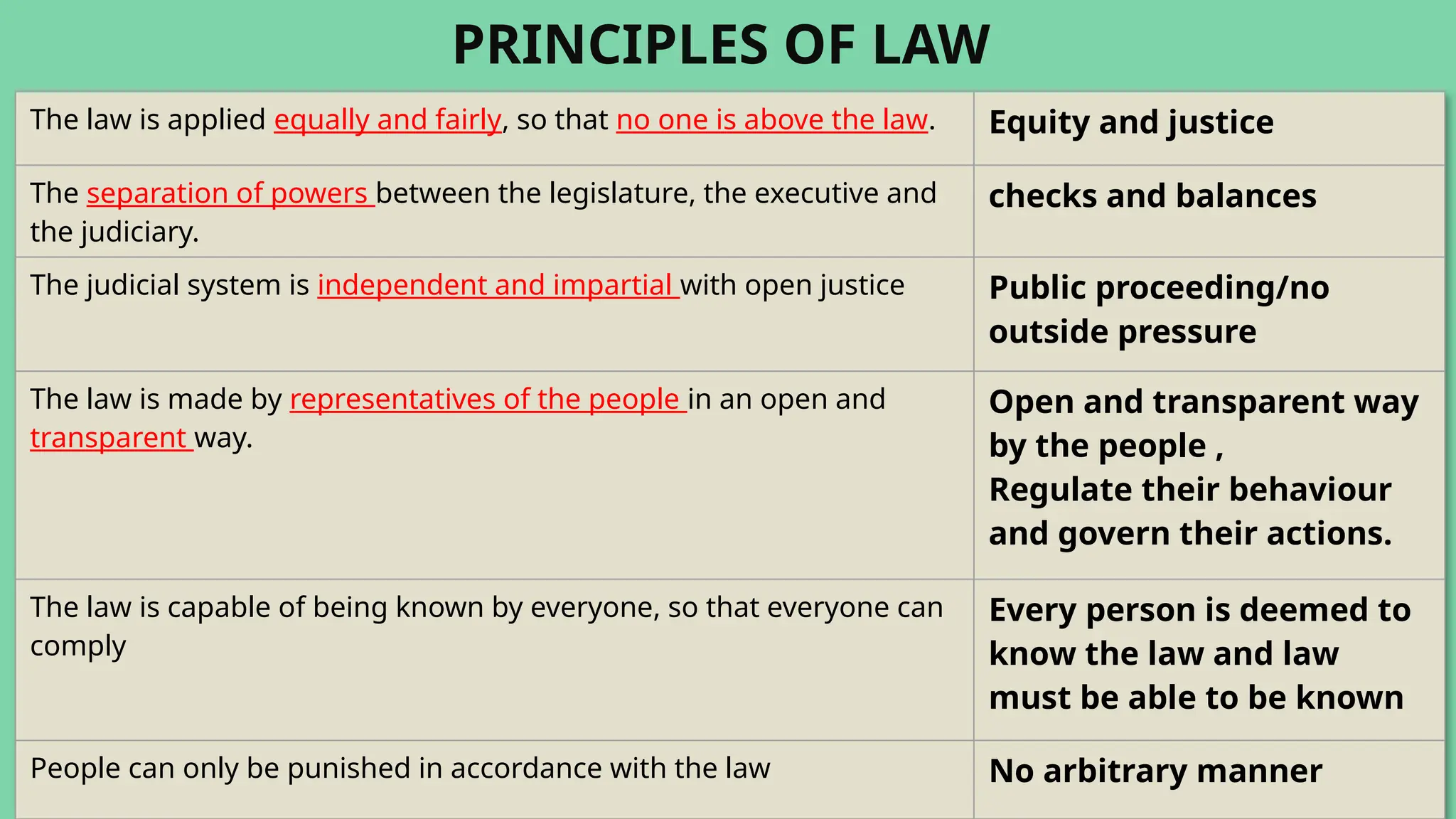
PRINCIPLES OF LAW
Thelaw is applied equally and fairly, so that no one is above the law. Equity and justice
The separation of powers between the legislature, the executive and
the judiciary.
checks and balances
The judicial system is independent and impartial with open justice Public proceeding/no
outside pressure
The law is made by representatives of the people in an open and
transparent way.
Open and transparent way
by the people ,
Regulate their behaviour
and govern their actions.
The law is capable of being known by everyone, so that everyone can
comply
Every person is deemed to
know the law and law
must be able to be known
People can only be punished in accordance with the law No arbitrary manner
13.
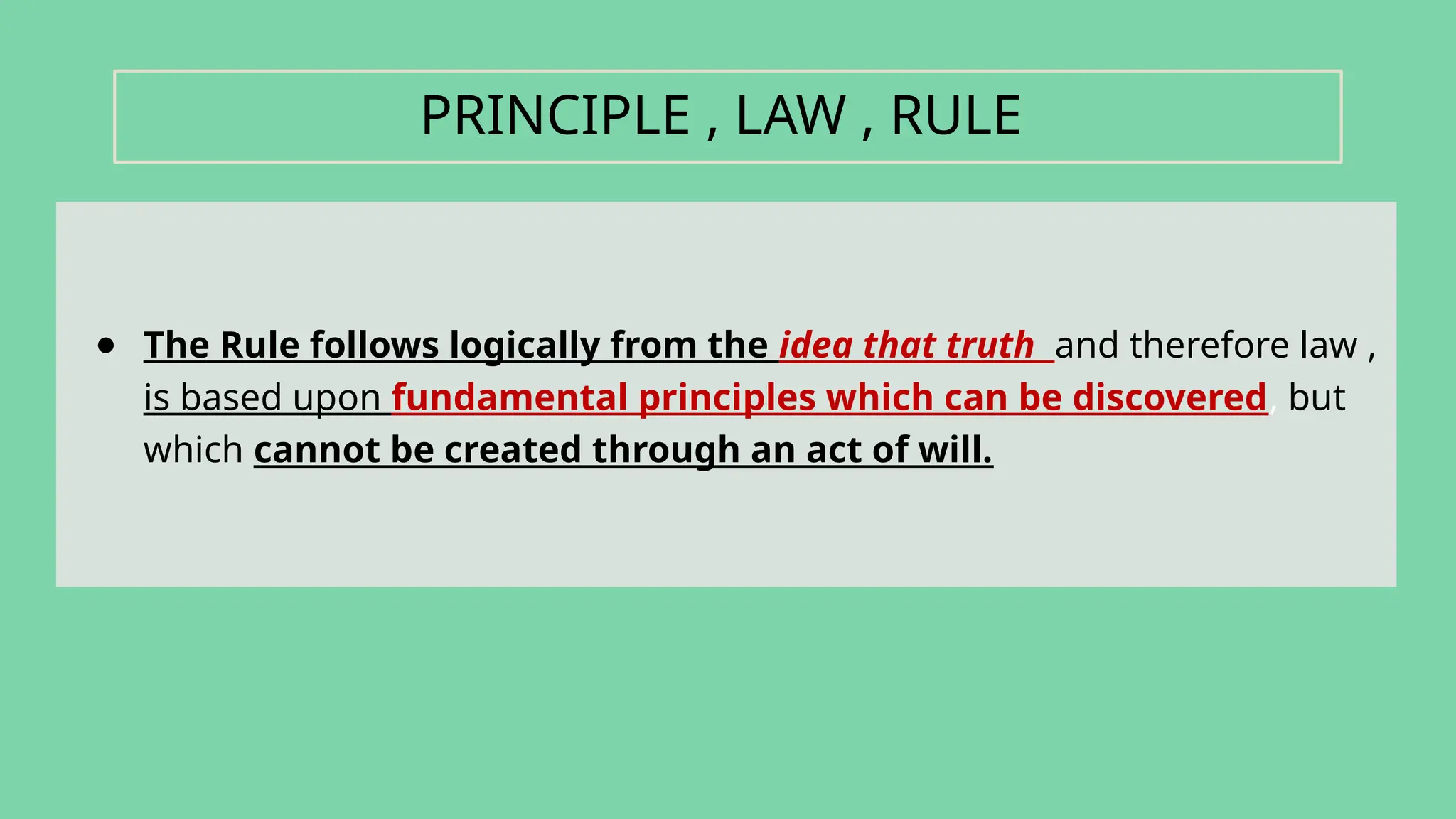
● The Rulefollows logically from the idea that truth and therefore law ,
is based upon fundamental principles which can be discovered, but
which cannot be created through an act of will.
PRINCIPLE , LAW , RULE
14.
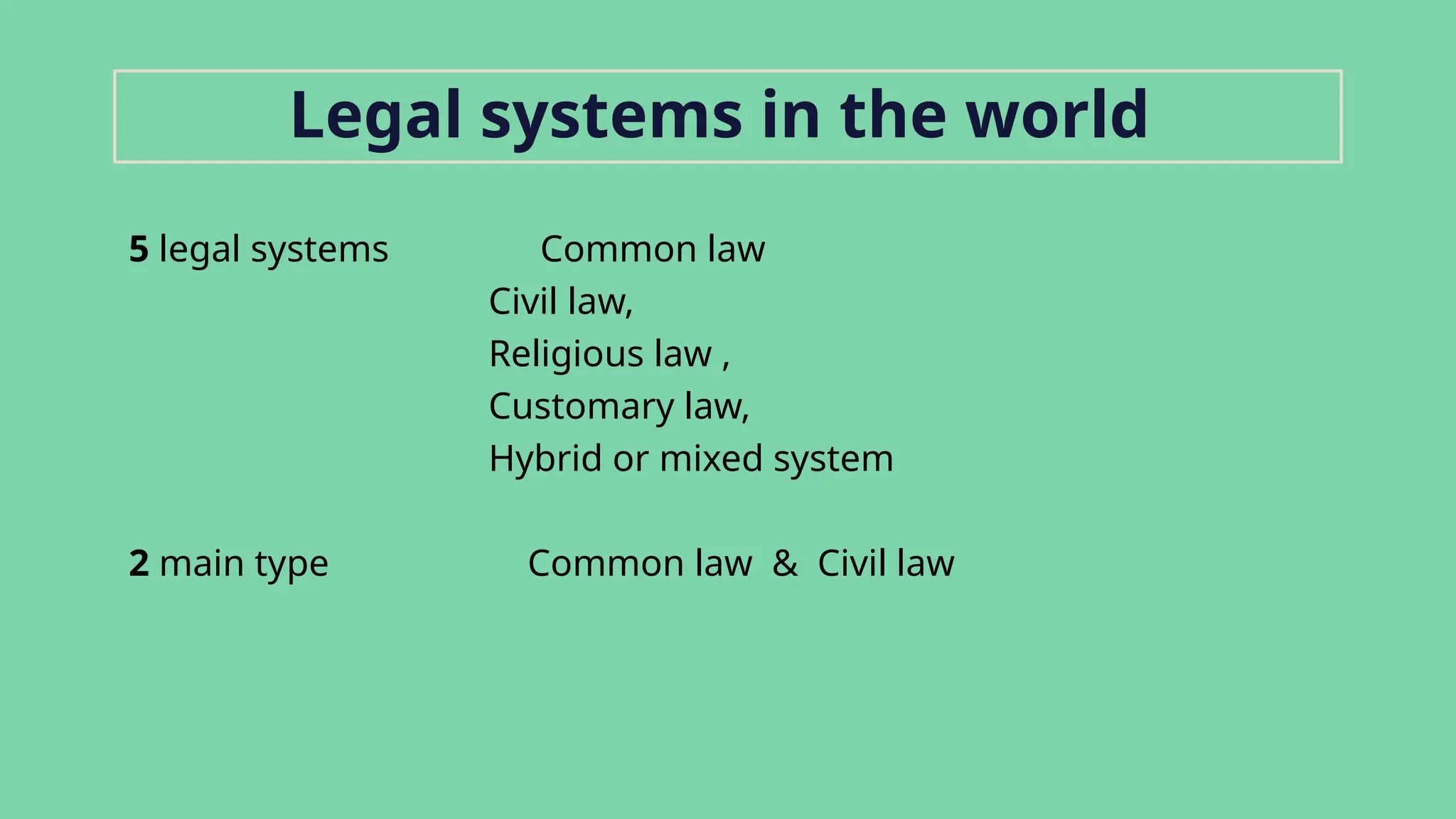
5 legal systemsCommon law
Civil law,
Religious law ,
Customary law,
Hybrid or mixed system
2 main type Common law & Civil law
Legal systems in the world
15.
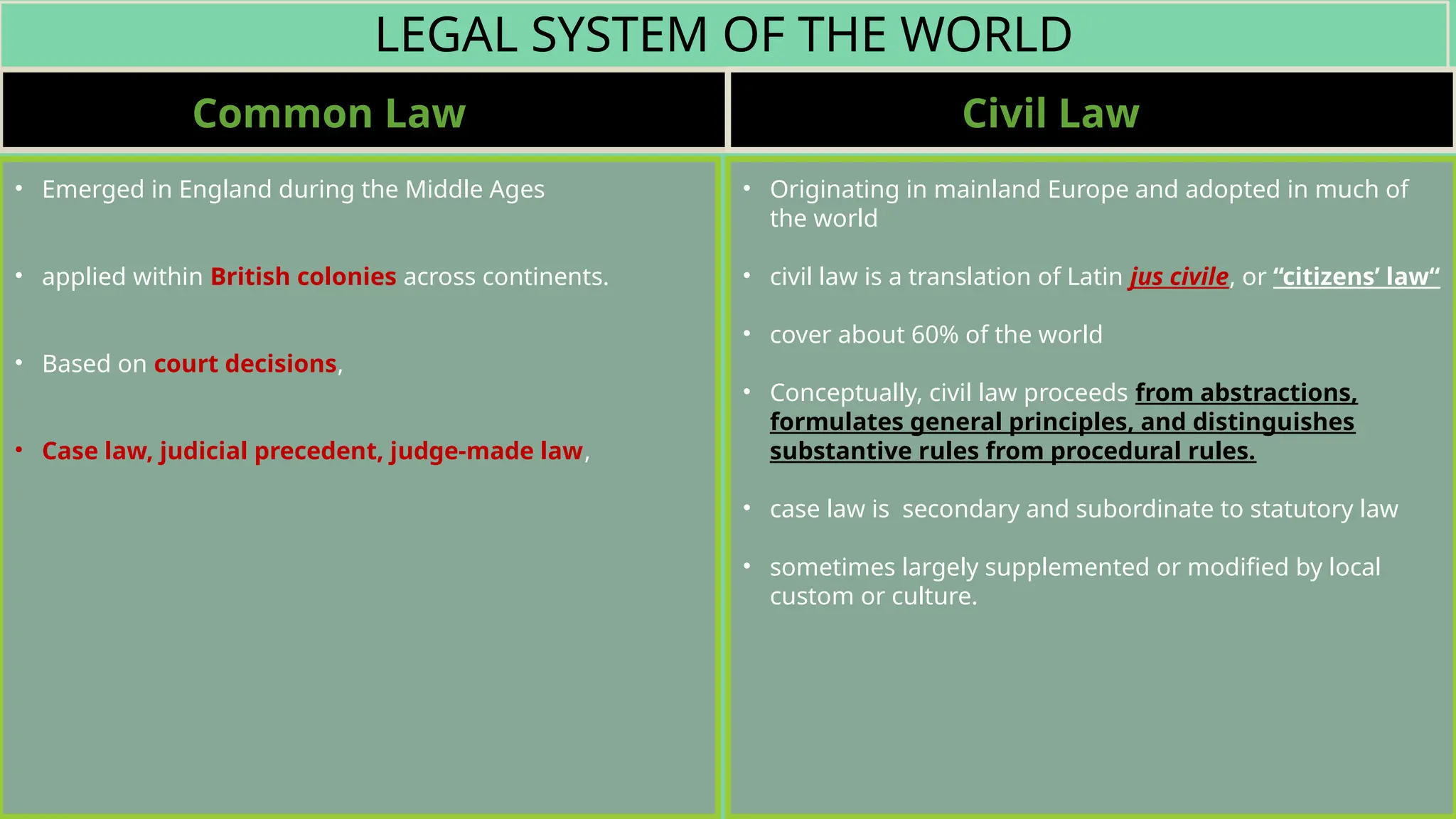
• Originating inmainland Europe and adopted in much of
the world
• civil law is a translation of Latin jus civile, or “citizens’ law“
• cover about 60% of the world
• Conceptually, civil law proceeds from abstractions,
formulates general principles, and distinguishes
substantive rules from procedural rules.
• case law is secondary and subordinate to statutory law
• sometimes largely supplemented or modified by local
custom or culture.
• Emerged in England during the Middle Ages
• applied within British colonies across continents.
• Based on court decisions,
• Case law, judicial precedent, judge-made law,
Common Law Civil Law
LEGAL SYSTEM OF THE WORLD
16.
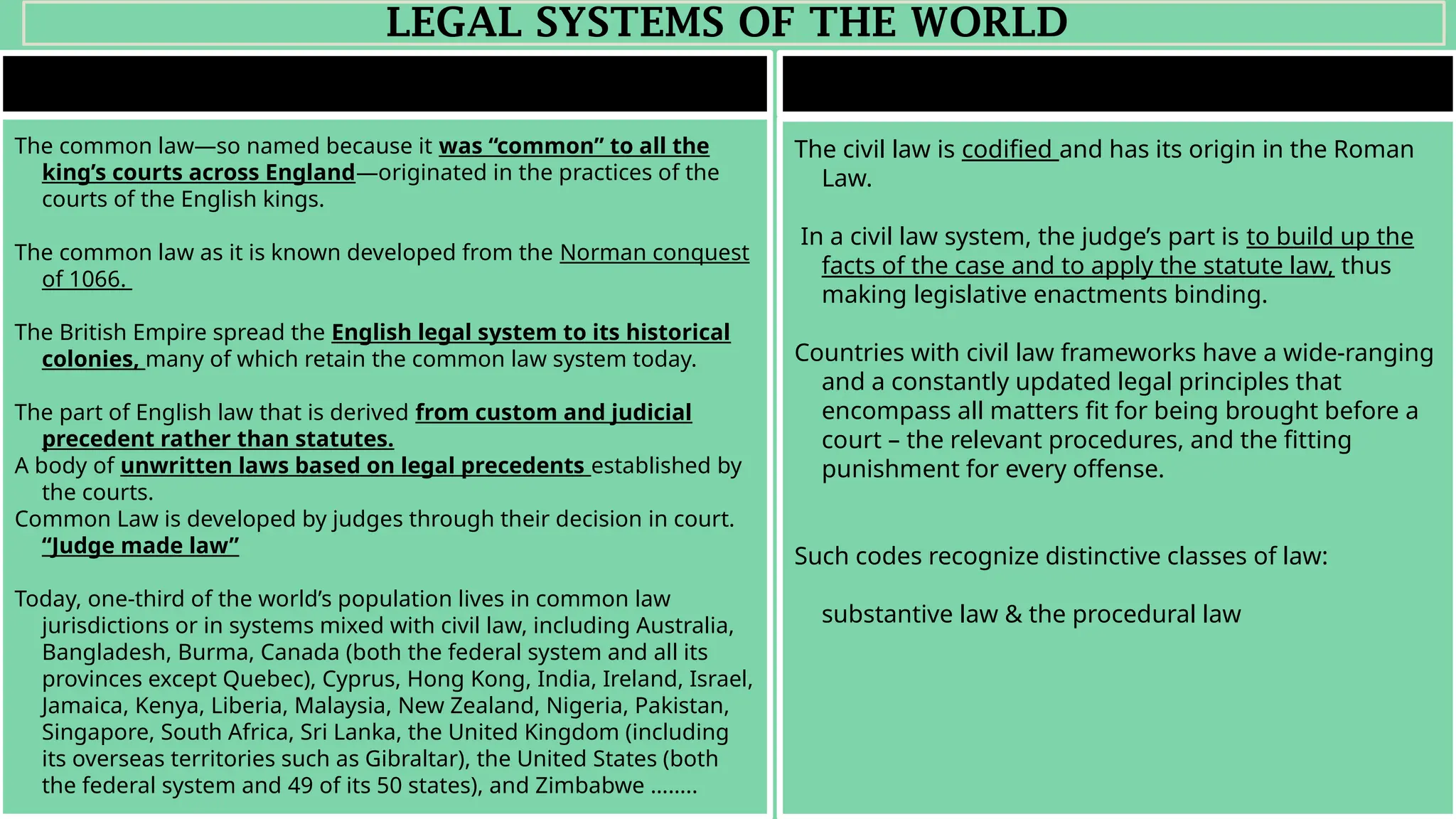
The civil lawis codified and has its origin in the Roman
Law.
In a civil law system, the judge’s part is to build up the
facts of the case and to apply the statute law, thus
making legislative enactments binding.
Countries with civil law frameworks have a wide-ranging
and a constantly updated legal principles that
encompass all matters fit for being brought before a
court – the relevant procedures, and the fitting
punishment for every offense.
Such codes recognize distinctive classes of law:
substantive law & the procedural law
The common law—so named because it was “common” to all the
king’s courts across England—originated in the practices of the
courts of the English kings.
The common law as it is known developed from the Norman conquest
of 1066.
The British Empire spread the English legal system to its historical
colonies, many of which retain the common law system today.
The part of English law that is derived from custom and judicial
precedent rather than statutes.
A body of unwritten laws based on legal precedents established by
the courts.
Common Law is developed by judges through their decision in court.
“Judge made law”
Today, one-third of the world’s population lives in common law
jurisdictions or in systems mixed with civil law, including Australia,
Bangladesh, Burma, Canada (both the federal system and all its
provinces except Quebec), Cyprus, Hong Kong, India, Ireland, Israel,
Jamaica, Kenya, Liberia, Malaysia, New Zealand, Nigeria, Pakistan,
Singapore, South Africa, Sri Lanka, the United Kingdom (including
its overseas territories such as Gibraltar), the United States (both
the federal system and 49 of its 50 states), and Zimbabwe ……..
LEGAL SYSTEMS OF THE WORLD
17.
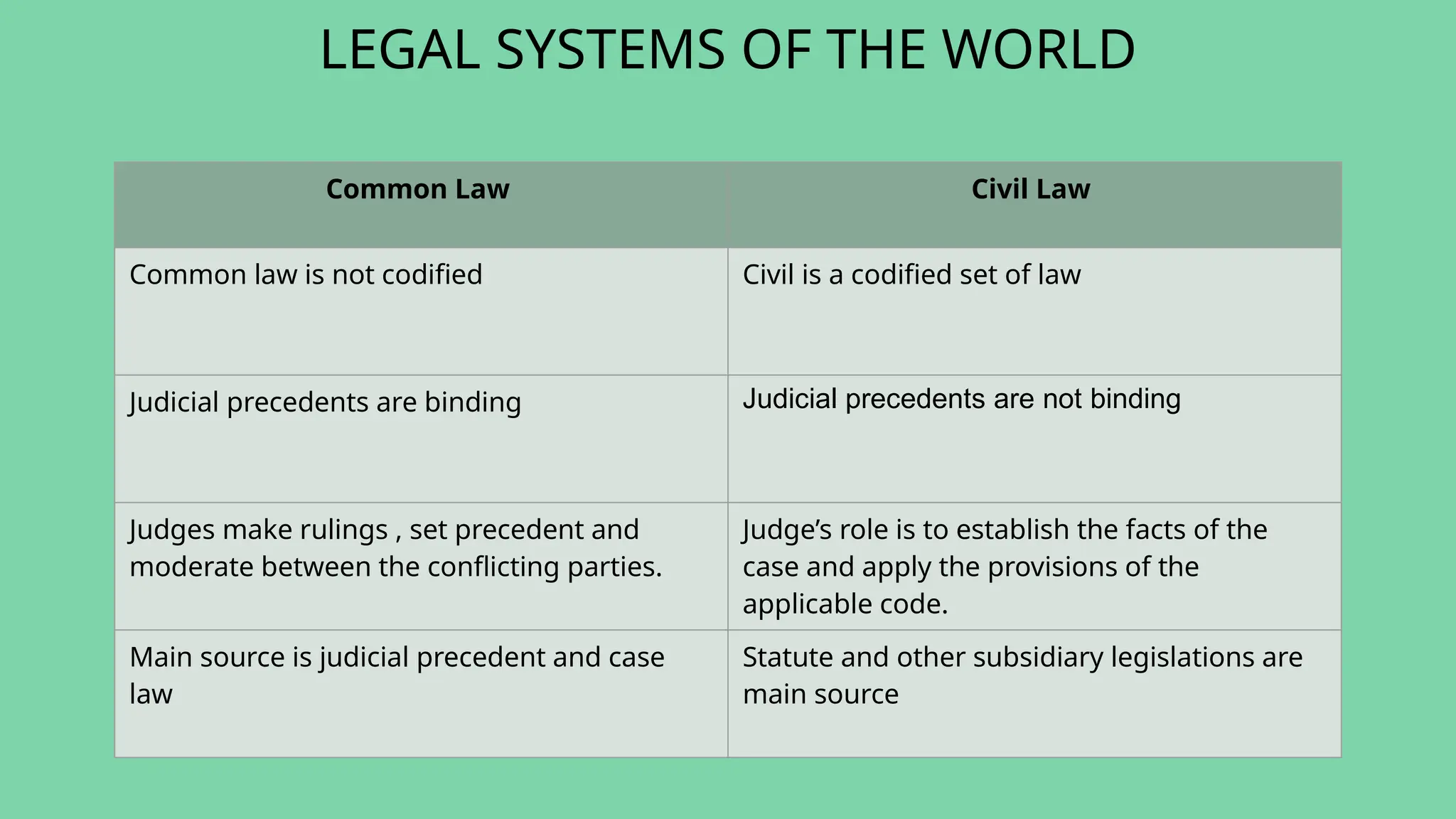
LEGAL SYSTEMS OFTHE WORLD
Common Law Civil Law
Common law is not codified Civil is a codified set of law
Judicial precedents are binding Judicial precedents are not binding
Judges make rulings , set precedent and
moderate between the conflicting parties.
Judge’s role is to establish the facts of the
case and apply the provisions of the
applicable code.
Main source is judicial precedent and case
law
Statute and other subsidiary legislations are
main source
18.
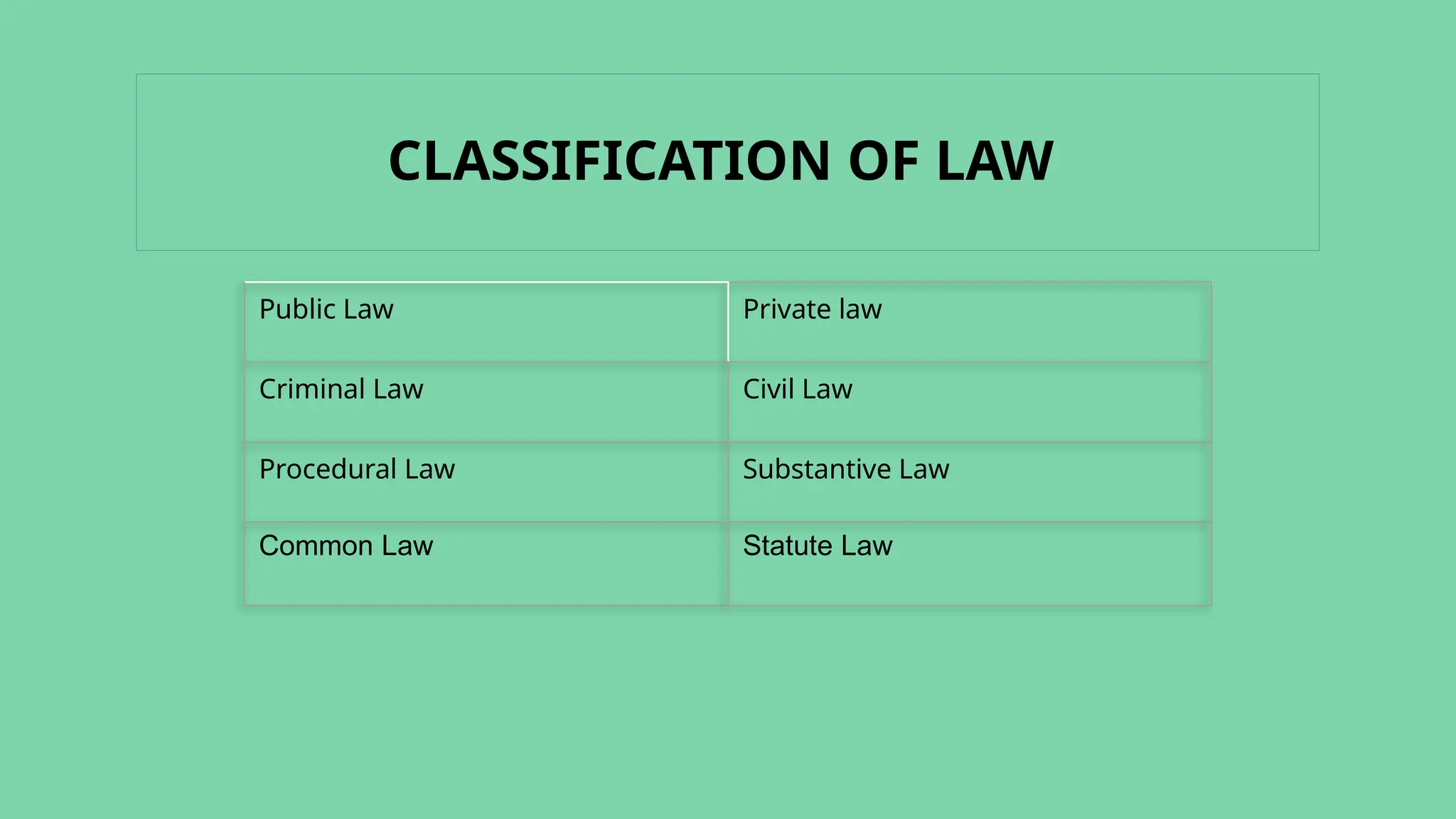
CLASSIFICATION OF LAW
PublicLaw Private law
Criminal Law Civil Law
Procedural Law Substantive Law
Common Law Statute Law
19.
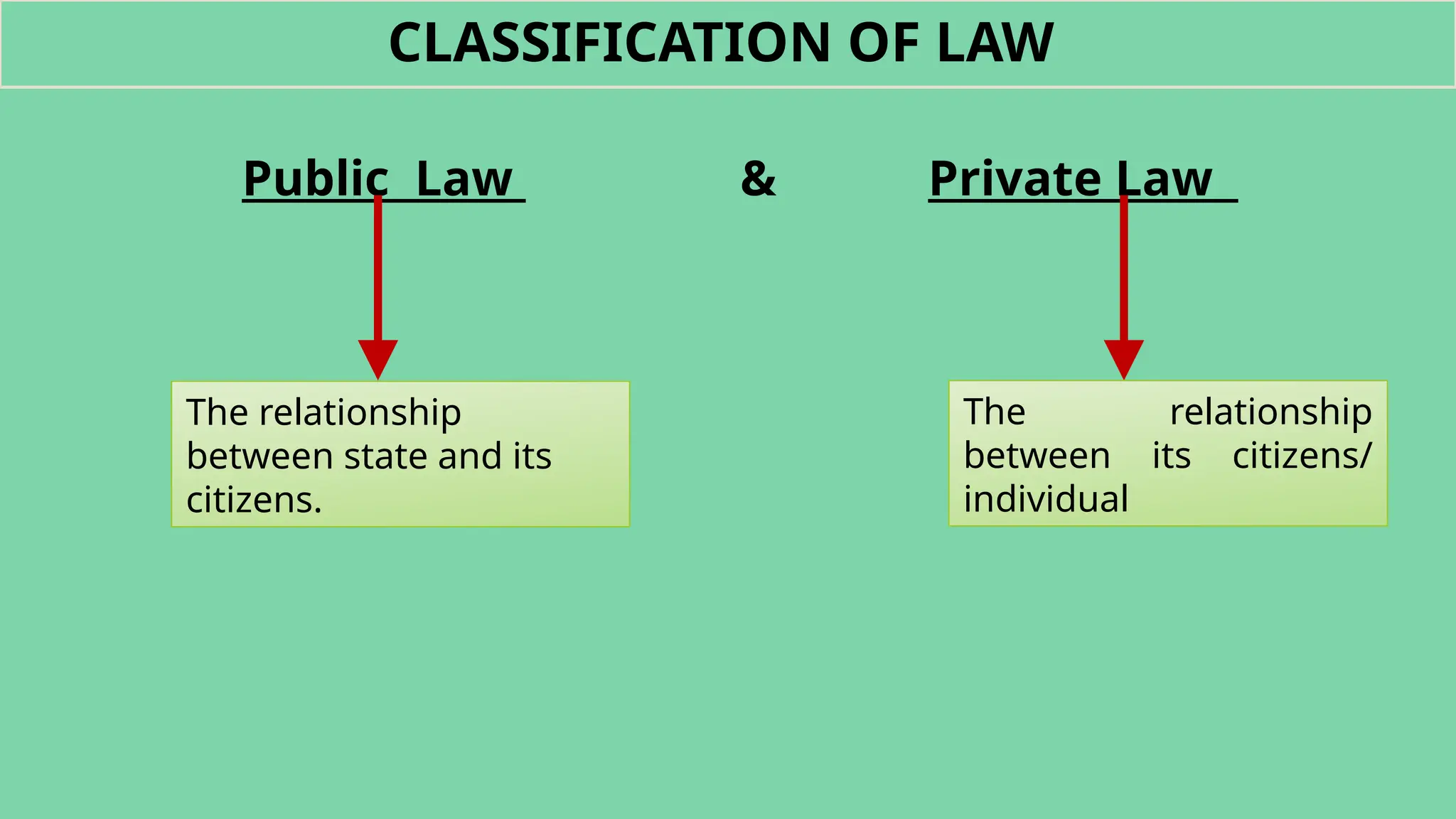
Public Law &Private Law
CLASSIFICATION OF LAW
The relationship
between state and its
citizens.
The relationship
between its citizens/
individual
20.
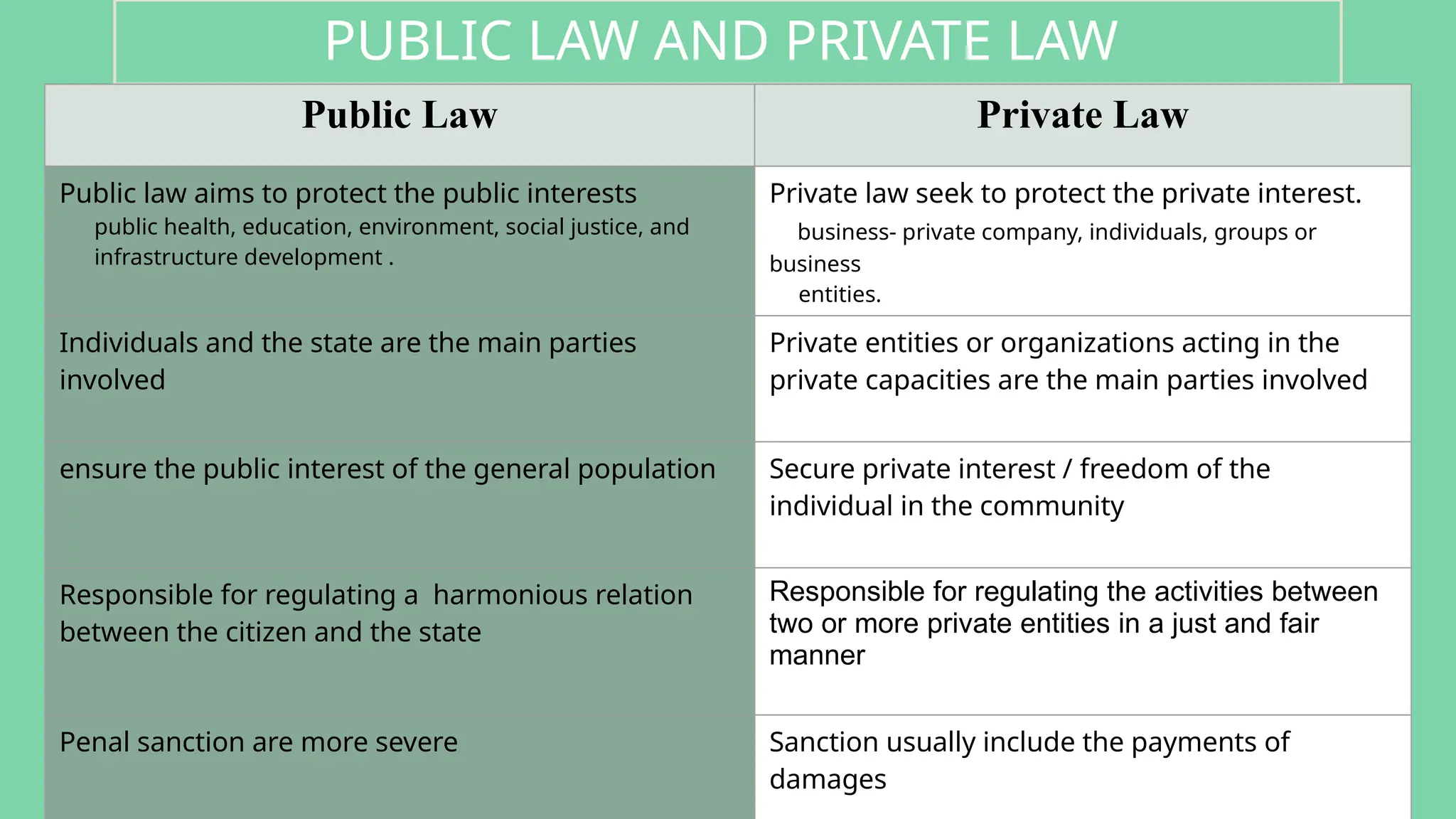
PUBLIC LAW ANDPRIVATE LAW
Public Law Private Law
Public law aims to protect the public interests
public health, education, environment, social justice, and
infrastructure development .
Private law seek to protect the private interest.
business- private company, individuals, groups or
business
entities.
Individuals and the state are the main parties
involved
Private entities or organizations acting in the
private capacities are the main parties involved
ensure the public interest of the general population Secure private interest / freedom of the
individual in the community
Responsible for regulating a harmonious relation
between the citizen and the state
Responsible for regulating the activities between
two or more private entities in a just and fair
manner
Penal sanction are more severe Sanction usually include the payments of
damages
21.
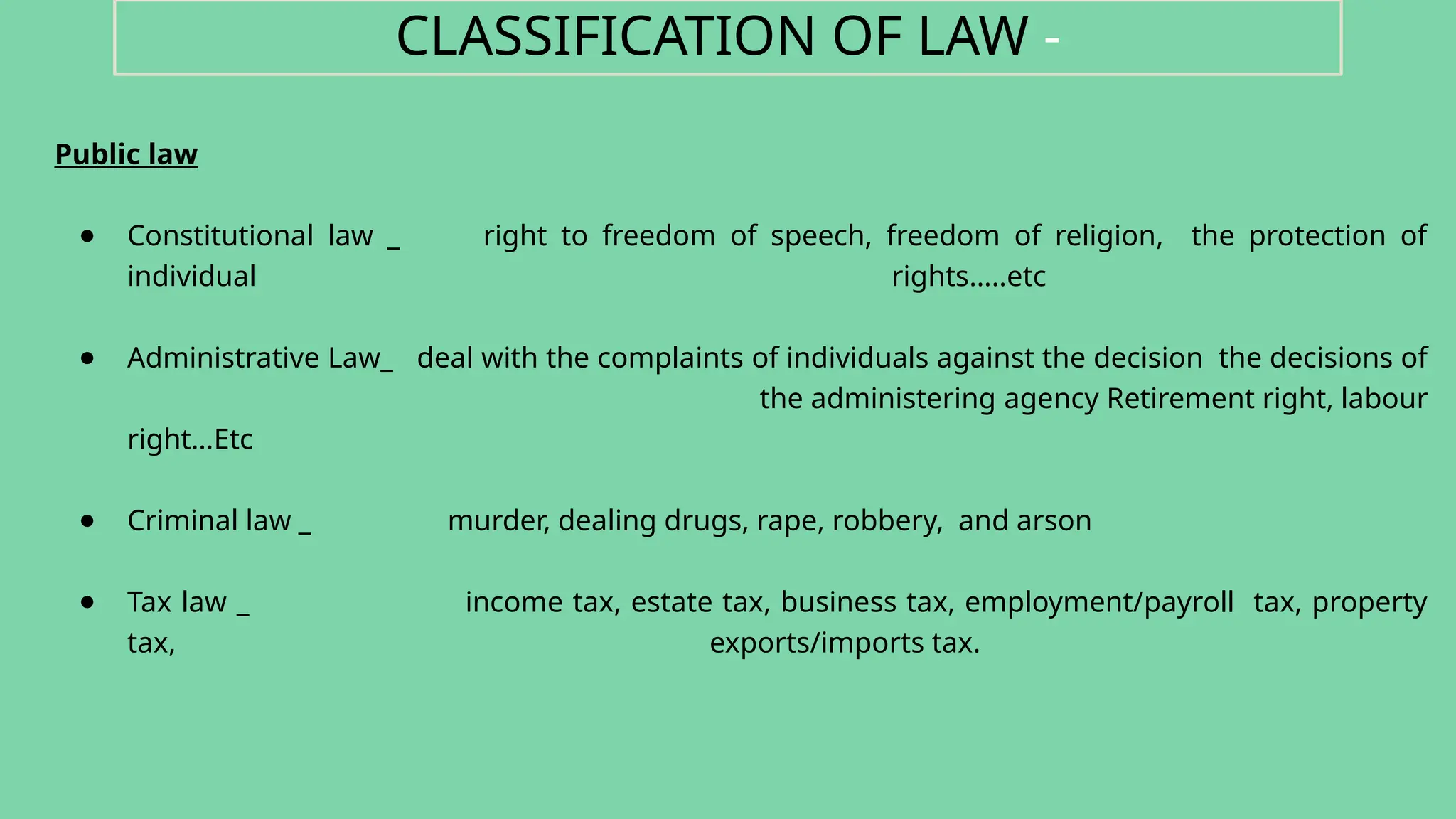
Public law
● Constitutionallaw _ right to freedom of speech, freedom of religion, the protection of
individual rights…..etc
● Administrative Law_ deal with the complaints of individuals against the decision the decisions of
the administering agency Retirement right, labour
right…Etc
● Criminal law _ murder, dealing drugs, rape, robbery, and arson
● Tax law _ income tax, estate tax, business tax, employment/payroll tax, property
tax, exports/imports tax.
CLASSIFICATION OF LAW -
22.
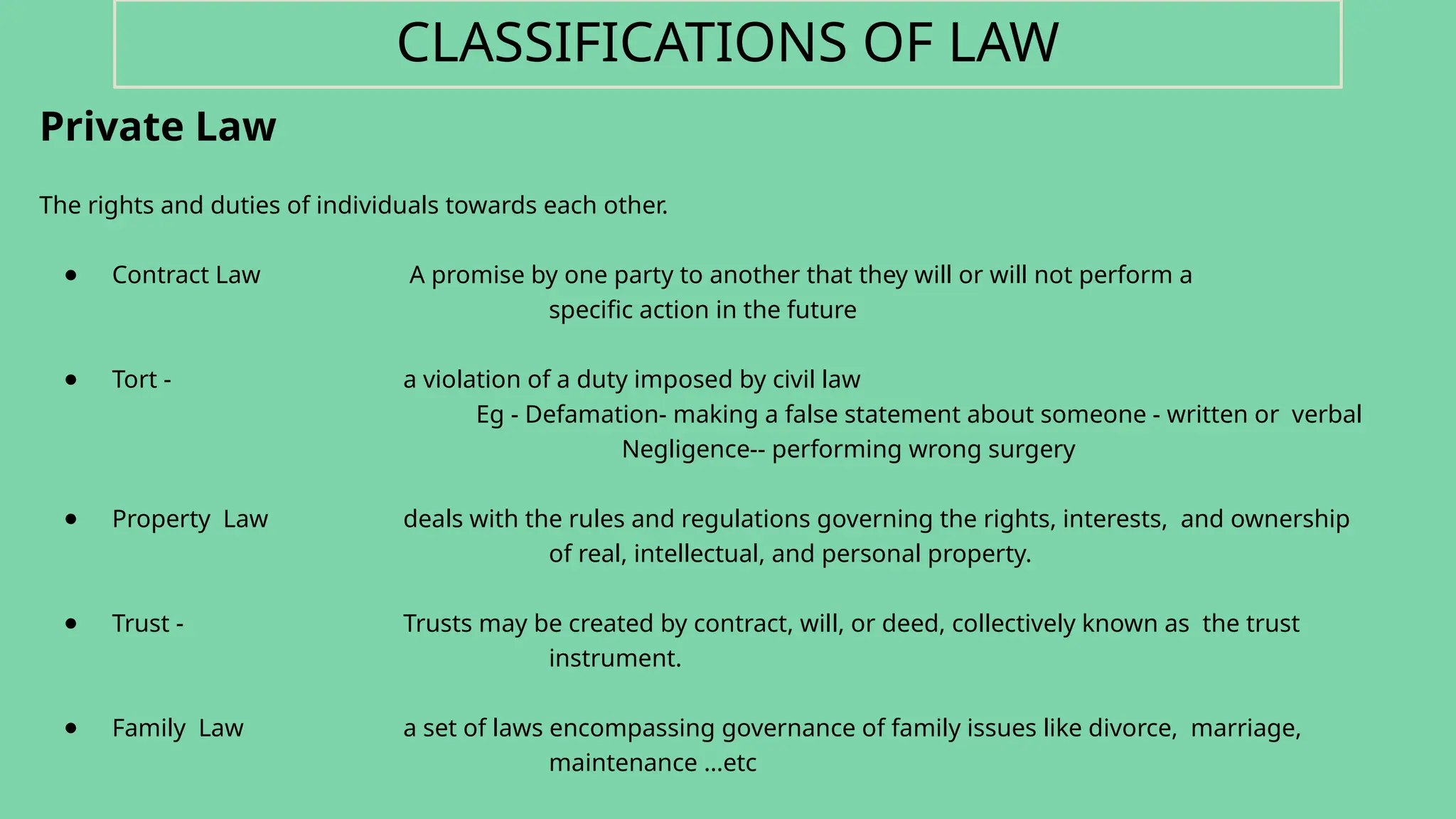
Private Law
The rightsand duties of individuals towards each other.
● Contract Law A promise by one party to another that they will or will not perform a
specific action in the future
● Tort - a violation of a duty imposed by civil law
Eg - Defamation- making a false statement about someone - written or verbal
Negligence-- performing wrong surgery
● Property Law deals with the rules and regulations governing the rights, interests, and ownership
of real, intellectual, and personal property.
● Trust - Trusts may be created by contract, will, or deed, collectively known as the trust
instrument.
● Family Law a set of laws encompassing governance of family issues like divorce, marriage,
maintenance …etc
CLASSIFICATIONS OF LAW
23.
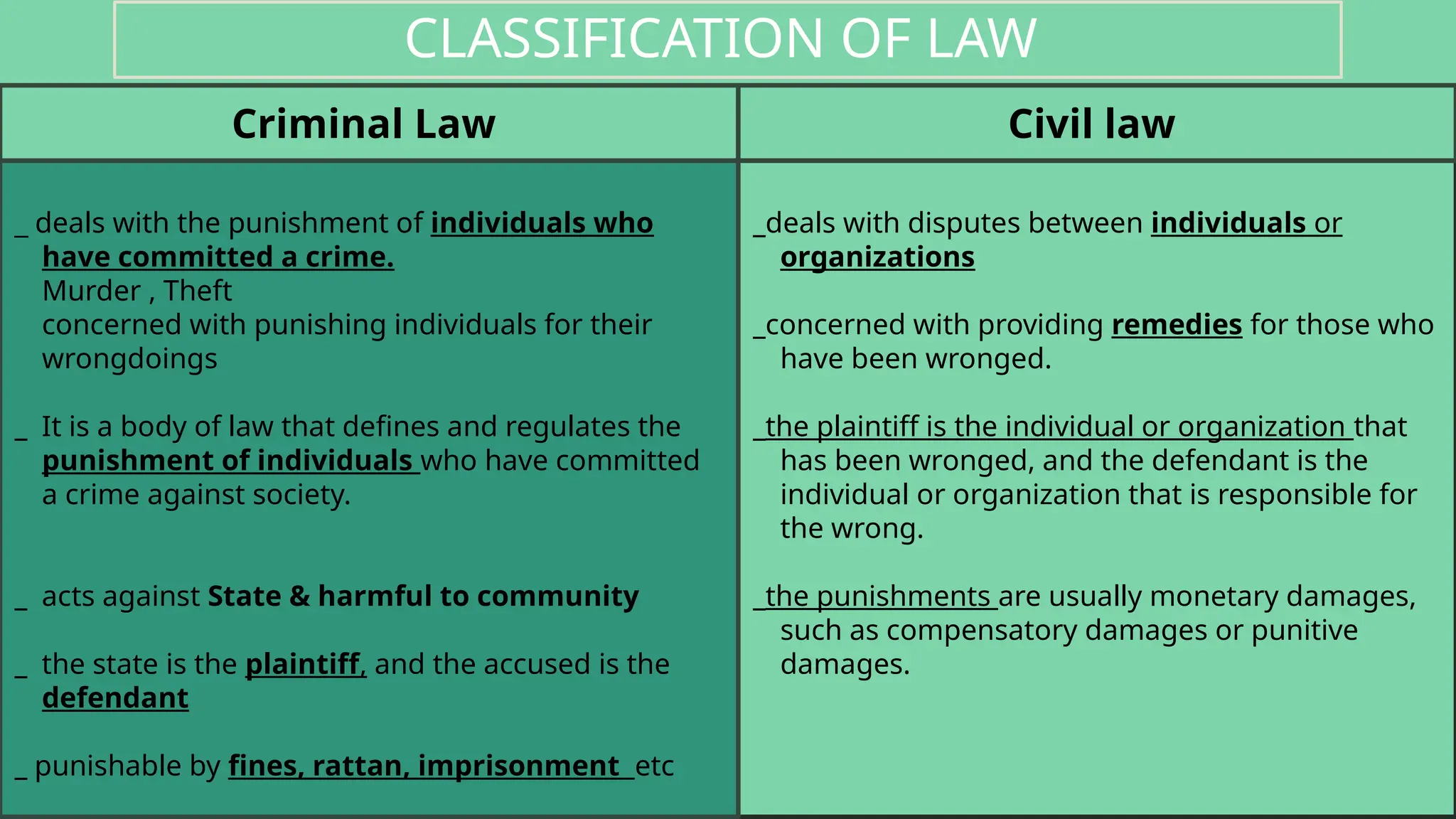
_deals with disputesbetween individuals or
organizations
_concerned with providing remedies for those who
have been wronged.
_the plaintiff is the individual or organization that
has been wronged, and the defendant is the
individual or organization that is responsible for
the wrong.
_the punishments are usually monetary damages,
such as compensatory damages or punitive
damages.
_ deals with the punishment of individuals who
have committed a crime.
Murder , Theft
concerned with punishing individuals for their
wrongdoings
_ It is a body of law that defines and regulates the
punishment of individuals who have committed
a crime against society.
_ acts against State & harmful to community
_ the state is the plaintiff, and the accused is the
defendant
_ punishable by fines, rattan, imprisonment etc
Criminal Law Civil law
CLASSIFICATION OF LAW
24.
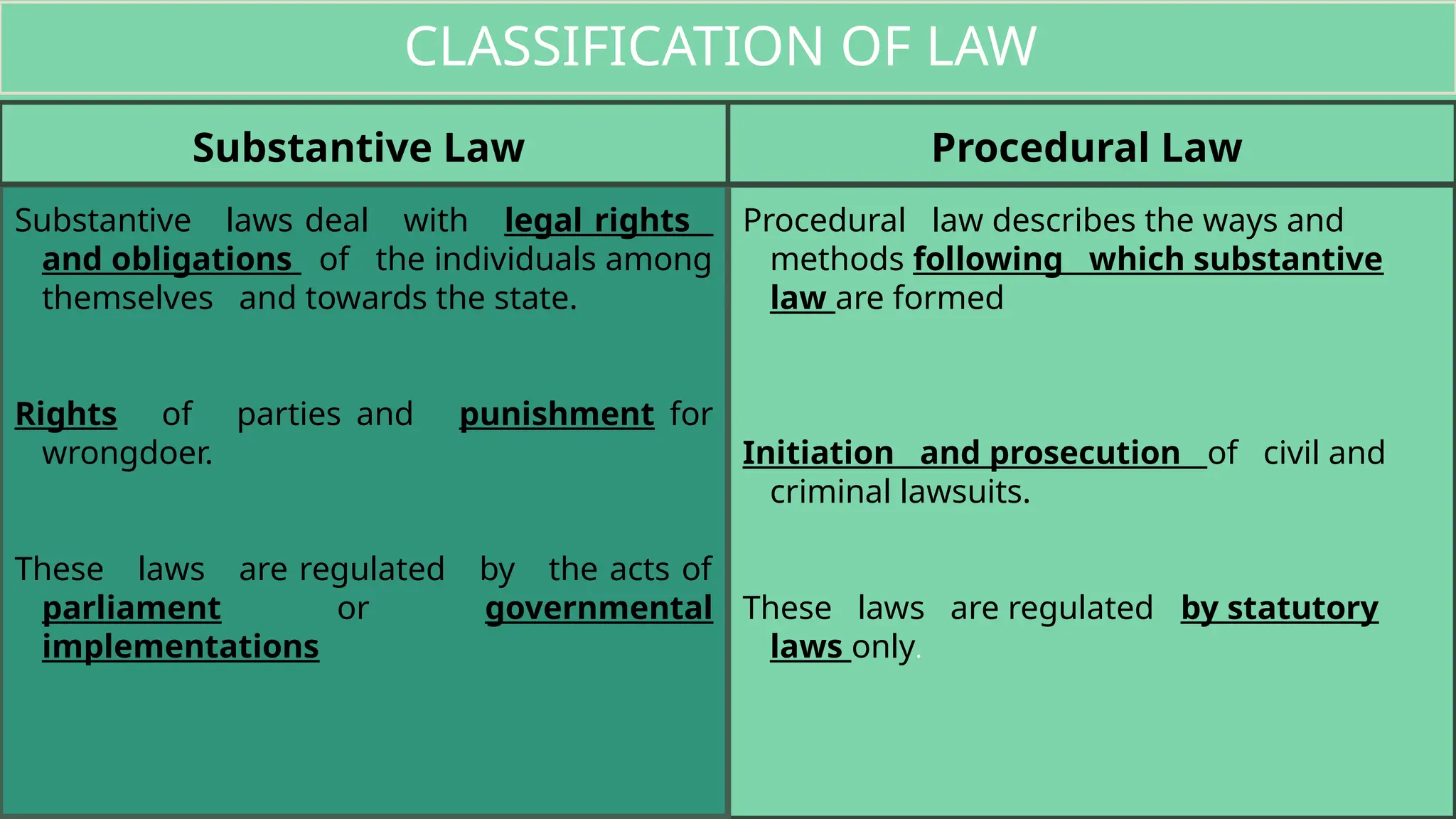
Procedural law describesthe ways and
methods following which substantive
law are formed
Initiation and prosecution of civil and
criminal lawsuits.
These laws are regulated by statutory
laws only.
Substantive laws deal with legal rights
and obligations of the individuals among
themselves and towards the state.
Rights of parties and punishment for
wrongdoer.
These laws are regulated by the acts of
parliament or governmental
implementations
Substantive Law Procedural Law
CLASSIFICATION OF LAW
25.
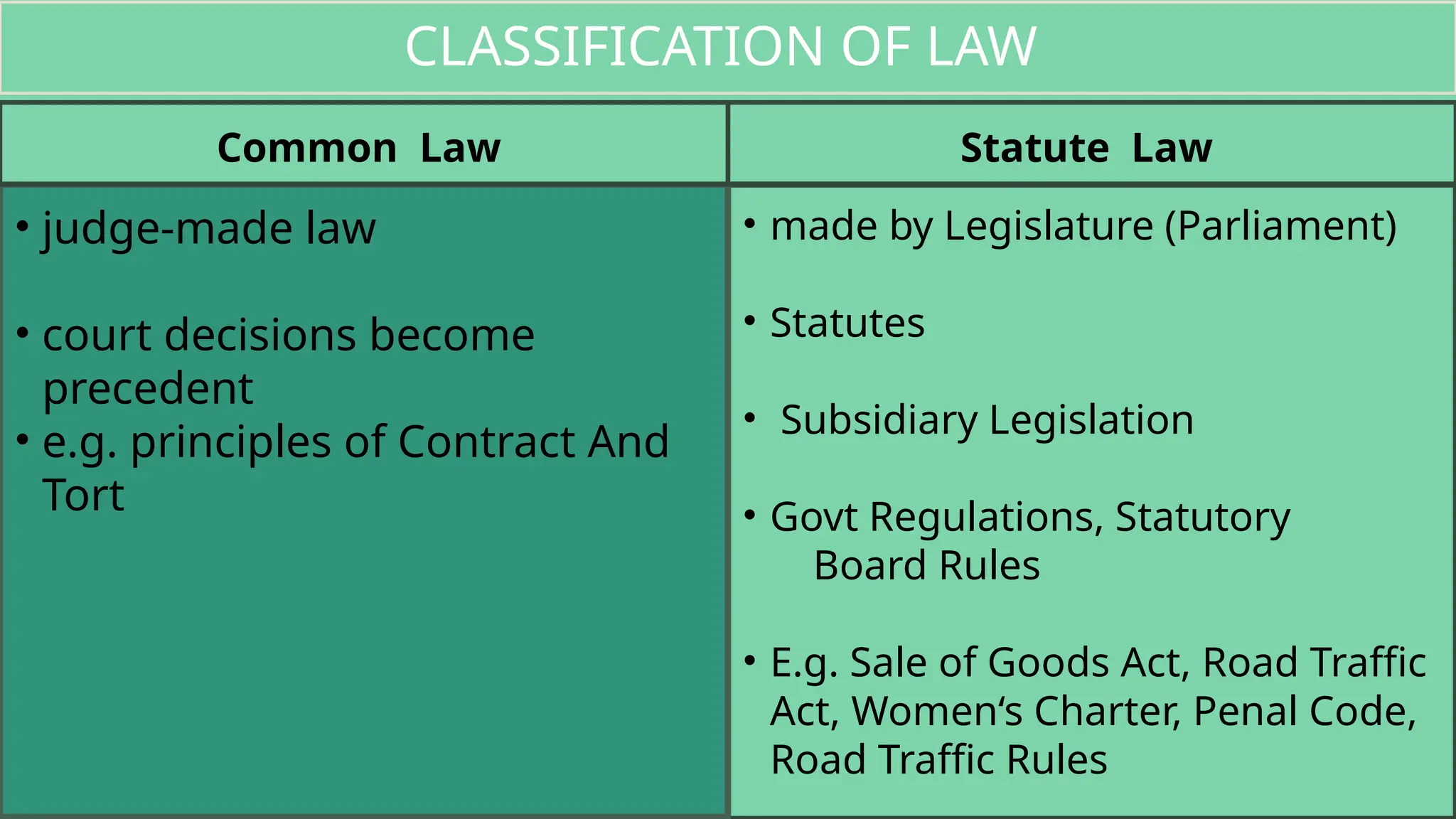
• made byLegislature (Parliament)
• Statutes
• Subsidiary Legislation
• Govt Regulations, Statutory
Board Rules
• E.g. Sale of Goods Act, Road Traffic
Act, Women‘s Charter, Penal Code,
Road Traffic Rules
• judge-made law
• court decisions become
precedent
• e.g. principles of Contract And
Tort
Common Law Statute Law
CLASSIFICATION OF LAW
26.
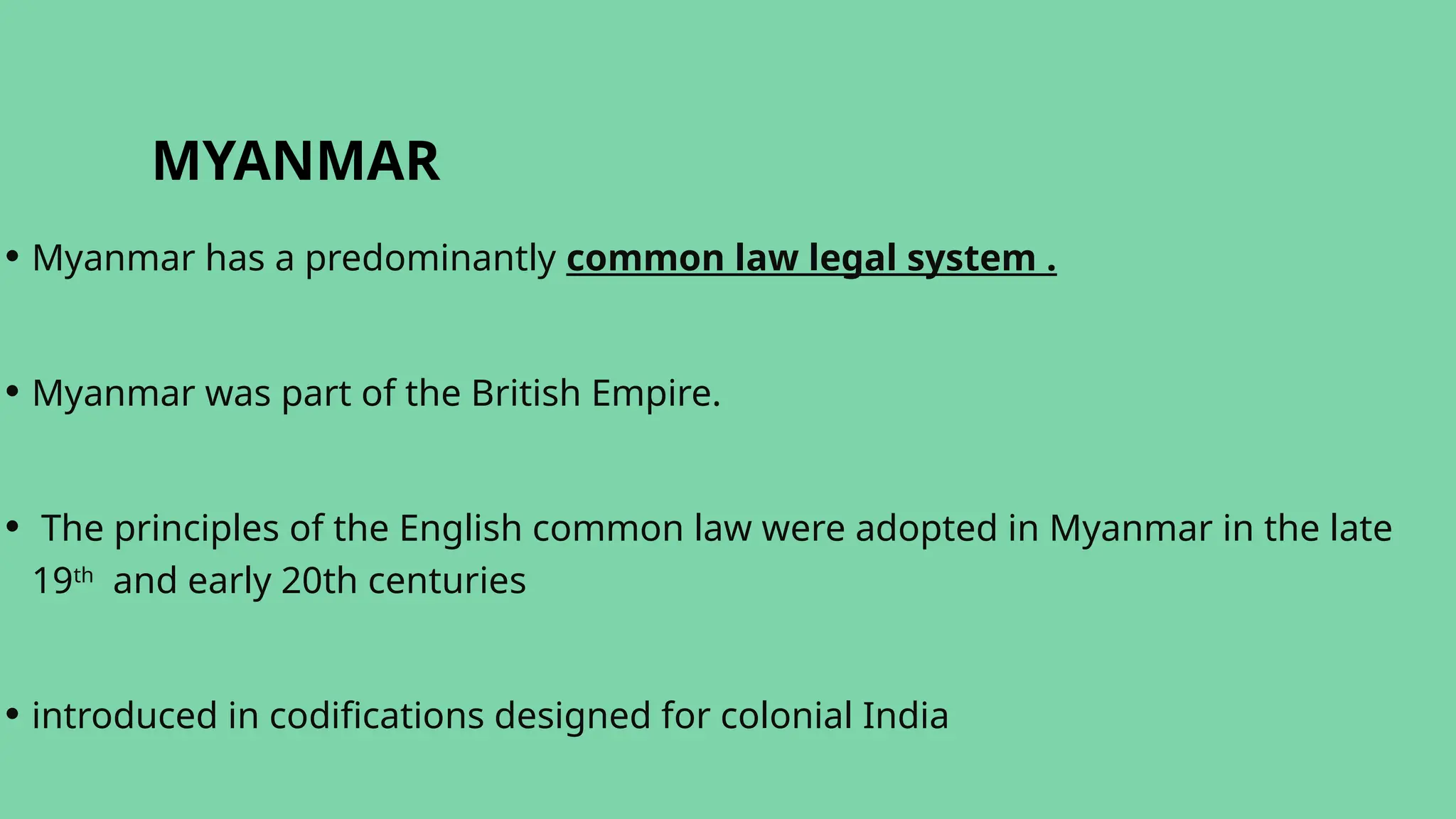
MYANMAR
• Myanmar hasa predominantly common law legal system .
• Myanmar was part of the British Empire.
• The principles of the English common law were adopted in Myanmar in the late
19th
and early 20th centuries
• introduced in codifications designed for colonial India
27.
-
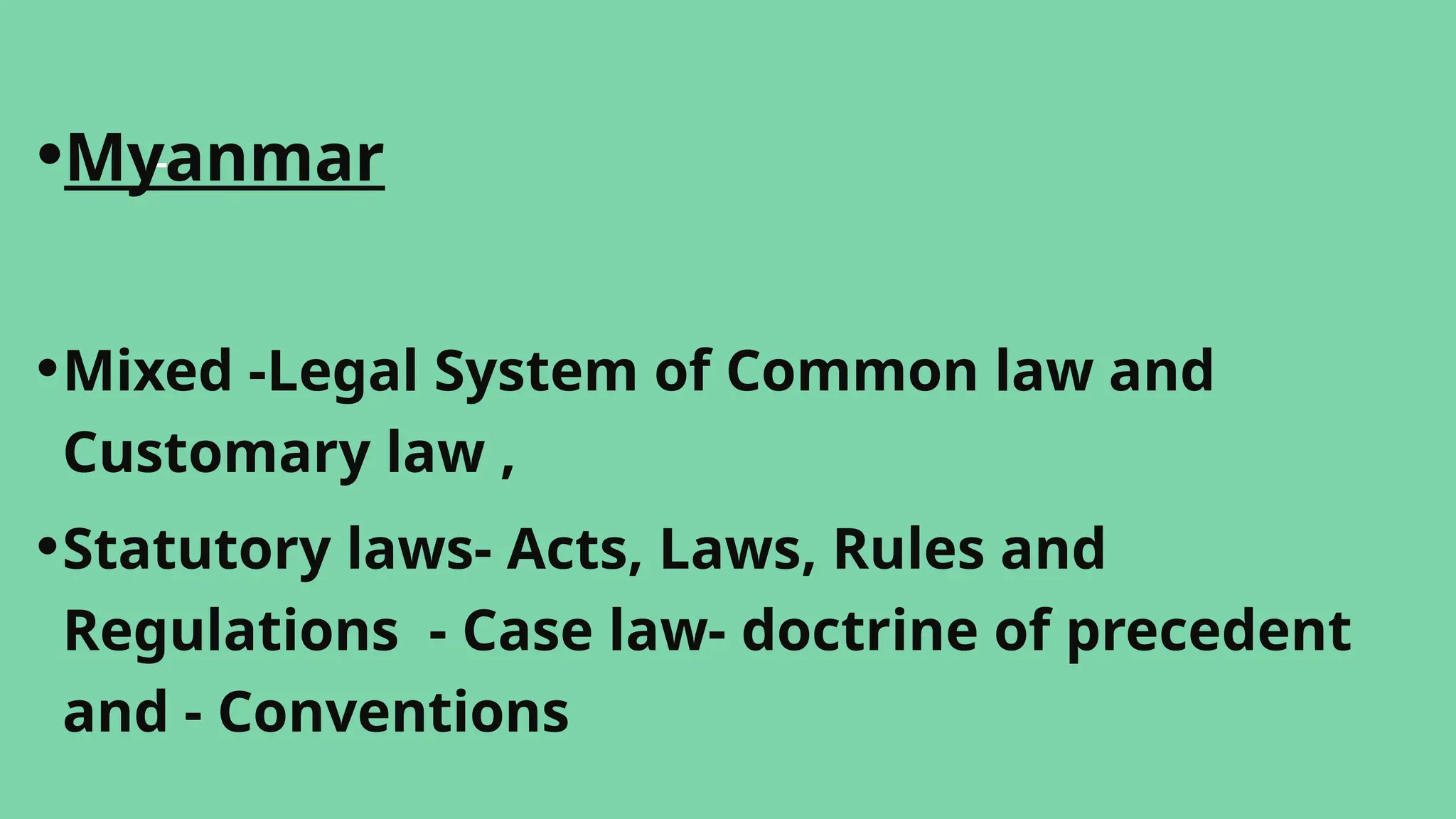
•Myanmar
•Mixed -Legal Systemof Common law and
Customary law ,
•Statutory laws- Acts, Laws, Rules and
Regulations - Case law- doctrine of precedent
and - Conventions
28.
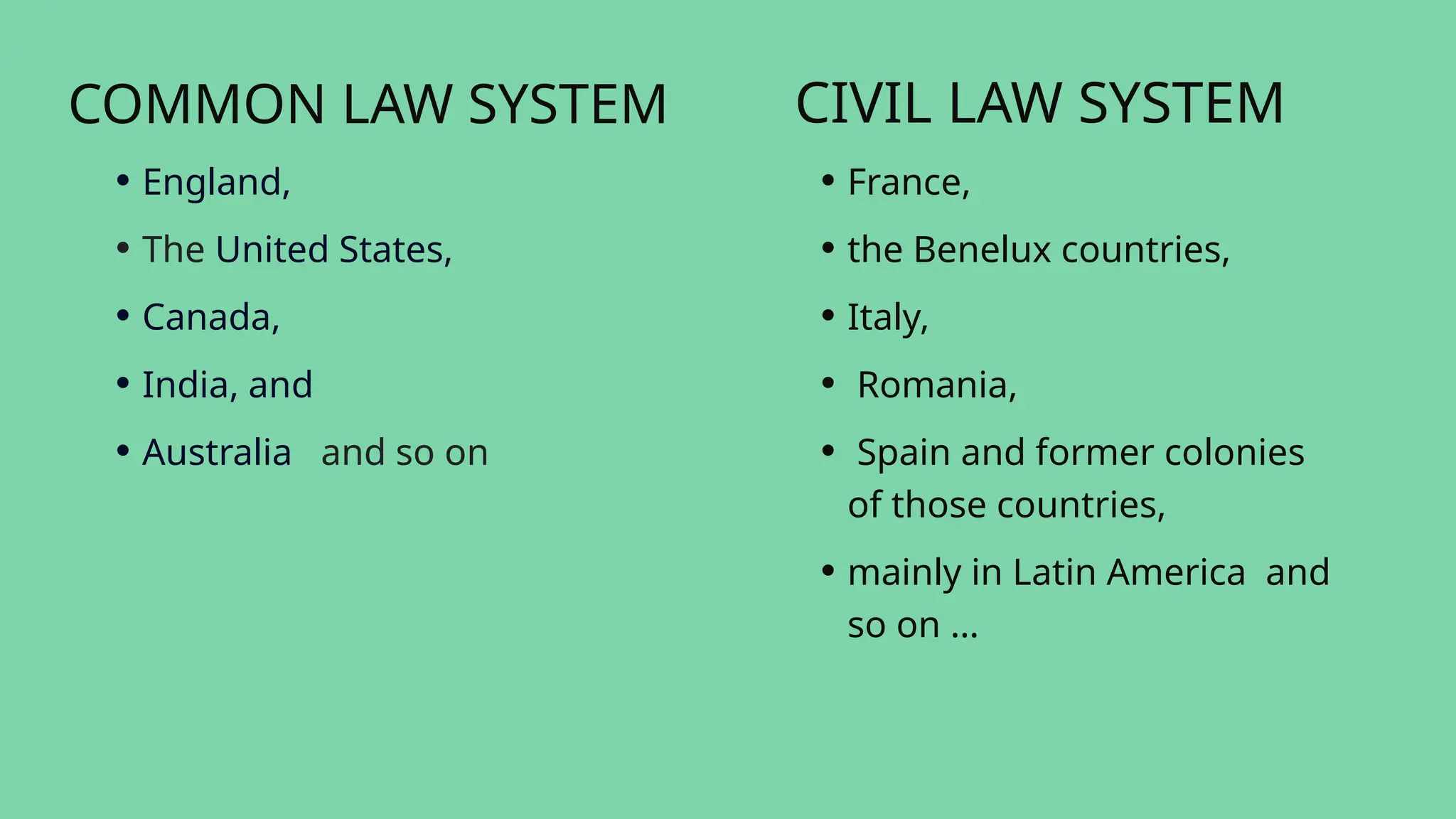
COMMON LAW SYSTEM
•England,
• The United States,
• Canada,
• India, and
• Australia and so on
CIVIL LAW SYSTEM
• France,
• the Benelux countries,
• Italy,
• Romania,
• Spain and former colonies
of those countries,
• mainly in Latin America and
so on …
29.
LAW - ?
•a set of rules,
• enforceable by the courts, which regulate the government of the state and
• governs the relationship between the state and its citizens and between one citizen
and another.
30.
LAW >>>
• Lawis essentially a set of rules.
• no rules in a society- completely chaotic.
• Thus, - laws for a society to function properly and peacefully.
31.
SOURCES OF LAW
•Legislation
• Case Law (Judicial Precedent)
• Customary Law
32.
● Common lawrefers to legal principles that have been developed over time through court
decisions, rather than through legislative action.
● Precedent is an essential aspect of common law, as it allows for consistency in legal decision-
making. A judge will often look to past cases that are similar to the one before them in order to
determine the appropriate outcome.
● This process ensures that the law is applied consistently and fairly, and it provides a degree of
predictability for individuals and businesses involved in legal disputes.
● Judges play a critical role in the development of common law. When a case is decided, the judge's
ruling becomes part of the body of common law.
● This means that judges have the power to shape the law over time, as they interpret and apply
legal principles to new cases.
PRINCIPLES OF COMMON LAW
33.
● The Relationshipbetween Common Law and Statutory Law:
Common law and statutory law are closely intertwined, and they often work together to
create a comprehensive legal system.
Statutory law is created by legislative bodies, and it can be used to supplement
or modify common law principles.
For example, if a court decision has created a loophole in the law, the legislature can pass a
statute to close that loophole.
● The Importance of Common Law in Modern Times:
Common law continues to play a vital role in shaping the legal system today. Although
statutory law has become more prevalent in recent years, common law principles are still
essential in many areas of the law.
For example, contract law is largely based on common law principles, and many tort claims
are also rooted in common law.
PRINCIPLES OF COMMON LAW Cont:
34.
LAW & BUSINESS
•Law and business are intertwined.
• most aspects of a business, such as setting up the business, buying or leasing a place for the business,
choosing a name for the business, getting financing for the business, getting insurance for the
business, buying equipment needed for the business, hiring employees for the business, marketing
the business, providing goods or services of the business and liquidating the business, can have legal
implications or consequences.
• with respect to business specifically, laws introduce certainty thereby reducing the risks associated with
running a business.
• Contract law , company law, investment law, labour law , environmental law , and so on



![Concept of Law 2-1[1].pptx](https://cdn.slidesharecdn.com/ss_thumbnails/conceptoflaw2-11-230406152345-e7a706cf-thumbnail.jpg?width=640&height=640&fit=bounds)


