BCSE308P-Computer
Networks
Lab Component
Sahaya Beni Prathiba, SCOPE
VIT-Chennai
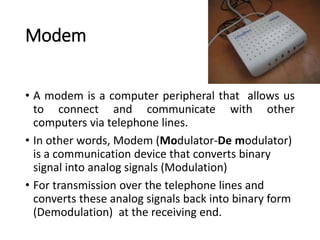
Modem
• A modem is a computer peripheral that allows us
to connect and communicate with other
computers via telephone lines.
• In other words, Modem (Modulator-De modulator)
is a communication device that converts binary
signal into analog signals (Modulation)
• For transmission over the telephone lines and
converts these analog signals back into binary form
(Demodulation) at the receiving end.
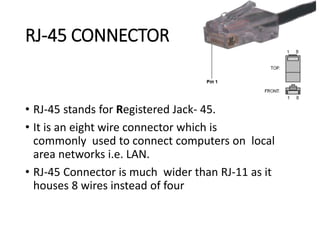
RJ-45 CONNECTOR
• RJ-45 stands for Registered Jack- 45.
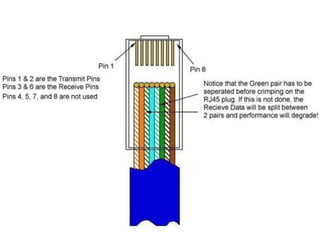
• It is an eight wire connector which is
commonly used to connect computers on local
area networks i.e. LAN.
• RJ-45 Connector is much wider than RJ-11 as it
houses 8 wires instead of four
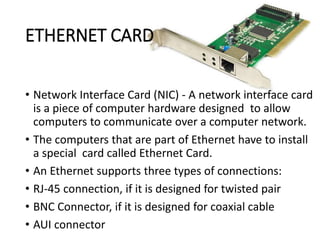
ETHERNET CARD
• Network Interface Card (NIC) - A network interface card
is a piece of computer hardware designed to allow
computers to communicate over a computer network.
• The computers that are part of Ethernet have to install
a special card called Ethernet Card.
• An Ethernet supports three types of connections:
• RJ-45 connection, if it is designed for twisted pair
• BNC Connector, if it is designed for coaxial cable
• AUI connector
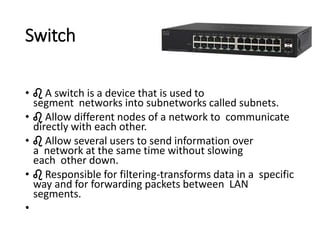
Switch
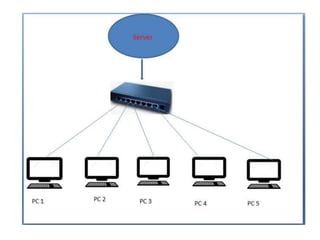
• ♌ A switch is a device that is used to
segment networks into subnetworks called subnets.
• ♌ Allow different nodes of a network to communicate
directly with each other.
• ♌ Allow several users to send information over
a network at the same time without slowing
each other down.
• ♌ Responsible for filtering-transforms data in a specific
way and for forwarding packets between LAN
segments.
•
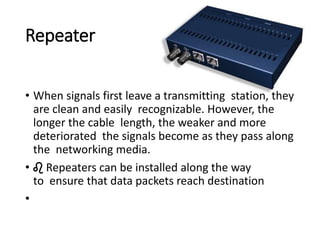
Repeater
• When signals first leave a transmitting station, they
are clean and easily recognizable. However, the
longer the cable length, the weaker and more
deteriorated the signals become as they pass along
the networking media.
• ♌ Repeaters can be installed along the way
to ensure that data packets reach destination
•
What is the disadvantage
associated with using a repeater?
• ♌ it can't filter network traffic. Data, sometimes
referred to as bits, arriving at one port of a
repeater gets sent out on all other ports
• ♌ data gets passed along by a repeater to all other
LAN segments of a network regardless of whether
it needs to go there or not.
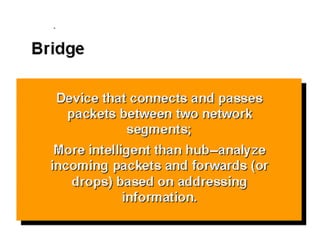
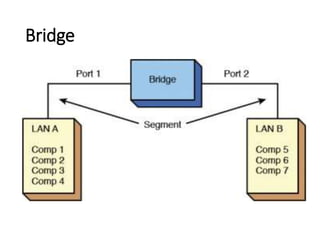
Bridge
Bridge
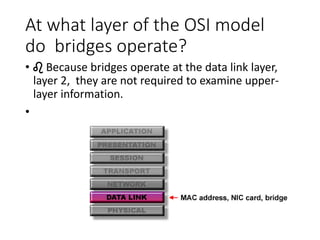
At what layer of the OSI model
do bridges operate?
• ♌ Because bridges operate at the data link layer,
layer 2, they are not required to examine upper-
layer information.
•
How are bridge data-
forwarding decisions limited?
• ♌ Although bridges use tables to
determine whether or not to forward data to
other segments of the network, the types
of comparisons and decisions they make
are relatively low level, simple ones
What types of network traffic
problems is a bridge incapable of
solving?
• ♌ Bridges work best where traffic from
one segment of a network to other segments
is not too great.
• ♌ However, when traffic between
network segments becomes too heavy, the
bridge can become a bottleneck and actually
slow down communication.
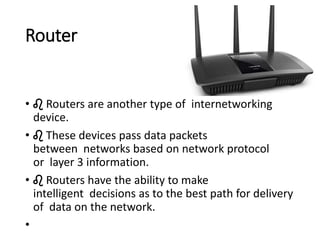
Router
• ♌ Routers are another type of internetworking
device.
• ♌ These devices pass data packets
between networks based on network protocol
or layer 3 information.
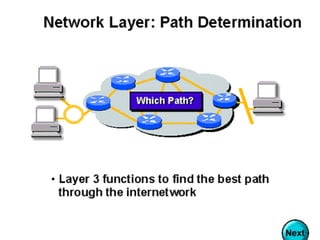
• ♌ Routers have the ability to make
intelligent decisions as to the best path for delivery
of data on the network.
•
What network problems
can routers help resolve?
• ♌ The problem of excessive broadcast traffic can
be solved by using a router.
• ♌ Routers are able to do this, because they do not
forward broadcast frames unless specifically told to
do so
•
How do routers differ
from bridges?
• ♌ Routers differ from bridges in several respects.
• First, bridging occurs at the data link layer or layer
2,while routing occurs at the network layer or layer
3 of the OSI model.
• ♌ Second, bridges use physical or MAC
addresses to make data forwarding decisions.
Routers use a different addressing scheme that
occurs at layer three
GATEWAY
• Device that connects dissimilar networks. Operates at
the highest level of abstraction.
• Expands the functionality of routers by performing
data translation and protocol conversion.
• Needed to convert Ethernet traffic from LAN to
San(Systems Network Architecture)traffic legacy
system.
• Then routes the SNA traffic to the mainframe.
• When Mainframe answers, Reverse
• process occurs.
• Establishes an intelligent connection between a local
network and external networks with completely
different structures.
Ex-1 Network components.pptx

Ex-1 Network components.pptx

  • 1.
  • 2.
    Modem • A modemis a computer peripheral that allows us to connect and communicate with other computers via telephone lines. • In other words, Modem (Modulator-De modulator) is a communication device that converts binary signal into analog signals (Modulation) • For transmission over the telephone lines and converts these analog signals back into binary form (Demodulation) at the receiving end.
  • 3.
    RJ-45 CONNECTOR • RJ-45stands for Registered Jack- 45. • It is an eight wire connector which is commonly used to connect computers on local area networks i.e. LAN. • RJ-45 Connector is much wider than RJ-11 as it houses 8 wires instead of four
  • 5.
    ETHERNET CARD • NetworkInterface Card (NIC) - A network interface card is a piece of computer hardware designed to allow computers to communicate over a computer network. • The computers that are part of Ethernet have to install a special card called Ethernet Card. • An Ethernet supports three types of connections: • RJ-45 connection, if it is designed for twisted pair • BNC Connector, if it is designed for coaxial cable • AUI connector
  • 6.
    Switch • ♌ Aswitch is a device that is used to segment networks into subnetworks called subnets. • ♌ Allow different nodes of a network to communicate directly with each other. • ♌ Allow several users to send information over a network at the same time without slowing each other down. • ♌ Responsible for filtering-transforms data in a specific way and for forwarding packets between LAN segments. •
  • 7.
    Repeater • When signalsfirst leave a transmitting station, they are clean and easily recognizable. However, the longer the cable length, the weaker and more deteriorated the signals become as they pass along the networking media. • ♌ Repeaters can be installed along the way to ensure that data packets reach destination •
  • 8.
    What is thedisadvantage associated with using a repeater? • ♌ it can't filter network traffic. Data, sometimes referred to as bits, arriving at one port of a repeater gets sent out on all other ports • ♌ data gets passed along by a repeater to all other LAN segments of a network regardless of whether it needs to go there or not.
  • 9.
  • 10.
  • 11.
    At what layerof the OSI model do bridges operate? • ♌ Because bridges operate at the data link layer, layer 2, they are not required to examine upper- layer information. •
  • 12.
    How are bridgedata- forwarding decisions limited? • ♌ Although bridges use tables to determine whether or not to forward data to other segments of the network, the types of comparisons and decisions they make are relatively low level, simple ones
  • 13.
    What types ofnetwork traffic problems is a bridge incapable of solving? • ♌ Bridges work best where traffic from one segment of a network to other segments is not too great. • ♌ However, when traffic between network segments becomes too heavy, the bridge can become a bottleneck and actually slow down communication.
  • 14.
    Router • ♌ Routersare another type of internetworking device. • ♌ These devices pass data packets between networks based on network protocol or layer 3 information. • ♌ Routers have the ability to make intelligent decisions as to the best path for delivery of data on the network. •
  • 16.
    What network problems canrouters help resolve? • ♌ The problem of excessive broadcast traffic can be solved by using a router. • ♌ Routers are able to do this, because they do not forward broadcast frames unless specifically told to do so •
  • 17.
    How do routersdiffer from bridges? • ♌ Routers differ from bridges in several respects. • First, bridging occurs at the data link layer or layer 2,while routing occurs at the network layer or layer 3 of the OSI model. • ♌ Second, bridges use physical or MAC addresses to make data forwarding decisions. Routers use a different addressing scheme that occurs at layer three
  • 18.
    GATEWAY • Device thatconnects dissimilar networks. Operates at the highest level of abstraction. • Expands the functionality of routers by performing data translation and protocol conversion. • Needed to convert Ethernet traffic from LAN to San(Systems Network Architecture)traffic legacy system. • Then routes the SNA traffic to the mainframe. • When Mainframe answers, Reverse • process occurs. • Establishes an intelligent connection between a local network and external networks with completely different structures.