Lecture 2 - Networking Devices
 Repeaters
Repeaters
 Hubs
Hubs
 Collisions
Collisions
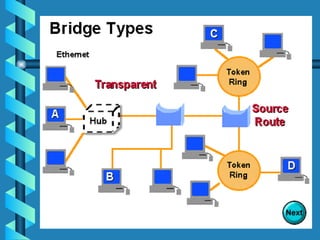
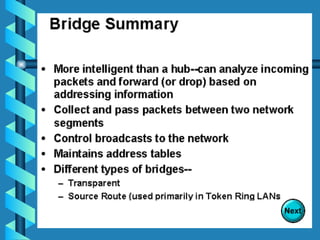
 Bridges
Bridges
 Routers
Routers
What are internetworking
devices?
devices?
 Internetworking devices are products
Internetworking devices are products
used to connect networks. As computer
networks grow in size and complexity, so do
the internetworking devices used to
connect them.
connect them.
The purposes of having devices
 First, they allow a greater number of nodes to
First, they allow a greater number of nodes to
be connected to the network.
 Second, they extend the distance over which a
Second, they extend the distance over which a
network can extend.
network can extend.
 Third, they localize traffic on the network.
Third, they localize traffic on the network.
 Fourth, they can merge existing networks.
Fourth, they can merge existing networks.
 Fifth, they isolate network problems so that
Fifth, they isolate network problems so that
they can be diagnosed more easily.
What internetworking devices operate at the
physical layer (layer 1) of the OSI model?
 A repeater can provide a simple solution if
A repeater can provide a simple solution if
either of these two problems exists.
 When signals first leave a transmitting
When signals first leave a transmitting
station, they are clean and easily
recognizable. However, the longer the cable
length, the weaker and more deteriorated
the signals become as they pass along the
networking media.
networking media.
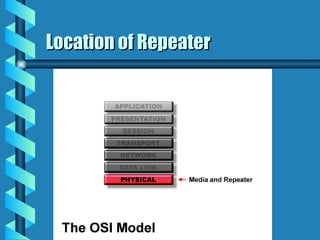
Location of Repeater
Hub
Hub
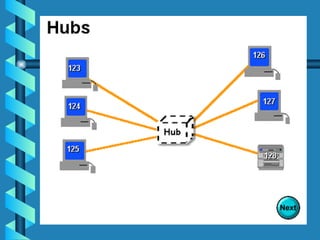
 Multi-port repeaters are often called hubs.
Multi-port repeaters are often called hubs.
Hubs are very common internetworking
devices. Generally speaking, the term hub
is used instead of repeater when referring
to the device that serves as the center of a
star topology network.
What is the disadvantage associated
with using a repeater?
 it can't filter network traffic. Data,
it can't filter network traffic. Data,
sometimes referred to as bits, arriving at
one port of a repeater gets sent out on all
other ports
other ports
 data gets passed along by a repeater to all
data gets passed along by a repeater to all
other LAN segments of a network
regardless of whether it needs to go there
or no
or no
What problem could occur as a result of
too much traffic on a network?
 if segments of a network are only connected
if segments of a network are only connected
by non-filtering devices such as repeaters,
this can result in more than one user trying
to send data on the network at the same time
 If more than one node attempts to transmit
If more than one node attempts to transmit
at the same time, a collision will occur.
 When a collision occurs, the data from each
When a collision occurs, the data from each
device impact and are damaged
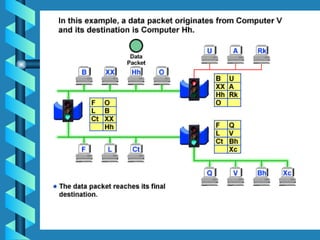
What internetworking device can be
used to filter traffic on the network?
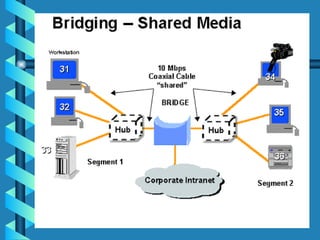
 One way to solve the problems of too much
One way to solve the problems of too much
traffic on a network and too many
collisions is to use an internetworking
device called a bridge.
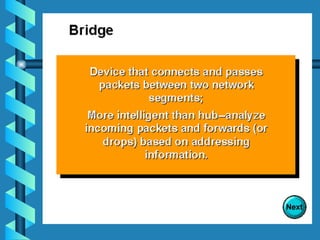
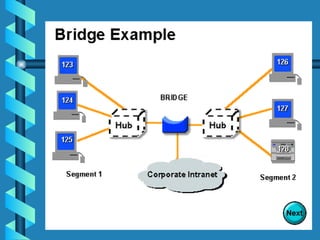
 A bridge eliminates unnecessary traffic
A bridge eliminates unnecessary traffic
and minimizes the chances of collisions
occurring on a network by dividing it into
segments
segments
At what layer of the OSI model do
bridges operate?
bridges operate?
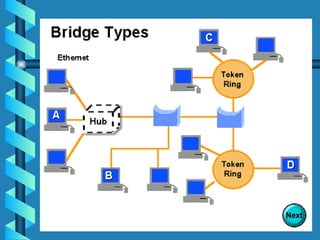
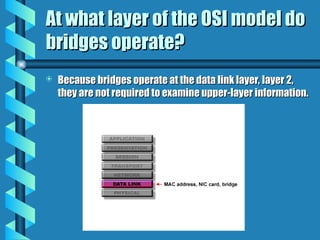
 Because bridges operate at the data link layer, layer 2,
Because bridges operate at the data link layer, layer 2,
they are not required to examine upper-layer information.
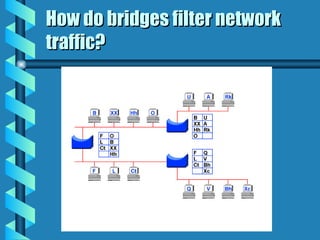
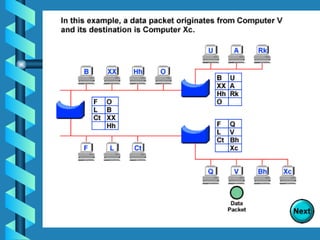
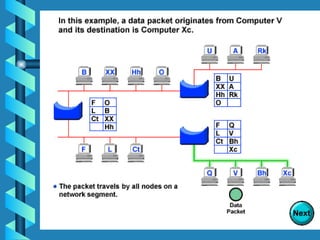
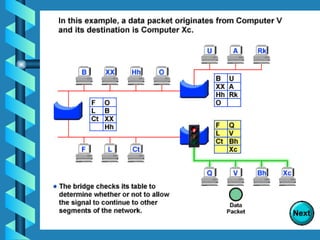
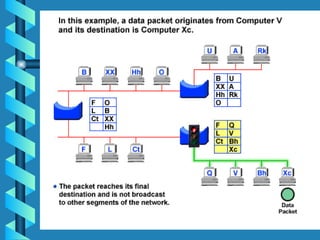
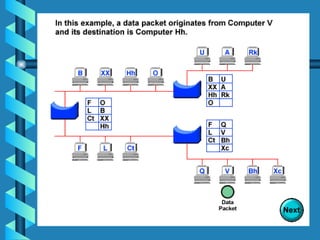
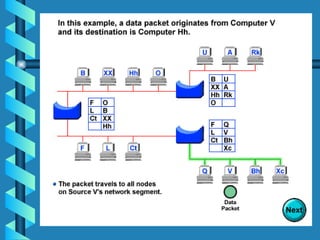
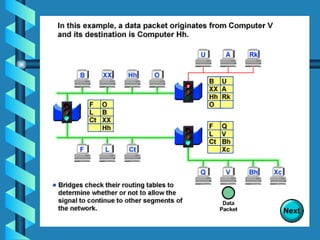
How do bridges filter network
traffic?
traffic?
How are bridge data-forwarding
decisions limited?
decisions limited?
 Although bridges use tables to determine
Although bridges use tables to determine
whether or not to forward data to other
segments of the network, the types of
comparisons and decisions they make are
relatively low level, simple ones
What types of network traffic
problems is a bridge incapable
of solving?
of solving?
 Bridges work best where traffic from one
Bridges work best where traffic from one
segment of a network to other segments is
not too great.
not too great.
 However, when traffic between network
However, when traffic between network
segments becomes too heavy, the bridge
can become a bottleneck and actually slow
down communication.
down communication.
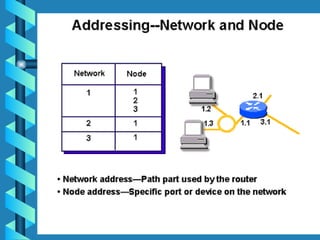
How many addressing schemes
are there in networking?
 You have already learned what one of these
You have already learned what one of these
addressing schemes is. It is the MAC
address.
address.
 The second addressing scheme in
The second addressing scheme in
networking makes use of what is called the
IP address.
IP address.
How do IP addresses differ from
MAC addresses?
MAC addresses?
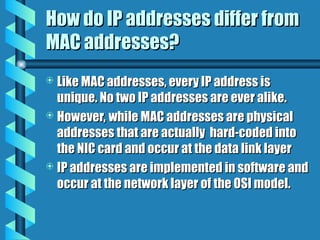
 Like MAC addresses, every IP address is
Like MAC addresses, every IP address is
unique. No two IP addresses are ever alike.
 However, while MAC addresses are physical
However, while MAC addresses are physical
addresses that are actually hard-coded into
the NIC card and occur at the data link layer
 IP addresses are implemented in software and
IP addresses are implemented in software and
occur at the network layer of the OSI model.
What are routers?
What are routers?
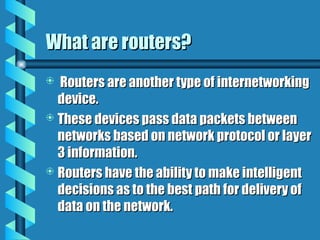
 Routers are another type of internetworking
Routers are another type of internetworking
device.
device.
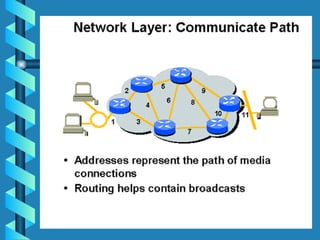
 These devices pass data packets between
These devices pass data packets between
networks based on network protocol or layer
3 information.
3 information.
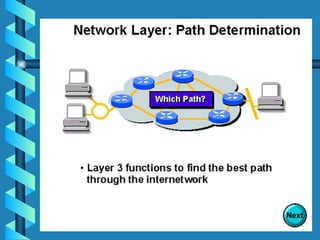
 Routers have the ability to make intelligent
Routers have the ability to make intelligent
decisions as to the best path for delivery of
data on the network.
What network problems can
routers help resolve?
 The problem of excessive broadcast traffic
The problem of excessive broadcast traffic
can be solved by using a router.
 Routers are able to do this, because they do
Routers are able to do this, because they do
not forward broadcast frames unless
specifically told to do so
How do routers differ from
bridges?
bridges?
 Routers differ from bridges in several respects.
Routers differ from bridges in several respects.
First, bridging occurs at the data link layer or
layer 2,while routing occurs at the network layer
or layer 3 of the OSI model.
 Second, bridges use physical or MAC addresses
Second, bridges use physical or MAC addresses
to make data forwarding decisions. Routers use a
different addressing scheme that occurs at layer
three
three
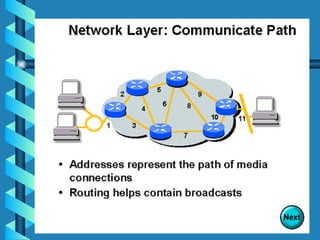
How do routers work?
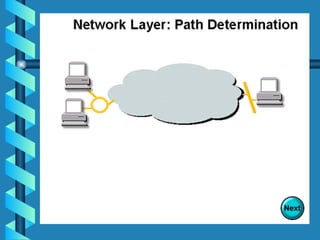
 Routers are used to connect two or more
Routers are used to connect two or more
networks. For routing to be successful,
each network must have a unique network
number
number
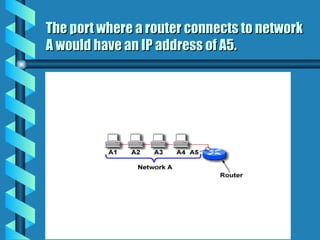
The port where a router connects to network
A would have an IP address of A5.
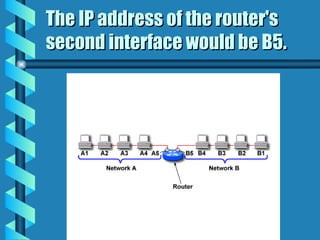
The IP address of the router's
second interface would be B5.
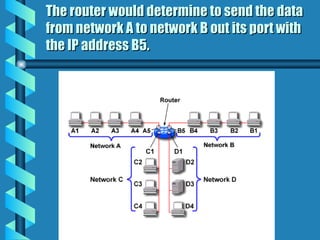
The router would determine to send the data
from network A to network B out its port with
the IP address B5.
the IP address B5.

Chapter4_2.ppt network types of topologies

  • 1.
    Lecture 2 -Networking Devices Lecture 2 - Networking Devices  Repeaters Repeaters  Hubs Hubs  Collisions Collisions  Bridges Bridges  Routers Routers
  • 2.
    What are internetworking Whatare internetworking devices? devices?  Internetworking devices are products Internetworking devices are products used to connect networks. As computer used to connect networks. As computer networks grow in size and complexity, so do networks grow in size and complexity, so do the internetworking devices used to the internetworking devices used to connect them. connect them.
  • 3.
    The purposes ofhaving devices The purposes of having devices  First, they allow a greater number of nodes to First, they allow a greater number of nodes to be connected to the network. be connected to the network.  Second, they extend the distance over which a Second, they extend the distance over which a network can extend. network can extend.  Third, they localize traffic on the network. Third, they localize traffic on the network.  Fourth, they can merge existing networks. Fourth, they can merge existing networks.  Fifth, they isolate network problems so that Fifth, they isolate network problems so that they can be diagnosed more easily. they can be diagnosed more easily.
  • 6.
    What internetworking devicesoperate at the What internetworking devices operate at the physical layer (layer 1) of the OSI model? physical layer (layer 1) of the OSI model?  A repeater can provide a simple solution if A repeater can provide a simple solution if either of these two problems exists. either of these two problems exists.  When signals first leave a transmitting When signals first leave a transmitting station, they are clean and easily station, they are clean and easily recognizable. However, the longer the cable recognizable. However, the longer the cable length, the weaker and more deteriorated length, the weaker and more deteriorated the signals become as they pass along the the signals become as they pass along the networking media. networking media.
  • 7.
  • 8.
    Hub Hub  Multi-port repeatersare often called hubs. Multi-port repeaters are often called hubs. Hubs are very common internetworking Hubs are very common internetworking devices. Generally speaking, the term hub devices. Generally speaking, the term hub is used instead of repeater when referring is used instead of repeater when referring to the device that serves as the center of a to the device that serves as the center of a star topology network. star topology network.
  • 11.
    What is thedisadvantage associated What is the disadvantage associated with using a repeater? with using a repeater?  it can't filter network traffic. Data, it can't filter network traffic. Data, sometimes referred to as bits, arriving at sometimes referred to as bits, arriving at one port of a repeater gets sent out on all one port of a repeater gets sent out on all other ports other ports  data gets passed along by a repeater to all data gets passed along by a repeater to all other LAN segments of a network other LAN segments of a network regardless of whether it needs to go there regardless of whether it needs to go there or no or no
  • 12.
    What problem couldoccur as a result of What problem could occur as a result of too much traffic on a network? too much traffic on a network?  if segments of a network are only connected if segments of a network are only connected by non-filtering devices such as repeaters, by non-filtering devices such as repeaters, this can result in more than one user trying this can result in more than one user trying to send data on the network at the same time to send data on the network at the same time  If more than one node attempts to transmit If more than one node attempts to transmit at the same time, a collision will occur. at the same time, a collision will occur.  When a collision occurs, the data from each When a collision occurs, the data from each device impact and are damaged device impact and are damaged
  • 13.
    What internetworking devicecan be What internetworking device can be used to filter traffic on the network? used to filter traffic on the network?  One way to solve the problems of too much One way to solve the problems of too much traffic on a network and too many traffic on a network and too many collisions is to use an internetworking collisions is to use an internetworking device called a bridge. device called a bridge.  A bridge eliminates unnecessary traffic A bridge eliminates unnecessary traffic and minimizes the chances of collisions and minimizes the chances of collisions occurring on a network by dividing it into occurring on a network by dividing it into segments segments
  • 20.
    At what layerof the OSI model do At what layer of the OSI model do bridges operate? bridges operate?  Because bridges operate at the data link layer, layer 2, Because bridges operate at the data link layer, layer 2, they are not required to examine upper-layer information. they are not required to examine upper-layer information.
  • 21.
    How do bridgesfilter network How do bridges filter network traffic? traffic?
  • 30.
    How are bridgedata-forwarding How are bridge data-forwarding decisions limited? decisions limited?  Although bridges use tables to determine Although bridges use tables to determine whether or not to forward data to other whether or not to forward data to other segments of the network, the types of segments of the network, the types of comparisons and decisions they make are comparisons and decisions they make are relatively low level, simple ones relatively low level, simple ones
  • 31.
    What types ofnetwork traffic What types of network traffic problems is a bridge incapable problems is a bridge incapable of solving? of solving?  Bridges work best where traffic from one Bridges work best where traffic from one segment of a network to other segments is segment of a network to other segments is not too great. not too great.  However, when traffic between network However, when traffic between network segments becomes too heavy, the bridge segments becomes too heavy, the bridge can become a bottleneck and actually slow can become a bottleneck and actually slow down communication. down communication.
  • 32.
    How many addressingschemes How many addressing schemes are there in networking? are there in networking?  You have already learned what one of these You have already learned what one of these addressing schemes is. It is the MAC addressing schemes is. It is the MAC address. address.  The second addressing scheme in The second addressing scheme in networking makes use of what is called the networking makes use of what is called the IP address. IP address.
  • 33.
    How do IPaddresses differ from How do IP addresses differ from MAC addresses? MAC addresses?  Like MAC addresses, every IP address is Like MAC addresses, every IP address is unique. No two IP addresses are ever alike. unique. No two IP addresses are ever alike.  However, while MAC addresses are physical However, while MAC addresses are physical addresses that are actually hard-coded into addresses that are actually hard-coded into the NIC card and occur at the data link layer the NIC card and occur at the data link layer  IP addresses are implemented in software and IP addresses are implemented in software and occur at the network layer of the OSI model. occur at the network layer of the OSI model.
  • 34.
    What are routers? Whatare routers?  Routers are another type of internetworking Routers are another type of internetworking device. device.  These devices pass data packets between These devices pass data packets between networks based on network protocol or layer networks based on network protocol or layer 3 information. 3 information.  Routers have the ability to make intelligent Routers have the ability to make intelligent decisions as to the best path for delivery of decisions as to the best path for delivery of data on the network. data on the network.
  • 39.
    What network problemscan What network problems can routers help resolve? routers help resolve?  The problem of excessive broadcast traffic The problem of excessive broadcast traffic can be solved by using a router. can be solved by using a router.  Routers are able to do this, because they do Routers are able to do this, because they do not forward broadcast frames unless not forward broadcast frames unless specifically told to do so specifically told to do so
  • 41.
    How do routersdiffer from How do routers differ from bridges? bridges?  Routers differ from bridges in several respects. Routers differ from bridges in several respects. First, bridging occurs at the data link layer or First, bridging occurs at the data link layer or layer 2,while routing occurs at the network layer layer 2,while routing occurs at the network layer or layer 3 of the OSI model. or layer 3 of the OSI model.  Second, bridges use physical or MAC addresses Second, bridges use physical or MAC addresses to make data forwarding decisions. Routers use a to make data forwarding decisions. Routers use a different addressing scheme that occurs at layer different addressing scheme that occurs at layer three three
  • 42.
    How do routerswork? How do routers work?  Routers are used to connect two or more Routers are used to connect two or more networks. For routing to be successful, networks. For routing to be successful, each network must have a unique network each network must have a unique network number number
  • 43.
    The port wherea router connects to network The port where a router connects to network A would have an IP address of A5. A would have an IP address of A5.
  • 44.
    The IP addressof the router's The IP address of the router's second interface would be B5. second interface would be B5.
  • 45.
    The router woulddetermine to send the data The router would determine to send the data from network A to network B out its port with from network A to network B out its port with the IP address B5. the IP address B5.