Language In Indian Context
The Transformation Of Sanskrit
Parakrit To Pali & Apbhransha.
The History of Visual Communication
The Revocation and Later Transformation
Hindi & Urdu
Dravidian Languages
Conclusion
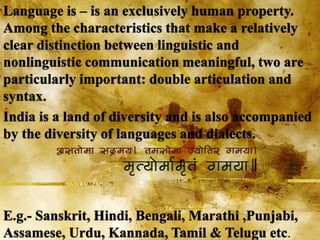
Language is – is an exclusively human property.
Among the characteristics that make a relatively
clear distinction between linguistic and
nonlinguistic communication meaningful, two are
particularly important: double articulation and
syntax.
India is a land of diversity and is also accompanied
by the diversity of languages and dialects.
E.g.- Sanskrit, Hindi, Bengali, Marathi ,Punjabi,
Assamese, Urdu, Kannada, Tamil & Telugu etc.
• The Vedic Sanskrit later transformed into the
Parakrit language in 1500-200 B.C.
• Parakrit means “occurring from the source of
Origin”. Since Sanskrit has been the origin of all
the languages it was Parakrit which was first
derived out of the Sanskrit.
• The difference between the Sanskrit and Parakrit
is proposed by the forms of speech and
grammatical use of the language.
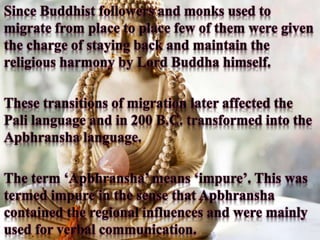
Since Buddhist followers and monks used to
migrate from place to place few of them were given
the charge of staying back and maintain the
religious harmony by Lord Buddha himself.
These transitions of migration later affected the
Pali language and in 200 B.C. transformed into the
Apbhransha language.
The term ‘Apbhransha’ means ‘impure’. This was
termed impure in the sense that Apbhransha
contained the regional influences and were mainly
used for verbal communication.
• It is interesting to note that language is
also a part of visuals. Language is
governed by the alphabets or letters which
in turn are symbols. Symbols are the part
of Visuals.
• Through the use of Visuals people
developed the phenomena of language and
then from language they went into the
much detailed principle of painting.
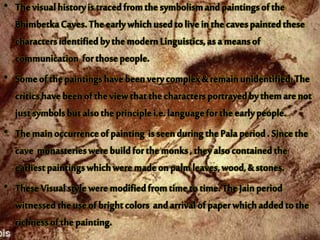
• Thevisualhistoryistracedfromthesymbolismandpaintingsofthe
BhimbetkaCaves.Theearlywhichusedtoliveinthecavespaintedthese
charactersidentifiedbythemodernLinguistics,asameansof
communication forthosepeople.
• Someofthepaintingshavebeenverycomplex&remainunidentified.The
criticshavebeenoftheviewthatthecharactersportrayedbythemarenot
justsymbolsbutalsotheprinciplei.e.languagefortheearlypeople.
• Themainoccurrenceofpainting isseenduringthePalaperiod.Sincethe
cave monasterieswerebuildforthemonks,theyalsocontainedthe
earliestpaintingswhichweremadeonpalmleaves,wood,&stones.
• TheseVisualstyleweremodifiedfromtimetotime.TheJainperiod
witnessedtheuseofbrightcolors andarrivalofpaperwhichaddedtothe
richnessofthepainting.
• Not only the visual communication but the lingual
communication was also influenced by different
cultures which arrived at the Indian land.
• The visual and language communication go hand in
hand and is transformed at the same time.
• History proves this fact of correlation visual and
language communication which will go on forever
• The use of Apbhransha existed till the 10th
Century A.D. With the arrival of the Jain culture
the use of Vedic Sanskrit was brought back into
the communication scenario.
• The societies now began their original
transformation. Also the Hindu followers who
didn’t believe in the existence of Buddha revoked
the use of Sanskrit.
• This revocation later resulted into the division
• The regional varieties and cultural
differentiation also added to the
transformation and by the end of the 14th
century there were several languages which
ended the revocation of Sanskrit.
• Also the arrival of Persians, Mongolians,
Colonials, etc. added on to the diversification
of the Language.
• The colonials also transformed the education
system in India which added on to the
language diversity.
relevance.
Evolution of languages

Evolution of languages

  • 2.
    Language In IndianContext The Transformation Of Sanskrit Parakrit To Pali & Apbhransha. The History of Visual Communication The Revocation and Later Transformation Hindi & Urdu Dravidian Languages Conclusion
  • 4.
    Language is –is an exclusively human property. Among the characteristics that make a relatively clear distinction between linguistic and nonlinguistic communication meaningful, two are particularly important: double articulation and syntax. India is a land of diversity and is also accompanied by the diversity of languages and dialects. E.g.- Sanskrit, Hindi, Bengali, Marathi ,Punjabi, Assamese, Urdu, Kannada, Tamil & Telugu etc.
  • 6.
    • The VedicSanskrit later transformed into the Parakrit language in 1500-200 B.C. • Parakrit means “occurring from the source of Origin”. Since Sanskrit has been the origin of all the languages it was Parakrit which was first derived out of the Sanskrit. • The difference between the Sanskrit and Parakrit is proposed by the forms of speech and grammatical use of the language.
  • 8.
    Since Buddhist followersand monks used to migrate from place to place few of them were given the charge of staying back and maintain the religious harmony by Lord Buddha himself. These transitions of migration later affected the Pali language and in 200 B.C. transformed into the Apbhransha language. The term ‘Apbhransha’ means ‘impure’. This was termed impure in the sense that Apbhransha contained the regional influences and were mainly used for verbal communication.
  • 9.
    • It isinteresting to note that language is also a part of visuals. Language is governed by the alphabets or letters which in turn are symbols. Symbols are the part of Visuals. • Through the use of Visuals people developed the phenomena of language and then from language they went into the much detailed principle of painting.
  • 10.
    • Thevisualhistoryistracedfromthesymbolismandpaintingsofthe BhimbetkaCaves.Theearlywhichusedtoliveinthecavespaintedthese charactersidentifiedbythemodernLinguistics,asameansof communication forthosepeople. •Someofthepaintingshavebeenverycomplex&remainunidentified.The criticshavebeenoftheviewthatthecharactersportrayedbythemarenot justsymbolsbutalsotheprinciplei.e.languagefortheearlypeople. • Themainoccurrenceofpainting isseenduringthePalaperiod.Sincethe cave monasterieswerebuildforthemonks,theyalsocontainedthe earliestpaintingswhichweremadeonpalmleaves,wood,&stones. • TheseVisualstyleweremodifiedfromtimetotime.TheJainperiod witnessedtheuseofbrightcolors andarrivalofpaperwhichaddedtothe richnessofthepainting.
  • 11.
    • Not onlythe visual communication but the lingual communication was also influenced by different cultures which arrived at the Indian land. • The visual and language communication go hand in hand and is transformed at the same time. • History proves this fact of correlation visual and language communication which will go on forever
  • 12.
    • The useof Apbhransha existed till the 10th Century A.D. With the arrival of the Jain culture the use of Vedic Sanskrit was brought back into the communication scenario. • The societies now began their original transformation. Also the Hindu followers who didn’t believe in the existence of Buddha revoked the use of Sanskrit. • This revocation later resulted into the division
  • 13.
    • The regionalvarieties and cultural differentiation also added to the transformation and by the end of the 14th century there were several languages which ended the revocation of Sanskrit. • Also the arrival of Persians, Mongolians, Colonials, etc. added on to the diversification of the Language. • The colonials also transformed the education system in India which added on to the language diversity.
  • 16.