Evolution of FacePresented by :-Dr. Manish kumarBapuji Dental College & Hospital, Davangere1
ContentsIntroductionDefinitionsTheories of evolutionEvolution of humansEvolution of faceQudrapedal to bipedal position              Enlargement of brain              Rotation of orbits              Rotation of olfactory bulb              Rotation of nasomaxillary complexConclusionreferences2
IntroductionThe history of planet Earth began 4.6 billion years ago. At each age one type of life has dominated over all other forms, so much that there is a direct relationship between climatic & geologic condition & the dominating type of life existing.From the biologic point of view we see  that as environment changed there was a corresponding change in the form & structure of the animal & plant kingdoms. 3
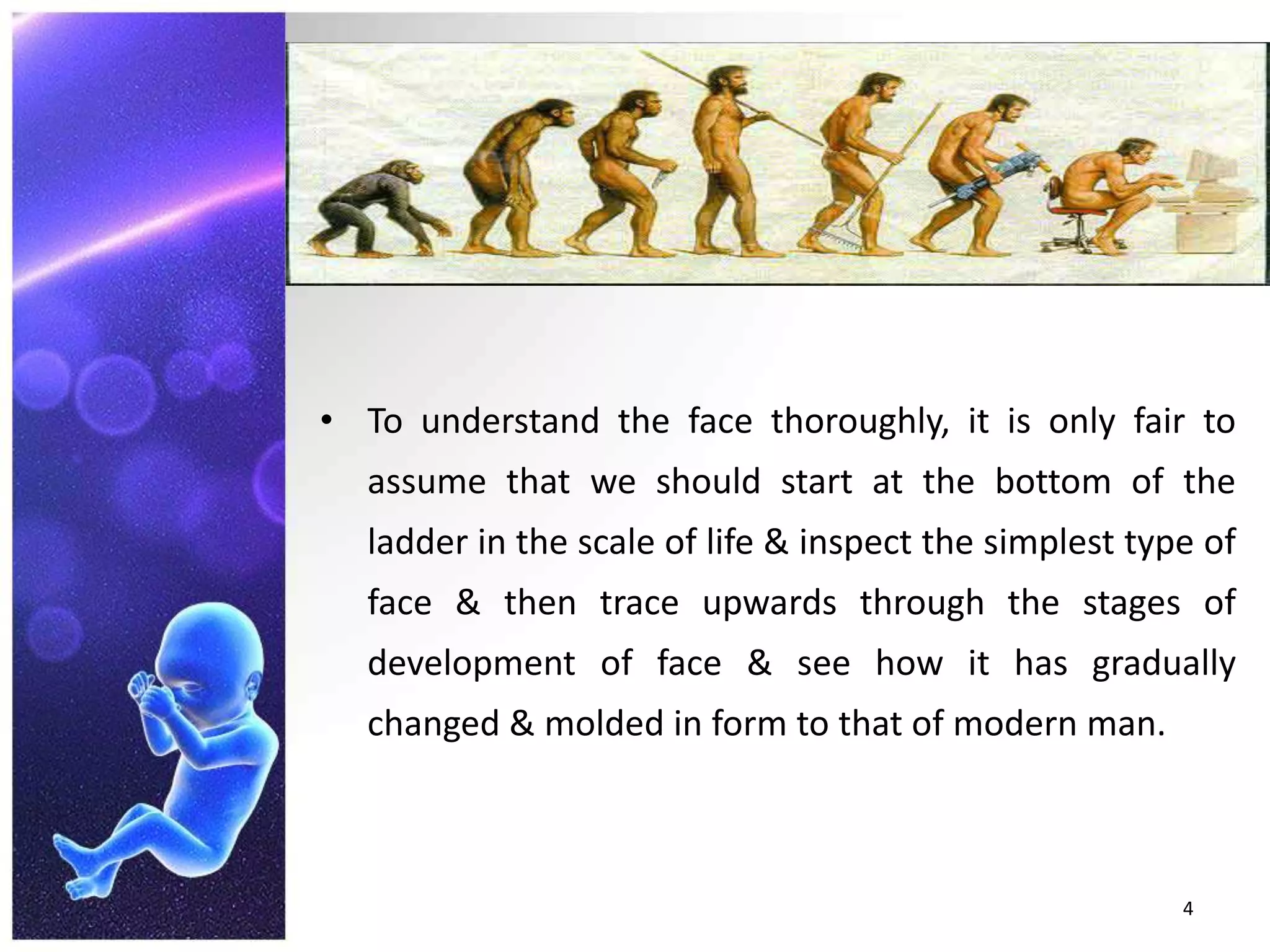
To understand the face thoroughly, it is only fair to assume that we should start at the bottom of the ladder in the scale of life & inspect the simplest type of face & then trace upwards through the stages of development of face & see how it has gradually changed & molded in form to that of modern man.4
Definition of Evolution“ A continuous process of change from one state, condition or form to another “Stedman’s Medical Dictionary “ A developmental process in which an organ or organism becomes more & more complex by differentiation of its parts; a continuous & progressive change according to certain laws & by means of resident forces “Dorland Medical Dictionary5
Theories of EvolutionFour main theories to explain the method by which species of life that exist today have evolved from earlier simpler forms.Thelamarckian theory.The theory of orthogenesis.The theory of natural selection.The mendelian theory.666666
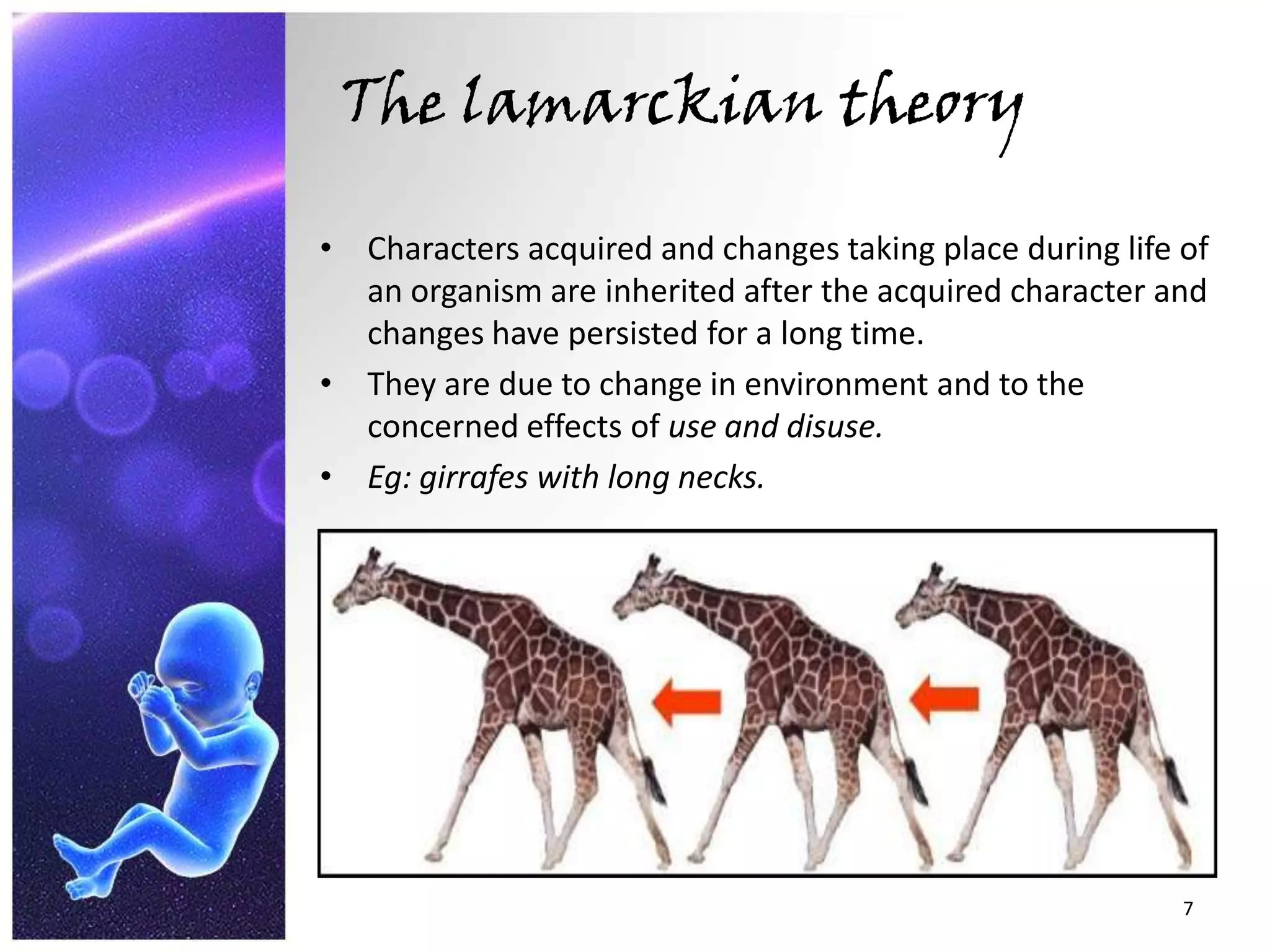
The lamarckian theoryCharacters acquired and changes taking place during life of an organism are inherited after the acquired character and changes have persisted for a long time.They are due to change in environment and to the concerned effects of use and disuse.Eg: girrafes with long necks.7
Theory of orthogenesis [development in straight line]Put forth by Haldane and Julian Huxley.They considered that evolution proceeds in any particular direction ,not because of any advantage gained by the race or because of direct moulding effect by the surrounding, but because of some inner urge ,some necessity for the hereditary constitution to change in just that particular way.8
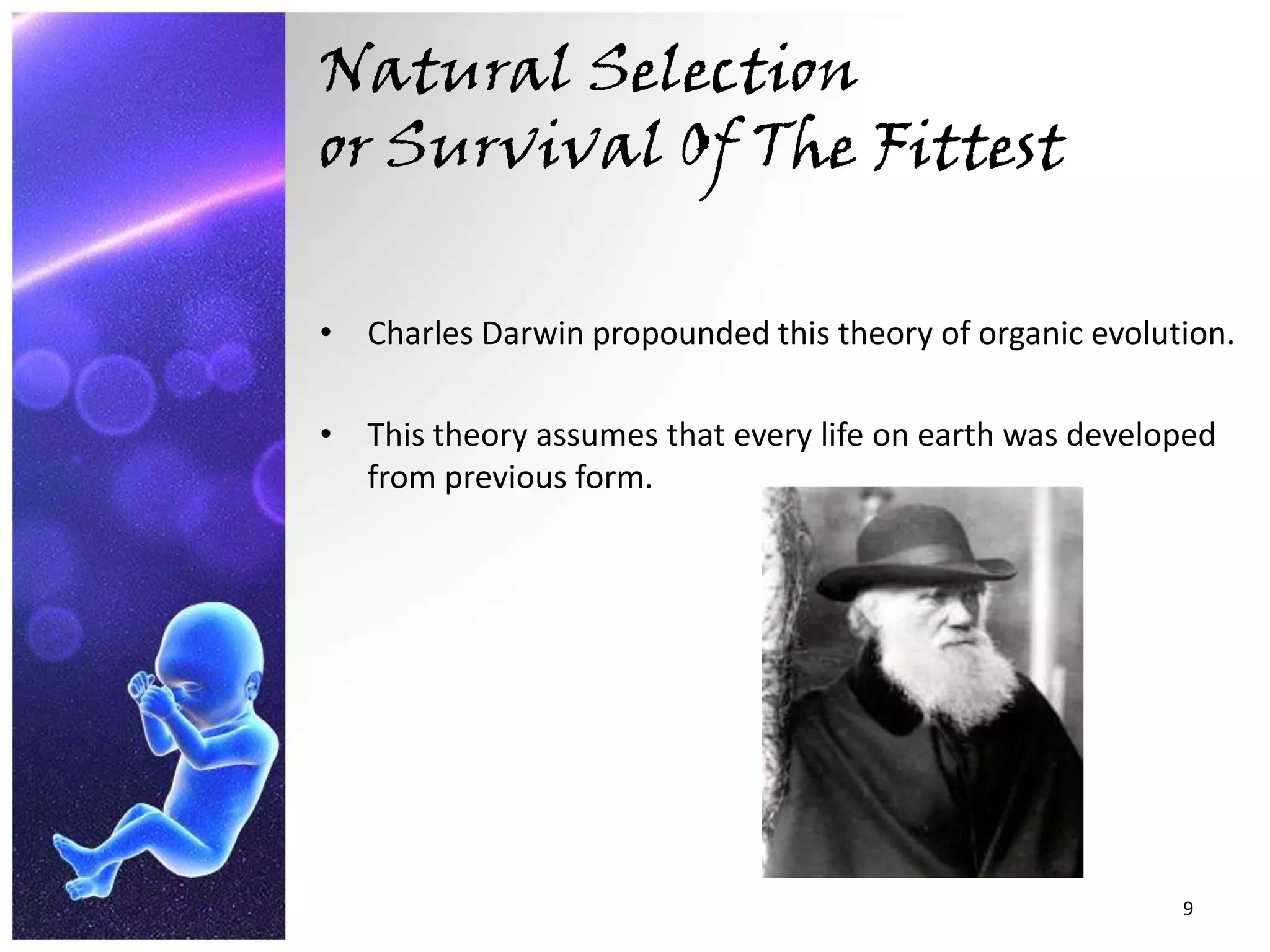
Natural Selection                                          or Survival Of The FittestCharles Darwin propounded this theory of organic evolution.This theory assumes that every life on earth was developed from previous form.9
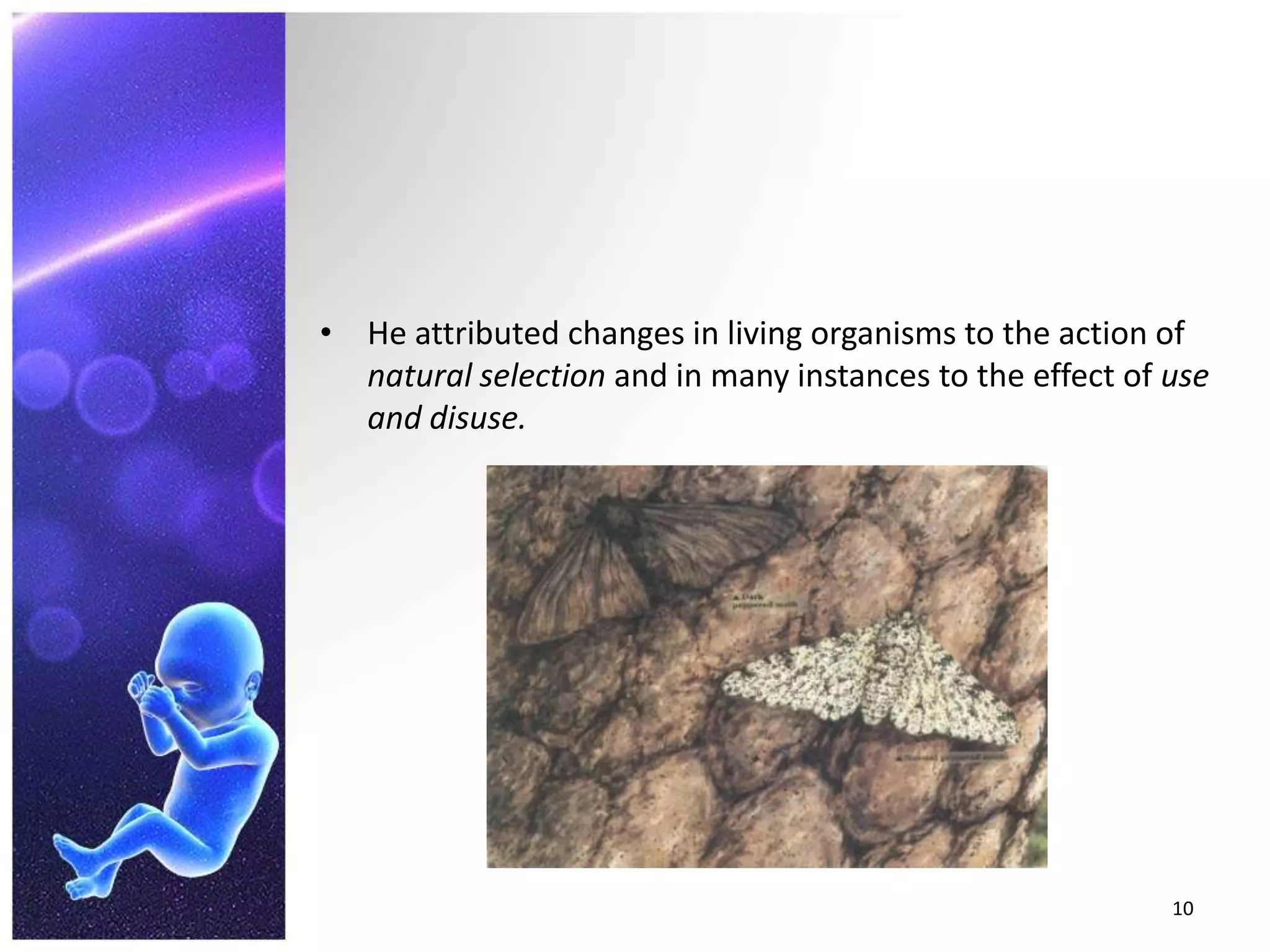
He attributed changes in living organisms to the action of natural selection and in many instances to the effect of use and disuse.10
This theory can be summarized briefly as:Struggle for existenceNatural selectionHereditySurvival of the fittest.11
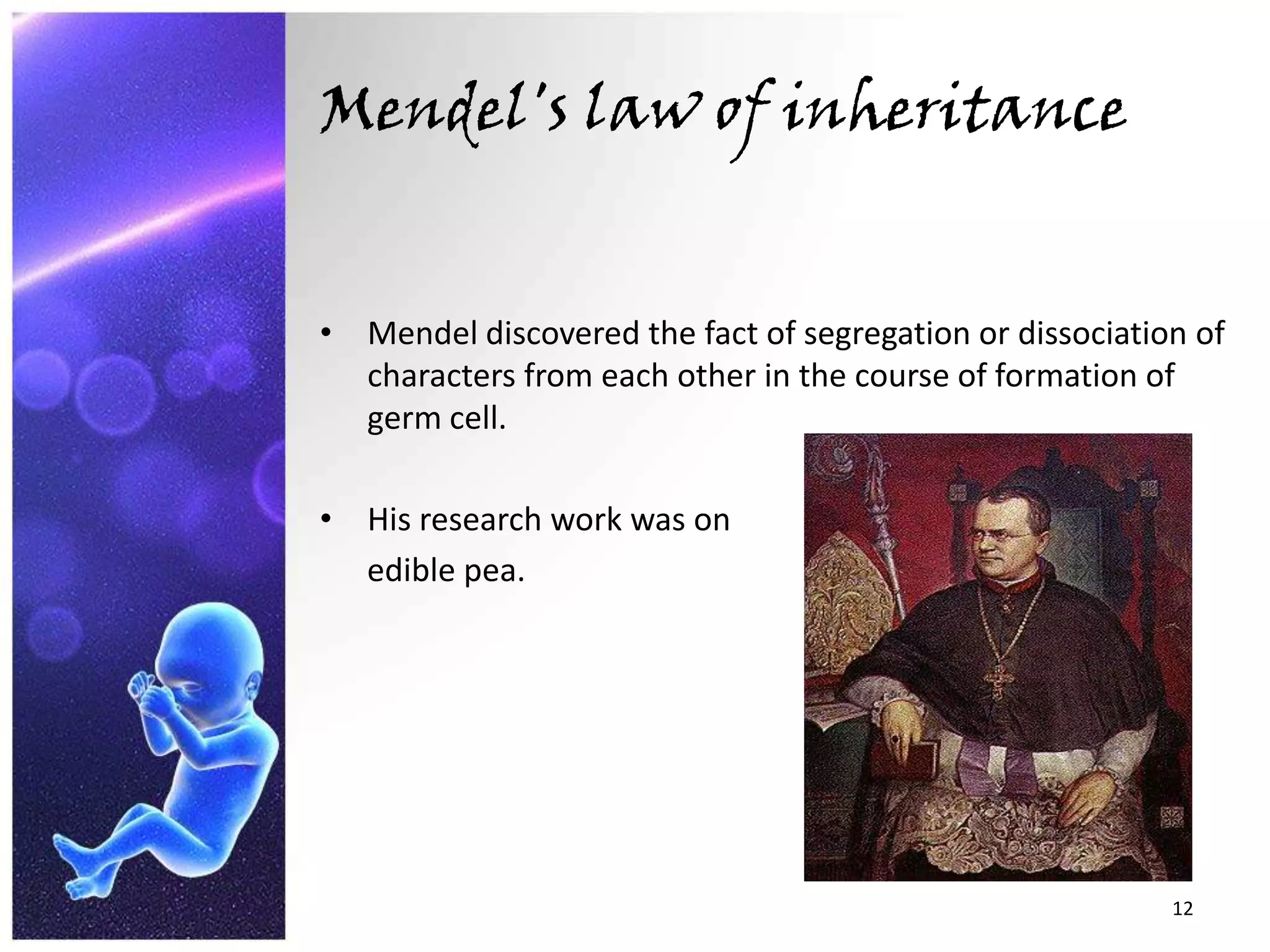
Mendel's law of inheritance Mendel discovered the fact of segregation or dissociation of characters from each other in the course of formation of germ cell.His research work was on       edible pea.12
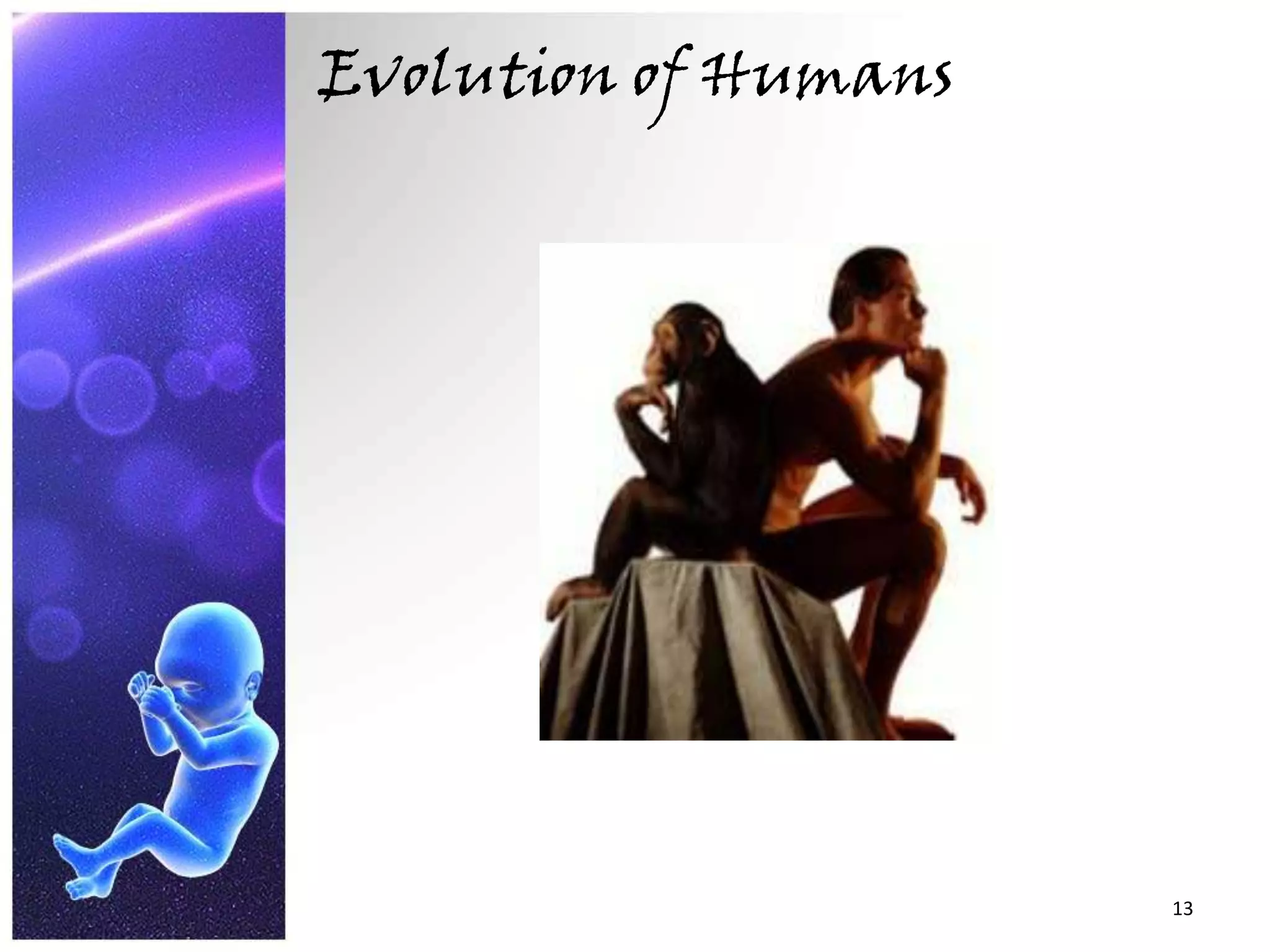
Evolution of Humans13
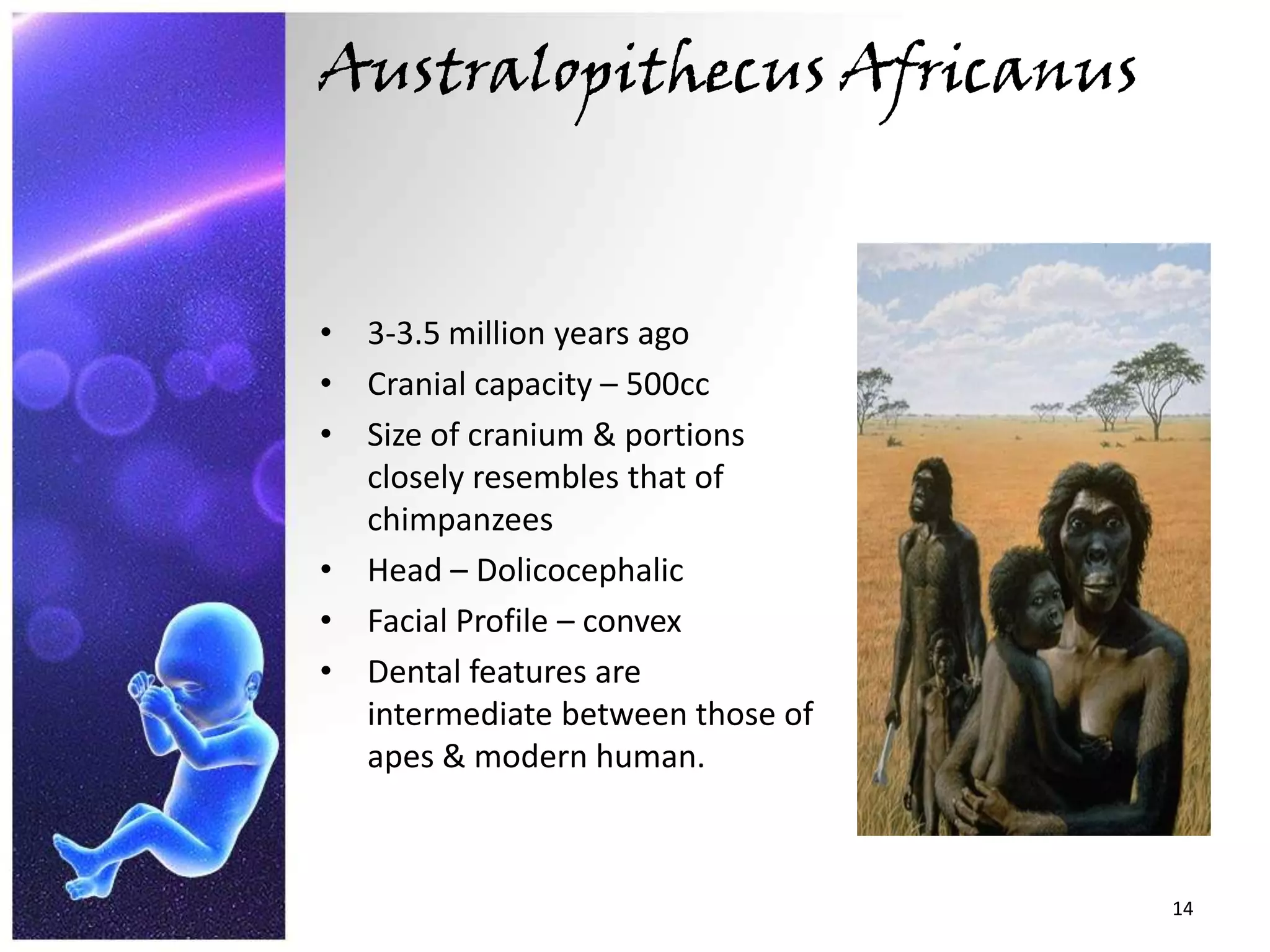
Australopithecus Africanus3-3.5 million years agoCranial capacity – 500ccSize of cranium & portions closely resembles that of chimpanzeesHead – DolicocephalicFacial Profile – convexDental features are intermediate between those of apes & modern human.14
This theory can be summarized briefly as:Struggle for existenceNatural selectionHereditySurvival of the fittest.15
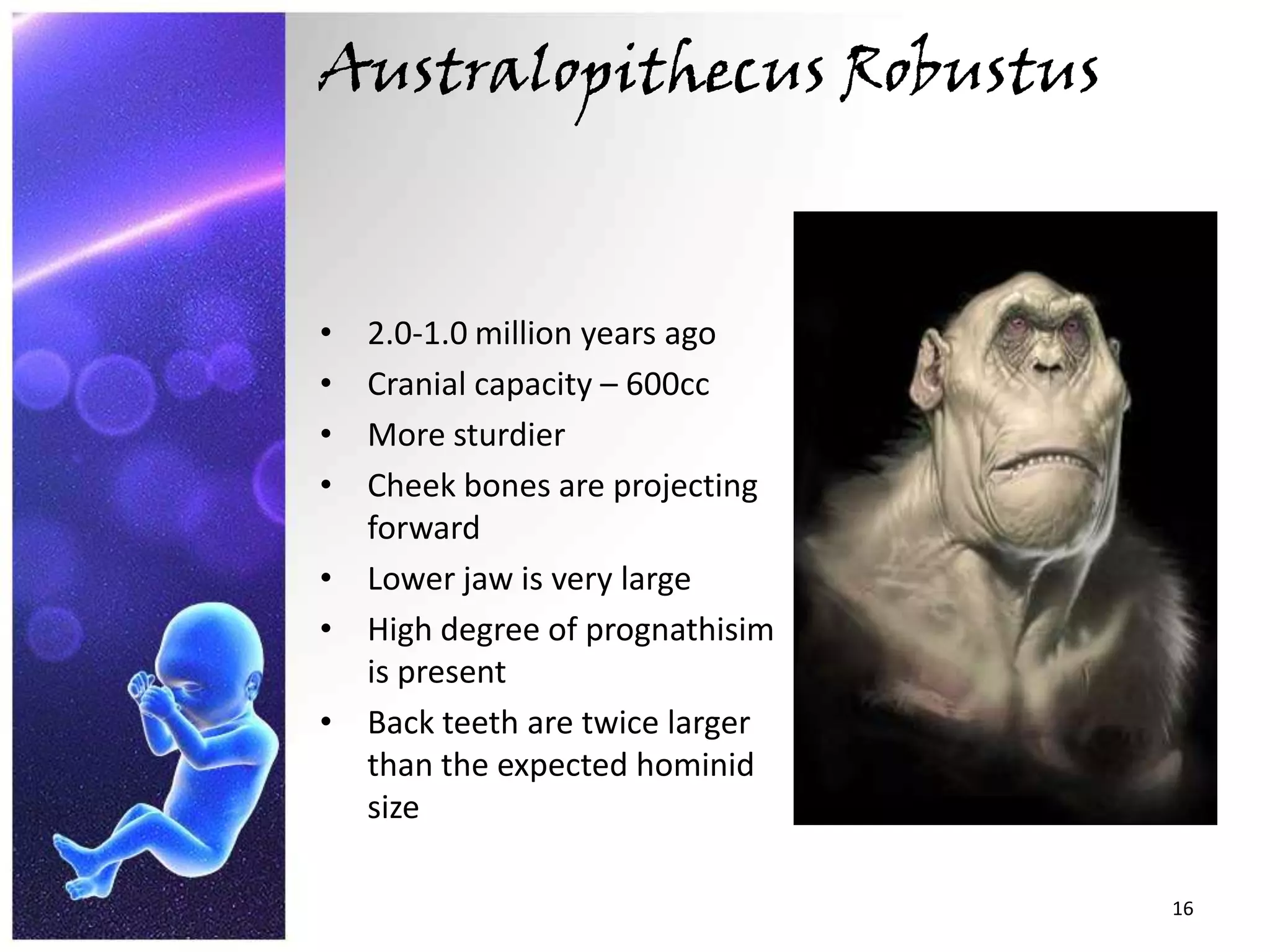
Australopithecus Robustus2.0-1.0 million years agoCranial capacity – 600ccMore sturdierCheek bones are projecting forwardLower jaw is very largeHigh degree of prognathisim is presentBack teeth are twice larger than the expected hominid size16
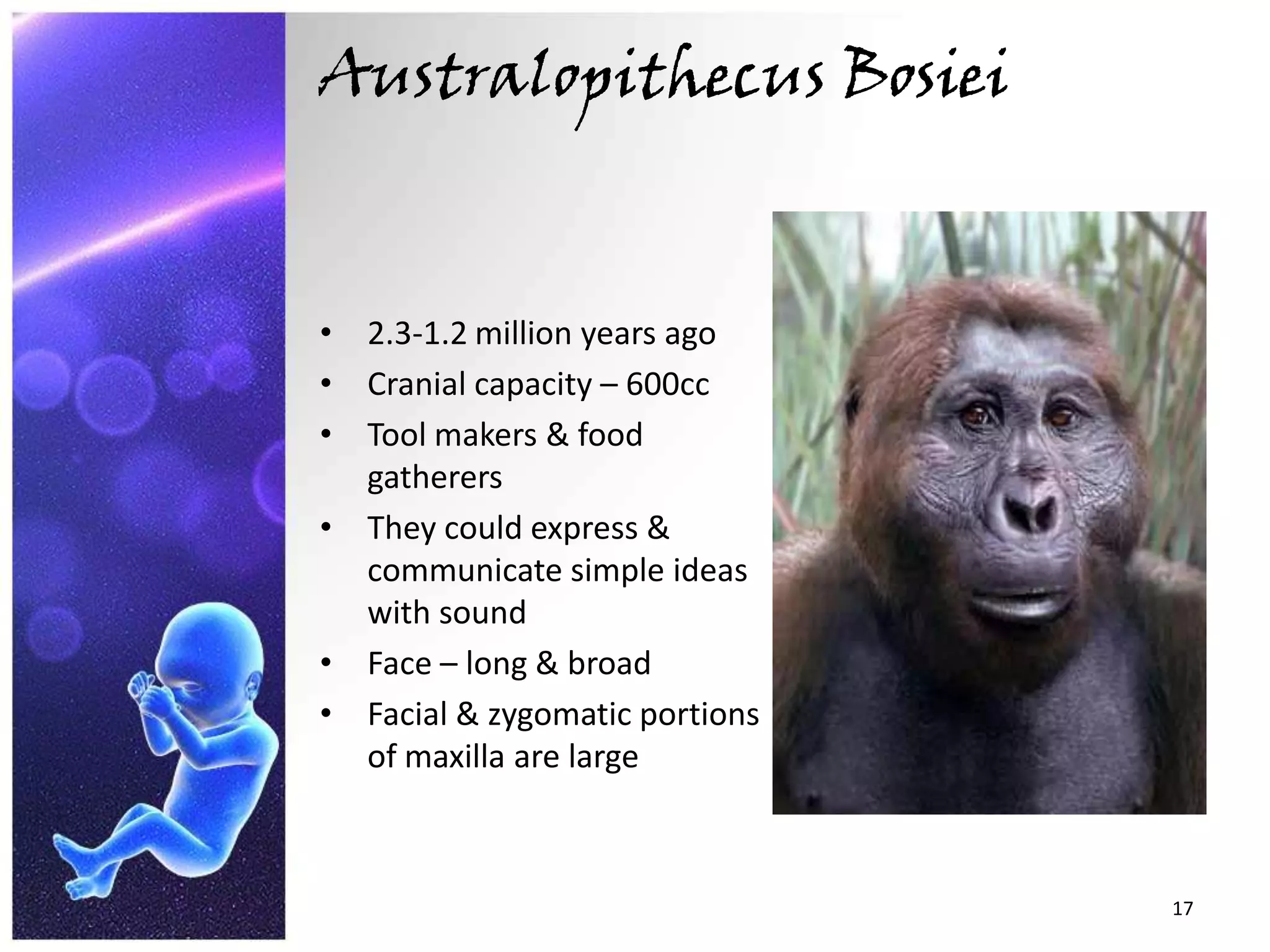
Australopithecus Bosiei2.3-1.2 million years agoCranial capacity – 600ccTool makers & food gatherersThey could express & communicate simple ideas with soundFace – long & broadFacial & zygomatic portions of maxilla are large 17
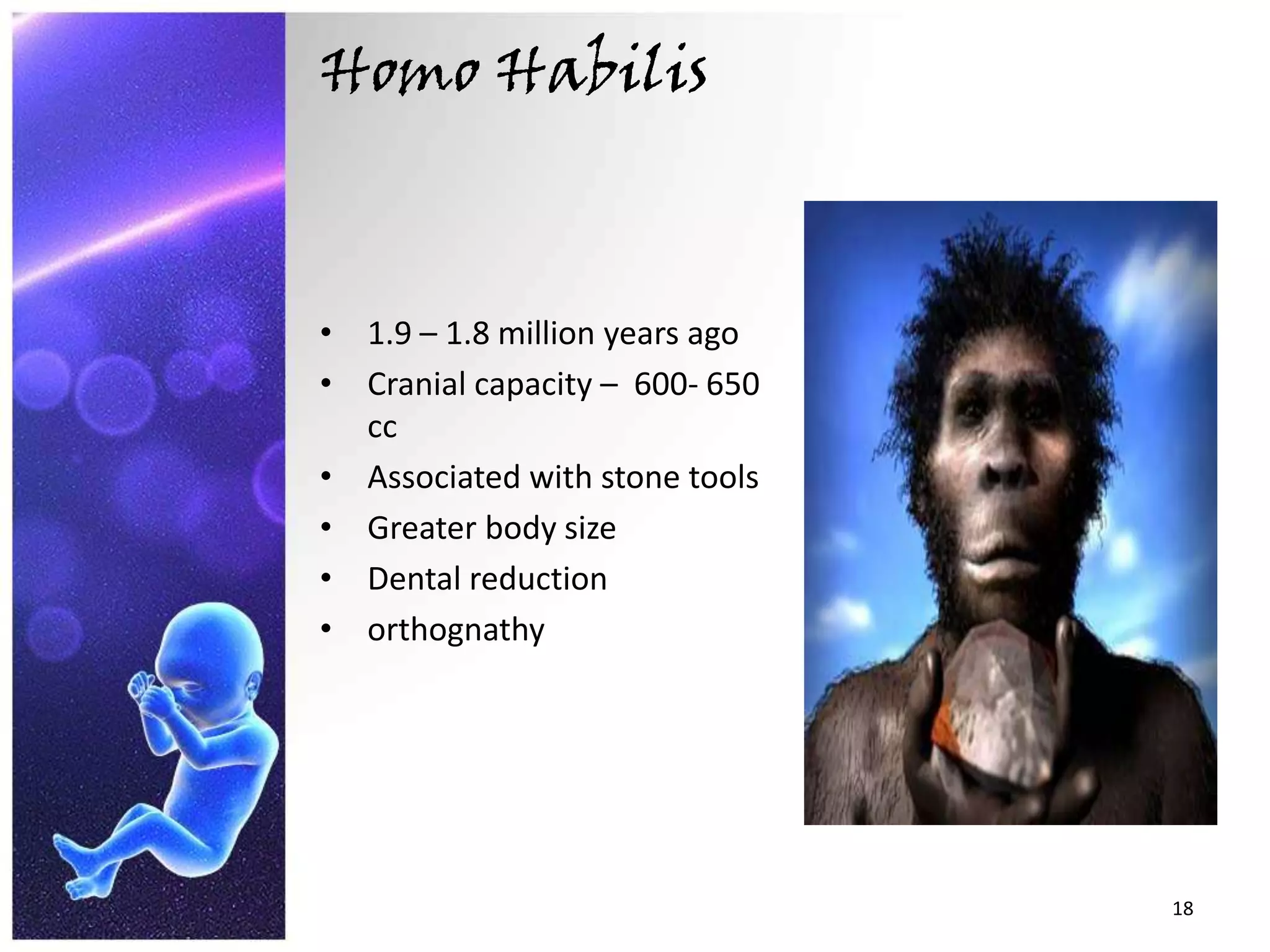
Homo Habilis1.9 – 1.8 million years agoCranial capacity –  600- 650 ccAssociated with stone toolsGreater body sizeDental reductionorthognathy18
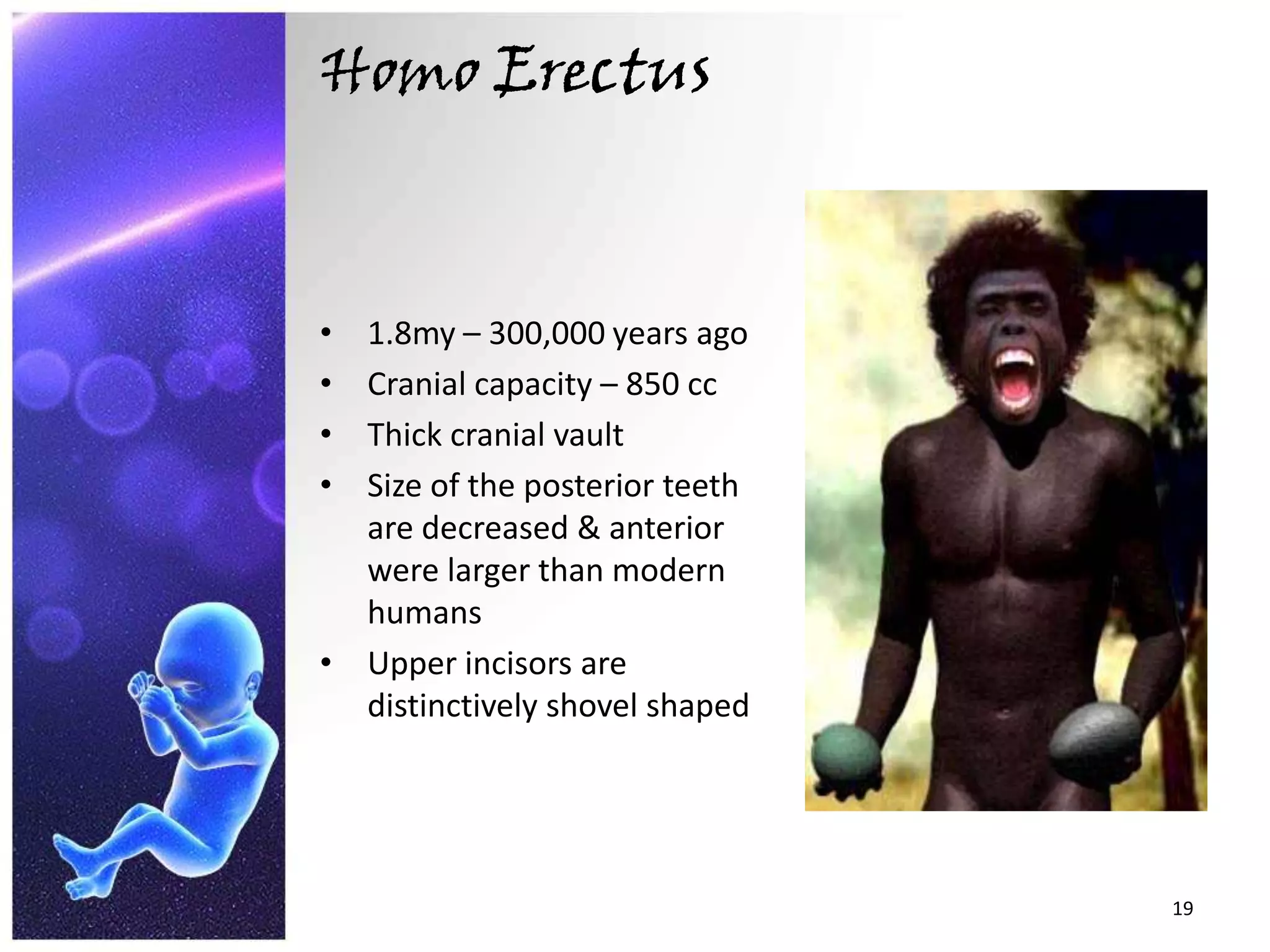
Homo Erectus1.8my – 300,000 years agoCranial capacity – 850 ccThick cranial vaultSize of the posterior teeth are decreased & anterior were larger than modern humansUpper incisors are distinctively shovel shaped19
Homo Neanderthals150,000 – 30,000 years agoRuggedly built & short stocky bodyDeveloped skilled stone tool technologyHad larger brainDentition as a whole is placed forward relative to the skull vault20
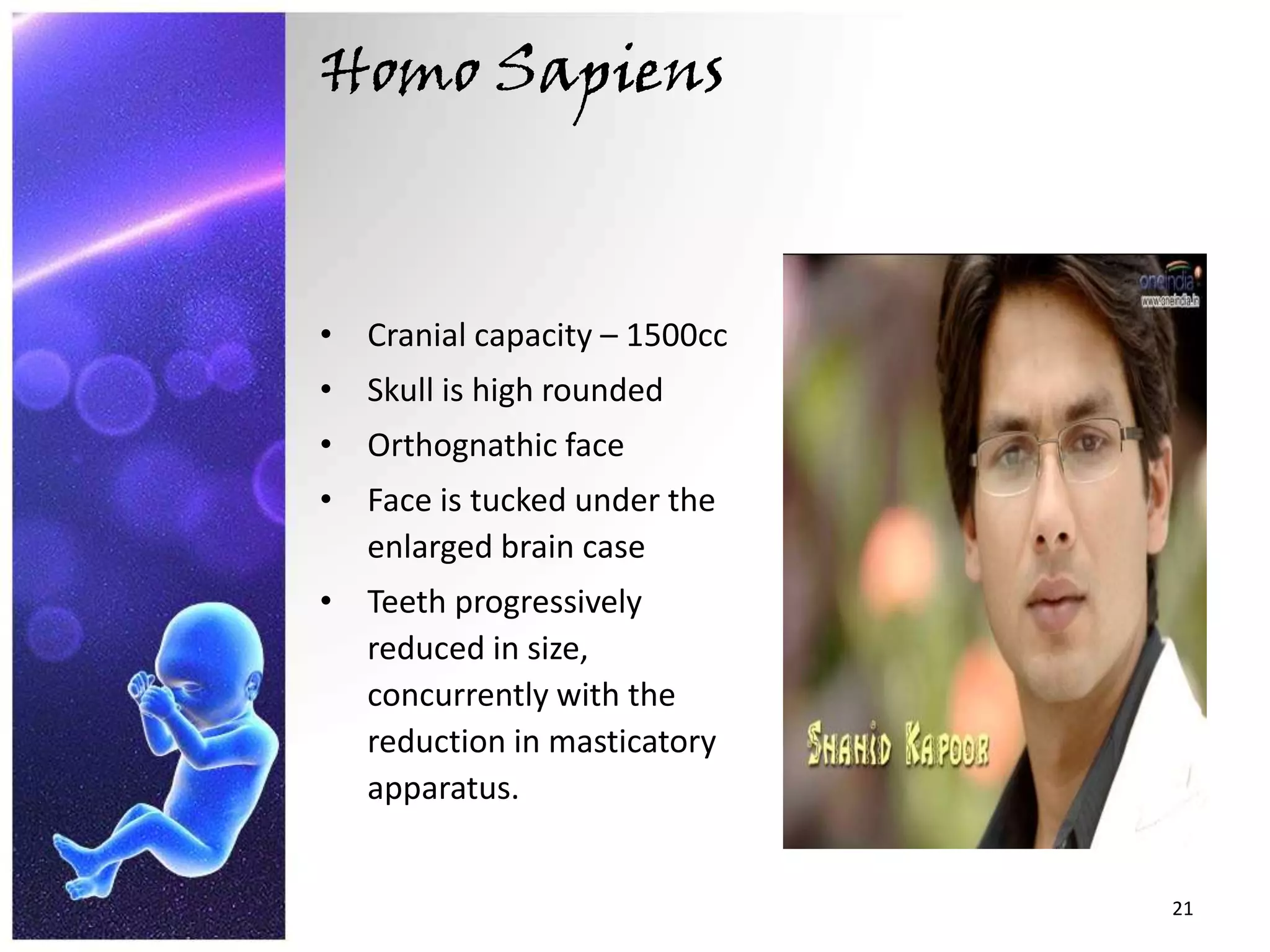
Homo SapiensCranial capacity – 1500ccSkull is high rounded Orthognathic faceFace is tucked under the enlarged brain caseTeeth progressively reduced in size, concurrently with the reduction in masticatory apparatus.21
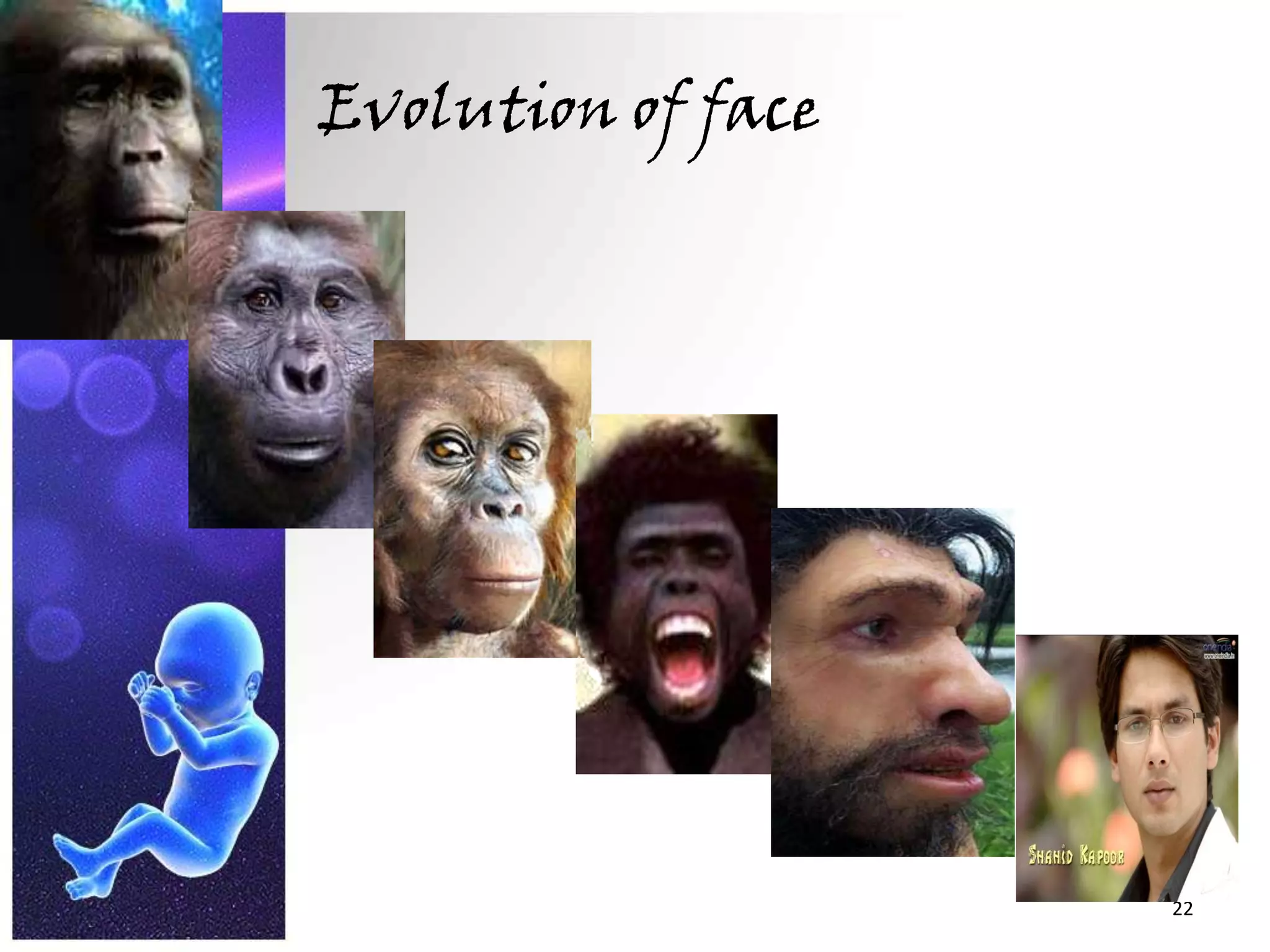
Evolution of face22
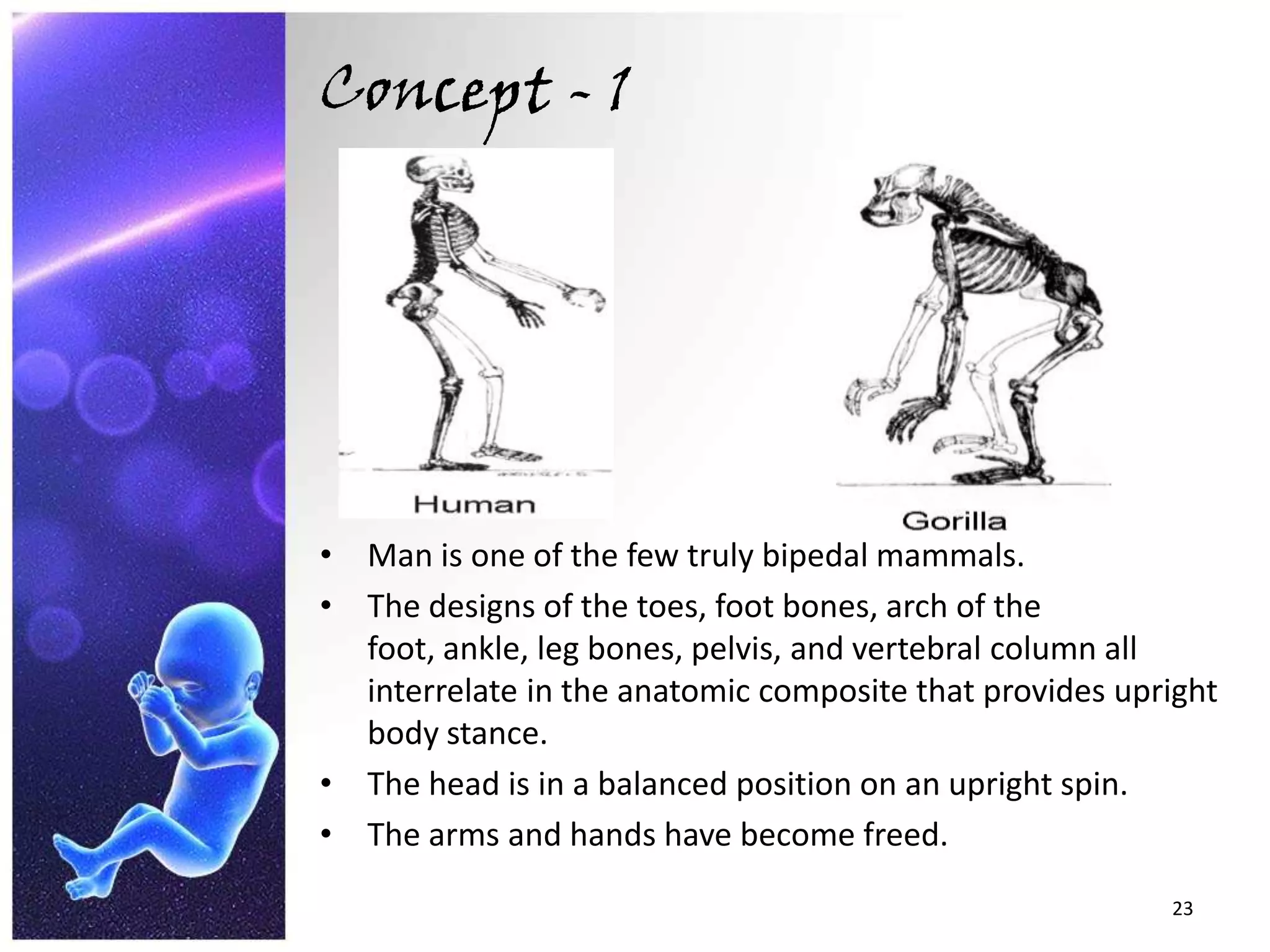
Concept - 1Man is one of the few truly bipedal mammals.The designs of the toes, foot bones, arch of the foot, ankle, leg bones, pelvis, and vertebral column all interrelate in the anatomic composite that provides upright body stance.The head is in a balanced position on an upright spin.The arms and hands have become freed. 23
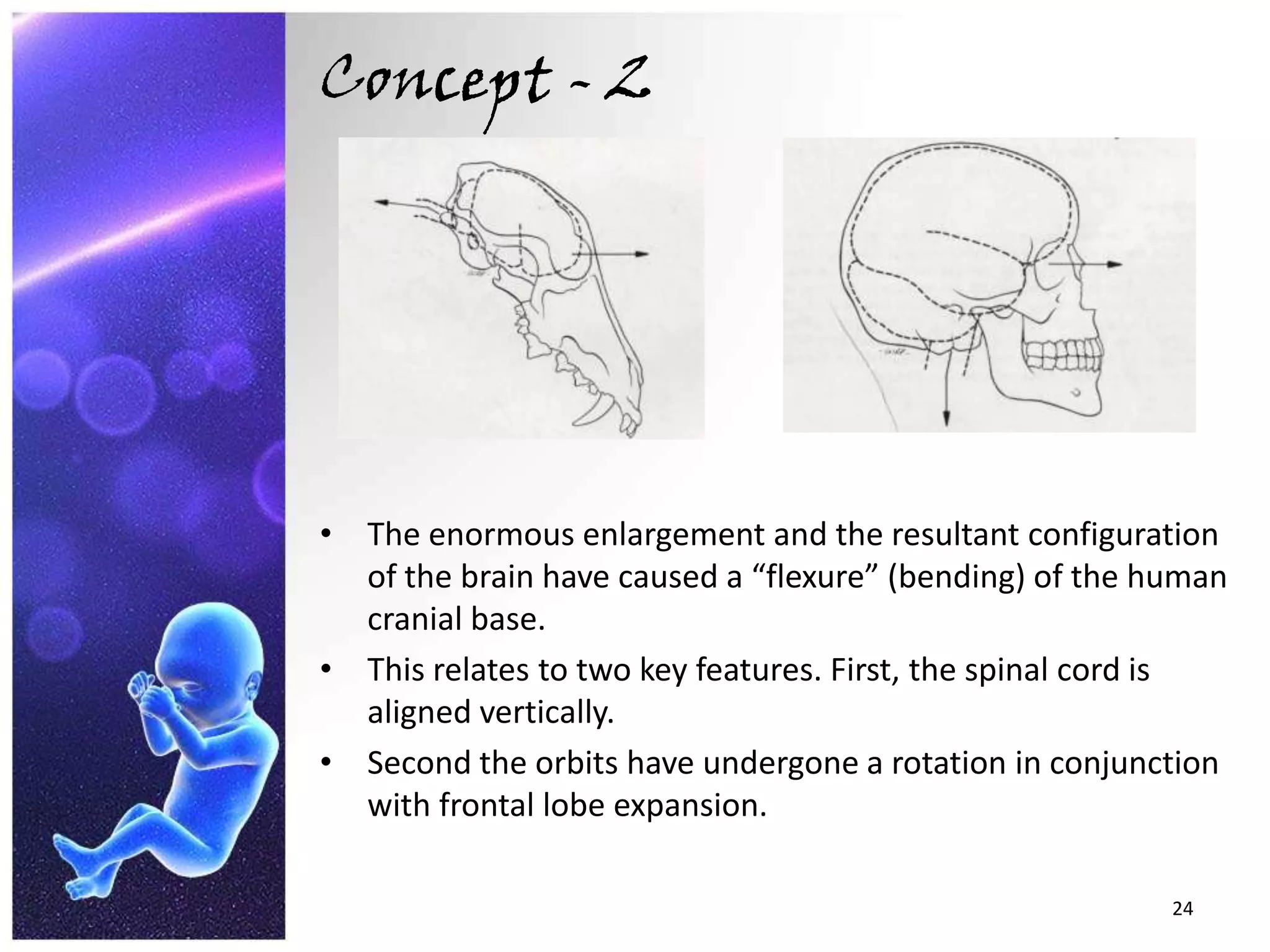
Concept - 2The enormous enlargement and the resultant configuration of the brain have caused a “flexure” (bending) of the human cranial base.This relates to two key features. First, the spinal cord is aligned vertically.Second the orbits have undergone a rotation in conjunction with frontal lobe expansion. 24
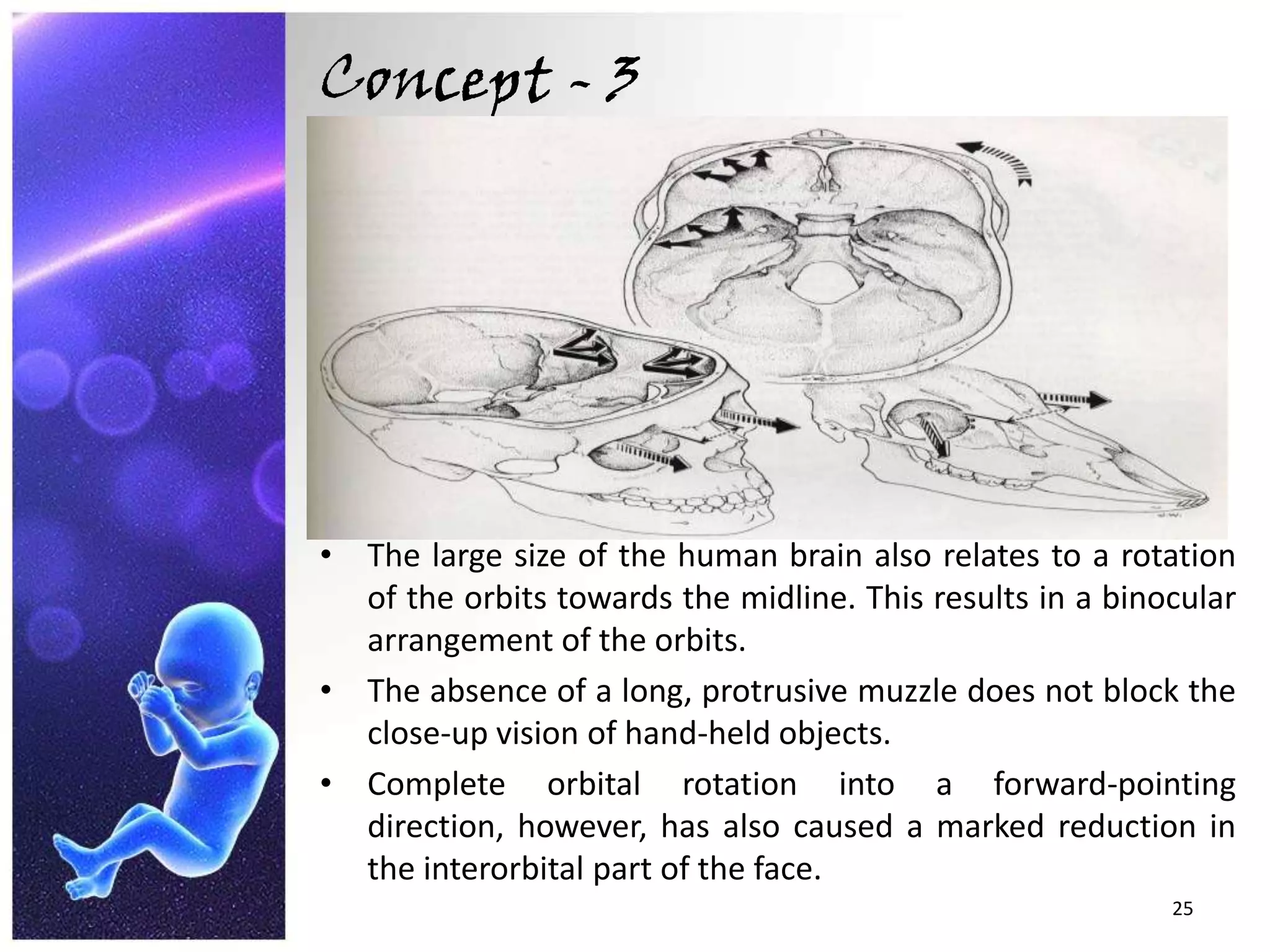
Concept - 3The large size of the human brain also relates to a rotation of the orbits towards the midline. This results in a binocular arrangement of the orbits. The absence of a long, protrusive muzzle does not block the close-up vision of hand-held objects. Complete orbital rotation into a forward-pointing direction, however, has also caused a marked reduction in the interorbital part of the face. 25
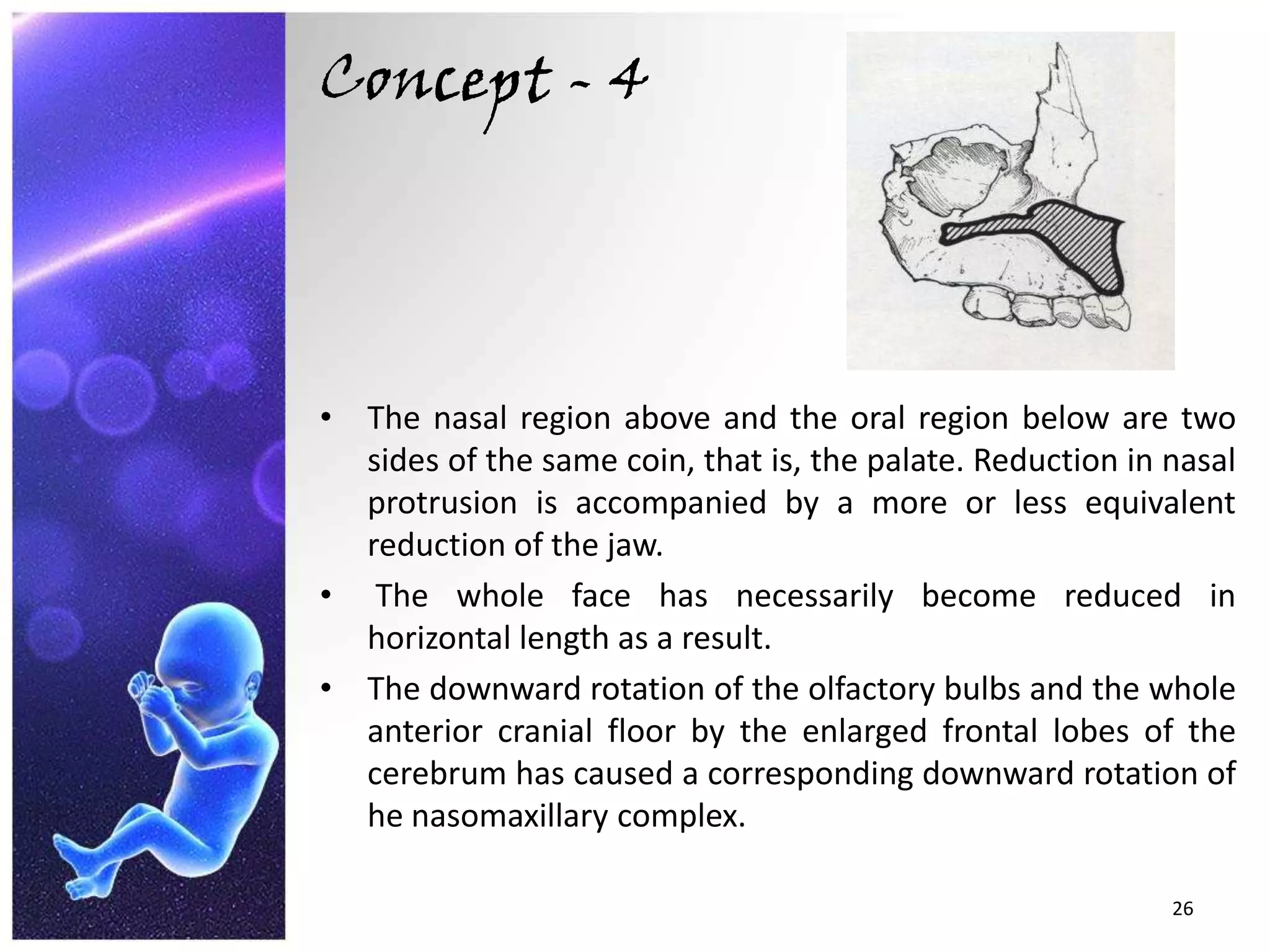
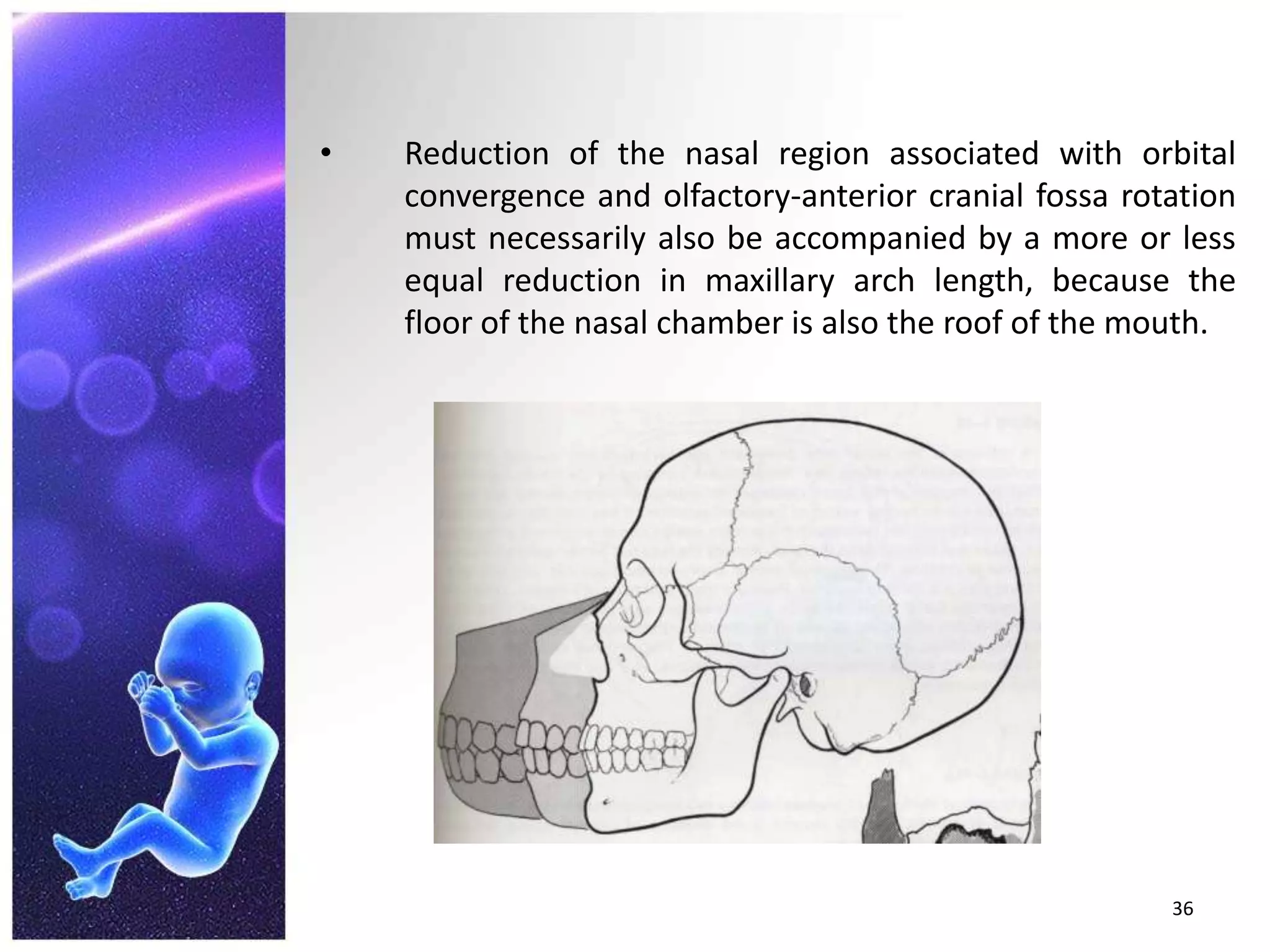
Concept - 4The nasal region above and the oral region below are two sides of the same coin, that is, the palate. Reduction in nasal protrusion is accompanied by a more or less equivalent reduction of the jaw. The whole face has necessarily become reduced in horizontal length as a result.The downward rotation of the olfactory bulbs and the whole anterior cranial floor by the enlarged frontal lobes of the cerebrum has caused a corresponding downward rotation of he nasomaxillary complex. 26
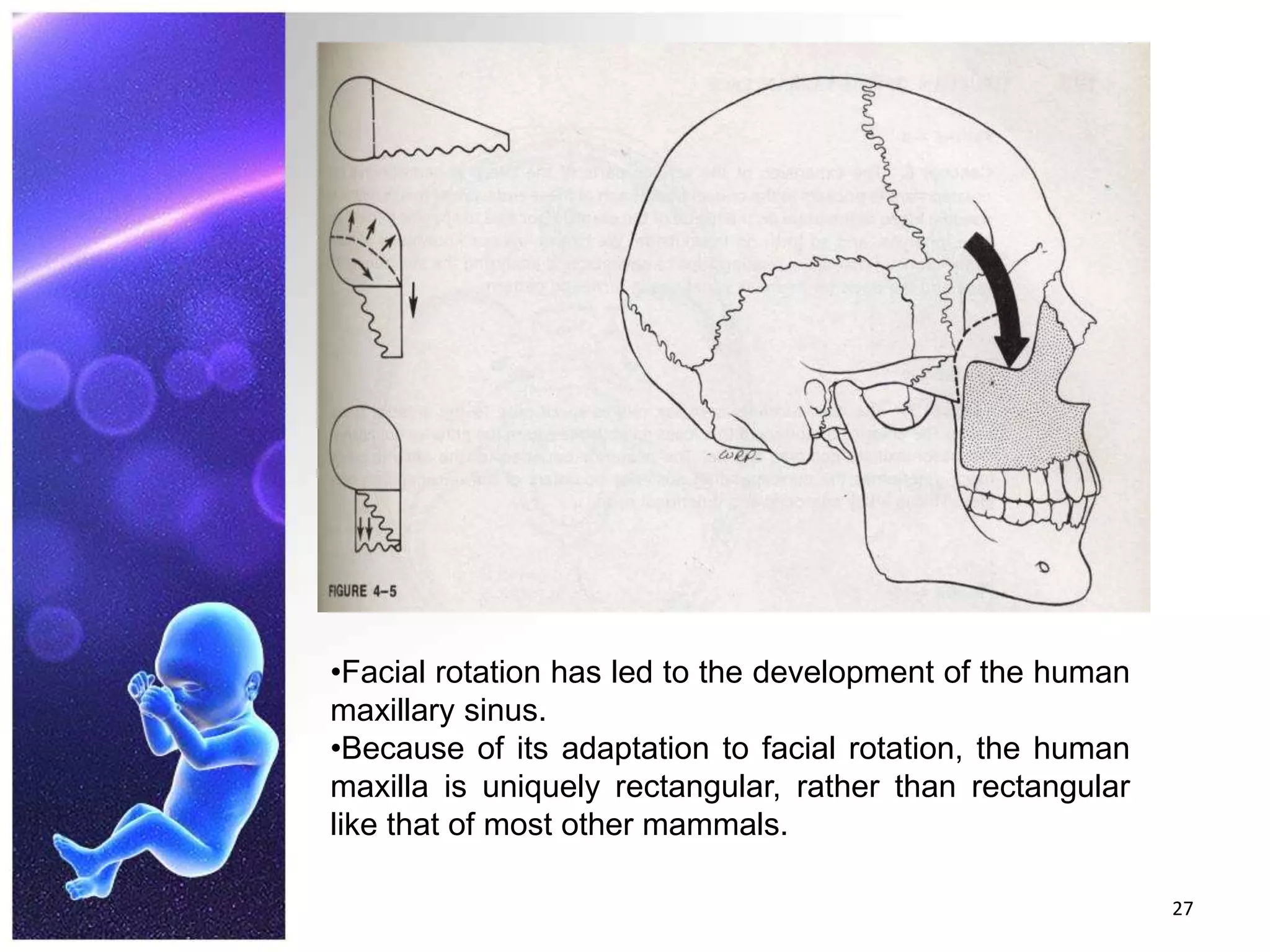
27Facial rotation has led to the development of the human maxillary sinus.
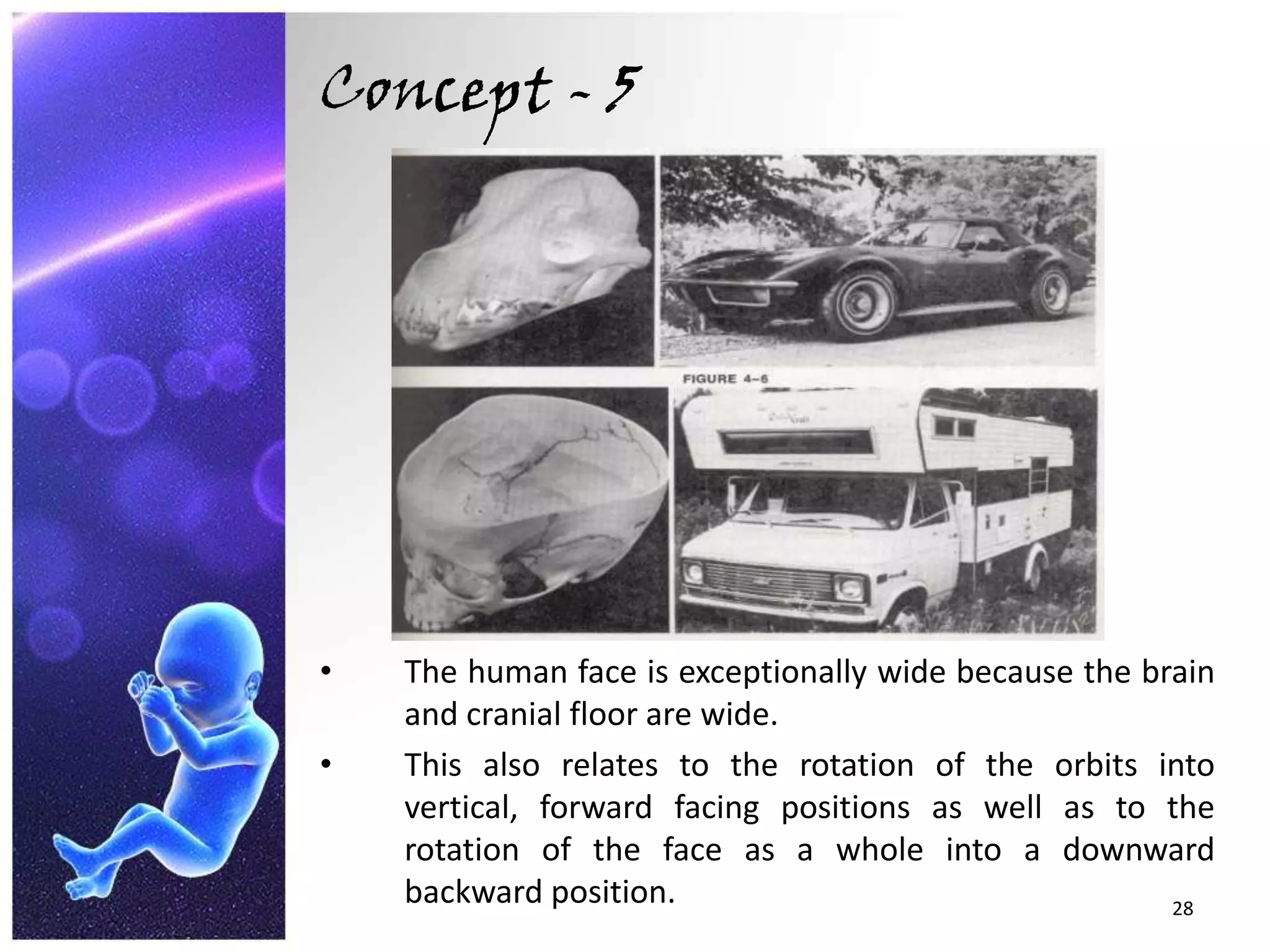
Because of its adaptation to facial rotation, the human maxilla is uniquely rectangular, rather than rectangular like that of most other mammals. Concept - 5The human face is exceptionally wide because the brain and cranial floor are wide.This also relates to the rotation of the orbits into vertical, forward facing positions as well as to the rotation of the face as a whole into a downward backward position.28
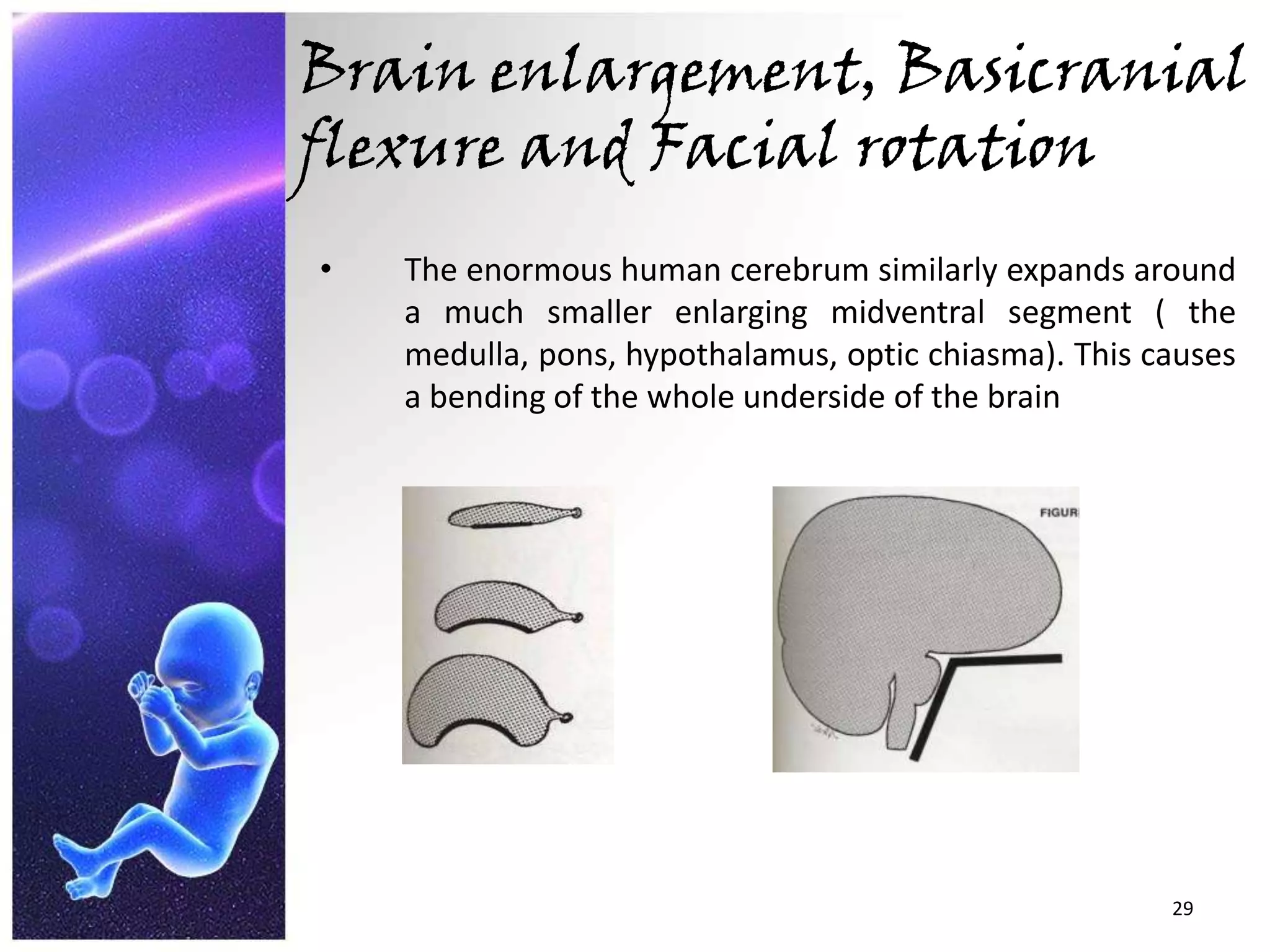
Brain enlargement, Basicranial flexure and Facial rotationThe enormous human cerebrum similarly expands around a much smaller enlarging midventral segment ( the medulla, pons, hypothalamus, optic chiasma). This causes a bending of the whole underside of the brain.29
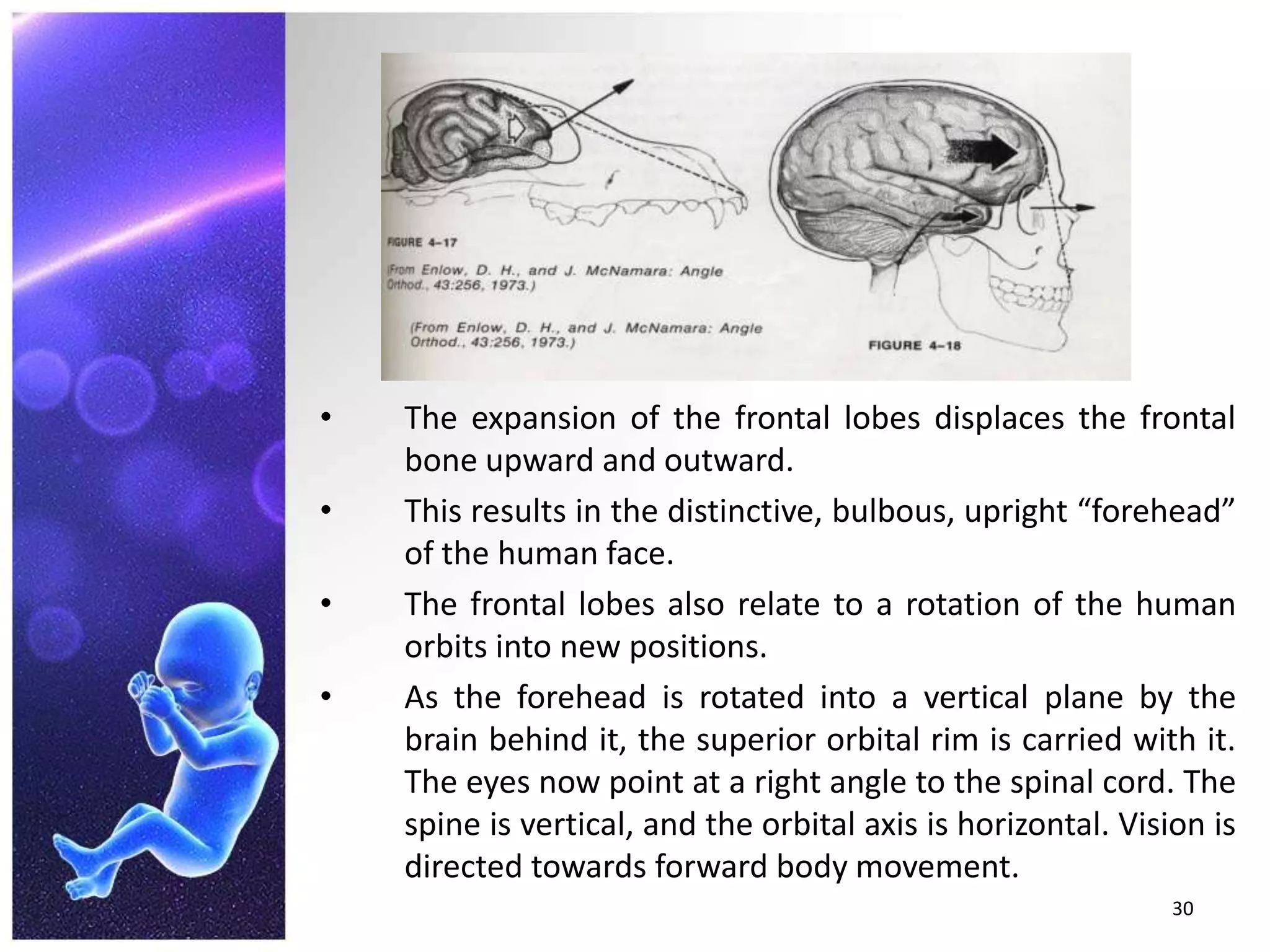
The expansion of the frontal lobes displaces the frontal bone upward and outward.This results in the distinctive, bulbous, upright “forehead” of the human face.The frontal lobes also relate to a rotation of the human orbits into new positions.As the forehead is rotated into a vertical plane by the brain behind it, the superior orbital rim is carried with it. The eyes now point at a right angle to the spinal cord. The spine is vertical, and the orbital axis is horizontal. Vision is directed towards forward body movement.30
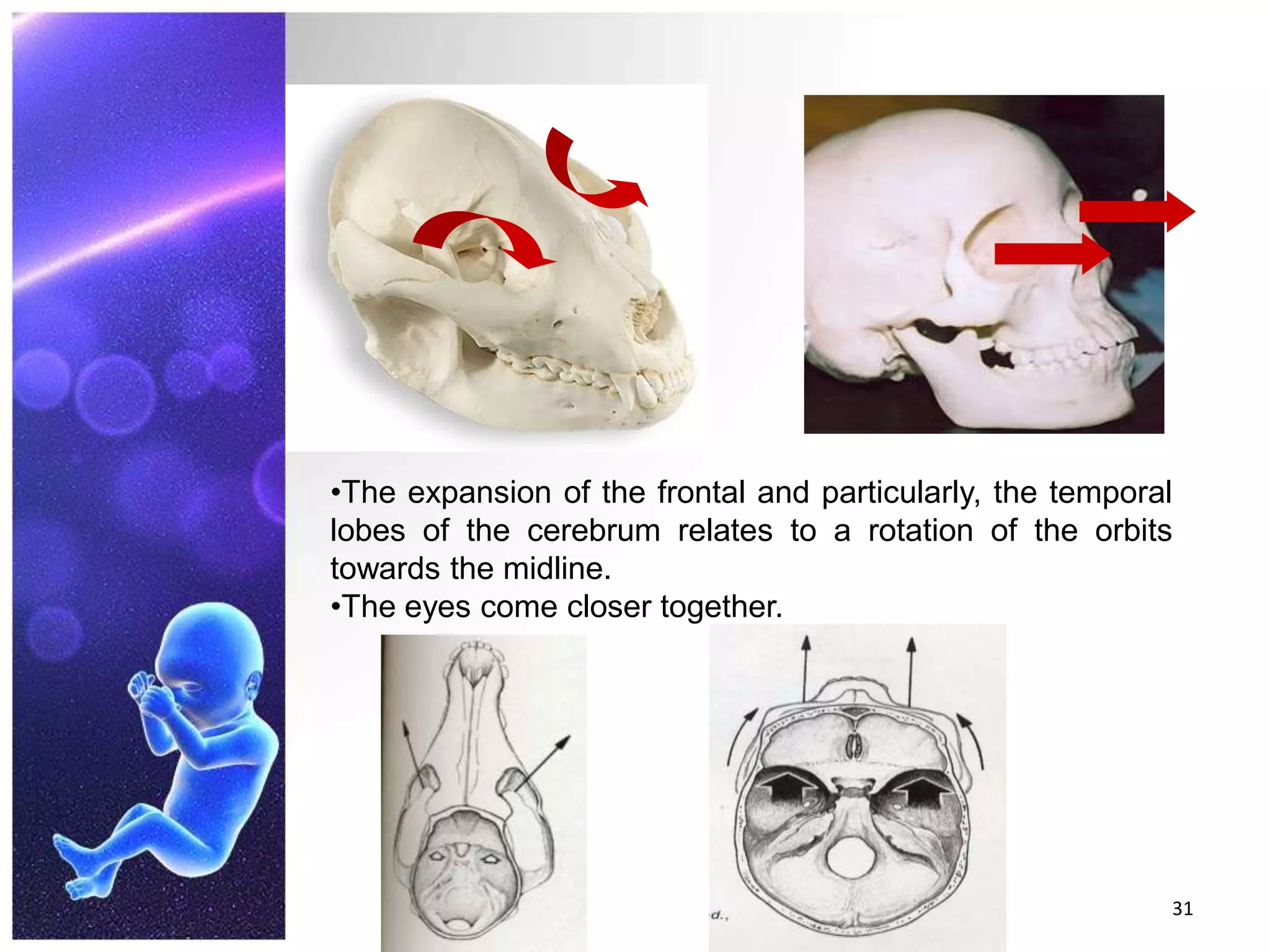
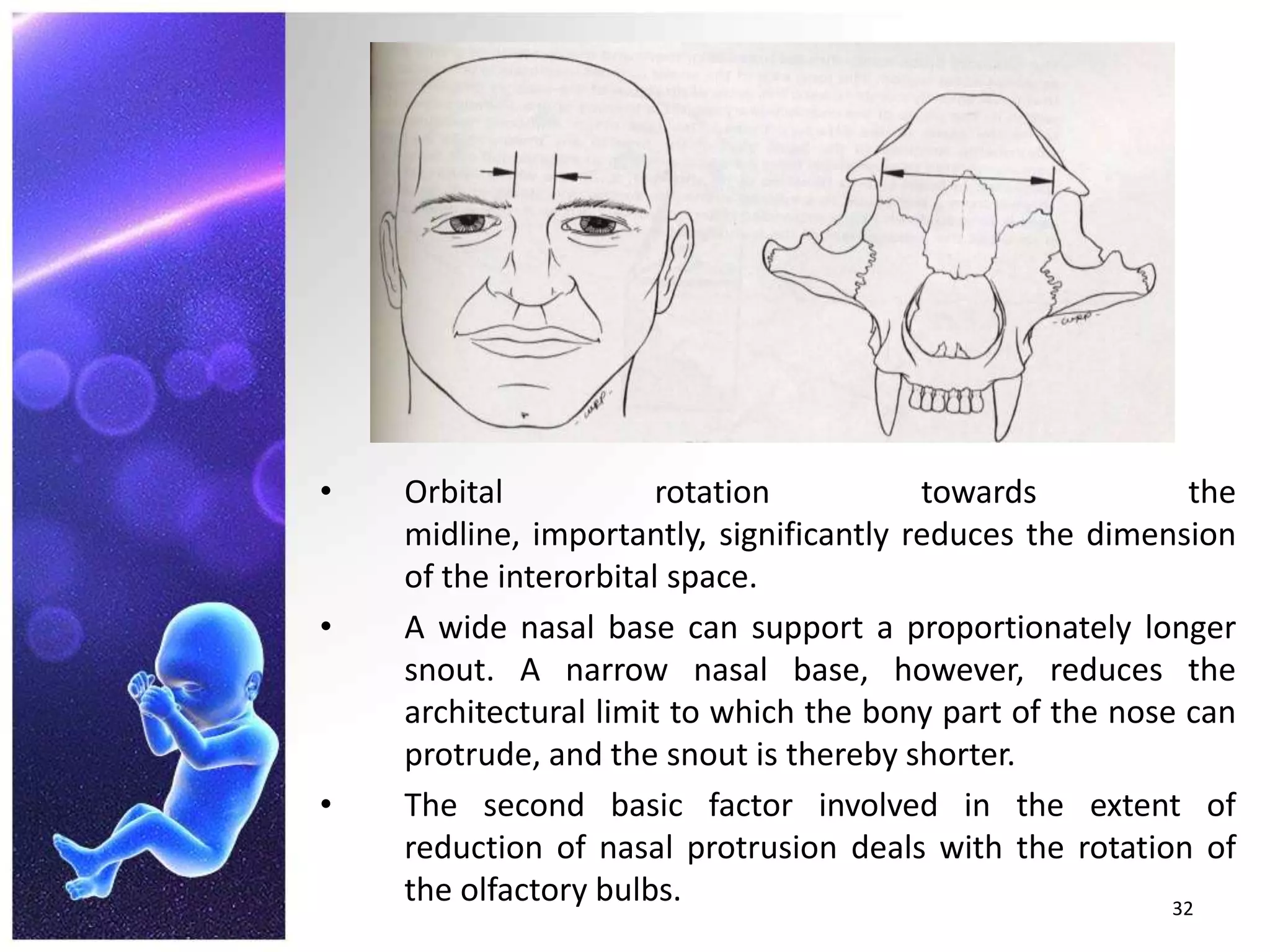
31The expansion of the frontal and particularly, the temporal lobes of the cerebrum relates to a rotation of the orbits towards the midline.
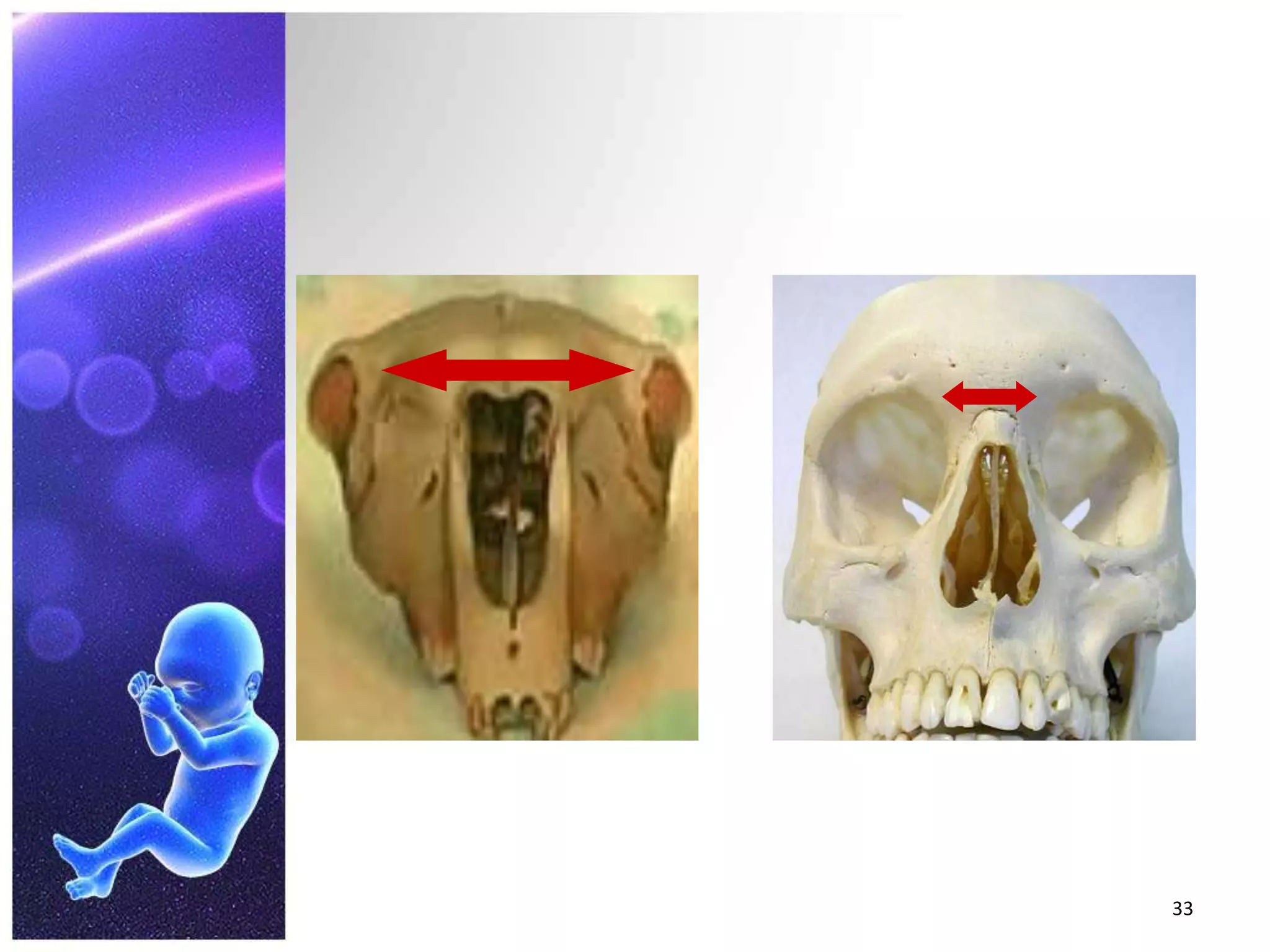
The eyes come closer together.Orbital rotation towards the midline, importantly, significantly reduces the dimension of the interorbital space.A wide nasal base can support a proportionately longer snout. A narrow nasal base, however, reduces the architectural limit to which the bony part of the nose can protrude, and the snout is thereby shorter.The second basic factor involved in the extent of reduction of nasal protrusion deals with the rotation of the olfactory bulbs.32
33
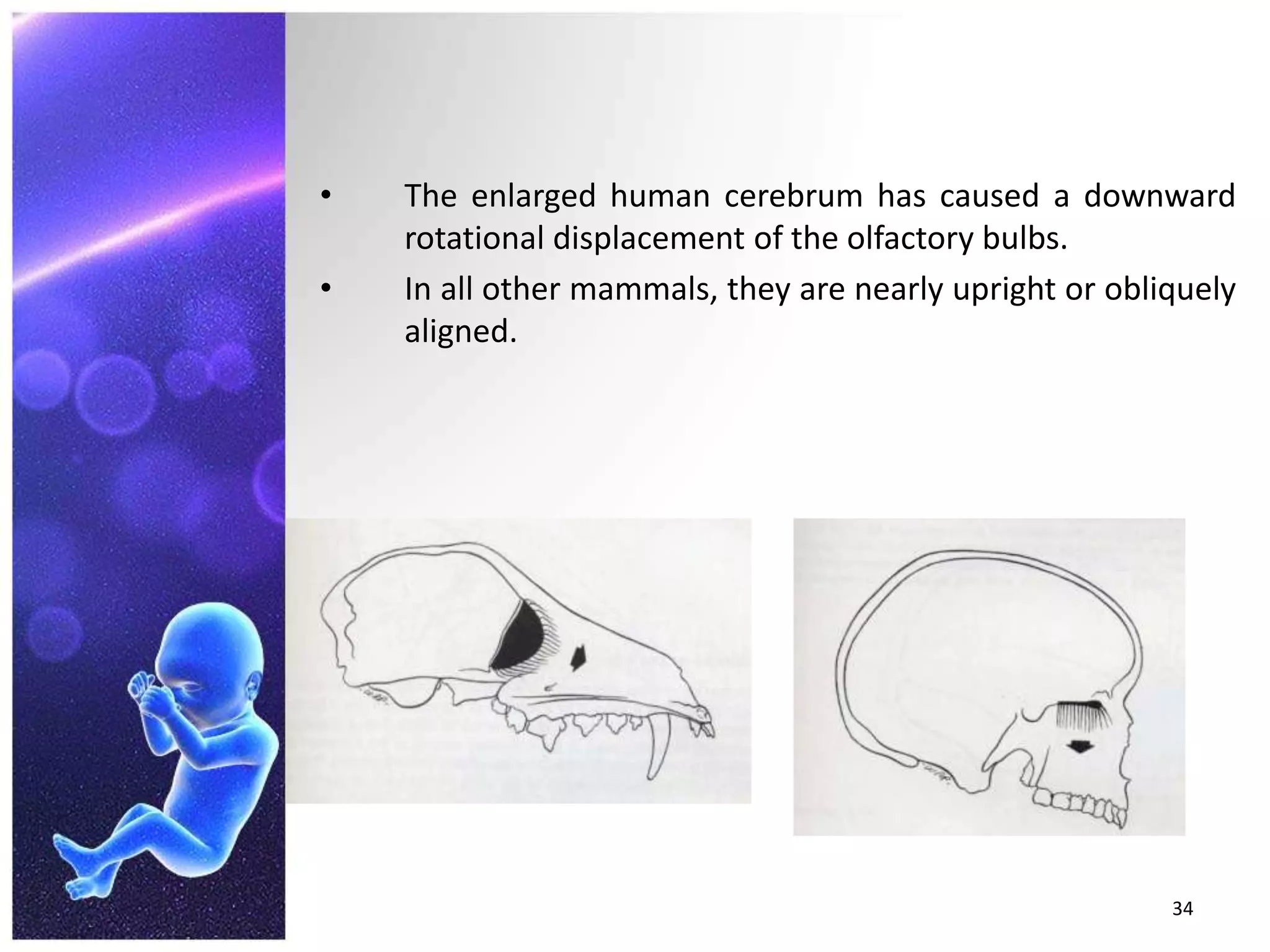
The enlarged human cerebrum has caused a downward rotational displacement of the olfactory bulbs.In all other mammals, they are nearly upright or obliquely aligned.34
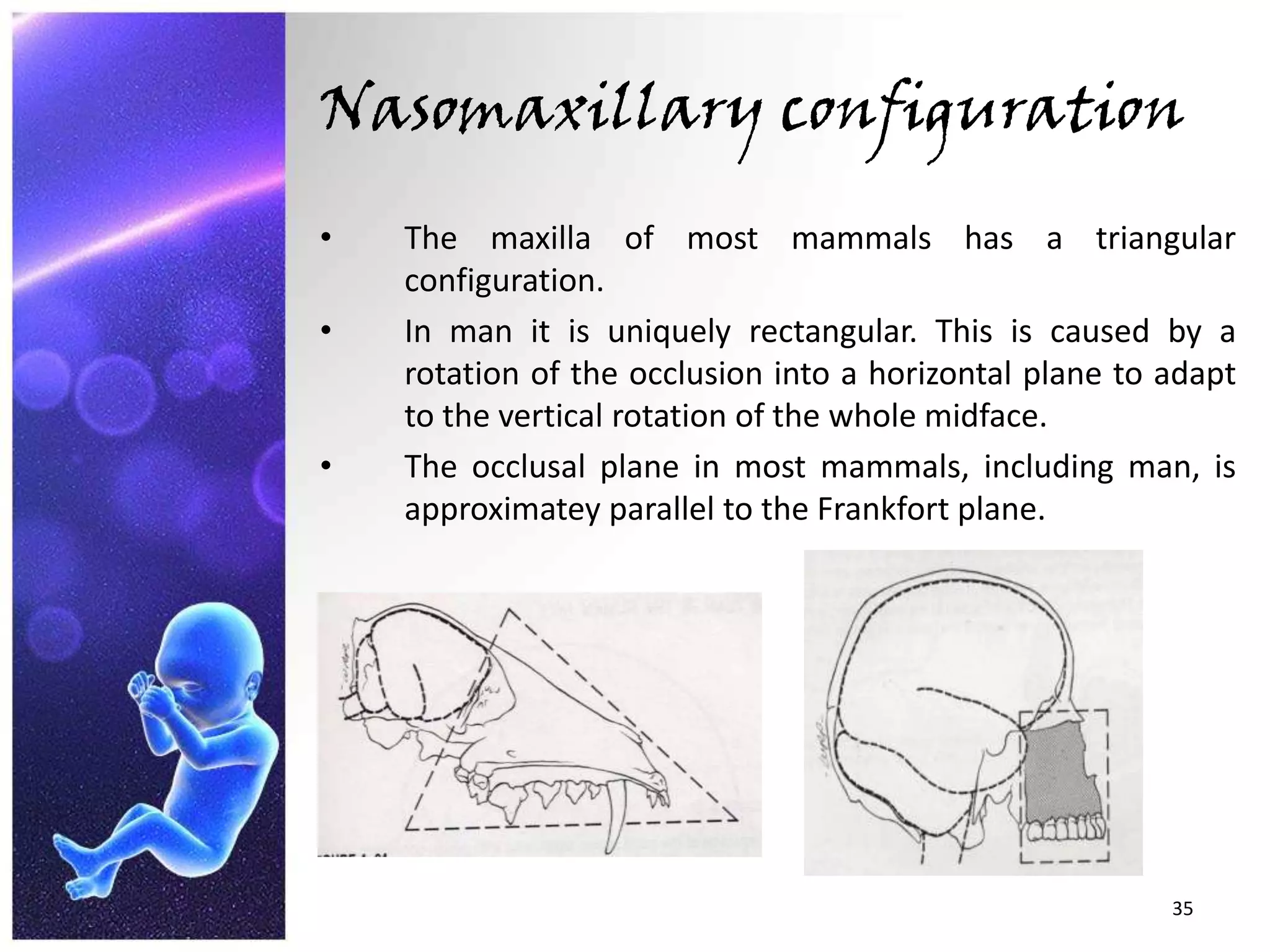
Nasomaxillary configurationThe maxilla of most mammals has a triangular configuration.In man it is uniquely rectangular. This is caused by a rotation of the occlusion into a horizontal plane to adapt to the vertical rotation of the whole midface.The occlusal plane in most mammals, including man, is approximatey parallel to the Frankfort plane.35
Reduction of the nasal region associated with orbital convergence and olfactory-anterior cranial fossa rotation must necessarily also be accompanied by a more or less equal reduction in maxillary arch length, because the floor of the nasal chamber is also the roof of the mouth.36
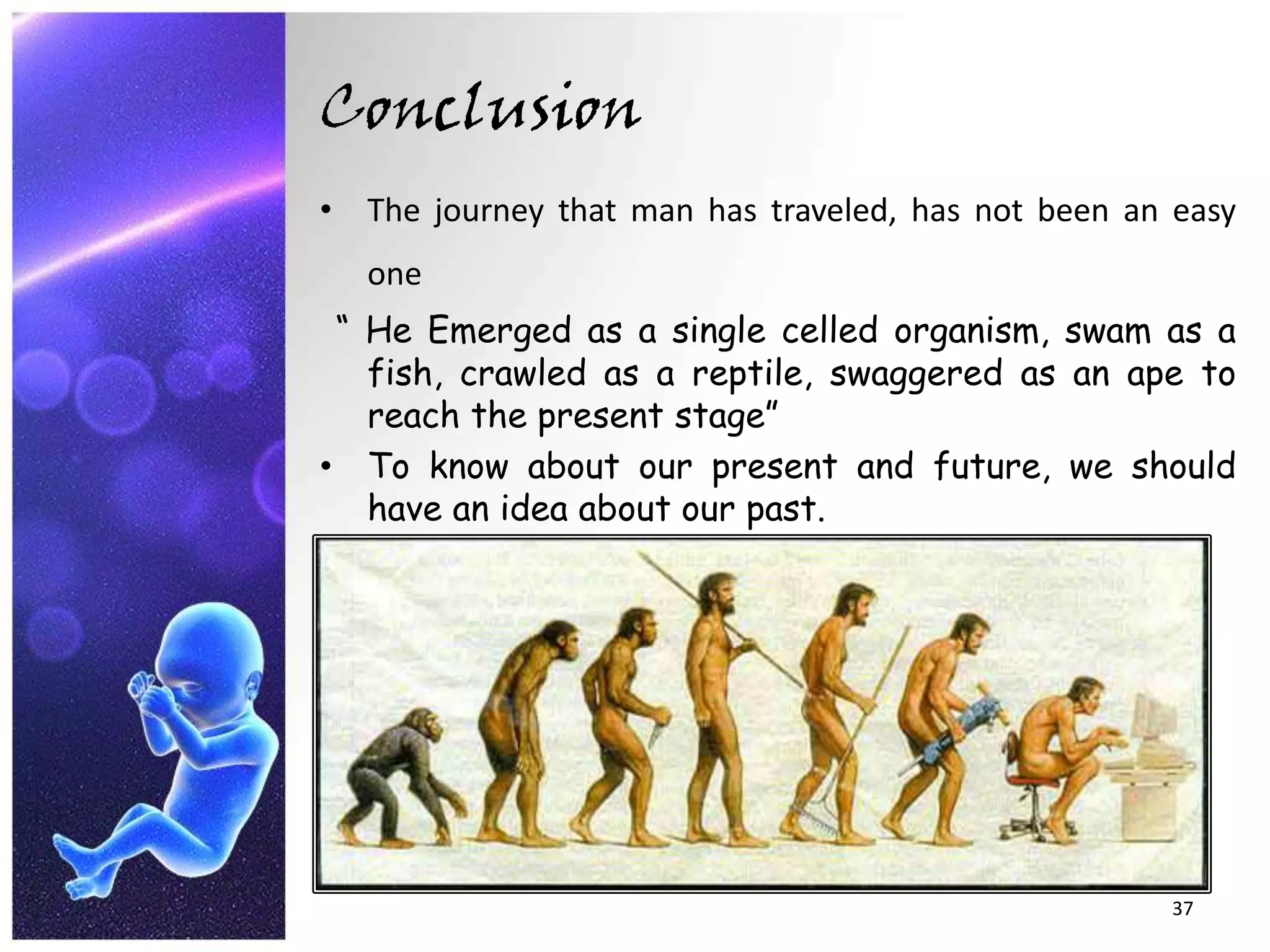
ConclusionThe journey that man has traveled, has not been an easy one“ He Emerged as a single celled organism, swam as a fish, crawled as a reptile, swaggered as an ape to reach the present stage”To know about our present and future, we should have an idea about our past.37
ReferencesA handbook of facial growth, 2nd edition, Donald H. EnlowAngle orthodontics – 1997-Vol.67 - Issue-1, 73-8Encyclopedia.comWikipedia.com38
39THANK YOU

Evolution of face

  • 1.
    Evolution of FacePresentedby :-Dr. Manish kumarBapuji Dental College & Hospital, Davangere1
  • 2.
    ContentsIntroductionDefinitionsTheories of evolutionEvolutionof humansEvolution of faceQudrapedal to bipedal position Enlargement of brain Rotation of orbits Rotation of olfactory bulb Rotation of nasomaxillary complexConclusionreferences2
  • 3.
    IntroductionThe history ofplanet Earth began 4.6 billion years ago. At each age one type of life has dominated over all other forms, so much that there is a direct relationship between climatic & geologic condition & the dominating type of life existing.From the biologic point of view we see that as environment changed there was a corresponding change in the form & structure of the animal & plant kingdoms. 3
  • 4.
    To understand theface thoroughly, it is only fair to assume that we should start at the bottom of the ladder in the scale of life & inspect the simplest type of face & then trace upwards through the stages of development of face & see how it has gradually changed & molded in form to that of modern man.4
  • 5.
    Definition of Evolution“A continuous process of change from one state, condition or form to another “Stedman’s Medical Dictionary “ A developmental process in which an organ or organism becomes more & more complex by differentiation of its parts; a continuous & progressive change according to certain laws & by means of resident forces “Dorland Medical Dictionary5
  • 6.
    Theories of EvolutionFourmain theories to explain the method by which species of life that exist today have evolved from earlier simpler forms.Thelamarckian theory.The theory of orthogenesis.The theory of natural selection.The mendelian theory.666666
  • 7.
    The lamarckian theoryCharactersacquired and changes taking place during life of an organism are inherited after the acquired character and changes have persisted for a long time.They are due to change in environment and to the concerned effects of use and disuse.Eg: girrafes with long necks.7
  • 8.
    Theory of orthogenesis[development in straight line]Put forth by Haldane and Julian Huxley.They considered that evolution proceeds in any particular direction ,not because of any advantage gained by the race or because of direct moulding effect by the surrounding, but because of some inner urge ,some necessity for the hereditary constitution to change in just that particular way.8
  • 9.
    Natural Selection or Survival Of The FittestCharles Darwin propounded this theory of organic evolution.This theory assumes that every life on earth was developed from previous form.9
  • 10.
    He attributed changesin living organisms to the action of natural selection and in many instances to the effect of use and disuse.10
  • 11.
    This theory canbe summarized briefly as:Struggle for existenceNatural selectionHereditySurvival of the fittest.11
  • 12.
    Mendel's law ofinheritance Mendel discovered the fact of segregation or dissociation of characters from each other in the course of formation of germ cell.His research work was on edible pea.12
  • 13.
  • 14.
    Australopithecus Africanus3-3.5 millionyears agoCranial capacity – 500ccSize of cranium & portions closely resembles that of chimpanzeesHead – DolicocephalicFacial Profile – convexDental features are intermediate between those of apes & modern human.14
  • 15.
    This theory canbe summarized briefly as:Struggle for existenceNatural selectionHereditySurvival of the fittest.15
  • 16.
    Australopithecus Robustus2.0-1.0 millionyears agoCranial capacity – 600ccMore sturdierCheek bones are projecting forwardLower jaw is very largeHigh degree of prognathisim is presentBack teeth are twice larger than the expected hominid size16
  • 17.
    Australopithecus Bosiei2.3-1.2 millionyears agoCranial capacity – 600ccTool makers & food gatherersThey could express & communicate simple ideas with soundFace – long & broadFacial & zygomatic portions of maxilla are large 17
  • 18.
    Homo Habilis1.9 –1.8 million years agoCranial capacity – 600- 650 ccAssociated with stone toolsGreater body sizeDental reductionorthognathy18
  • 19.
    Homo Erectus1.8my –300,000 years agoCranial capacity – 850 ccThick cranial vaultSize of the posterior teeth are decreased & anterior were larger than modern humansUpper incisors are distinctively shovel shaped19
  • 20.
    Homo Neanderthals150,000 –30,000 years agoRuggedly built & short stocky bodyDeveloped skilled stone tool technologyHad larger brainDentition as a whole is placed forward relative to the skull vault20
  • 21.
    Homo SapiensCranial capacity– 1500ccSkull is high rounded Orthognathic faceFace is tucked under the enlarged brain caseTeeth progressively reduced in size, concurrently with the reduction in masticatory apparatus.21
  • 22.
  • 23.
    Concept - 1Manis one of the few truly bipedal mammals.The designs of the toes, foot bones, arch of the foot, ankle, leg bones, pelvis, and vertebral column all interrelate in the anatomic composite that provides upright body stance.The head is in a balanced position on an upright spin.The arms and hands have become freed. 23
  • 24.
    Concept - 2Theenormous enlargement and the resultant configuration of the brain have caused a “flexure” (bending) of the human cranial base.This relates to two key features. First, the spinal cord is aligned vertically.Second the orbits have undergone a rotation in conjunction with frontal lobe expansion. 24
  • 25.
    Concept - 3Thelarge size of the human brain also relates to a rotation of the orbits towards the midline. This results in a binocular arrangement of the orbits. The absence of a long, protrusive muzzle does not block the close-up vision of hand-held objects. Complete orbital rotation into a forward-pointing direction, however, has also caused a marked reduction in the interorbital part of the face. 25
  • 26.
    Concept - 4Thenasal region above and the oral region below are two sides of the same coin, that is, the palate. Reduction in nasal protrusion is accompanied by a more or less equivalent reduction of the jaw. The whole face has necessarily become reduced in horizontal length as a result.The downward rotation of the olfactory bulbs and the whole anterior cranial floor by the enlarged frontal lobes of the cerebrum has caused a corresponding downward rotation of he nasomaxillary complex. 26
  • 27.
    27Facial rotation hasled to the development of the human maxillary sinus.
  • 28.
    Because of itsadaptation to facial rotation, the human maxilla is uniquely rectangular, rather than rectangular like that of most other mammals. Concept - 5The human face is exceptionally wide because the brain and cranial floor are wide.This also relates to the rotation of the orbits into vertical, forward facing positions as well as to the rotation of the face as a whole into a downward backward position.28
  • 29.
    Brain enlargement, Basicranialflexure and Facial rotationThe enormous human cerebrum similarly expands around a much smaller enlarging midventral segment ( the medulla, pons, hypothalamus, optic chiasma). This causes a bending of the whole underside of the brain.29
  • 30.
    The expansion ofthe frontal lobes displaces the frontal bone upward and outward.This results in the distinctive, bulbous, upright “forehead” of the human face.The frontal lobes also relate to a rotation of the human orbits into new positions.As the forehead is rotated into a vertical plane by the brain behind it, the superior orbital rim is carried with it. The eyes now point at a right angle to the spinal cord. The spine is vertical, and the orbital axis is horizontal. Vision is directed towards forward body movement.30
  • 31.
    31The expansion ofthe frontal and particularly, the temporal lobes of the cerebrum relates to a rotation of the orbits towards the midline.
  • 32.
    The eyes comecloser together.Orbital rotation towards the midline, importantly, significantly reduces the dimension of the interorbital space.A wide nasal base can support a proportionately longer snout. A narrow nasal base, however, reduces the architectural limit to which the bony part of the nose can protrude, and the snout is thereby shorter.The second basic factor involved in the extent of reduction of nasal protrusion deals with the rotation of the olfactory bulbs.32
  • 33.
  • 34.
    The enlarged humancerebrum has caused a downward rotational displacement of the olfactory bulbs.In all other mammals, they are nearly upright or obliquely aligned.34
  • 35.
    Nasomaxillary configurationThe maxillaof most mammals has a triangular configuration.In man it is uniquely rectangular. This is caused by a rotation of the occlusion into a horizontal plane to adapt to the vertical rotation of the whole midface.The occlusal plane in most mammals, including man, is approximatey parallel to the Frankfort plane.35
  • 36.
    Reduction of thenasal region associated with orbital convergence and olfactory-anterior cranial fossa rotation must necessarily also be accompanied by a more or less equal reduction in maxillary arch length, because the floor of the nasal chamber is also the roof of the mouth.36
  • 37.
    ConclusionThe journey thatman has traveled, has not been an easy one“ He Emerged as a single celled organism, swam as a fish, crawled as a reptile, swaggered as an ape to reach the present stage”To know about our present and future, we should have an idea about our past.37
  • 38.
    ReferencesA handbook offacial growth, 2nd edition, Donald H. EnlowAngle orthodontics – 1997-Vol.67 - Issue-1, 73-8Encyclopedia.comWikipedia.com38
  • 39.