EVOLUTION &
EVOLUTION &
DEVELOPMENT OF
DEVELOPMENT OF
MANDIBLE
MANDIBLE
-
- Dr. Patil Shrish.
Dr. Patil Shrish.
PG in Dept of Anatomy
Mandible
Mandible
-The strongest and largest skull bone in
man.
man.
-Only bone in human skull to move
independently, with the exception of
ear ossicles.
ear ossicles.
 Various modifications from the jaw of
Various modifications from the jaw of
cartilaginous fishes to present day.
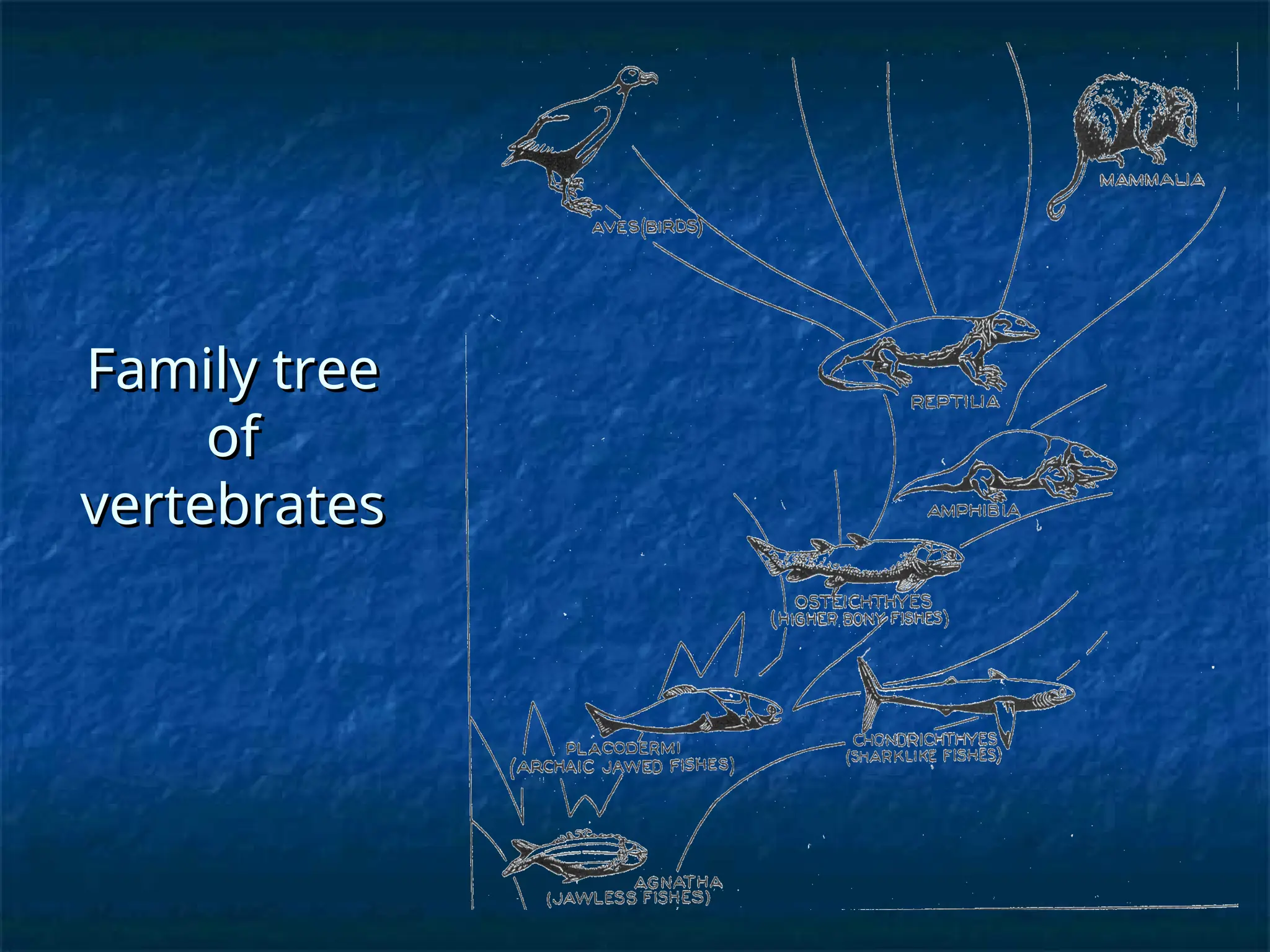
Family tree
Family tree
of
of
vertebrates
vertebrates
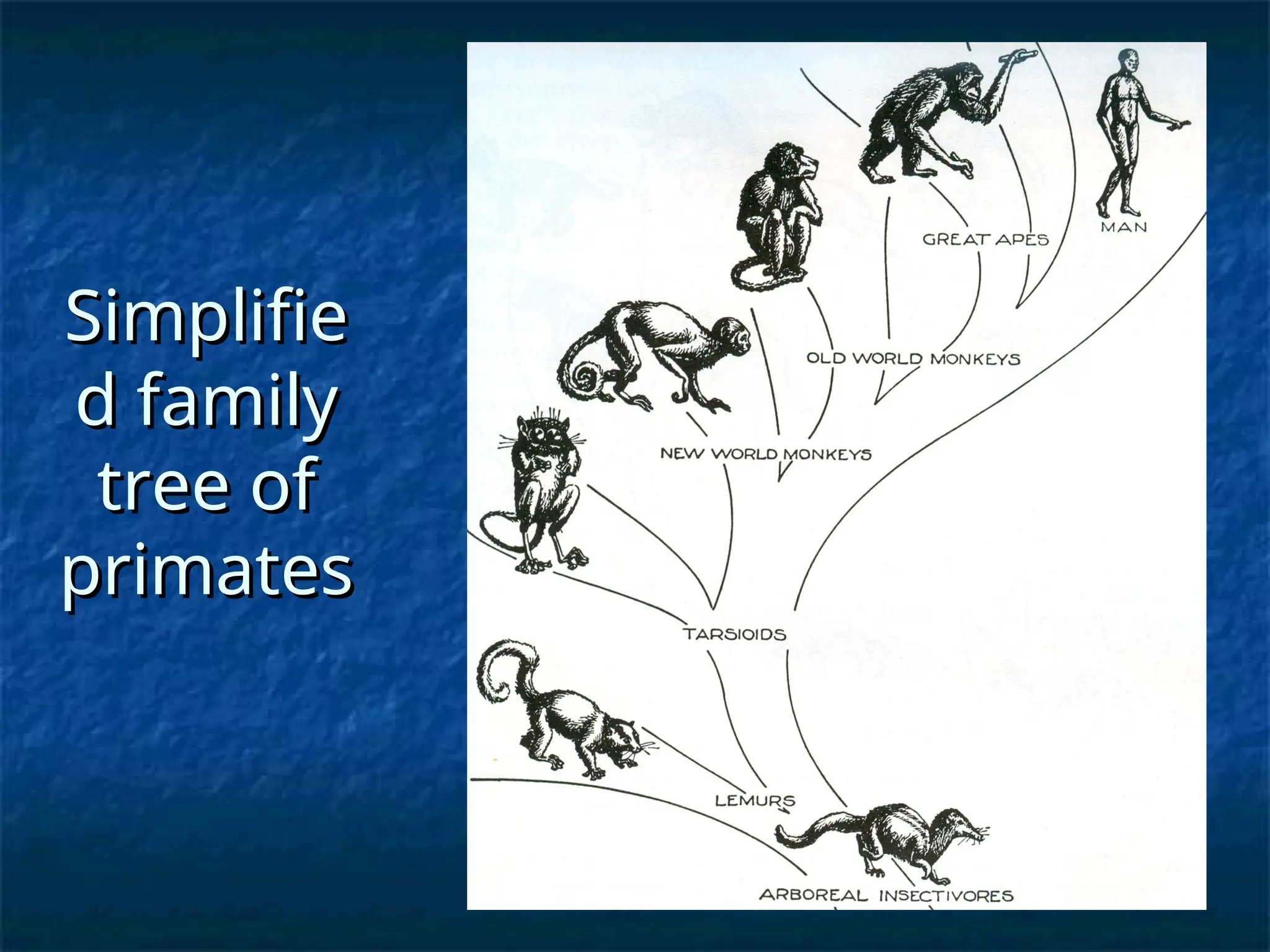
Simplifie
Simplifie
d family
d family
tree of
tree of
primates
primates
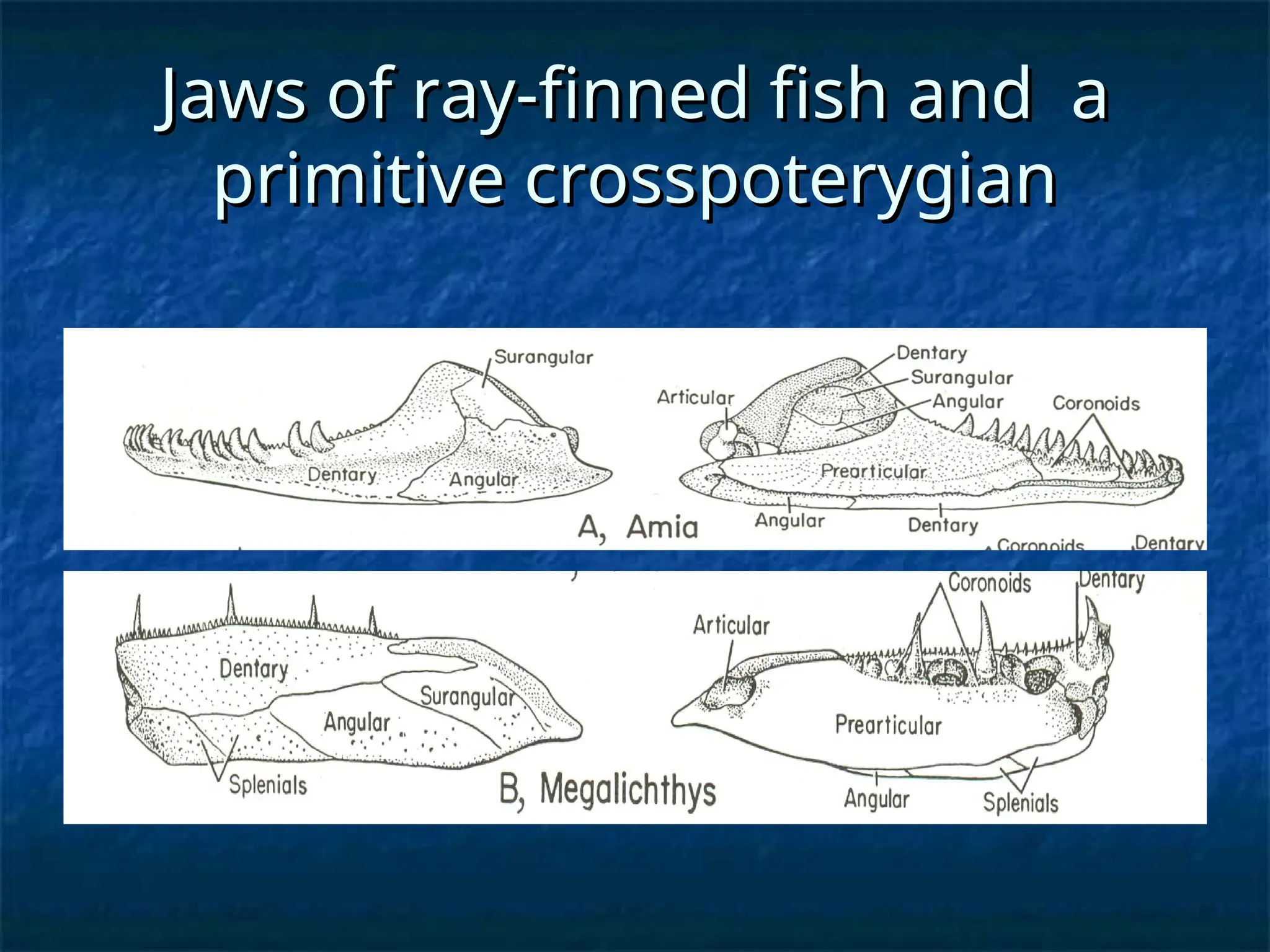
Jaws of ray-finned fish and a
primitive crosspoterygian
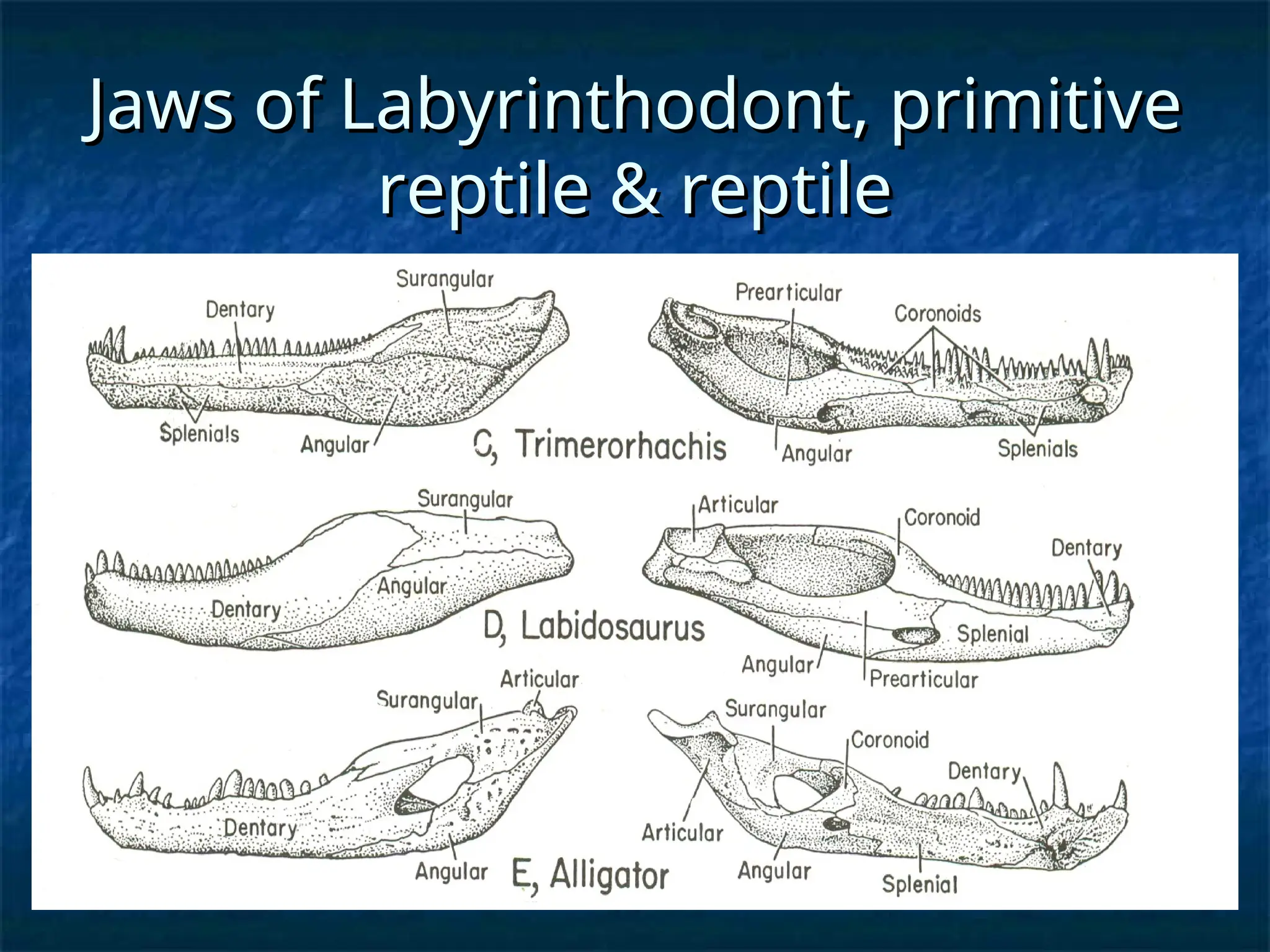
Jaws of Labyrinthodont, primitive
reptile & reptile
reptile & reptile
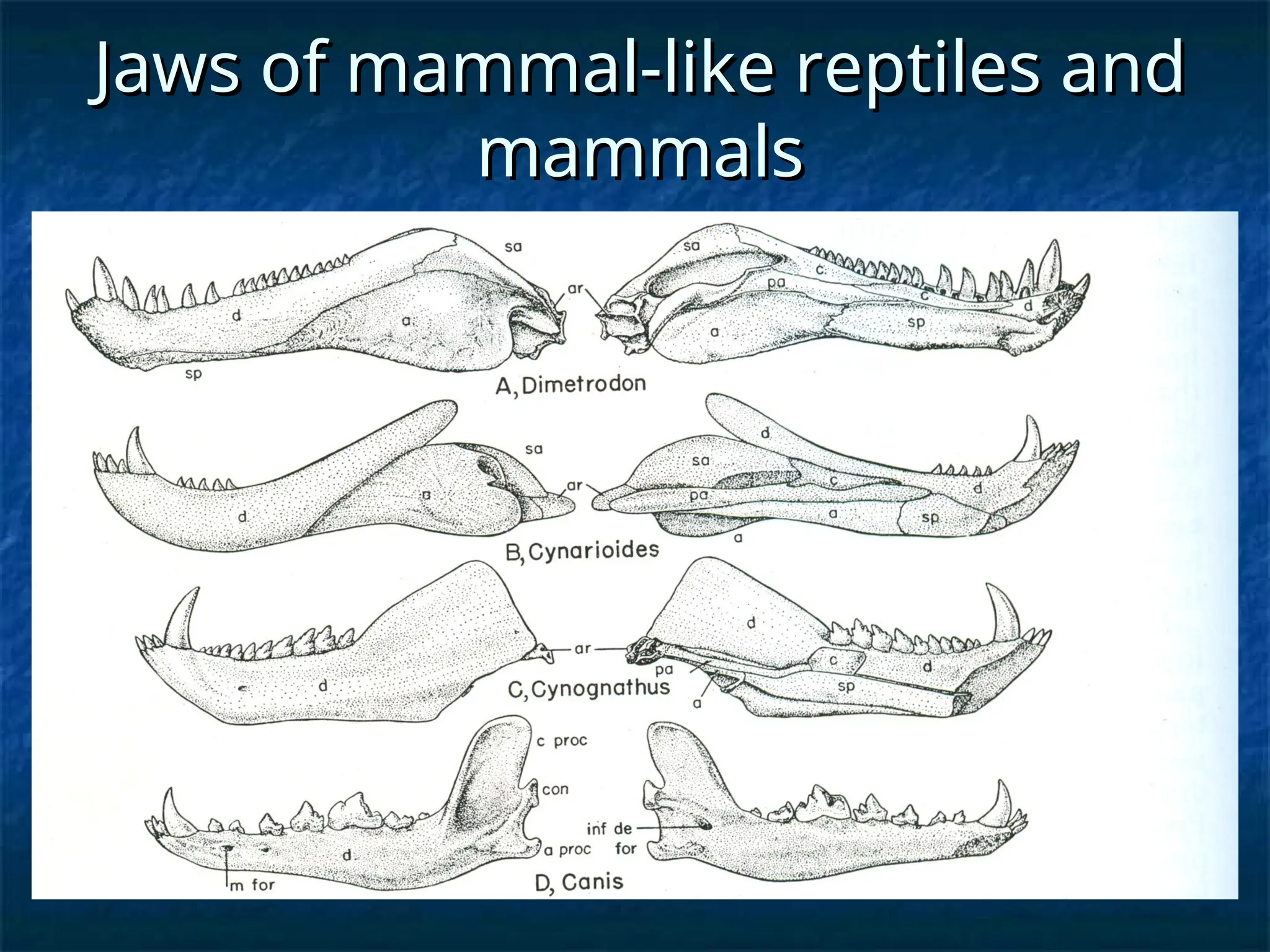
Jaws of mammal-like reptiles and
mammals
mammals
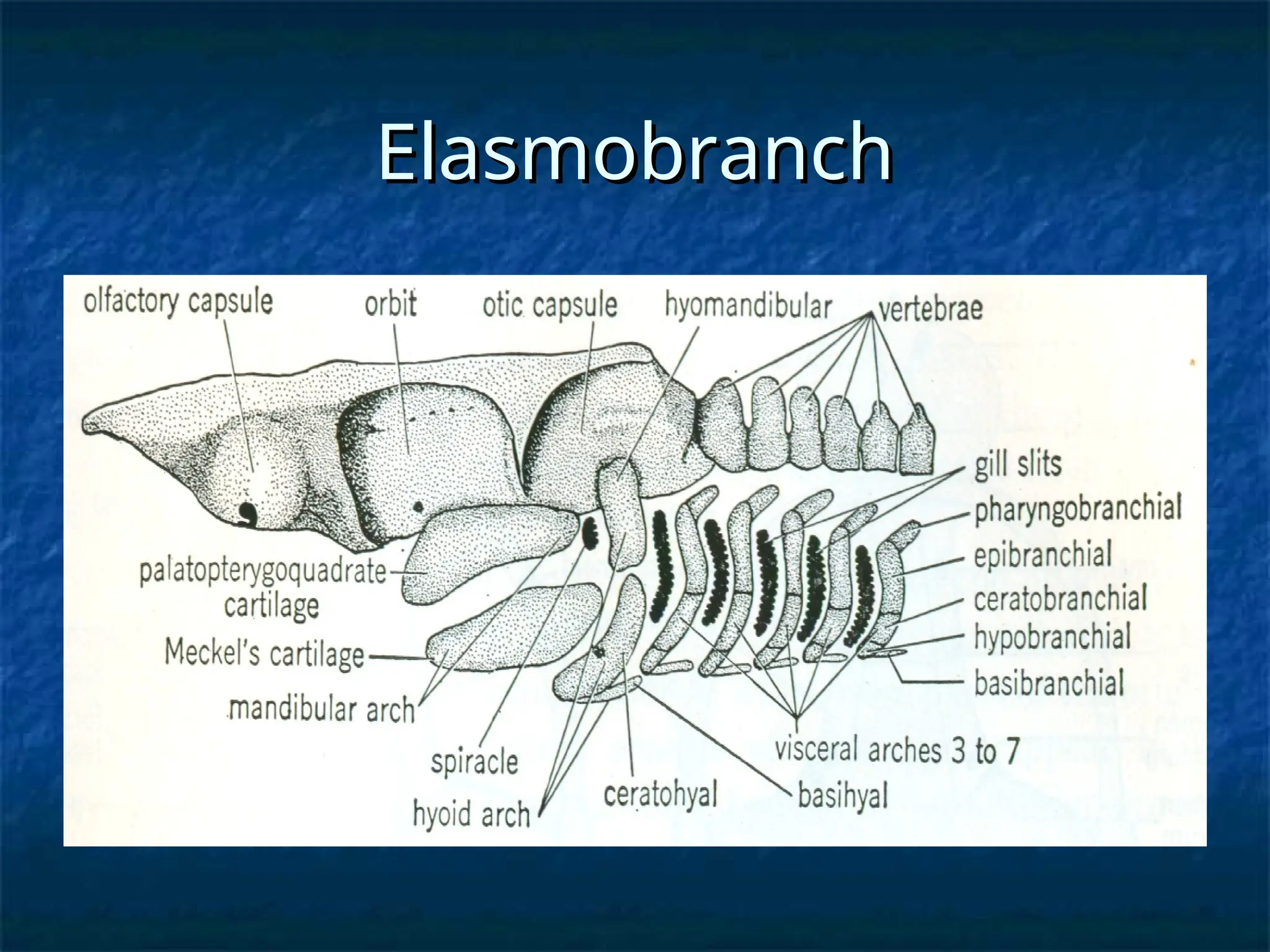
Elasmobranch
Elasmobranch
 At no time in it’s evolution has there
At no time in it’s evolution has there
been a cessation in function, although it
no longer is used as a nut-cracker /
bone –cruncher.
bone –cruncher.
 The successive changes which an
The successive changes which an
individual passes through, during a life
time are strikingly paralleled in the
evolutionary emergence of the human
race.
race. (Walter & sayles-fig519-520)
(Walter & sayles-fig519-520)
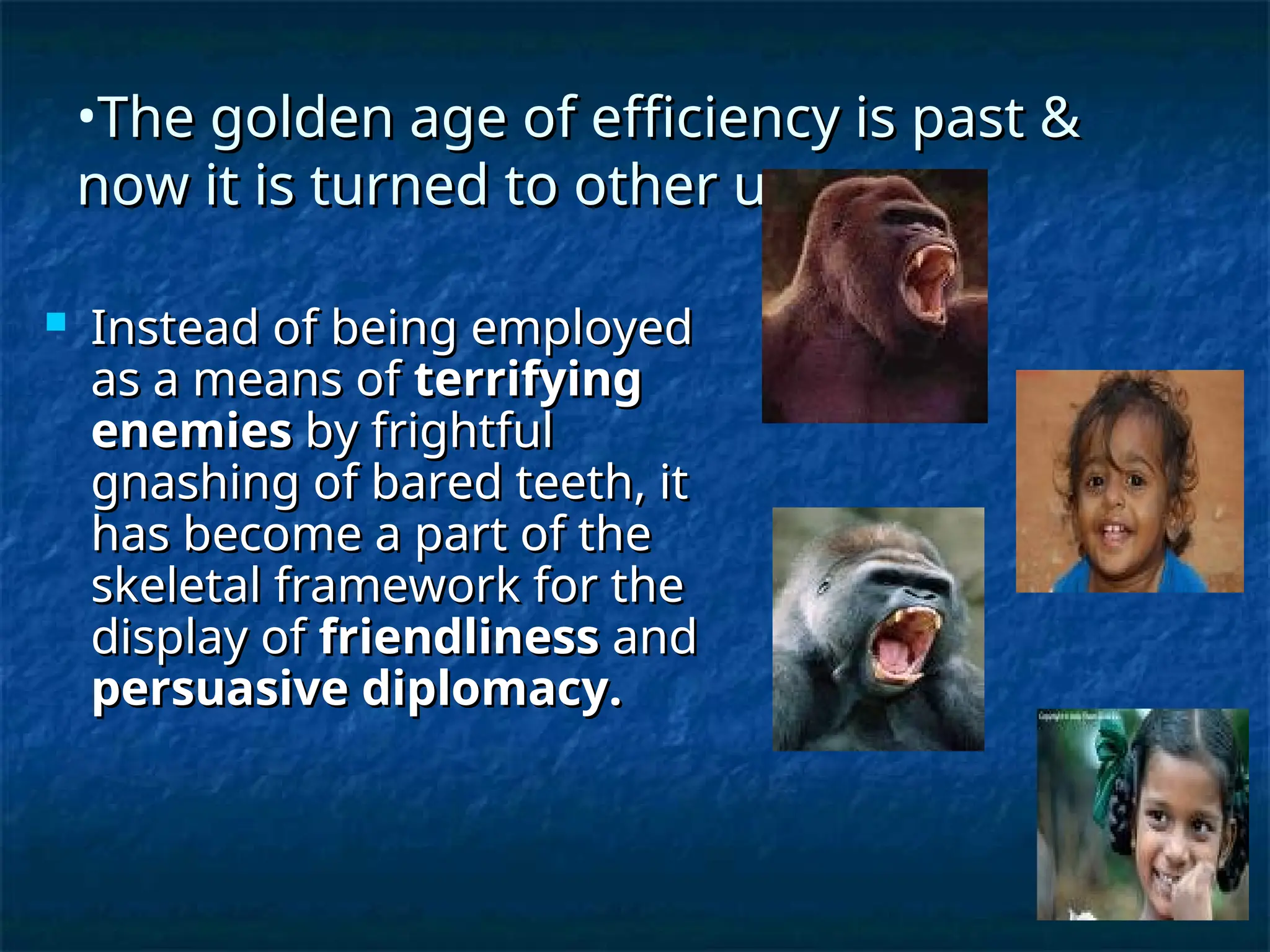
•The golden age of efficiency is past &
The golden age of efficiency is past &
now it is turned to other uses.
 Instead of being employed
Instead of being employed
as a means of
as a means of terrifying
terrifying
enemies
enemies by frightful
by frightful
gnashing of bared teeth, it
has become a part of the
skeletal framework for the
display of
display of friendliness
friendliness and
and
persuasive diplomacy.
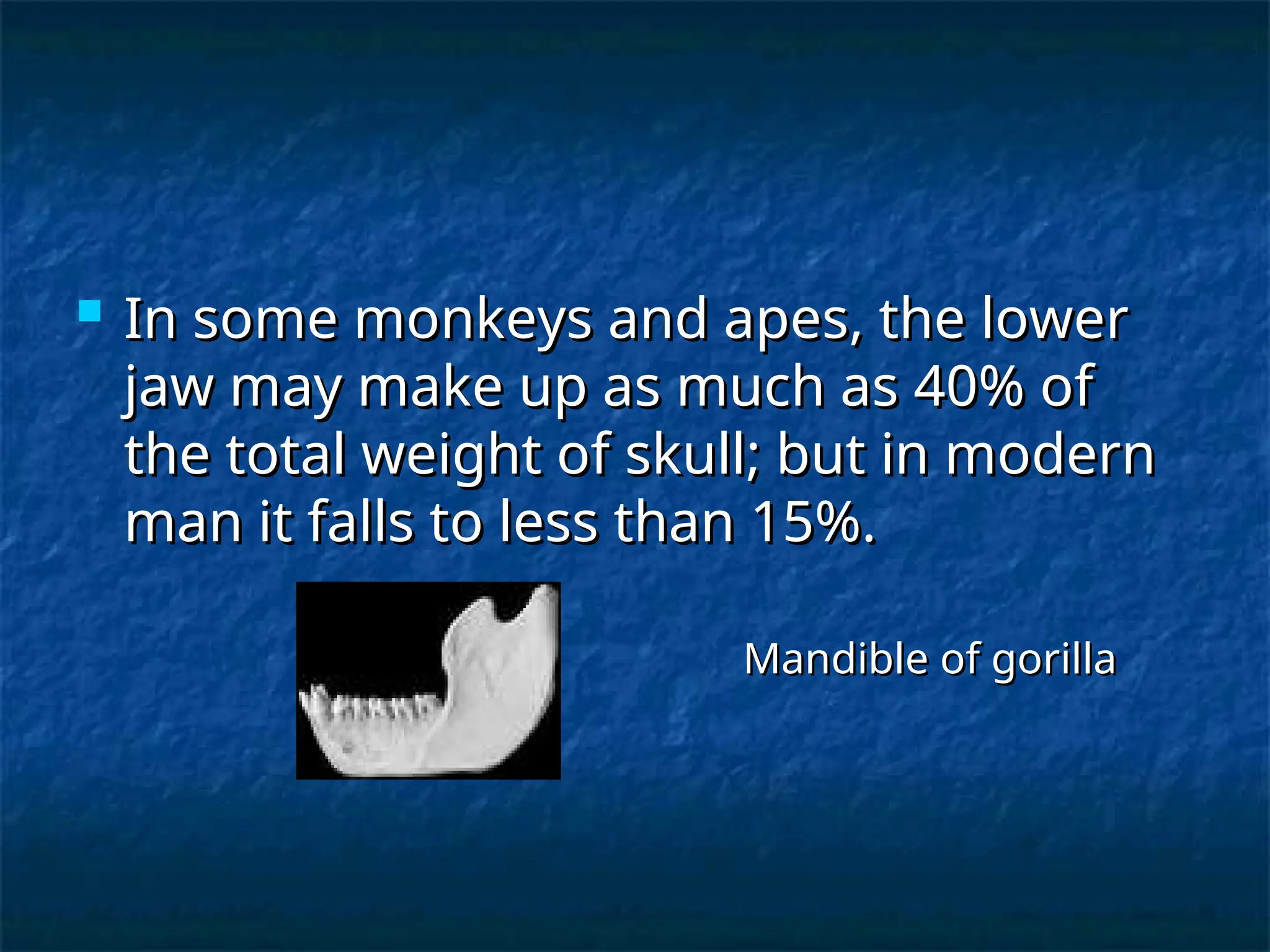
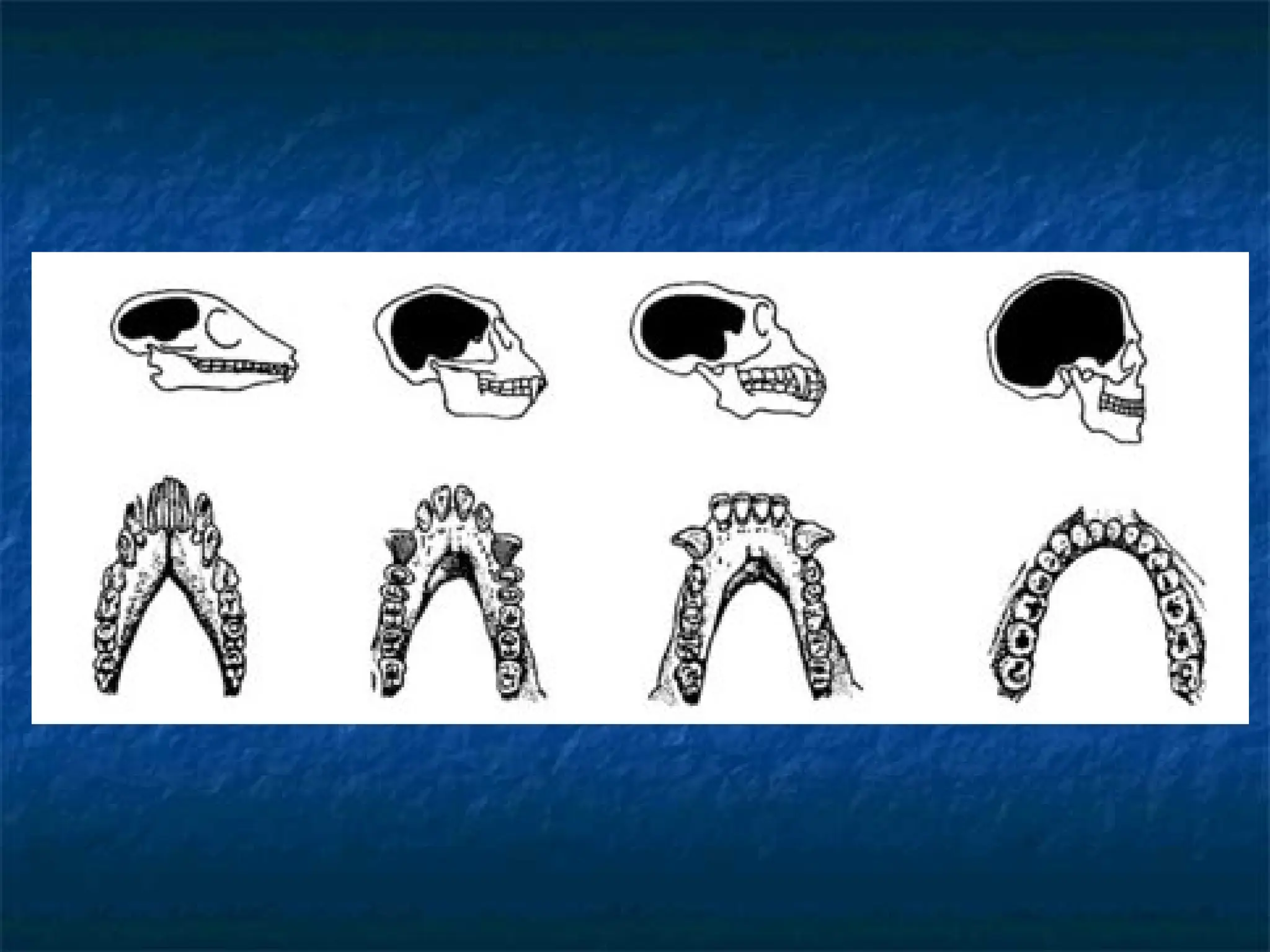
 In some monkeys and apes, the lower
In some monkeys and apes, the lower
jaw may make up as much as 40% of
the total weight of skull; but in modern
man it falls to less than 15%.
Mandible of gorilla
Mandible of gorilla
EVOLUTION
EVOLUTION
- A TIME
- A TIME
CHART
CHART
 Pithecanthropus-
Pithecanthropus- Pliocene
Pliocene
 Heidelberg man-
Heidelberg man- Lower pleistocene
Lower pleistocene
 Neanderthal man-
Neanderthal man- Lower pleistocene
Lower pleistocene
 Grimaldi race-
Grimaldi race- Betn lower & mid pleistocene
Betn lower & mid pleistocene
 Cro-magnon race-
Cro-magnon race- Mid. pleistocene
Mid. pleistocene
 Chancelade race-
Chancelade race- Upper pleistocene
Upper pleistocene
 Homo sapiens-
Homo sapiens- Holocene
Holocene
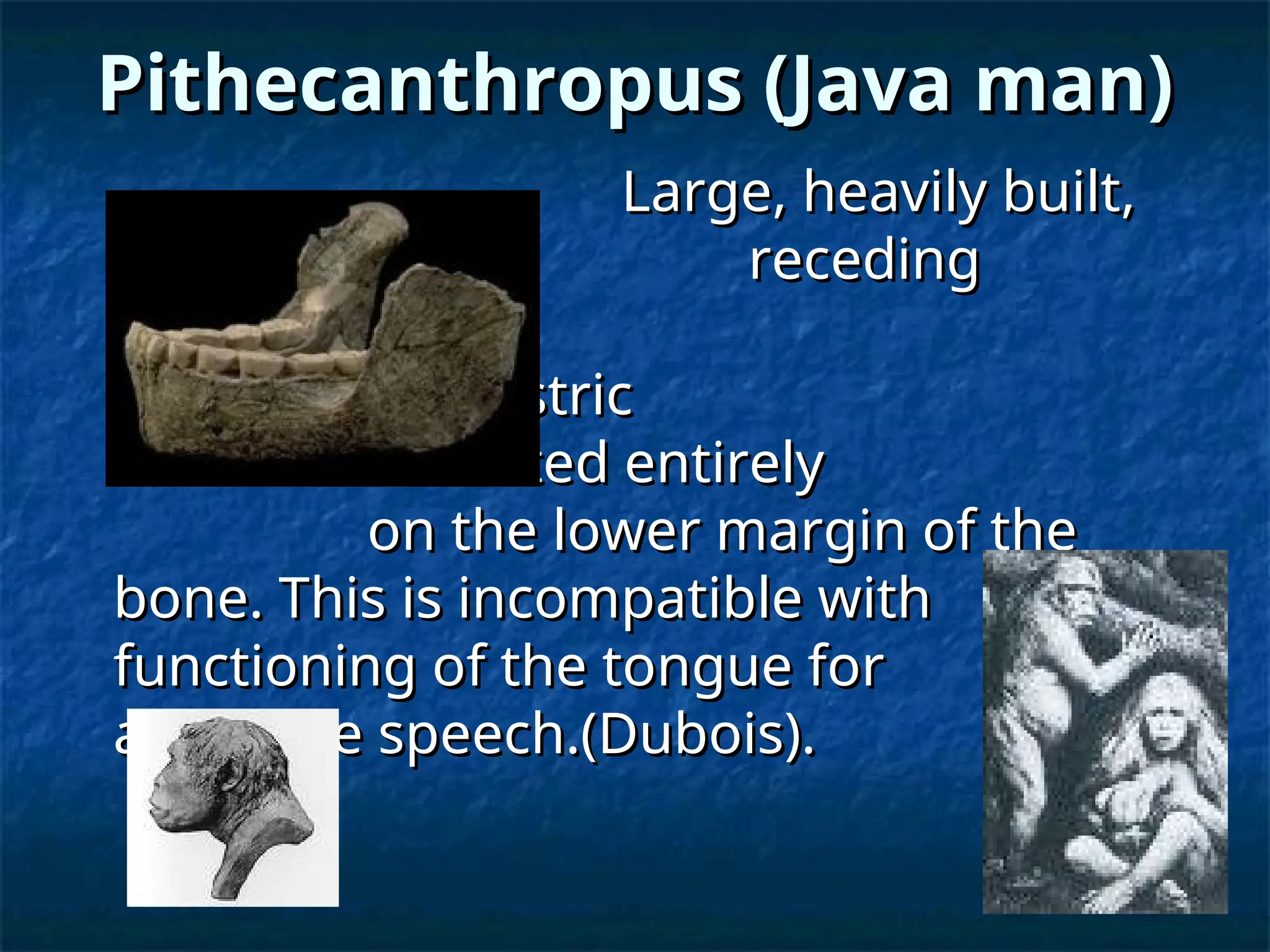
Pithecanthropus (Java man)
Large, heavily built,
receding
receding
symphysis- no
symphysis- no
chin, large digastric
fossa situated entirely
on the lower margin of the
bone. This is incompatible with
functioning of the tongue for
articulate speech.(Dubois).
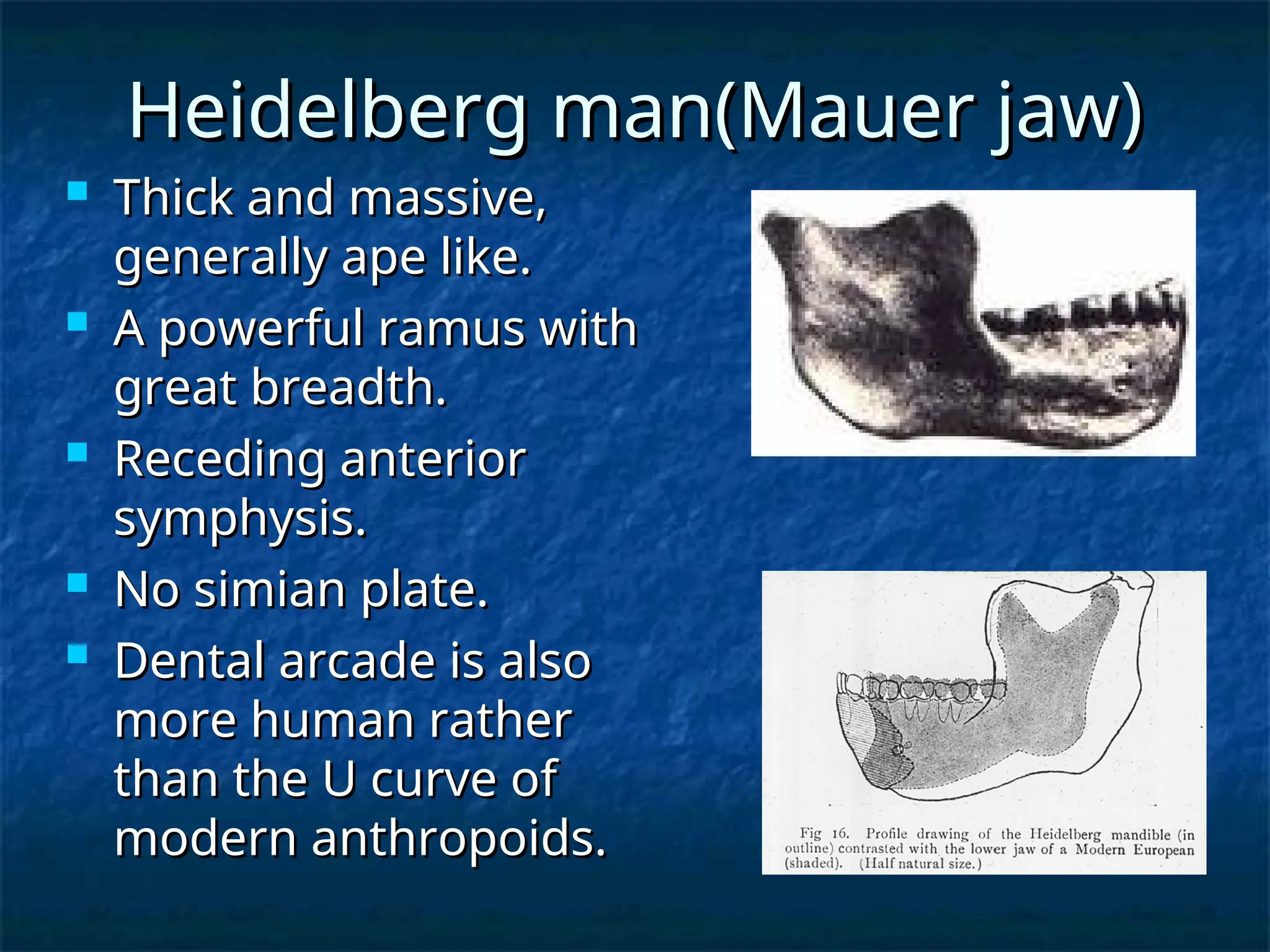
Heidelberg man(Mauer jaw)
 Thick and massive,
Thick and massive,
generally ape like.
generally ape like.
 A powerful ramus with
A powerful ramus with
great breadth.
great breadth.
 Receding anterior
Receding anterior
symphysis.
symphysis.
 No simian plate.
No simian plate.
 Dental arcade is also
Dental arcade is also
more human rather
more human rather
than the U curve of
than the U curve of
modern anthropoids.
modern anthropoids.
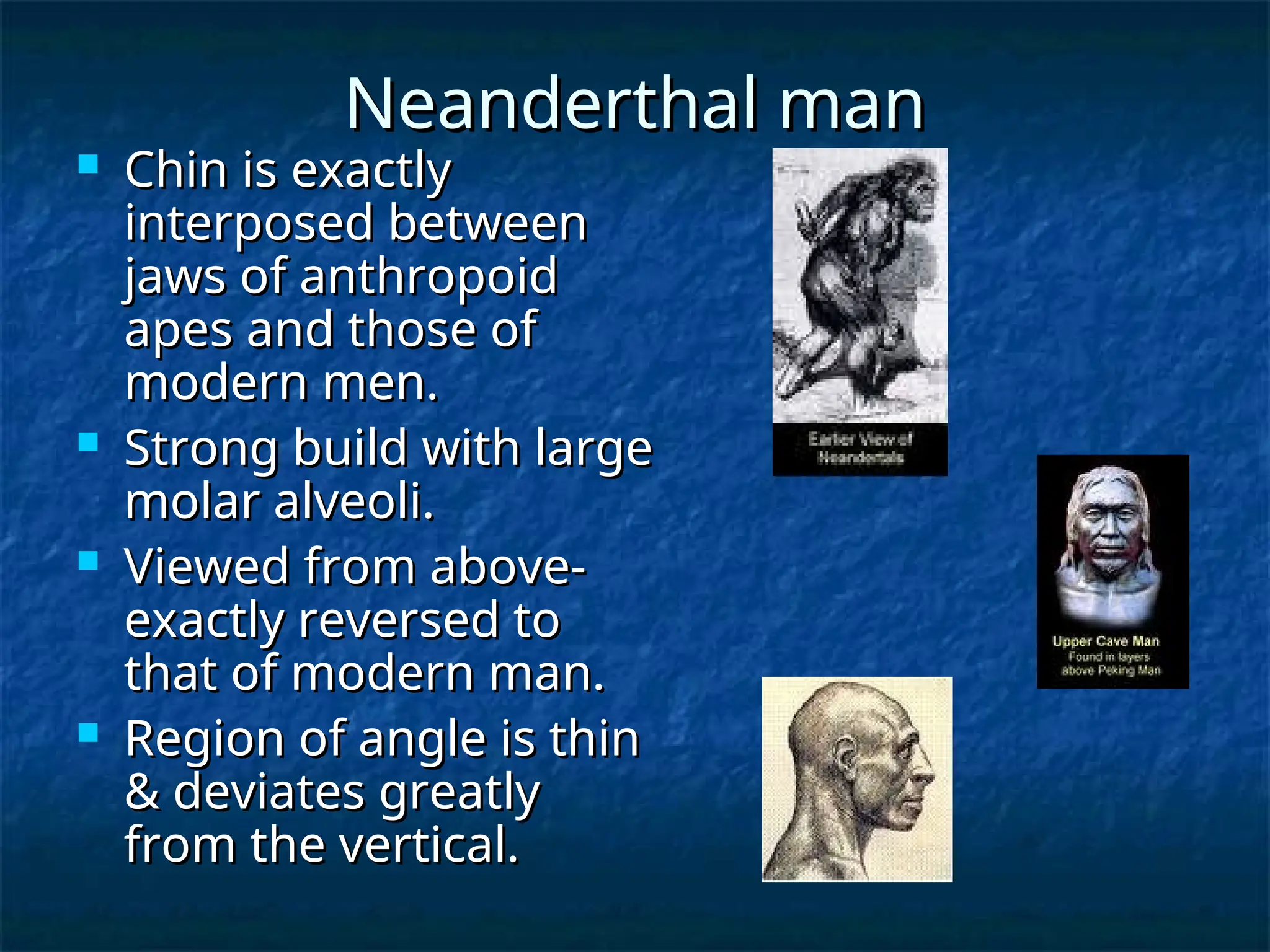
Neanderthal man
Neanderthal man
 Chin is exactly
Chin is exactly
interposed between
interposed between
jaws of anthropoid
jaws of anthropoid
apes and those of
apes and those of
modern men.
modern men.
 Strong build with large
Strong build with large
molar alveoli.
molar alveoli.
 Viewed from above-
Viewed from above-
exactly reversed to
exactly reversed to
that of modern man.
that of modern man.
 Region of angle is thin
Region of angle is thin
& deviates greatly
& deviates greatly
from the vertical.
from the vertical.
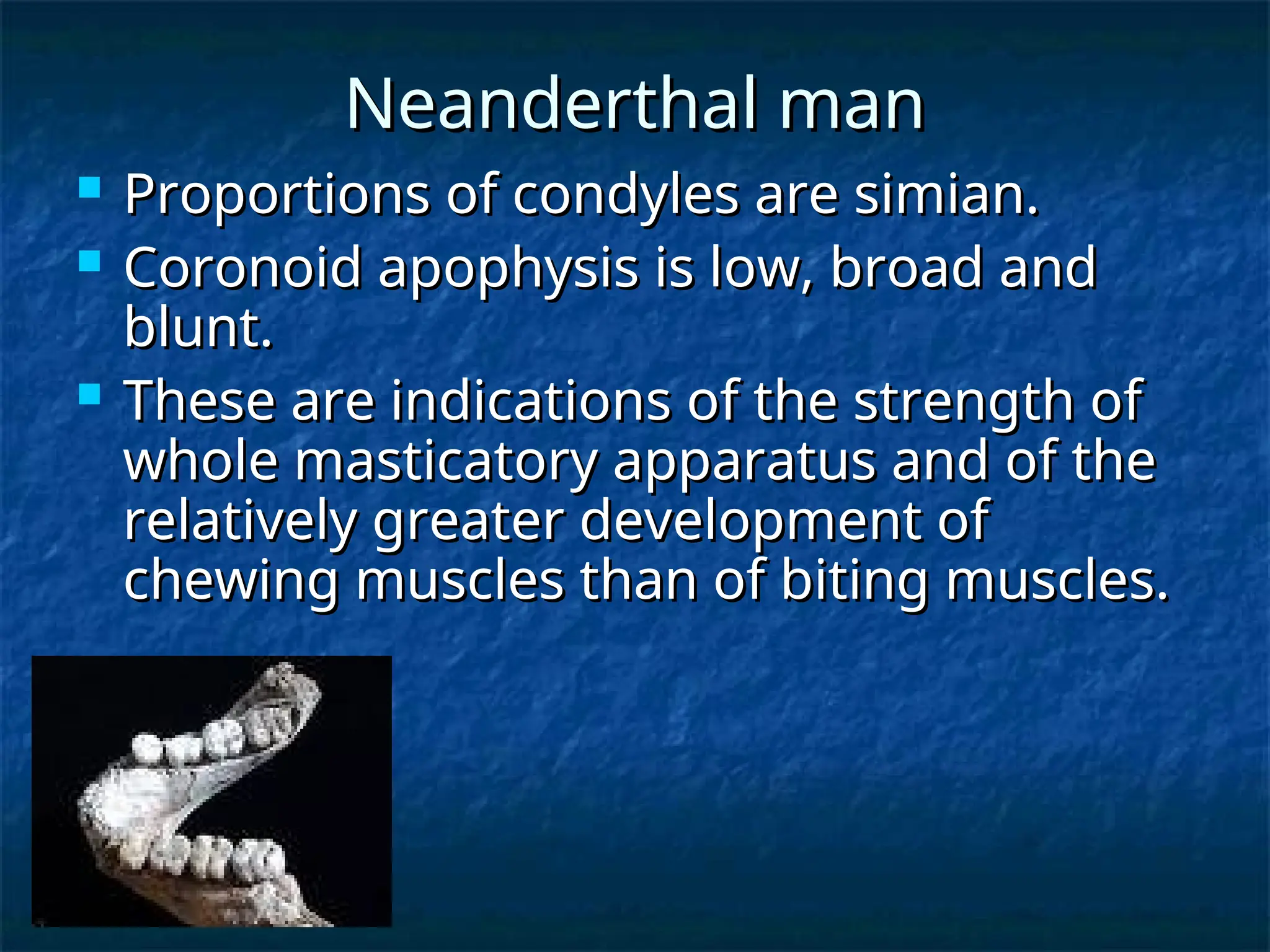
Neanderthal man
Neanderthal man
Neanderthal man
Neanderthal man
 Proportions of condyles are simian.
Proportions of condyles are simian.
 Coronoid apophysis is low, broad and
Coronoid apophysis is low, broad and
blunt.
blunt.
 These are indications of the strength of
These are indications of the strength of
whole masticatory apparatus and of the
relatively greater development of
chewing muscles than of biting muscles.
Grimaldi race (Negroid race)
 Jaw is strong, body is very thick, ramus
Jaw is strong, body is very thick, ramus
is broad and low.
is broad and low.
 Chin not greatly developed.
Chin not greatly developed.
 Strongly marked alveolar prognathism.
Strongly marked alveolar prognathism.
 Dental arch is less widely divergent than
Dental arch is less widely divergent than
in higher races.
in higher races.
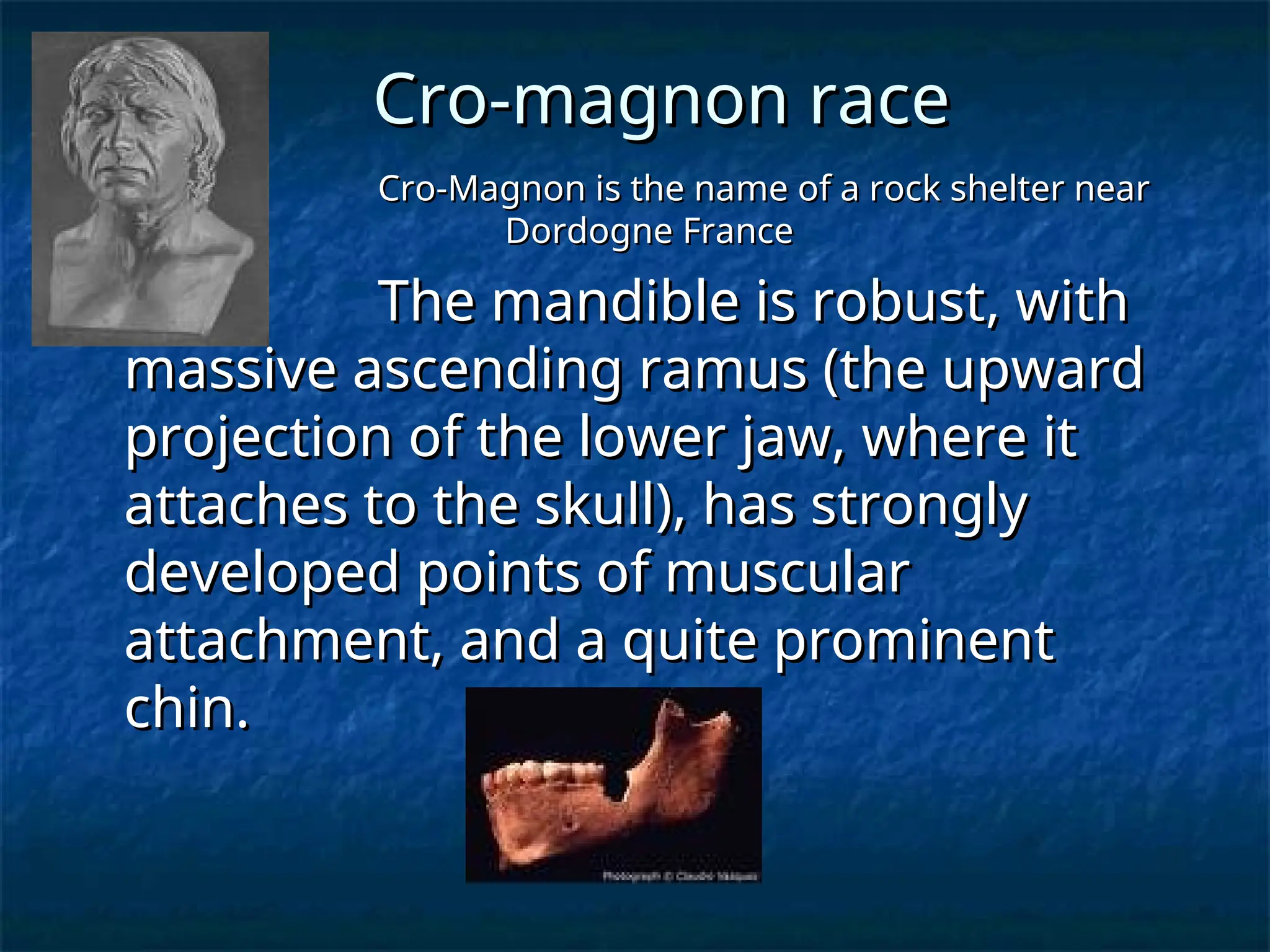
Cro-magnon race
Cro-magnon race
Cro-Magnon is the name of a rock shelter near
Dordogne France
Dordogne France
The mandible is robust, with
massive ascending ramus (the upward
projection of the lower jaw, where it
attaches to the skull), has strongly
developed points of muscular
attachment, and a quite prominent
chin.
chin.
Chancelade race
Chancelade race
 Jaw is narrow & strong.
Jaw is narrow & strong.
 Remarkable for the breadth of it’s ramus.
Remarkable for the breadth of it’s ramus.
 Chin forms a very broad & prominent
Chin forms a very broad & prominent
projection.
projection.
 Flaring gonial angles.
Flaring gonial angles.
 Testify to a considerable development of
Testify to a considerable development of
muscles of mastication.
 Special character is
Special character is
presence of
presence of
‘Torus mandibularis’.
Homo sapiens
Homo sapiens
DEVELOPMENT OF MANDIBLE
 The primary mandible is represented by the
The primary mandible is represented by the
Meckel’s cartilage.
Meckel’s cartilage.
 The ossifying parts of the mandible lie, at first
The ossifying parts of the mandible lie, at first
altogether on the outer side of the cartilage,
subsequently extending below it and then up
on it’s inner side to enclose it.
 The widening roof of the mouth has been met
The widening roof of the mouth has been met
by maxillary growth & formation of
membranous bones outside the original
arcade: this has necessitated a concomitant
formation outside the original mandible.
DEVELOPMENT OF MANDIBLE
 The first branchial arch gives rise to both
The first branchial arch gives rise to both
maxillary and mandibular processes.
 Meckel’s cartilage extends from the
Meckel’s cartilage extends from the
future malleus to the future symphysis
mentalis.
mentalis.
 The dorsal part of the Meckel’s cartilage
The dorsal part of the Meckel’s cartilage
proceeds towards the symphysis
mentalis but fusion is denied.
Ossification.
Ossification.
 The mandible appears immediately
The mandible appears immediately
external to the cartilage & begins to
ossify at 6-7 weeks of IUL.
 The mandibular cartilage & mandible
The mandibular cartilage & mandible
are believed to arise from neural crest
cells.
cells.
DEVELOPMENT OF MANDIBLE
 Morphogenesis of the medial region of
Morphogenesis of the medial region of
the developing mandible is regulated by
multiple signaling pathways.
 Studies suggest that in the medial
Studies suggest that in the medial
region of the developing mandible, FGF-
mediated signaling is involved in
growth-promoting interaction, whereas
BMP
BMP (Bone Morphogenetic Protein)
(Bone Morphogenetic Protein) -mediated
-mediated
signaling is involved in chondrogenesis.
 Experimental evidence indicates that the
Experimental evidence indicates that the
mandibular primordia are specified as at
least two independent functional regions:
two large lateral (proximal) regions where
morphogenesis is dependent on FGF-8
signaling, and a small medial region
where morphogenesis is independent of
FGF-8 and dependent on other signals.
Factors thought to be responsible for
ossification-
ossification-
 Mandibular cartilage itself.
Mandibular cartilage itself.
 Epithelio-mesenchymal interactions
Epithelio-mesenchymal interactions
between oral epithelium & subjacent
mesenchyme.
mesenchyme.
 Teeth are also considered to affect
Teeth are also considered to affect
mandibular development, especially the
body.
body.
 At birth the two halves of mandible are
At birth the two halves of mandible are
united at the symphysis by a
cartilaginous joint that allows further
forward growth at the body of the bone
until synostosis occurs during the first 3
years of life.
years of life.
 A secondary cartilage in the condylar
A secondary cartilage in the condylar
process is responsible for most of the
later growth in length of the mandible.
 Mandible of the young child is characterized
Mandible of the young child is characterized
by it’s diminutive appearance.
 Chin is poorly developed.
Chin is poorly developed.
 With increasing age
With increasing age
 It becomes more massive
It becomes more massive
 Squared in character
Squared in character
 Forward contour of lower jaw becomes flattened
Forward contour of lower jaw becomes flattened
 Mental region becomes progressively prominent.
Mental region becomes progressively prominent.
 The whole face becomes deeper in the
The whole face becomes deeper in the
AP plane.
AP plane.
 Concept of ‘Growth equivalents’- i.e.,
Concept of ‘Growth equivalents’- i.e.,
direct inter-relationship between cranial
base, nasomaxillary complex and
mandible.
mandible.
Jaw suspension
Jaw suspension
 Huxley (1876) proposed terme for the
Huxley (1876) proposed terme for the
manner in which the qudrate portion of
the pterygoquadrate cartilage is related
to the otic region.
to the otic region.
 Some other authors applied the same/
Some other authors applied the same/
similar terms to indicate the manner in
which the entire upper jaw was
suspended from the skull, leading to
confusing terminologies.
 Hyostyly- Hyoid braced
Hyostyly- Hyoid braced
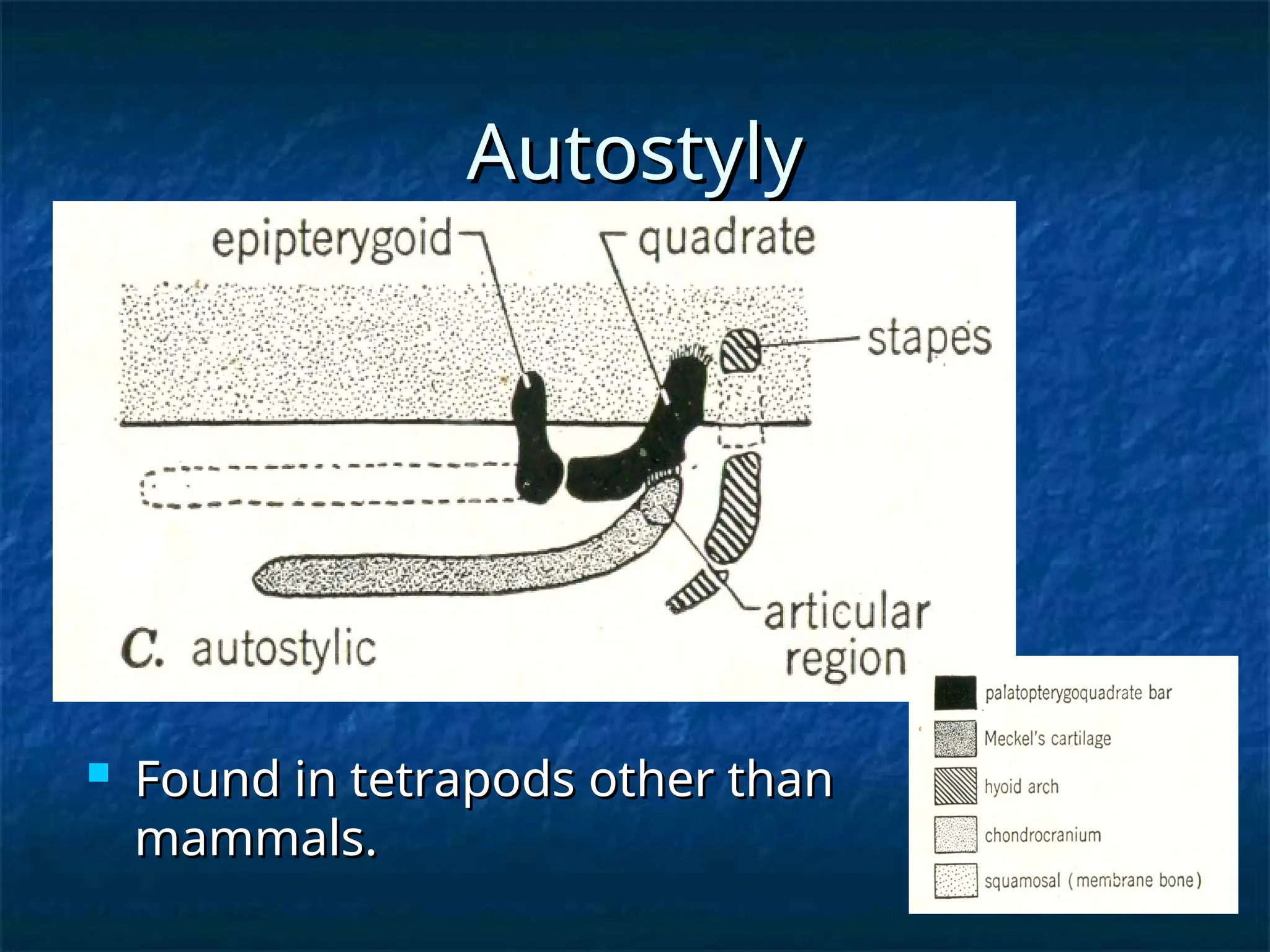
 Autostyly- Self braced. Quadrate
Autostyly- Self braced. Quadrate
articulates directly against, and often
fuses with the otic region of the
chondrocranium.
chondrocranium.
 Amphistyly- Both hyomandibular &
Amphistyly- Both hyomandibular &
quadrate articulate against the
chondrocranium.
chondrocranium.
Hyostyly
Hyostyly
 Seen in Sharks and Sturgeons
Seen in Sharks and Sturgeons
Autostyly
Autostyly
 Found in tetrapods other than
Found in tetrapods other than
mammals.
mammals.
Amphistylic
Amphistylic
 Found in primitive elasmobranchs
Found in primitive elasmobranchs
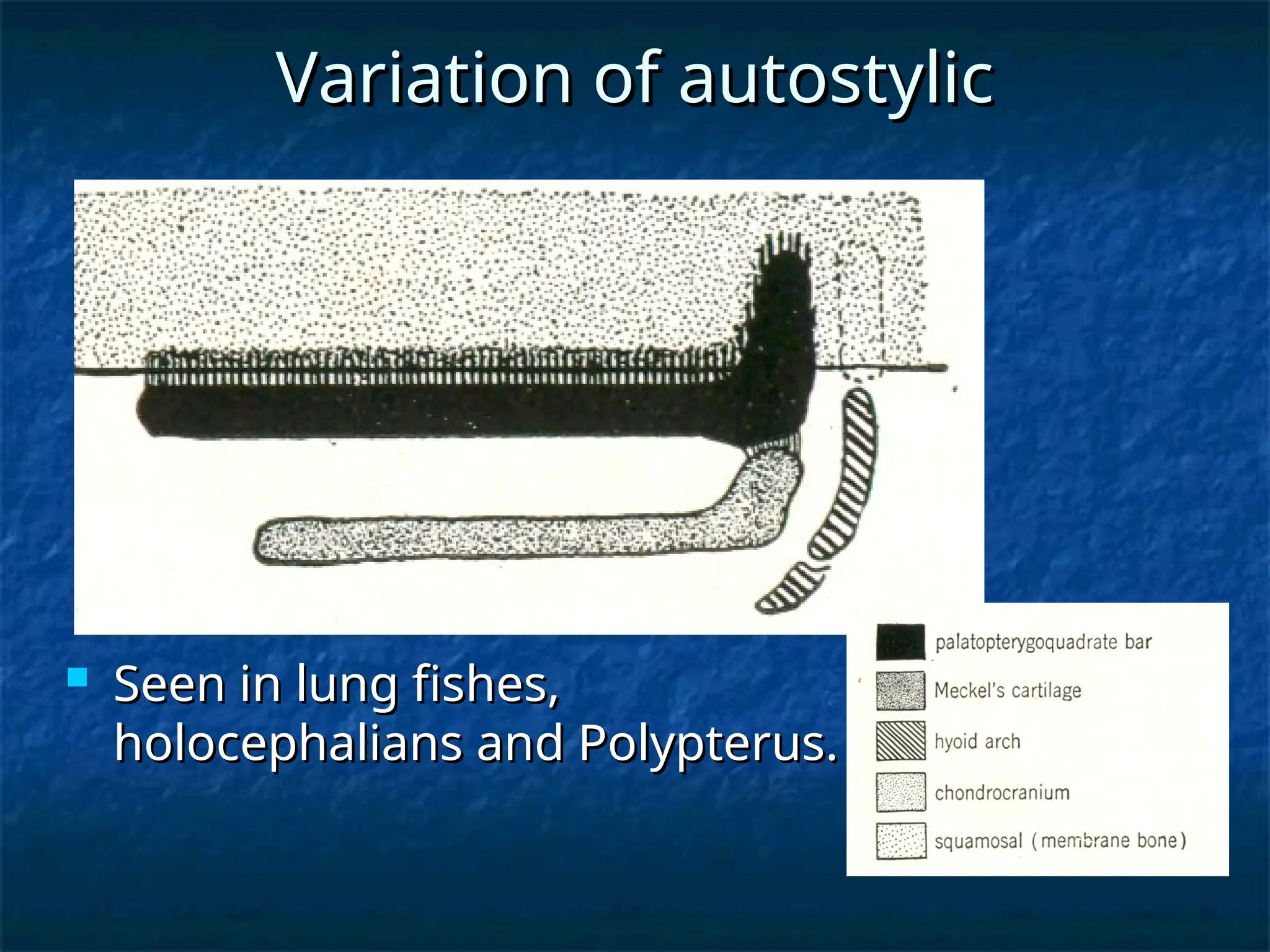
Variation of autostylic
 Seen in lung fishes,
Seen in lung fishes,
holocephalians and Polypterus.
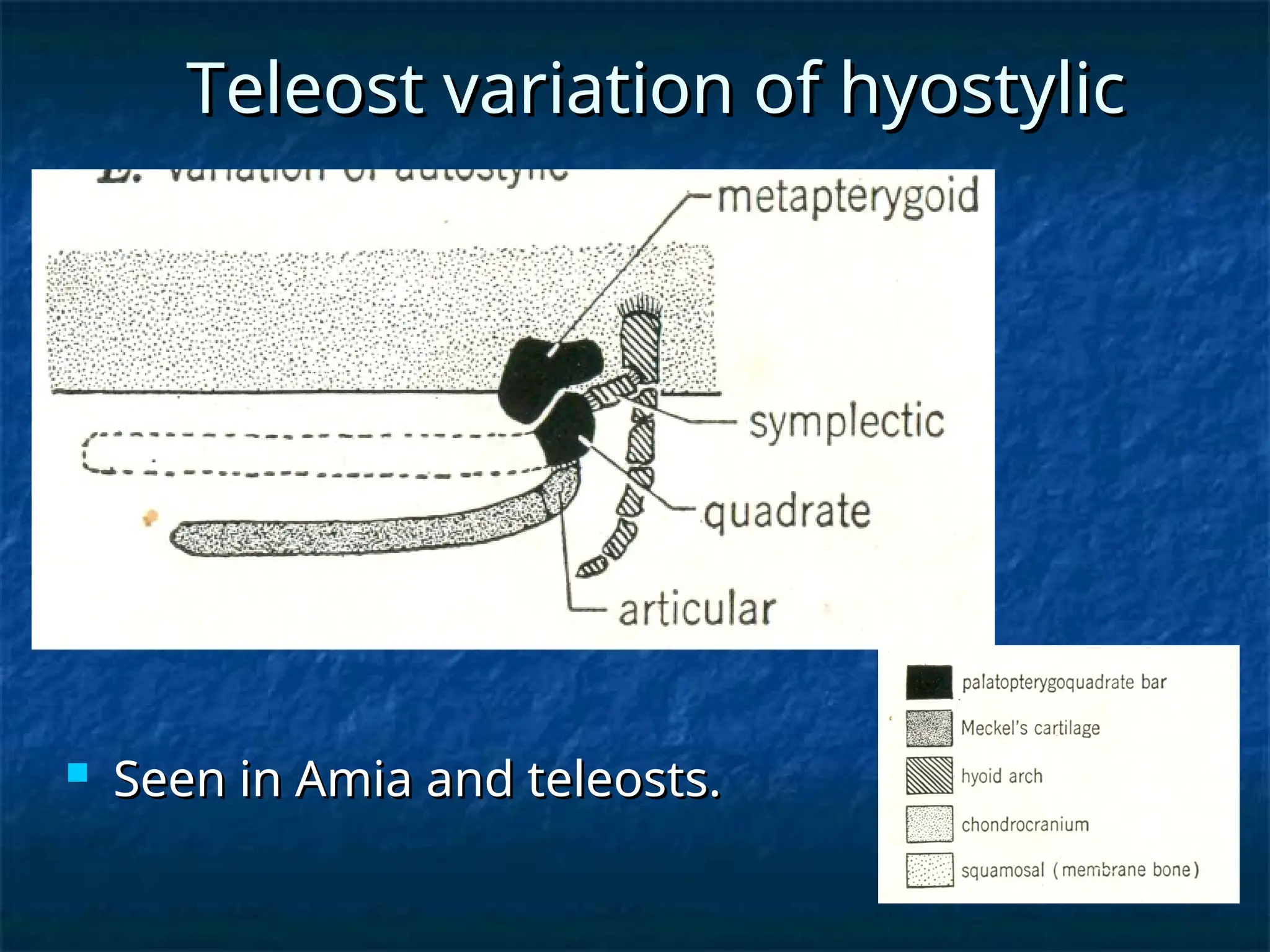
Teleost variation of hyostylic
 Seen in Amia and teleosts.
Seen in Amia and teleosts.
Skull of Sphenodon
Skull of Sphenodon
Tuatara have been referred to as living fossils. This means
that they have remained mostly unchanged throughout
their entire history, which is approximately 220 million
years.
Skull of Boa constrictor
Skull of monkey
Skull of monkey
Evolution & development of Mandibles.ppt

Evolution & development of Mandibles.ppt

  • 1.
    EVOLUTION & EVOLUTION & DEVELOPMENTOF DEVELOPMENT OF MANDIBLE MANDIBLE - - Dr. Patil Shrish. Dr. Patil Shrish. PG in Dept of Anatomy PG in Dept of Anatomy
  • 2.
    Mandible Mandible -The strongest andlargest skull bone in -The strongest and largest skull bone in man. man. -Only bone in human skull to move -Only bone in human skull to move independently, with the exception of independently, with the exception of ear ossicles. ear ossicles.
  • 3.
     Various modificationsfrom the jaw of Various modifications from the jaw of cartilaginous fishes to present day. cartilaginous fishes to present day.
  • 4.
  • 5.
    Simplifie Simplifie d family d family treeof tree of primates primates
  • 6.
    Jaws of ray-finnedfish and a Jaws of ray-finned fish and a primitive crosspoterygian primitive crosspoterygian
  • 7.
    Jaws of Labyrinthodont,primitive Jaws of Labyrinthodont, primitive reptile & reptile reptile & reptile
  • 8.
    Jaws of mammal-likereptiles and Jaws of mammal-like reptiles and mammals mammals
  • 9.
  • 10.
     At notime in it’s evolution has there At no time in it’s evolution has there been a cessation in function, although it been a cessation in function, although it no longer is used as a nut-cracker / no longer is used as a nut-cracker / bone –cruncher. bone –cruncher.
  • 11.
     The successivechanges which an The successive changes which an individual passes through, during a life individual passes through, during a life time are strikingly paralleled in the time are strikingly paralleled in the evolutionary emergence of the human evolutionary emergence of the human race. race. (Walter & sayles-fig519-520) (Walter & sayles-fig519-520)
  • 12.
    •The golden ageof efficiency is past & The golden age of efficiency is past & now it is turned to other uses. now it is turned to other uses.  Instead of being employed Instead of being employed as a means of as a means of terrifying terrifying enemies enemies by frightful by frightful gnashing of bared teeth, it gnashing of bared teeth, it has become a part of the has become a part of the skeletal framework for the skeletal framework for the display of display of friendliness friendliness and and persuasive diplomacy. persuasive diplomacy.
  • 13.
     In somemonkeys and apes, the lower In some monkeys and apes, the lower jaw may make up as much as 40% of jaw may make up as much as 40% of the total weight of skull; but in modern the total weight of skull; but in modern man it falls to less than 15%. man it falls to less than 15%. Mandible of gorilla Mandible of gorilla
  • 14.
  • 15.
     Pithecanthropus- Pithecanthropus- Pliocene Pliocene Heidelberg man- Heidelberg man- Lower pleistocene Lower pleistocene  Neanderthal man- Neanderthal man- Lower pleistocene Lower pleistocene  Grimaldi race- Grimaldi race- Betn lower & mid pleistocene Betn lower & mid pleistocene  Cro-magnon race- Cro-magnon race- Mid. pleistocene Mid. pleistocene  Chancelade race- Chancelade race- Upper pleistocene Upper pleistocene  Homo sapiens- Homo sapiens- Holocene Holocene
  • 16.
    Pithecanthropus (Java man) Pithecanthropus(Java man) Large, heavily built, Large, heavily built, receding receding symphysis- no symphysis- no chin, large digastric chin, large digastric fossa situated entirely fossa situated entirely on the lower margin of the on the lower margin of the bone. This is incompatible with bone. This is incompatible with functioning of the tongue for functioning of the tongue for articulate speech.(Dubois). articulate speech.(Dubois).
  • 17.
    Heidelberg man(Mauer jaw) Heidelbergman(Mauer jaw)  Thick and massive, Thick and massive, generally ape like. generally ape like.  A powerful ramus with A powerful ramus with great breadth. great breadth.  Receding anterior Receding anterior symphysis. symphysis.  No simian plate. No simian plate.  Dental arcade is also Dental arcade is also more human rather more human rather than the U curve of than the U curve of modern anthropoids. modern anthropoids.
  • 18.
    Neanderthal man Neanderthal man Chin is exactly Chin is exactly interposed between interposed between jaws of anthropoid jaws of anthropoid apes and those of apes and those of modern men. modern men.  Strong build with large Strong build with large molar alveoli. molar alveoli.  Viewed from above- Viewed from above- exactly reversed to exactly reversed to that of modern man. that of modern man.  Region of angle is thin Region of angle is thin & deviates greatly & deviates greatly from the vertical. from the vertical.
  • 19.
  • 20.
    Neanderthal man Neanderthal man Proportions of condyles are simian. Proportions of condyles are simian.  Coronoid apophysis is low, broad and Coronoid apophysis is low, broad and blunt. blunt.  These are indications of the strength of These are indications of the strength of whole masticatory apparatus and of the whole masticatory apparatus and of the relatively greater development of relatively greater development of chewing muscles than of biting muscles. chewing muscles than of biting muscles.
  • 21.
    Grimaldi race (Negroidrace) Grimaldi race (Negroid race)  Jaw is strong, body is very thick, ramus Jaw is strong, body is very thick, ramus is broad and low. is broad and low.  Chin not greatly developed. Chin not greatly developed.  Strongly marked alveolar prognathism. Strongly marked alveolar prognathism.  Dental arch is less widely divergent than Dental arch is less widely divergent than in higher races. in higher races.
  • 22.
    Cro-magnon race Cro-magnon race Cro-Magnonis the name of a rock shelter near Cro-Magnon is the name of a rock shelter near Dordogne France Dordogne France The mandible is robust, with The mandible is robust, with massive ascending ramus (the upward massive ascending ramus (the upward projection of the lower jaw, where it projection of the lower jaw, where it attaches to the skull), has strongly attaches to the skull), has strongly developed points of muscular developed points of muscular attachment, and a quite prominent attachment, and a quite prominent chin. chin.
  • 23.
    Chancelade race Chancelade race Jaw is narrow & strong. Jaw is narrow & strong.  Remarkable for the breadth of it’s ramus. Remarkable for the breadth of it’s ramus.  Chin forms a very broad & prominent Chin forms a very broad & prominent projection. projection.  Flaring gonial angles. Flaring gonial angles.  Testify to a considerable development of Testify to a considerable development of muscles of mastication. muscles of mastication.  Special character is Special character is presence of presence of ‘Torus mandibularis’. ‘Torus mandibularis’.
  • 24.
  • 26.
    DEVELOPMENT OF MANDIBLE DEVELOPMENTOF MANDIBLE  The primary mandible is represented by the The primary mandible is represented by the Meckel’s cartilage. Meckel’s cartilage.  The ossifying parts of the mandible lie, at first The ossifying parts of the mandible lie, at first altogether on the outer side of the cartilage, altogether on the outer side of the cartilage, subsequently extending below it and then up subsequently extending below it and then up on it’s inner side to enclose it. on it’s inner side to enclose it.  The widening roof of the mouth has been met The widening roof of the mouth has been met by maxillary growth & formation of by maxillary growth & formation of membranous bones outside the original membranous bones outside the original arcade: this has necessitated a concomitant arcade: this has necessitated a concomitant formation outside the original mandible. formation outside the original mandible.
  • 27.
    DEVELOPMENT OF MANDIBLE DEVELOPMENTOF MANDIBLE  The first branchial arch gives rise to both The first branchial arch gives rise to both maxillary and mandibular processes. maxillary and mandibular processes.  Meckel’s cartilage extends from the Meckel’s cartilage extends from the future malleus to the future symphysis future malleus to the future symphysis mentalis. mentalis.  The dorsal part of the Meckel’s cartilage The dorsal part of the Meckel’s cartilage proceeds towards the symphysis proceeds towards the symphysis mentalis but fusion is denied. mentalis but fusion is denied.
  • 28.
    Ossification. Ossification.  The mandibleappears immediately The mandible appears immediately external to the cartilage & begins to external to the cartilage & begins to ossify at 6-7 weeks of IUL. ossify at 6-7 weeks of IUL.  The mandibular cartilage & mandible The mandibular cartilage & mandible are believed to arise from neural crest are believed to arise from neural crest cells. cells.
  • 29.
    DEVELOPMENT OF MANDIBLE DEVELOPMENTOF MANDIBLE  Morphogenesis of the medial region of Morphogenesis of the medial region of the developing mandible is regulated by the developing mandible is regulated by multiple signaling pathways. multiple signaling pathways.  Studies suggest that in the medial Studies suggest that in the medial region of the developing mandible, FGF- region of the developing mandible, FGF- mediated signaling is involved in mediated signaling is involved in growth-promoting interaction, whereas growth-promoting interaction, whereas BMP BMP (Bone Morphogenetic Protein) (Bone Morphogenetic Protein) -mediated -mediated signaling is involved in chondrogenesis. signaling is involved in chondrogenesis.
  • 30.
     Experimental evidenceindicates that the Experimental evidence indicates that the mandibular primordia are specified as at mandibular primordia are specified as at least two independent functional regions: least two independent functional regions: two large lateral (proximal) regions where two large lateral (proximal) regions where morphogenesis is dependent on FGF-8 morphogenesis is dependent on FGF-8 signaling, and a small medial region signaling, and a small medial region where morphogenesis is independent of where morphogenesis is independent of FGF-8 and dependent on other signals. FGF-8 and dependent on other signals.
  • 31.
    Factors thought tobe responsible for Factors thought to be responsible for ossification- ossification-  Mandibular cartilage itself. Mandibular cartilage itself.  Epithelio-mesenchymal interactions Epithelio-mesenchymal interactions between oral epithelium & subjacent between oral epithelium & subjacent mesenchyme. mesenchyme.  Teeth are also considered to affect Teeth are also considered to affect mandibular development, especially the mandibular development, especially the body. body.
  • 32.
     At birththe two halves of mandible are At birth the two halves of mandible are united at the symphysis by a united at the symphysis by a cartilaginous joint that allows further cartilaginous joint that allows further forward growth at the body of the bone forward growth at the body of the bone until synostosis occurs during the first 3 until synostosis occurs during the first 3 years of life. years of life.  A secondary cartilage in the condylar A secondary cartilage in the condylar process is responsible for most of the process is responsible for most of the later growth in length of the mandible. later growth in length of the mandible.
  • 33.
     Mandible ofthe young child is characterized Mandible of the young child is characterized by it’s diminutive appearance. by it’s diminutive appearance.  Chin is poorly developed. Chin is poorly developed.  With increasing age With increasing age  It becomes more massive It becomes more massive  Squared in character Squared in character  Forward contour of lower jaw becomes flattened Forward contour of lower jaw becomes flattened  Mental region becomes progressively prominent. Mental region becomes progressively prominent.
  • 34.
     The wholeface becomes deeper in the The whole face becomes deeper in the AP plane. AP plane.  Concept of ‘Growth equivalents’- i.e., Concept of ‘Growth equivalents’- i.e., direct inter-relationship between cranial direct inter-relationship between cranial base, nasomaxillary complex and base, nasomaxillary complex and mandible. mandible.
  • 35.
    Jaw suspension Jaw suspension Huxley (1876) proposed terme for the Huxley (1876) proposed terme for the manner in which the qudrate portion of manner in which the qudrate portion of the pterygoquadrate cartilage is related the pterygoquadrate cartilage is related to the otic region. to the otic region.  Some other authors applied the same/ Some other authors applied the same/ similar terms to indicate the manner in similar terms to indicate the manner in which the entire upper jaw was which the entire upper jaw was suspended from the skull, leading to suspended from the skull, leading to confusing terminologies. confusing terminologies.
  • 36.
     Hyostyly- Hyoidbraced Hyostyly- Hyoid braced  Autostyly- Self braced. Quadrate Autostyly- Self braced. Quadrate articulates directly against, and often articulates directly against, and often fuses with the otic region of the fuses with the otic region of the chondrocranium. chondrocranium.  Amphistyly- Both hyomandibular & Amphistyly- Both hyomandibular & quadrate articulate against the quadrate articulate against the chondrocranium. chondrocranium.
  • 37.
    Hyostyly Hyostyly  Seen inSharks and Sturgeons Seen in Sharks and Sturgeons
  • 38.
    Autostyly Autostyly  Found intetrapods other than Found in tetrapods other than mammals. mammals.
  • 39.
    Amphistylic Amphistylic  Found inprimitive elasmobranchs Found in primitive elasmobranchs
  • 40.
    Variation of autostylic Variationof autostylic  Seen in lung fishes, Seen in lung fishes, holocephalians and Polypterus. holocephalians and Polypterus.
  • 41.
    Teleost variation ofhyostylic Teleost variation of hyostylic  Seen in Amia and teleosts. Seen in Amia and teleosts.
  • 42.
    Skull of Sphenodon Skullof Sphenodon Tuatara have been referred to as living fossils. This means that they have remained mostly unchanged throughout their entire history, which is approximately 220 million years.
  • 43.
    Skull of Boaconstrictor Skull of Boa constrictor
  • 44.