The Evolution of Ethernet
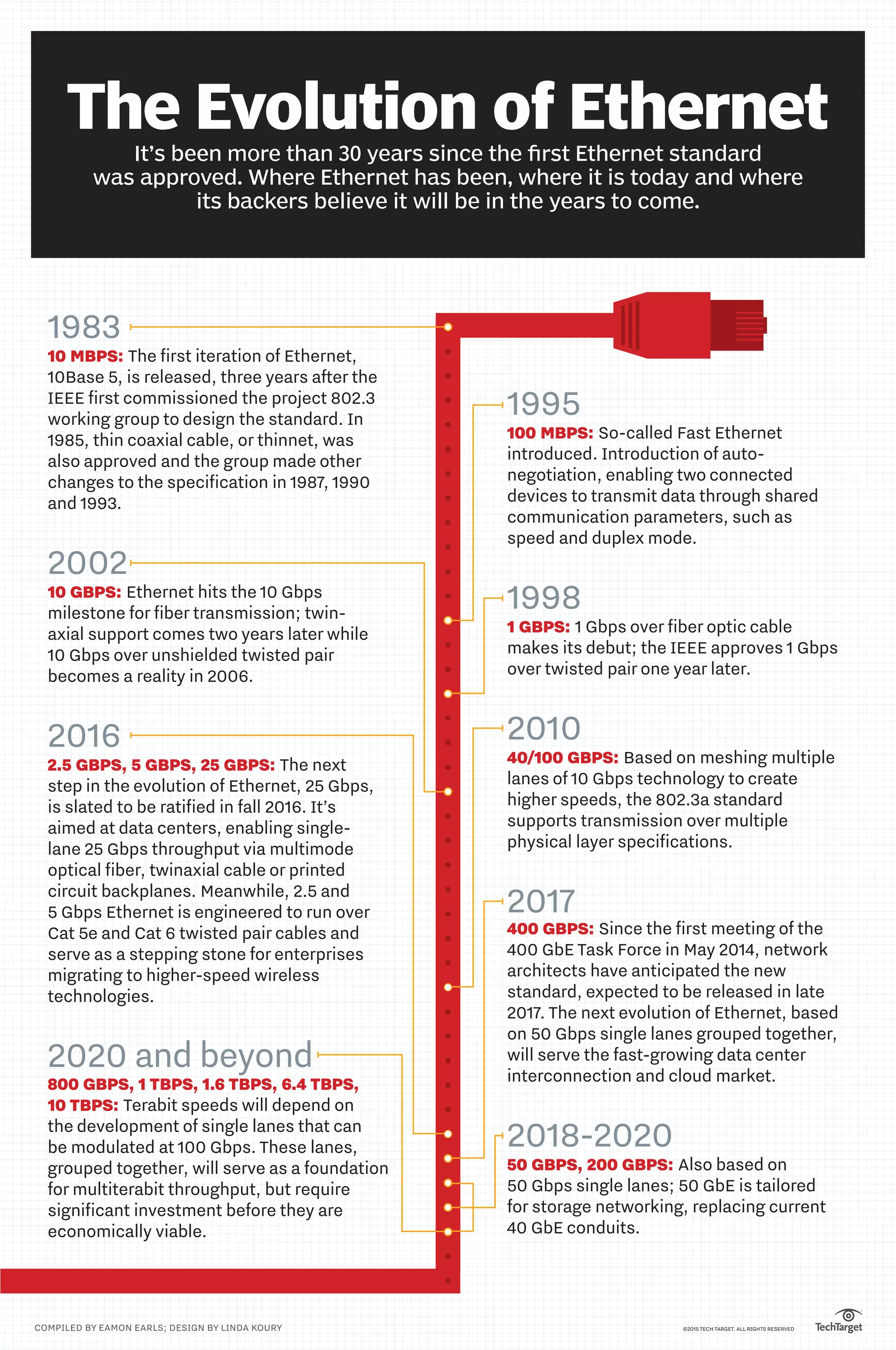
It’s been more than 30 years since the first Ethernet standard
was approved. Where Ethernet has been, where it is today and where
its backers believe it will be in the years to come.
1983
10 MBPS: The first iteration of Ethernet,
10Base 5, is released, three years after the
IEEE first commissioned the project 802.3
working group todesign the standard. In
1985, thin coaxial cable, or thinnet, was
also approved and the group made other
changes to the specification in 1987, 1990
and 1993.
2002
10 GBPS: Ethernet hits the 10 Gbps
milestone for fiber transmission; twin-
axial support comes two years later while
10 Gbps over unshielded twisted pair
becomes a reality in 2006.
2016
2.5 GBPS, 5 GBPS, 25 GBPS: The next
step in the evolution of Ethernet, 25 Gbps,
is slated to be ratified in fall 2016. It’s
aimed at data centers, enabling single-
lane 25 Gbps throughput via multimode
optical fiber, twinaxial cable or printed
circuit backplanes. Meanwhile, 2.5 and
5 Gbps Ethernet is engineered to run over
Cat 5e and Cat 6 twisted paircables and
serve as a stepping stone forenterprises
migrating to higher-speed wireless
technologies.
2020 and beyond
800 GBPS, 1 TBPS, 1.6 TBPS, 6.4 TBPS,
10 TBPS: Terabit speeds will depend on
the development of single lanes that can
be modulated at 100 Gbps. These lanes,
grouped together, will serve as a foundation
for multiterabit throughput, but require
significant investment before they are
economically viable.
COMPILED BY EAMON EARLS; DESIGN BY LINDA KOURY ©2015 TECH TARGET. ALL RIGHTS RESERVED
1995
100 MBPS: So-called Fast Ethernet
introduced. Introduction of auto-
negotiation, enabling twoconnected
devices to transmit data through shared
communication parameters, such as
speed and duplex mode.
1998
1 GBPS: 1 Gbps over fiberoptic cable
makes its debut; the IEEE approves 1 Gbps
over twisted pairone year later.
2010
40/100 GBPS: Based on meshing multiple
lanes of 10 Gbps technology tocreate
higher speeds, the 802.3a standard
supports transmission over multiple
physical layer specifications.
2017
400 GBPS: Since the first meeting of the
400 GbETask Force in May 2014, network
architects have anticipated the new
standard, expected to be released in late
2017. The next evolution of Ethernet, based
on 50 Gbps single lanes grouped together,
will serve the fast-growing data center
interconnection and cloud market.
2018-2020
50 GBPS, 200 GBPS: Also based on
50 Gbps single lanes; 50 GbE is tailored
for storage networking, replacing current
40 GbE conduits.

Evolution of Ethernet Infographic

  • 1.
    The Evolution ofEthernet It’s been more than 30 years since the first Ethernet standard was approved. Where Ethernet has been, where it is today and where its backers believe it will be in the years to come. 1983 10 MBPS: The first iteration of Ethernet, 10Base 5, is released, three years after the IEEE first commissioned the project 802.3 working group todesign the standard. In 1985, thin coaxial cable, or thinnet, was also approved and the group made other changes to the specification in 1987, 1990 and 1993. 2002 10 GBPS: Ethernet hits the 10 Gbps milestone for fiber transmission; twin- axial support comes two years later while 10 Gbps over unshielded twisted pair becomes a reality in 2006. 2016 2.5 GBPS, 5 GBPS, 25 GBPS: The next step in the evolution of Ethernet, 25 Gbps, is slated to be ratified in fall 2016. It’s aimed at data centers, enabling single- lane 25 Gbps throughput via multimode optical fiber, twinaxial cable or printed circuit backplanes. Meanwhile, 2.5 and 5 Gbps Ethernet is engineered to run over Cat 5e and Cat 6 twisted paircables and serve as a stepping stone forenterprises migrating to higher-speed wireless technologies. 2020 and beyond 800 GBPS, 1 TBPS, 1.6 TBPS, 6.4 TBPS, 10 TBPS: Terabit speeds will depend on the development of single lanes that can be modulated at 100 Gbps. These lanes, grouped together, will serve as a foundation for multiterabit throughput, but require significant investment before they are economically viable. COMPILED BY EAMON EARLS; DESIGN BY LINDA KOURY ©2015 TECH TARGET. ALL RIGHTS RESERVED 1995 100 MBPS: So-called Fast Ethernet introduced. Introduction of auto- negotiation, enabling twoconnected devices to transmit data through shared communication parameters, such as speed and duplex mode. 1998 1 GBPS: 1 Gbps over fiberoptic cable makes its debut; the IEEE approves 1 Gbps over twisted pairone year later. 2010 40/100 GBPS: Based on meshing multiple lanes of 10 Gbps technology tocreate higher speeds, the 802.3a standard supports transmission over multiple physical layer specifications. 2017 400 GBPS: Since the first meeting of the 400 GbETask Force in May 2014, network architects have anticipated the new standard, expected to be released in late 2017. The next evolution of Ethernet, based on 50 Gbps single lanes grouped together, will serve the fast-growing data center interconnection and cloud market. 2018-2020 50 GBPS, 200 GBPS: Also based on 50 Gbps single lanes; 50 GbE is tailored for storage networking, replacing current 40 GbE conduits.